
- Atomic number
- 80
- Atomic mass
- 200.59
- Shells
- 2, 8, 18, 32, 18, 2
- Configuration
- 1s² 2s² 2p⁶ 3s² 3p⁶ 4s² 3d¹⁰ 4p⁶ 5s² 4d¹⁰ 5p⁶ 6s² 4f¹⁴ 5d¹⁰
- In the table
- period 6, group 12 (IIB), d-block
- Kind
- Transition metal
- Valency
- 1 and 2 (mercurous Hg₂²⁺, mercuric Hg²⁺)
- State at 25 °C
- liquid
- Melts · boils
- −39 °C · 357 °C
- Density
- 13.5 × as heavy as water
- Known since
- ancient times
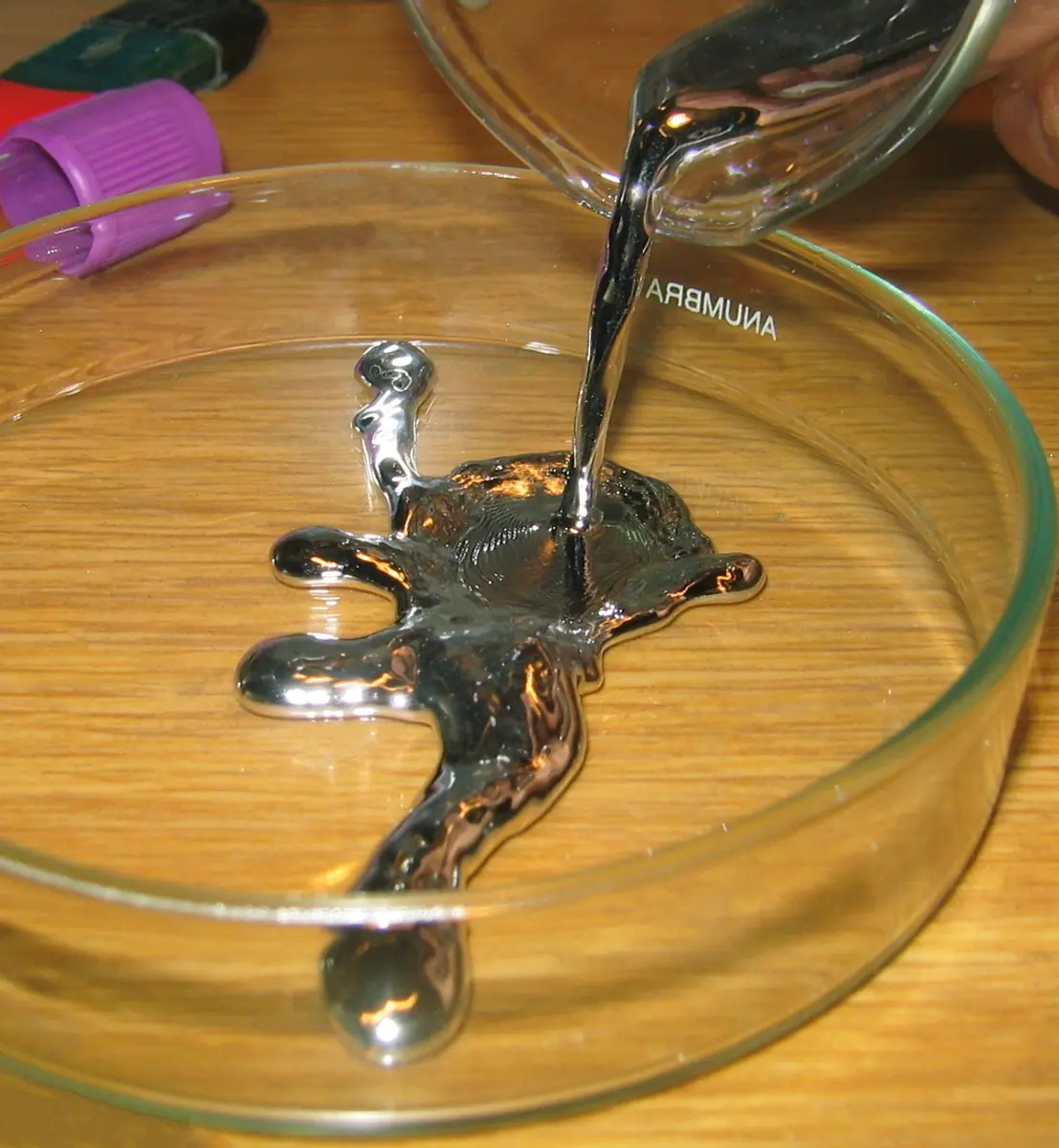
Every metal you have held is solid: a steel spoon, a copper wire, a gold earring. One metal is different. Pour it, and it runs like water; spill it, and it breaks into shining silver beads that roll away. That is mercury, पारो in Nepali, the only metal that is liquid in your room.
For centuries its silver thread moved up and down in thermometers, and doctors read your blood pressure from a column of it. Today we are getting rid of it almost everywhere, because it is also one of the most dangerous metals there is. Here is its story.
The mercury atom
A mercury atom has 80 protons in its nucleus, so mercury’s atomic number is 80, and a neutral atom has 80 electrons. The most common kind of mercury atom has 122 neutrons, so its mass number is 80 + 122 = 202.
The electrons fill six shells: 2, 8, 18, 32, 18, 2. The first four shells are full, each holding its 2n² Grade 8: Bohr and Bury’s rule: 2, 8, 18 and 32. The fifth shell could hold 50 but has only 18, and the sixth has 2. Big atoms start a new outer shell before the inner ones are full, because of the order in which subshells fill Grade 10: The Aufbau principle:
1s² 2s² 2p⁶ 3s² 3p⁶ 4s² 3d¹⁰ 4p⁶ 5s² 4d¹⁰ 5p⁶ 6s² 4f¹⁴ 5d¹⁰
Every subshell is completely full: the two outermost electrons are in 6s, and 4f and 5d inside it are full too.
Its place in the periodic table
- Period 6, because its electrons are in six shells.
- Group 12, called IIB in the older naming. Its neighbors are gold (79) on the left and thallium (81) on the right.
- d-block, because its last electrons go into the 5d subshell. So mercury is counted with the transition metals Grade 10: Metals.
Above mercury in group 12 are zinc and cadmium. All three have two outer s electrons over a full d subshell, so they all form ions with a charge of 2+ (Zn²⁺, Cd²⁺, Hg²⁺). And all three melt at low temperatures for metals, mercury lowest of all (Figure 4).
Its valency
Mercury has two valencies Grade 9: Variable valency:
- 2, in mercuric compounds, such as mercuric oxide (HgO) and mercuric chloride (HgCl₂). This is the more common.
- 1, in mercurous compounds, such as mercurous chloride (Hg₂Cl₂). Here two mercury atoms stay joined to each other, so the ion is really a pair, Hg₂²⁺.
Mercury is a liquid. Which part of the periodic table is it in?
Pick an answer to see why.
How mercury was found and named
Nobody knows who first saw mercury. It is not found as a metal very often, but its red ore, cinnabar (mercury sulphide, HgS), gives up the liquid metal when it is simply heated, so it was known in many ancient lands. Mercury has been found in Egyptian tombs of about 1500 BCE. In China, the historian Sima Qian wrote, about a hundred years later, that the tomb of the first emperor, Qin Shi Huang (who died in 210 BCE), had rivers and seas of flowing mercury. The tomb has never been opened, but the soil over it holds unusually much mercury.
People were fascinated by a metal that flows and dissolves gold; alchemists hoped it was the key to making gold (no chemical reaction can turn one element into another).
The names. English once called it quicksilver, “living silver”, because it seems to move by itself. The ancient Greeks called it hydrargyros, “water-silver”, and the Latin form, hydrargyrum, gives its symbol, Hg Grade 8: Symbols from Latin names. The name “mercury” comes from the planet Mercury, named after the quick-footed messenger of the Roman gods; alchemists matched each metal with a planet, and the fastest-moving metal went with the fastest-moving planet.
Nepali’s पारो comes from Sanskrit पारद. In Ayurveda mercury is also called रसराज, “king of the rasas”, and it was used in old medicines. Modern tests have found harmful amounts of mercury in some such medicines, so they should never be taken without a qualified doctor’s advice.
Where mercury is found
In the universe. Mercury is heavier than iron, so it could not be made in the ordinary fusion inside stars. It was made when atoms caught neutrons, slowly inside giant stars and in a flash when dead stars collided (Heavier than iron: catching neutrons).
In the Earth’s crust. Mercury is rare: ordinary rock holds less than a tenth of a gram in a tonne. It is mined from cinnabar, a bright red mineral, sometimes with drops of liquid mercury in it. Heating cinnabar in air gives off mercury vapor, which is cooled until it condenses into liquid metal:
HgS + O₂ → Hg + SO₂
Because mercury boils at a low temperature for a metal (357 °C), it is made pure by distillation: boiled, and the vapor condensed Grade 10: Distillation.
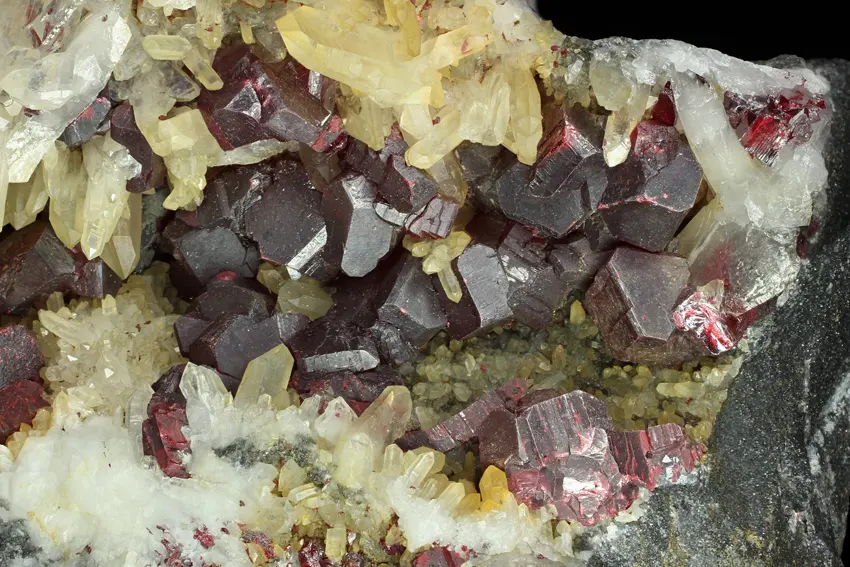
The world’s most famous mercury mine was at Almadén in Spain, worked for about 2,000 years until it closed in 2003. In 2024 the world mined only about 1,200 tonnes of mercury, most of it (about 1,000 tonnes) in China (USGS, 2025). Much more is now recovered by recycling.
In Nepal. Nepal mines no mercury: all of it has come from abroad, in thermometers, lamps, tooth fillings and for gilding.
In your body. Mercury does nothing useful in the body. Every mouthful of food holds a tiny trace, less than a hundredth of a milligram a day in all, which the body can cope with.
What mercury is like
- A liquid metal. It melts at −39 °C and boils at 357 °C, so it is liquid in every room on Earth, from Jumla in January to the Terai in June Grade 9: Melting and boiling points of metals.
- Shiny and silvery, like a mirror that flows.
- Very heavy. Its density is 13.5 g/cm³, 13.5 times that of water: a 1-liter bottle of mercury would weigh about 13.5 kg. An iron nail floats on it Grade 10: The density of the liquid.
- A metal that conducts electricity, though only about a sixtieth as well as copper, and heat.
- It stays in beads. Mercury’s atoms pull on each other very strongly, so its surface tension is nearly seven times that of water. It doesn’t wet glass, and in a glass tube its surface bulges up instead of curving down like water’s.
- It evaporates slowly, even at room temperature. You cannot see or smell its vapor, which is the most dangerous thing about it.
Why is mercury a liquid?
In a solid metal, each atom gives its outer electrons to a shared “sea” of free electrons, which holds the atoms together Grade 9: What is inside a metal. Mercury’s atom has full subshells, and its two 6s electrons are held unusually tightly by its big nucleus of 80 protons. So mercury atoms share their electrons only weakly, the “glue” between them is weak, and a little warmth is enough to let them slide past each other.
Why are those electrons held so tightly? In a heavy atom, the electrons nearest the 80 protons move at more than half the speed of light. Einstein’s theory of relativity says such fast electrons behave as if they were heavier, and they and the 6s electrons are pulled in closer to the nucleus. Calculations published in 2013 found that without this effect, mercury would melt at about 80 °C, not −39 °C. The same effect gives gold, its neighbor, its yellow color.
Why is mercury used in thermometers instead of water?
Pick an answer to see why.
Thermometers and barometers
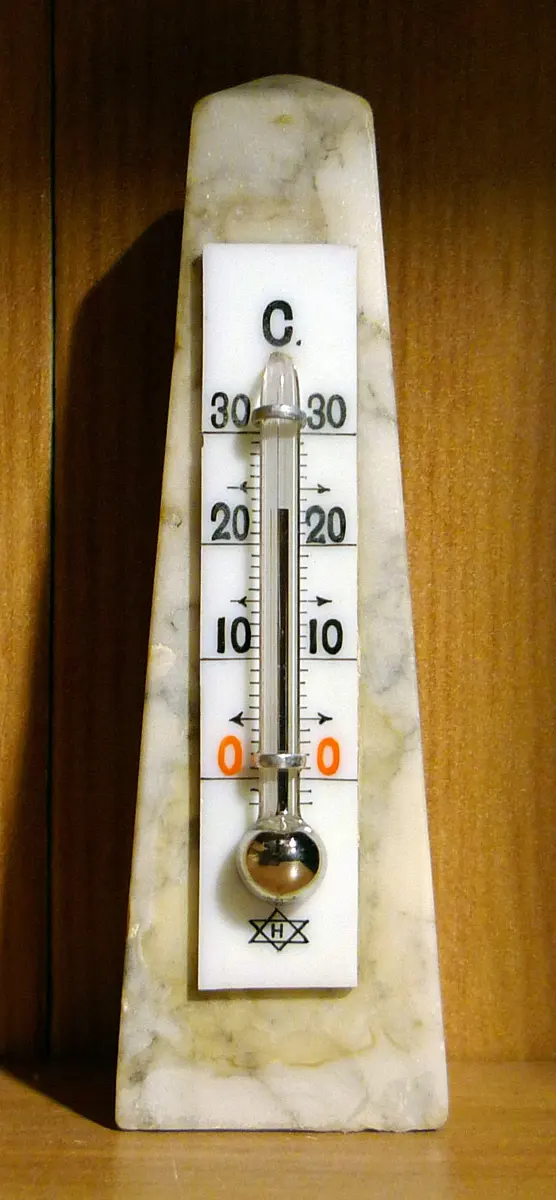
Mercury expands a little, and evenly, when it is heated. In a thermometer, a bulb of mercury opens into a very fine tube, so even a tiny expansion moves the thread a long way along the scale.
Mercury is also the liquid of the barometer. In 1643 Evangelista Torricelli filled a glass tube with mercury and turned it upside down in a dish: the mercury fell until a column about 760 mm tall was left, held up by the air pushing on the dish Grade 8: Atmospheric pressure. With water, the column would have to be 13.6 times taller, over 10 meters. That is why air pressure, and your blood pressure, are still given in millimeters of mercury (mmHg) Grade 10: Blood pressure.
How mercury reacts
Mercury is not very reactive. It sits low in the reactivity series, below hydrogen and copper Grade 9: The reactivity series:
K > Na > Ca > Mg > Al > Zn > Fe > Pb > (H) > Cu > Hg > Ag > Au
So it does not react with water, and it gives no hydrogen with dilute hydrochloric or sulphuric acid.
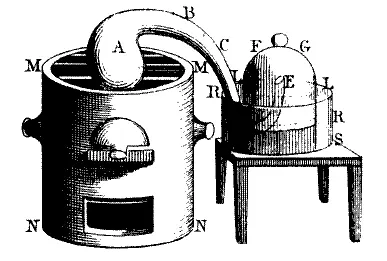
With oxygen. Heated in air for a long time near its boiling point, mercury slowly turns into a red powder, mercuric oxide:
2Hg + O₂ → 2HgO
Heat that red powder more strongly, and it breaks down again into mercury and oxygen Grade 10: Decomposition reaction:
2HgO → 2Hg + O₂
Mercury is one of the few metals whose oxide comes apart with heat alone, which is why it needs no reducing agent Grade 10: Reduction.
With sulphur. Mercury joins with sulphur powder even at room temperature, making black mercury sulphide (Hg + S → HgS). Sulphur powder is sprinkled on spilled mercury to help collect it.
Amalgams. Many metals dissolve in mercury, as sugar dissolves in water, making alloys called amalgams: gold, silver, tin, zinc and sodium among them. Iron does not, which is why mercury is kept and shipped in steel flasks.
A drop of mercury falls into dilute hydrochloric acid. What happens?
Pick an answer to see why.
Mercury in daily life and in Nepal
For over a century mercury was used in thermometers, barometers and blood-pressure meters; in fluorescent tubes and CFL bulbs, where a few milligrams of mercury vapor glow with ultraviolet light that the white coating turns into visible light Grade 8: Electric bulb; in small batteries; in tooth fillings (dental amalgam, about half mercury mixed with silver, tin and copper); and in factories making chlorine and caustic soda. Huge lighthouse lenses, some weighing several tonnes, were floated on a bath of mercury so that a small clockwork could turn them.
Almost all of these are being replaced. LED bulbs need no mercury, digital thermometers and blood-pressure meters are cheap, and new fillings use other materials.
Gold mining. The biggest use of mercury in the world today is by small, often poor, gold miners. They mix mercury with river sand to dissolve the gold, then heat the amalgam in the open to drive the mercury off. This one practice puts more mercury into the air than any other human activity, more than a third of the total (UNEP).
In Nepal. The Newar metalworkers of the Kathmandu Valley have long gilded copper statues and temple roofs with mercury: gold dissolved in mercury is painted onto the copper and heated, the mercury boils away, and a thin layer of gold is left (fire gilding). It gives a beautiful, lasting gold, but the vapor is poisonous to the gilders, and many now use safer methods.
In 2013 Nepal’s Ministry of Health banned the import, purchase and use of mercury thermometers and other mercury equipment in health care, and in 2019 it stopped amalgam fillings for children under 15 and for pregnant and breastfeeding women. Nepal signed the Minamata Convention on mercury in 2013 (as of 2026 it has not yet ratified it).
Isotopes of mercury
Natural mercury is a mixture of seven stable isotopes, from mercury-196 to mercury-204. The most common are mercury-202 (about 30%), mercury-200 (23%) and mercury-199 (17%). Their average gives mercury’s atomic mass, 200.59 Grade 9: Atomic mass.
Mercury and your health
Mercury has no use in the body, and it harms it in three forms Grade 9: Harmful effects of mercury:
- The vapor, breathed in, passes from the lungs into the blood and on to the brain. Over time it causes shaking hands, memory loss, mood changes and kidney damage. Felt-hat makers of the 1800s, who used a mercury compound, suffered so often that people said “mad as a hatter”.
- Liquid mercury swallowed mostly passes through the gut. It is not safe, but it is less dangerous than the vapor.
- Methylmercury, made from mercury by tiny living things in water, builds up along food chains. Big fish that eat smaller fish (shark, swordfish, some tuna) collect the most. It harms the developing brain, so a baby in the womb is most at risk. This is what poisoned the town of Minamata in Japan in the 1950s.
The Minamata Convention of 2013, agreed by most of the world’s countries, ended the making and trade of most mercury products (thermometers, many lamps and batteries) from 2020 in the countries that joined it.
Surprising facts and records
- The only liquid metal. Mercury is the only metal that is liquid at room temperature. Gallium (30 °C) and cesium (28 °C) melt on a warm day, and gallium melts in your hand.
- Frozen mercury. Below −39 °C mercury freezes into a solid, silvery metal that can be hammered flat.
- The first superconductor. In 1911, cooled to about −269 °C, mercury’s electrical resistance suddenly dropped to zero: the discovery of superconductivity (the Nobel Prize in Physics, 1987).
In your science books
- Grade 8: symbols from Latin names, metals in the periodic table, the mercury barometer and bulbs that contain mercury.
- Grade 9: variable valency (mercurous and mercuric), melting points of metals, the reactivity series, Priestley’s oxygen and the harmful effects of mercury.
- Grade 10: electronic configuration, transition metals, the liquid-in-glass thermometer, floating on mercury, millimeters of mercury, heat alone reduces HgO and distillation.
- Going further: melting and boiling for every substance, surface tension and where the heavy atoms came from.
More to explore
- Nobel Prizes with mercury in them: superconductors (1987) and the theory of superconductors (2003), both starting from Kamerlingh Onnes’s mercury; radium (1911, made pure in a pool of mercury); the ECG (1924, the first heart traces were read from a thread of mercury); the Raman effect (1930, seen with the light of a mercury lamp); and water channels (2003, found because mercury blocks them).
- Play: find mercury in Guess the Element, Higher or Lower and the Periodic Table Jigsaw.
- Read more: mercury at the Royal Society of Chemistry and at PubChem.