
- Atomic number
- 99
- Atomic mass
- 252.08
- Shells
- 2, 8, 18, 32, 29, 8, 2
- Configuration
- 1s² 2s² 2p⁶ 3s² 3p⁶ 4s² 3d¹⁰ 4p⁶ 5s² 4d¹⁰ 5p⁶ 6s² 4f¹⁴ 5d¹⁰ 6p⁶ 7s² 5f¹¹
- In the table
- period 7, group none (f-block), f-block
- Kind
- Actinide
- Valency
- 3 (Es³⁺), and 2 in a few solids
- State at 25 °C
- solid
- Melts · boils
- 860 °C · not known
- Known since
- 1952
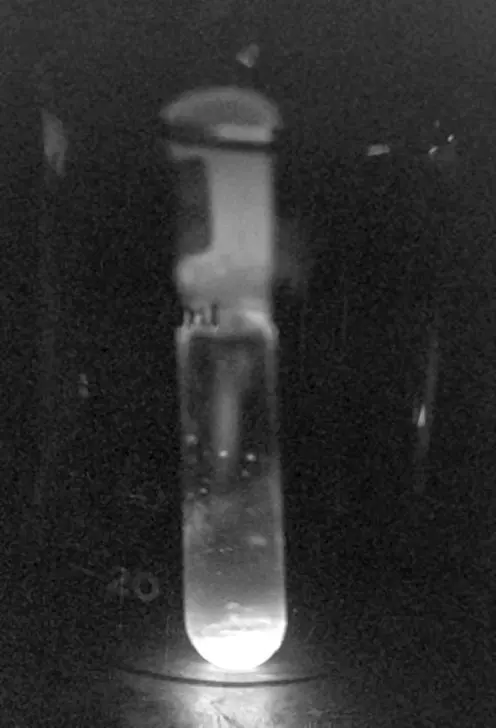
The sample in the photo is not lit by a lamp. It glows with its own light, because einsteinium, element 99, is so radioactive that each gram of it would give out about as much heat as an electric heater. It is the heaviest element that anyone has ever seen with their own eyes, and it is named after the most famous scientist of all, Albert Einstein.
The einsteinium atom
An einsteinium atom has 99 protons (atomic number 99) and 99 electrons. The kind made most often, einsteinium-253, has 253 − 99 = 154 neutrons. By shells, the electrons are 2, 8, 18, 32, 29, 8, 2, and in subshells Grade 10: The Aufbau principle:
… 6p⁶ 7s² 5f¹¹
Einsteinium is in period 7, the eleventh of the actinides in the f-block Grade 10: Features of the modern periodic table, and a metal. It usually gives away three electrons to form Es³⁺.
How einsteinium was found and named
Einsteinium was not made on purpose. It was found in the dust from the first hydrogen-bomb test, on an island in the Pacific Ocean on 1 November 1952. Scientists led by Albert Ghiorso at Berkeley, California, studied the dust and in December 1952 found a new element in it: fewer than 200 atoms of element 99. A few weeks later they found element 100, fermium, in the same dust.
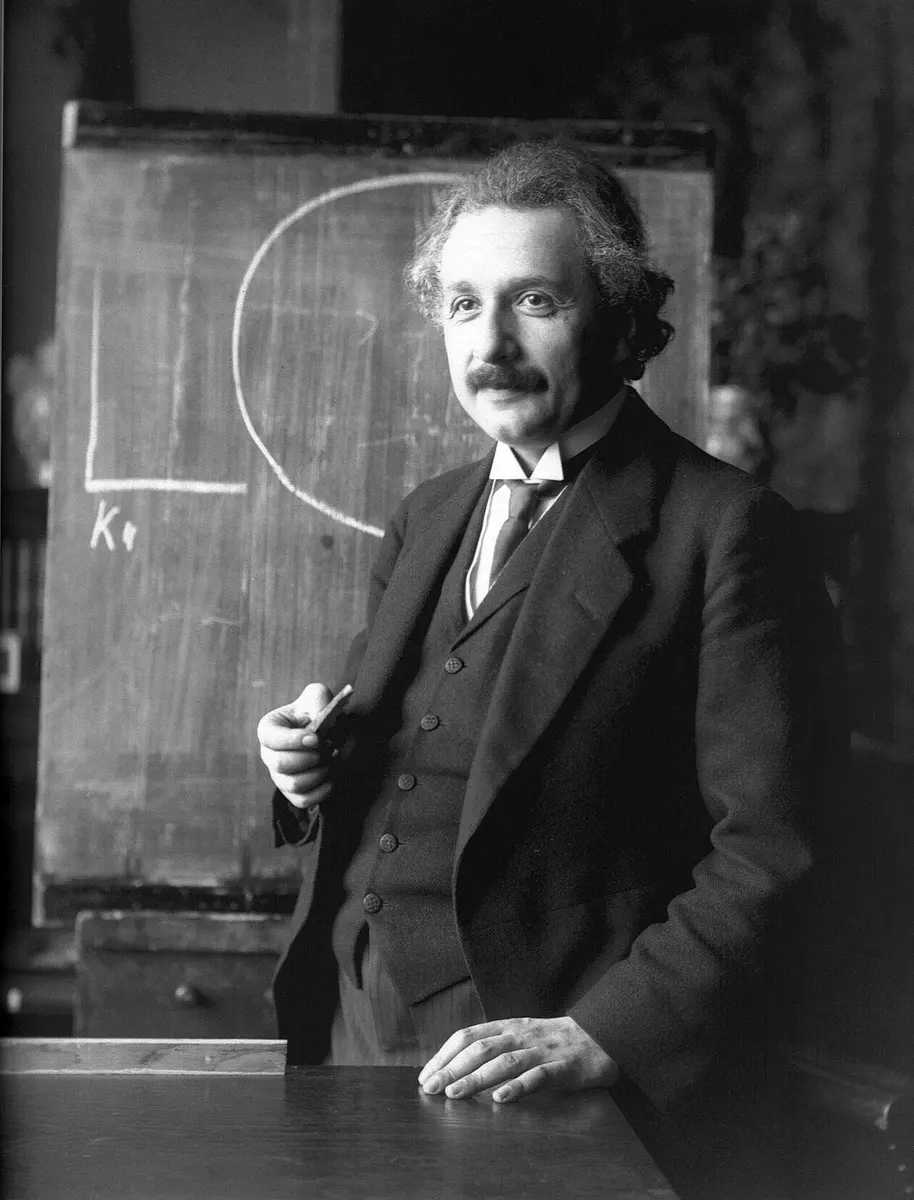
The discovery was kept secret until 1955. Meanwhile, the team made both elements again in reactors and in a cyclotron, and proposed the names einsteinium and fermium, after Albert Einstein and Enrico Fermi. Both men died before the names were announced, in August 1955. Einsteinium’s symbol was first E; it was later changed to Es.
Where einsteinium comes from
No einsteinium is left from the Earth’s birth: its longest-lasting kind, einsteinium-252, has a half-life of only about 470 days. Today it is made in the same two reactors as berkelium and californium, at Oak Ridge in the USA and Dimitrovgrad in Russia, a few thousandths of a gram a year at most. The first sample big enough to weigh, in 1961, was about ten billionths of a gram.
In the reactor, nuclei catch neutrons one by one, and every so often a neutron turns into a proton, moving the nucleus one place along the table. Figure 3 shows the main steps.
In space, nuclei catch neutrons even faster when dead stars collide; that is where much of the gold and uranium on Earth was made (catching neutrons in a flash).
What einsteinium is like
What has been measured, on samples smaller than a grain of sand:
- It is a soft, silvery metal.
- It melts at about 860 °C.
- It glows in the dark, from its own radiation. Einsteinium-253 gives out about 1,000 watts of heat per gram.
What is not known for sure: its density (one measurement gave about 8.8 g/cm³, surprisingly light for so heavy an atom, but the Royal Society of Chemistry lists it as unknown, and the facts card leaves it out) and its boiling point (never measured).
Why so hard? Einsteinium-253 has a half-life of only 20.5 days: about 3 in every 100 of its atoms decay each day. Each one gives out an alpha particle and becomes berkelium-249. Its radiation also breaks up its own crystals and heats it. So a sample is never pure for long, and scientists must measure quickly.
Einsteinium-253 (99 protons) gives out an alpha particle: 2 protons and 2 neutrons. What does it become?
Pick an answer to see why.
Einsteinium and element 101
In 1955, Ghiorso, Bernard Harvey, Gregory Choppin, Stanley Thompson and Glenn Seaborg spread about a billion atoms of einsteinium-253, far too few to see, on a thin foil and fired alpha particles at it. Einsteinium’s 99 protons and the alpha particle’s 2 make 101. They found 17 atoms of element 101, one at a time, and named it mendelevium, after Dmitri Mendeleev, who made the first periodic table.
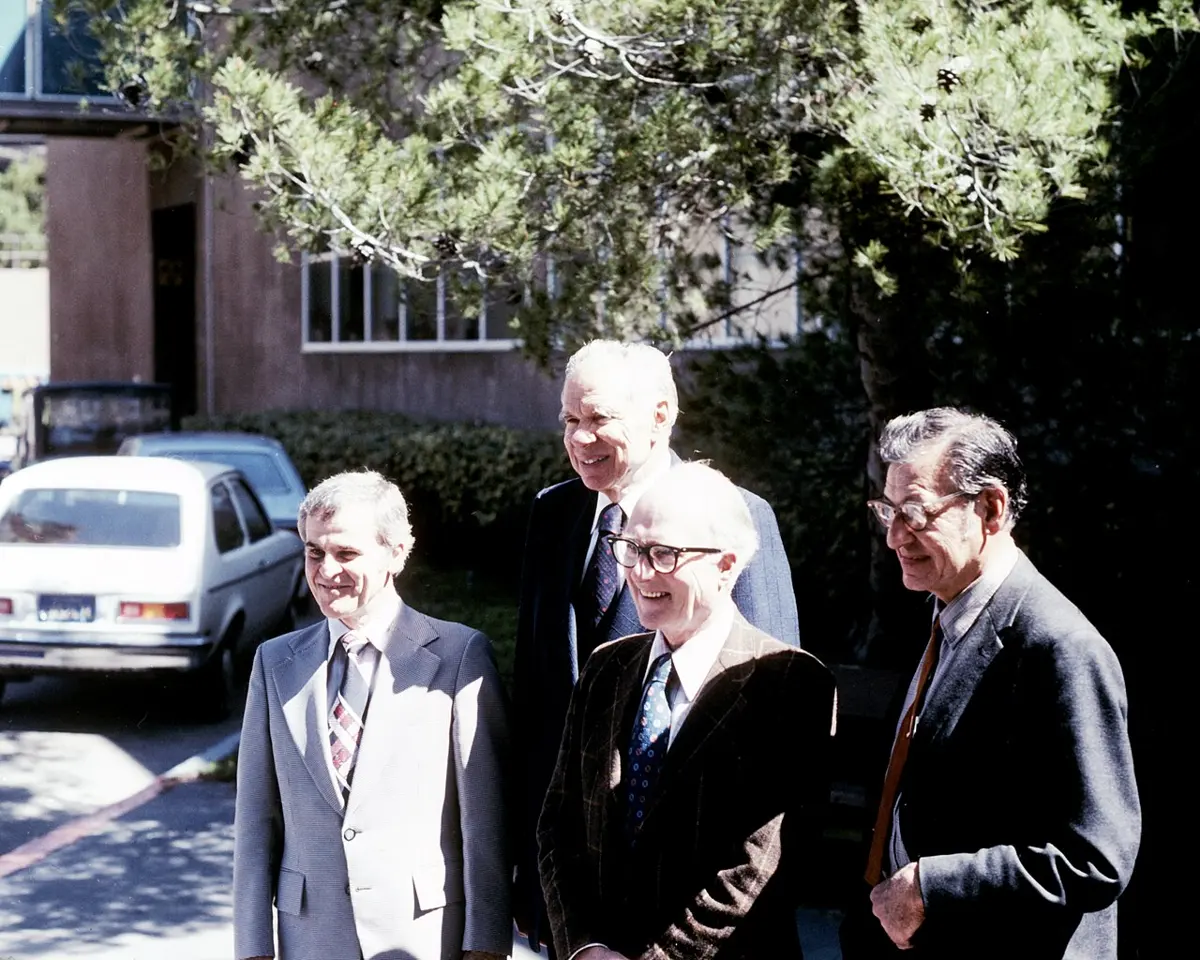
Einsteinium is still studied today. In 2021, a team at Berkeley used about 200 billionths of a gram of einsteinium-254 to measure, for the first time, how far an einsteinium atom sits from the atoms it bonds to.
Einsteinium and your health
The body has no use for einsteinium. Studies on animals show that if it is swallowed, very little gets into the blood; what does settles mostly in the bones, and some in the lungs, where its alpha particles damage cells and can cause cancer. Only a few laboratories in the world ever handle it, in sealed glove boxes.
In your science books
- Grade 9: radioactive elements and shells and their energy.
- Grade 10: the actinides and the Aufbau principle.
- Going further: alpha decay, beta decay and catching neutrons in a flash.
More to explore
- Nobel Prizes: Einstein’s prize (1921) and Seaborg and McMillan’s prize (1951) for the elements beyond uranium.
- Its neighbors: californium, the element before it, fermium, found with it, berkelium, which it turns into, and holmium, the element above it.
- Play: find einsteinium in Guess the Element and the Periodic Table Jigsaw.
- Read more: einsteinium at the Royal Society of Chemistry and at PubChem.