
Strike a match. In a second, a little stick of wood and a blob of chemicals turn into flame, smoke and ash, and nothing you do will turn them back. Leave an iron nail out in the rain and the same kind of thing happens, only so slowly that it takes weeks: the nail turns into crumbly brown rust. Curd forming from milk, rice cooking in the pressure cooker, the leaves outside making sugar from sunlight: all of these are chemical reactions.
In this unit you will learn to write reactions as equations, to balance them so that no atom is lost or invented, to sort them into a few kinds, and to make them go faster or slower, which is something cooks, doctors, farmers and factory engineers do every day.
Physical and chemical changes
You met these in earlier classes. A quick reminder:
| Physical change | Chemical change |
|---|---|
| no new substance is formed | one or more new substances are formed |
| usually easy to reverse (freeze the water again) | usually hard or impossible to reverse |
| the composition of the substance stays the same | the composition changes |
| e.g. ice melting, water boiling, sugar dissolving | e.g. burning, rusting, cooking, digestion |
The substances you start with in a chemical change are the reactants; the new substances formed are the products.
Which of these is a physical change?
Pick an answer to see why.
Chemical equations
During a chemical reaction, atoms don’t appear or disappear. The reactants lose, gain or share electrons; their bonds break, and the same atoms join up in new ways: reactants combine, break apart, or swap their ions to form the products. This process is a chemical reaction.
Writing the reaction down in words, symbols or chemical formulae gives a chemical equation. The same reaction three ways:
- Word equation: magnesium + oxygen → magnesium oxide
- Skeleton equation (formulae, not yet balanced): Mg + O₂ → MgO
- Balanced equation: 2Mg + O₂ → 2MgO
The reactants go on the left and the products on the right, with an arrow (→, read “gives” or “forms”) between them. Conditions are often written over the arrow: heat (or Δ), light, a catalyst, high pressure. Sometimes the state of each substance is added in brackets: (s) solid, (l) liquid, (g) gas, (aq) dissolved in water.
Balancing an equation
In the skeleton Mg + O₂ → MgO, there are 2 oxygen atoms on the left and only 1 on the right. An oxygen atom can’t vanish, so the equation is wrong. A balanced equation has the same number of atoms of each element on both sides. This is the law of conservation of mass written in symbols: the mass of the products equals the mass of the reactants.
To balance, you change only the big numbers in front (the coefficients), never the small numbers inside a formula. Changing H₂O into H₂O₂ would turn water into hydrogen peroxide, a different substance.
Types of chemical reaction
By the kinds of reactants and products, reactions are sorted into a few types. Figure 15.1 shows them with colored balls.
1. Combination reaction
A reaction in which two or more reactants combine to form only one product is a combination reaction (also called an addition or synthesis reaction). Its general form is A + B → AB.
| Reaction | Equation |
|---|---|
| sodium + chlorine → sodium chloride | 2Na + Cl₂ → 2NaCl |
| carbon + oxygen → carbon dioxide | C + O₂ → CO₂ |
| nitrogen + hydrogen → ammonia | N₂ + 3H₂ → 2NH₃ |
| magnesium + oxygen → magnesium oxide | 2Mg + O₂ → 2MgO |
| iron + oxygen → ferric oxide (rust, roughly) | 4Fe + 3O₂ → 2Fe₂O₃ |
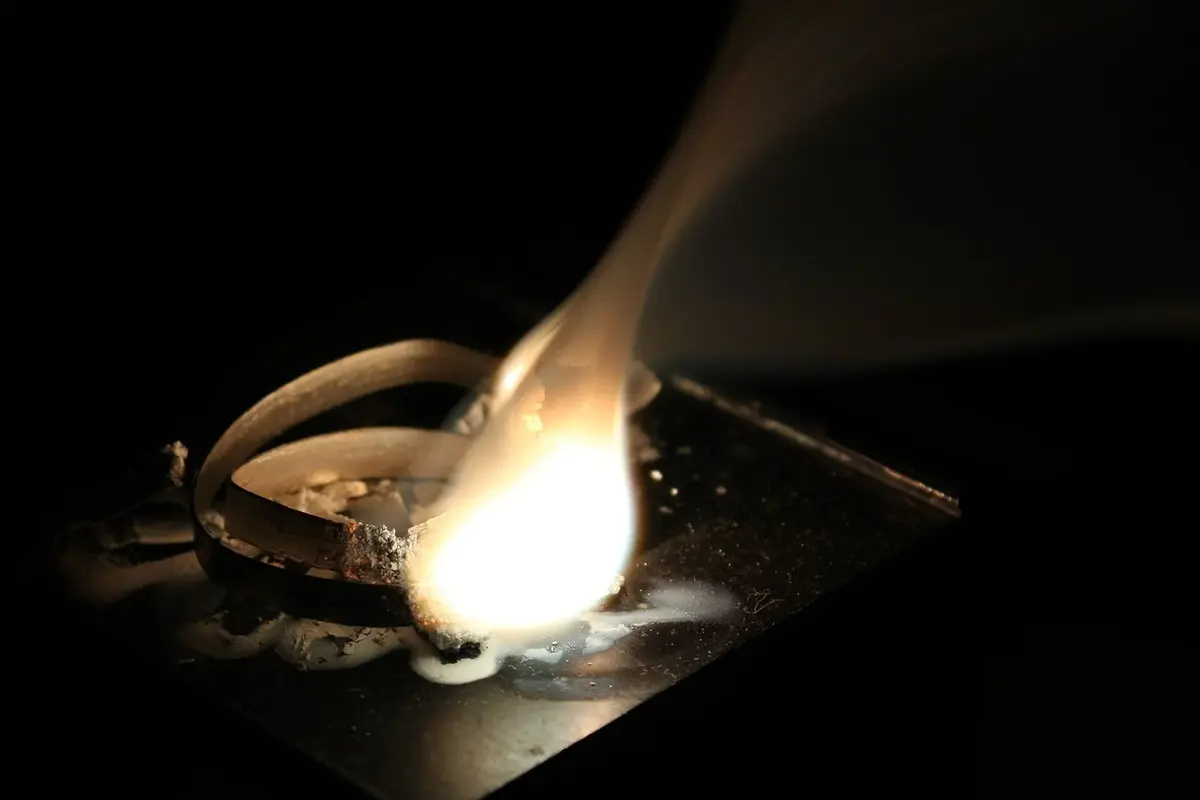
2. Decomposition reaction
A reaction in which one reactant breaks down into two or more products is a decomposition reaction. Its general form is AB → A + B. Most need energy to break the reactant apart: heat (thermal decomposition), light or electricity.
The first is how lime (CaO) is made from limestone, in kilns like the ones beside Nepal’s cement factories. The third happens every time you open a bottle of soda: the carbonic acid in it breaks into fizz (carbon dioxide) and water.
What type of reaction is (passing electricity through water)?
Pick an answer to see why.
3. Displacement reaction
A reaction in which an atom or radical of one reactant is pushed out (displaced) by an atom or radical of another reactant is a displacement reaction. There are two kinds.
i. Single displacement reaction
One element (or radical) displaces another element from its compound. Its general form is AB + C → A + BC: element C takes B away from A, and A is left on its own.
Which element wins? The more reactive one always displaces the less reactive one, never the other way round. For metals, chemists list them in order, the reactivity series:
K > Na > Ca > Mg > Al > Zn > Fe > Pb > (H) > Cu > Hg > Ag > Au
Zinc is above hydrogen, so it pushes hydrogen out of acids. Copper is below hydrogen, so it doesn’t react with dilute hydrochloric acid at all, but it is above silver, so it pushes silver out of silver nitrate. Among the halogens, reactivity goes F > Cl > Br > I (as you saw in Unit 14), so chlorine displaces bromine, and bromine displaces iodine, but iodine can’t displace either.
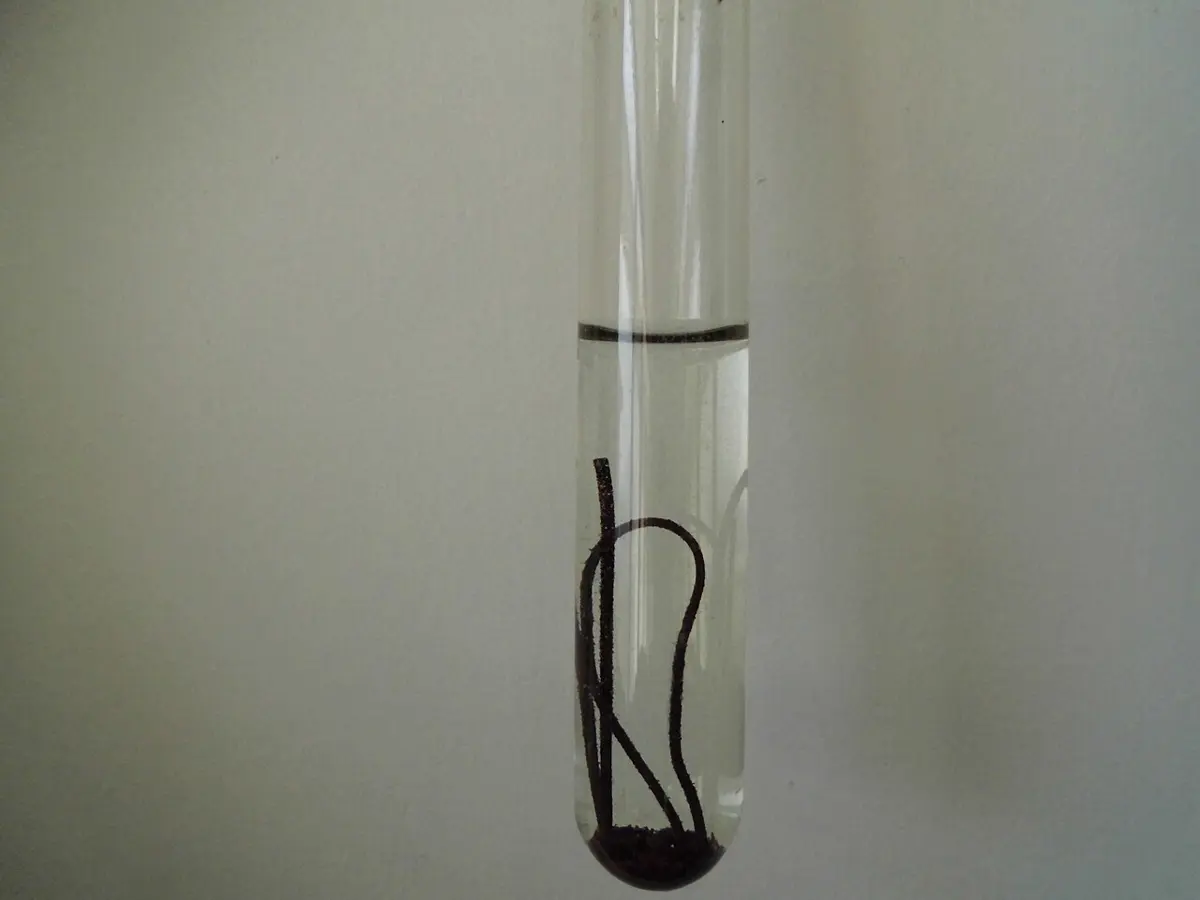
A strip of copper is dipped into zinc sulphate solution. What happens?
Pick an answer to see why.
ii. Double displacement reaction
Two compounds swap their atoms or radicals with each other, forming two new compounds. Its general form is AB + CD → AD + CB. Often one of the new compounds doesn’t dissolve in water and appears as a cloudy solid, a precipitate:
The first gives a white precipitate of silver chloride (a test for chlorides), the second a white precipitate of barium sulphate (a test for sulphates), and the third a brilliant yellow precipitate of lead iodide.
4. Acid–base reaction
The reaction of an acid with a base to form a salt and water is an acid–base reaction. It is also a kind of double displacement (the acid’s H and the base’s metal swap partners). The acid and the base destroy each other’s properties and form neutral products, so it is also called a neutralization reaction:
acid + base → salt + water
In the first, HCl is the acid, NaOH the base, NaCl the salt. A base doesn’t have to be a hydroxide: calcium oxide, CaO, is a base too.
Which type of reaction is ?
Pick an answer to see why.
Rate of chemical reaction
Some reactions are over in a flash: an acid and a base neutralize each other the moment they meet, and a firework explodes. Others take days or years: an iron gate rusts, and a banana ripens. The rate of a chemical reaction is how fast the reactants change into products: the amount of reactant used up, or of product formed, per unit time.
At the start, the amount (concentration) of the reactants is greatest and there is no product at all. As the reaction goes on, the reactants are used up and the products build up, as in Figure 15.5. The reaction is usually fastest at the start, when there are most reactant particles to meet, and slows down as they run out.
Why reactions happen at all: collisions
Particles can only react when they collide. But most collisions are just bumps: the particles bounce off unchanged. A collision makes products only if the particles hit hard enough, with at least a certain minimum energy, called the activation energy. It is like pushing a stone over a hill before it can roll down the other side (Figure 15.6).
So anything that makes particles collide more often, or hit harder, or lowers the hill, speeds a reaction up. That one idea explains every factor below.
Factors affecting the rate of reaction
1. Catalyst
A catalyst is a substance that changes the rate of a chemical reaction without itself undergoing any permanent chemical change. It is written above the arrow, not as a reactant, because it comes out at the end just as it went in.
- A positive catalyst speeds a reaction up. Examples: manganese dioxide (MnO₂), vanadium pentoxide (V₂O₅, in making sulphuric acid) and iron (Fe, in making ammonia).
- A negative catalyst slows a reaction down. Phosphoric acid (H₃PO₄) is added to hydrogen peroxide to slow its decomposition, so it keeps longer in the bottle.
2. Heat (temperature)
Generally, the rate of a reaction increases as the temperature rises. Hotter particles move faster, so they collide more often, and, much more importantly, a bigger share of the collisions have enough energy to get over the hill. For many reactions, a rise of just 10 °C roughly doubles the rate. Potassium chlorate gives off oxygen only when heated:
This is also why we cook food (the reactions that soften rice are fast at 100 °C and very slow at room temperature), why a pressure cooker cooks faster (water boils at about 120 °C inside it) and why a refrigerator keeps milk from going sour (the reactions of the bacteria in it slow down in the cold).
3. Pressure
For reactions between gases, the rate depends on the pressure. Squeezing a gas into a smaller space crowds its molecules together, so they collide more often. Generally, the rate of a gaseous reaction increases with pressure. Ammonia is made from nitrogen and hydrogen at a very high pressure, usually about 200 times the pressure of the air (different factories have used anywhere from 200 to 900 atm):
4. Surface area
Only the particles on the surface of a solid can be hit by the other reactant; those inside have to wait their turn. Break a lump into small pieces and many more particles are on a surface. So the larger the surface area of contact, the faster the reaction.
5. Light
Some reactions need light, and light increases their rate. Photosynthesis is the most important:
carbon dioxide + water → glucose + oxygen. Silver nitrate also breaks down in light, which is why it is kept in dark bottles:
(silver nitrate → silver + nitrogen dioxide + oxygen). Old camera film worked this way: light turned silver compounds into tiny dark grains of silver, making the picture.
6. Concentration (one more factor)
Concentration matters just as much: the more concentrated a solution, the faster the reaction. More particles in the same volume means more collisions every second. Marble chips fizz gently in dilute acid and furiously in concentrated acid.
Why do wood shavings catch fire more easily than a log?
Pick an answer to see why.
Food is kept in a refrigerator because…
Pick an answer to see why.
Exercise
1. Choose the best option
a. What type of chemical reaction is the reaction between sodium chloride and silver nitrate?
Pick an answer to see why.
b. What type of reaction is ?
Pick an answer to see why.
c. Which substance is X in ?
Pick an answer to see why.
d. What type of reaction is the heating of CaCO₃?
Pick an answer to see why.
2. Give reasons
Hydrogen peroxide is not stored in a transparent vessel.
Answer
Light increases the rate at which hydrogen peroxide decomposes into water and oxygen (2H₂O₂ → 2H₂O + O₂). In a transparent bottle, light would make it break down and lose its strength. So it is kept in dark (brown or opaque) bottles, often with a little phosphoric acid added as a negative catalyst.
An acid–base reaction is also known as a neutralization reaction.
Answer
When an acid reacts with a base, they form a salt and water, and the acid and the base lose (cancel) each other’s properties: the H⁺ ions of the acid and the OH⁻ ions of the base combine into water. The products are neutral, neither acidic nor basic, so the reaction is called neutralization.
The rate of chemical reaction is different according to the type of reaction.
Answer
The rate depends on the nature of the reactants and on how many bonds must be broken. In reactions between ions in solution (such as acid + base, or a precipitation), the particles are already free and only need to meet, so these reactions are almost instant. Where strong bonds must be broken first, or where a solid reacts only at its surface, as in the rusting of iron, few collisions have enough energy, and the reaction is slow.
3. Write differences between
Single and double displacement reaction
Answer
| Single displacement | Double displacement |
|---|---|
| an element displaces another element (or radical) from its compound | two compounds exchange their atoms or radicals |
| the reactants are an element and a compound | both reactants are compounds |
| the products are an element and a compound | both products are compounds |
| happens only if the free element is more reactive than the one it displaces | often happens when one product is a precipitate, a gas or water |
| general form: AB + C → A + BC | general form: AB + CD → AD + CB |
| e.g. Zn + 2HCl → ZnCl₂ + H₂ | e.g. NaCl + AgNO₃ → AgCl + NaNO₃ |
Combination and decomposition reaction
Answer
| Combination | Decomposition |
|---|---|
| two or more reactants combine into one product | one reactant breaks into two or more products |
| general form: A + B → AB | general form: AB → A + B |
| often gives out heat | usually needs energy (heat, light or electricity) |
| e.g. 2Mg + O₂ → 2MgO | e.g. CaCO₃ → CaO + CO₂ |
4. Balance these equations and name their types
KClO₃ → KCl + O₂
Answer
Check: K 2 = 2, Cl 2 = 2, O 6 = 3 × 2. Decomposition (by heat, faster with MnO₂ as a catalyst).
CH₄ + O₂ → CO₂ + H₂O
Answer
Check: C 1 = 1, H 4 = 2 × 2, O 2 × 2 = 4 = 2 + 2. This is the burning of methane (biogas): a combustion reaction, in which a fuel reacts with oxygen giving heat and light. It doesn’t fit the four types neatly; it is an oxidation.
Fe + O₂ → Fe₂O₃
Answer
Check: Fe 4 = 2 × 2, O 3 × 2 = 6 = 2 × 3. Combination (iron and oxygen form one product).
Zn + H₂SO₄ → ZnSO₄ + H₂
Answer
It is already balanced: . Zn 1 = 1, H 2 = 2, S 1 = 1, O 4 = 4. Single displacement (zinc displaces hydrogen from the acid).
Al + H₂SO₄ → Al₂(SO₄)₃ + H₂
Answer
Check: Al 2 = 2, H 6 = 6, S 3 = 3, O 12 = 12. Single displacement.
5. Answer these questions
What do you mean by a chemical reaction? Explain with an example.
Answer
A chemical reaction is a process in which one or more substances (reactants) change into new substances (products) with different properties, as their atoms are rearranged by losing, gaining or sharing electrons. For example, when magnesium ribbon burns in air, magnesium and oxygen form a new white substance, magnesium oxide: 2Mg + O₂ → 2MgO.
What is the rate of chemical reaction? Write any four factors that affect it.
Answer
The rate of a chemical reaction is the amount of reactant changed into product per unit time. Four factors:
- i.Catalyst: a positive catalyst increases the rate, a negative one decreases it.
- ii.Temperature: a higher temperature increases the rate.
- iii.Surface area: a larger surface area of a solid reactant increases the rate.
- iv.Pressure (for gases): a higher pressure increases the rate.
Others: light (for reactions like photosynthesis) and concentration.
What do you mean by a displacement reaction? Write two examples with balanced equations.
Answer
A displacement reaction is one in which an atom or radical of one reactant is displaced (pushed out) by an atom or radical of another reactant; a more reactive element displaces a less reactive one from its compound. Examples:
Write two examples of decomposition reactions with balanced equations.
Answer
An iron nail hangs by a thread in copper sulphate solution in a test tube (Figure 15.3). What type of reaction takes place? Write its balanced equation.
Answer
A single displacement reaction. Iron is more reactive than copper, so it displaces copper from copper sulphate. The nail is coated with reddish-brown copper and the blue solution turns pale green (iron(II) sulphate):
Four students, A, B, C and D, were asked to carry out a decomposition reaction in the laboratory. A burnt magnesium ribbon; B put zinc into ferrous sulphate solution; C heated potassium chlorate (KClO₃) in a hard-glass test tube; D mixed zinc with hydrochloric acid. Which student followed the correct procedure? Write the balanced equation for that process.
Answer
Student C. Heating potassium chlorate breaks one reactant into two products:
The others did different reactions: A did a combination (2Mg + O₂ → 2MgO); B and D did single displacements (Zn + FeSO₄ → ZnSO₄ + Fe, and Zn + 2HCl → ZnCl₂ + H₂).
Samir burns a magnesium ribbon. It burns brightly and forms a white ash, A. Name substance A and write a balanced equation for the process.
Answer
A is magnesium oxide (MgO).
It is a combination reaction.
Practice every question in the book, and keep track of the ones you miss →