
- Atomic number
- 112
- Atomic mass
- 286.18
- Shells
- 2, 8, 18, 32, 32, 18, 2
- Configuration
- 1s² 2s² 2p⁶ 3s² 3p⁶ 4s² 3d¹⁰ 4p⁶ 5s² 4d¹⁰ 5p⁶ 6s² 4f¹⁴ 5d¹⁰ 6p⁶ 7s² 5f¹⁴ 6d¹⁰ (predicted)
- In the table
- period 7, group 12 (IIB), d-block
- Kind
- Transition metal
- Valency
- Not measured; expected 2, like mercury (Cn²⁺)
- State at 25 °C
- expected to be a solid
- Melts · boils
- not known · not known
- Known since
- 1996
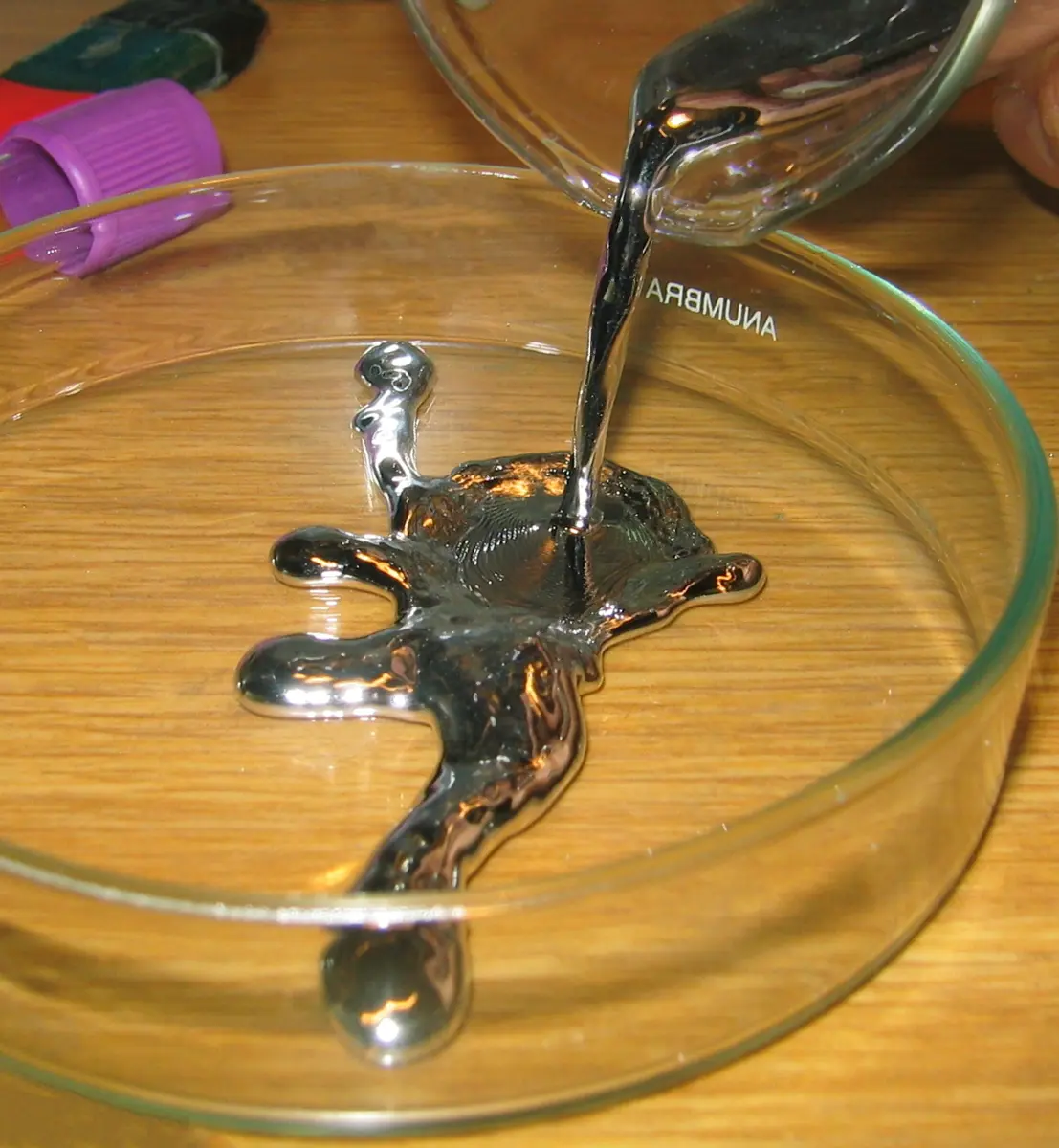
Mercury is the only metal that is a liquid at room temperature. It sits in group 12, under zinc and cadmium. Under mercury is element 112, copernicium. Chemists expected it to be a metal like mercury, only heavier. When they finally tested a handful of atoms, it did behave like a metal, but one that turns to vapor far more easily than mercury, and calculations now say it may even be a liquid at room temperature.
The copernicium atom
A copernicium atom has 112 protons (atomic number 112) and 112 electrons. Its longest-lasting known kind, copernicium-285, has 285 − 112 = 173 neutrons.
By the order of filling Grade 10: The Aufbau principle its outer electrons are
… 7s² 5f¹⁴ 6d¹⁰
with every subshell full, just like mercury’s 6s² 4f¹⁴ 5d¹⁰. The shells are 2, 8, 18, 32, 32, 18, 2. Copernicium is in period 7 and group 12, the last of the d-block Grade 10: Features of the modern periodic table.
Full subshells make an atom stable and unreactive, as in the noble gases. In copernicium there is more: its inner electrons move so fast, a large part of the speed of light, that the 7s subshell is pulled in close to the nucleus and its two electrons are held very tightly. Calculations say it is about as hard to pull an electron off a copernicium atom as off an atom of the noble gas xenon.
Found in Germany, named after a Polish astronomer
On 9 February 1996, at the GSI laboratory near Darmstadt, Germany, Sigurd Hofmann’s team fired zinc-70 nuclei (30 protons) at a lead-208 target (82 protons) and made one atom with 30 + 82 = 112 protons. It lasted less than a thousandth of a second. GSI made a second atom in 2000, and the RIKEN laboratory in Japan confirmed the reaction in 2004. In 2009 the judges of IUPAC and IUPAP agreed that GSI had found element 112.
The team proposed copernicium, after Nicolaus Copernicus, “to honour an outstanding scientist, who changed our view of the world”. They first suggested the symbol Cp, but Cp had once been the symbol of an old name for lutetium, so it was changed to Cn. IUPAC accepted the name on 19 February 2010, Copernicus’s 537th birthday.
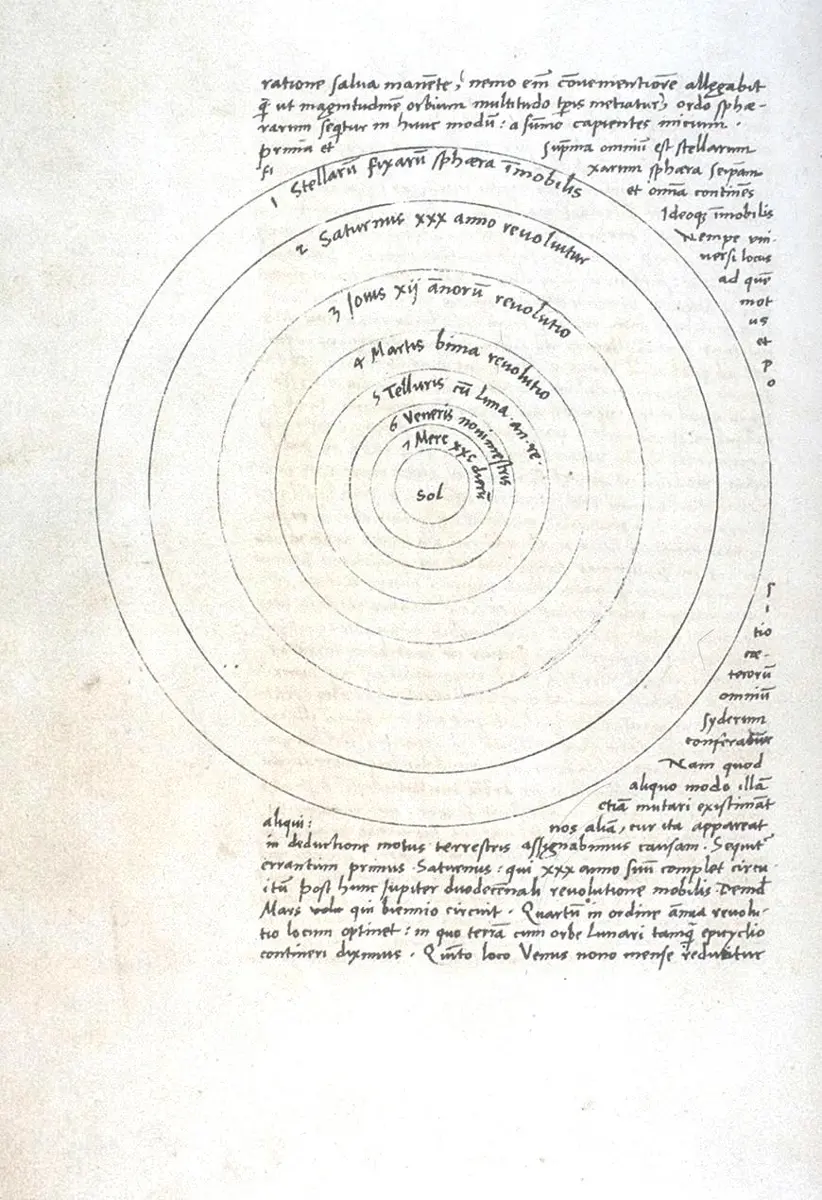
Copernicus (1473–1543) was born in Toruń, in Poland. For more than a thousand years, most people had believed that the Sun, the Moon and the planets went round the Earth. Copernicus worked out a different picture: the Sun at the center, and the Earth one of the planets going round it, turning on its axis once a day. His book, On the Revolutions of the Heavenly Spheres, was printed in 1543, the year he died. Your Grade 9 book tells how this heliocentric idea replaced the old one Grade 9: Do scientific theories change with time?.

Testing copernicium on gold
In 2006 and 2007, a team from Dubna in Russia and the Paul Scherrer Institute in Switzerland, led by Robert Eichler, did the first chemistry with copernicium. They made copernicium-283, which lasts about 4 seconds, as the product of the decay of flerovium. A stream of helium gas carried each atom along a narrow channel lined with gold-covered detectors, at about +30 °C at the start and colder and colder along it, down to about −180 °C at the end. How far an atom travels before it sticks shows how strongly it holds on to gold. Mercury atoms, sent along the same channel, stick to gold at once. Atoms of the noble gas radon hardly stick at all.
Only five atoms were caught: two in 2006 and three in 2007. They did stick to the gold, as a group 12 metal should, so copernicium forms a bond with gold like mercury does. But the bond is weaker than mercury’s, and copernicium turns to vapor very easily: it is a very volatile metal.
What has been measured, and what is only predicted
What has been measured: how its nuclei decay and how long they last (copernicium-285, the longest-lasting known kind, has a half-life of about 30 seconds), and how its single atoms stick to gold.
From the gold experiments came a first estimate of its boiling point: about 84 °C, but with only a few atoms the uncertainty is huge, anywhere from about −24 °C to 196 °C.
What is only predicted: a calculation published in 2019 gives copernicium a melting point of about 10 °C and a boiling point of about 67 °C, each give or take about 10 degrees, and a density of about 14 g/cm³, close to mercury’s 13.5. If that is right, copernicium is a liquid at room temperature, like mercury, but held together only weakly, like the liquid of a noble gas.
If copernicium really melts at about 10 °C and boils at about 67 °C, what would it be on a hot summer day in the Terai, at 40 °C?
Pick an answer to see why.
In your science books
- Grade 9: do scientific theories change with time? and radioactive elements.
- Grade 10: features of the modern periodic table and the Aufbau principle.
- Going further: alpha decay and half-life.
More to explore
- Its neighbors: mercury, above it in group 12, roentgenium before it and nihonium after it.
- Play: find copernicium in Guess the Element and the Periodic Table Jigsaw.
- Read more: copernicium at the Royal Society of Chemistry and at PubChem.