
Superconductors that work in liquid nitrogen
Nobel Prize in Physics, 1987: J. Georg Bednorz and K. Alex Müller
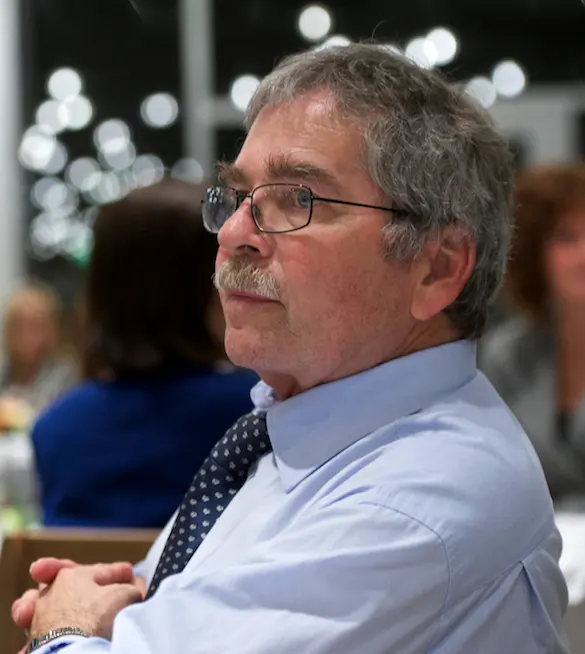
J. Georg Bednorz
born 1950 in Neuenkirchen, Germany
As a boy he would rather fix his brothers’ motorcycles than practice the piano. He loved chemistry because you could do the experiments yourself.
Photo: IBM Research, CC BY 2.0
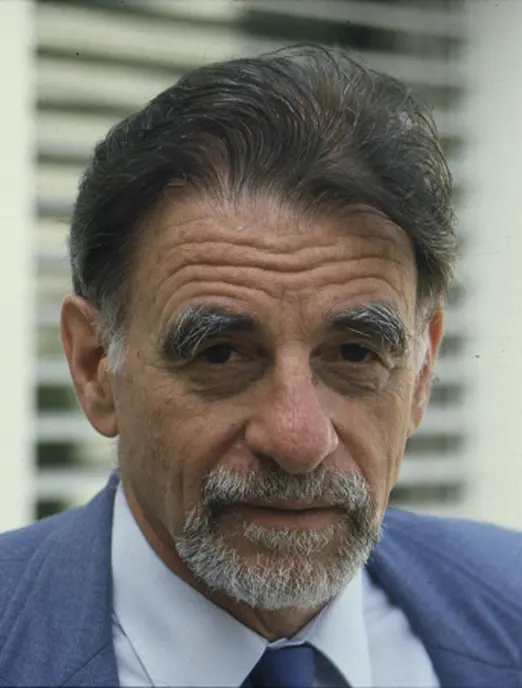
K. Alex Müller
1927–2023, born in Basel, Switzerland
As a schoolboy he built radios and wanted to be an electrical engineer. A chemistry teacher talked him into physics instead.
Hold a phone charger after an hour of charging, or touch the wire of an electric heater: it is warm. Every wire, even a good copper one, resists the flow of electricity a little, and that turns some of the electrical energy into heat Grade 9: Heating effect of electric current. Along the long power lines that bring electricity from hydropower stations in the hills to the towns, some of the energy is lost in this way before it reaches anyone.
There is a kind of material in which this loss disappears completely: a superconductor. But for 75 years, superconductors worked only when cooled almost to the coldest temperature possible. In 1986 two scientists at IBM’s laboratory near Zurich, in Switzerland, found superconductors in a place nobody expected: in a ceramic, a material more like a clay pot than a metal wire. Within months, other scientists used their discovery to make superconductors that work in liquid nitrogen. In 1987 Georg Bednorz and Alex Müller received the Nobel Prize in Physics, less than two years after their discovery.
The problem: superconductors needed to be very, very cold
Electric current is a flow of electrons through a wire. As they move, the electrons keep bumping into the vibrating atoms of the metal and lose energy, which heats the wire. This is resistance Grade 9: Electric resistance. A hotter wire has more resistance, and a colder wire less, but in an ordinary metal it never reaches zero.
In 1911 the Dutch physicist Heike Kamerlingh Onnes cooled solid mercury to −269 °C and found that its resistance suddenly vanished. Not small: zero. A current set flowing round a ring of superconductor keeps going for years with no battery at all.
Scientists measure such low temperatures from absolute zero, −273 °C, the coldest possible temperature, at which atoms barely move. Temperatures counted from absolute zero are in kelvin (K): 0 K is −273 °C, so mercury becomes a superconductor at about 4 K.
The temperature at which a material becomes a superconductor is called its critical temperature. Over the next sixty years, scientists found better and better superconductors among metals and alloys, but progress was slow. By 1973 the record, held by an alloy of niobium and germanium, was 23 K, or −250 °C. Then it stuck for thirteen years.
To cool something that far, you need liquid helium, which boils at −269 °C. Helium is rare and expensive, and keeping it liquid needs costly equipment. That is why superconductors were used only in a few special machines.
A material’s resistance drops to zero below 30 K. What is that temperature in degrees Celsius?
Pick an answer to see why.
How a superconductor behaves
A superconductor does two strange things when it is cooled below its critical temperature.
- Its resistance drops to exactly zero. Not gradually, but suddenly, at one temperature.
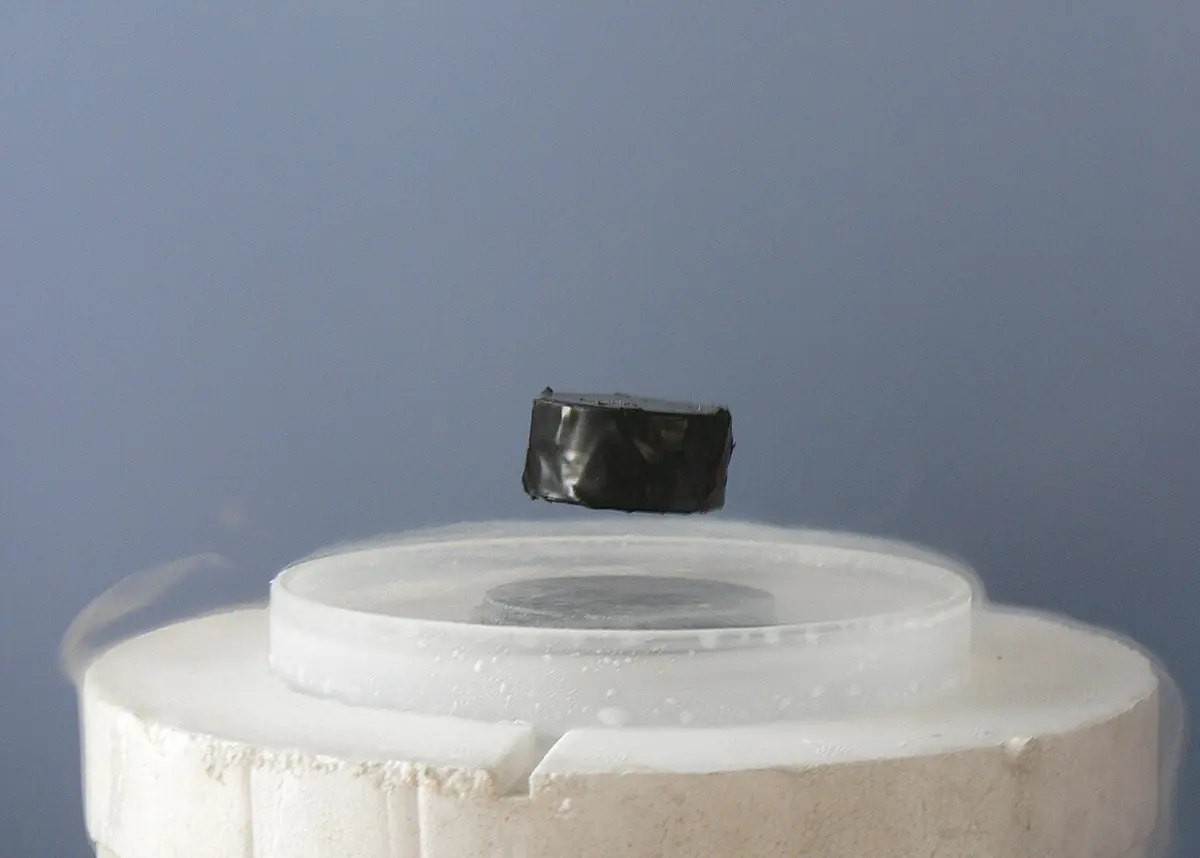
- It pushes magnetic fields out. A magnet held above a superconductor is pushed away so strongly that it can float in the air. This is called the Meissner effect, after the German physicist who found it in 1933. It is the surest test that a material is a true superconductor, because zero resistance could also be faked by a faulty measurement.
In 1957 three American physicists, John Bardeen, Leon Cooper and Robert Schrieffer, explained how the old superconductors work. In a superconductor, the electrons join up in pairs, helped by the vibrations of the atoms around them. The pairs move together in step, like a huge crowd marching, and slip through the metal without bumping into anything. Warm the metal, and the vibrations shake the pairs apart. Many physicists took the theory to mean that superconductivity could not survive much above the temperatures already reached.
Why it was hard
- Nobody looked in oxides. Most oxides, like rust or sand, hardly conduct electricity at all. Almost every superconductor known was a metal or an alloy, so that is where almost everyone searched.
- The theory seemed to set a limit. Many physicists doubted that the record could be pushed much higher.
- Many false alarms. Over the years, several laboratories had announced “high-temperature” superconductors that nobody else could reproduce. Any new claim would be met with doubt.
What they did, step by step
Alex Müller worked at IBM’s research laboratory at Rüschlikon, near Zurich, from 1963. For about fifteen years he studied oxides with a special crystal shape called perovskite, in which each metal atom sits in a little cage of six oxygen atoms. Georg Bednorz came to the same laboratory in 1972 as a 22-year-old summer student, learned to grow perovskite crystals there, and joined IBM in 1982.
- 1983, a bold plan. Müller asked Bednorz to join him in looking for superconductivity in oxides. Bednorz agreed at once. Müller had an idea: in certain oxides, the oxygen cage around a metal atom stretches and squeezes as an electron moves past. That might bind electrons into pairs more strongly, and so keep them paired at higher temperatures.
- 1983–1985, years of failure. They made and tested oxides of lanthanum and nickel, then added aluminium, then yttrium, then copper. Some conducted electricity; none became superconductors. They had to share another group’s measuring equipment, working late in the evening. By 1985 they wondered whether they were heading into a blind alley.
- Late 1985, a French paper. Bednorz read an article by three French chemists about an oxide of barium, lanthanum and copper that conducted electricity like a metal. The French team was interested in it for speeding up chemical reactions, not for superconductivity. But to Bednorz it had everything their idea needed. He made a batch of samples in a single day.
- January 1986, the drop. The samples waited while the laboratory prepared for a visit by IBM’s director of research and then over the holidays. In mid-January Bednorz measured them. As the temperature fell towards 30 K, his tension grew; at 11 K the resistance suddenly dropped by half. Within two weeks, by changing the recipe and the heating, they moved the start of the drop up to 35 K, about 12 degrees above the old record.
- April 1986, a careful report. They had not yet tested the Meissner effect, because their new magnetic measuring instrument had not arrived. So they gave their paper a cautious title: “Possible high Tc superconductivity in the Ba–La–Cu–O system”. It appeared in a German physics journal that summer.
- Autumn 1986, the proof. With the visiting Japanese scientist Masaaki Takashige, they showed that the samples pushed out magnetic fields: true superconductivity. They also found which compound in their mixture was doing it: lanthanum copper oxide with some barium in it, built in layers.
The race that followed
At first, few people noticed. Then, in late 1986, a team at the University of Tokyo repeated the experiment and confirmed it, and so did Paul Chu’s team in Houston, USA. Hundreds of laboratories around the world dropped what they were doing.
In early 1987 Chu’s team, working with Maw-Kuen Wu’s team in Alabama, replaced the lanthanum with the smaller atom yttrium and found superconductivity at about 92 K (−181 °C) in yttrium barium copper oxide. For the first time, a superconductor worked above the boiling point of liquid nitrogen, −196 °C Grade 9: Uses of nitrogen. Liquid nitrogen is made from air and is far cheaper and easier to handle than liquid helium. In March 1987 so many physicists crowded into one late-night meeting in New York to hear the news that it was nicknamed “the Woodstock of physics”, after a famous music festival.
How the new superconductors work, as far as anyone knows
The new materials are called cuprates, because they all contain copper and oxygen. They are built like a layered cake: flat sheets of copper and oxygen atoms, separated by layers of other atoms such as lanthanum, barium or yttrium. The current flows along the copper–oxygen sheets. The other layers act as a reservoir: by changing them (for example, putting some barium in place of lanthanum), chemists can take a few electrons out of the copper–oxygen sheets, and that is what makes them superconduct.
The electrons still travel in pairs. But what holds the pairs together so strongly, at temperatures where the old theory said they should fall apart, is still not known. It is one of the biggest unsolved problems in physics.
Before 1987, superconducting machines had to be cooled with liquid helium. Why did the jump to 92 K matter so much?
Pick an answer to see why.
In your life today
- Hospital scanners. The strong magnets of MRI scanners, found in big hospitals in Kathmandu and around the world, are coils of superconducting wire. Most still use the older metal superconductors, cooled with liquid helium, because ceramics are brittle and hard to make into wire.
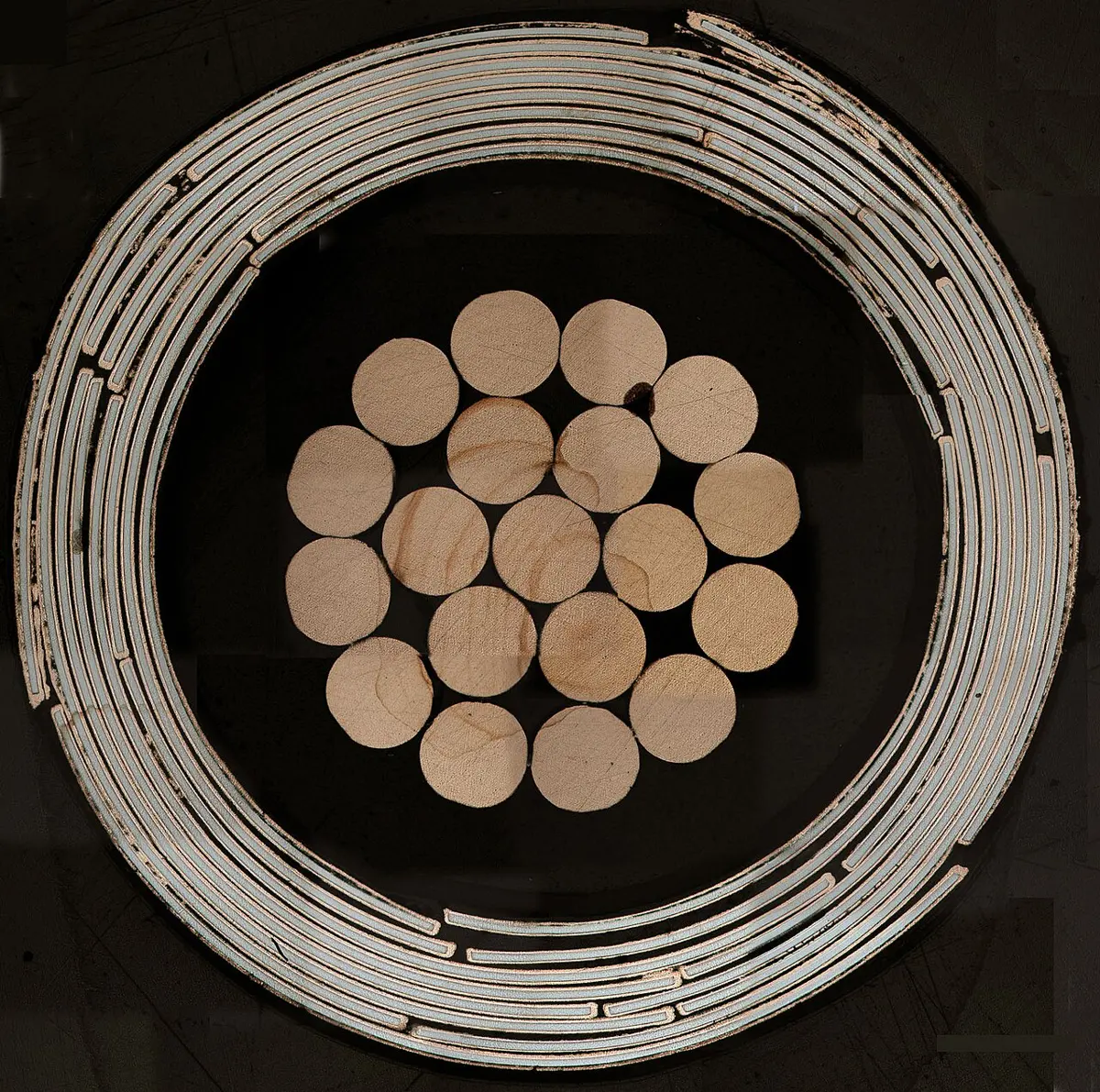
- Power cables. A few cities use underground cables made of the new superconductors, cooled with liquid nitrogen. One in Essen, Germany, about a kilometer long, has carried a city’s power since 2014. They carry far more current than copper cables of the same size, but they are still expensive.
- Fusion power. Engineers trying to build fusion power stations, which would make energy the way the Sun does, need extremely strong magnets. Flat tapes coated with yttrium barium copper oxide, one of the new superconductors, now make some of the strongest magnets ever built for this Grade 9: Nuclear reaction in the Sun.
What came next
- Higher temperatures. In 1993 a copper oxide containing mercury set a record of about 133 K, or −140 °C, at normal pressure, and it has hardly moved since. Under enormous pressure, much higher records have been reported, in materials made mostly of hydrogen, but those exist only squeezed between diamonds.
- The open question. Nobody can yet explain why the cuprates superconduct at such high temperatures. If someone does, it may show how to make a superconductor that works at room temperature: with no cooling at all, power lines, motors and magnets would waste almost no energy. Several claims of room-temperature superconductors have been made in recent years; so far, none has stood up to checking by other laboratories.
In your science books
- Grade 8: magnets and their uses.
- Grade 9: electric current, electric resistance and what affects it, the heating effect of electric current, electric power, and nitrogen and its uses.
- Grade 10: heat and temperature, and the electromagnet.
- Going further: how magnets push without touching, and which energy Nepal should use.
Learn more
- The Swedish Academy’s press release and the presentation speech (nobelprize.org).
- The Nobel lecture by Bednorz and Müller, in which Bednorz tells the story of the search, the French paper and the January measurement.
The official reason
The prize was given “for their important break-through in the discovery of superconductivity in ceramic materials.”