
Superconductors and superfluids
Nobel Prize in Physics, 2003: Alexei Abrikosov, Vitaly Ginzburg, and Anthony Leggett
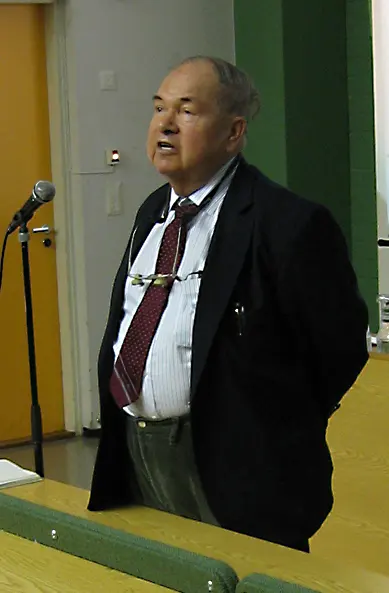
Alexei Abrikosov
1928–2017, born in Moscow, Russia
He worked out, in 1953, how a strong magnet can get inside a superconductor. His teacher did not believe him, so the paper waited four years.
Photo: Qifei, English Wikipedia, CC BY-SA 3.0
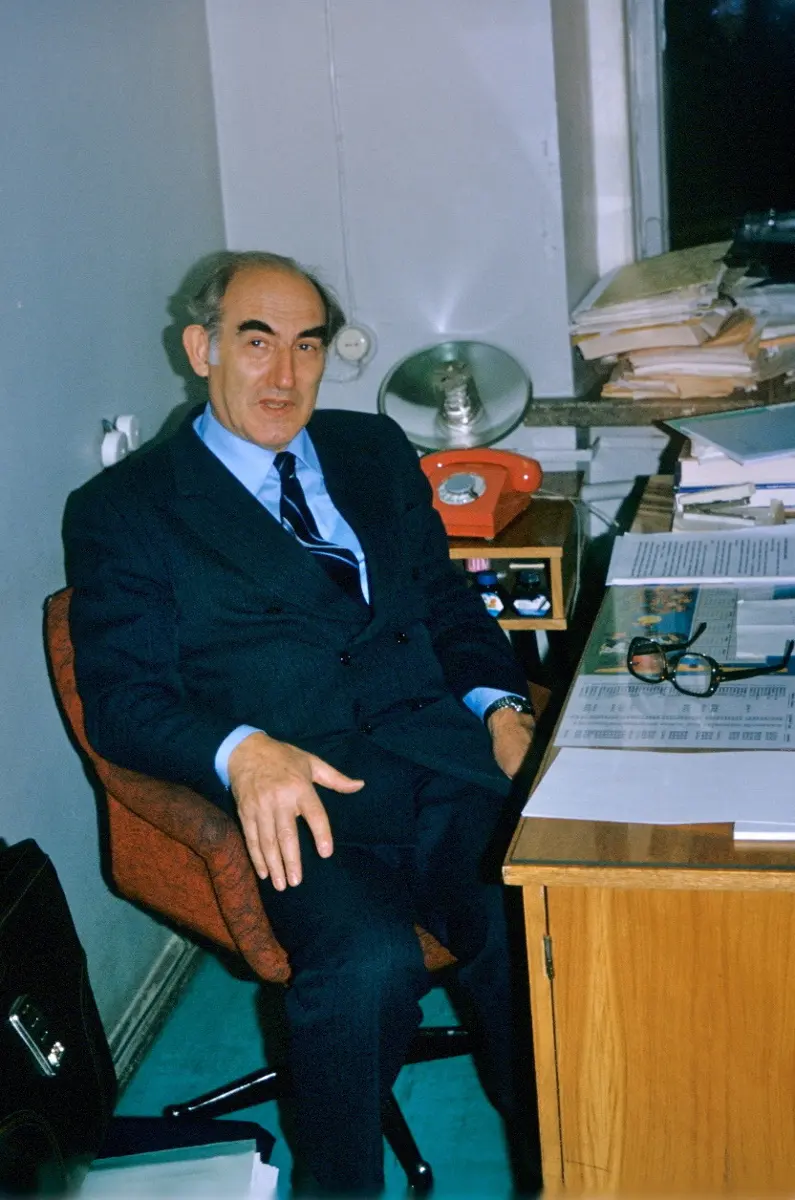
Vitaly Ginzburg
1916–2009, born in Moscow, Russia
With Lev Landau he wrote, in 1950, the equations that are still used to describe superconductors. He was 87 when he received the prize.
Photo: Woodruff T. Sullivan III, NRAO/AUI Archives, CC BY 4.0
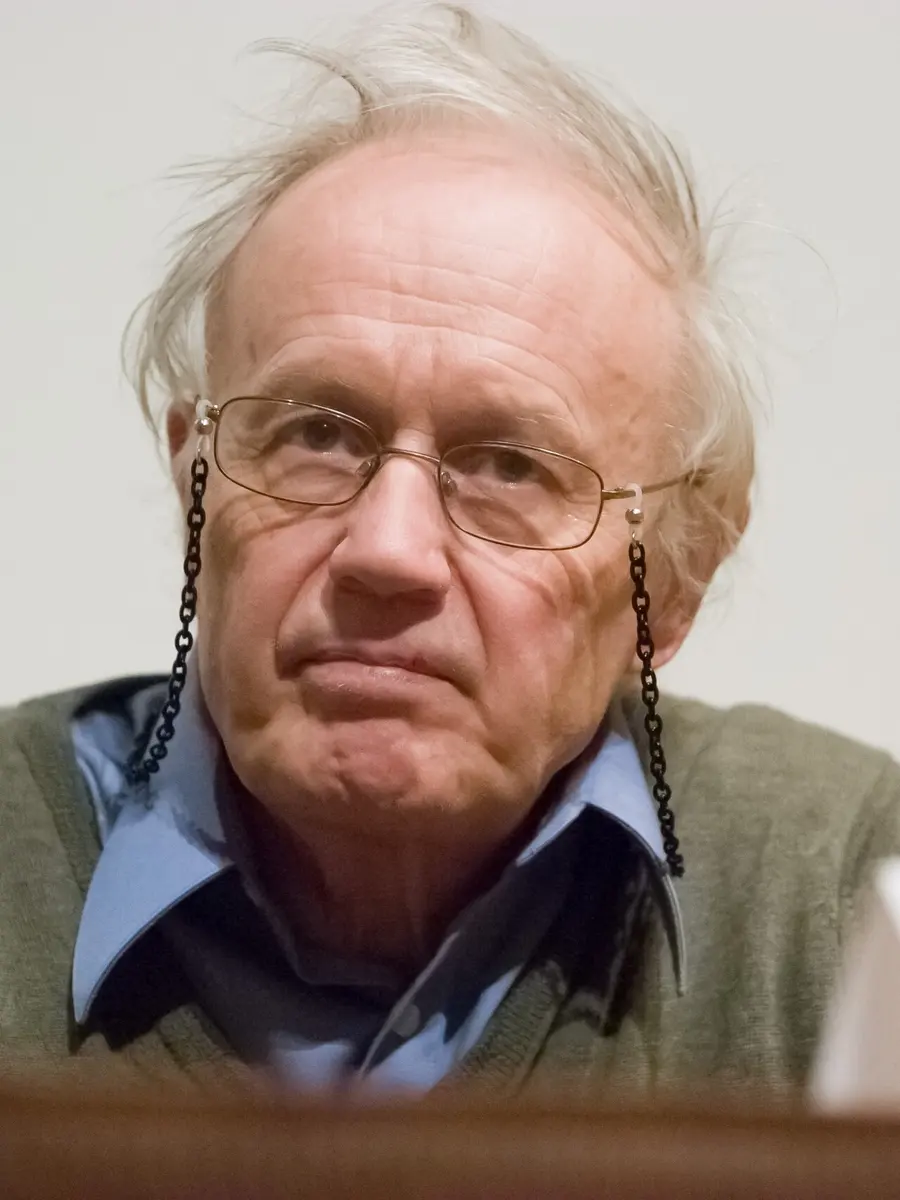
Anthony Leggett
1938–2026, born in London, England
He first took a degree in Latin, Greek and philosophy, then switched to physics. In the 1970s he explained the strangest liquid known.
Photo: Kenneth C. Zirkel, CC BY-SA 3.0
In a big hospital in Kathmandu, a patient slides into the tunnel of an MRI scanner. Around that tunnel is a long coil of wire. It carries a large electric current, round and round, day and night, often for years, and the electricity company is not paying for it to keep flowing. The wire has no electrical resistance at all. It is a superconductor, and it is kept at about −269 °C, colder than anything in nature on Earth.
The 2003 Nobel Prize in Physics went to three scientists who explained how superconductors and their strange cousins, superfluids, behave. Two of them explained why some superconductors survive strong magnets, which is what made MRI scanners possible. The third explained a liquid that flows with no friction at all.
The problem: wires that waste energy
When a current flows through an ordinary wire, the moving electrons keep bumping into the atoms of the metal. This makes the atoms shake harder, so the wire gets warm. This opposition to the current is called resistance Grade 9: Electric resistance. It is why a heater, a kettle and an old bulb get hot, and why some of the electricity sent along power lines is lost as heat on the way Grade 9: Heating effect of electric current.
If you cool a metal, its atoms shake less and its resistance falls. But for an ordinary metal like copper, it never reaches zero. There is always some loss.
Cold beyond anything in nature
Scientists measure very cold temperatures in kelvin (K). One kelvin is the same size of step as one degree Celsius, but the scale starts at absolute zero, 0 K or −273.15 °C, the coldest anything can ever be Grade 10: Thermal energy, heat and temperature. So 0 °C is about 273 K, and a room is about 293 K.
In 1908 the Dutch physicist Heike Kamerlingh Onnes turned helium gas into a liquid for the first time. Liquid helium boils at just 4.2 K (−269 °C). With it he could cool other things almost to absolute zero.
In 1911 he cooled a thread of solid mercury and measured its resistance. At about 4 K, it suddenly dropped to zero. Not small: zero, as far as anyone could measure. He called this superconductivity. In a superconducting ring, a current can go round for years without a battery.
A copper wire and a superconductor both carry a current. Which statement is true?
Pick an answer to see why.
Superconductors and magnets
Engineers saw the use at once: coils of superconducting wire could make huge electromagnets that waste no energy Grade 10: The electromagnet. But there was a catch. Mercury, lead and tin stopped superconducting in quite a weak magnetic field. A superconducting magnet made of them would destroy its own superconductivity.
In 1933 two German physicists, Walther Meissner and Robert Ochsenfeld, found something else. A superconductor does not just carry current without loss. It pushes magnetic fields out of itself. Bring a magnet close and the superconductor makes currents in its surface that repel it. This is the Meissner effect, and it is why a small magnet can float in the air above a superconductor.
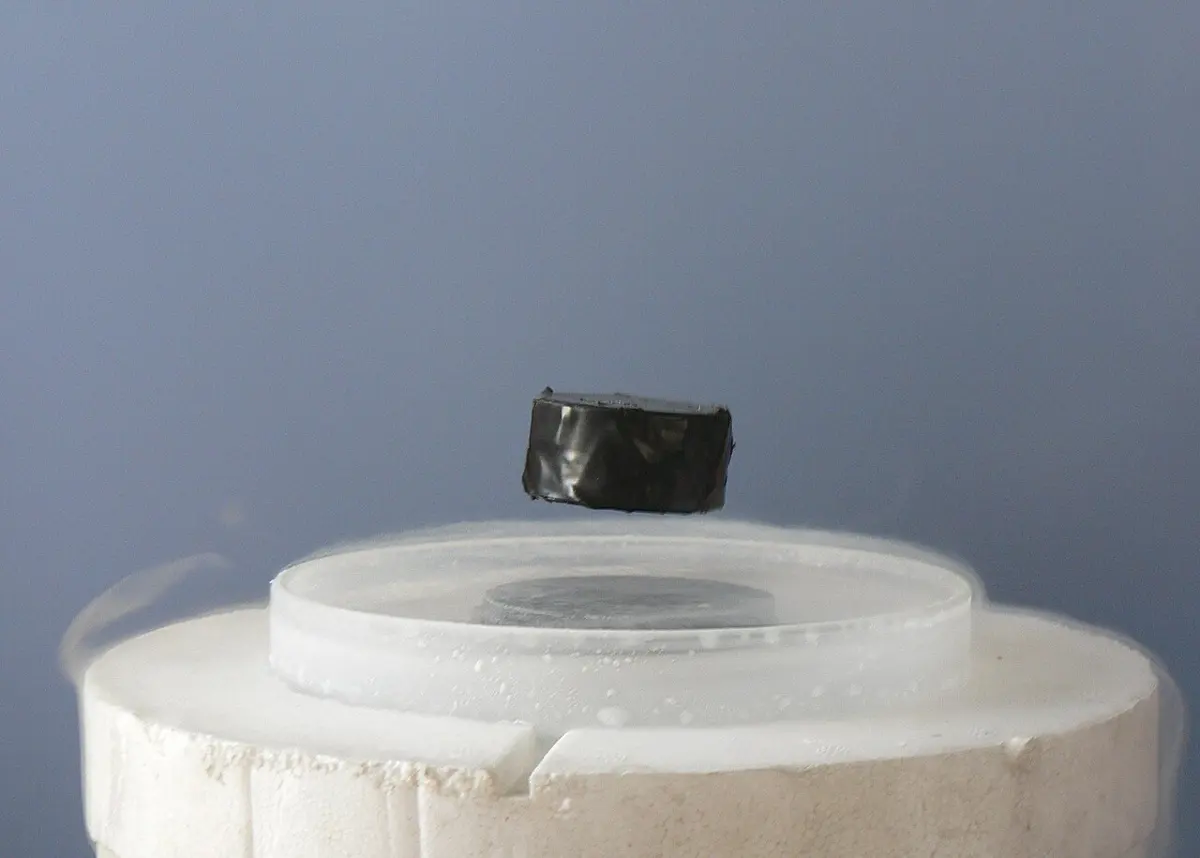
Superconductors of this kind, which push the field out until the field gets too strong and then give up, are now called type I. Pure metals such as mercury, lead and tin are type I.
Why it was hard to explain
For almost fifty years nobody could say why superconductivity happens. Ordinary physics says that electrons always bump into atoms. The answer needed quantum physics, the rules that govern very small things like electrons and atoms.
Quantum physics says an electron is not just a tiny ball. It also behaves like a wave. Usually the waves of the billions of electrons in a wire are all out of step, a jumble. In a superconductor, below its special temperature, the electrons pair up, and the pairs all fall into step, like a crowd marching in time. A marching crowd can’t be knocked off course by one bump. This picture, the BCS theory, was found by three Americans in 1957 (they won the Nobel Prize in 1972).
There was also a second puzzle. In the mid-1930s, in Kharkiv, the Soviet physicist Lev Shubnikov measured superconducting alloys (mixtures of metals). They did not give up all at once in a magnetic field. The field crept in slowly, between two strengths, and they kept superconducting in fields that would kill mercury. Nobody could explain it.
What they did, step by step
Ginzburg and Landau: one number that sorts superconductors
Vitaly Ginzburg and his colleague Lev Landau worked in Moscow. In 1950 they wrote a set of equations for superconductors without knowing what the electrons were doing in detail.
- They described a superconductor by a quantity that says, at each point, how strongly the material is superconducting there. Deep inside it is fully superconducting; near a surface or a magnetic field it may be weaker. Physicists call this an order parameter: a measure of how much order (how much “marching in step”) there is.
- Their equations showed how this order parameter changes from place to place, and how it fights with a magnetic field.
- Out of the equations came one number for each material, now called the Ginzburg–Landau parameter. It compares how deep a magnetic field can reach into the material with how quickly the superconducting order can change. For mercury it is about 0.16.
- They saw that if the number were above about 0.71, the material would behave quite differently. But every superconductor they knew of was below it, so they set that case aside.
Abrikosov: the field gets in through tiny whirlpools
Alexei Abrikosov, a young physicist in Landau’s group, looked at what Ginzburg and Landau had set aside.
- Early 1950s. His friend Nikolay Zavaritskii measured very thin superconducting films made in a new, careful way. The results did not fit the theory. Abrikosov found they fitted if the Ginzburg–Landau number was large.
- 1953, the whirlpools. He worked out what happens in a strong magnetic field when the number is large. The field does not stay out, and it does not flood in everywhere. It gets in through thin threads. Around each thread the superconducting electrons swirl in a circle, like the whirlpool of water going down a drain. Each thread is a vortex (plural: vortices), and each one carries exactly the same tiny amount of magnetism.
- The pattern. The vortices push each other apart and settle into a neat triangular pattern, like the cells of a honeycomb. Between them, the material still superconducts. As the field gets stronger, more vortices crowd in, until their cores touch and the superconductivity is gone.
- 1957, published. He had found a second kind of superconductor, which he called type II. It matched Shubnikov’s old measurements on alloys exactly.
Why can type II superconductors be used to make very strong magnets, but type I cannot?
Pick an answer to see why.
Leggett: the strangest liquid
Superconductivity has a cousin in liquids. In 1937 Pyotr Kapitsa in Moscow, and at the same time John Allen and Don Misener in Cambridge, found that liquid helium cooled below 2.17 K flows with no friction at all. It runs through gaps too narrow for any ordinary liquid and even creeps up the walls of its container. This is a superfluid.
Helium comes in two kinds of atom, two isotopes. Ordinary helium, helium-4, has 2 protons and 2 neutrons in its nucleus. The rare helium-3 has only 1 neutron. Quantum physics says that helium-4 atoms can all fall into step on their own, which is why helium-4 becomes superfluid. Helium-3 atoms cannot; like electrons, they would first have to form pairs.
- 1972, the discovery. Three Americans, David Lee, Douglas Osheroff and Robert Richardson, cooled helium-3 to about 0.0025 K, a thousand times colder than helium-4 needs, and saw it change. It had become a superfluid (they won the Nobel Prize in 1996).
- The puzzle. The new liquid behaved very strangely. Its pairs of atoms are little magnets, and they also spin around each other, so the liquid had different properties in different directions, and it came in three different forms, called A, A1 and B, depending on the temperature, pressure and magnetic field.
- 1972–1975, the explanation. Anthony Leggett, at the University of Sussex in England, worked out how the pairs of helium-3 atoms line up and what each form of the liquid is. His theory explained the measurements and told experimenters what to look for next.
How superconducting magnets work now
Almost every superconductor used today is type II. The most common is an alloy of niobium and titanium, made into wire and wound into coils.
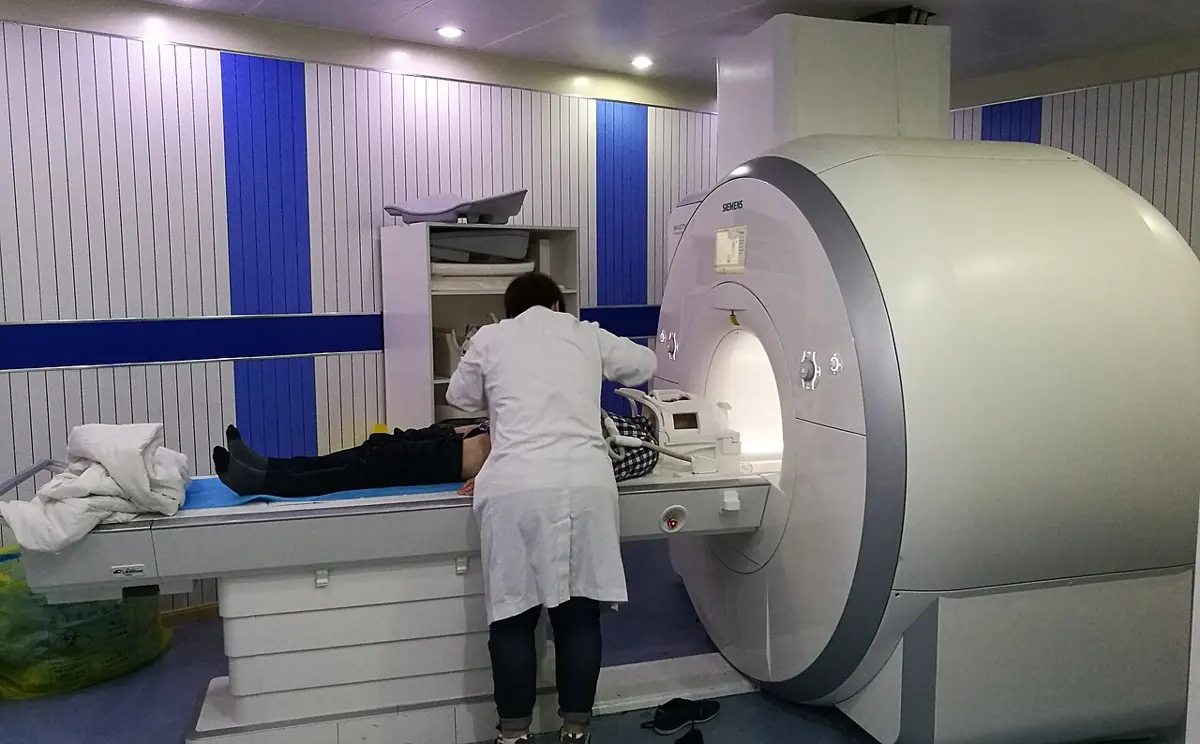
- MRI scanners. The magnet of a hospital MRI scanner is a coil of niobium–titanium wire in a bath of liquid helium at about 4 K. Its field is usually 1.5 or 3 tesla, roughly 30,000 to 60,000 times stronger than the Earth’s Grade 8: Uses of magnets. A type I superconductor would stop working in a field a hundred times weaker. Once the current is started, it keeps flowing by itself, as long as the coil stays cold.
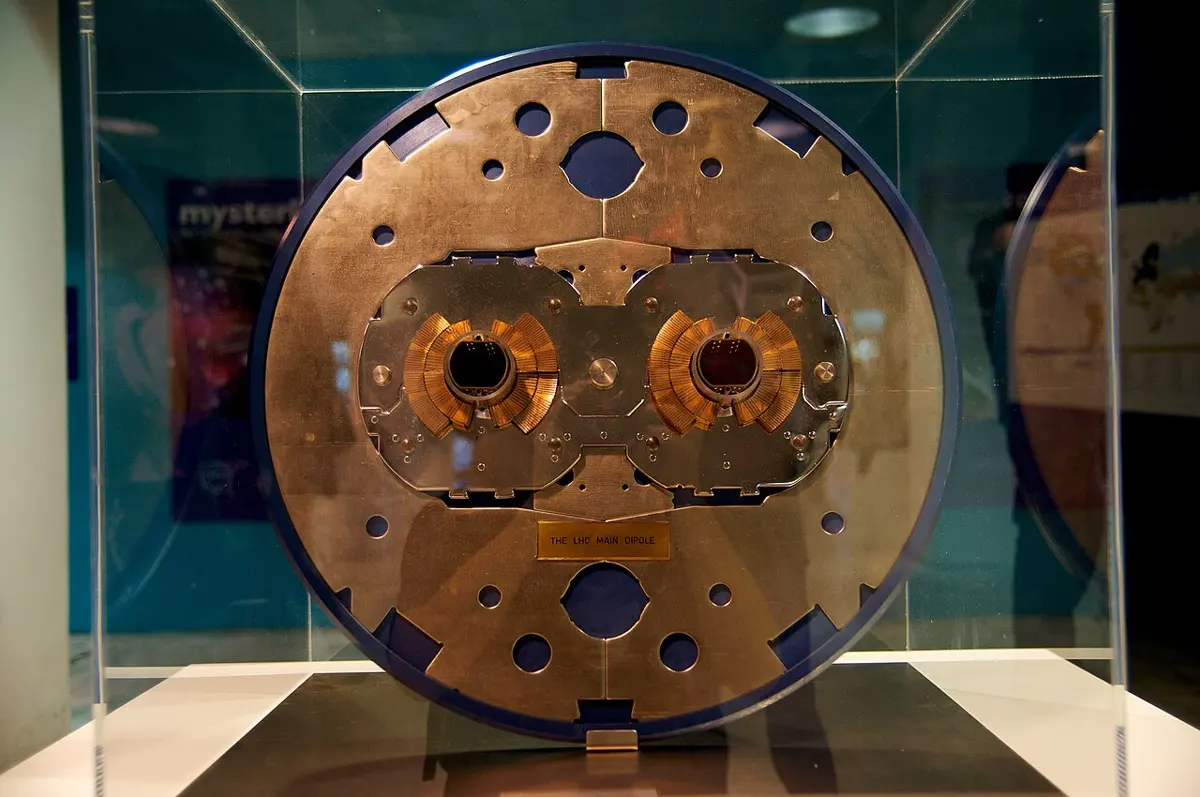
- Particle accelerators. The Large Hadron Collider at CERN, near Geneva, steers its beams with 1,232 bending magnets of niobium–titanium, each about 15 m long, with a field of 8.3 tesla. They are cooled to 1.9 K with superfluid helium-4, which carries heat away better than any other liquid. Both halves of this prize are at work in the same machine.
Why must the magnet of an MRI scanner be filled with liquid helium?
Pick an answer to see why.
In your life today
- Hospitals. Large hospitals in Nepal, in Kathmandu and other cities, have MRI scanners. Every one of them depends on a type II superconductor, the kind Abrikosov explained. (How an MRI turns magnetism into a picture won the Nobel Prize in Medicine the same year.)
- High-temperature superconductors. In 1986 and 1987, scientists found superconductors made of copper oxides, some of which work above 77 K (−196 °C), the boiling point of liquid nitrogen, which is much cheaper than liquid helium. All of them are type II. They are used in some power cables and in very strong research magnets.
- Fast trains. In Japan, a test train floating on superconducting magnets reached 603 km/h in 2015, a world record for a train. A line between Tokyo and Nagoya is being built.
What came next
- Leggett and quantum computers. From 1978 Leggett asked whether a whole electric circuit, made of superconductors, could behave like a single quantum particle. Experiments in the 1980s showed it could, and that work won the Nobel Prize in Physics in 2025. Many of today’s quantum computers are built from such superconducting circuits.
- Vortices that get stuck. In real magnets, engineers add tiny defects to the wire on purpose, to pin Abrikosov’s vortices in place. Vortices that move waste energy and warm the wire.
- A superconductor at room temperature? The record at ordinary pressure is still about 133 K (−140 °C). Some hydrogen compounds superconduct at about −23 °C, but only when squeezed to more than a million times the pressure of the air. Claims of a room-temperature superconductor, such as one in 2023, have not held up so far. Finding one would change electric power, transport and medicine. This is an open question.
In your science books
- Grade 8: uses of magnets, including the MRI scanner’s magnet, and inert gases such as helium.
- Grade 9: electric resistance and the heating effect of electric current.
- Grade 10: temperature, the kelvin and absolute zero and the electromagnet.
- Going Further: how magnets push without touching.
Learn more
- The Nobel Prize’s own explanation: Superconductivity and superfluidity (nobelprize.org).
- The three laureates’ Nobel lectures: Abrikosov, Ginzburg and Leggett.
The official reason
The prize was given “for pioneering contributions to the theory of superconductors and superfluids.”