
- Atomic number
- 102
- Atomic mass
- 259.1
- Shells
- 2, 8, 18, 32, 32, 8, 2
- Configuration
- 1s² 2s² 2p⁶ 3s² 3p⁶ 4s² 3d¹⁰ 4p⁶ 5s² 4d¹⁰ 5p⁶ 6s² 4f¹⁴ 5d¹⁰ 6p⁶ 7s² 5f¹⁴
- In the table
- period 7, group none (f-block), f-block
- Kind
- Actinide
- Valency
- 2 (No²⁺), and 3 (No³⁺)
- State at 25 °C
- solid
- Melts · boils
- 827 °C · not known
- Known since
- 1966
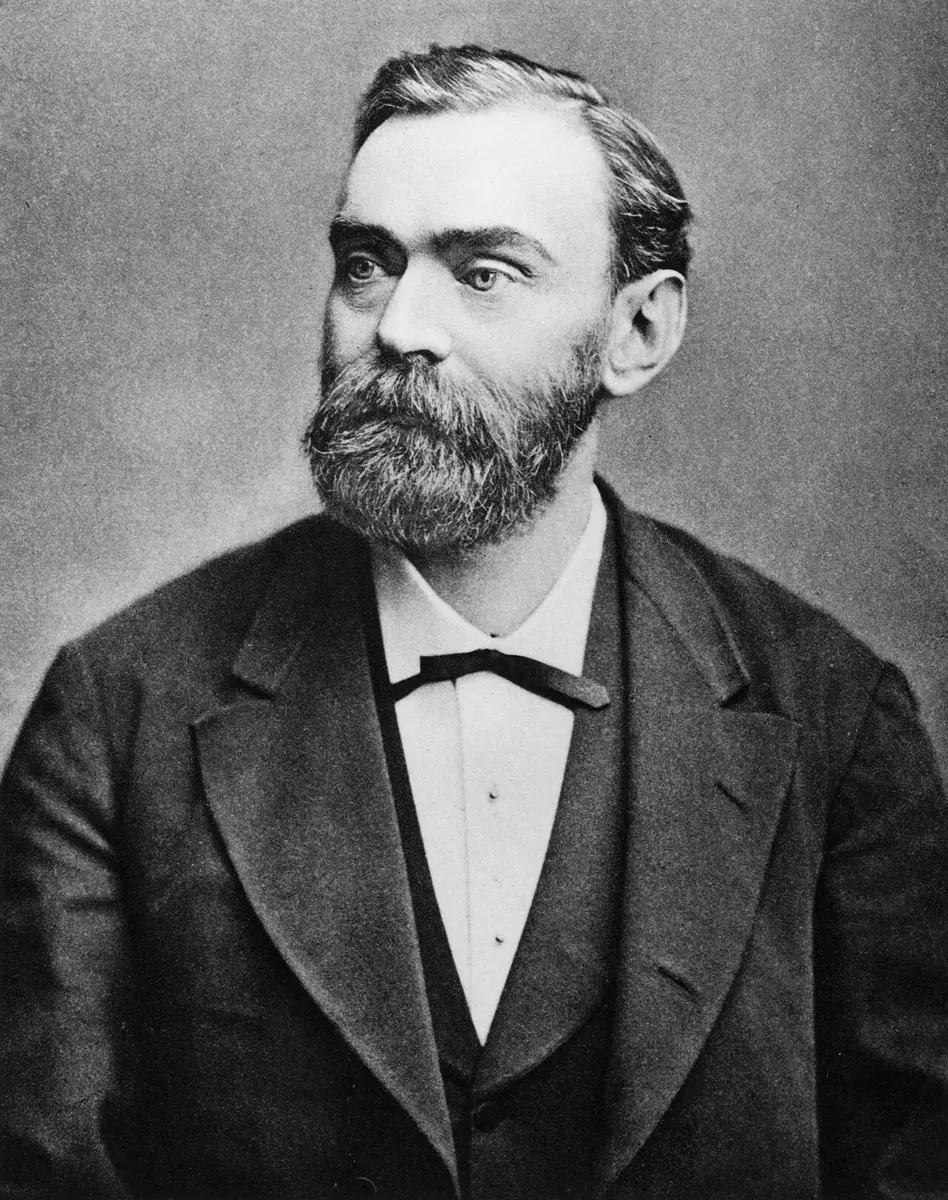
Nobelium, element 102, got its name in 1957, for a discovery that turned out to be wrong. The atoms really made later were found by other scientists, who wanted other names, and the argument lasted for decades. In the end the first name stayed. Only a few atoms of nobelium have ever been made at a time, yet they have shown something no other element of its row does.
The nobelium atom
A nobelium atom has 102 protons (atomic number 102) and 102 electrons. Its longest-lasting kind, nobelium-259, has 259 − 102 = 157 neutrons. By shells, the electrons are 2, 8, 18, 32, 32, 8, 2, and in subshells Grade 10: The Aufbau principle:
… 6p⁶ 7s² 5f¹⁴
Nobelium is in period 7, the fourteenth of the actinides in the f-block Grade 10: Features of the modern periodic table, under ytterbium. With 14 electrons, its 5f subshell is full.
Most actinides give away three electrons and form ions with a charge of 3+. Nobelium is different: in water its usual ion is No²⁺. It is the only element of the whole f-block whose most stable ion in water has a charge of 2+.
A full subshell holds on to its electrons especially tightly. Nobelium gives away its two 7s electrons easily, but a third would have to come out of the full 5f, which takes much more energy. Chemists predicted this before element 102 had been made, and in 1968 experiments showed it was true: nobelium behaved in water like calcium and strontium, whose ions are 2+, and not like the other actinides.
Nobelium’s usual ion is No²⁺. Which electrons does the atom give away to form it?
Pick an answer to see why.
A name, and a long argument
1957. Scientists working at the Nobel Institute for Physics in Stockholm, Sweden, with colleagues from Britain and the United States, fired carbon nuclei at curium (96 + 6 = 102). They reported atoms of a new element with a half-life of about 10 minutes, and named it nobelium, after Alfred Nobel. The name was accepted at once.
1958. At Berkeley, California, Albert Ghiorso and Glenn Seaborg’s team tried again and could not find the 10-minute atoms. They reported other atoms of element 102 instead.
1958–1966. At Dubna, near Moscow, Georgy Flerov’s team made element 102 in other ways, and measured the half-lives again. Later work showed that no kind of nobelium has the half-life and radiation the Swedish team had reported, and they withdrew their claim. Berkeley’s first identification also turned out to be mistaken. In 1966 the Dubna team published results that later work confirmed, and Berkeley’s own experiments the same year agreed with them.
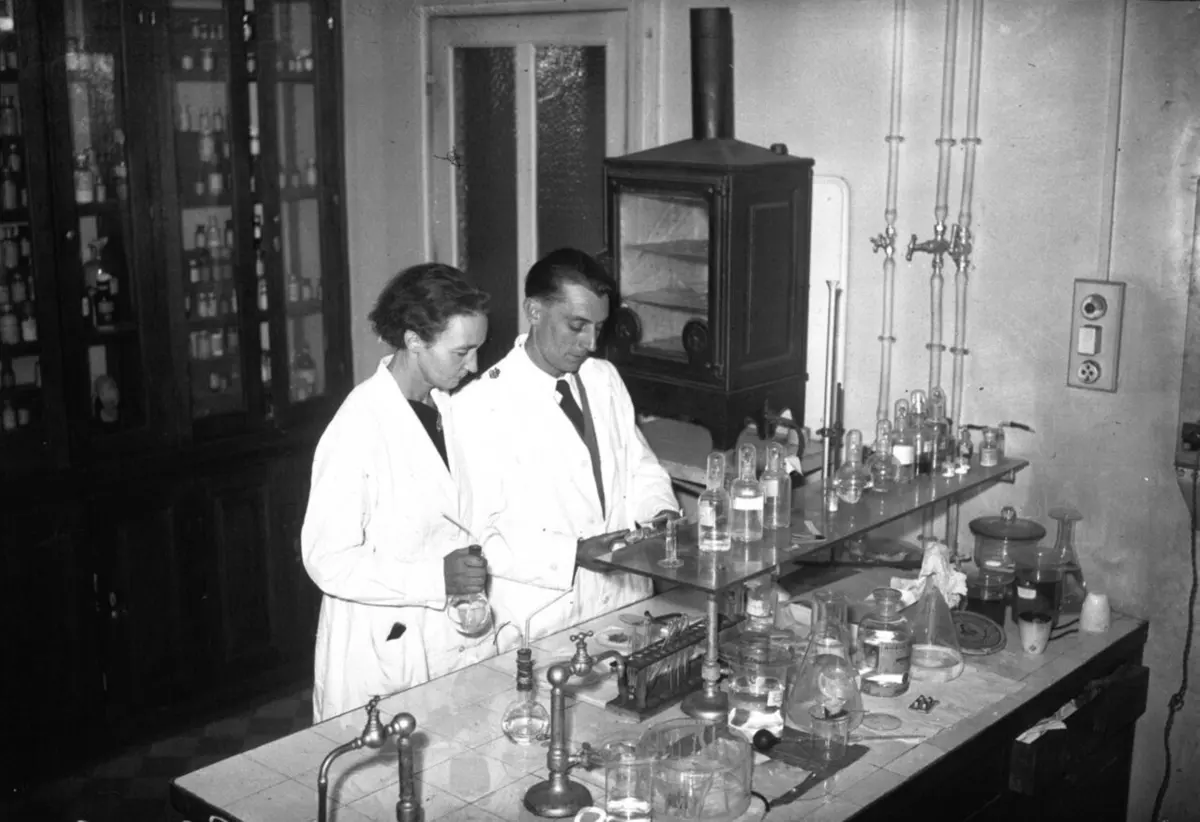
The Dubna team proposed a different name, joliotium, after the French physicist Irène Joliot-Curie, Marie Curie’s daughter. For years, books in different countries used different names.
1992. A working group of the two international unions of chemists and physicists (IUPAC and IUPAP) studied every claim and gave the credit for discovering element 102 to the Dubna team. The Berkeley team disagreed with the decision.
1997. IUPAC settled the names of elements 101 to 109. Element 102 kept the name nobelium, because it had been used for so long. Its symbol is No.
Who was Alfred Nobel?
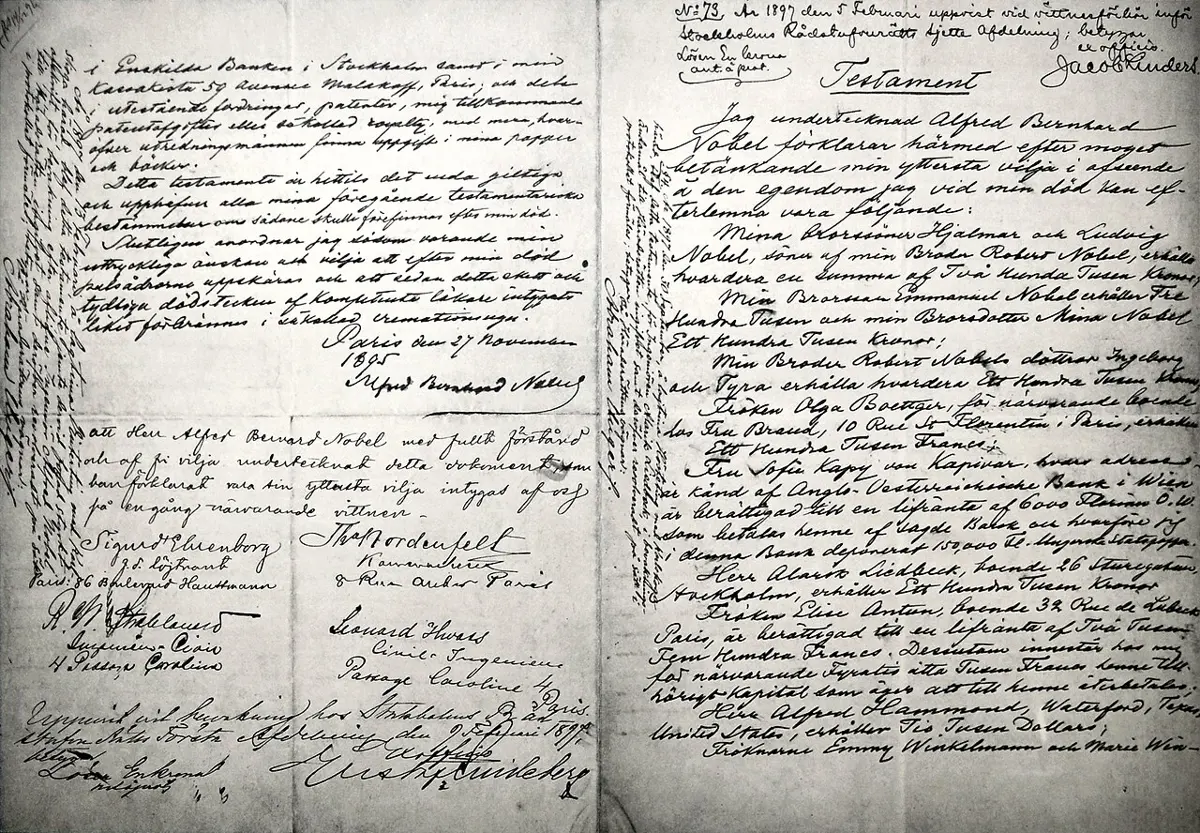
Alfred Nobel was a Swedish chemist and inventor. In 1867 he patented dynamite, a way to make the dangerous explosive nitroglycerine safe enough to handle, and he made a fortune from explosives. In his will he left most of his money to fund prizes, every year, for the people whose work had done the most good: in physics, chemistry, medicine, literature and peace. These are the Nobel Prizes. A name meant to honor a Swedish laboratory ended up honoring the man behind the prizes.
What single atoms have shown
Nobelium is made by firing light nuclei, such as carbon, at heavy targets, such as curium or californium, a few atoms at a time. Its longest-lasting kind, nobelium-259, has a half-life of about 58 minutes. Chemists often use nobelium-255, with a half-life of about 3 minutes, because more of it can be made.
What has been measured:
- Its ion in water is No²⁺, and it can be forced to No³⁺ only by a strong oxidizing agent.
- In 2016, scientists at Darmstadt, Germany, shone lasers on single nobelium atoms and found a color of light they absorb: the first time the light of an element heavier than fermium had been measured. Two years later, with lasers, they measured very precisely how much energy it takes to pull one electron off a nobelium atom.
- In 2025, scientists at Berkeley identified molecules of nobelium, formed with traces of water and nitrogen, by weighing them one at a time: the first molecules of so heavy an element to be identified directly.
What is only predicted: that nobelium is a solid metal, and its melting point. The facts card’s 827 °C is an estimate (another is about 800 °C). Its density and boiling point are unknown.
The body has no use for nobelium. It would harm only through its radiation, and so little is ever made that no one outside a laboratory meets it.
In your science books
- Grade 9: radioactive elements, ions and shells and their energy.
- Grade 10: the actinides, the Aufbau principle and valency.
- Going further: alpha decay and half-life.
More to explore
- Nobel Prizes: the full list of prizes in physics, chemistry and medicine, Alfred Nobel’s legacy, and the Joliot-Curies’ new radioactive atoms (1935).
- Its neighbors: mendelevium and lawrencium on either side, and ytterbium, the element above it.
- Play: find nobelium in Guess the Element and the Periodic Table Jigsaw.
- Read more: nobelium at the Royal Society of Chemistry and at PubChem.