
- Atomic number
- 116
- Atomic mass
- 293.2
- Shells
- 2, 8, 18, 32, 32, 18, 6
- Configuration
- 1s² 2s² 2p⁶ 3s² 3p⁶ 4s² 3d¹⁰ 4p⁶ 5s² 4d¹⁰ 5p⁶ 6s² 4f¹⁴ 5d¹⁰ 6p⁶ 7s² 5f¹⁴ 6d¹⁰ 7p⁴
- In the table
- period 7, group 16 (VIA), p-block
- Kind
- Other metal
- Valency
- 2 predicted (Lv²⁺); 4 less often
- State at 25 °C
- expected to be a solid
- Melts · boils
- not known · not known
- Known since
- 2000
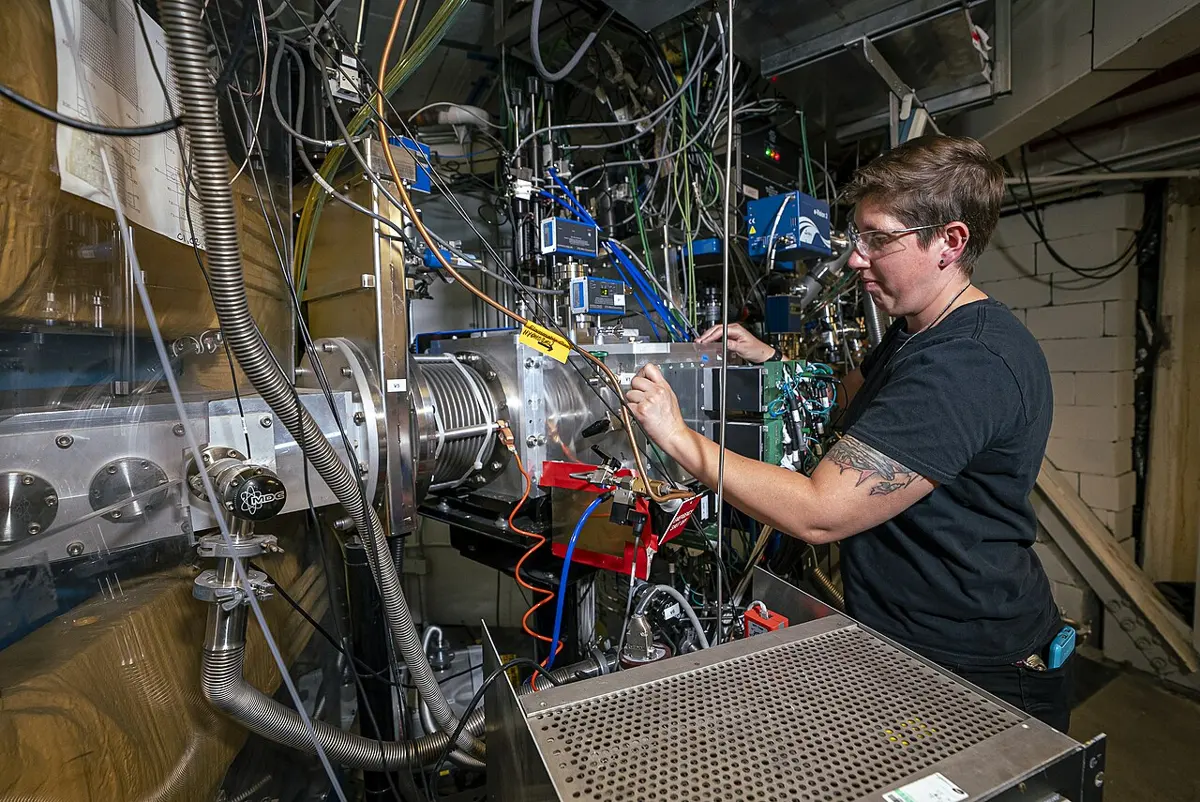
For the elements 114 to 118, the recipe was always the same: fire calcium at the heaviest target you can make. But there is no target heavy enough to reach element 120 that way. So in 2023 and 2024, laboratories in Russia and the USA tried heavier beams, chromium and titanium, and tested them by making an element whose recipe was already known: livermorium, element 116. Both worked, and the search for element 120 began.
The livermorium atom
A livermorium atom has 116 protons (atomic number 116) and 116 electrons. Its longest-lasting known kind, livermorium-293, has 293 − 116 = 177 neutrons. By shells, the electrons are 2, 8, 18, 32, 32, 18, 6, and in subshells Grade 10: The Aufbau principle:
… 7s² 5f¹⁴ 6d¹⁰ 7p⁴
With six electrons in its outermost shell, livermorium is in group 16, the oxygen family: oxygen, sulphur, selenium, tellurium, polonium and livermorium. Oxygen and sulphur take two electrons and form ions such as O²⁻ and S²⁻, so their valency is 2 Grade 10: Valency. But down the group the elements become more metallic Grade 10: Electropositivity: polonium is already a metal. Livermorium, at the very bottom, is expected to be a metal that gives away two electrons instead, forming Lv²⁺.
Which element is directly above livermorium in the periodic table?
Pick an answer to see why.
How livermorium was found and named
On 19 July 2000, at the Joint Institute for Nuclear Research in Dubna, Russia, a team led by Yuri Oganessian, working with scientists from the Lawrence Livermore National Laboratory in California, fired calcium-48 (20 protons) at curium-248 (96 protons): 96 + 20 = 116. They saw one atom, which gave out an alpha particle within a fraction of a second and turned into flerovium, element 114. More atoms followed in 2001 and 2005. At first the team thought they had made livermorium-292; later work showed it was livermorium-293.
In June 2011, IUPAC and IUPAP accepted the discovery of elements 114 and 116. In 2012, element 116 was named livermorium, symbol Lv, after the Livermore laboratory, which in turn is named after the town of Livermore, California. The town took its name from Robert Livermore, an English-born rancher who settled in the valley in the 1800s. Until then the element was called ununhexium (un-un-hex: 1-1-6).

A new beam
Every element from 114 to 118 was first made the same way: calcium-48 fired at a target of a heavy element. Calcium-48 is special: its nucleus has just the right numbers of protons and neutrons to hold together well and to join with a heavy nucleus without too much extra energy. But calcium has only 20 protons. To make element 120 with it, you would need a target with 100 protons, fermium, and fermium can be made only a few atoms at a time, far too little for a target. The heaviest element that can be made in amounts big enough for a target (Berkeley’s will hold about 45 thousandths of a gram) is californium (98), and 98 + 20 = 118, the end of the table so far.
So the beam must bring more protons. In 2023, at Dubna, a team fired chromium-54 (24 protons) at uranium-238 (92): 92 + 24 = 116, and found one atom of livermorium. In 2024, at Berkeley’s 88-Inch Cyclotron, a team fired about 6 trillion ions of titanium-50 (22 protons) a second at a target of plutonium-244 (94 protons) for 22 days: 94 + 22 = 116. They found two atoms of livermorium. The heavier beams make far fewer atoms than calcium does, but they make some.
Berkeley’s plan is to fire titanium-50 at californium-249: 98 + 22 = 120. The team expects it to take about ten times as long as livermorium did, perhaps years, and there is no promise it will work. Dubna plans to try chromium on curium: 96 + 24 = 120. As of 2026, no atom of element 120 has been reported (oganesson has more on the search).
What is measured, and what is only predicted
What has been measured, from a few dozen atoms:
- Six kinds of livermorium, from livermorium-288 to livermorium-293, all with half-lives under a tenth of a second. The longest-lasting, livermorium-293, has a half-life of about 0.06 seconds (published values range from about 0.06 to 0.08); livermorium-288, made in 2023, lasted less than a thousandth of a second.
- Each decays by giving out an alpha particle, turning into flerovium.
What is only predicted: no chemistry has been done with livermorium, because its atoms do not last long enough. Calculations say it is a solid metal (about 12.9 g/cm³, melting somewhere between about 360 and 510 °C), that it forms Lv²⁺ more readily than Lv⁴⁺, and that, unlike oxygen and sulphur, it hardly ever takes electrons. The facts card gives no melting point or density because none has been measured.
Livermorium has no uses outside research, and the body has none for it.
In your science books
- Grade 8: the last four elements named, in 2016 and groups and periods.
- Grade 9: ions, radioactive elements and nuclear fusion, joining nuclei.
- Grade 10: features of the modern periodic table, the Aufbau principle and electropositivity down a group.
- Going further: alpha decay and fusion: joining light nuclei.
More to explore
- Its family: polonium, above it in group 16, and oxygen, at the top.
- Its neighbors: flerovium, which it decays into, and moscovium and tennessine, on either side; curium and plutonium, its two targets.
- Nobel Prizes: Lawrence’s prize (1939) for the cyclotron.
- Play: find livermorium in Guess the Element and the Periodic Table Jigsaw.
- Read more: livermorium at the Royal Society of Chemistry and at PubChem.