
- Atomic number
- 108
- Atomic mass
- 269.13
- Shells
- 2, 8, 18, 32, 32, 14, 2
- Configuration
- 1s² 2s² 2p⁶ 3s² 3p⁶ 4s² 3d¹⁰ 4p⁶ 5s² 4d¹⁰ 5p⁶ 6s² 4f¹⁴ 5d¹⁰ 6p⁶ 7s² 5f¹⁴ 6d⁶
- In the table
- period 7, group 8 (VIIIB), d-block
- Kind
- Transition metal
- Valency
- 8 (as in HsO₄)
- State at 25 °C
- solid
- Melts · boils
- not known · not known
- Known since
- 1984
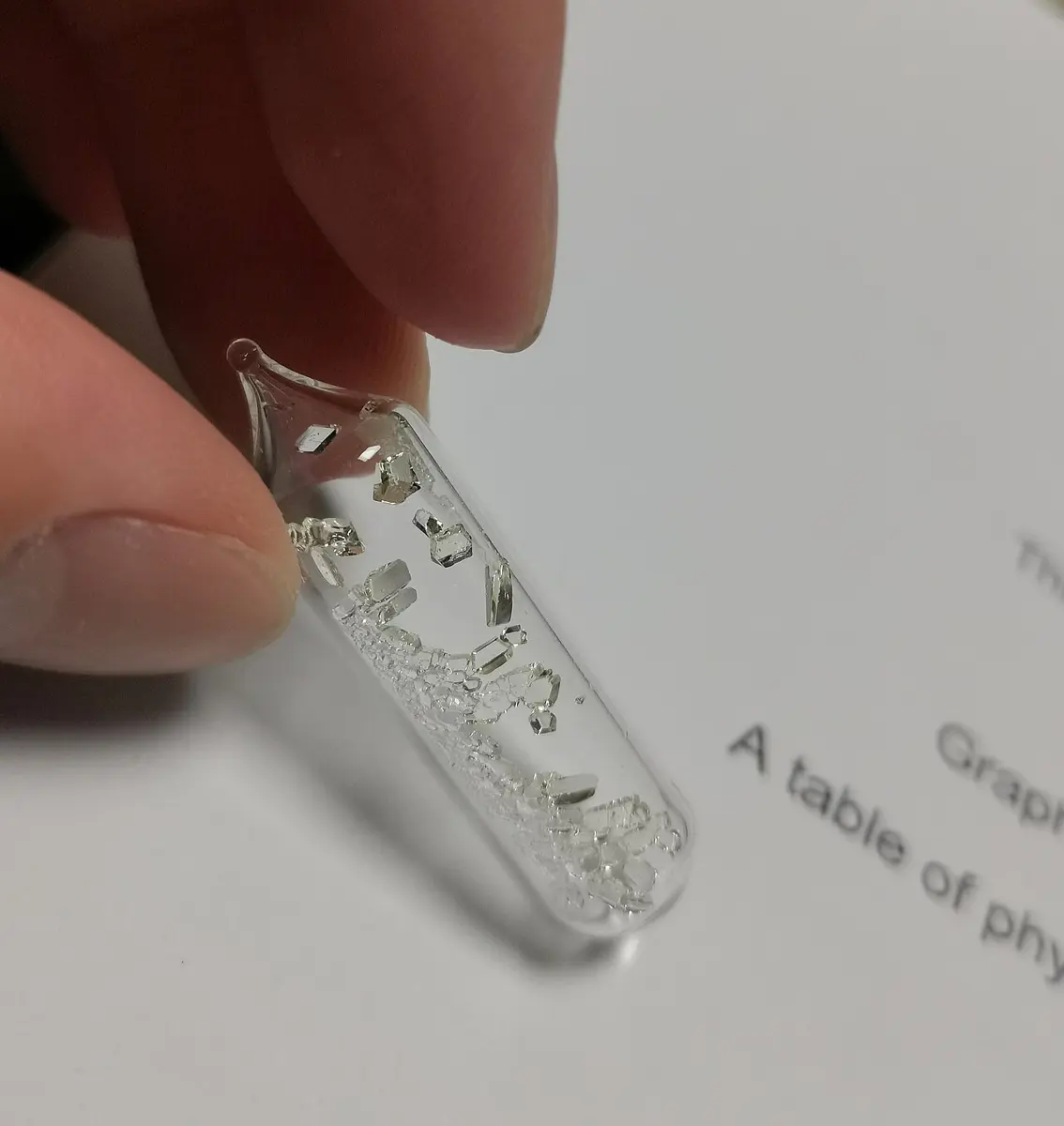
Most metals never give away more than three or four electrons. Osmium, the densest metal you can hold, can give away all eight of its outer electrons, to make osmium tetroxide, OsO₄, a solid that turns into a gas easily. Element 108, hassium, sits under osmium. In 2001, chemists asked whether it would do the same, and they answered the question with seven atoms.
The hassium atom
A hassium atom has 108 protons (atomic number 108) and 108 electrons. Its first known kind, hassium-265, has 265 − 108 = 157 neutrons. By shells the electrons are 2, 8, 18, 32, 32, 14, 2, and in subshells Grade 10: The Aufbau principle:
… 7s² 5f¹⁴ 6d⁶
It is a transition metal in period 7 and group 8, under iron, ruthenium and osmium Grade 10: Features of the modern periodic table. It has eight electrons outside the full subshells.
Osmium forms OsO₄, using all eight of its outer electrons. If hassium behaves like osmium, what should its oxide be?
Pick an answer to see why.
Made in Darmstadt, named after Hesse
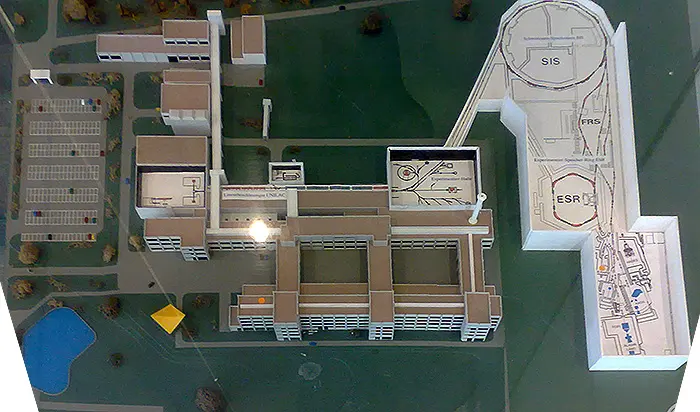
In 1984, Peter Armbruster and Gottfried Münzenberg’s team at the GSI laboratory in Darmstadt fired iron nuclei (26 protons) at lead (82): 82 + 26 = 108. They found three atoms of hassium-265. The same year, a team at Dubna, near Moscow, also very probably made the element, but the international working group found Darmstadt’s evidence enough on its own, and gave the discovery to GSI.
The team chose hassium, symbol Hs, from Hassia, the Latin name of Hesse (Hessen in German), the state where Darmstadt is. In 1994, IUPAC suggested giving element 108 the name hahnium, after Otto Hahn, instead (Dubnium shows that list), but in 1997 it accepted the discoverers’ name.
Seven atoms of HsO₄
At GSI in 2001, an international team fired magnesium nuclei (12) at curium (96): 96 + 12 = 108. The new hassium atoms were swept by helium and oxygen into an oven at 600 °C, where each formed HsO₄, and carried on into a long, narrow channel lined with detectors. One end of the channel was at about −20 °C, the other at −170 °C. Each molecule drifts along until the channel is cold enough to hold it, and the detector there records its decay. A molecule that turns into a gas very easily gets further before it sticks.
Osmium atoms were made at the same time, so OsO₄ ran through the same channel, for comparison.
What has been measured:
- Hassium forms a tetroxide, HsO₄, a gas like OsO₄. It uses all eight outer electrons: it is a true member of group 8.
- HsO₄ sticks to a cold surface a little more easily than OsO₄, so it is slightly less volatile.
- In 2004, HsO₄ reacted with sodium hydroxide, as OsO₄ does, to form a salt, sodium hassate.
- Its longest-lasting known kinds have half-lives of about ten seconds. Hassium-270, with 108 protons and 162 neutrons, was predicted to be held together unusually well for its size, and the few atoms seen so far seem to agree.
What is only predicted: that hassium is a solid metal, and one of the densest of all, about 27–29 g/cm³ by recent calculations, against osmium’s 22.6. No one will ever weigh enough of it to check.
Is there any hassium in nature?
Every kind of hassium made so far decays within seconds, so any hassium present when the Earth formed is long gone. But what if some kind, never made in a laboratory, lasts for millions of years? In 1963 a Soviet scientist claimed to have found element 108 in a natural mineral, molybdenite, but other physicists showed that his measurements could not be right. If natural hassium existed, chemistry says where it would hide: with osmium, its lighter cousin, in osmium ores. Searches in natural osmium have found none.
In your science books
- Grade 9: radioactive elements and variable valency.
- Grade 10: features of the modern periodic table, the Aufbau principle and valency.
- Going further: alpha decay.
More to explore
- Its neighbors: bohrium, the element before it, meitnerium, the element after it, and osmium, ruthenium and iron, above it in group 8.
- Play: find hassium in Guess the Element and the Periodic Table Jigsaw.
- Read more: hassium at the Royal Society of Chemistry and at PubChem.