
- Atomic number
- 61
- Atomic mass
- 144.91
- Shells
- 2, 8, 18, 23, 8, 2
- Configuration
- 1s² 2s² 2p⁶ 3s² 3p⁶ 4s² 3d¹⁰ 4p⁶ 5s² 4d¹⁰ 5p⁶ 6s² 4f⁵
- In the table
- period 6, group none (f-block), f-block
- Kind
- Lanthanide
- Valency
- 3 (Pm³⁺)
- State at 25 °C
- solid
- Melts · boils
- 1,042 °C · 3,000 °C
- Density
- 7.3 × as heavy as water
- Known since
- 1945
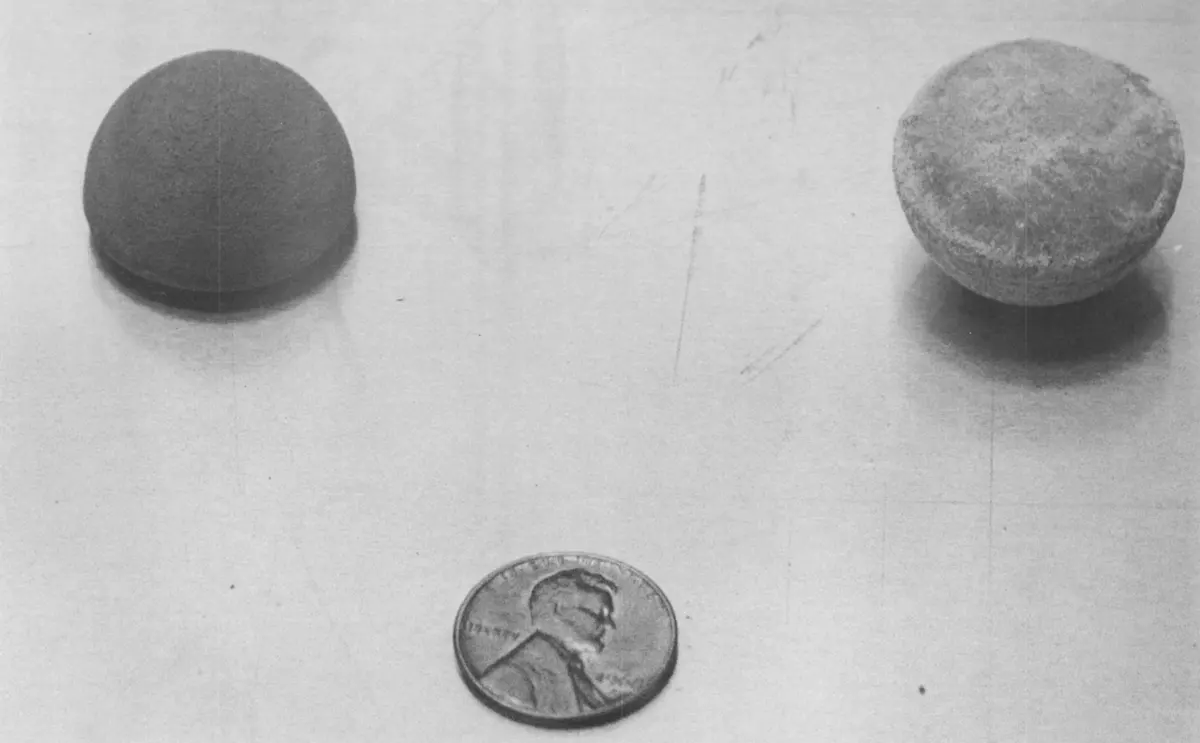
Every element from hydrogen to lead has at least one kind of atom that lasts for ever, except two. One is technetium, element 43. The other is promethium (say proh-MEE-thee-um), element 61, right in the middle of the lanthanides. Every promethium atom is radioactive, and the longest-lived kind loses half its atoms in under 18 years. So the Earth, 4.5 billion years old, has almost none: at any moment, perhaps half a kilogram in the whole of its crust.
This is the story of the empty box between neodymium and samarium, and of the element that was finally found inside a nuclear reactor.
The promethium atom
A promethium atom has 61 protons and 61 electrons. There is no “usual” promethium, since none is found in nature; the kind that is made and used most is promethium-147, with 86 neutrons: 61 + 86 = 147.
By shells its electrons are 2, 8, 18, 23, 8, 2, and in subshells it ends 6s² 4f⁵, five electrons in 4f Grade 10: The Aufbau principle. Like its neighbors it loses three electrons to form Pm³⁺ Grade 9: Cations: its valency is 3, its oxide Pm₂O₃ and its chloride PmCl₃. Its chemistry is just like that of the other lanthanides (fifteen near-twins); its salts are pink, like neodymium’s.
Why promethium has no stable atom
Whether a nucleus lasts depends on its mix of protons and neutrons Grade 9: Nuclear stability. An unstable nucleus can change one particle into the other: in beta decay a neutron becomes a proton, and in electron capture a proton becomes a neutron (Beta decay). Either way, the mass number stays the same, and the atom becomes the element next door.
So the real question for any promethium atom is: is there a neighbor with the same mass number that is more stable? In 1934 the physicist Josef Mattauch noticed a rule: two atoms with the same mass number, whose proton numbers differ by one, cannot both be stable. Nuclei with an even number of protons are also more stable than those with an odd number, and promethium has 61, an odd number.
Now look at promethium’s neighbors. Neodymium (60 protons) and samarium (62) both have an even number of protons, and between them they have long-lasting atoms at every mass number from 142 to 150. Whatever number of neutrons a promethium nucleus has, one of them is more stable, and the promethium atom sooner or later turns into it.
The half kilogram in the crust is new: it is made all the time when a few uranium atoms in uranium ores split on their own, and a tiny bit more when europium atoms decay.
Why is there almost no promethium in the Earth’s rocks?
Pick an answer to see why.
The gap in the table, and how it was found
- 1902. The Czech chemist Bohuslav Brauner noticed that neodymium and samarium were more different from each other than any other two lanthanides next to each other. He guessed that an unknown element lay between them.
- 1914. Henry Moseley measured the atomic numbers of the elements with X-rays and showed that number 61 was missing.
- 1920s and 1930s. Several teams claimed to have found it in rare-earth minerals, and gave it names. None could prove it: there was nothing to find.
- 1945. At Clinton Laboratories in Oak Ridge, USA (today’s Oak Ridge National Laboratory), Jacob Marinsky, Lawrence Glendenin and Charles Coryell studied the atoms left when uranium splits in a nuclear reactor Grade 9: Nuclear fission. Using a new method, ion-exchange chromatography, which sorts the rare earths one by one as their solution runs through a column of resin, they caught element 61 between neodymium and samarium. Busy with war work, they announced it in 1947.
Coryell’s wife, Grace Mary Coryell, suggested the name, after Prometheus, who in Greek stories stole fire from the gods and gave it to people: a fitting name for an element taken from the fire of a nuclear reactor. The symbol is Pm.
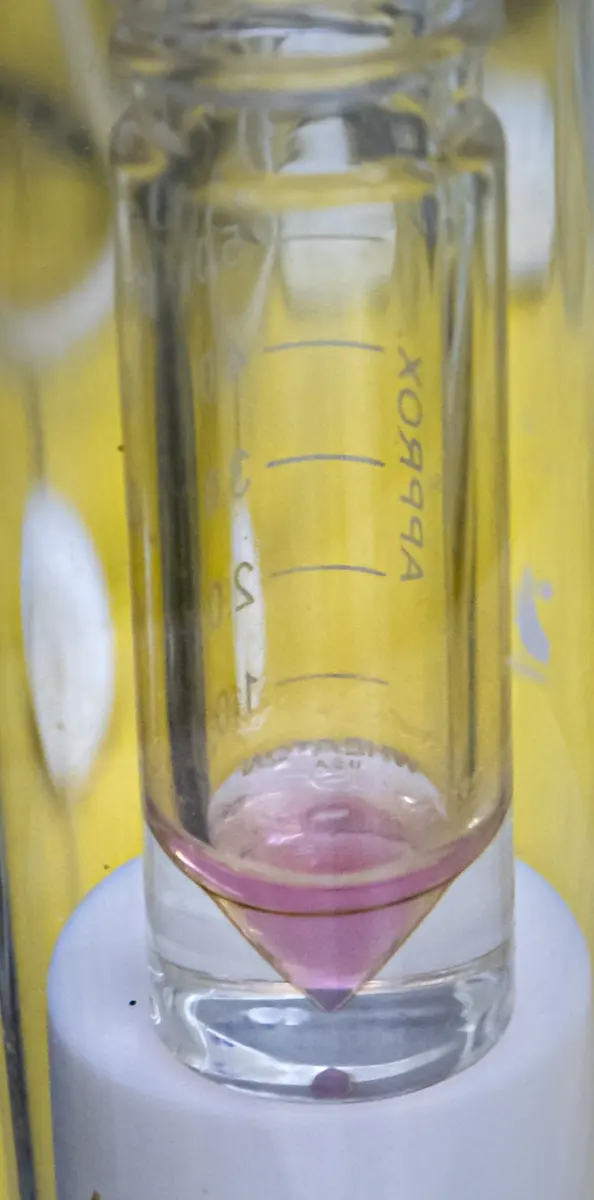
The first promethium metal was made in 1963.
Promethium at work
Promethium is made in nuclear reactors, from the atoms left when uranium splits, or by hitting neodymium-146 with neutrons: it becomes neodymium-147, which decays to promethium-147 in days. Only small amounts are made. Promethium-147 is the useful kind: its half-life of 2.6 years is long enough to use, and it gives out only weak beta rays, which a thin layer stops.
- Glowing paint. Mixed with a powder that gives out light when beta rays hit it (a phosphor), it glows in the dark without any sunlight or battery. It replaced dangerous radium in the glowing paint of some watch dials, signs and switches (radium’s glowing paint), until tritium and paints that glow after soaking up light took over. Its glow halves every 2.6 years.
- Atomic batteries. Its beta rays can be turned into a small electric current that lasts for years. Such batteries once powered some heart pacemakers.
- Thickness gauges. In factories, the beta rays that get through a sheet of paper, plastic or metal show how thick it is.
Promethium and your health
Promethium has no job in the body. Its danger is its radiation: sealed inside a watch or battery, its weak beta rays stay inside, but promethium that is swallowed or breathed in would keep giving off radiation inside the body. It is only ever handled in laboratories that are equipped for radioactive materials.
In your science books
- Grade 9: nuclear stability, radioactive elements, nuclear fission and cations.
- Grade 10: the Aufbau principle and the lanthanides.
- Going further: beta decay, half-lives and why each element has its own lines.
More to explore
- The other element with no stable atom below lead: technetium.
- Its neighbors: neodymium before it and samarium after it, which its atoms decay into, and lanthanum, with the story of the whole row.
- Play: find promethium in Guess the Element, the Periodic Table Jigsaw and Higher or Lower.
- Read more: promethium at the Royal Society of Chemistry and at PubChem.