
- Atomic number
- 31
- Atomic mass
- 69.72
- Shells
- 2, 8, 18, 3
- Configuration
- 1s² 2s² 2p⁶ 3s² 3p⁶ 4s² 3d¹⁰ 4p¹
- In the table
- period 4, group 13 (IIIA), p-block
- Kind
- Other metal
- Valency
- 3 (Ga³⁺, as in Ga₂O₃ and GaCl₃)
- State at 25 °C
- solid
- Melts · boils
- 30 °C · 2,204 °C
- Density
- 5.9 × as heavy as water
- Known since
- 1875
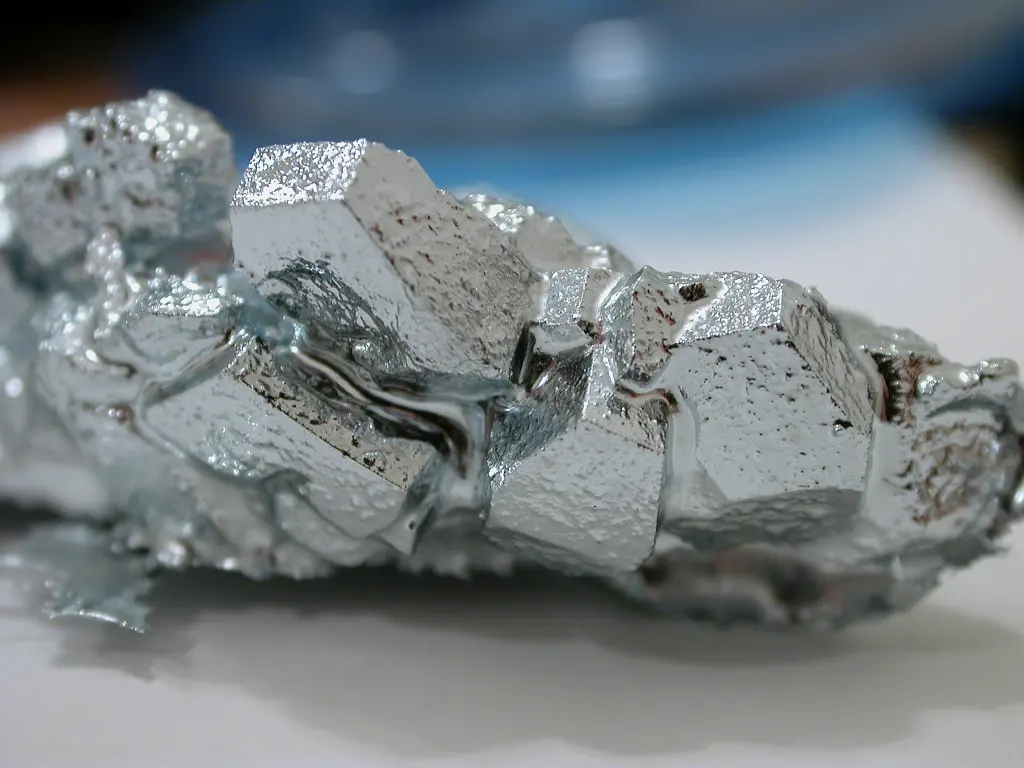
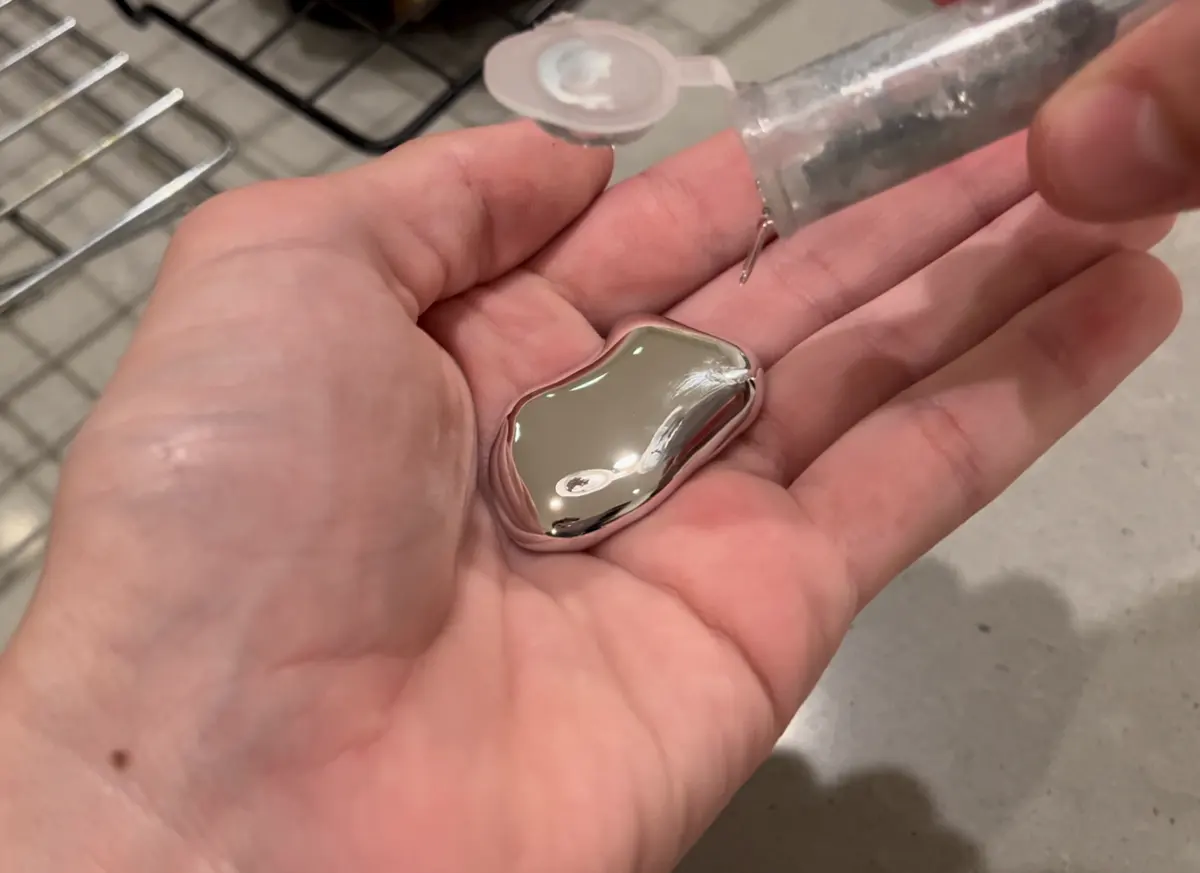
Hold a piece of most metals in your hand and nothing happens. Hold a piece of gallium and, within a few minutes, it starts to turn into a shiny silver puddle in your palm, like mercury. Gallium melts at just under 30 °C, a warm day in the Terai.
That is its famous trick, but not its important one. The white light of an LED bulb, the screen of your phone, the little red lamp on a television remote, and the chip that lets your phone talk to the nearest mobile tower all depend on compounds of gallium. And gallium is the element that made the world believe in the periodic table.
The gallium atom
Every gallium atom has 31 protons, so gallium’s atomic number is 31, and a neutral atom has 31 electrons. Six atoms in ten have 38 neutrons, mass number 31 + 38 = 69; the rest have 40 neutrons (mass number 71).
Its shells and subshells
By the 2n² rule Grade 8: Bohr and Bury’s rule, the shells fill as 2, 8, 18, leaving 3 electrons for the N shell: 2, 8, 18, 3.
In Grade 10 subshells Grade 10: The Aufbau principle, gallium comes just after zinc, which has filled 4s and 3d. Its 31st electron goes into the next subshell, 4p:
1s² 2s² 2p⁶ 3s² 3p⁶ 4s² 3d¹⁰ 4p¹
The outermost shell, N, has 4s² 4p¹: 3 valence electrons.
How many valence electrons does a gallium atom have?
Pick an answer to see why.
Its place in the periodic table
- Period 4, because its electrons are in four shells.
- Group 13, called IIIA in the older naming, with boron, aluminium, indium and thallium.
- p-block, because its last electron goes into a p subshell. It comes just after the transition metals, so it is sometimes called a post-transition metal.
Gallium sits right below aluminium, and the two are much alike: both have 3 valence electrons, both give them up to form ions with a charge of +3, Ga³⁺ and Al³⁺, and both have a valency of 3 Grade 9: Valency. Gallium oxide is Ga₂O₃, just as aluminium oxide is Al₂O₃.
How gallium was predicted, found and named
In 1871 the Russian chemist Dmitri Mendeleev left a gap in his periodic table below aluminium, and described the element he was sure belonged there. He called it eka-aluminium, “one place below aluminium” Grade 10: The gaps that came true.
Four years later, in 1875, the French chemist Paul-Émile Lecoq de Boisbaudran was studying zinc ore from the Pyrenees mountains with a spectroscope, an instrument that spreads out the light from a hot substance into its colors. Every element gives its own pattern of bright lines. He saw two violet lines that no known element made. Later that year he made a little of the new metal by electrolysis.
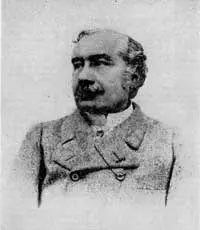
Lecoq had not known about Mendeleev’s prediction. When he measured his metal’s density, he got 4.7 g/cm³. Mendeleev, who had never seen it, wrote to him: it should be about 5.9, and the sample must be impure. Lecoq purified it, measured again, and found 5.9.
| Mendeleev’s eka-aluminium (1871) | Gallium, measured | |
|---|---|---|
| atomic mass | about 68 | 69.7 |
| density | about 5.9 g/cm³ | 5.9 g/cm³ |
| melting point | low | 29.8 °C |
| oxide | Ea₂O₃ | Ga₂O₃ |
| how it would be found | with the spectroscope | with the spectroscope |
A man who had never seen an element had corrected the man who had discovered it. After that, chemists took the periodic table seriously.
The name. Lecoq named it after Gallia, the Latin name for France, and the symbol is Ga. People soon joked that he had named it after himself too: le coq is French for “the rooster”, and the Latin for rooster is gallus. In 1877 he wrote that this was not true.
Where gallium is found
In the universe. Gallium was made in stars, much of it by atoms slowly catching neutrons inside giant stars (Slowly, in giant stars).
In the Earth’s crust. Gallium is not especially rare: about 17 grams in every tonne of rock, about as common as lead. But unlike lead, it never gathers into ores of its own. It is spread thinly through other minerals, mainly bauxite, the ore of aluminium Grade 10: Ores of aluminium, which has about 50 grams per tonne, and zinc ores.
So gallium is a by-product. When bauxite is dissolved in hot sodium hydroxide to make pure aluminium oxide, a little gallium dissolves too, and collects in the liquid; it is taken out and turned into metal by electrolysis (Aluminium).
In 2025 the world made about 900 tonnes of gallium, 99% of it in China (USGS, 2026). That is so much of it in one country that when China began to limit its sales abroad in 2023, governments around the world started looking for other ways to get it.
In Nepal and in your body. None is produced in Nepal, and gallium has no known use in any living thing.
What gallium is like
- A soft, silvery metal. It can be cut with a knife, and very pure gallium breaks like glass, with curved, shell-like faces.
- Melts at 29.8 °C, just above room temperature, but below the temperature of your hand. So a lump melts in your palm.
- Boils above 2,200 °C. So it stays liquid over a range of more than 2,000 degrees, one of the widest of any element.
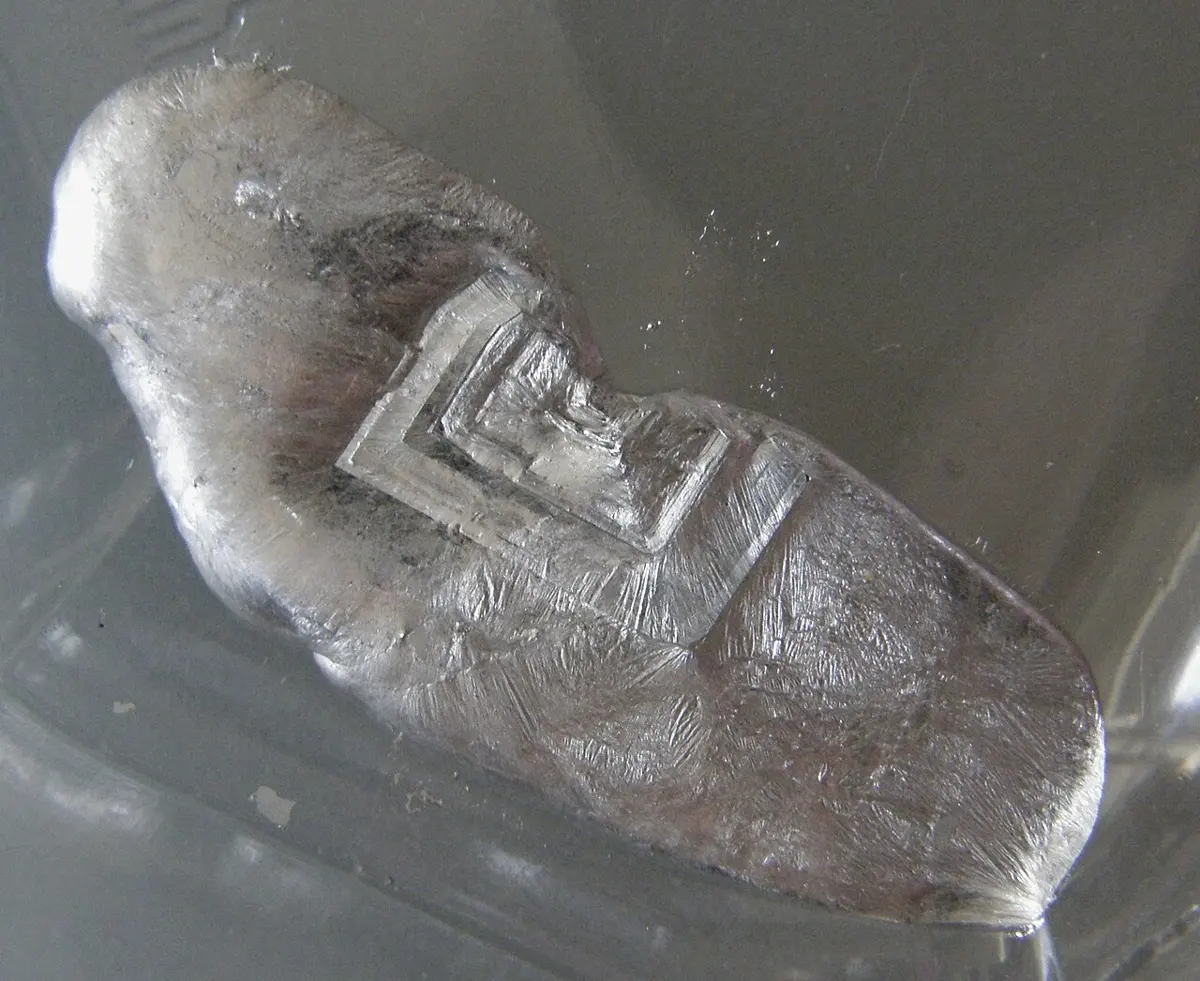
- Expands when it freezes, by about 3%, like water Grade 10: Anomalous expansion of water. Solid gallium floats on liquid gallium, as ice floats on water.
- Wets glass and skin. Unlike mercury, which rolls about in beads, liquid gallium spreads and sticks, leaving a gray smear. Painted on glass, it makes a bright mirror.
Why does gallium melt so easily, when its neighbors zinc and germanium melt at 420 °C and 938 °C? In solid gallium, the atoms are joined in pairs, and the pairs are packed together only loosely. Little heat is needed to break up that loose packing.
Gallium can also supercool: melted gallium can stay liquid well below 29.8 °C, until something, such as a tiny solid crystal of gallium dropped in, starts it freezing.
A teaspoon made of gallium is stirred in a cup of hot tea. What happens?
Pick an answer to see why.
How gallium reacts
Gallium behaves much like aluminium, the element above it.
- Air and water. At room temperature a thin layer of oxide protects it, so it does not tarnish or react with water. Heated strongly in air, it forms gallium oxide Grade 9: Metals react with oxygen:
4Ga + 3O₂ → 2Ga₂O₃
- Acids. It dissolves in acids, giving a salt and hydrogen Grade 9: Metals and dilute acids:
2Ga + 6HCl → 2GaCl₃ + 3H₂
- Alkalis. Like aluminium, it also dissolves in strong alkalis such as sodium hydroxide, giving hydrogen. A metal whose oxide reacts with both acids and alkalis is called amphoteric.
Gallium eats aluminium
Liquid gallium does something startling to aluminium. A drop on an aluminium sheet or can soaks in between the tiny crystals the metal is made of, and loosens them. Within hours the aluminium becomes weak and crumbly, and can be broken with your fingers. Aluminium is normally protected by its oxide layer; gallium gets underneath it.
Why do airlines treat gallium as dangerous goods, which must be specially packed?
Pick an answer to see why.
Gallium in your phone and your lights
Almost all gallium is used as two compounds, gallium arsenide (GaAs) and gallium nitride (GaN). Both are semiconductors Grade 10: Metalloids: they conduct electricity better than an insulator but much worse than a metal, and how well they conduct can be controlled.
LEDs: light from a semiconductor
In an LED (light-emitting diode), electricity pushes electrons across a tiny crystal of semiconductor. Each electron drops down an energy “step” as it goes, and gives out the energy it loses as a little packet of light, a photon (Photons at work). The size of the step decides the color: a small step gives infrared or red light, a bigger step green, and a big step blue or violet. Mix gallium with other elements and you can choose the step.
The first LED to give visible light, a dim red one, was made in 1962 from a compound of gallium, arsenic and phosphorus. Red, orange, yellow and green followed, but a bright blue LED took thirty more years: it needed gallium nitride, which nobody could grow as good crystals. Three Japanese scientists solved that, and won the Nobel Prize in Physics in 2014.
Blue made white possible. A white LED bulb is a blue gallium nitride LED coated with a yellow-glowing powder; blue and yellow together look white. LED bulbs give the same light as old filament bulbs for about a sixth of the electricity (Which energy should Nepal use?).
Phones, chargers and spacecraft
- Phones. Gallium arsenide chips amplify the radio signal your phone sends to the mobile tower. Electrons move faster through gallium arsenide than through silicon, which suits the very fast radio waves.
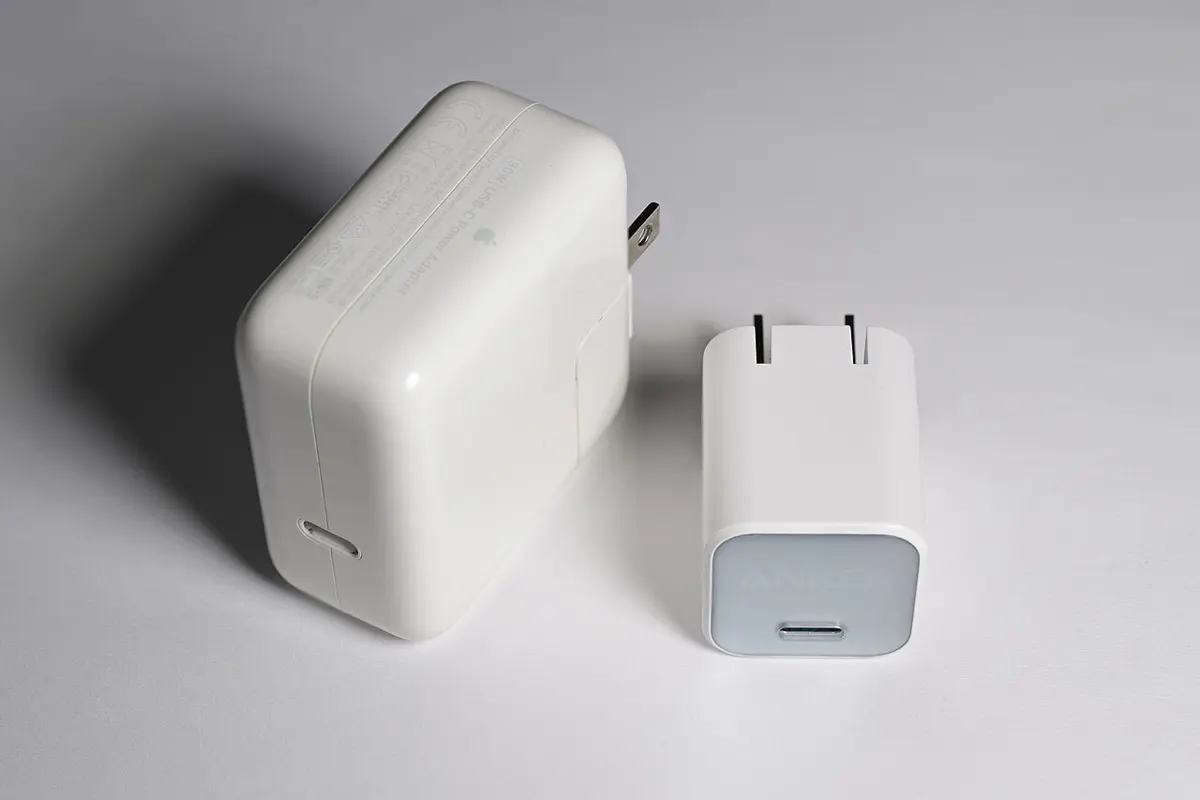
- Chargers. Small, fast phone chargers labeled “GaN” use gallium nitride switches, which waste less energy as heat than silicon ones, so the charger can be smaller.
- Solar cells in space. The best solar cells, on satellites and on rovers sent to Mars, are made of layers of gallium compounds. They turn more of the sunlight into electricity than ordinary silicon cells Grade 9: Solar electricity, though they cost far more.
Thermometers without mercury
Galinstan, an alloy of gallium, indium and stannum (Latin for tin), is liquid at room temperature and far less poisonous than mercury. It is used in some clinical thermometers instead of mercury.
Isotopes of gallium
Natural gallium is a mixture of two stable isotopes: about 60% gallium-69 (38 neutrons) and 40% gallium-71 (40 neutrons).
Two radioactive isotopes are made for hospitals. To the body, the Ga³⁺ ion looks a lot like iron, so it gathers where the body is busy with iron: in tumors and in places fighting an infection. Gallium-67 (half-life about 3¼ days) is injected for a gallium scan, and a camera that detects its gamma rays shows where it has gathered Grade 9: Gamma rays. Gallium-68 (half-life 68 minutes) is used in PET scans, to find some kinds of cancer.
Gallium and your health
Gallium is not needed by the body, and the metal is of low toxicity: far less dangerous than mercury, which is why it replaces mercury in some thermometers. Still, it is a chemical, not a toy.
Surprising facts and records
- A fixed point of temperature. Pure gallium always melts at exactly 29.7646 °C, so scientists use melting gallium to check their most accurate thermometers. It is one of the fixed points of the world’s temperature scale.
- Hot enough for a furnace, still liquid. Because it stays liquid from about 30 °C to over 2,200 °C, gallium has been used in glass thermometers for measuring high temperatures, far hotter than a mercury thermometer could go.
In your science books
- Grade 8: the 2n² rule and metals in the periodic table (gallium, the metal that nearly melts in your room).
- Grade 9: valency, melting points of metals, atomic mass and solar electricity.
- Grade 10: Mendeleev’s gaps (eka-aluminium), electronic configuration, semiconductors and ores of aluminium.
- Going further: photons and where the atoms in your body came from.
More to explore
- Nobel Prizes with gallium in them: blue LEDs (2014, gallium nitride), the chip and the tiny laser (2000, lasers of gallium arsenide) and the fractional quantum Hall effect (1998, seen in layers of gallium arsenide).
- Elements next door: aluminium above it, and germanium, the next element, also predicted by Mendeleev.
- Play: find gallium in Guess the Element and the Periodic Table Jigsaw.
- Read more: gallium at the Royal Society of Chemistry and at PubChem.