
- Atomic number
- 41
- Atomic mass
- 92.91
- Shells
- 2, 8, 18, 12, 1
- Configuration
- 1s² 2s² 2p⁶ 3s² 3p⁶ 4s² 3d¹⁰ 4p⁶ 5s¹ 4d⁴
- In the table
- period 5, group 5 (VB), d-block
- Kind
- Transition metal
- Valency
- 5 (as in Nb₂O₅), also 3
- State at 25 °C
- solid
- Melts · boils
- 2,477 °C · 4,744 °C
- Density
- 8.6 × as heavy as water
- Known since
- 1801
Lie down in an MRI scanner in a big hospital, and you lie inside one of the strongest magnets most people will ever meet. Its coil carries a huge current with no loss at all, because the wire is made of a metal that, when cold enough, has no resistance whatsoever. The same metal hides, a few hundredths of a percent, in the steel of gas pipelines, bridges and cars, and it makes earrings in blue, purple and gold without a drop of paint.
That metal is niobium. It is not famous, but you have almost certainly been near it. Here is its story.
The niobium atom
A niobium atom has 41 protons, so niobium’s atomic number is 41, and 41 electrons. Every niobium atom in nature is the same kind, niobium-93, with 52 neutrons: mass number 41 + 52 = 93.
By the 2n² rule Grade 8: Bohr and Bury’s rule, its shells are 2, 8, 18, 12, 1. The N shell could hold 32 electrons but has only 12, because after 4p the next electrons go first into 5s, part of the O shell, and only then into 4d Grade 10: The Aufbau principle.
Its electronic configuration
From the filling order you would expect niobium to end 5s² 4d³, like vanadium above it (4s² 3d³). But measurements of its light show that the real atom is:
1s² 2s² 2p⁶ 3s² 3p⁶ 4s² 3d¹⁰ 4p⁶ 5s¹ 4d⁴
Why? In chromium and copper, an electron moves to make a d subshell half full or completely full, which is especially stable. Niobium’s 4d⁴ is neither. The reason is simpler and less tidy: in period 5, the 5s and 4d subshells are very close in energy, so the electrons settle in whichever way gives the lowest total energy, and for niobium that is 5s¹ 4d⁴. Period 5 has more such exceptions than any other period before it (niobium, molybdenum, ruthenium, rhodium, palladium and silver).
How many electrons are in the outermost shell of a niobium atom?
Pick an answer to see why.
Its place in the periodic table
- Period 5, because its electrons are in five shells.
- Group 5, called VB in the older naming many books use. Above it is vanadium, below it tantalum.
- d-block, because its last electrons go into a d subshell: a transition metal Grade 10: Metals.
Its valency
Niobium can use all five of its outer electrons (5s¹ and 4d⁴), so its usual valency is 5, as in niobium oxide, Nb₂O₅, a white powder. It also has a valency of 3 in some compounds Grade 9: Variable valency.
Niobium has a valency of 5 and oxygen 2. What is the formula of niobium oxide?
Pick an answer to see why.
How niobium was found and named
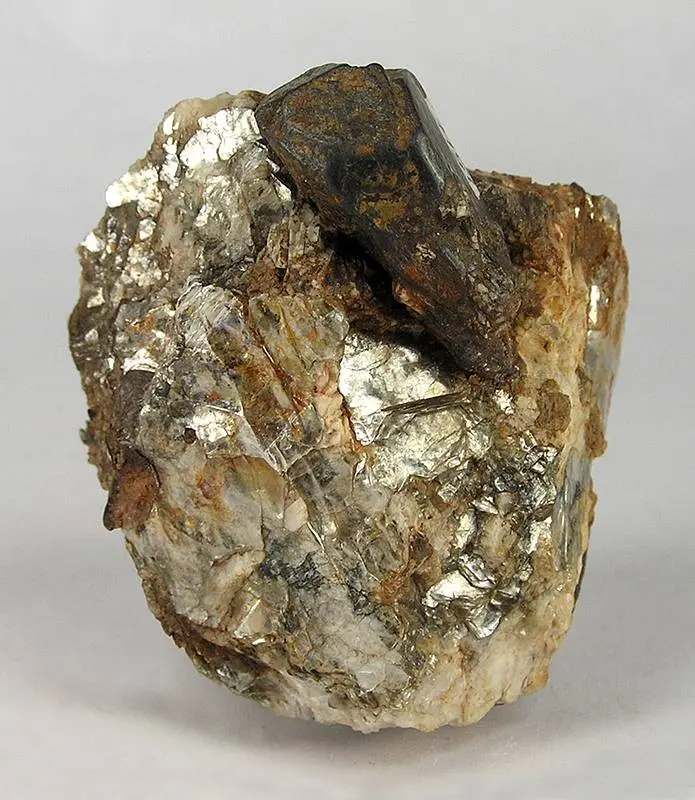
The story starts in North America. In the 1730s, a heavy black mineral from Connecticut, then a British colony, was sent to London, where it ended up in the collection of the British Museum. It lay there for about seventy years.
- 1801. The English chemist Charles Hatchett analyzed the black mineral and found the oxide of a new metal in it. He could not get the metal out, but he named it columbium, after Columbia, a poetic name for America; the mineral is still called columbite.
- 1802. In Sweden, Anders Ekeberg found another new metal, tantalum, in a similar mineral.
- 1809. The English chemist William Hyde Wollaston compared the two oxides and decided that columbium and tantalum were the same element. Most chemists believed him for decades.
- 1840s. The German chemist Heinrich Rose showed that columbite and tantalite hold two different metals after all. He named the second one niobium, after Niobe, the daughter of Tantalus in Greek legend: a fitting name for a metal that is like a child of tantalum.
- 1860s. The Swedish chemist Christian Wilhelm Blomstrand made the first niobium metal, by heating niobium chloride in hydrogen.
Why the confusion? Niobium and tantalum sit one above the other in group 5, and their atoms are almost exactly the same size, so they behave almost the same in chemical reactions. They are always found together, and are still hard to separate.
Two names for one metal. For over a hundred years, Europe said niobium and America said columbium (symbol Cb). Around 1950 chemists agreed on niobium, symbol Nb, and on tungsten rather than the European wolfram for element 74: a compromise. Some American metal companies still say columbium, and the US Geological Survey still heads its yearly report “Niobium (Columbium)”. Nepali books use the English name, नियोबियम.
Where niobium is found
In the universe. Niobium is heavier than iron, so it was not made by fusion in the middle of a star. Its atoms were built when nuclei caught neutrons, one at a time, in old giant stars, or all at once when dead stars collided (Heavier than iron).
In the Earth’s crust. Niobium is a fairly rare metal: roughly 10 to 20 grams in every tonne of rock (estimates differ). It is never found as the metal. Its main ore today is not columbite but pyrochlore, a mineral of niobium, calcium and sodium, which is found in unusual rocks called carbonatites, made mostly of carbonate minerals that came up as magma from deep in the Earth.
In 2025 the world mined about 112,000 tonnes of niobium, and Brazil mined about 93% of it, mostly from one huge deposit at Araxá, in the state of Minas Gerais. Canada mined most of the rest (USGS, 2026). Few metals depend so much on one country.
In Nepal. No niobium is mined in Nepal, and it has no part in the body or in living things.
What niobium is like
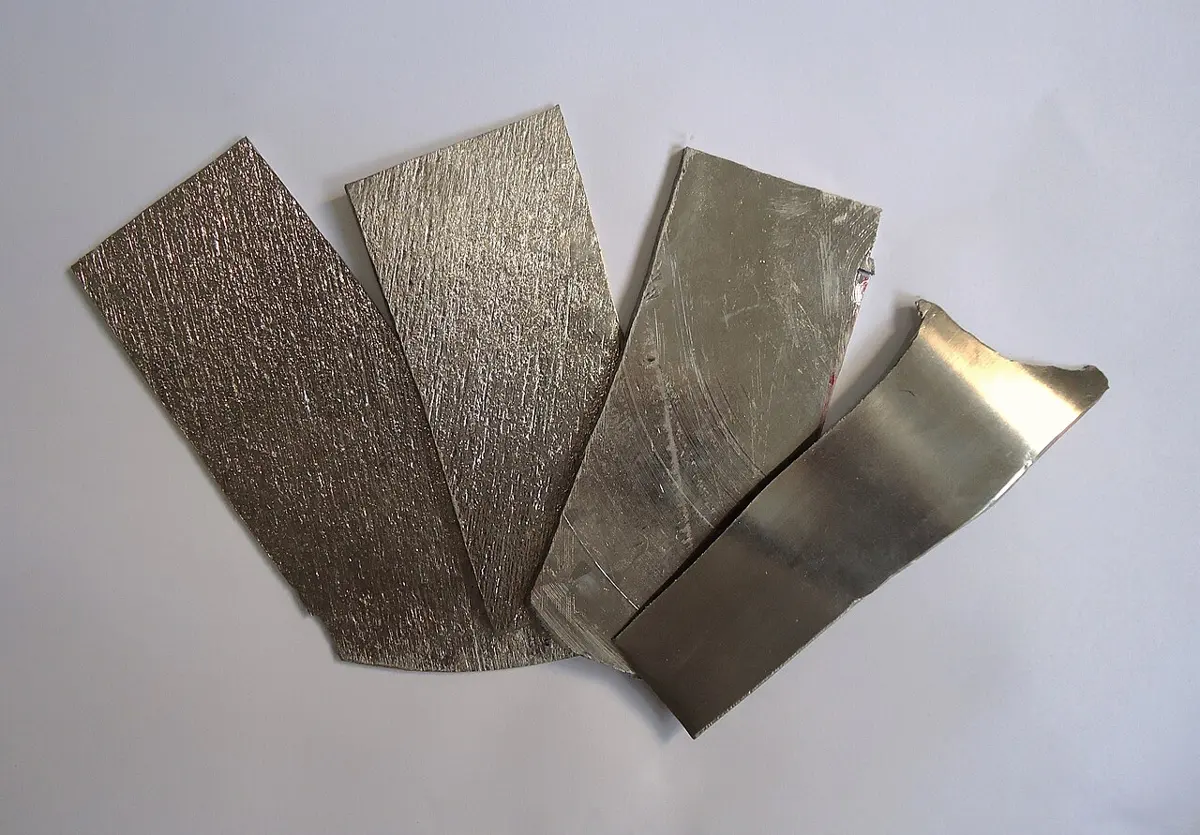
- A soft, gray, shiny metal that can be bent, rolled into thin sheets and drawn into wire (Malleable, ductile).
- Melts at 2,477 °C, one of the highest melting points of all metals Grade 9: High melting points.
- Density 8.57 g/cm³, a little heavier than iron (7.87).
- Does not corrode. In air, a very thin layer of niobium oxide forms on its surface at once and protects the metal underneath, as on aluminium and titanium. Left for a long time, the surface takes on a faint bluish tint.
- Kind to skin. Many people get an itchy rash from nickel in cheap jewelry. Niobium causes almost no such allergy, so it is used for earrings and in some medical implants.
- A superconductor when very cold: its most remarkable property, below.
Superconducting niobium
In an ordinary wire, the free electrons that carry the current bump into the vibrating metal atoms and lose energy as heat: that is resistance Grade 9: Factors affecting resistance. Cool a copper wire, and the atoms vibrate less and its resistance falls, but never to zero.
Some materials do something astonishing. Below a certain temperature, their resistance does not just fall: it vanishes completely. A current started in a closed loop of such a material keeps flowing for years with no battery. This is superconductivity, discovered in 1911 in frozen mercury (Superconductors and superfluids). The temperature below which it happens is the material’s critical temperature.
Of all the elements, niobium has the highest critical temperature at ordinary pressure: about 9.2 K, that is 9.2 degrees above absolute zero, or about −264 °C.
To keep anything so cold, it is bathed in liquid helium, which boils at about 4.2 K (−269 °C). Pure niobium loses its superconductivity in a strong magnetic field, but two of its alloys keep it: niobium–titanium and niobium–tin. Wire of these alloys makes nearly all the world’s superconducting magnets.
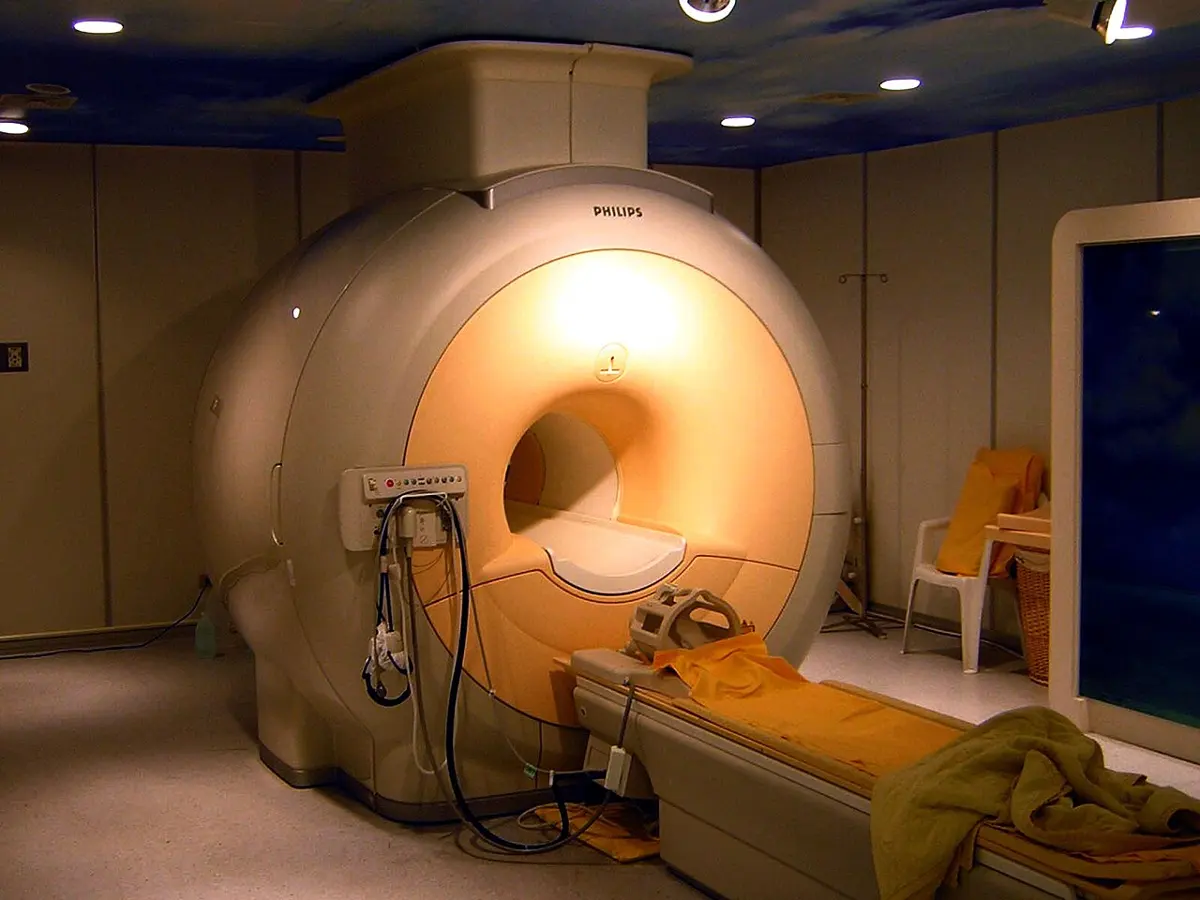
- MRI scanners. The big doughnut of a hospital’s MRI scanner holds a coil of niobium–titanium wire in liquid helium. The current flows round it without loss, making a steady magnetic field of 1.5 or 3 tesla, tens of thousands of times stronger than the Earth’s, and the machine uses it with radio waves to make pictures of the soft parts of the body (MRI). Most MRI scanners, in Nepal as everywhere, work this way. A magnet made with ordinary copper wire would need enormous power and would heat up.
- Particle accelerators. The Large Hadron Collider near Geneva steers its beams round a 27 km ring with 1,232 bending magnets of niobium–titanium. The ITER fusion experiment in France uses niobium–tin, which stays superconducting in even stronger fields.
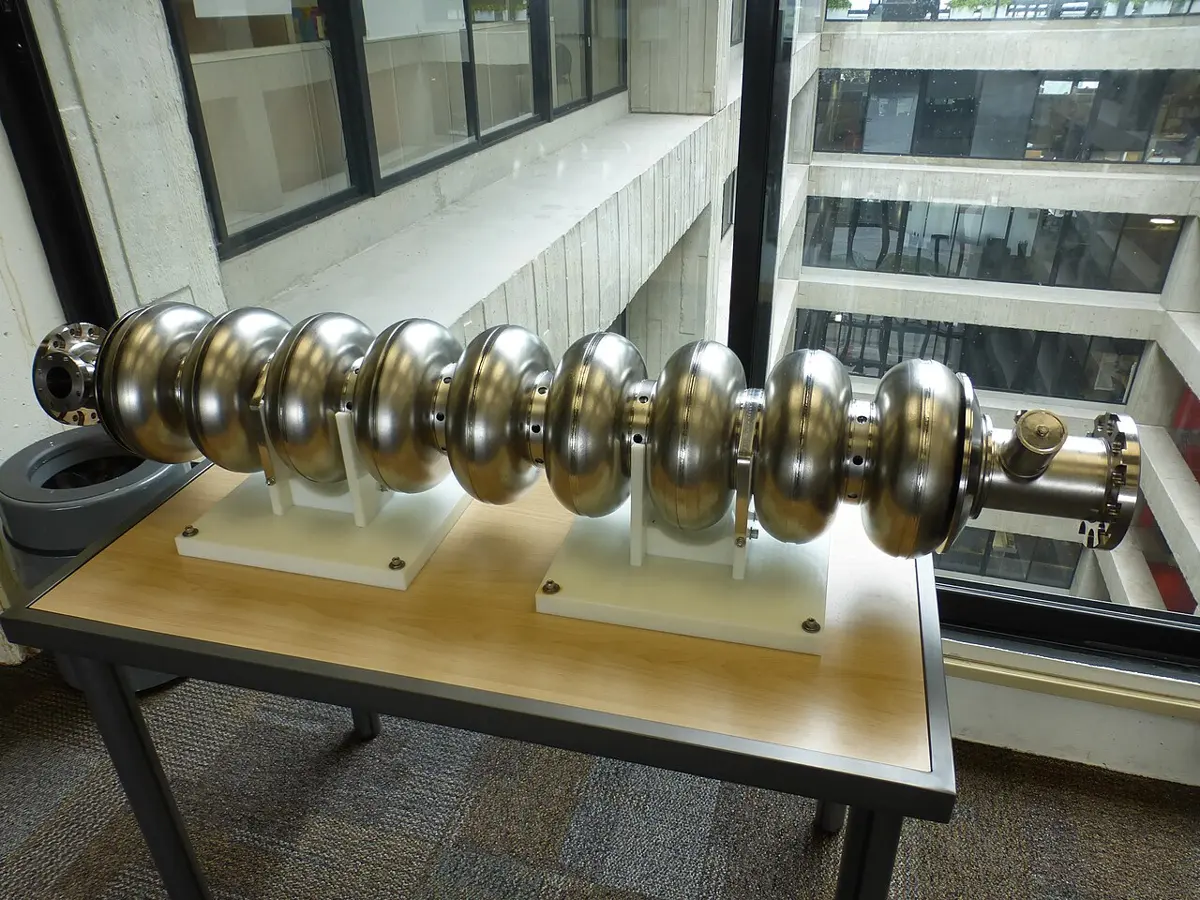
- Speeding up particles. Hollow cavities of pure niobium, cooled in liquid helium, hold powerful radio waves that push electrons to nearly the speed of light, in machines for studying materials and atoms.
Why must the niobium–titanium coil of an MRI scanner be kept in liquid helium?
Pick an answer to see why.
How niobium reacts
Niobium is protected by its oxide layer, so at room temperature it hardly reacts with air, water or most acids. Strongly heated, it reacts:
- With oxygen. Above about 200 °C in air, niobium starts to oxidize, and strongly heated it turns into white niobium oxide Grade 9: Metals react with oxygen:
4Nb + 5O₂ → 2Nb₂O₅
That is why niobium is welded and heated in vacuum or in argon, never in open air. - With chlorine, it gives niobium chloride, NbCl₅, which Blomstrand heated with hydrogen to make the first metal.
Unlike sodium’s oxide, niobium oxide is not basic: it does not dissolve in water to make an alkali. It is used in glass for spectacle lenses: it bends light more, so the lenses can be made thinner.
Colors without paint
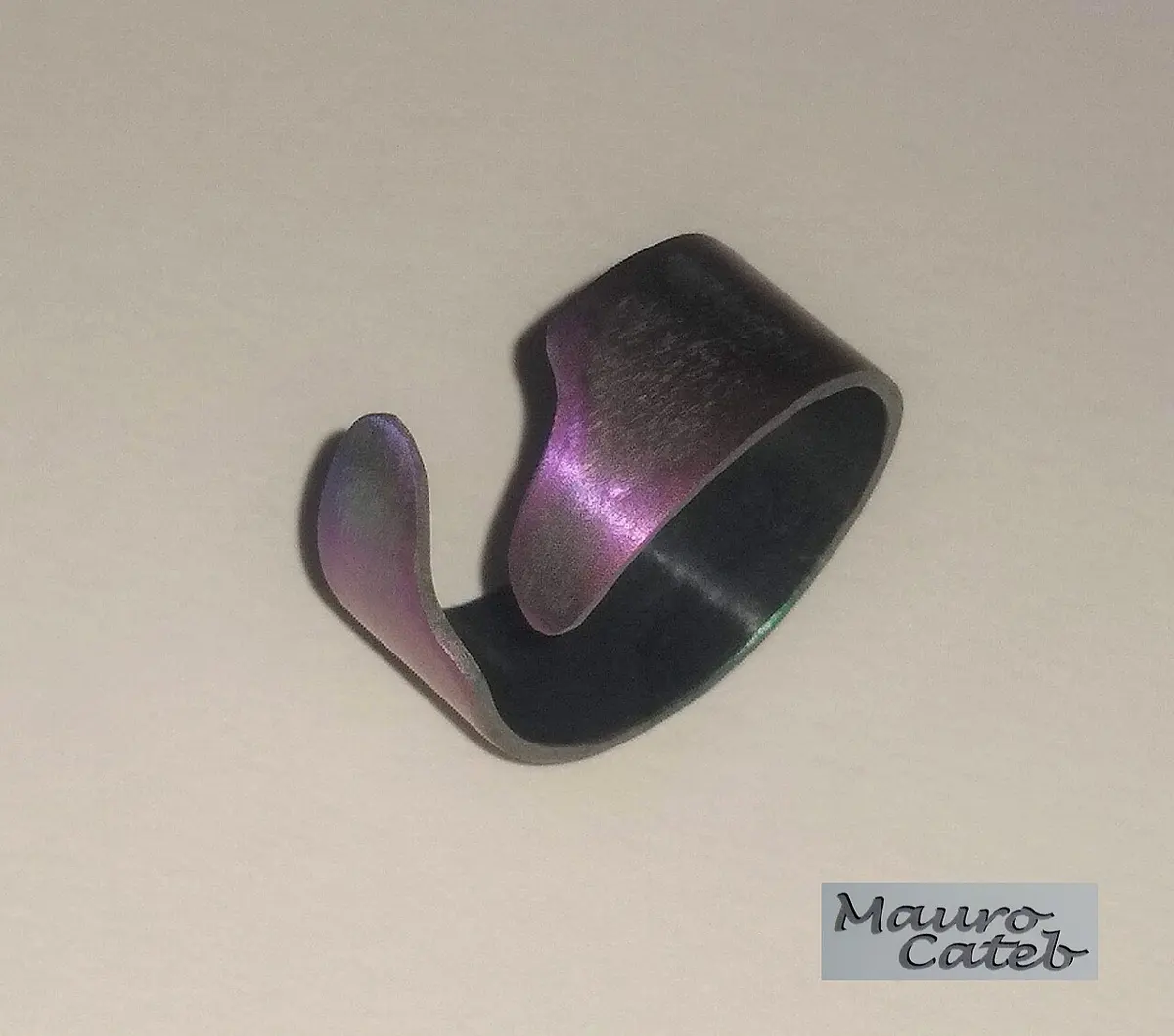
Hang a piece of niobium in a weak solution, connect it to a battery or power supply, and pass a current: its oxide layer grows thicker. This is anodizing. The layer is clear and thinner than the length of a light wave, yet the metal turns bronze, purple, blue, gold or green. The higher the voltage, the thicker the layer and the different the color.
There is no dye in it: the color comes from the same effect that makes the colors of a soap bubble or of a thin film of oil on a wet road. Two reflections of light, from the top and the bottom of a very thin clear layer, add up for some colors and cancel others. Because niobium does not cause allergies, and the colors never fade, jewelers make rings and earrings of it, and Austria has made coins with a colored niobium center since 2003.
Niobium in daily life
Stronger steel. Most niobium, three-quarters or more, goes into steel. It is added as ferroniobium, an alloy of about two-thirds niobium and one-third iron. Just a pinch, usually less than a tenth of one percent, makes steel much stronger and tougher: the niobium forms tiny grains of niobium carbide and nitride that keep the steel’s crystals small, and steel with smaller crystals is stronger Grade 8: Alloys. Such microalloyed steel is used for gas and oil pipelines, bridges, tall buildings, ships and the bodies of cars, which can then be made lighter for the same strength, and so burn less fuel.
Jet engines and rockets. Alloys of nickel with niobium, called superalloys, stay strong in the fierce heat inside jet engines and power-station gas turbines. An alloy that is mostly niobium, with a little hafnium and titanium, was used for the nozzle of the engine that landed the Apollo astronauts on the Moon, and is still used for rocket nozzles today.
Other uses. Superconducting magnets (above), thinner spectacle lenses, jewelry and medical implants, and the arc-welding rods for some stainless steels.
Niobium and your health
Niobium has no known job in the human body or in any living thing. As a solid metal it is harmless, which is why it can be worn against the skin and put inside the body. Fine niobium dust can irritate the eyes and skin, and like many metal powders it can catch fire, so it is handled with care in factories.
Surprising facts and records
- The warmest superconducting element. No other element superconducts at a higher temperature at ordinary pressure (9.2 K). Even so, that is colder than anywhere on Earth.
- One country, one mine. About nine in every ten tonnes of the world’s niobium come from Brazil, most of it from a single mine.
- One kind of atom. Every niobium atom in nature is niobium-93, so its atomic mass, 92.91, is almost a whole number.
- The photon box. In 2012, a Nobel Prize went to an experiment that kept single particles of light bouncing between two mirrors of superconducting niobium (Holding one atom, counting one photon).
In your science books
- Grade 8: the 2n² rule and alloys and their properties.
- Grade 9: variable valency, the criss-cross method, properties of metals and resistance.
- Grade 10: the Aufbau principle, transition metals and the electromagnet.
- Going further: where the heavy elements were made.
More to explore
- Nobel Prizes with niobium in them: superconductors and superfluids (2003, the niobium–titanium wire of every MRI magnet), MRI (2003), superconductors that work in liquid nitrogen (1987) and the photon box (2012, its mirrors were niobium).
- Its neighbors: zirconium before it, molybdenum after it, and vanadium above it.
- Play: find niobium in Guess the Element, the Periodic Table Jigsaw and Higher or Lower.
- Read more: niobium at the Royal Society of Chemistry and at PubChem.