
- Atomic number
- 45
- Atomic mass
- 102.91
- Shells
- 2, 8, 18, 16, 1
- Configuration
- 1s² 2s² 2p⁶ 3s² 3p⁶ 4s² 3d¹⁰ 4p⁶ 5s¹ 4d⁸
- In the table
- period 5, group 9 (VIIIB), d-block
- Kind
- Transition metal
- Valency
- 3 (as in RhCl₃), also 1
- State at 25 °C
- solid
- Melts · boils
- 1,964 °C · 3,695 °C
- Density
- 12.4 × as heavy as water
- Known since
- 1803
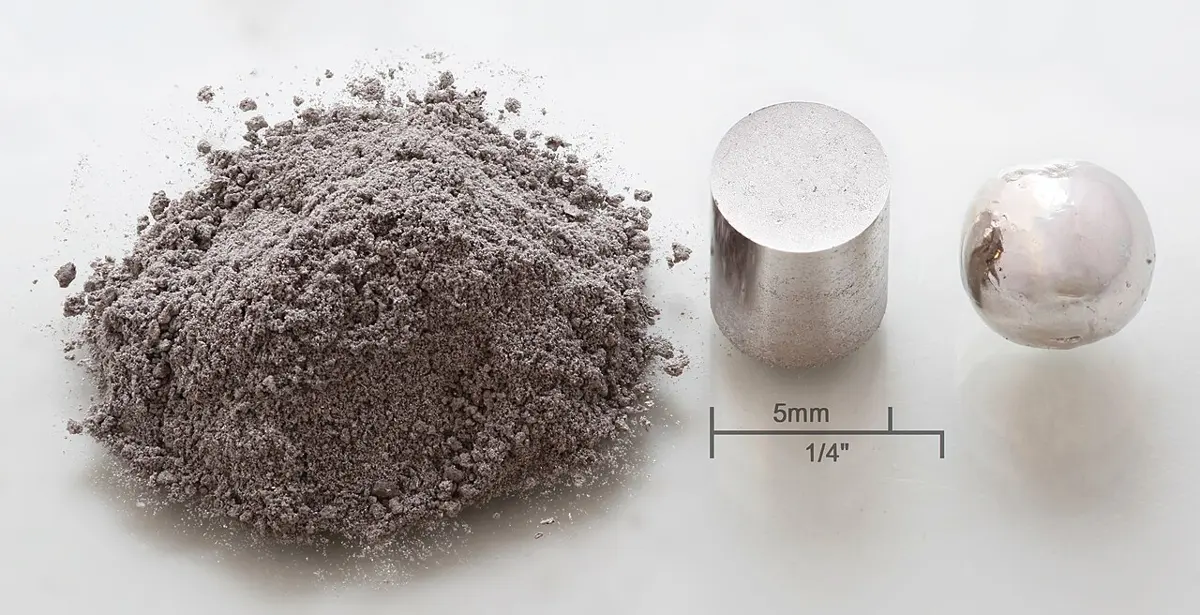
Stand beside a busy road and you breathe what comes out of the exhaust pipes. Among the gases a petrol engine makes are nitrogen oxides, which sting the eyes and lungs, turn the air over a city into a brown haze, and come down again as acid rain. Inside most cars, a few grams of metal quietly turn these gases back into the nitrogen and oxygen of ordinary air.
The metal that does that job is rhodium, one of the rarest metals on Earth. The world produces only about 30 tonnes of it a year, about a hundredth as much as gold, and in 2021 an ounce of rhodium cost more than ten times as much as an ounce of gold. Here is its story.
The rhodium atom
A rhodium atom has 45 protons, so rhodium’s atomic number is 45, and a neutral atom has 45 electrons. Every rhodium atom in nature has 58 neutrons: mass number 45 + 58 = 103. Rhodium-103 is the only kind of rhodium found in nature.
Its shells are 2, 8, 18, 16, 1 Grade 8: Bohr and Bury’s rule.
Its electronic configuration
From the Aufbau order Grade 10: The Aufbau principle you would expect rhodium to end 5s² 4d⁷, like cobalt above it (4s² 3d⁷). The real atom is:
1s² 2s² 2p⁶ 3s² 3p⁶ 4s² 3d¹⁰ 4p⁶ 5s¹ 4d⁸
As in ruthenium just before it, one electron has moved from 5s into 4d: in period 5 the two subshells have almost the same energy. Cobalt and iridium, above and below rhodium in its group, keep two s electrons.
How many electrons are in the outermost shell of a rhodium atom?
Pick an answer to see why.
Its place in the periodic table
- Period 5, because its electrons are in five shells. It sits between ruthenium (44) and palladium (46).
- Group 9, the middle of the three columns that older tables call VIIIB, with cobalt above it and iridium below.
- d-block: a transition metal Grade 10: Metals.
Rhodium is one of the six platinum group metals: ruthenium, rhodium and palladium in period 5, osmium, iridium and platinum in period 6. All six are rare, unreactive and found together in the same ores.
In compounds, rhodium usually has a valency of 3, as in rhodium chloride, RhCl₃, and sometimes 1 Grade 9: Variable valency.
How rhodium was found and named
William Hyde Wollaston (1766–1828) was an English doctor who gave up medicine for science. With his friend Smithson Tennant he set up a small business making pure platinum, which was then very hard to work. On Christmas Eve 1800 the two bought a large batch of platinum ore that had been smuggled out of South America, from what is now Colombia.
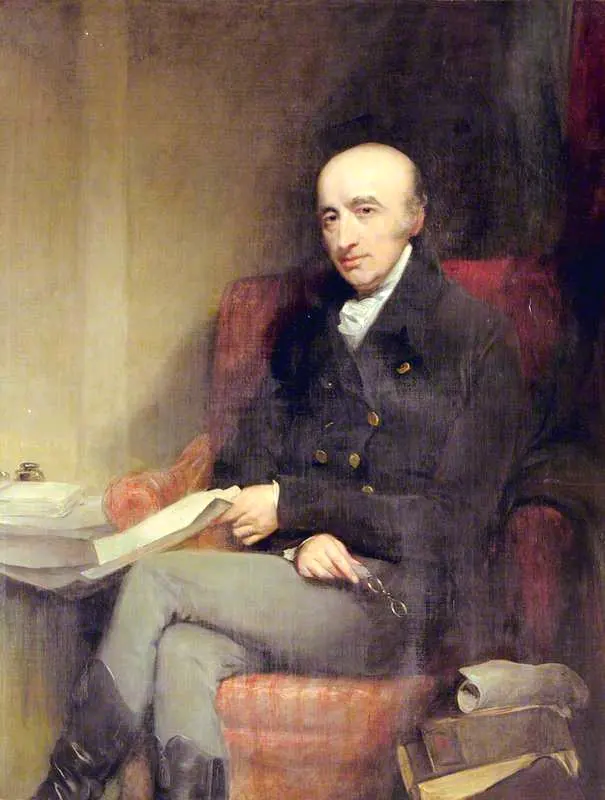
To purify the platinum, Wollaston dissolved the ore in aqua regia, a mixture of concentrated nitric and hydrochloric acids. Tennant worked on the black powder that would not dissolve, and found two new metals in it, osmium and iridium. Wollaston worked on the solution.
- 1802. He took the platinum out of the solution, and then found a new metal in what was left: palladium.
- 1803. In the liquid left after that, he found a beautiful rose-red solution. From it he got dark red crystals of a salt of yet another new metal, sodium rhodium chloride.
- He then dropped in zinc. Zinc is more reactive, so it pushed the new metal out of its compound as a powder Grade 10: Single displacement reaction, just as iron pushes copper out of copper sulphate.
He announced the new metal in 1804 and named it after the color of its salts, from the Greek rhodon, “rose”. Its symbol is Rh. The same Greek word gives rhododendron, “rose tree”, the गुराँस whose red flowers cover Nepal’s hills in spring. Nepali uses the English name for the metal: रोडियम.
Wollaston got rhodium metal by adding zinc to a solution of a rhodium salt. Why did that work?
Pick an answer to see why.
Where rhodium is found
In the universe. Like every element heavier than iron, rhodium was built when atomic nuclei caught neutrons, in giant stars and in collisions of dead stars (Heavier than iron).
In the Earth’s crust. Rhodium is one of the rarest elements in the crust, with less than a milligram in a tonne of rock; the Royal Society of Chemistry calls it the rarest of all metals that are not radioactive. It has hardly any ores of its own. It comes mixed in tiny amounts with platinum and palladium, and as a by-product of refining nickel and copper.
About 30 tonnes are produced each year, most of it in South Africa, from the same ancient rocks of the Bushveld that give most of the world’s platinum; most of the rest comes from Russia and Zimbabwe.
Figure 3 shows how little that is.
In Nepal. No rhodium is mined in Nepal. You meet it only in imported goods: the exhaust systems of cars, and the bright plating on some jewelry.
From rock to metal
Getting rhodium out of rock is one of the longest jobs in metallurgy Grade 10: Metallurgy. The ore of the Bushveld holds only a few grams of all six platinum group metals together in each tonne, and only a small part of that is rhodium. So:
- The ore is crushed, ground and concentrated by froth flotation Grade 10: Concentration.
- The concentrate is smelted: most of the rock floats off as slag, and the metals sink as a heavy mixture of nickel, copper and iron sulphides.
- The nickel and copper are taken out, leaving a powder rich in the precious metals.
- The six platinum group metals are then separated from each other, one by one, by dissolving them and making each come out of solution in turn. Rhodium is among the hardest to separate, and the whole process takes weeks.
What rhodium is like
- A hard, silvery-white metal, with a brilliant shine like a mirror. It reflects most of the light that falls on it.
- Never tarnishes. Air and water do not dull it, so it stays bright for ever.
- Melts at 1,964 °C, and has a density of 12.4 g/cm³.
- Hardly reacts with acids: it does not dissolve in nitric acid, and only very slowly even in aqua regia. Wollaston used this to separate it from platinum.
- Conducts electricity well and keeps a clean surface, so it is used on the contacts of switches that must work for years.
- Hard to shape. It is hard and not very malleable, so solid rhodium objects are rare. It is used mostly as a thin plating, or mixed into platinum.
Rhodium at work
Cleaning car exhaust
About four-fifths of all rhodium goes into catalytic converters: the box in a car’s exhaust pipe whose honeycomb walls are coated with tiny particles of precious metal (see platinum for the inside of one). A catalyst speeds up a reaction without being used up Grade 10: Catalyst.
A petrol engine’s exhaust carries three harmful kinds of gas, so a modern converter has three jobs; it is called a three-way converter. Platinum and palladium are best at two of them, adding oxygen to carbon monoxide and to unburnt fuel. Rhodium does the third: on its surface, nitrogen oxides lose their oxygen and become plain nitrogen, mostly by reacting with the carbon monoxide that is there too:
2NO + 2CO → N₂ + 2CO₂
Taking oxygen away from a substance is reduction Grade 10: Reduction. Rhodium is very good at it, and no cheaper metal does it as well. Nitrogen oxides are one of the main causes of smog and of acid rain Grade 10: Acid rain, so those few grams of rhodium matter to everyone who breathes city air.
In 2NO + 2CO → N₂ + 2CO₂, which substance is reduced?
Pick an answer to see why.
The price of rarity
Because so little rhodium is mined, and almost every new petrol car needs some, its price jumps whenever demand rises or a mine closes. In 2021 its average price was over US$20,000 an ounce (an ounce of precious metal is about 31 grams), more than eleven times the price of gold, about US$1,800. Then demand eased and the price fell, to under US$5,000 in 2024 (USGS).

Other jobs
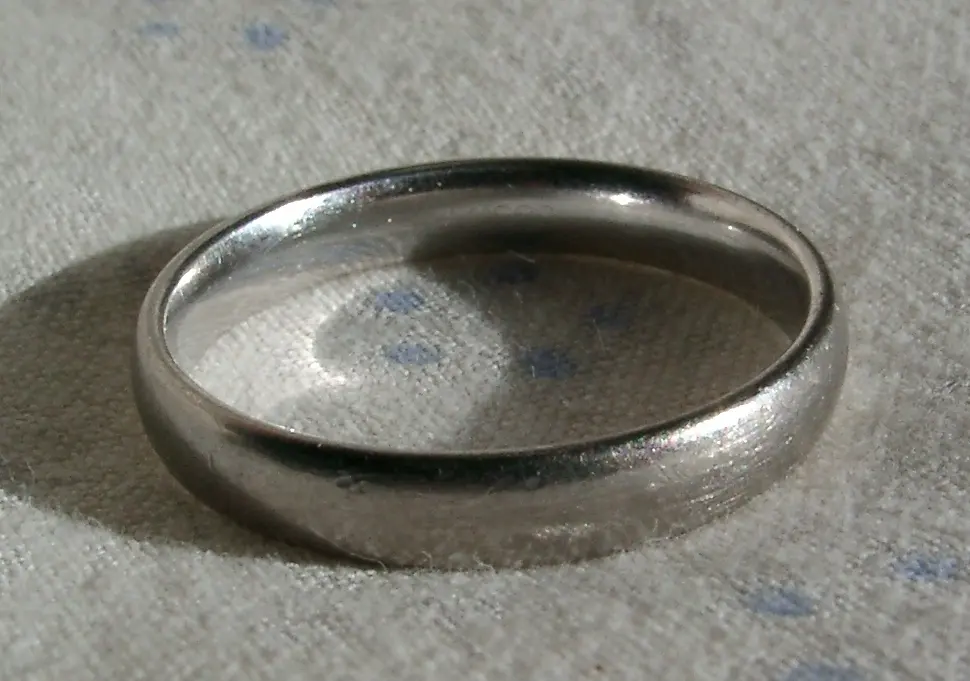
- Shine on jewelry. White gold is gold mixed with a white metal such as palladium, and it is still slightly yellowish. Most white gold rings are given a thin coat of rhodium by electroplating, which makes them brilliant white; the coat slowly wears off and can be renewed. Silver is sometimes rhodium-plated too, to stop it tarnishing.
- Measuring great heat. A junction of two wires, one of platinum and one of platinum mixed with rhodium, gives a small voltage that grows with temperature: a thermocouple. These measure the heat inside furnaces, up to about 1,800 °C.
- Making fertilizer. Nitric acid, for fertilizers, is made by burning ammonia on a gauze of platinum–rhodium wire Grade 10: Uses of ammonia.
- Making glass fiber. Melted glass is drawn into fibers through hundreds of tiny holes in a plate of platinum–rhodium, which does not melt or corrode in the hot glass.
- Making medicines and flavors. Rhodium compounds are catalysts for making many chemicals. In the 1970s William Knowles used one to make L-DOPA, a medicine for Parkinson’s disease, in only the mirror-image form that works: part of the Nobel Prize in Chemistry in 2001. A rhodium catalyst devised by Ryoji Noyori, who shared that prize, is used to make menthol, the cool taste of mint, by the thousands of tonnes.
Only one isotope
Most elements are a mixture of isotopes, which is why their atomic masses are not whole numbers: chlorine’s is 35.5, copper’s 63.5 Grade 9: Atomic mass. Rhodium has just one natural isotope, rhodium-103, so its atomic mass, 102.91, is very close to the whole number 103. Its neighbor ruthenium, with seven isotopes, has an atomic mass of 101.07.
The atomic mass of rhodium is 102.91, almost a whole number. What is the best reason?
Pick an answer to see why.
Rhodium-103 is also the key to a clever instrument. When it catches a neutron it becomes rhodium-104, which is radioactive and gives out a small electric signal as it decays. Strings of rhodium detectors inside nuclear reactors measure how many neutrons are flying about, to keep the reactor running safely.
Rhodium and your health
Your body has no need for rhodium. The metal itself is harmless: a rhodium-plated ring is safe to wear, because the metal does not dissolve on your skin.
Some rhodium compounds, such as rhodium chloride, are poisonous, and some may cause cancer. They are used only in laboratories and factories, where workers are protected from breathing their dust.
Surprising facts and records
- A rhodium record. In 1979 the Guinness Book of Records gave the musician Paul McCartney a disc plated with rhodium for being the best-selling songwriter and recording artist ever: gold and platinum discs were not special enough.
- Recycled again and again. Rhodium from old converters is recovered and used again.
- The color is in its salts, not the metal. Rhodium is named for rose-red, but the metal is white: it is many rhodium compounds that are red.
In your science books
- Grade 8: the 2n² rule, precious metallic minerals and acid rain.
- Grade 9: variable valency, atomic mass and properties of metals.
- Grade 10: electronic configuration, single displacement, catalysts, reduction and acid rain.
- Going further: how catalysts lower the hill and where heavy atoms are made.
More to explore
- Nobel Prizes with rhodium in them: left-handed and right-handed molecules (2001, Knowles’s rhodium catalyst for L-DOPA), surface chemistry (2007, how gases react on the metals of a catalytic converter) and evolution in a test tube (2018, an enzyme that replaced a rhodium catalyst in making a diabetes medicine).
- Its neighbors: ruthenium, palladium and platinum, its partners in the catalytic converter.
- Play: find rhodium in Guess the Element and the Periodic Table Jigsaw.
- Read more: rhodium at the Royal Society of Chemistry and at PubChem.