
- Atomic number
- 118
- Atomic mass
- 295.22
- Shells
- 2, 8, 18, 32, 32, 18, 8
- Configuration
- 1s² 2s² 2p⁶ 3s² 3p⁶ 4s² 3d¹⁰ 4p⁶ 5s² 4d¹⁰ 5p⁶ 6s² 4f¹⁴ 5d¹⁰ 6p⁶ 7s² 5f¹⁴ 6d¹⁰ 7p⁶
- In the table
- period 7, group 18 (0), p-block
- Kind
- Noble gas
- Valency
- 0, like the other noble gases (expected)
- State at 25 °C
- expected to be a solid
- Melts · boils
- not known · not known
- Known since
- 2006
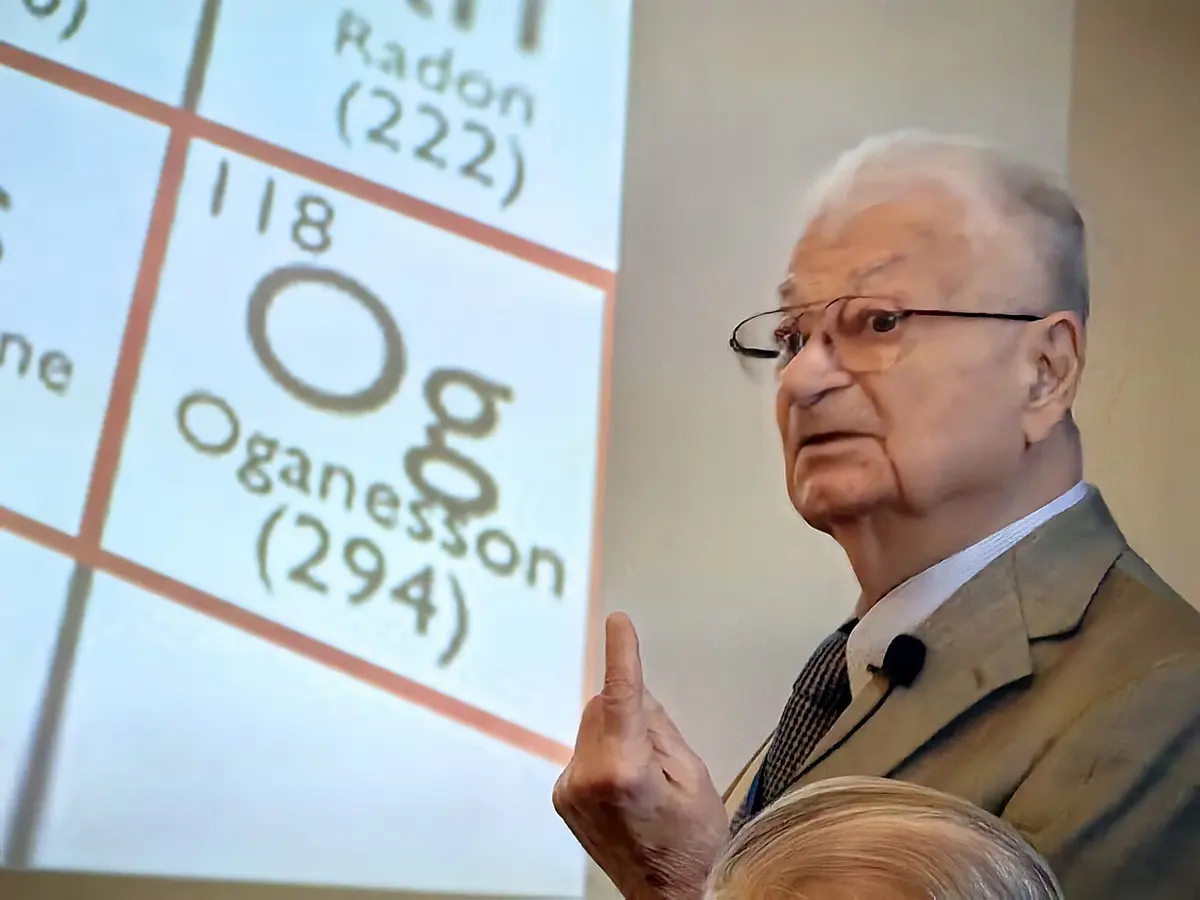
Look at the bottom right corner of the periodic table. The last box, number 118, is oganesson. It completes the table’s seventh row, and no element beyond it has been made. Only a handful of its atoms have ever existed, each for less than a thousandth of a second. It is named after a scientist who was alive and working when it was named, and by its place it is a noble gas, like neon and argon. Calculations say it may not even be a gas.
The oganesson atom
An oganesson atom has 118 protons (atomic number 118) and 118 electrons. The only kind known, oganesson-294, has 294 − 118 = 176 neutrons. By shells, the electrons are 2, 8, 18, 32, 32, 18, 8, and in subshells Grade 10: The Aufbau principle:
… 7s² 5f¹⁴ 6d¹⁰ 7p⁶
Its outermost shell has eight electrons, a full octet, like neon, argon, krypton, xenon and radon above it in group 18 Grade 8: Position of inert gases. With the 7p subshell full, the seventh row, period 7, is complete.
How many electrons does oganesson have in its outermost shell, and what does that make it, by its place in the table?
Pick an answer to see why.
How oganesson was found and named
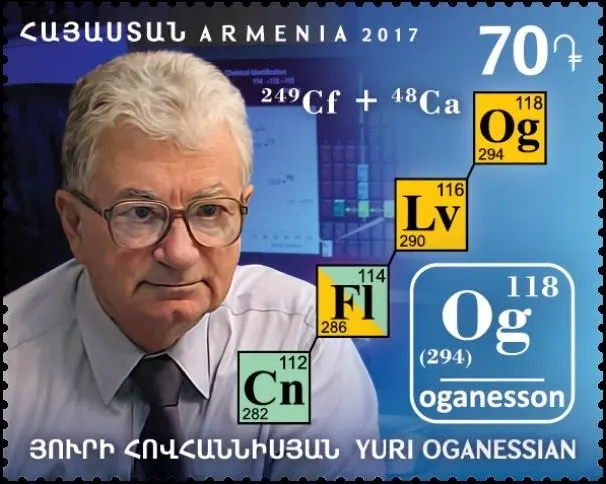
The real first atom was seen in 2002 at the Joint Institute for Nuclear Research in Dubna, Russia, by a team led by Yuri Oganessian, with scientists from the Lawrence Livermore National Laboratory in the USA. They fired calcium-48 (20 protons) at californium-249 (98 protons): 98 + 20 = 118. After two more atoms in 2005, they reported the discovery in 2006: three atoms in all, perhaps four.
In December 2015, IUPAC and IUPAP accepted the discovery, and in November 2016 element 118 was named oganesson, symbol Og. Until then it was ununoctium (un-un-oct: 1-1-8). The ending “-on” matches the other noble gases: neon, argon, krypton, xenon, radon.
Yuri Oganessian was born in 1933 in Rostov-on-Don, in what was then the Soviet Union, to an Armenian family. At Dubna he worked out new ways of joining nuclei: first with lead and bismuth targets, which helped make elements 106 to 113, then with calcium-48 beams on heavy targets, which made elements 114 to 118. He is only the second person to have an element named after him while alive; the first was Glenn Seaborg, for seaborgium, in 1997.
What is measured, and what is only predicted
What has been measured, from about five atoms:
- One kind, oganesson-294, with a half-life of about 0.7 thousandths of a second (0.0007 s).
- It decays by giving out an alpha particle, turning into livermorium-290.
What is only predicted, by calculations on the world’s fastest computers:
- That it is not a gas. The facts card says “expected to be a gas”, which was the long-held guess for a noble gas. Calculations published in 2020 suggest a solid at room temperature, melting at about 50 °C and boiling at about 180 °C.
- That it would be far more reactive than radon, and could even hold an extra electron, which no other noble gas can.
- That it might be a semiconductor, like silicon.
The reason, once again, is speed: in an atom with 118 protons, the inner electrons move at a large fraction of the speed of light, and that changes how all the others are held. No one may ever test these predictions, because no one can collect enough atoms to make a solid.
The end of the table, and beyond
The next element, 119, would go into a new subshell, 8s, and start period 8 in group 1, under francium: an alkali metal Grade 10: A table that keeps growing. Element 120 would go under radium, in group 2. Calcium beams cannot reach them: they would need targets of einsteinium (99) or fermium (100), which cannot be made in large enough amounts. So laboratories use heavier beams:
- Since 2018, RIKEN in Japan has been firing vanadium (23 protons) at curium (96): 96 + 23 = 119.
- Berkeley, in the USA, plans to fire titanium (22) at californium (98): 98 + 22 = 120, after testing the beam by making livermorium in 2024. Dubna plans a similar search for 120.
As of October 2026, no atom of either has been reported. Each new element is harder: the chance that two nuclei join, and survive, falls steeply as they get heavier.
The island of stability
Superheavy atoms fall apart in seconds or less, so why look further? Your Grade 9 book explains that a nucleus holds together best with the right number of neutrons for its protons Grade 9: Nuclear stability. Physicists predict that nuclei with about 114 to 126 protons and about 184 neutrons would hold together much better than their neighbors: an island of stability in a sea of quickly decaying nuclei. How long they would last is not known; estimates range from minutes to much longer.
What has been seen fits the idea: among the superheavy elements made so far, the kinds with more neutrons generally last longer. But the most neutron-rich made so far have about 177 neutrons, still short of 184, because the beams and targets available simply do not have enough neutrons between them. Whether the island is really there, no one yet knows.
In your science books
- Grade 8: the last four elements named, in 2016 and the position of the inert gases.
- Grade 9: the octet rule and nuclear stability.
- Grade 10: features of the modern periodic table, the Aufbau principle and a table that keeps growing.
- Going further: alpha decay and a periodic table of where elements were made.
More to explore
- Its family: radon, above it, and xenon and neon, higher up in group 18.
- Its neighbors: tennessine, element 117, livermorium, which it decays into, and californium, its target; seaborgium, the first element named after a living scientist.
- Nobel Prizes: Seaborg and McMillan’s prize (1951) for the elements beyond uranium.
- Play: find oganesson in Guess the Element and the Periodic Table Jigsaw.
- Read more: oganesson at the Royal Society of Chemistry and at PubChem.