
- Atomic number
- 22
- Atomic mass
- 47.87
- Shells
- 2, 8, 10, 2
- Configuration
- 1s² 2s² 2p⁶ 3s² 3p⁶ 4s² 3d²
- In the table
- period 4, group 4 (IVB), d-block
- Kind
- Transition metal
- Valency
- 4 (TiO₂, TiCl₄); also 3
- State at 25 °C
- solid
- Melts · boils
- 1,668 °C · 3,287 °C
- Density
- 4.5 × as heavy as water
- Known since
- 1791
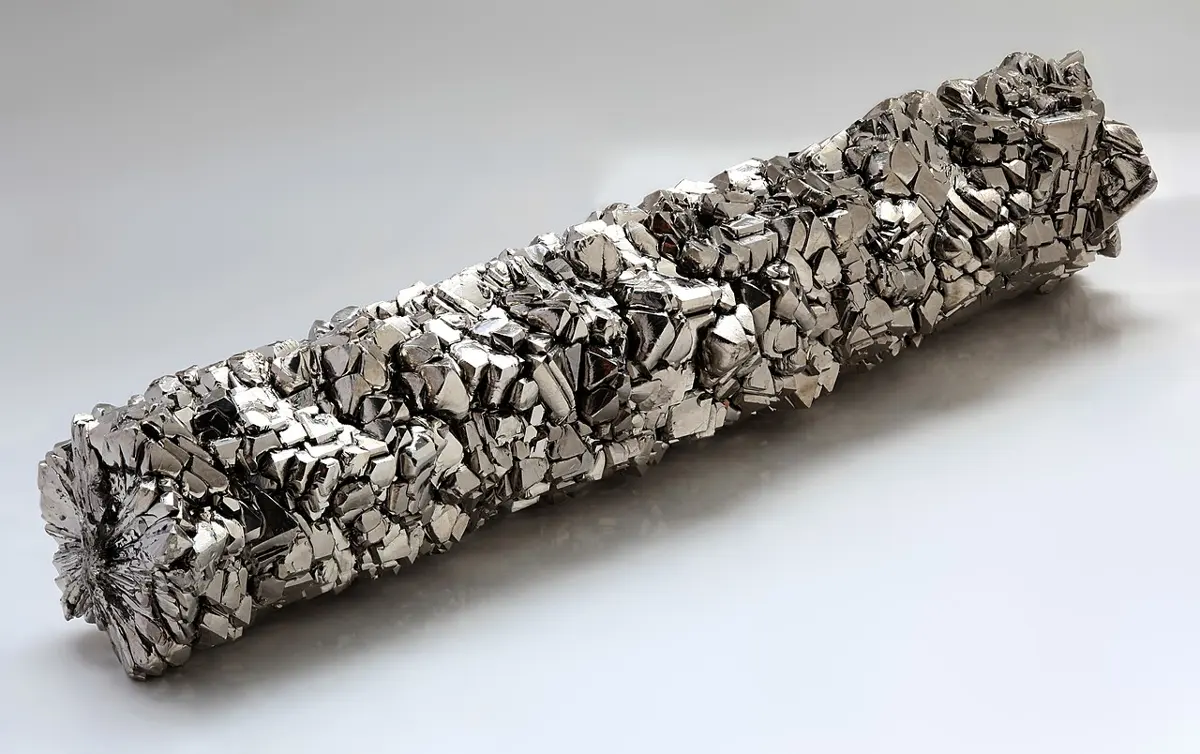
Look at a tube of toothpaste, a tin of white wall paint, or a bottle of sunscreen, and read the ingredients. You will very likely find titanium dioxide (TiO₂). It is what makes them so white. Then think of the fastest aircraft ever flown, a replacement hip joint, the frame of a light pair of glasses. They are often titanium metal.
Titanium is one of the most common metals in the Earth’s crust, yet it was a hundred years after its discovery before anyone made the pure metal, and it still costs several times as much as steel. Here is why, and what makes it worth the trouble.
The titanium atom
Every titanium atom has 22 protons, so titanium’s atomic number is 22, and a neutral atom has 22 electrons. Most titanium atoms also have 26 neutrons: mass number 22 + 26 = 48.
Its shells: a surprise
By the 2n² rule Grade 8: Bohr and Bury’s rule, the K shell holds 2 and the L shell 8. That leaves 12. The M shell can hold 18, so you might put all 12 there. But the real atom is 2, 8, 10, 2: two electrons go into the fourth shell, N, while the M shell holds only 10.
The reason is in the subshells you meet in Grade 10 Grade 10: The Aufbau principle. The 4s subshell has a little less energy than 3d, so it fills first, at potassium and calcium. Only then does 3d begin to fill, starting at scandium (21). Titanium is the second element to put electrons in 3d:
1s² 2s² 2p⁶ 3s² 3p⁶ 4s² 3d²
The 4s electrons belong to the N shell, the 3d electrons to the M shell. So the M shell keeps filling after the N shell has started, all the way to zinc.
How are the 22 electrons of a titanium atom arranged in shells?
Pick an answer to see why.
Its place in the periodic table
- Period 4, because its electrons are in four shells.
- Group 4, called IVB in the older naming. Its family below it is zirconium (40) and hafnium (72).
- d-block, because its last electrons go into a d subshell, so it is a transition metal Grade 10: Metals.
All four of its outer electrons (4s² 3d²) can take part in bonds, so titanium’s usual valency is 4, as in titanium dioxide (TiO₂) and titanium tetrachloride (TiCl₄). It also shows valency 3, as in violet solutions of Ti³⁺ Grade 9: Variable valency.
How titanium was found and named
1791, a black sand in Cornwall. William Gregor, a priest in the parish of Manaccan in Cornwall, England, who was also an amateur mineralogist, found a black sand in a stream valley that was pulled by a magnet. He analyzed it and found the oxide of iron (the magnetic part) and the oxide of a metal nobody knew. He called the sand menachanite, after his parish. Today the mineral is called ilmenite, FeTiO₃.
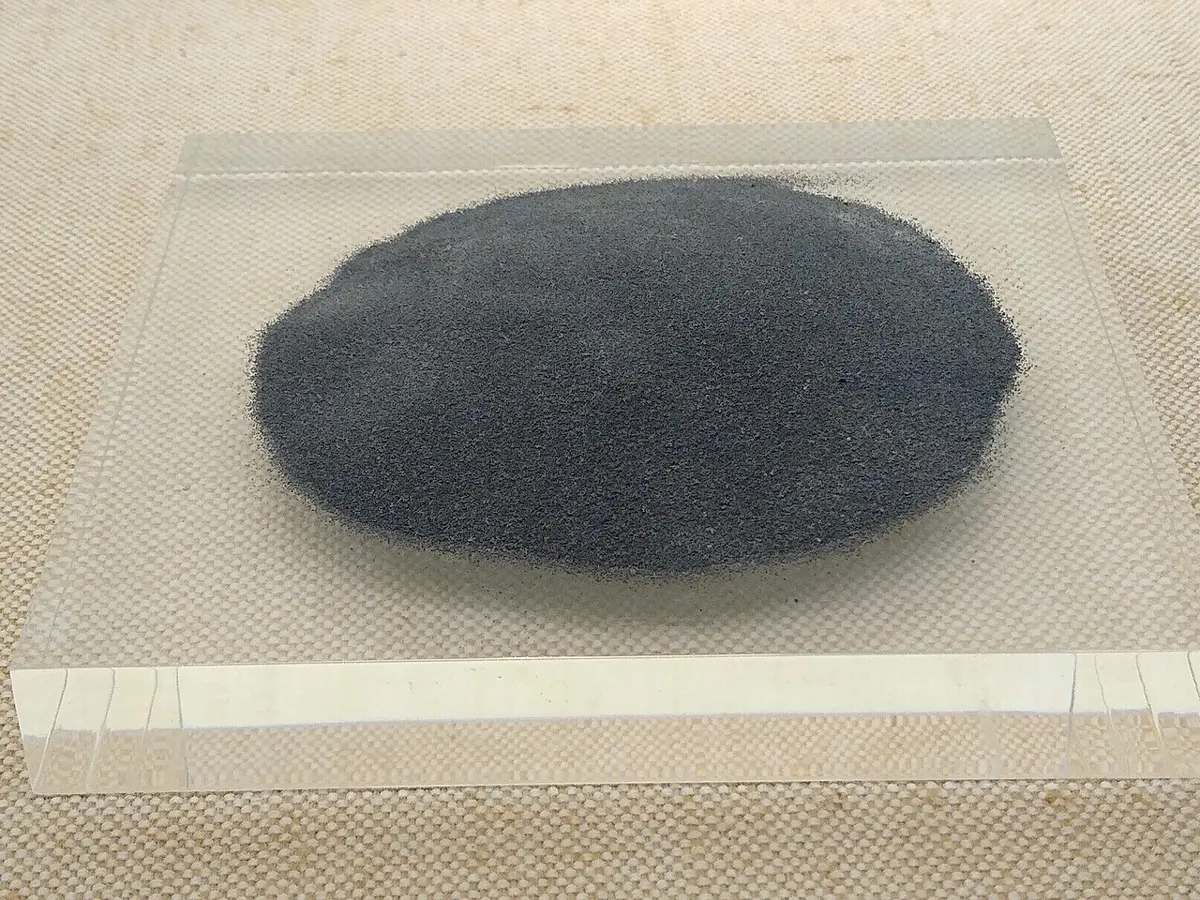
1795, the name. In Berlin, the German chemist Martin Heinrich Klaproth found the same unknown oxide in a red mineral, rutile, and named the new element after the Titans, the giant children of the Earth in Greek myths. When he heard of Gregor’s work, he tested menachanite and agreed: the same element. The symbol is Ti.
1910, the pure metal. For more than a century, chemists could get only impure, brittle titanium. In 1910 Matthew Hunter, working in the USA, at last made titanium about 99.9% pure, by heating titanium tetrachloride with sodium in a sealed steel container. You will see below why it was so hard.
Where titanium is found
In the universe. Titanium was made inside stars and scattered when they exploded (Getting the atoms out). It is common on the Moon: the dark rocks the Apollo 11 astronauts brought back in 1969 were unusually rich in it, and one new titanium mineral found in them was named armalcolite, after Armstrong, Aldrin and Collins.
In the Earth’s crust. Titanium is the ninth most common element in the crust, about 0.6% of it by mass: far more common than copper or zinc. It is in almost every rock, but always joined to oxygen. The ores mined are black ilmenite (FeTiO₃, about 90% of what is used) and red-brown rutile (TiO₂), often dug from beach and river sands where the heavy grains collect (Sorted by a river). In 2025 the world mined titanium minerals holding about 9.8 million tonnes of TiO₂, a third of it in China, followed by Mozambique, South Africa and Australia (USGS, 2026).
In your body. Titanium has no known use in any living thing, and it is not poisonous.
What titanium is like
- A silvery-gray metal, shiny when polished.
- Light for its strength. Its density is 4.5 g/cm³, a little over half that of steel. Yet its alloys are about as strong as many steels. That strength for its weight is why it goes into aircraft (Weight for weight).
- Melts at 1,668 °C, about 130 °C higher than iron.
- Hardly corrodes, even in seawater, where steel rusts fast.
- Not rejected by the body. Bone grows tightly onto it.
Why doesn’t titanium corrode? Not because it is unreactive. Titanium is quite a reactive metal, like aluminium. But the moment fresh titanium meets air, it is covered with a layer of titanium dioxide only a few millionths of a millimeter thick, which sticks tightly and stops air and water from reaching the metal underneath. If it is scratched, a new layer forms at once. Aluminium protects itself in the same way (Aluminium).
Titanium is quite a reactive metal. Why, then, do titanium ship parts last for years in seawater?
Pick an answer to see why.
How titanium reacts
Behind its oxide coat, titanium reacts with many things when it is hot:
- Oxygen. Heated strongly, titanium burns with a brilliant white light, forming titanium dioxide Grade 9: Metals react with oxygen. Titanium powder gives the bright white sparks in some fireworks.
Ti + O₂ → TiO₂
- Nitrogen. Above about 800 °C it even reacts with nitrogen, which few metals do, making golden-yellow titanium nitride. A thin coat of it gives some drill bits their gold color and makes them harder.
2Ti + N₂ → 2TiN
- Chlorine, when hot, giving titanium tetrachloride, a colorless liquid that fumes in moist air. Its water reaction makes a dense white smoke of tiny titanium dioxide grains and hydrochloric acid, once used for smoke screens:
TiCl₄ + 2H₂O → TiO₂ + 4HCl
- Dilute acids such as hydrochloric and sulphuric acid at room temperature hardly attack it, thanks to its oxide layer.
Titanium dioxide: the whitest white
Titanium dioxide (TiO₂) is a white powder that does not dissolve in water and is not poisonous. It makes almost everything white: wall paint, the coating on paper, plastic buckets, the white of toothpaste and tablets. About 95% of all the titanium used is used as this oxide, not as metal.
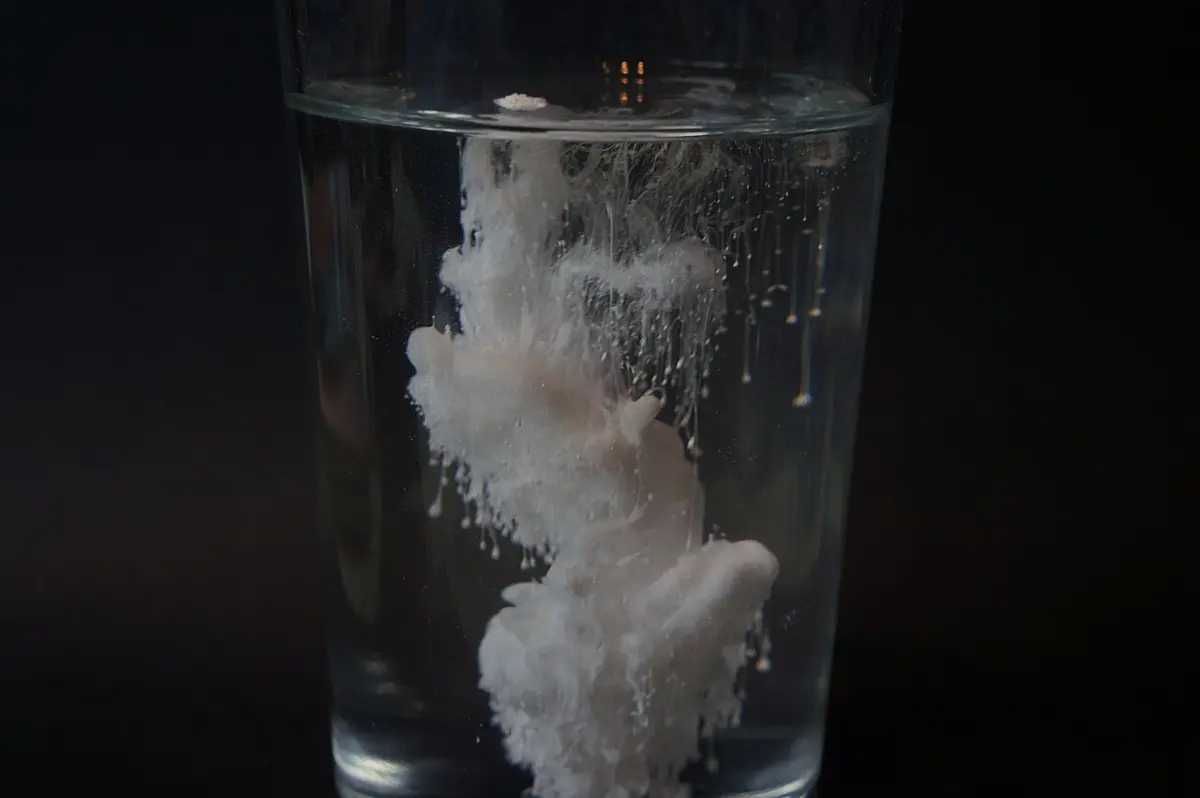
What makes it so white? When light passes from air into a crystal, it bends and partly reflects Grade 10: Refraction. The more a substance bends light, the more it reflects. Titanium dioxide bends light more strongly than almost anything, even more than diamond. So a layer of its tiny grains reflects and scatters every color of light back at you, and covers what is underneath: one coat of a good white paint hides the old color.
It also blocks ultraviolet rays Grade 9: Ultraviolet rays, which is why it is in many sunscreens, especially the “mineral” ones that leave a white film.
Why titanium metal is so hard to make
Iron is made by heating its ore with carbon (coke): the carbon takes the oxygen away Grade 10: Reduction. Try that with titanium dioxide and you get titanium carbide instead: hot titanium joins with the carbon. And hot titanium grabs oxygen and nitrogen from the air too, which make it brittle. That is why a century passed between Gregor’s sand and Hunter’s pure metal.
Today almost all titanium metal is made by the Kroll process, worked out by William Kroll in Luxembourg around 1940. The oxide is first turned into titanium tetrachloride, and that is reduced by magnesium, a more reactive metal, under a blanket of argon so that no air gets in (Argon):
TiCl₄ + 2Mg → Ti + 2MgCl₂
Each step is slow, and done in batches, with the air kept out. That, not rarity, is why titanium costs several times as much as stainless steel. In 2025 the world made about 370,000 tonnes of titanium sponge, about 70% of it in China (USGS, 2026), against nearly 2 billion tonnes of steel.
Titanium is about a hundred times as common in the crust as copper. Why does titanium metal cost more?
Pick an answer to see why.
Titanium in daily life
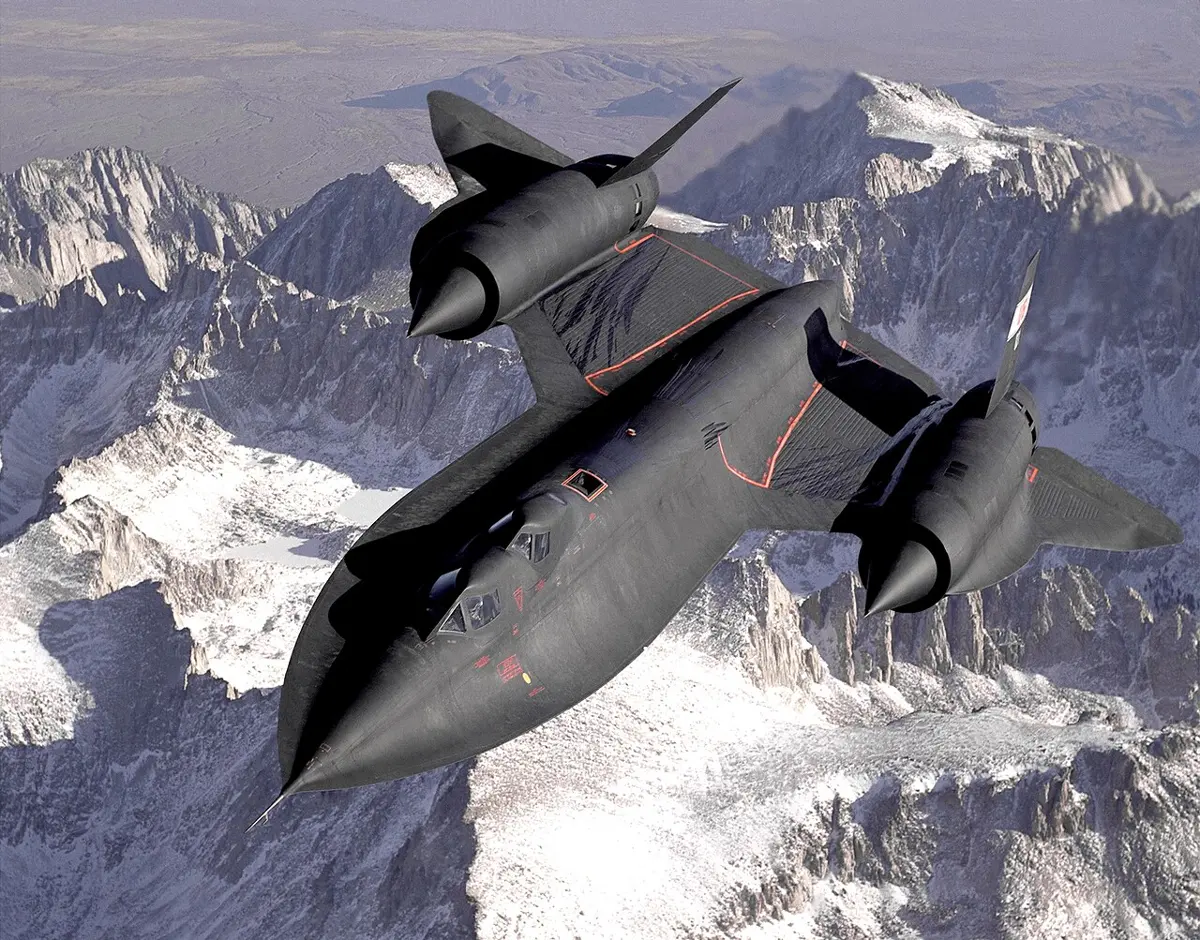
Aircraft and spacecraft. About two thirds of all titanium metal goes into aircraft frames and engines, where every kilogram saved means less fuel burnt. A large modern airliner is built with many tonnes of it. Titanium alloys, mixed with a little aluminium and vanadium, are stronger than the pure metal Grade 8: Alloys.
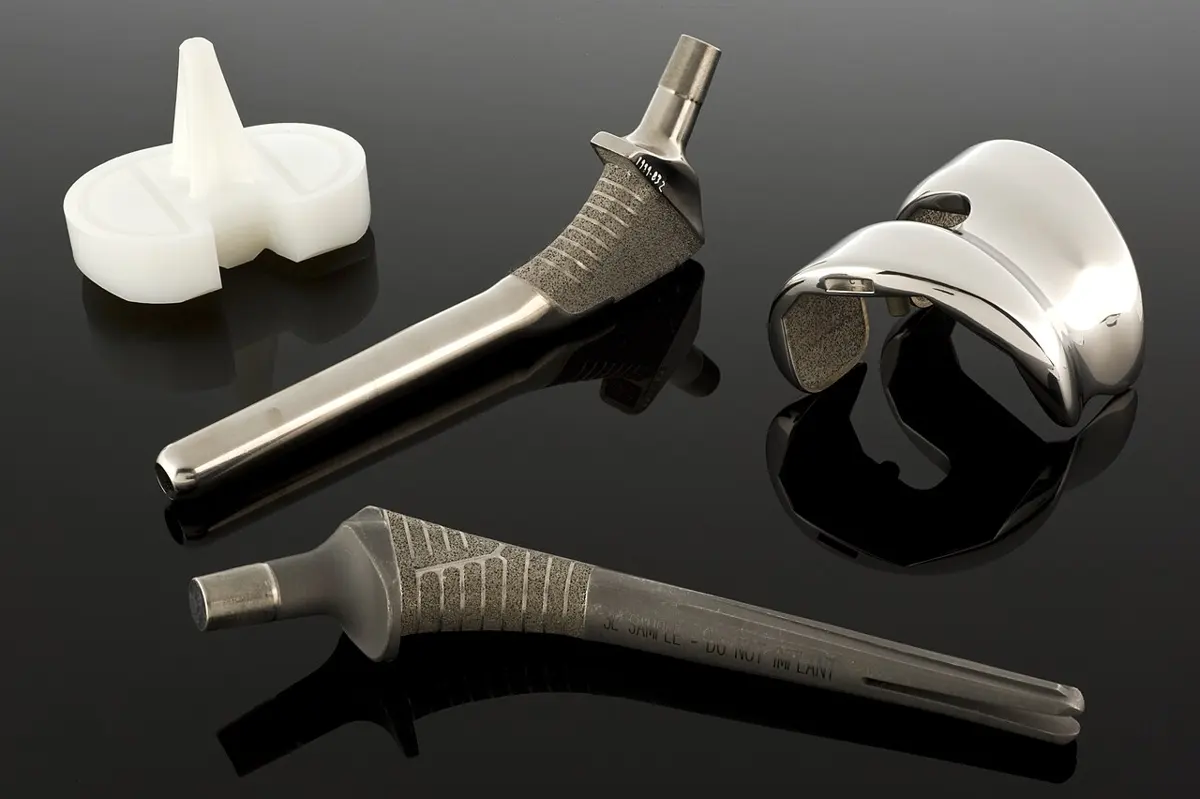
In the body. Because the body does not reject it and bone grows tightly onto its surface, titanium is used for hip and knee replacements, plates and screws that hold broken bones, and dental implants: a titanium screw set into the jawbone, which a false tooth is fixed to. In the 1950s the Swedish doctor Per-Ingvar Brånemark put a small titanium chamber into a rabbit’s bone to watch the blood flow, and found he could not get it out: the bone had grown onto the metal. He called this osseointegration (“joining with bone”), and dental implants grew from it.
Against the sea. Titanium pipes and heat exchangers are used in power stations and in plants that turn seawater into drinking water, and for parts of ships and submarines.
Everyday things. Light spectacle frames, bicycle frames, tennis rackets and golf clubs, watches, laptop cases, and the light titanium mugs and pots that trekkers and climbers carry, because every gram on your back counts.
Buildings. The Guggenheim Museum in Bilbao, Spain, opened in 1997, is covered in about 33,000 thin titanium plates, which shine silver or gold as the light changes and will not corrode.
Isotopes of titanium
Natural titanium is a mixture of five stable isotopes, all with 22 protons: titanium-46, 47, 48, 49 and 50. Titanium-48 (26 neutrons) makes up nearly three quarters.
Titanium and your health
Titanium metal is one of the safest materials to put inside the body, and the body has no need for it. Titanium dioxide is not poisonous to touch or swallow in the small amounts in toothpaste and tablets. The real risk is breathing fine dust of it, as workers in pigment factories might, which is treated as possibly causing cancer; such workplaces control the dust.
Surprising facts and records
- Hidden in rubies and sapphires. A blue sapphire owes its color to tiny amounts of iron and titanium in aluminium oxide. Thin needles of rutile inside a sapphire make the six-rayed “star” of a star sapphire.
- Self-cleaning glass. A very thin coat of titanium dioxide on glass uses sunlight to break down dirt, and lets rain spread over the glass in a sheet and wash it off.
In your science books
- Grade 8: the 2n² rule, alloys and metallic minerals.
- Grade 9: variable valency, metals and oxygen and ultraviolet rays.
- Grade 10: electronic configuration, transition metals, reduction in metallurgy and refraction of light.
- Going further: strength for weight, a question on rutile’s formula and where the atoms in your body came from.
More to explore
- Nobel Prizes with titanium in them: handed molecules (2001, a titanium catalyst that makes only one hand), the lithium-ion battery (2019, the first one used titanium disulfide) and superconductors (2003, the magnets of the Large Hadron Collider are niobium–titanium).
- Play: find titanium in Guess the Element and the Periodic Table Jigsaw.
- Read more: titanium at the Royal Society of Chemistry and at PubChem.