
- Atomic number
- 34
- Atomic mass
- 78.97
- Shells
- 2, 8, 18, 6
- Configuration
- 1s² 2s² 2p⁶ 3s² 3p⁶ 4s² 3d¹⁰ 4p⁴
- In the table
- period 4, group 16 (VIA), p-block
- Kind
- Non-metal
- Valency
- 2 (H₂Se), also 4 (SeO₂) and 6 (SeO₃)
- State at 25 °C
- solid
- Melts · boils
- 221 °C · 685 °C
- Density
- 4.8 × as heavy as water
- Known since
- 1817
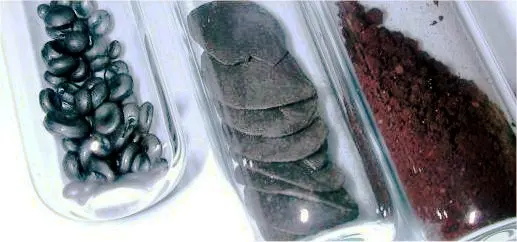
Every cell in your body holds more than a million atoms of an element you may never have heard of. It helps protect your cells from damage and helps your thyroid gland work. Your whole body holds only about 14 milligrams of it, half the mass of a grain of rice, yet you could not live without it. But eat several times the amount you need, every day for months, and your hair and nails begin to fall out.
The element is selenium, named after the Moon. It has a strange talent: it conducts electricity better in light than in the dark. That talent gave us the first light meters, the first solar cell and, for decades, the photocopier. Here is its story.
The selenium atom
Every selenium atom has 34 protons, so selenium’s atomic number is 34, and a neutral atom has 34 electrons. Selenium has six natural isotopes; the most common, about half of all selenium atoms, has 46 neutrons: mass number 34 + 46 = 80.
Its shells and subshells
By the 2n² rule Grade 8: Bohr and Bury’s rule, the shells fill as 2, 8, 18, leaving 6 electrons for the N shell: 2, 8, 18, 6.
In subshells Grade 10: The Aufbau principle, after 4s and 3d are full, four electrons go into 4p:
1s² 2s² 2p⁶ 3s² 3p⁶ 4s² 3d¹⁰ 4p⁴
The N shell holds 4s² 4p⁴: 6 valence electrons, just like oxygen (2s² 2p⁴) and sulphur (3s² 3p⁴) above it.
Its place in the periodic table
- Period 4, because its electrons are in four shells.
- Group 16, called VIA in the older naming: oxygen, sulphur, selenium, tellurium and polonium, the oxygen family.
- p-block, because its last electrons go into a p subshell.
Selenium is a non-metal, though its gray form shines like a metal. It is very like sulphur, the element above it: so like it that the two are found together in the same ores.
Selenium is two electrons short of a full outer shell (an octet). With hydrogen it shares two electrons, just as oxygen does in water (H₂O) and sulphur in hydrogen sulphide (H₂S), making hydrogen selenide, H₂Se Grade 9: Covalent bond. With a metal it can gain two electrons and become the selenide ion, Se²⁻, as oxygen becomes the oxide ion, O²⁻. So its usual valency is 2. With oxygen it also shows valency 4 (SeO₂) and 6 (SeO₃) Grade 9: Variable valency.
Water is H₂O and hydrogen sulphide is H₂S. What is the formula of the compound of selenium and hydrogen?
Pick an answer to see why.
How selenium was found and named
In 1817 the Swedish chemist Jöns Jacob Berzelius and his friend Johan Gottlieb Gahn owned a factory making sulphuric acid at Gripsholm, in Sweden. They made the acid by burning pyrite, a mineral of iron and sulphur, from the Falun copper mine. A reddish-brown sludge kept collecting at the bottom of the lead-lined chambers.
When Berzelius heated the sludge, it gave off a strong smell like radishes. That smell was known from compounds of tellurium, an element found in 1798, so he first thought he had tellurium. But there was no tellurium in the Falun ore. Testing further, by early 1818 he was sure it was a new element, very like sulphur and tellurium. He worked so long with it that his own breath began to smell of it.

The name. Tellurium had been named after the Earth (Latin tellus). Since his new element was so like it, Berzelius named it after the Moon, from the Greek Selene (σελήνη), the goddess of the Moon. The symbol is Se. In Nepali it is simply सेलेनियम.
Where selenium is found
In the universe. Most selenium was made in exploding and aging stars, as lighter atoms caught neutrons (Heavier than iron).
In the Earth’s crust. Selenium is rare: only about a tenth of a gram in every tonne of rock. It hides in the ores of copper, lead and nickel, in place of some of their sulphur. Almost all of it is collected as a by-product of copper. When copper is purified by electrolysis, the impurities that do not dissolve sink below the anode as anode mud, and selenium is one of them, along with silver and gold.
In 2025 the world refined roughly 3,800 tonnes of selenium, more than half of it in China; Japan, Russia and Belgium were next (USGS, 2026).
In soils and food. The amount of selenium in soil varies a great deal from place to place, and so does the selenium in the crops grown on it. Some soils in China and in parts of Europe have very little; some in the USA have so much that plants growing there poison the animals that eat them.
In your body. An adult holds about 14 milligrams of selenium.
What selenium is like
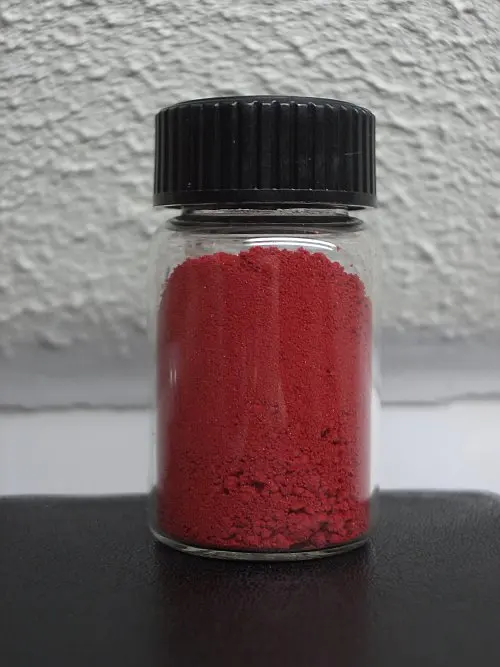
Selenium comes in several forms, called allotropes, like the diamond and graphite of carbon:
- Gray selenium, the most stable form: shiny, metal-like crystals, brittle, density 4.8 g/cm³, melting at 221 °C and boiling at 685 °C.
- Red selenium: a brick-red powder, the form a chemical reaction usually gives.
- Black selenium: a glassy solid, made by cooling melted selenium quickly; sold as beads.
Better in the light
In the dark, gray selenium hardly conducts electricity: nearly all its outer electrons are held in the bonds between its atoms. But light can knock some of them loose. The more light falls on it, the more electrons are set free to carry a current, and the lower its resistance Grade 9: Factors affecting resistance. This is called photoconductivity: “conducting with light”.
It was found by accident. In 1873 the English engineer Willoughby Smith was testing undersea telegraph cables, using rods of selenium as resistors. His measurements kept changing, and he traced the change to sunlight falling on the selenium.
A selenium cell is connected to a battery and an ammeter in a dark room. What happens when the light is switched on?
Pick an answer to see why.
How selenium reacts
Selenium reacts much like sulphur, a little less strongly.
- Burning. It burns in air with a blue flame, giving white selenium dioxide and a foul smell, like rotting radishes:
Se + O₂ → SeO₂
- Hydrogen. Heated with hydrogen, it forms hydrogen selenide, a colorless gas that smells even worse than the rotten-egg gas hydrogen sulphide, and is far more poisonous:
H₂ + Se → H₂Se
- Metals. Heated with metals, it forms selenides, as sulphur forms sulphides: zinc selenide (ZnSe), cadmium selenide (CdSe).
- Water and acids. It does not react with water or dilute hydrochloric acid, but concentrated nitric acid dissolves it.
Selenium dioxide dissolves in water to form an acid, selenious acid (H₂SeO₃), just as sulphur dioxide forms sulphurous acid: like sulphur, selenium is a non-metal, and non-metal oxides are acidic.
Selenium in daily life
According to the USGS, about 40% of the world’s selenium goes into making metals (most of it to help make manganese metal by electrolysis, and some into steel and brass that is easier to machine), 20% into farming and animal feed, 20% into glass, 10% into electronics and solar cells, and the rest into chemicals and pigments (2025 figures).
Glass. Iron impurities give ordinary glass a green tint. A little selenium adds a pinkish tint that cancels the green, so the glass looks clear. More of it, as cadmium selenide, makes glass a deep ruby red. Selenium is also used to make tinted window glass that cuts the glare of the Sun.
Shampoo. Selenium sulphide is the active ingredient in some anti-dandruff shampoos: it slows a fungus that lives on the scalp.
Farms. In places with selenium-poor soils, a little selenium is added to fertilizers and to animal feed, so that the crops, the animals and the people who eat them get enough. Finland has added it to fertilizers since 1984.
Light meters, the first solar cell, and the photocopier
Selenium’s photoconductivity found many uses:
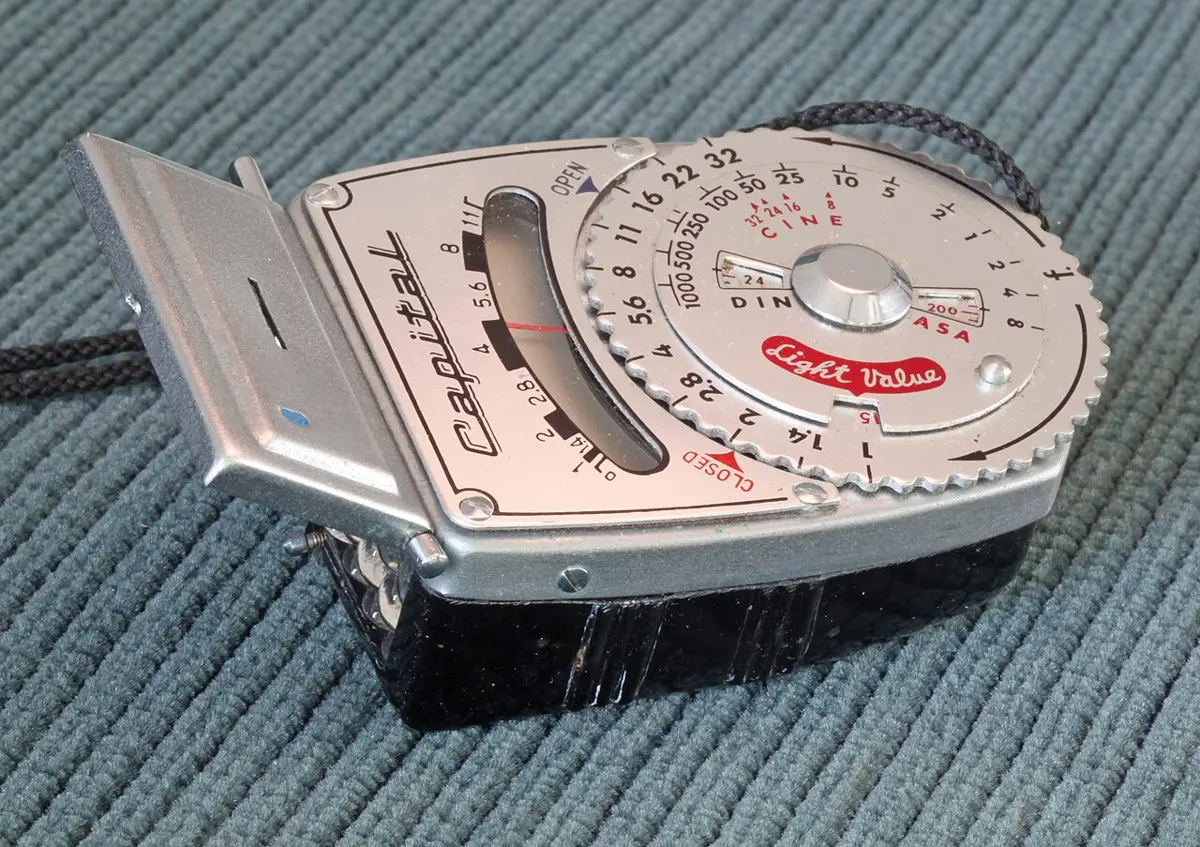
- Light meters. For much of the 20th century, the light meters photographers used to set their cameras worked with a selenium cell. Some needed no battery: the cell made its own current from the light.
- The first solar cell. In 1883 the American inventor Charles Fritts coated selenium with a very thin film of gold and made the first solar cell, turning only about 1% of the light into electricity. Today’s silicon cells turn about 20% (Silicon). Selenium is still in some modern thin solar cells (CIGS: copper, indium, gallium and selenium).
- The photocopier. A photocopier needs a drum that holds an electric charge in the dark but loses it where light falls. For the first decades of photocopying, from the 1950s, that drum was coated with selenium Grade 8: Photocopy machine. Since the 1980s most drums use other light-sensitive materials, but the idea is the same.
Isotopes of selenium
Natural selenium is a mixture of six isotopes, all with 34 protons. The two most common are selenium-80 (about 50%) and selenium-78 (about 24%), and four others share the rest. So selenium’s atomic mass, 78.97, is an average a little below 80 Grade 9: Atomic mass. One of the six, selenium-82, is radioactive, but its half-life is about 10²⁰ years, billions of times the age of the universe.
Selenium and your health
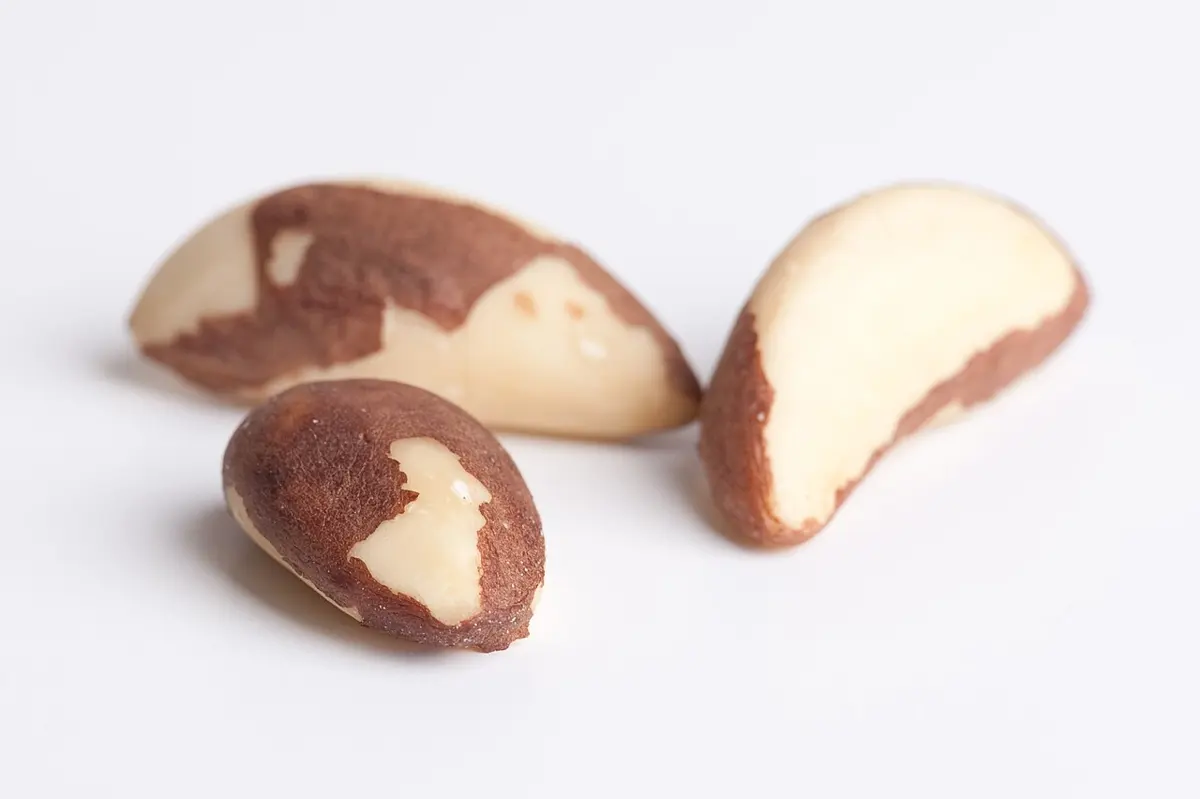
Your body uses selenium to build about two dozen selenoproteins. Some are enzymes that destroy harmful chemicals made in your cells, protecting them from damage; others are needed to make the thyroid hormones that control how fast your body uses energy (iodine is the other element they need).
How much? An adult needs about 55 micrograms a day (a microgram is a millionth of a gram). Good sources are fish, eggs, meat, milk, mushrooms Grade 9: Mushrooms as a source of minerals, whole grains and lentils, though how much a grain or lentil holds depends on the soil it grew in. A mixed diet usually gives enough.
Too little. In a belt of north-east to south-west China, where the soil has very little selenium, children and young women used to suffer from Keshan disease, a weakness of the heart muscle. In the 1970s, giving children selenium tablets once a week cut the number of cases sharply.
Too much. More than about 400 micrograms a day, kept up for a long time, causes selenosis: breath that smells of garlic, a metallic taste, and hair and nails that become brittle and fall out. It usually comes from taking too many selenium pills.
Surprising facts and records
- Moon and Earth. Selenium (the Moon) and tellurium (the Earth) sit one above the other in group 16, named by different chemists 20 years apart.
- The smelly element. Workers with selenium compounds can have “selenium breath” for weeks: the body turns selenium into a garlic-smelling compound, which leaves through the lungs.
- A light-powered telephone. In 1880 Alexander Graham Bell, inventor of the telephone, sent a voice over a beam of sunlight about 200 meters long. A selenium cell turned the flickering light back into sound.
In your science books
- Grade 8: the 2n² rule, groups in the periodic table and the photocopy machine.
- Grade 9: covalent bonds, variable valency, resistance and mushrooms as a source of minerals.
- Grade 10: electronic configuration, non-metals and electro-refining (where selenium comes from).
- Going further: water, the odd one out (H₂O, H₂S, H₂Se and H₂Te compared), the photoelectric effect and where the atoms in your body came from.
More to explore
- Elements next door: sulfur above it, oxygen at the top of its group, and arsenic and bromine on either side; copper, from whose refining it comes; and iodine, its partner in the thyroid.
- Play: find selenium in Guess the Element and the Periodic Table Jigsaw.
- Read more: selenium at the Royal Society of Chemistry and at PubChem.