
- Atomic number
- 23
- Atomic mass
- 50.94
- Shells
- 2, 8, 11, 2
- Configuration
- 1s² 2s² 2p⁶ 3s² 3p⁶ 4s² 3d³
- In the table
- period 4, group 5 (VB), d-block
- Kind
- Transition metal
- Valency
- 2, 3, 4 and 5 (V²⁺, V³⁺, VO²⁺, V₂O₅)
- State at 25 °C
- solid
- Melts · boils
- 1,910 °C · 3,407 °C
- Density
- 6.0 × as heavy as water
- Known since
- 1801
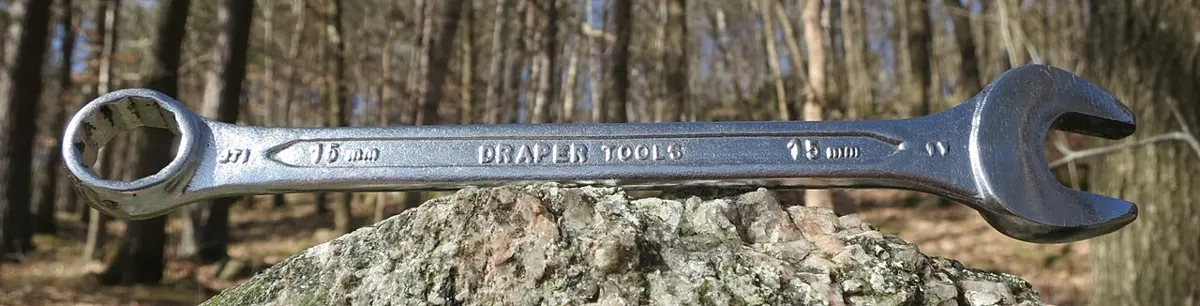
Pick up a good spanner or a set of screwdrivers in a hardware shop and look at the steel. Many are stamped Cr-V, or “chrome vanadium”. That means the steel has a little chromium and a little vanadium in it, less than one part in a hundred of each, and it makes the tool tough enough to take years of hard turning without cracking.
Most of the vanadium the world produces goes into steel in this way. But vanadium also gives a chemistry lesson in colors: one metal that makes yellow, blue, green and violet solutions. Its compounds help make sulphuric acid, store electricity from solar farms, and fill the blood cells of a strange sea animal. Here is its story.
The vanadium atom
Every vanadium atom has 23 protons, so vanadium’s atomic number is 23, and a neutral atom has 23 electrons. Almost all vanadium atoms (99.75%) also have 28 neutrons, so their mass number is 23 + 28 = 51.
Its shells and subshells
By the 2n² rule Grade 8: Bohr and Bury’s rule, the K shell takes 2 electrons and the L shell 8. You might then put the other 13 all in the M shell, which can hold 18. But the real atom is 2, 8, 11, 2.
The reason is in the subshells you meet in Grade 10 Grade 10: The Aufbau principle. After 3s and 3p, the next subshell to fill is 4s, which has a little less energy than 3d. So two electrons go into 4s, in the N shell, and only then does 3d start to fill. Vanadium is the third element to put electrons into 3d:
1s² 2s² 2p⁶ 3s² 3p⁶ 4s² 3d³
The M shell holds 3s² 3p⁶ 3d³: 2 + 6 + 3 = 11 electrons. The N shell holds 4s²: 2.
How are the 23 electrons of a vanadium atom arranged in shells?
Pick an answer to see why.
Its place in the periodic table
- Period 4, because its electrons are in four shells.
- Group 5, called VB in the older naming. Below it are niobium (41) and tantalum (73).
- d-block, because its last electrons go into a d subshell, so it is a transition metal Grade 10: Metals. It sits between titanium (22) and chromium (24).
Vanadium has five outer electrons (4s² 3d³), and it can use two, three, four or all five of them in bonds. So it has a variable valency of 2, 3, 4 or 5 Grade 9: Variable valency. Its most important compound, vanadium pentoxide (V₂O₅), has valency 5: “penta” means five, the five electrons each vanadium atom has given up.
How vanadium was found and named
Vanadium was discovered twice, and the first discoverer was talked out of it.
- 1801, in Mexico. Andrés Manuel del Río, a Spanish professor of mineralogy in Mexico City, studied a brown lead mineral from Zimapán and found a new metal in it. Its salts came in so many colors that he called it panchromium, “all colors”, and then erythronium, “red”, because they turned red when heated.
- 1805, a mistake. A French chemist, Hippolyte-Victor Collet-Descotils, tested a sample and declared that the new metal was only impure chromium. Del Río accepted this and withdrew his claim.
- Around 1830, in Sweden. Nils Gabriel Sefström found an unknown element in iron made from the ore of a mine in Småland. Friedrich Wöhler in Germany then showed that it was the same as del Río’s metal.
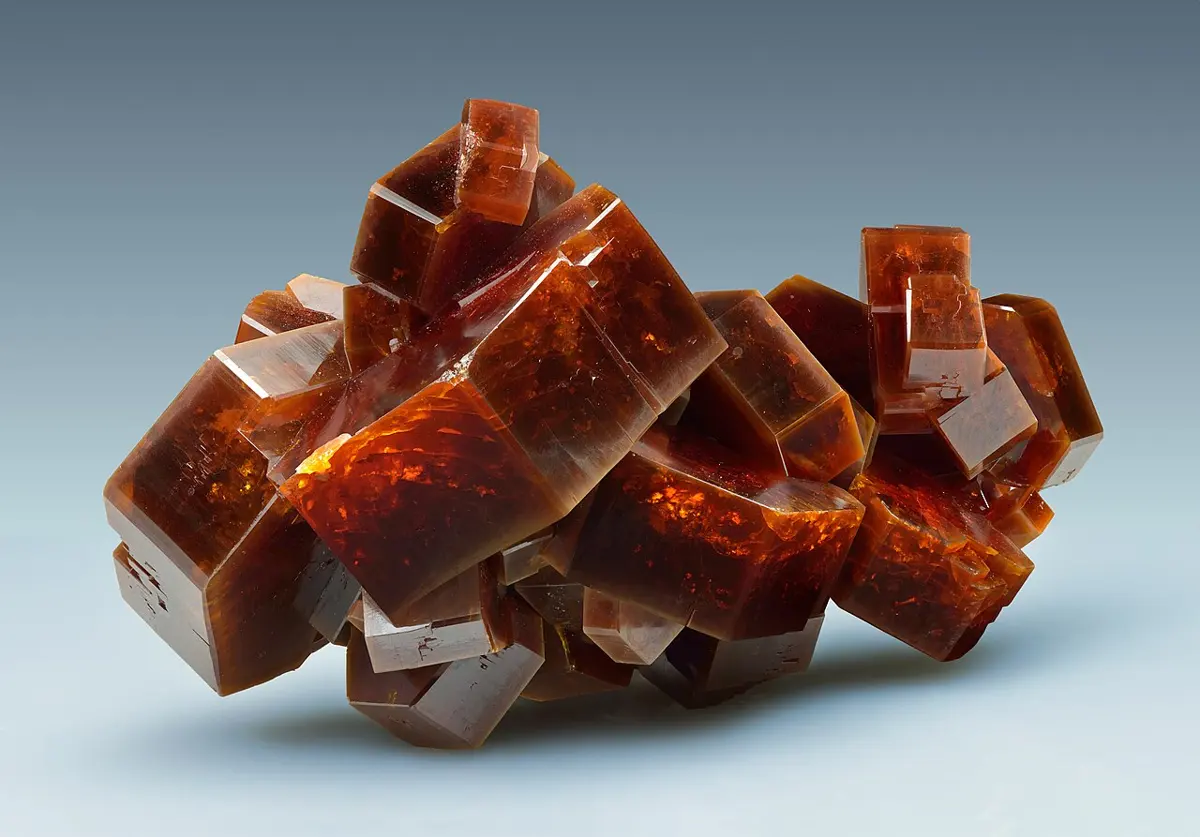
Sefström named it after Vanadís, a name of Freyja, the Norse goddess of beauty, for the beautiful colors of its compounds. The symbol is V. Del Río’s brown lead mineral is now called vanadinite, Pb₅(VO₄)₃Cl.
For years the metal itself could not be made: what chemists took for vanadium was really vanadium joined with nitrogen. In the late 1860s the English chemist Henry Roscoe at last made the metal, by heating vanadium chloride with hydrogen.
Where vanadium is found
In the universe. Vanadium was made inside massive stars and in the explosions that ended them (Getting the atoms out). Its lines can be seen in the light of the Sun.
In the Earth’s crust. Vanadium is not rare. It makes up about 0.01 to 0.02% of the crust, more than copper, zinc or lead. But it is spread thinly through about 65 different minerals and is hardly ever concentrated into a rich ore. So most vanadium is a by-product: some iron ores (titanium-rich magnetite) contain a little of it, and when the iron is made, the vanadium collects in the slag that floats on the molten iron, and is taken out of it. Vanadium is also recovered from the ash of burnt oil and from used catalysts.
In 2025 the world produced about 110,000 tonnes of vanadium, three quarters of it in China, then Russia, Brazil and South Africa (USGS, 2026).
In crude oil. Some crude oils, especially from Venezuela, hold a surprising amount of vanadium. It sits in ring-shaped molecules called porphyrins, much like the ring of chlorophyll, which holds magnesium. In the 1930s the German chemist Alfred Treibs found these rings in oil and saw what they meant: oil was made from the remains of living things, buried and slowly cooked (Oil: buried, then cooked).
In Nepal. No vanadium is mined in Nepal. It arrives inside imported steel, tools and machines.
What vanadium is like
- A silvery-gray metal, a little blue in some lights, and shiny when polished.
- Hard but not brittle. It can be drawn into wire and rolled into sheets Grade 9: Ductile.
- Melts at about 1,910 °C, almost 400 °C higher than iron.
- About 6 g/cm³, a little lighter than iron.
- Resists corrosion. Like titanium and chromium, it is covered at once with a very thin layer of oxide that protects it.
Why a pinch of vanadium makes steel tough
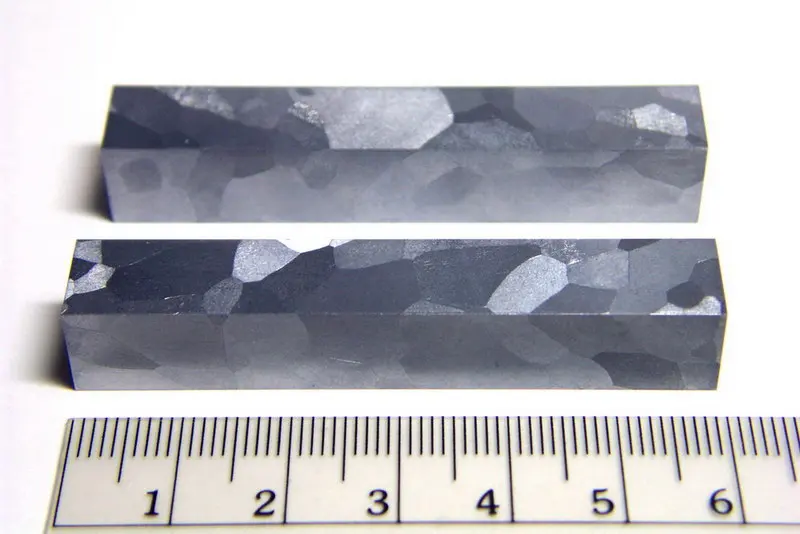
Steel is iron with a little carbon Grade 8: Steel. Like all metals, it is made of tiny crystals, or grains, packed together. Large grains make a steel that cracks more easily; small grains make it stronger and tougher, because a crack has to keep changing direction at every grain edge.
When a little vanadium is added, it joins with some of the carbon and nitrogen in the steel to make countless tiny, very hard particles of vanadium carbide and vanadium nitride. These stop the grains from growing large while the steel is hot, and they pin the grains in place. Just 0.1 to 0.2% of vanadium, a gram or two in each kilogram of steel, makes a strong difference. That is why more than four fifths of all vanadium goes into steel Grade 8: Alloys.
How vanadium reacts
Because of its oxide coat, vanadium is not attacked by water, air or dilute hydrochloric and sulphuric acids at room temperature Grade 9: Metals and dilute acids. Strong oxidizing acids, such as nitric acid, dissolve it.
Heated in air above about 660 °C, it combines with oxygen to form orange-yellow vanadium pentoxide Grade 9: Metals react with oxygen:
4V + 5O₂ → 2V₂O₅
Most metal oxides are basic. Vanadium pentoxide is mainly acidic: it dissolves in alkalis to form salts called vanadates. This is common for metals with a high valency.
Four valencies, four colors
Dissolve a vanadate in acid and you get a yellow solution, with vanadium at valency 5. Add a few granules of zinc, which gives electrons away, and watch. Over the next few minutes the solution turns blue, then green, then violet. Each change happens because the vanadium has taken one more electron and its valency has dropped by one.
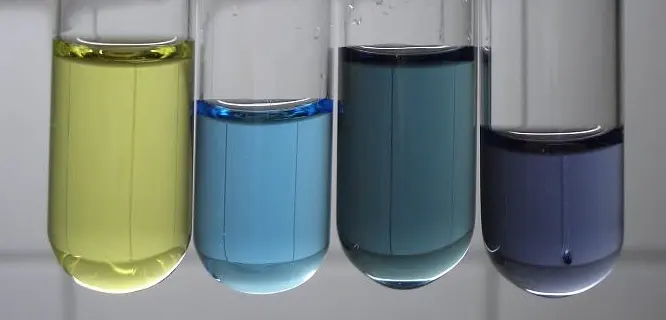
A vanadium solution is yellow. Zinc gives it electrons and it turns blue. What has happened to the vanadium?
Pick an answer to see why.
The catalyst for sulphuric acid
Sulphuric acid is made in larger amounts than any other chemical: for fertilizers, batteries and countless factories (Sulphur). The key step joins sulphur dioxide with oxygen, and on its own this goes far too slowly. Pass the gases over vanadium pentoxide at about 450 °C, and it goes fast. This is the contact process:
2SO₂ + O₂ → 2SO₃ (V₂O₅ catalyst)
The V₂O₅ is a catalyst: it speeds up the reaction and comes out unchanged Grade 10: Catalyst. It works because vanadium changes valency so easily. Vanadium(5) hands an oxygen atom to the sulphur dioxide and becomes vanadium(4); oxygen from the air then turns it back into vanadium(5), ready to do it again (Lowering the hill).
Why is vanadium pentoxide written as a catalyst, and not as a reactant, in the contact process?
Pick an answer to see why.
Vanadium in daily life
Steel. Tools such as spanners, sockets and screwdriver bits; springs, axles, gears and crankshafts in vehicles; high-speed cutting tools that stay hard when hot; and the high-strength steel bars that reinforce concrete in modern buildings.
Titanium alloy. The most used alloy of titanium is Ti-6Al-4V: titanium with 6% aluminium and 4% vanadium. It is in aircraft frames and engines, and in artificial hips and knees (Titanium).
Batteries for the grid. Solar panels make electricity only by day, so it has to be stored for the night. One way is a vanadium flow battery, developed in the 1980s by Maria Skyllas-Kazacos in Australia. Its energy is kept in two big tanks of vanadium solution, at different valencies, which are pumped through a cell to charge it or take electricity out.
Both tanks hold the same element, so if a little solution leaks through the membrane, it is not ruined: only the valency is different. The batteries can be charged and emptied many thousands of times. They are large and heavy, so they are for power stations, not phones.
Other uses. Vanadium pentoxide colors glass and ceramic glazes; wires of vanadium and gallium are used in strong superconducting magnets.
Isotopes of vanadium
Natural vanadium is a mixture of two isotopes: vanadium-51 (28 neutrons), which is stable, and a tiny amount of vanadium-50 (27 neutrons), which is radioactive but decays so slowly (a half-life of more than 10¹⁷ years, millions of times the age of the universe) that it makes no difference.
Vanadium and living things
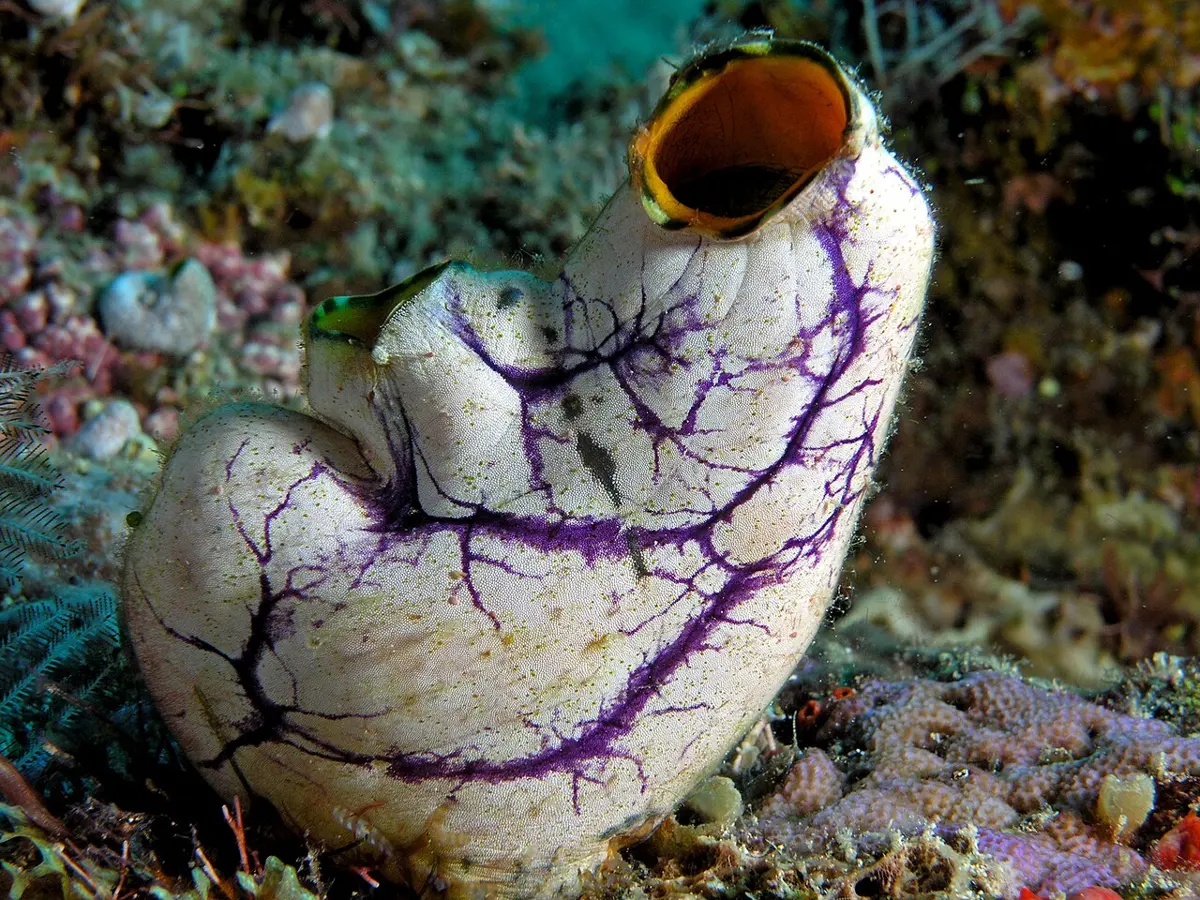
Sea squirts. In 1911 the German scientist Martin Henze found that some sea squirts, small bag-shaped animals that cling to rocks in the sea and filter food from the water, collect vanadium in special blood cells. Their blood holds up to ten million times as much vanadium as the seawater around them. Nobody is yet sure why. One idea is that it makes them taste bad to fish.
A mushroom and seaweeds. The red-and-white fly agaric mushroom, a poisonous one, holds a vanadium compound called amavadin Grade 9: Edible and poisonous mushrooms. Many seaweeds use vanadium in an enzyme that makes bromine compounds.
In people. Your food gives you about a hundredth of a milligram of vanadium a day. Animal studies suggest a trace may be needed, but scientists are not sure whether people need it at all, so no daily amount is recommended. Vanadium is not one of the metals the body is known to need Grade 9: Metals for the human body.
Surprising facts and records
- A battery in four colors. A vanadium flow battery uses all four of vanadium’s colors. As it charges, the tank on one side turns from blue (valency 4) to yellow (5), and the tank on the other side from green (3) to violet (2). As it gives out electricity, they change back.
- Iron’s leftovers. Very little vanadium is mined for its own sake. In China and Russia, the biggest producers, most of it is taken from the slag left over from making iron.
In your science books
- Grade 8: the 2n² rule and steel and its alloys.
- Grade 9: variable valency, metals and oxygen, atomic mass and poisonous mushrooms.
- Grade 10: electronic configuration, transition metals and catalysts (V₂O₅ in making sulphuric acid).
- Going further: how catalysts work, how oil formed and where the atoms in your body came from.
More to explore
- Nobel Prizes with vanadium in them: crown ethers (1987, Charles Pedersen found his first crown ether while trying to make a molecule to hold vanadium).
- Elements next door: titanium, chromium and sulphur, the element of the contact process.
- Play: find vanadium in Guess the Element and the Periodic Table Jigsaw.
- Read more: vanadium at the Royal Society of Chemistry and at PubChem.