
- Atomic number
- 40
- Atomic mass
- 91.22
- Shells
- 2, 8, 18, 10, 2
- Configuration
- 1s² 2s² 2p⁶ 3s² 3p⁶ 4s² 3d¹⁰ 4p⁶ 5s² 4d²
- In the table
- period 5, group 4 (IVB), d-block
- Kind
- Transition metal
- Valency
- 4 (Zr⁴⁺, as in ZrO₂)
- State at 25 °C
- solid
- Melts · boils
- 1,855 °C · 4,409 °C
- Density
- 6.5 × as heavy as water
- Known since
- 1789
A ring in a jewelry shop sparkles almost like a diamond, for a hundredth of the price. A dentist fits a tooth-colored crown that will not crack for years. In a nuclear power station, thousands of thin metal tubes hold the uranium fuel, while the neutrons that keep the reactor going pass straight through their walls. And in the sand of the Narayani lie tiny crystals that can tell how old the rocks of the Himalaya are.
All four are the work of one element, zirconium. Here is its story.
The zirconium atom
A zirconium atom has 40 protons, so zirconium’s atomic number is 40, and 40 electrons. About half of all zirconium atoms (51%) have 50 neutrons, so their mass number is 40 + 50 = 90.
Its shells are 2, 8, 18, 10, 2: the N shell, which could hold 32, has 10 Grade 8: Bohr and Bury’s rule. As in yttrium, the element before it, the electrons after strontium go into the 4d subshell, part of the N shell, once 5s is full Grade 10: The Aufbau principle. Zirconium has two of them:
1s² 2s² 2p⁶ 3s² 3p⁶ 4s² 3d¹⁰ 4p⁶ 5s² 4d²
Its place in the periodic table
- Period 5, because its electrons are in five shells.
- Group 4, called IVB in the older naming many books use. Above it is titanium, below it hafnium.
- d-block, because its last electrons go into a d subshell: a transition metal Grade 10: Metals.
Its valency
Zirconium uses all four of its outer electrons, the two 5s and the two 4d. In its compounds it has a valency of 4: zirconium oxide (zirconia) is ZrO₂, zirconium chloride ZrCl₄, and the mineral zircon, zirconium silicate, ZrSiO₄ Grade 8: Valency. Unlike iron or copper, zirconium almost always has this one valency, and its compounds are mostly white or colorless.
Zirconium has a valency of 4 and oxygen 2. What is the formula of zirconium oxide?
Pick an answer to see why.
How zirconium was found and named
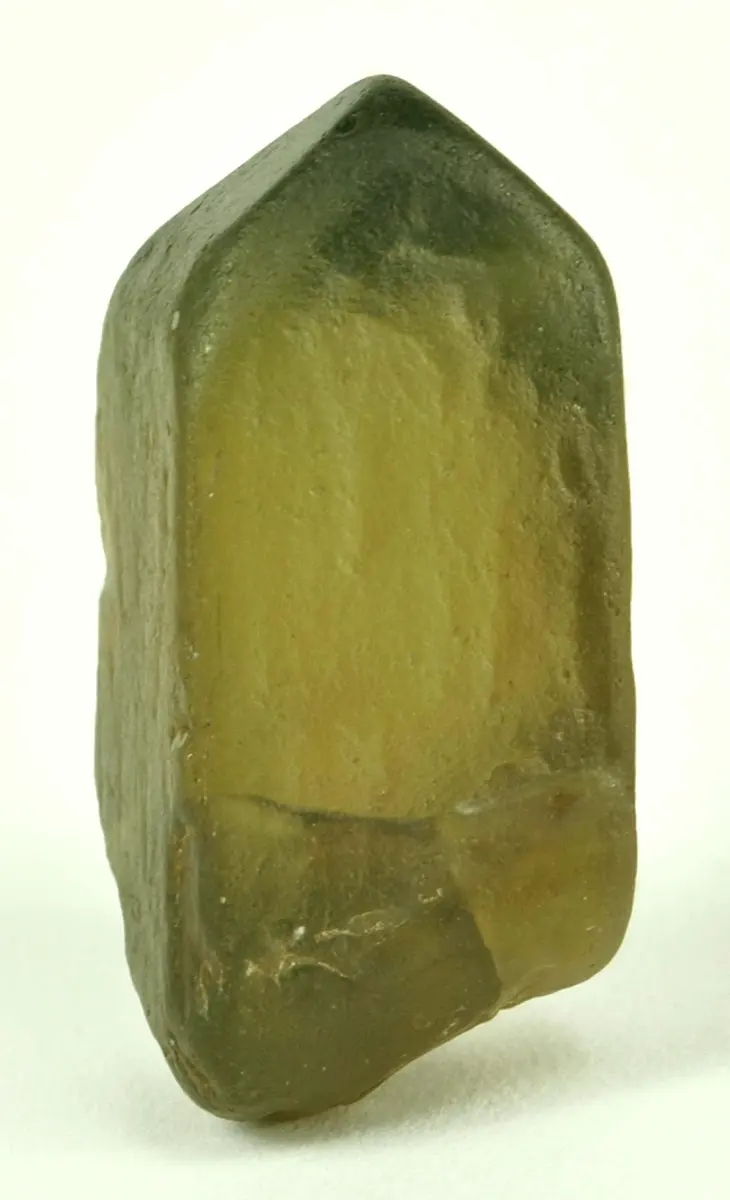
The gem zircon has been worn as jewelry since ancient times, in colors from golden brown to red, green and blue, and colorless. Its name probably comes from the Persian zargun, “gold-colored”.
- 1789. The German chemist Martin Heinrich Klaproth, in Berlin, analyzed a zircon from Sri Lanka (then called Ceylon). He found a new earth (a metal oxide) in it, which he called Zirkonerde, zirconia. It was a new element’s oxide, but he could not get the metal out.
- 1808. Humphry Davy tried with electricity, as he had for sodium, potassium and strontium, and failed: zirconia holds its oxygen too tightly.
- 1824. The Swedish chemist Jöns Jacob Berzelius heated a zirconium compound with potassium and got zirconium as an impure black powder.
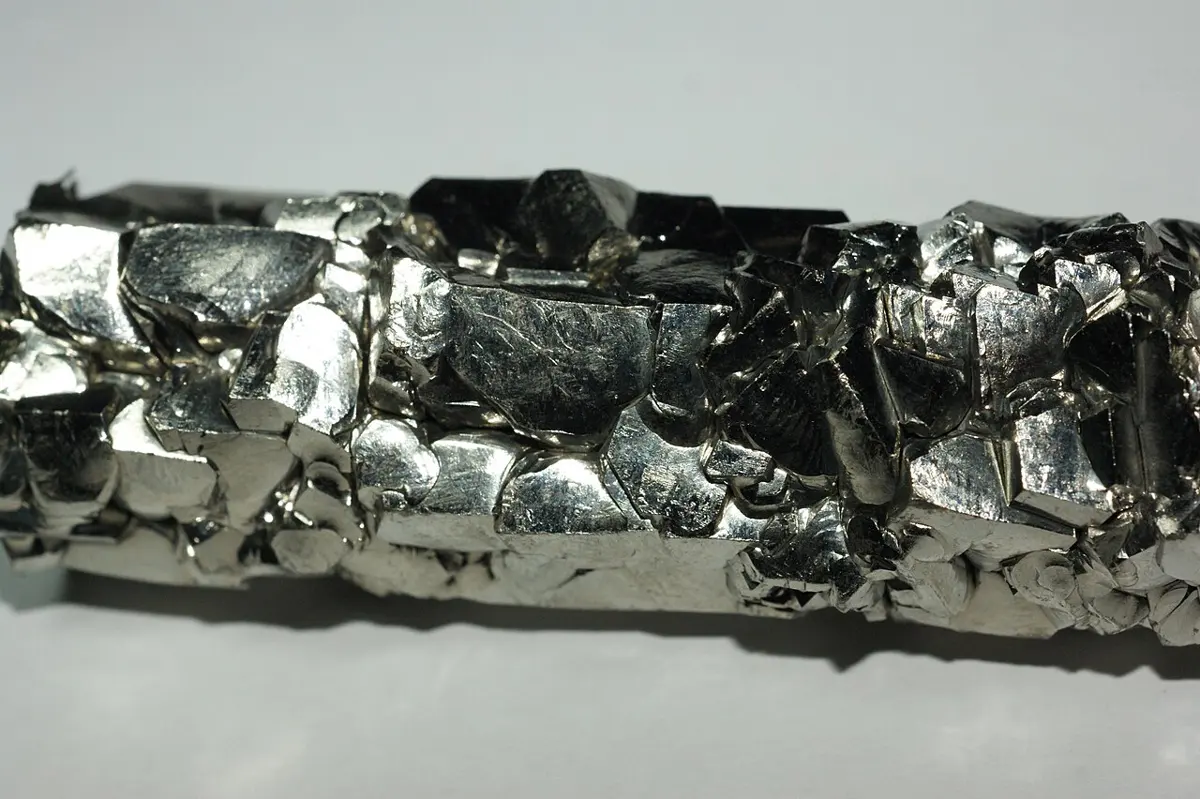
- 1925. The Dutch chemists Anton van Arkel and Jan Hendrik de Boer made the first really pure zirconium. They let zirconium iodide vapor touch a white-hot wire; the iodide broke up, and pure zirconium grew on the wire, crystal by crystal, into a bar like the one in the photo.
The symbol is Zr. Nepali books use the English name.
The twin that hid for 134 years
All zirconium found in nature contains 1 to 3% of another element, so like it that no one noticed it until 1923, when Dirk Coster and George de Hevesy, in Copenhagen, found it by the X-rays it gave out. They named it hafnium, after Hafnia, the Latin name of Copenhagen. Hafnium is directly below zirconium in group 4, and its atoms are almost exactly the same size. For most uses the two need not be separated, but for one they must, as you will see.
Where zirconium is found
In the universe. Zirconium, like strontium and yttrium, is made when nuclei catch neutrons, mostly slowly, inside old giant stars (Slowly, in giant stars). Zirconium-90, with its especially stable 50 neutrons, is the most common.
In the Earth’s crust. Zirconium is fairly common: about 130 grams in every tonne of rock, more than copper or zinc. It is never found as the metal. Its main mineral is zircon (ZrSiO₄), which forms in granite and other rocks that cooled from molten magma and is so hard and unreactive that it survives when the rock wears away. Rivers carry the grains to the sea, and with other heavy minerals they collect in beach sands. Most zircon is dug from such sands, together with titanium minerals. In 2025 the world mined over a million tonnes of zircon, most of it in Australia and South Africa (USGS, 2026).
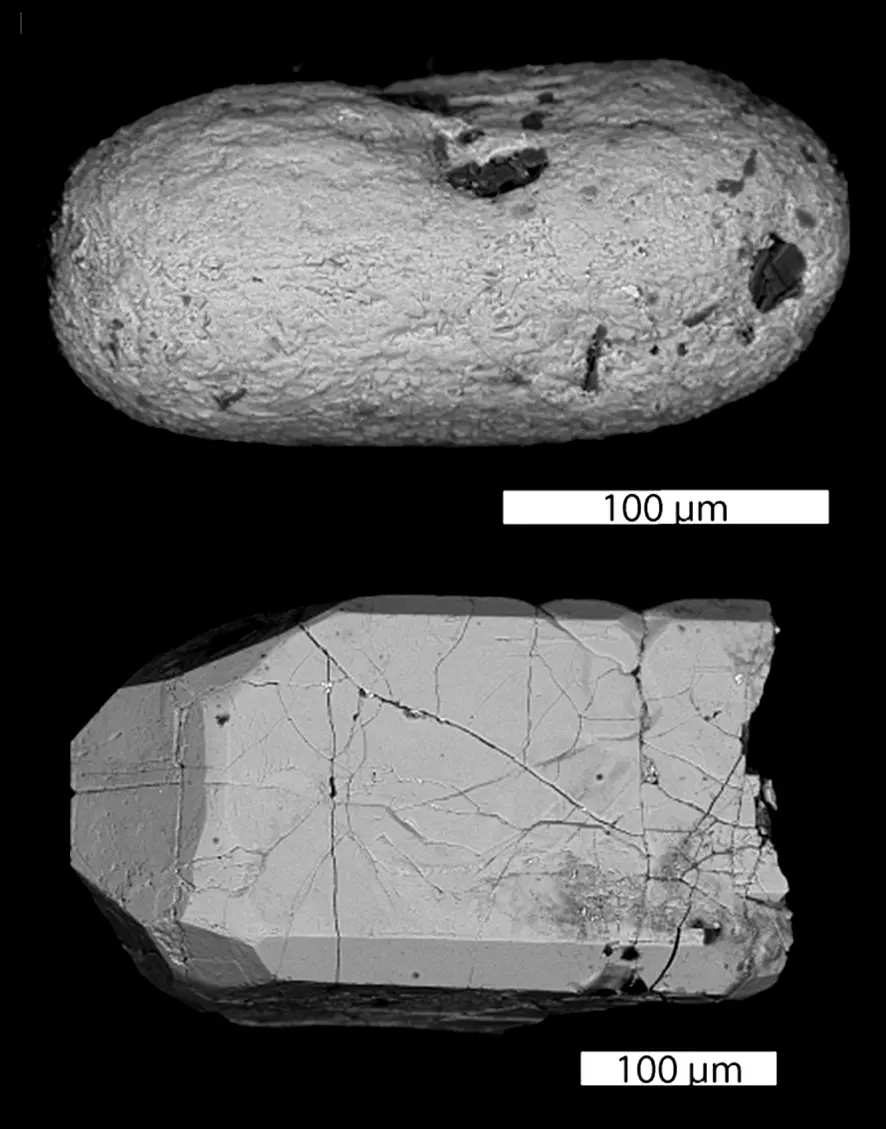
In Nepal. No zircon is mined in Nepal, but the sand of the Narayani, the Koshi and the Karnali carries tiny zircon grains washed out of rocks across the whole Himalaya (Zircons in Nepal’s rivers).
The oldest crystals on Earth
When a zircon crystal grows in molten rock, it takes in a few uranium atoms in place of zirconium, but keeps lead out. Uranium slowly decays into lead, at a steady, known rate. So the lead in a zircon tells how long ago it crystallized: zircon is a clock (Why zircon is the perfect clock).
The oldest pieces of the Earth ever found are zircon grains from the Jack Hills in Western Australia, 4.4 billion years old: older than any rock, and only about 150 million years younger than the Earth itself (The oldest pieces of the Earth).
What zirconium is like
- A hard, silvery-gray metal, which can be bent and drawn into tubes when pure.
- Fairly light: its density is 6.52 g/cm³, less than iron’s (7.87).
- Melts at 1,855 °C, hotter than iron (1,538 °C).
- Does not corrode. A thin, tight layer of zirconium oxide forms on its surface at once and protects it, so it resists water, seawater, most acids and alkalis even when hot. Chemical factories use zirconium pipes and tanks for liquids that would eat through steel.
- Neutrons pass through it. This is its most unusual property, and the reason most zirconium metal is made.
How zirconium reacts
Although its oxide layer protects it, zirconium is a reactive metal underneath.
- With oxygen. A solid piece is safe, but powder or thin shavings burn with a brilliant white light, giving zirconium oxide Grade 9: Metals react with oxygen:
Zr + O₂ → ZrO₂ - With steam. Above about 900 °C, zirconium takes the oxygen from steam, giving off hydrogen:
Zr + 2H₂O → ZrO₂ + 2H₂ - Making the metal. Zirconium oxide is too stable to reduce with carbon, so the metal is made from zirconium chloride, by heating it with the more reactive metal magnesium (the Kroll process, as for titanium) Grade 10: Reduction:
ZrCl₄ + 2Mg → Zr + 2MgCl₂
In the Kroll process, ZrCl₄ + 2Mg → Zr + 2MgCl₂. What kind of reaction is this?
Pick an answer to see why.
Zirconium in nuclear reactors
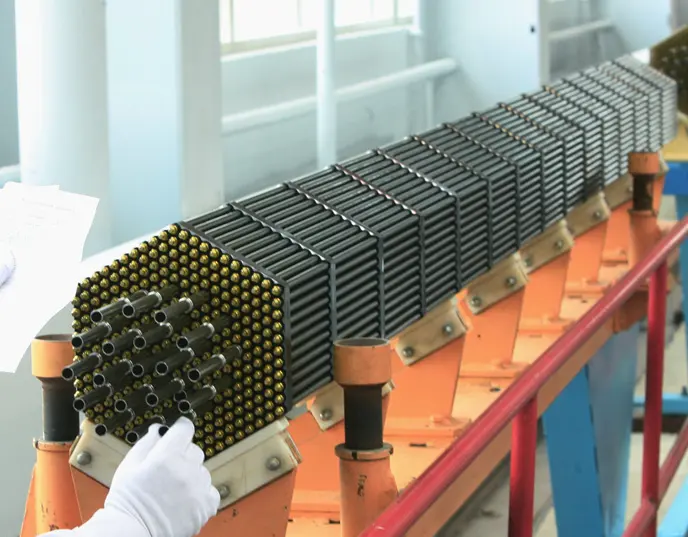
In a nuclear power station, uranium nuclei split when they catch a slow neutron, giving out energy and two or three new neutrons, which go on to split more nuclei Grade 9: Nuclear fission. The uranium, as pellets of uranium oxide, is packed in long, thin tubes, surrounded by water. The tubes must stand heat and hot water for years, and must not swallow the neutrons, or the chain of fissions would stop.
Iron and nickel, in steel, catch neutrons easily. Aluminium and magnesium let them through, but melt below 700 °C. Zirconium lets neutrons through almost as well, melts at 1,855 °C and does not corrode in hot water. So the fuel tubes of nearly every power reactor are made of zirconium alloy, zirconium with a little tin, niobium or iron. A big reactor can hold more than 100 kilometers of such tubes.
Remember hafnium, the hidden twin? It soaks up neutrons over 500 times more strongly than zirconium. So for reactors, the hafnium must be taken out of zirconium, a hard job because the two are so alike. The hafnium is not wasted: it makes control rods, which are lowered into a reactor to soak up neutrons and slow it down.
Zirconium in daily life
Cubic zirconia. Zirconium oxide can be grown into large, clear crystals, if a little yttrium oxide is added to keep the crystals in their cubic form (see yttrium). Cut like a diamond, this cubic zirconia (CZ) sparkles almost as brightly, for a tiny part of the price. It has been made since the 1970s and is the most common imitation diamond.
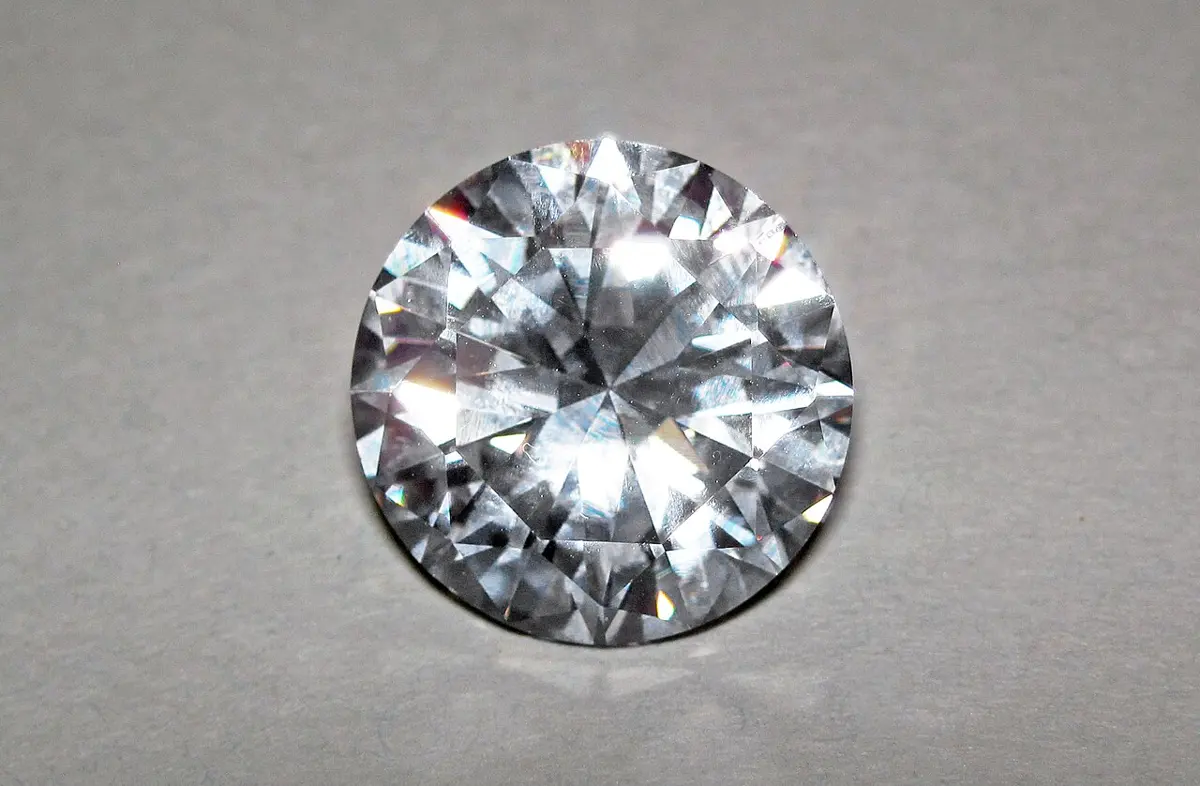
A diamond sparkles because light inside it is totally internally reflected again and again Grade 10: The sparkle of a diamond. Cubic zirconia bends light almost as much:
| diamond | cubic zirconia | glass | |
|---|---|---|---|
| refractive index | 2.42 | about 2.17 | about 1.5 |
| hardness (Mohs scale, out of 10) | 10 | about 8 | about 5.5 |
| density (g/cm³) | 3.5 | about 5.8 | about 2.5 |
So a jeweler can tell them apart: cubic zirconia is about 1.7 times as heavy as a diamond of the same size, and its facets get scratched and rounded over the years.
Ceramics. Zirconia toughened with yttrium is one of the strongest ceramics. It makes white dental crowns and implants, parts of artificial hip joints, ceramic knives that stay sharp for years, and the oxygen sensors in car exhausts. Zirconia also lines furnaces, because it stands great heat.
Tiles and toilets. Most zircon is not made into metal at all: it is ground into a fine powder that makes the glaze on tiles, washbasins and toilets bright and white, and it is used as a heat-proof sand for casting molten metal (USGS, 2026).
Antiperspirants. Many antiperspirants contain a compound of aluminium and zirconium that blocks sweat.
Isotopes of zirconium
Natural zirconium is a mixture of five isotopes Grade 9: Atomic mass:
| isotope | neutrons | share of natural zirconium |
|---|---|---|
| zirconium-90 | 50 | 51.45% |
| zirconium-91 | 51 | 11.22% |
| zirconium-92 | 52 | 17.15% |
| zirconium-94 | 54 | 17.38% |
| zirconium-96 | 56 | 2.80% |
Zirconium-96 is radioactive, but only just: its half-life is about 20 billion billion years (2 × 10¹⁹ years), more than a billion times the age of the universe. Zirconium-90 is where the decay of strontium-90 ends, by way of yttrium-90.
Zirconium and your health
Zirconium has no known job in the body, and it has low toxicity: the small amounts in food do no harm. That, and its resistance to corrosion, is why it is trusted in teeth, joints and surgical tools.
Surprising facts and records
- The oldest thing on Earth. A 4.4-billion-year-old zircon grain from the Jack Hills is the oldest known piece of our planet.
- A hidden twin. Every piece of zirconium ever used, until 1923, held a few percent of an element no one knew was there: hafnium.
- Gold-colored name. Zircon’s name probably comes from Persian for “gold-colored”, though zircons come in many colors.
In your science books
- Grade 8: valency and the 2n² rule.
- Grade 9: the criss-cross method, atomic mass and nuclear fission.
- Grade 10: the Aufbau principle, transition metals, reduction, single displacement, the critical angle and the sparkle of a diamond.
- Going further: how zircon dates rocks, the oldest pieces of the Earth, fission and where zirconium is made.
More to explore
- Its neighbors: yttrium before it, titanium above it, and uranium, the fuel its tubes hold.
- Play: find zirconium in Guess the Element, the Periodic Table Jigsaw and Higher or Lower.
- Read more: zirconium at the Royal Society of Chemistry and at PubChem.