
Put an ice cube in a steel bowl and in a few minutes it is a puddle. Put a spoonful of salt in a dry iron pan on the highest flame of the gas stove, and it just sits there, crackling a little. It will still be salt crystals when the pan is too hot to touch. Salt melts only at 801 °C.
Here is a stranger pair. Water and methane, the gas that burns in a biogas stove, are made of molecules of almost the same size: a water molecule is only a little heavier than a methane molecule. Yet water boils at 100 °C, and methane at −162 °C. At room temperature one is a liquid you drink, the other a gas you burn.
What makes the difference? The particles of every substance pull on each other, some hard, some hardly at all. Nobody can see those pulls. But you can measure them, with a thermometer. This topic shows you how.
What melting and boiling really do
You learned in Grade 9 that salt is made of ions held by electrovalent (ionic) bonds, and that ionic compounds have high melting points, while covalent compounds like water and methane have low ones (Characteristics of electrovalent compounds; Characteristics of covalent compounds). You were told it as a fact. Here is why it is true, and how to use it.
The particles of everything are always jiggling. The hotter a substance, the harder they jiggle: temperature is a measure of the average energy of that jiggling. At the same time, the particles pull on each other.
- In a solid, the pulls win. Each particle jiggles about a fixed place, held there by its neighbors.
- Melting happens when the jiggling is strong enough for particles to slip past each other. They still touch and still pull; they just aren’t locked in place. That is a liquid.
- Boiling happens when the jiggling is strong enough to tear particles away from the liquid altogether. In a gas, the particles are far apart and hardly pull on each other at all.
So the harder the particles pull on each other, the hotter you must make them before they melt, and hotter still before they boil. A melting point or a boiling point is a measurement of how strongly the particles of a substance hold on to each other.
Now an important detail. In water, two different kinds of holding are going on.
Inside a water molecule, the oxygen and the two hydrogens are held by covalent bonds, and those are strong: to break water into hydrogen and oxygen you need electricity or a temperature of thousands of degrees. Between one water molecule and the next there is a separate, much weaker pull. When water boils, only those weak pulls between the molecules are broken. The bubbles in a pot of boiling water are full of H₂O molecules, not hydrogen and oxygen.
So for a substance made of molecules, the melting and boiling points tell you about the pulls between its molecules, called intermolecular forces (inter means “between”). They tell you nothing about the bonds inside.
A pot of water is boiling on the stove. What is inside the bubbles?
Pick an answer to see why.
All these pulls, between ions, between atoms and between molecules, are electrical: positive charges attracting negative ones. Ions have whole charges, so they pull hard. As you will see, molecules can have small, partial charges, so they pull gently.
How much energy does it take?
You can measure the pull another way: by the heat needed to pull the particles apart, at the melting or boiling point, where the temperature stays the same until the change is complete. The heat needed to change 1 kg of a substance from solid to liquid without any change in temperature is its specific latent heat of fusion; from liquid to gas, its specific latent heat of vaporization. Both are measured in joules per kilogram (J/kg). The heat needed is
where m is the mass and L the specific latent heat. (It is like Q = msΔt from Grade 10, Calculating heat, but with no temperature change.)
| Substance | Specific latent heat of fusion | Specific latent heat of vaporization |
|---|---|---|
| water | 334,000 J/kg (at 0 °C) | 2,260,000 J/kg (at 100 °C) |
| ethanol | 108,000 J/kg (at −114 °C) | 840,000 J/kg (at 78 °C) |
| methane | 59,000 J/kg (at −182 °C) | 510,000 J/kg (at −162 °C) |
Four kinds of solid
Melting points sort solids into four families, by what their particles are and how they hold together.
| Kind of solid | Particles | What holds them | Examples (melting point) |
|---|---|---|---|
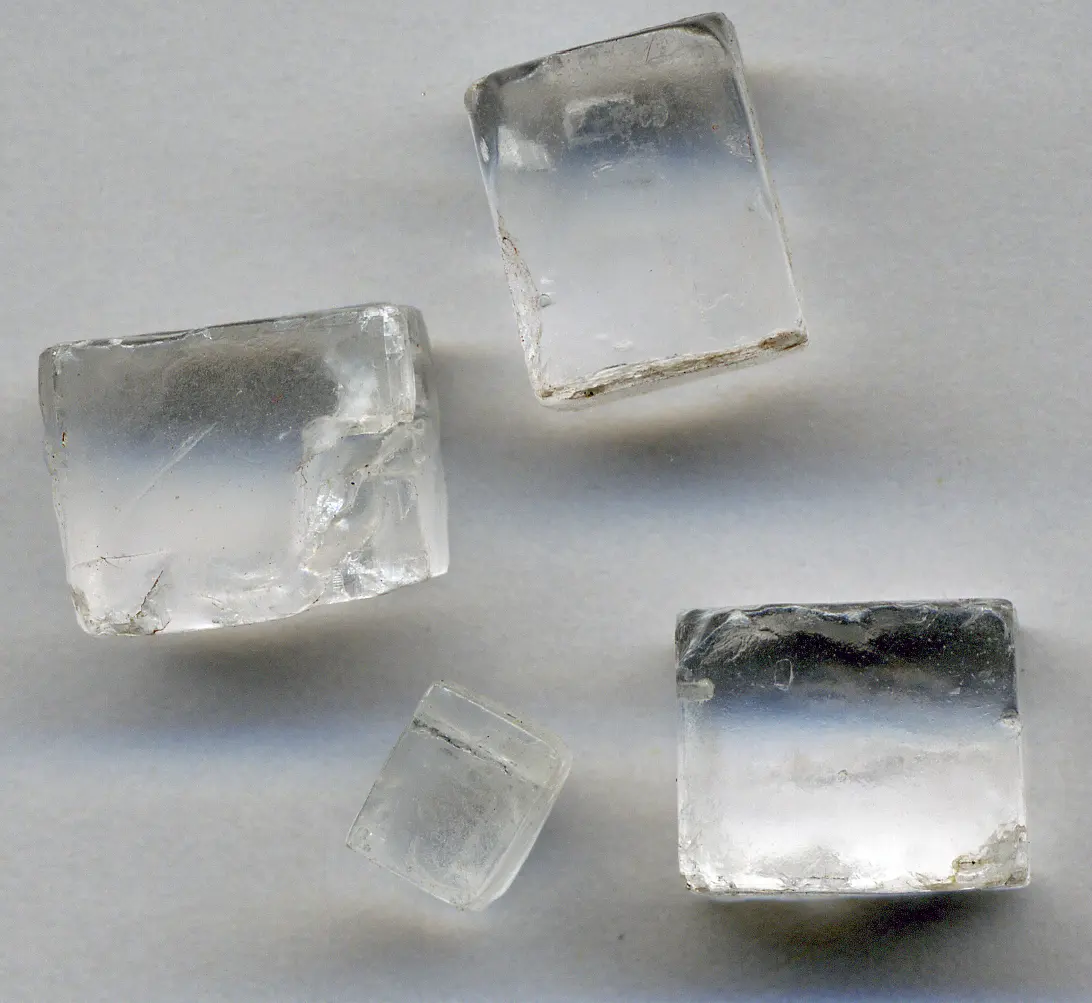
| ionic | positive and negative ions | the pull between opposite charges, on every side | salt, NaCl (801 °C); magnesium oxide, MgO (over 2,800 °C) |
| metallic | metal ions in a sea of shared electrons | the pull between the ions and the electrons around them | sodium (98 °C); iron (1,538 °C); tungsten (3,422 °C) |
| giant covalent network | atoms | covalent bonds, through the whole crystal | quartz (sand), SiO₂ (about 1,700 °C); diamond (doesn’t melt at normal pressure) |
| molecular | molecules | weak pulls between the molecules | ice (0 °C); iodine (114 °C); wax (about 60 °C); methane (−182 °C) |
Ionic solids are hard to melt because every ion is held by all the ions of opposite charge around it, in every direction, through the whole crystal. In magnesium oxide the ions carry double charges, Mg²⁺ and O²⁻. Doubling both charges makes the pull between them four times as strong (and these ions are smaller, so closer together, which makes it stronger still). That is why magnesium oxide melts at over 2,800 °C, and is used to line furnaces.
Metals range widely. In a metal, the outer electrons are shared by all the atoms and drift between them Grade 9: What is inside a metal. Sodium has only one shared electron per atom and big atoms, so its pull is weak and it melts at only 98 °C, below the boiling point of water. Iron and tungsten share more and hold on much harder.
Giant covalent networks have no separate molecules at all: the whole crystal is held together by covalent bonds, the strong kind. To melt it you must break covalent bonds, so the melting points are very high. You met one in Grade 9: diamond, every carbon atom bonded to four others Grade 9: Diamond, graphite and fullerene. Sand and quartz are another.
Molecular solids melt easily, because melting them only separates molecules, held by the weak pulls between them. The covalent bonds inside each molecule are just as strong as those in quartz, but melting never touches them.
A white solid melts at 1,710 °C. It doesn’t conduct electricity, solid or melted, and doesn’t dissolve in water. What kind of solid is it most likely to be?
Pick an answer to see why.
Sodium chloride melts at 801 °C, sodium bromide at 747 °C and sodium iodide at 661 °C. Chloride, bromide and iodide ions all have a charge of −1, but get bigger in that order. What does this pattern tell you?
Pick an answer to see why.
Why molecules pull on each other at all
A molecule has no overall charge. So why should two molecules attract each other? There are two reasons, and both come from the electrons.
Molecules with charged ends
In Grade 10 you met electronegativity: how strongly an atom pulls on electrons Grade 10: Electropositivity and electronegativity. In a covalent bond between two different atoms, the more electronegative atom pulls the shared electrons towards itself. They are still shared, just not equally.
In water, oxygen is much more electronegative than hydrogen. The shared electrons spend more time near the oxygen, so the oxygen end of the molecule is slightly negative and the hydrogen ends slightly positive. Chemists write these partial charges with the Greek letter delta: δ− and δ+. Because the molecule is bent, at 104.5°, its charges don’t cancel: one side is negative, the other positive. A molecule like this is called polar.
Methane is different. Carbon and hydrogen pull on electrons almost equally, and the four hydrogens sit evenly around the carbon, pointing to the corners of a pyramid with a triangular base (a tetrahedron). Whatever small charges there are cancel out. Methane is non-polar.
Polar molecules line up, the positive end of one near the negative end of the next, and attract each other. In water the attraction is unusually strong, for a reason of its own: the hydrogen is tiny, so the slightly positive hydrogen of one molecule can get very close to the slightly negative oxygen of the next. This special attraction is called a hydrogen bond. You met it in Grade 10, holding ice in its open pattern Grade 10: Anomalous expansion of water. It forms when a hydrogen joined to a small, very electronegative atom (nitrogen, oxygen or fluorine) is pulled towards a nitrogen, oxygen or fluorine of another molecule.
Molecules with no charged ends
Methane, nitrogen and the noble gases have no charged ends, yet they too turn liquid when cooled enough: nitrogen at −196 °C, helium at −269 °C. So even these must attract each other a little.
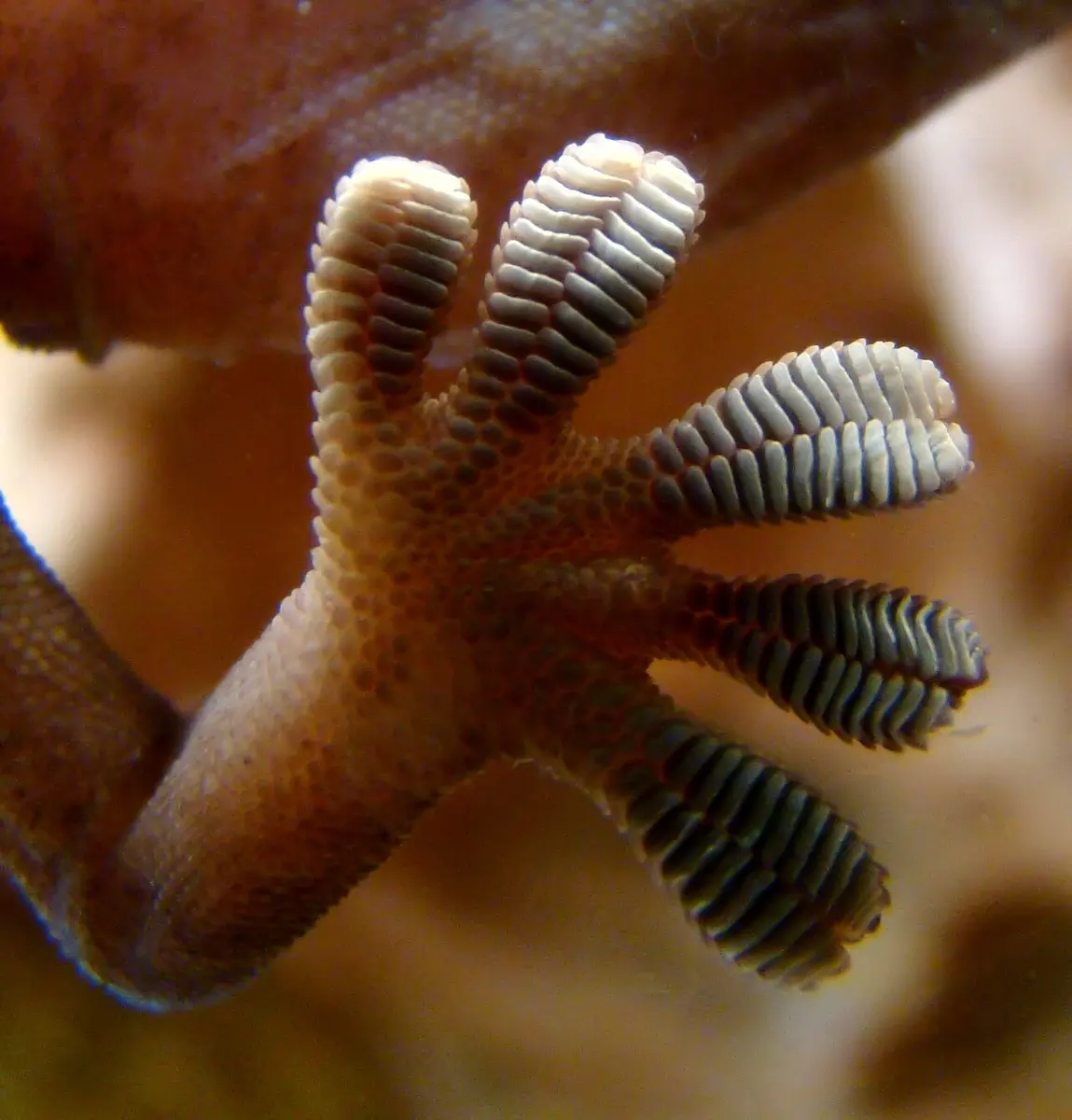
The electrons in an atom or molecule are always moving. At any instant, they may happen to be a little more on one side than the other, giving a tiny, short-lived δ− on that side and δ+ on the other. That nudges the electrons of the next molecule out of place too, and for a moment the two attract. These flickering pulls exist between all atoms and molecules, polar or not. They are weak, but:
- The more electrons a molecule has, the more its electron cloud can be pushed out of shape, and the stronger the pull. So bigger molecules pull harder.
- The longer a molecule, the more of it touches its neighbors, and the more the small pulls add up.
The pulls between molecules (polar or not, flickering or permanent) are often called van der Waals forces, after the scientist who first saw that they must exist.
Fluorine (F₂) boils at −188 °C, chlorine (Cl₂) at −34 °C, bromine (Br₂) at 59 °C and iodine (I₂) at 184 °C. Why?
Pick an answer to see why.
Water: the odd one out
Now you can test an idea with data. In the periodic table, oxygen sits at the top of group 16, above sulphur, selenium and tellurium. Each of these makes a compound with hydrogen of the same shape: H₂O, H₂S, H₂Se, H₂Te. Going down the group, the molecules get bigger, with more electrons, so you would expect the boiling points to rise steadily, with water, the smallest, the lowest of all.
Water is far off the trend. If it followed its group, it would boil somewhere near −80 °C, and there would be no liquid water on Earth, no rivers, no rain, and no life. Instead it boils at 100 °C, because of its hydrogen bonds. The other two that stand out, ammonia (NH₃) and hydrogen fluoride (HF), are exactly the other molecules where hydrogen is joined to nitrogen, oxygen or fluorine. Methane, with its carbon, follows the trend.
That is evidence for hydrogen bonds: something extra holds those three molecules together, beyond what their size would give them. And water has more of it than the other two: each water molecule has two hydrogens to give and two lone pairs of electrons on its oxygen to receive, so it can make up to four hydrogen bonds at once.
Ethanol (molecular mass 46) boils at 78 °C. Propane (molecular mass 44, almost the same) boils at −42 °C. What best explains the difference?
Pick an answer to see why.
More evidence: surface tension and evaporation
Boiling and melting points are not the only clues. Two everyday things show the same pulls.
Surface tension
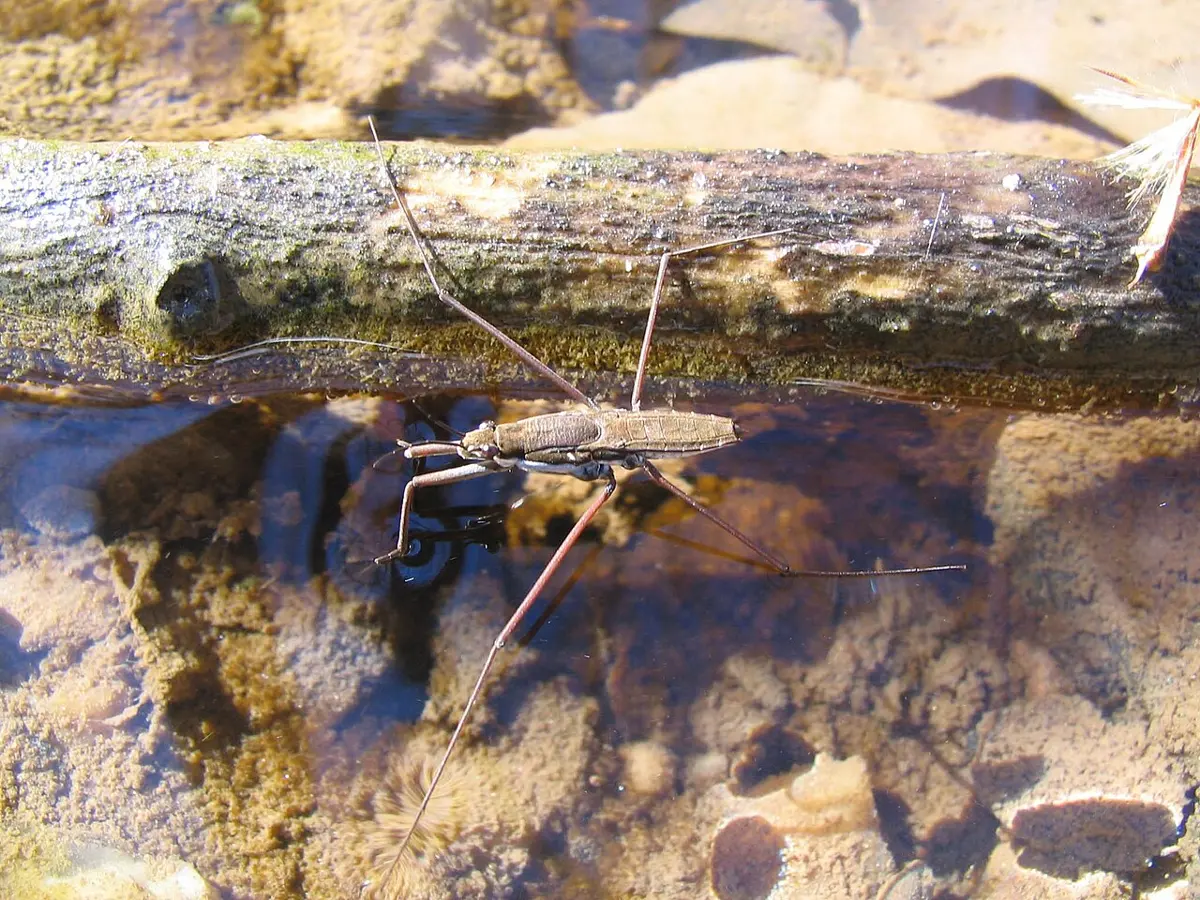
A drop of water on a leaf pulls itself into a ball. A pond skater stands on a pond without sinking. A sewing needle, laid gently on water, floats. All of these come from the pull between molecules.
A molecule deep inside the water is pulled equally in every direction by its neighbors, so the pulls cancel. A molecule at the surface has no water molecules above it, only air, so it is pulled sideways and inwards. The surface behaves like a stretched skin, always trying to shrink: that is why a drop is round. The strength of this skin is the liquid’s surface tension, and it is bigger when the pull between molecules is stronger. Water’s surface tension is more than three times that of alcohol. Mercury’s, held by metallic bonding, is nearly seven times that of water, which is why spilled mercury breaks into shiny beads.
Evaporation and vapor pressure
Wet clothes dry on a line far below 100 °C. Even in a cool liquid, the jiggling energy is shared out unevenly: at any moment a few molecules at the surface are moving fast enough to break free. That is evaporation. The weaker the pull between molecules, the more of them escape each second, so the faster the liquid evaporates. Nail polish remover (acetone) on your fingers is gone in seconds; spirit in a minute or two; water much more slowly.
In a closed jar, the escaping molecules can’t get away. They fill the space above the liquid, and some bump back into it. Soon as many return each second as escape, and the vapor above the liquid stays at a fixed pressure: the liquid’s vapor pressure. A liquid whose molecules hold on weakly has a high vapor pressure. Heat it, and more molecules can escape, so the vapor pressure rises, faster and faster.
A liquid boils when its vapor pressure becomes equal to the pressure of the air above it: then bubbles of vapor can form inside the liquid and push the air aside. That is why water boils at about 95 °C in Bhaktapur, where the air pressure is lower than at sea level Grade 10: Boiling below 100 °C.
At 20 °C, the vapor pressure of water is 2.3 kPa, of ethanol 5.9 kPa and of acetone 24.6 kPa. Which liquid’s molecules attract each other most strongly?
Pick an answer to see why.
Investigate: which liquid holds together best?
Now find the order yourself, with things from home. Scientists compare substances in a fair test: change one thing (which liquid), measure the result, and keep everything else the same.
Questions
Which of these needs the most energy?
Pick an answer to see why.
A student says: “When water boils, the bonds between hydrogen and oxygen break.” Explain what is wrong, and say what does happen.
Answer
The O–H bonds are covalent bonds inside each water molecule, and boiling doesn’t break them: steam is still made of H₂O molecules. What boiling breaks are the much weaker attractions between molecules (mostly hydrogen bonds), so that each molecule escapes from its neighbors into the gas. Breaking the O–H bonds would turn water into hydrogen and oxygen, which needs far more energy, as in electrolysis.
How much heat is needed to turn 2.5 kg of water at 100 °C into steam? (Specific latent heat of vaporization of water = 2,260,000 J/kg.)
Answer
A laboratory has four solids, A to D. Use the evidence to decide what kind of solid each is (ionic, metallic, giant covalent or molecular). Explain each choice.
| Solid | Melting point | Conducts when solid? | Conducts when melted? |
|---|---|---|---|
| A | 80 °C | no | no |
| B | 714 °C | no | yes |
| C | 1,710 °C | no | no |
| D | 660 °C | yes | yes |
Answer
A: molecular. The low melting point means only weak pulls between its particles; no ions or free electrons, so it never conducts. (It could be naphthalene, the mothball compound, 80 °C.)
B: ionic. A high melting point, and it conducts only when melted: its ions are fixed in the solid but free to move in the liquid. (Magnesium chloride melts at 714 °C.)
C: giant covalent. A very high melting point means strong bonds throughout, but it never conducts, so no ions and no free electrons: atoms held by covalent bonds. (Quartz.)
D: metallic. It conducts even as a solid, which only metals (and graphite) do. (Aluminium melts at 660 °C.)
The noble gases are single atoms. Their boiling points are: helium −269 °C, neon −246 °C, argon −186 °C, krypton −153 °C, xenon −108 °C. (i) Describe the trend.
- ii.Explain why single atoms with full outer shells attract each other at all.
- iii.Explain the trend.
Answer
- i.The boiling point rises steadily down the group, from −269 °C for helium to −108 °C for xenon.
- ii.The electrons in an atom are always moving. At any instant they may be a little more on one side, giving the atom a tiny, short-lived δ− on that side and δ+ on the other. This pushes the electrons of a neighboring atom out of place too, and the two attract for a moment. These flickering pulls act between all atoms and molecules.
- iii.Going down the group, the atoms have more electrons, further from the nucleus, which are more easily pushed out of shape. So the flickering pulls are stronger, more energy is needed to separate the atoms, and the boiling point rises.
Hydrogen sulphide, H₂S, has the same shape as water and more electrons, yet it is a gas at room temperature (boiling point −60 °C). Water boils at 100 °C. Explain the difference.
Answer
Oxygen is much more electronegative than sulphur, and a small atom. In water, the O–H bonds are very polar, so the hydrogens are strongly δ+ and the oxygen strongly δ−; a hydrogen of one molecule can come very close to the oxygen of the next and form a hydrogen bond. In H₂S the S–H bonds are hardly polar, and sulphur is too big and not electronegative enough for hydrogen bonds. H₂S molecules are held only by the weaker pulls, so they separate at a much lower temperature, even though H₂S has more electrons.
Plan an investigation to compare the strength of the pulls between molecules in three clear liquids, using only evaporation. Say what you would change, what you would measure, what you would keep the same, and how you would use your results.
Answer
Change: the liquid (for example water, spirit and acetone).
Measure: the time each takes to evaporate completely.
Keep the same: the volume of each sample (the same dropper, the same number of drops), the surface it sits on (one plate, so the same material), the area it spreads over as far as possible, the place (same temperature, same air movement, out of direct sunlight), and the starting time. Repeat each liquid three times and average the times.
Use: the faster a liquid evaporates, the more easily its molecules escape, so the weaker the pulls between them. Rank the liquids by time, slowest (strongest pulls) to fastest (weakest). Check the ranking against another kind of evidence, such as their boiling points or a drops-on-a-coin test.
Explain why salt (NaCl) melts at 801 °C but ice melts at 0 °C. Use the words ion, molecule and hydrogen bond in your answer.
Answer
Salt is made of Na⁺ and Cl⁻ ions. Each ion is pulled by the six ions of opposite charge around it, and those by theirs, through the whole crystal. These pulls between whole charges are strong, so the ions must jiggle very hard, at 801 °C, before they can slip past each other. Ice is made of separate water molecules with no overall charge. They are held to each other by hydrogen bonds, the pull between the slightly positive hydrogen of one molecule and the slightly negative oxygen of the next. These pulls between partial charges are much weaker, so a much lower temperature, 0 °C, is enough to let the molecules slip past each other. Melting ice doesn’t break the water molecules themselves.
Where to go next
- Why Do Some Reactions Get Hot? This topic was about the weak pulls between molecules. The strong bonds inside them break and form in chemical reactions, and that is where the heat of a fire comes from.
- Why Is Spider Silk So Strong? Hydrogen bonds between long protein chains help make silk tougher, weight for weight, than steel. How the way particles are arranged decides what a material can do.
- How Do You Count Atoms by Weighing Them? Why 18 g of water and 16 g of methane hold exactly the same number of molecules.