
- Atomic number
- 5
- Atomic mass
- 10.81
- Shells
- 2, 3
- Configuration
- 1s² 2s² 2p¹
- In the table
- period 2, group 13 (IIIA), p-block
- Kind
- Metalloid
- Valency
- 3 (shared, not as B³⁺ ions)
- State at 25 °C
- solid
- Melts · boils
- 2,075 °C · 4,000 °C
- Density
- 2.4 × as heavy as water
- Known since
- 1808
Pour boiling water into a beaker in your school laboratory and it will not crack, though a drinking glass might. A goldsmith in Asan or Patan melting gold sprinkles on a white powder, सुहागा, so the metal flows clean. Children everywhere mix glue with a pinch of borax to make wobbly slime. And in some fields of Nepal, wheat grows tall but its ears stay empty. All four are stories of one element: boron.
Boron is element 5. It is neither a true metal nor a true non-metal, but something in between. Here is its story.
The boron atom
Every boron atom has 5 protons, so boron’s atomic number is 5, and a neutral atom has 5 electrons. About four boron atoms in five have 6 neutrons (mass number 5 + 6 = 11); the rest have 5 neutrons (boron-10).
By the 2n² rule Grade 8: Bohr and Bury’s rule, the K shell takes 2 electrons and the L shell the other 3: 2, 3. In subshells Grade 10: The Aufbau principle that is 1s² 2s² 2p¹: boron is the first element to put an electron into a p subshell.
Its place in the periodic table
- Period 2, because its electrons are in two shells, between beryllium (4) and carbon (6).
- Group 13, called IIIA in the older naming, because it has three outer electrons.
- p-block, because its last electron goes into a p subshell. Boron is the first element of the p-block.
Below boron in group 13 are aluminium, gallium, indium and thallium, all metals. Boron is the only one that is not: it is a metalloid Grade 10: Metalloids. The metalloids sit on a diagonal “staircase” between the metals on the left of the table and the non-metals on the right, and boron is at the top of it.
Its valency
With three outer electrons, boron has a valency of 3: its oxide is B₂O₃ and its chloride BCl₃ Grade 9: Molecular formula. But unlike aluminium below it, boron does not form B³⁺ ions. Its atom is tiny, and losing three electrons would take far too much energy, so boron shares its three electrons in covalent bonds Grade 9: Covalent bond.
Aluminium (2, 8, 3) and boron (2, 3) both have three outer electrons. What is the difference in how they combine?
Pick an answer to see why.
How boron was found and named
People used boron’s compounds for centuries before anyone knew the element.
Borax from Tibet. Borax is a white mineral, a compound of sodium, boron and oxygen with water. For hundreds of years, the borax used in India and Europe came from dry salt lakes in Tibet, carried over the Himalaya. In a letter printed by the Royal Society in London in 1787, the head of the Capuchin mission in Tibet described a valley “twenty-eight days journey to the north of Nepal” where villagers waded into the pools to dig borax, and sold it “into Thibet and Nepal”. Goldsmiths and metalworkers used it as a flux: melted onto hot metal, it dissolves the dirty layer of oxide, so the metal flows and joins cleanly. Nepal’s goldsmiths still use it for that; in Nepali it is सुहागा.
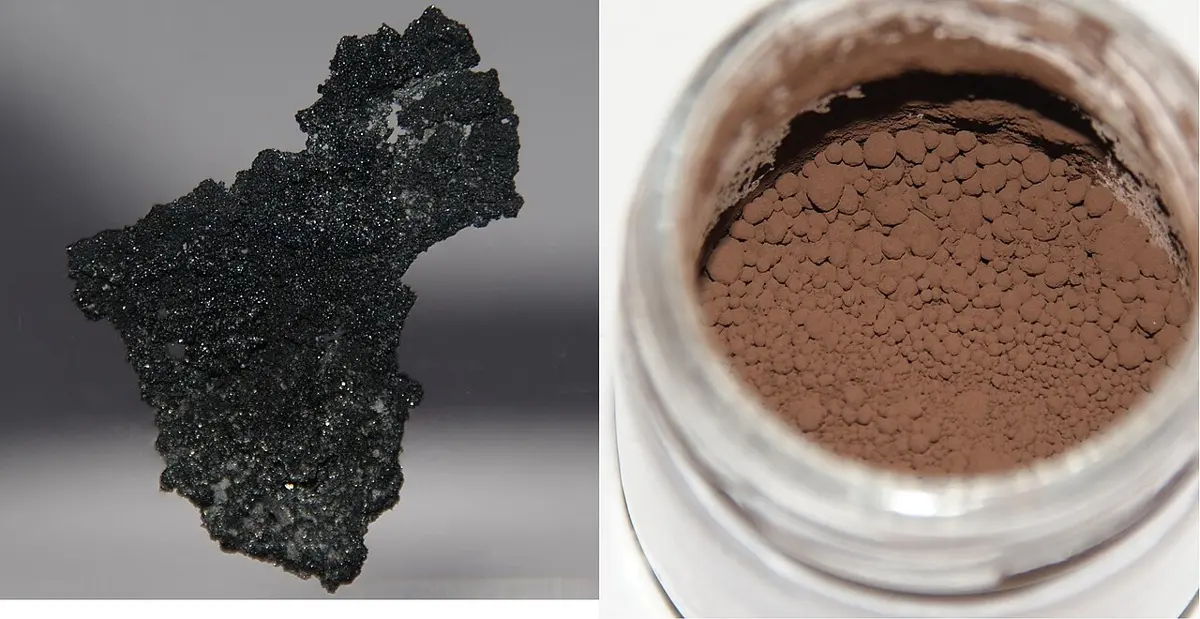
The element. In 1808, Joseph Louis Gay-Lussac and Louis-Jacques Thénard in Paris and Humphry Davy in London, working separately, each got a brown powder out of boric acid or borax. It was a new element, though far from pure: pure boron is so hard to make that it was only obtained in 1909, a century later, by the American chemist Ezekiel Weintraub.
The name. Davy first called it boracium, after borax. He then changed it to boron: bor- from borax, and -on from carbon, the element it resembles in many ways. Its symbol is B. The word borax itself came to English through Arabic būraq from Persian. Nepali has no word of its own for the element: the books call it बोरोन.
Where boron is found
In the universe. Like lithium and beryllium, boron is rare for a light element. Stars destroy it rather than make it. Almost all of it was made by cosmic rays, fast nuclei that smashed into carbon, nitrogen and oxygen atoms in space and chipped off pieces (Getting the atoms out).
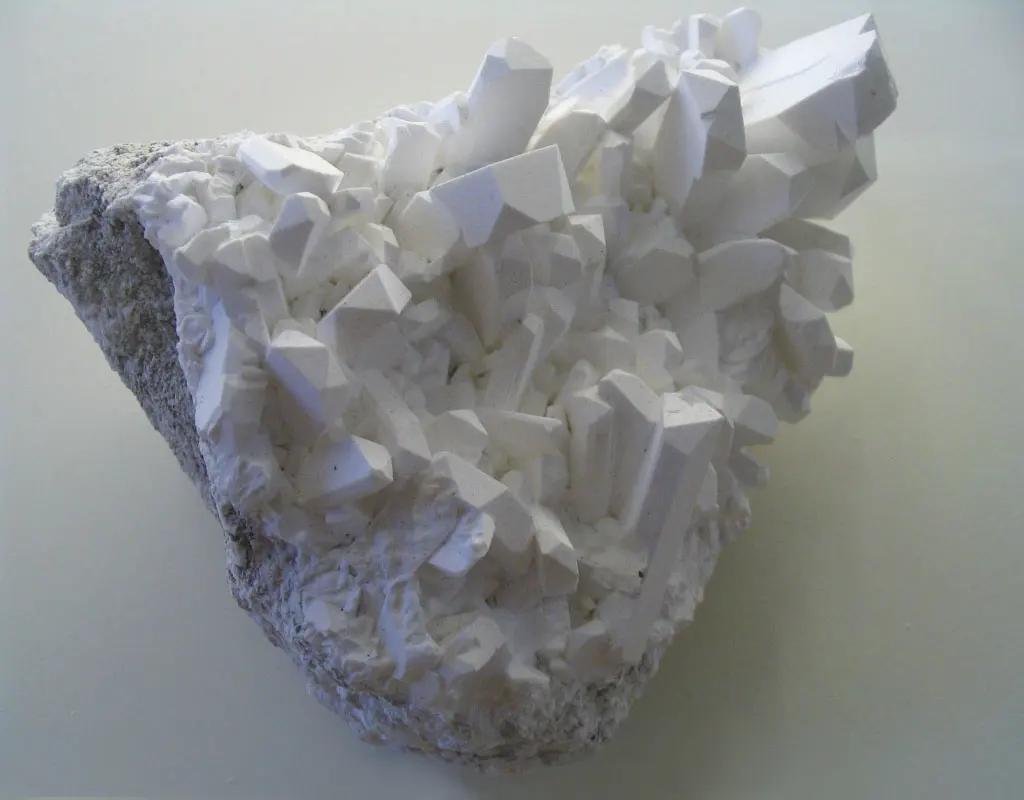
In the Earth’s crust. Ordinary rock has only about 10 grams of boron per tonne. But boron compounds dissolve in water. Where hot springs and volcanoes bring boron up into lakes with no outlet, in a dry climate, the water evaporates and leaves thick beds of borates (compounds of boron and oxygen with a metal): borax, kernite, colemanite and ulexite. Boron is never found as the free element.
The largest beds are in Turkey, which holds most of the world’s known reserves and produced about 1.5 million tonnes of refined borates in 2025; others are in the Mojave Desert of California, in Chile, Bolivia, Argentina and Peru, and in China (USGS, 2026). Nepal has no borate mines.
In living things. Plants need boron (see below). You take in about 1 to 2 milligrams a day with your food, mostly from fruit, vegetables, nuts and pulses.
What boron is like
Pure boron comes in two forms. Crystalline boron is black, shiny and very hard. Amorphous boron (with no regular crystal shape) is a brown powder.
- Melts at about 2,075 °C, one of the highest melting points of any element.
- Light, about 2.3 g/cm³, a little lighter than aluminium.
- Brittle: it cannot be beaten into sheets or drawn into wire.
- A poor conductor of electricity at room temperature, but a better one when hot. Metals do the opposite: they conduct a little worse when hot. A material whose conductivity rises with temperature is a semiconductor. Silicon, boron’s neighbor on the staircase, is the famous one.
This mixture of properties is what makes boron a metalloid. It looks a little like a metal, but it is brittle, conducts poorly and forms covalent bonds like a non-metal Grade 9: Metals, non-metals and metalloids.
A substance is shiny and black, very hard and brittle, conducts electricity poorly when cold and better when hot. What is it most likely to be?
Pick an answer to see why.
How boron reacts
Crystalline boron is quite unreactive at room temperature: water, air and hydrochloric acid leave it alone. Heated strongly in air, amorphous boron burns, giving boron oxide Grade 8: Chemical reaction:
4B + 3O₂ → 2B₂O₃
Boron oxide is an acidic oxide, like the oxides of non-metals: with water it gives a weak acid, boric acid:
B₂O₃ + 3H₂O → 2H₃BO₃
Its important compounds
- Boric acid, H₃BO₃: white, flaky crystals. It is a very weak acid, weak enough that a dilute solution was long used to wash eyes and wounds as a mild antiseptic. It also kills cockroaches and ants.
- Borax, Na₂B₄O₇·10H₂O, sodium borate: a white salt whose solution is mildly alkaline. It is used in some washing powders, as a goldsmith’s flux, and in glass and the glaze on tiles and pottery.
- Boron nitride, BN: made of boron and nitrogen. One form is soft and slippery like graphite (“white graphite”), and another is almost as hard as diamond.
- Boron carbide, B₄C: one of the hardest materials made by people, used in body armor.
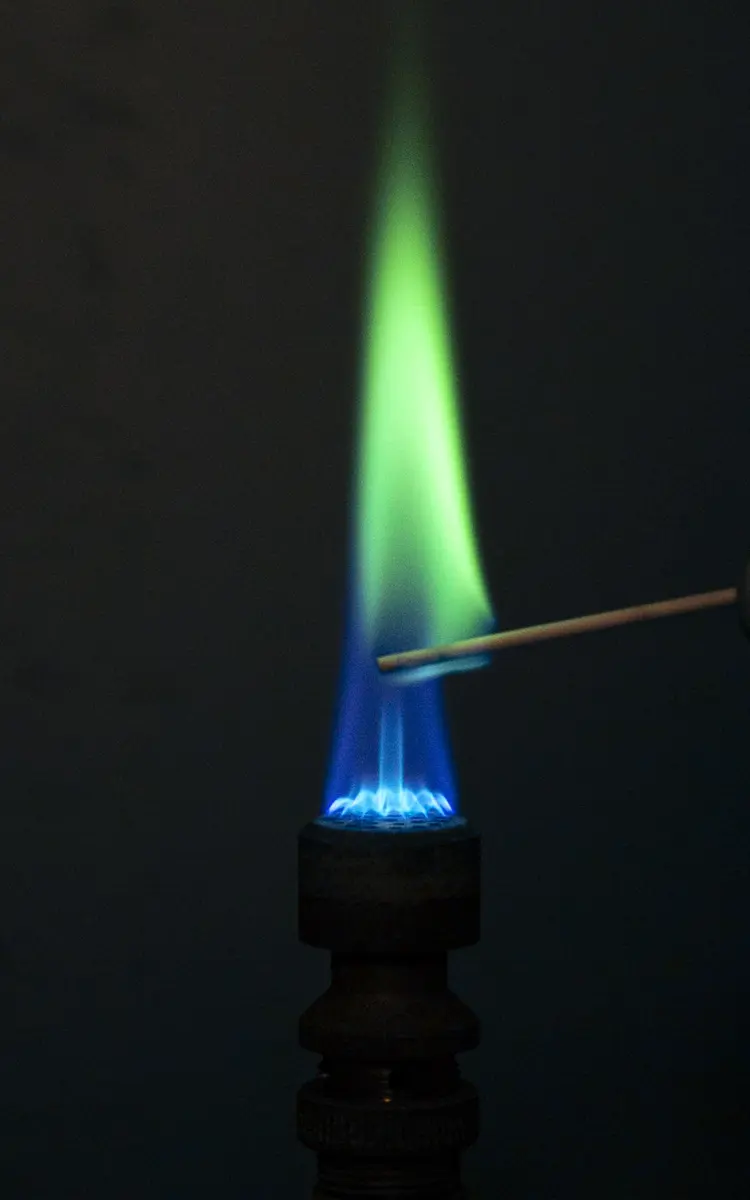
A green flame. Boron compounds color a flame green. Mix boric acid with methanol and burn it, and the flame is green. Fireworks get their green from boron, or from barium (Why each element has its own lines).
Boron at work
Glass that doesn’t crack
Ordinary glass, the glass of bottles, windows and tumblers, is made from sand, soda and lime. When boiling water is poured into a cold tumbler, the inside of the glass gets hot and expands at once, while the outside is still cold. The inner layer pushes on the outer layer, and the glass can crack Grade 10: Four warnings, four reasons.
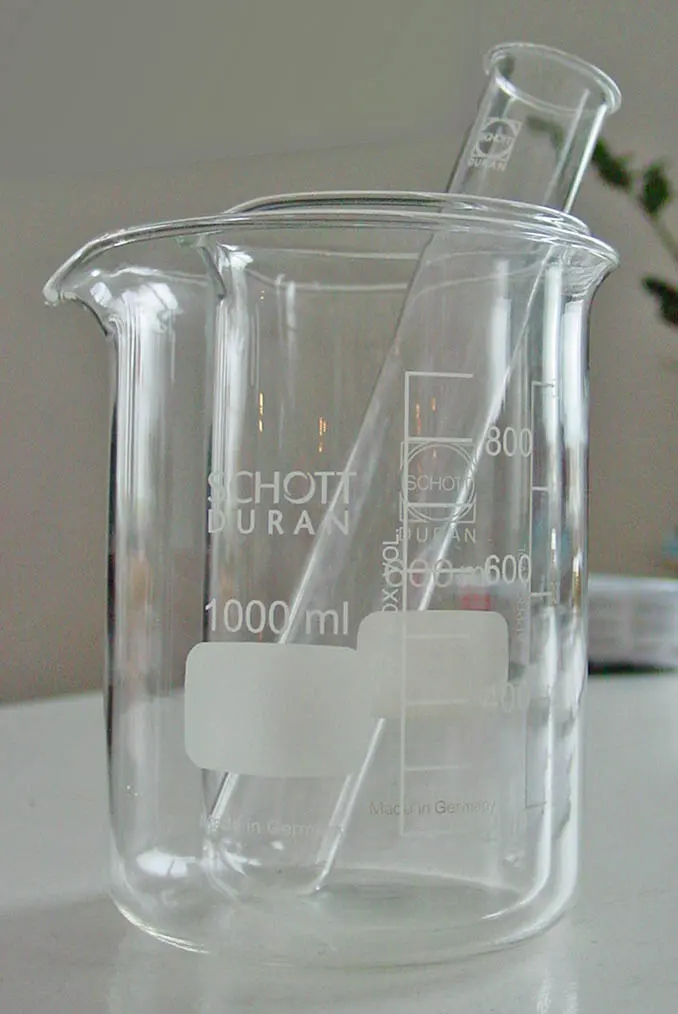
Add about 13% boron oxide to the glass and you get borosilicate glass, which expands only about a third as much when heated. Less expansion means less strain, so it can go from cold to hot without cracking. That is why beakers, test tubes and flasks are made of it; look at a beaker in your laboratory and it probably carries a borosilicate brand such as Borosil or Duran. Ovenware and the glass tubes of solar water heaters are borosilicate too.
More uses
- Fiberglass: the glass wool that insulates houses and the glass fibers in boats and helmets are mostly borosilicate glass.
- Magnets: the strongest permanent magnets, neodymium magnets (Nd₂Fe₁₄B), are an alloy of neodymium, iron and boron. They are in earphones, phone speakers, hard disks and the motors of electric cars.
- Electronics: a trace of boron added to pure silicon leaves “holes” where electrons are missing and turns it into a p-type semiconductor, one half of every transistor and solar cell (the transistor).
- Nuclear power: boron-10 swallows neutrons, so rods containing boron are pushed into a nuclear reactor to slow it down or stop it.
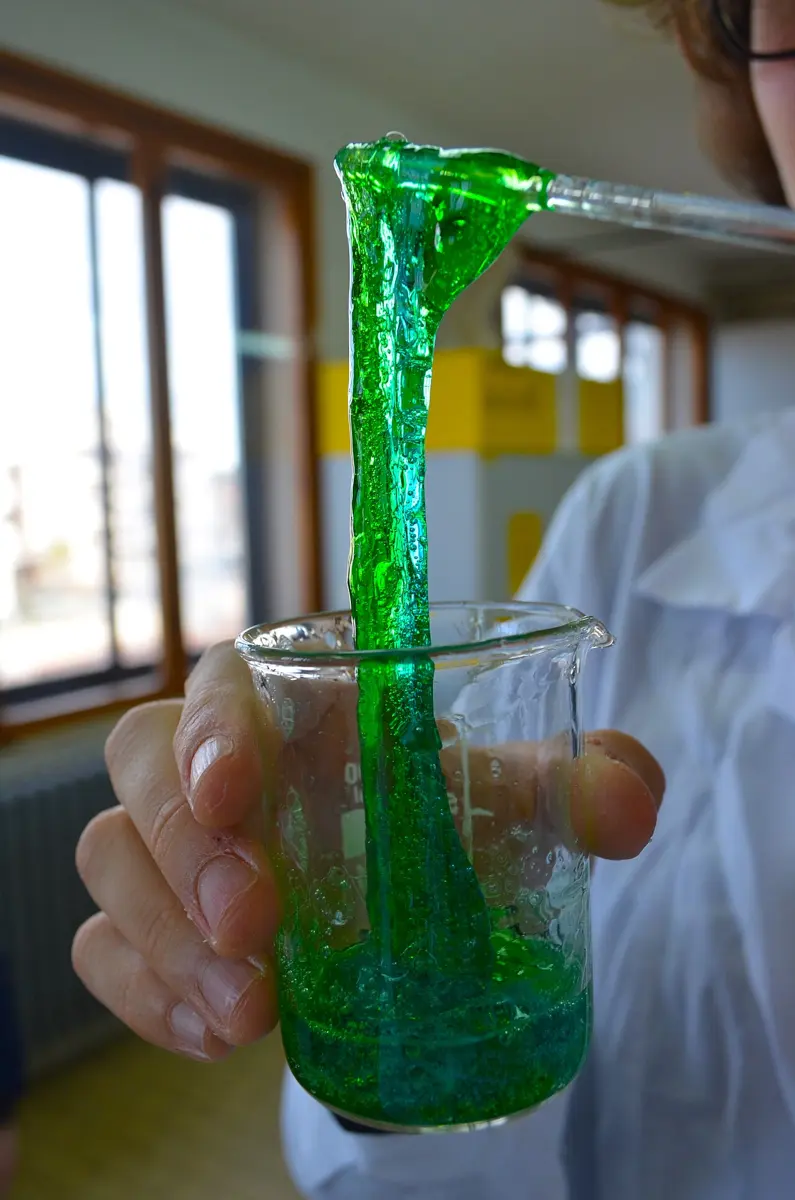
Boron and plants: Nepal’s fields
Boron is one of the micronutrients plants need in tiny amounts Grade 9: Micronutrients. It holds the walls of plant cells together, and it is needed where plants grow fastest: the tips of shoots and roots, and the pollen tubes that grow from a grain of pollen down to the ovule to make a seed. So when the soil is short of boron, the plant may look healthy but fail at the moment it forms flowers and seeds.
Nepal’s farmers know two signs of it well:
- Empty ears of wheat. In parts of Nepal, wheat on boron-poor soil grows normally but many of its flowers are sterile, and the ears hold few grains. Scientists at Nepal’s research farms found that some wheat varieties suffer much more than others, and that adding boron cures it.
- Hollow cauliflower stems. Cauliflower short of boron grows a hollow, cracked stem and brownish curds. Trials from Terhathum to Rupandehi found that a little boron in the soil prevents it and raises the harvest.
The cure is easy: a few kilograms of borax spread over a hectare of field, or sprayed on the leaves. But not too much: there is only a small gap between too little boron and too much, and a heavy dose burns the leaves.
Isotopes of boron
Natural boron is a mixture of two isotopes, neither radioactive: about 20% boron-10 (5 neutrons) and 80% boron-11 (6 neutrons). So its atomic mass is 10.81, not a whole number Grade 9: Atomic mass. The exact share varies a little from place to place, from about 19% to 20% boron-10, which is why tables give boron’s atomic mass as 10.81 and no more exactly.
Boron and your health
Scientists are not yet sure that people need boron, though it may help bones and joints; plants certainly do. A normal diet gives 1 to 2 mg a day, which is safe.
In large amounts, boric acid and borax are poisonous: swallowed, they cause vomiting and diarrhea, and can harm the kidneys. Babies are most at risk, because their bodies get rid of boron slowly: boric acid used again and again as an eye wash or on broken skin has poisoned babies, which is why it is no longer used that way.
Surprising facts and records
- A town called Boron. One of the world’s biggest borax mines is beside a town in California’s Mojave Desert named Boron.
- The first p electron. Boron is the first element in the table with an electron in a p subshell.
- Treating tumors. Doctors are testing a treatment in which a boron compound that collects in a tumor is hit with slow neutrons; each boron-10 nucleus that swallows a neutron splits and damages only the cell it is in.
In your science books
- Grade 8: atoms and symbols, the 2n² rule and valency.
- Grade 9: metalloids, covalent bonds, atomic mass and plant micronutrients.
- Grade 10: electronic configuration, metalloids in the periodic table and why glass cracks.
- Going further: flame colors and spectra and where the atoms in your body came from.
More to explore
- Nobel Prizes with boron in them: the transistor (1956, boron makes p-type silicon), joining carbon atoms with palladium (2010, Suzuki’s reaction hands a carbon over from boron), the first radioactive atoms made by people (1935, boron was one of the first elements made radioactive) and graphene (2010, whose cousin is boron nitride).
- Play: find boron in Guess the Element and the Periodic Table Jigsaw.
- Read more: boron at the Royal Society of Chemistry and at PubChem.