
Pick up a steel spoon and a wooden one. The steel one is cold to the touch, shiny, heavy, and rings when you drop it. The wooden one feels warmer, is dull, and lands with a soft thud. Hammer a copper coin and it goes flat; hammer a lump of coal and it shatters.
These differences are not accidents. They come from what is happening inside the two materials, down at the level of atoms and electrons. In this unit you will find out what makes a metal a metal, how metals react with air, water and acids, which metals your body cannot live without, and which two metals can quietly poison it.
Metals, non-metals and metalloids
Everything around you is made of matter, and some of that matter is made of a single kind of atom: the elements. Elements are sorted into three groups:
- Metals, such as iron, copper, aluminium, gold and sodium;
- Non-metals, such as carbon, sulphur, oxygen and chlorine;
- Metalloids, such as silicon and boron, which are in between: they behave partly like metals and partly like non-metals.
Of the 118 elements known, the great majority (more than 90) are metals. We use metals more than any other kind of element: for cooking pots, buses, bridges, coins, wires and phones.
A few metals, such as gold and platinum, are found in nature as the pure metal: we say they occur in the free state. Most metals have joined with other elements long ago, and are found in rocks as compounds, called ores; the metal has to be taken out of them.
Metals are not only around us but inside living things. Every red blood cell carries iron, which holds the oxygen you breathe. Every green leaf has a magnesium atom at the center of each molecule of chlorophyll, the green pigment that catches sunlight.
Activity 17.1: metals around you
General properties of metals
The properties of metals are of two kinds:
- Physical properties: what a metal is like, and how it behaves when you hammer, stretch, heat or touch it. Nothing new is made.
- Chemical properties: how a metal reacts with other substances, such as air, water and acids, to make new substances.
What is inside a metal
Almost every property of a metal comes from one fact. In a metal, the atoms are packed closely together, and each atom lets go of its outermost electrons. Those electrons no longer belong to any one atom: they wander freely through the whole piece of metal, like a sea in which the atoms sit. These are the free electrons.
The atoms, having lost electrons, are positively charged; the sea of electrons is negative. The pull between them holds the metal together. This kind of bonding is called metallic bonding.
Keep this picture in mind. It explains why metals are malleable, ductile, good conductors and shiny.
A. Physical properties of metals
Most metals:
- have a shine, called luster, when freshly cut or polished;
- are hard;
- are good conductors of heat and electricity;
- are sonorous: they ring when struck;
- are malleable: they can be beaten into thin sheets;
- are ductile: they can be drawn into thin wires;
- have high melting and boiling points.
Let’s test them one by one.
1. Metals are malleable
Metals such as iron, copper, aluminium, silver, tin and gold become flat sheets when hammered. Non-metals such as sulphur and carbon break into pieces. The property of being beaten into thin sheets without breaking is called malleability.
Why? Look again at Figure 17.1. When you hit a metal, rows of atoms slide over each other. The bonds don’t snap, because the free electrons were never tied to particular atoms: they simply flow along and hold the atoms in their new places. In sulphur or coal there are no free electrons to do this: the particles are locked in place, and when one layer is pushed past the next, the forces holding them together break instead of re-forming. So the solid cracks.
Why does a copper sheet bend instead of breaking when you hammer it?
Pick an answer to see why.
2. Metals are ductile
All these wires are made by pulling a metal through smaller and smaller holes until it is long and thin. The metal is still the same metal; only its shape has changed. The property of being drawn into thin wires is called ductility. The reason is the same as for malleability: the layers of atoms slide, and the free electrons hold them together.
Gold is again the champion: one gram of it can be drawn into a wire more than 2 km long.
3. Metals are good conductors of electricity
The bulb glows with aluminium, copper and iron wires, the coin and zinc, but not with sulphur, coal, wood or paper. So metals are good conductors of electricity, and most non-metals are not.
Why? An electric current is a flow of electric charge. In a metal, the free electrons are already loose. Connect a cell, and they all drift along the wire together: that drift is the current. In sulphur, every electron is held tightly in a bond, so there is nothing free to move.
The best conductor of all is silver; copper comes second. Silver is too costly for house wiring, so wires are made of copper, and the long overhead cables of aluminium, which is light and cheap.
4. Metals are good conductors of heat
Heat travels along a metal from the hot end to the cold end; it hardly travels through non-metals. So metals are good conductors of heat, and most non-metals are bad conductors (insulators). The free electrons help here too: at the hot end they gain energy, rush about faster, and carry that energy quickly through the metal.
That is why a cooking pot is made of aluminium or steel, but its handle is made of wood or plastic.
5. Metals are sonorous
Metal objects ring when they are struck. This property is called sonority, and we say metals are sonorous. When a metal is struck, it vibrates strongly and keeps vibrating for a long time, so the sound is loud and lasts. That is why bells, gongs, jhyali (cymbals) and the strings of musical instruments are made of metal, and why a school bell is a piece of iron.

6. Most metals are hard
Most metals are hard: they are not easily cut, scratched or broken. Most solid non-metals are soft or brittle, and can be scratched and broken easily.
7. Most metals have high melting and boiling points
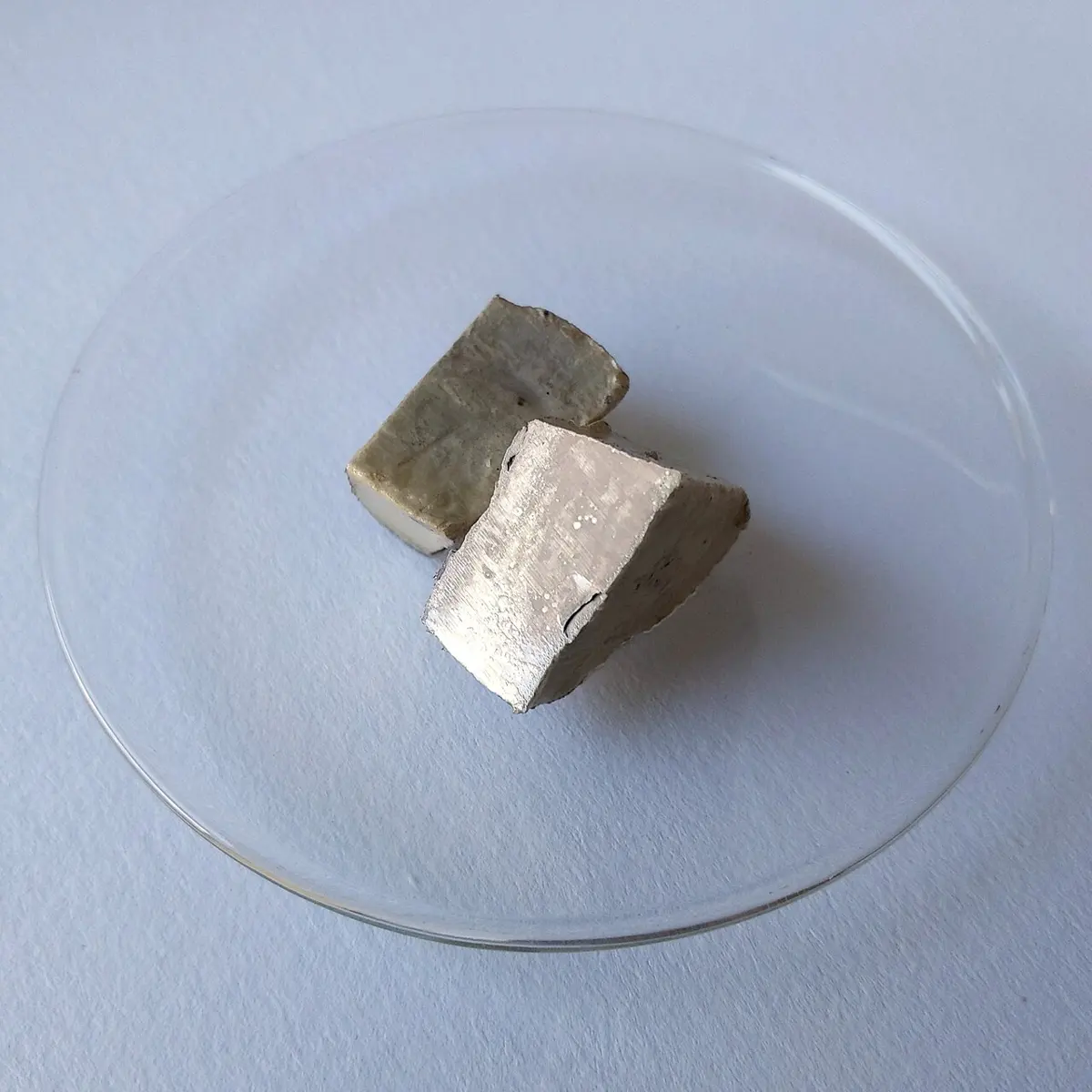
The atoms of a metal are held together by strong forces. To melt a metal, those forces must be partly overcome; to boil it, overcome completely. That takes a lot of heat, so most metals have high melting and boiling points. Most non-metals have low melting and boiling points; many, like oxygen and nitrogen, are gases at room temperature.
| Element | Metal or non-metal? | Melting point |
|---|---|---|
| tungsten | metal | 3,422 °C (the highest of all metals) |
| iron | metal | 1,538 °C |
| copper | metal | 1,085 °C |
| aluminium | metal | 660 °C |
| lead | metal | 327 °C |
| sodium | metal | 98 °C (melts in boiling water) |
| mercury | metal | −39 °C (liquid in your room) |
| sulphur | non-metal | 115 °C |
| oxygen | non-metal | −218 °C (a gas in your room) |
| carbon (graphite) | non-metal | turns to gas at about 3,600 °C |
A shiny element can be cut with a knife, melts at 98 °C and conducts electricity. What is it?
Pick an answer to see why.
B. Chemical properties of metals
1. Metals react with oxygen to form basic oxides
Metals combine with oxygen to form metal oxides, and these oxides are basic (a metal oxide that dissolves in water makes an alkali).
| Reaction | Product |
|---|---|
| 4Na + O₂ → 2Na₂O | sodium oxide |
| 2Mg + O₂ → 2MgO | magnesium oxide |
| 4Al + 3O₂ → 2Al₂O₃ | aluminium oxide |
| 4Fe + 3O₂ → 2Fe₂O₃ | iron(III) oxide (ferric oxide) |
| 2Cu + O₂ → 2CuO | copper(II) oxide (cupric oxide) |
Some metals react with air at once: freshly cut sodium goes dull within seconds. Iron reacts slowly, and needs water as well: the brown rust on an old gate is mostly iron(III) oxide, Fe₂O₃, with water in it. (Iron heated in a flame gets a black coat of a different oxide, Fe₃O₄.) Copper turns black on top when heated in a flame. Gold doesn’t react with oxygen at all, which is why gold coins thousands of years old still shine.
Non-metals form oxides too, but theirs are acidic: carbon dioxide (CO₂) and sulphur dioxide (SO₂) dissolve in water to make acids. This is one of the clearest chemical differences between metals and non-metals.
2. Reactive metals react with dilute acids to give a salt and hydrogen
Reactive metals push the hydrogen out of an acid. The metal takes hydrogen’s place, forming a salt, and the hydrogen is set free as a gas.
| Reaction | Salt formed |
|---|---|
| Mg + 2HCl → MgCl₂ + H₂ | magnesium chloride |
| 2Al + 6HCl → 2AlCl₃ + 3H₂ | aluminium chloride |
| Fe + 2HCl → FeCl₂ + H₂ | iron(II) chloride (ferrous chloride) |
| Zn + H₂SO₄ → ZnSO₄ + H₂ | zinc sulphate |
| Mg + 2HNO₃ → Mg(NO₃)₂ + H₂ | magnesium nitrate |
Not every metal does this. Copper, silver and gold don’t react with dilute hydrochloric or sulphuric acid at all: they are less reactive than hydrogen. Acids still attack many everyday metals slowly. That is why sour foods such as pickles (achar) or tamarind should not be stored for long in aluminium or iron pots.
A shopkeeper says a ring is pure gold. You drop it into dilute hydrochloric acid and see bubbles on it. What can you conclude?
Pick an answer to see why.
3. Very reactive metals react with water to give an alkali and hydrogen
The most reactive metals, lithium, sodium, potassium and calcium, push hydrogen out even from water. They form the metal hydroxide, which is an alkali.
| Reaction | Hydroxide formed |
|---|---|
| 2Li + 2H₂O → 2LiOH + H₂ | lithium hydroxide |
| 2Na + 2H₂O → 2NaOH + H₂ | sodium hydroxide (caustic soda) |
| 2K + 2H₂O → 2KOH + H₂ | potassium hydroxide (caustic potash) |
| Ca + 2H₂O → Ca(OH)₂ + H₂ | calcium hydroxide (slaked lime) |
Potassium reacts so fast that the hydrogen catches fire with a lilac flame. Magnesium reacts with cold water only very slowly, iron not at all (iron reacts only with steam, at red heat), and copper, silver and gold never.
So metals are not all equally keen to react. Put them in order, from the most reactive to the least, and you get the reactivity series:
The metals above hydrogen give hydrogen with dilute acids (lead only very slowly); those below it don’t.
Which metal would you never expect to see fizzing in cold water?
Pick an answer to see why.
Differences between metals and non-metals
| Property | Metals | Non-metals |
|---|---|---|
| malleability | malleable: beaten into sheets | not malleable: brittle, break into pieces |
| ductility | ductile: drawn into wires | not ductile |
| electricity | good conductors | bad conductors (except graphite) |
| heat | good conductors: carry heat well | bad conductors (insulators) |
| melting and boiling points | mostly high | mostly low |
| hardness | mostly hard, don’t break easily | solid ones mostly soft or brittle (except diamond) |
| luster | shiny when fresh | mostly dull (except iodine and graphite) |
| sound | sonorous: ring when struck | not sonorous |
| state at room temperature | solid (except mercury, a liquid) | solid, liquid (bromine) or gas (oxygen, nitrogen…) |
| oxides | basic | acidic (or neutral) |
| with dilute acids | reactive metals give hydrogen | no hydrogen |
Some metals required for the human body
Your body is mostly made of non-metals (oxygen, carbon, hydrogen, nitrogen). But it also needs small amounts of several metals to work properly: sodium, potassium, calcium, magnesium, iron and zinc among them. They take part in metabolism, the thousands of chemical reactions that keep you alive. The body can’t make these elements; they must come in food, and too little of any one causes illness. With too little iron, for example, the blood can’t carry enough oxygen (anemia); with too little sodium or potassium, the heart can beat unevenly.
These metals are not in your food as shiny lumps of metal! They are present as compounds and ions (charged atoms), such as the sodium in common salt (sodium chloride).
| Metal | Sources in food | What it does in the body | Effects of too little |
|---|---|---|---|
| Zinc (Zn) | seeds (pumpkin, sunflower, flax or aalas), cereals, mushrooms, nuts (almonds, cashews); milk products, meat, fish, eggs | helps the body fight bacteria and viruses (immunity); needed to make proteins and DNA; helps wounds heal; needed for a baby’s growth in the womb | hair falls out; smell and taste become weaker; tiredness; loss of weight and diarrhea; wounds and injuries take longer to heal |
| Iron (Fe) | spinach and other green leafy vegetables, broccoli, cereals, seeds, beans and lentils; meat, fish and eggs | part of hemoglobin, which carries oxygen in the blood; needed for respiration in cells and to make energy; helps immunity | anemia: tiredness, pale skin, difficulty breathing when active |
| Sodium (Na) | common salt (the main source); meat, eggs, milk | keeps the right balance of water and salt inside and outside cells; needed for nerves and muscles to work | hyponatremia (too little sodium in the blood): muscle cramps, vomiting, confusion, fainting; in severe cases, death |
| Potassium (K) | fruits (banana, avocado), soybean, vegetables, bamboo shoots (tama), milk, curd | controls the water in cells, and the working of muscles and nerves; helps keep the heartbeat regular; helps keep bones strong and kidney stones away | hypokalemia (too little potassium in the blood): weakness, tired muscles, constipation, uneven heartbeat; a diet low in potassium also raises blood pressure |
Two more metals the body needs in large amounts: calcium (from milk, curd, cheese, green vegetables and small fish eaten with their bones) builds bones and teeth and helps the blood clot and muscles contract; too little causes weak bones. Magnesium (from green vegetables, nuts, whole grains and beans) helps more than 300 enzymes work and keeps muscles and nerves healthy; too little causes cramps and tiredness.
Sunita feels tired all the time and gets out of breath climbing stairs. Her doctor finds she is pale and her blood has too little hemoglobin. Which metal is she most likely short of?
Pick an answer to see why.
Harmful effects of mercury and lead
Some metals do the body nothing but harm. The two most common in daily life are lead and mercury. They are called heavy metals: they are dense, they build up in the body over time, and the body has no good way to get rid of them.
Lead
Lead is used in vehicle batteries, paints, lead crystal glass, and sheets that shield people from X-rays and other radiation. In the past it was also added to petrol. Lead harms almost every part of the body.
Children are harmed most. Their bodies absorb lead more easily, and their brains are still growing. Lead can cause:
- headache and stomach ache;
- changes in behavior: irritability, trouble paying attention;
- anemia, because lead stops the body from making hemoglobin;
- slower development of the brain, and lower learning ability, which can’t be undone.
The body stores lead in the bones, in place of calcium. There it weakens the bones and interferes with the making of blood cells in the bone marrow. Doctors now say there is no safe level of lead in the body.
Mercury
Mercury is the only metal that is liquid at room temperature. It is used in thermometers, barometers and fluorescent tube lights. The harm that mercury does to the body is called mercury poisoning, also known as hydrargyria or mercurialism (mercury’s symbol, Hg, comes from its Latin name, hydrargyrum, “liquid silver”).
- Mercury vapor, breathed in, passes easily from the lungs into the blood. (A drop of mercury that gets into a blood vessel could block it, which can be fatal.)
- Mercury and its compounds damage the brain and nerves: they cause trembling hands, memory loss and changes in mood, and can weaken sight, hearing and speech.
- They damage the kidneys and the lungs.
- Mercury crosses the placenta easily, so it can harm a baby developing in the womb.
- Mercury compounds harm the mental development of children.
Why is mercury more dangerous to breathe in than to swallow as a single drop?
Pick an answer to see why.
Exercise
1. Choose the correct answer
(i) Which of the following is a non-metal?
Pick an answer to see why.
(ii) Which of the following is a property of non-metals?
Pick an answer to see why.
(iii) Which of the following metals is harmful to our body?
Pick an answer to see why.
(iv) What is the harmful effect of mercury on the body called?
Pick an answer to see why.
(v) Metals conduct electric current. What is the reason?
Pick an answer to see why.
2. Differentiate between
Metals and non-metals, on the basis of physical properties
Answer
| Metals | Non-metals |
|---|---|
| Malleable: can be beaten into thin sheets. | Brittle: break into pieces when hammered. |
| Ductile: can be drawn into wires. | Not ductile. |
| Good conductors of heat and electricity. | Bad conductors of heat and electricity (except graphite). |
| Shiny (lustrous). | Mostly dull. |
| Sonorous: ring when struck. | Not sonorous. |
| Mostly hard. | Solid ones mostly soft (except diamond). |
| Mostly high melting and boiling points. | Mostly low melting and boiling points. |
| Solid at room temperature (except mercury). | Solid, liquid or gas at room temperature. |
Malleability and ductility
Answer
| Malleability | Ductility |
|---|---|
| The property of a metal of being beaten into thin sheets without breaking. | The property of a metal of being drawn into thin wires without breaking. |
| It is shown by hammering or rolling. | It is shown by pulling (stretching) through small holes. |
| Example: aluminium foil, gold leaf, iron sheets. | Example: copper wires, steel wires, tungsten filaments. |
| The most malleable metal is gold. | Gold, silver and platinum are the most ductile metals. |
Both come from the same cause: the layers of atoms can slide over one another while the free electrons hold them together.
3. Give reasons
Metals can be beaten into thin sheets and drawn into wires.
Answer
In a metal, the atoms are held together by metallic bonds: positive ions sit in a sea of free electrons that belong to the whole piece of metal. When the metal is hammered or pulled, layers of ions slide over one another, but the free electrons move with them and keep holding them together. So the metal changes shape without breaking: it is malleable and ductile.
Metals have high melting and boiling points.
Answer
The atoms of a metal are held together by strong attractive forces (metallic bonds). To melt the metal, or to boil it, a lot of energy must be supplied to overcome these forces, so the metal must be heated to a high temperature.
A mercury thermometer should not be given to children to put in their mouths.
Answer
A child may bite and break the glass. The sharp glass can cut the mouth, and the mercury inside is poisonous: its vapor is absorbed through the lungs and damages the brain, nerves and kidneys, and children are the most easily harmed. A digital thermometer is safer, or the thermometer can be held under the arm.
4. Answer the following questions
Make a list of the physical properties of metals.
Answer
- Metals have a shine (luster).
- They are mostly hard.
- They are good conductors of heat and electricity.
- They are sonorous: they ring when struck.
- They are malleable: they can be beaten into sheets.
- They are ductile: they can be drawn into wires.
- They mostly have high melting and boiling points.
- They are solid at room temperature (except mercury).
“Metals are good conductors of electricity.” How can you prove it? Explain.
Answer
Make a simple circuit with a dry cell, a torch bulb in a holder and connecting wires, leaving a gap between two bare ends A and B. Place different things across the gap one at a time: a copper wire, an aluminium wire, an iron nail, a coin, and then a piece of wood, paper, sulphur and coal.
Observation: the bulb glows when the copper wire, aluminium wire, iron nail or coin is placed across the gap, but not with wood, paper, sulphur or coal.
Conclusion: current flows through the metals and completes the circuit, but not through the non-metals. So metals are good conductors of electricity. (They conduct because they contain free electrons, which can flow.)
Write any three chemical properties of metals, with chemical equations.
Answer
- Metals react with oxygen to form basic oxides:
2Mg + O₂ → 2MgO
2. Reactive metals react with dilute acids to form a salt and hydrogen gas:
Zn + H₂SO₄ → ZnSO₄ + H₂
3. Very reactive metals react with water to form a metal hydroxide (an alkali) and hydrogen gas:
2Na + 2H₂O → 2NaOH + H₂
Write any two harmful effects each of mercury and lead on the human body.
Answer
Mercury:
- It damages the brain and nervous system (trembling, memory loss), especially in children.
- It damages the kidneys and lungs, and can harm a baby in the womb, as it crosses the placenta.
Lead:
- It slows the development of a child’s brain, causing learning problems and changes in behavior.
- It causes anemia; and stored in the bones in place of calcium, it weakens them and interferes with the making of blood cells.
Make a list of the food sources of the metals the human body needs.
| Metal | Iron (Fe) | Zinc (Zn) | Sodium (Na) | Potassium (K) |
|---|---|---|---|---|
| Sources |
Answer
| Metal | Iron (Fe) | Zinc (Zn) | Sodium (Na) | Potassium (K) |
|---|---|---|---|---|
| Sources | spinach and other green leafy vegetables, broccoli, cereals, beans and lentils, fish, meat | seeds (pumpkin, sunflower, aalas), nuts (almonds, cashews), mushrooms, cereals, milk, meat, fish, eggs | common salt, meat, eggs, milk | bananas, avocados, soybean, vegetables, bamboo shoots (tama), milk, curd |
Practice every question in the book, and keep track of the ones you miss →