
- Atomic number
- 29
- Atomic mass
- 63.55
- Shells
- 2, 8, 18, 1
- Configuration
- 1s² 2s² 2p⁶ 3s² 3p⁶ 4s¹ 3d¹⁰
- In the table
- period 4, group 11 (IB), d-block
- Kind
- Transition metal
- Valency
- 1 and 2 (cuprous Cu⁺, cupric Cu²⁺)
- State at 25 °C
- solid
- Melts · boils
- 1,085 °C · 2,562 °C
- Density
- 8.9 × as heavy as water
- Known since
- ancient times
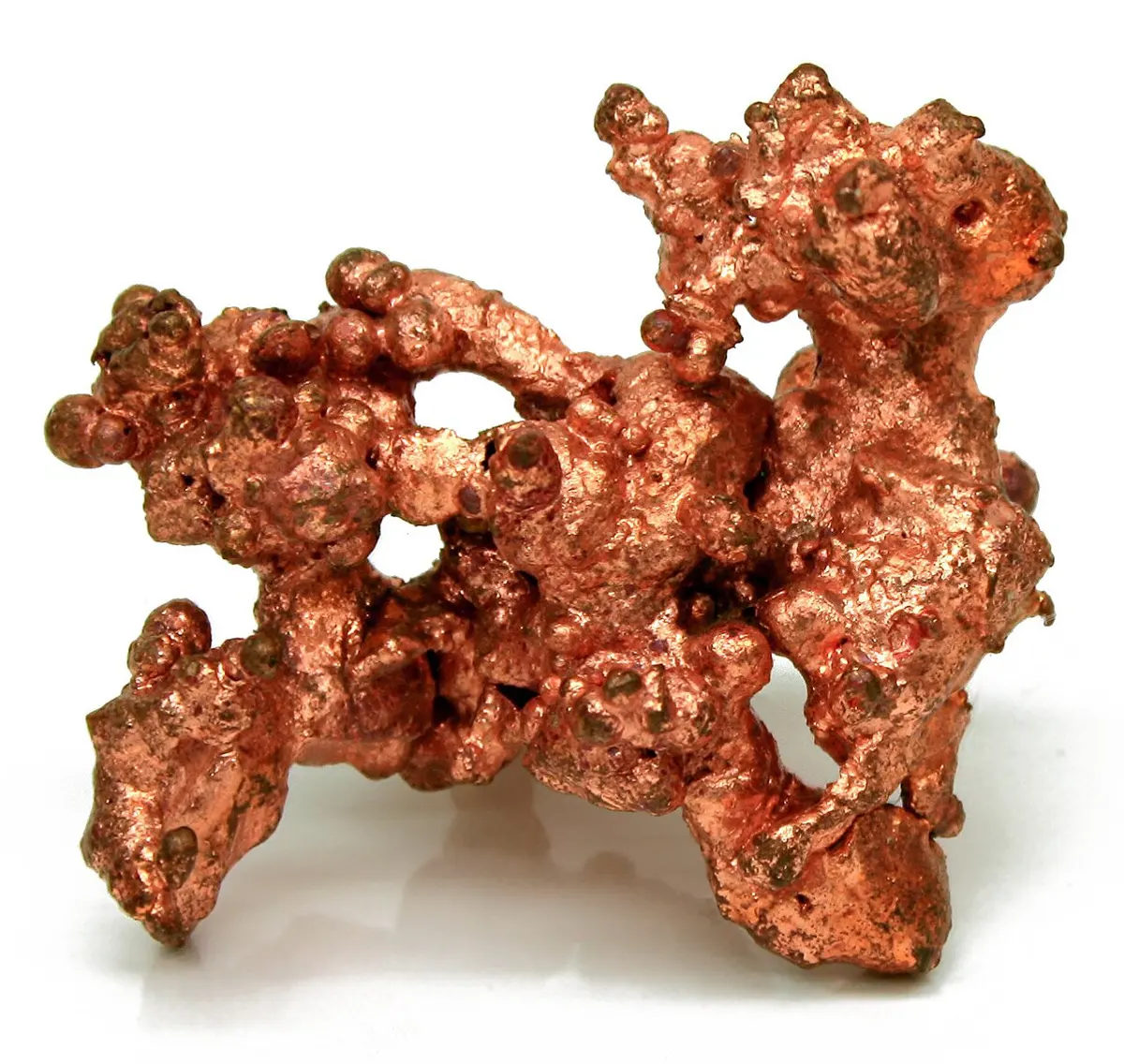
Switch on a light or charge a phone, and the electricity almost certainly reaches it through copper: in the wires in your walls, the cable of your charger, the coils of every fan and water pump. Look around a kitchen in Nepal and you may find it again: a copper करुवा (water jug), a brass (पित्तल) gagri, a bronze (काँसो) plate.
Copper was also the first metal people ever used, more than ten thousand years ago. Here is its whole story, from its atom to the Statue of Liberty.
The copper atom
Every copper atom has 29 protons in its nucleus, so copper’s atomic number is 29. A neutral atom also has 29 electrons around the nucleus. Most copper atoms have 34 neutrons as well, so their mass number is 29 + 34 = 63.
By the 2n² rule Grade 8: Bohr and Bury’s rule, the 29 electrons fill the K, L and M shells (2, 8, 18) and leave just one for the N shell: 2, 8, 18, 1.
Its electronic configuration
In Grade 10 you write electrons in subshells Grade 10: The Aufbau principle. Since 4s fills before 3d, you would expect copper to be:
1s² 2s² 2p⁶ 3s² 3p⁶ 4s² 3d⁹
But the real atom is:
1s² 2s² 2p⁶ 3s² 3p⁶ 4s¹ 3d¹⁰
One electron moves from 4s into 3d, because a completely full d subshell is especially stable. Copper and chromium are the two famous exceptions in period 4.
How many electrons are in the outermost shell of a copper atom?
Pick an answer to see why.
Its place in the periodic table
- Period 4, because its electrons are in four shells.
- Group 11, called IB in the older naming many books use. It sits between nickel (28) and zinc (30).
- d-block, because its last electrons go into a d subshell. That makes copper a transition metal Grade 10: Metals.
Below copper in group 11 are silver and gold. Like a family, all three are soft, shiny, excellent conductors, and unreactive enough to be found as pure metal in the ground. For thousands of years they were the metals of coins, so group 11 is called the coinage metals.
In compounds, copper loses its 4s electron to become Cu⁺ (valency 1, cuprous), or one more from 3d to become Cu²⁺ (valency 2, cupric) Grade 9: Variable valency. Cu²⁺, as in copper sulphate (CuSO₄), is the more common.
How copper was found and named
Most metals are hidden in rocks as compounds. Copper is sometimes found as lumps of pure metal, native copper, which early people could pick up and beat into shape with a stone. That is why it was the first metal humans used.
- Over 10,000 years ago, people in the Middle East hammered native copper into beads; some found in northern Iraq are that old.
- About 7,000 years ago (around 5000 BCE), people learned to smelt copper: to heat an ore such as malachite with charcoal until the metal came out (the oldest site found is Belovode, in Serbia). The carbon of the charcoal takes the oxygen away Grade 10: Reduction.
- About 5,500 years ago (around 3500 BCE), metalworkers began mixing copper with a little tin to make bronze, which is much harder. Bronze tools and weapons changed history so much that this time is called the Bronze Age Grade 8: Bronze.
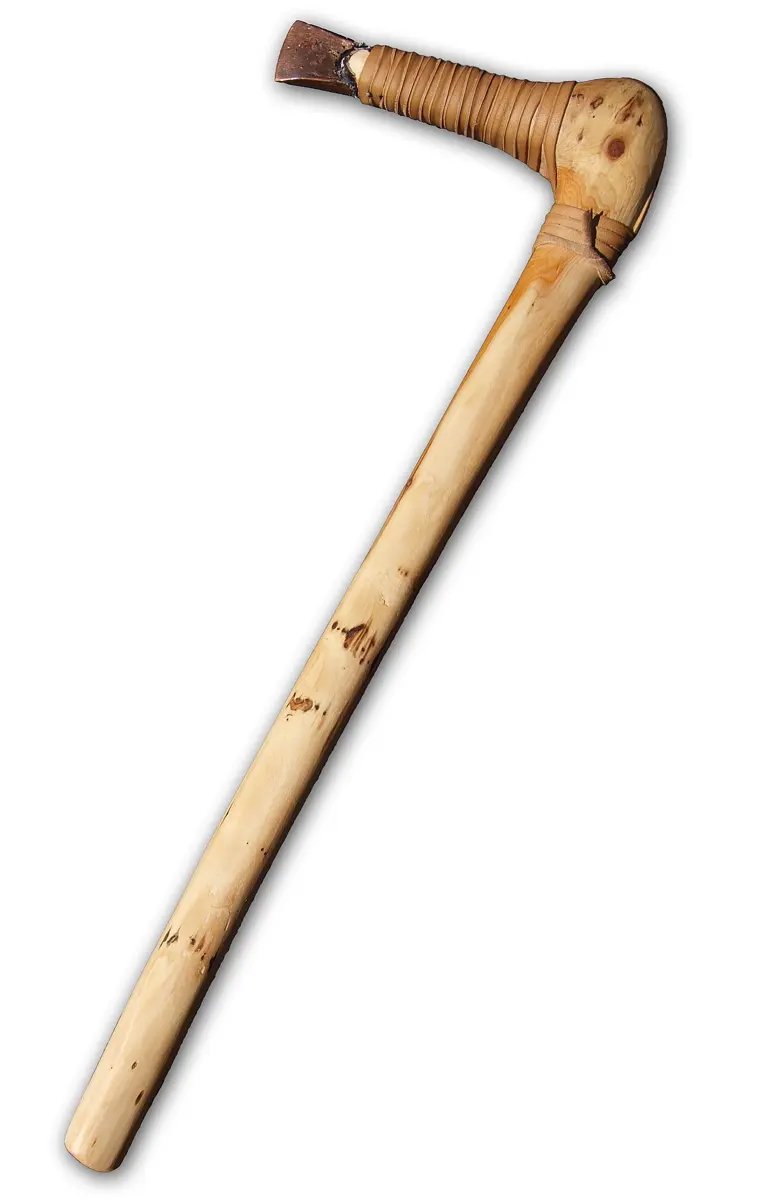
The name. The ancient Romans got much of their copper from the island of Cyprus and called it aes Cyprium, “metal of Cyprus”, later cuprum: hence “copper” and the symbol Cu Grade 8: Symbols from Latin names. Nepali’s तामा comes from Sanskrit ताम्र (tāmra), which means both copper and copper-red.
Where copper is found
In the universe. Copper atoms were made in stars and scattered into space when they exploded, long before the Sun was born (Getting the atoms out).
In the Earth’s crust. Ordinary rock has only a few tens of grams of copper per tonne. It is mined where hot water from deep underground has gathered it into ores with hundreds of times more (Ores: where hot water ran). The main ore is brassy chalcopyrite (CuFeS₂) Grade 10: Ores of copper. In 2024 the world mined about 23 million tonnes of copper, nearly a quarter of it in Chile.
In Nepal. Copper minerals have been found in more than 100 places in Nepal’s hills Grade 8: Minerals in Nepal. For centuries people mined them by hand and smelted the copper in small furnaces; old pits and heaps of slag remain. Before 1951 Nepal even sold copper to Tibet. Then cheaper imported metal closed the old mines, and today Nepal imports almost all its copper.
In your body. An adult holds only about a tenth of a gram, but could not live without it (see below).
What copper is like
- Color. Fresh copper is a shiny salmon-pink or reddish-orange. Almost every other metal is silvery gray; copper and gold are the famous exceptions.
- Soft, malleable and ductile. Copper can be beaten into thin sheets and drawn into fine wires without breaking (Malleable, ductile).
- Heavy for its size. Its density is 8.96 g/cm³, nearly nine times that of water.
- Melts at 1,085 °C, within reach of a charcoal fire blown with bellows, so ancient people could cast it.
- A superb conductor of heat, about five times better than iron: used in the pipes of refrigerators and air conditioners.
- A superb conductor of electricity, second only to silver.
Why is copper so good? In a metal, the outer electrons wander freely through the whole piece, a “sea” of free electrons Grade 9: Metals are good conductors of electricity. Copper gives one per atom, its 4s¹ electron, and they drift easily between its neatly packed atoms. So a copper wire has a low resistance Grade 9: Factors affecting resistance and wastes little energy as heat.
Silver conducts electricity a little better than copper. Why are the wires in your house made of copper?
Pick an answer to see why.
How copper reacts
Copper is not very reactive. It sits low in the reactivity series, below hydrogen. So:
- it does not react with water, even when hot;
- it does not react with dilute hydrochloric or sulphuric acid Grade 9: Metals and dilute acids.
That is why copper is good for water pipes and jugs. But it reacts slowly with air. Heated in air, copper becomes coated with black copper(II) oxide, cupric oxide Grade 9: Metals react with oxygen:
2Cu + O₂ → 2CuO
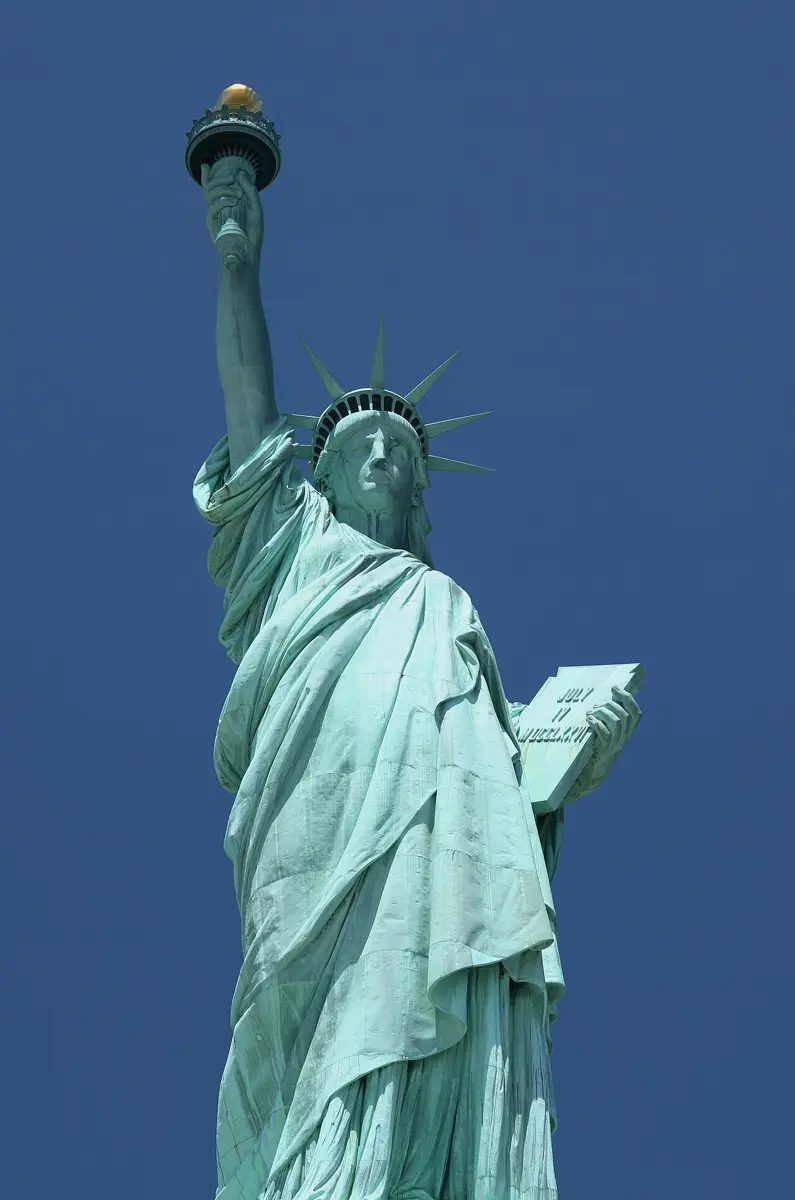
Left outdoors for years, it reacts with oxygen, water, carbon dioxide and sulphur gases: it goes dull brown, then almost black, and finally a blue-green patina forms, which sticks tightly and protects the copper underneath.
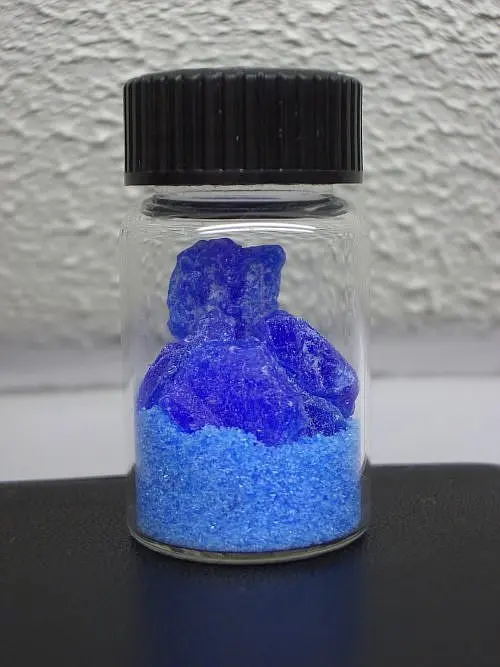
Copper sulphate: blue crystals
Copper sulphate (CuSO₄), निलोतुथो in Nepali, is copper’s best-known compound. Its blue crystals hold five water molecules for each CuSO₄, as water of crystallization (CuSO₄·5H₂O). Heat them and the water is driven off, leaving a white powder; a drop of water turns it blue again, a test for water.
An iron nail in copper sulphate solution turns reddish-brown with copper, and the blue fades to pale green: iron, being more reactive, displaces copper Grade 10: Single displacement reaction:
Fe + CuSO₄ → FeSO₄ + Cu
A strip of copper is put in a solution of iron(II) sulphate. What happens?
Pick an answer to see why.
From ore to wire
Copper ore is usually less than 1% copper, its minerals scattered through ordinary rock, so getting the metal takes the steps of metallurgy Grade 10: Metallurgy: the ore is ground and concentrated (by froth flotation), roasted in air, and smelted to give impure copper. Wires need copper about 99.99% pure, since tiny impurities make it conduct much worse, so it is finished by electro-refining Grade 10: Electro-refining.
Copper in daily life and in Nepal
Electricity. Most copper carries electricity: house wiring, cables, the coils of motors, transformers and generators, the tracks on circuit boards. An electric car holds two to three times as much copper as a petrol car.
Alloys Grade 8: Alloys: brass (पित्तल, copper and zinc) for puja items, gagri and taps; bronze (काँसो, copper and tin) for plates, bells and statues; and a little copper hardens 22-carat gold. Many coins are copper alloys too.
Water vessels. Copper surfaces really do kill many bacteria: in one study, harmful bacteria added to water kept in a copper pot for 16 hours could no longer be found. But a copper jug is no cure for unsafe water: boil or filter it.
Farming. Copper is a plant micronutrient Grade 9: Micronutrients, and copper sulphate with lime makes Bordeaux mixture, sprayed since the 1880s against fungal diseases such as potato blight.
The copper craft of the Kathmandu Valley
For over a thousand years, the metalworkers of the Kathmandu Valley, many of them in Patan, have made statues of copper and its alloys, in two old ways:
- Lost-wax casting: a wax model is covered in clay, the wax melted out, and molten metal poured into the hollow.
- Repoussé: a copper sheet is hammered from behind into a raised picture, copper’s malleability turned into art.
The piece is often gilded with a thin layer of gold, which also keeps the copper from turning green. The Newar surname Tamrakar (ताम्रकार), carried by families of coppersmiths in the Valley, comes from ताम्र, copper.
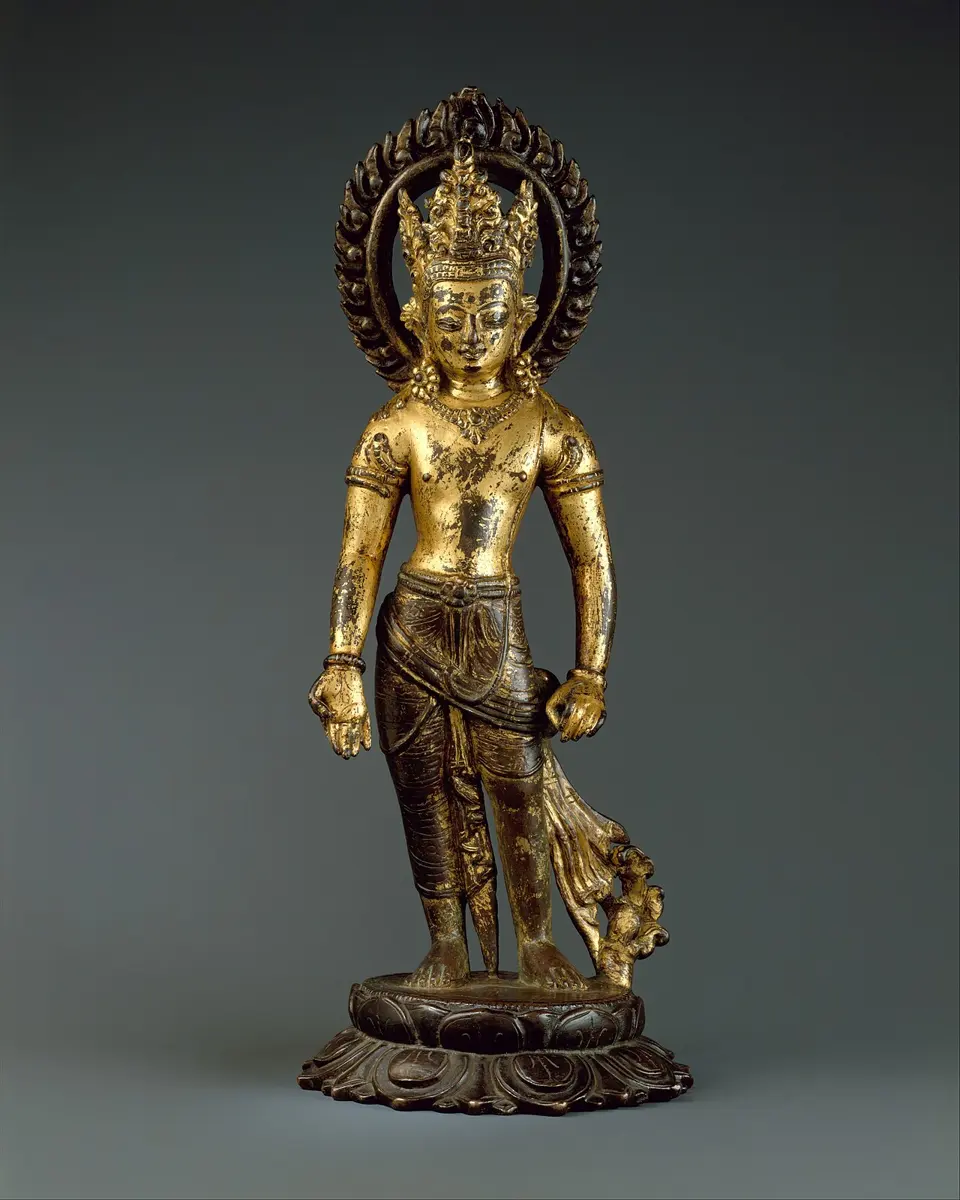
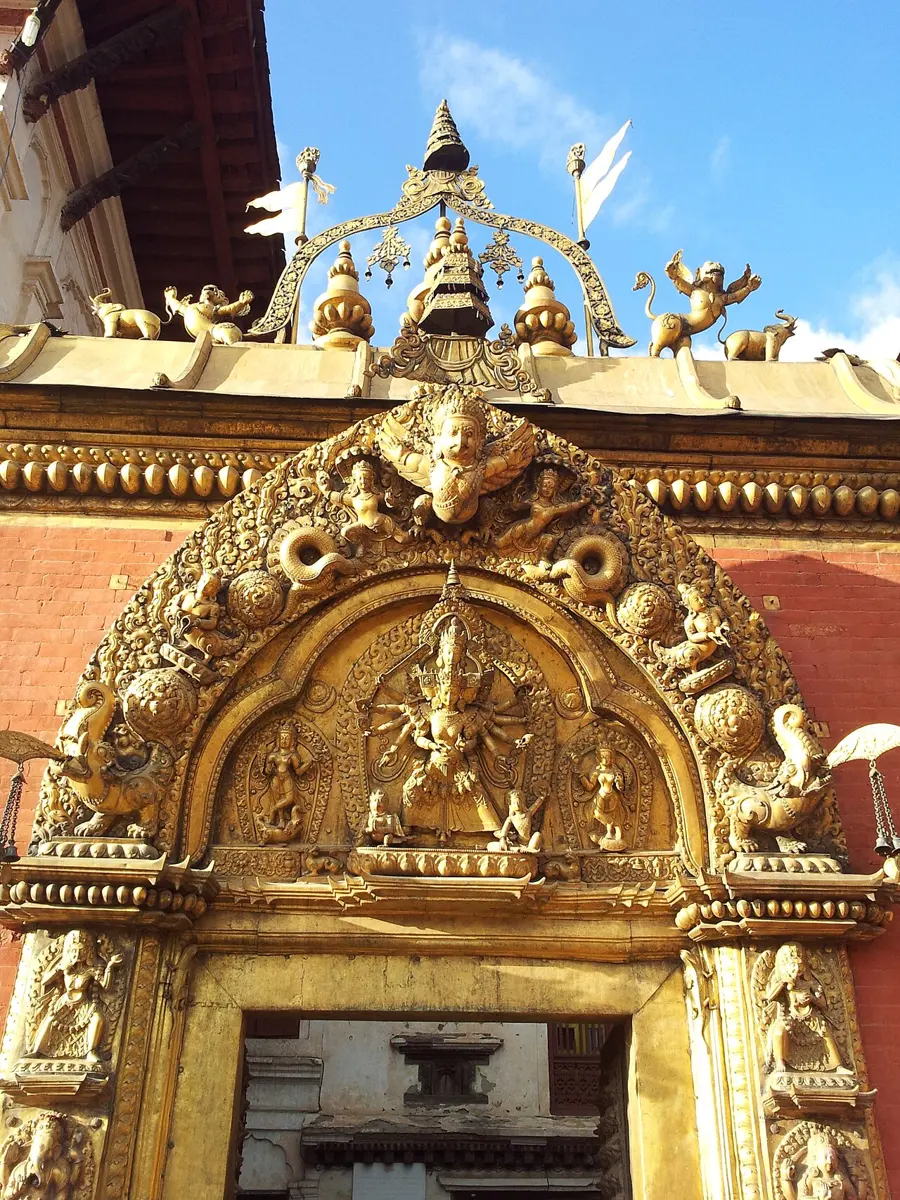
Kings in Nepal and India also wrote important records, such as gifts of land, on copper plates called ताम्रपत्र, because copper does not rot like paper or rust like iron.
Isotopes of copper
Natural copper is a mixture of two isotopes (same 29 protons, different numbers of neutrons): about 69% copper-63 (34 neutrons) and 31% copper-65 (36 neutrons), neither radioactive. So its atomic mass isn’t a whole number Grade 9: Atomic mass.
A third isotope, copper-64, is made for hospitals: radioactive, with a half-life of 12.7 hours, it helps take pictures of tumors.
Copper and your health
Your body needs a little copper every day: about 0.9 milligrams (less than a thousandth of a gram) for an adult. Copper is part of enzymes (substances that speed up the body’s chemical reactions) that:
- release energy from food in your cells;
- help the body use iron to make red blood cells;
- build the tough connective tissue of skin, bones and blood vessels;
- make melanin, the pigment of hair and skin, and keep nerves working.
Nuts, seeds such as sesame, whole grains such as millet, chickpeas, potatoes and green vegetables give enough, so a varied diet rarely runs short. Too little causes anemia and weak bones; too much harms the liver, as in Wilson’s disease, a rare inherited illness in which copper builds up.
Surprising facts and records
- Most copper is still in use. About 80% of all copper ever mined is still in use, because it can be recycled again and again without getting worse; about a third of the copper used each year is recycled.
- The standard for every conductor. Since 1913, other metals’ conductivity has been measured as a percentage of copper’s.
- A Nobel Prize catalyst. A few copper ions make two molecules “click” together quickly and cleanly. This click chemistry won the Nobel Prize in Chemistry in 2022.
In your science books
- Grade 8: atoms and symbols (Cu from cuprum), the 2n² rule, alloys: brass and bronze, displacement reactions and minerals in Nepal.
- Grade 9: variable valency (cuprous and cupric), properties of metals, resistance (why wires are copper) and plant micronutrients.
- Grade 10: electronic configuration, transition metals, ores of copper, electro-refining and single displacement.
- Going further: where ores come from and where the atoms in your body came from.
More to explore
- Nobel Prizes with copper in them: click chemistry (2022), molecular machines (2016, a copper ion holds the first molecular chain together), MOFs (2025, the first one was built on copper ions) and plastic that conducts (2000, the plastic that might one day replace copper wire).
- Play: make copper sulphate and malachite in Molecule Kitchen, or find copper in Guess the Element and the Periodic Table Jigsaw.
- Read more: copper at the Royal Society of Chemistry and at PubChem.