
- Atomic number
- 46
- Atomic mass
- 106.42
- Shells
- 2, 8, 18, 18
- Configuration
- 1s² 2s² 2p⁶ 3s² 3p⁶ 4s² 3d¹⁰ 4p⁶ 4d¹⁰
- In the table
- period 5, group 10 (VIIIB), d-block
- Kind
- Transition metal
- Valency
- 2 (as in PdCl₂), also 4
- State at 25 °C
- solid
- Melts · boils
- 1,555 °C · 2,963 °C
- Density
- 12.0 × as heavy as water
- Known since
- 1803
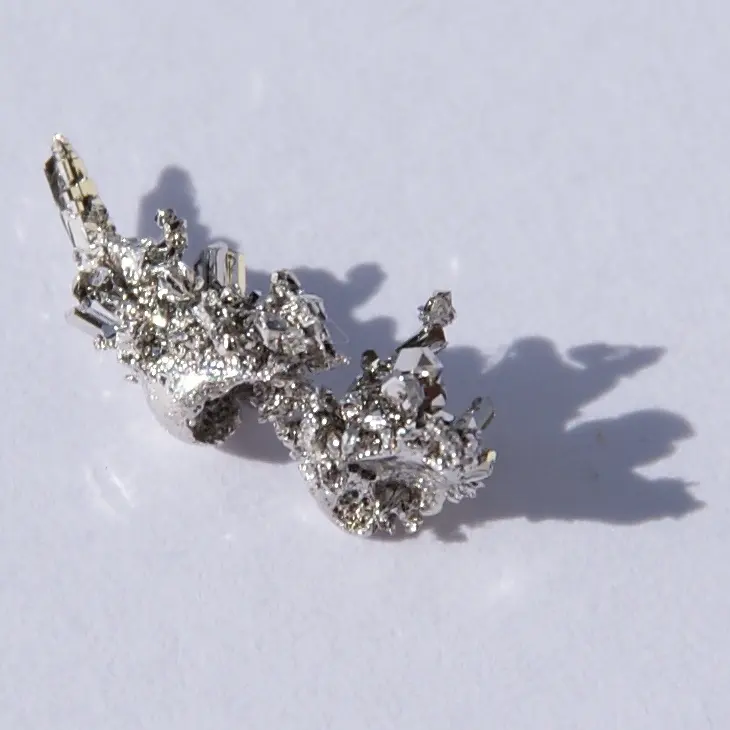
A sponge soaks up water: the water fills the tiny holes in it. Now imagine a shiny, solid piece of metal that does the same with a gas. Put a piece of palladium in hydrogen, and it quietly soaks it up: one cubic centimeter of the metal can take in about 900 cubic centimeters of hydrogen gas, nearly a liter, and still look exactly the same. Warm it, and the hydrogen comes out again.
Palladium is also in the exhaust pipes of most petrol cars, in the tiny capacitors of your phone, in white gold rings and in dental crowns, and it helped three chemists win a Nobel Prize for joining carbon atoms. Its atom is the strangest in its period. Here is its story.
The palladium atom
A palladium atom has 46 protons, so palladium’s atomic number is 46, and a neutral atom has 46 electrons. The most common kind, palladium-106, has 60 neutrons: mass number 46 + 60 = 106.
Palladium is in period 5, so you would expect its electrons to fill five shells. They don’t. Its 46 electrons are arranged 2, 8, 18, 18: four shells, with the fifth (O) shell empty Grade 8: Bohr and Bury’s rule. It is the only element in the whole periodic table whose outermost shell is not the shell of its period.
Its electronic configuration
From the Aufbau order Grade 10: The Aufbau principle, 5s fills before 4d, so you would expect palladium to end 5s² 4d⁸, like nickel above it (4s² 3d⁸). The real atom is:
1s² 2s² 2p⁶ 3s² 3p⁶ 4s² 3d¹⁰ 4p⁶ 4d¹⁰
Both 5s electrons have moved into 4d. Then the 4d subshell is completely full, with all five of its orbitals holding two electrons, and a full d subshell is especially stable, as in copper’s 3d¹⁰. In period 5, 5s and 4d have so nearly the same energy that this small extra stability is enough to empty 5s altogether. Its neighbors ruthenium and rhodium move one electron; palladium moves two.
How many shells hold electrons in a palladium atom?
Pick an answer to see why.
Its place in the periodic table
If palladium has only four shells, why is it in period 5? Because the periodic table puts the elements in order of atomic number Grade 10: The modern periodic table. Palladium (46) comes after rhodium (45) and before silver (47), and its properties match nickel and platinum, so its place is fixed:
- Period 5, between rhodium and silver.
- Group 10, the last of the three columns that older tables call VIIIB, with nickel above it and platinum below. These three share their ten outer electrons between s and d in three different ways (see platinum’s atom).
- d-block: a transition metal Grade 10: Metals.
Palladium is one of the six platinum group metals: ruthenium, rhodium and palladium in period 5, osmium, iridium and platinum in period 6. It is the lightest of the six and melts at the lowest temperature.
In compounds, palladium usually has a valency of 2, as in palladium chloride, PdCl₂, and sometimes 4 Grade 9: Variable valency.
How palladium was found and named
In 1802 the English scientist William Hyde Wollaston was purifying platinum ore from South America. He dissolved it in aqua regia, a mixture of concentrated nitric and hydrochloric acids, took the platinum out, and found that the solution still held another metal. It was new.
That same year, a German astronomer, Heinrich Olbers, had found a new body in the sky, the second asteroid ever seen. It was named Pallas, after Pallas Athena, the Greek goddess of wisdom. Wollaston named his metal after it: palladium, symbol Pd. Nepali uses the English name: प्यालाडियम.
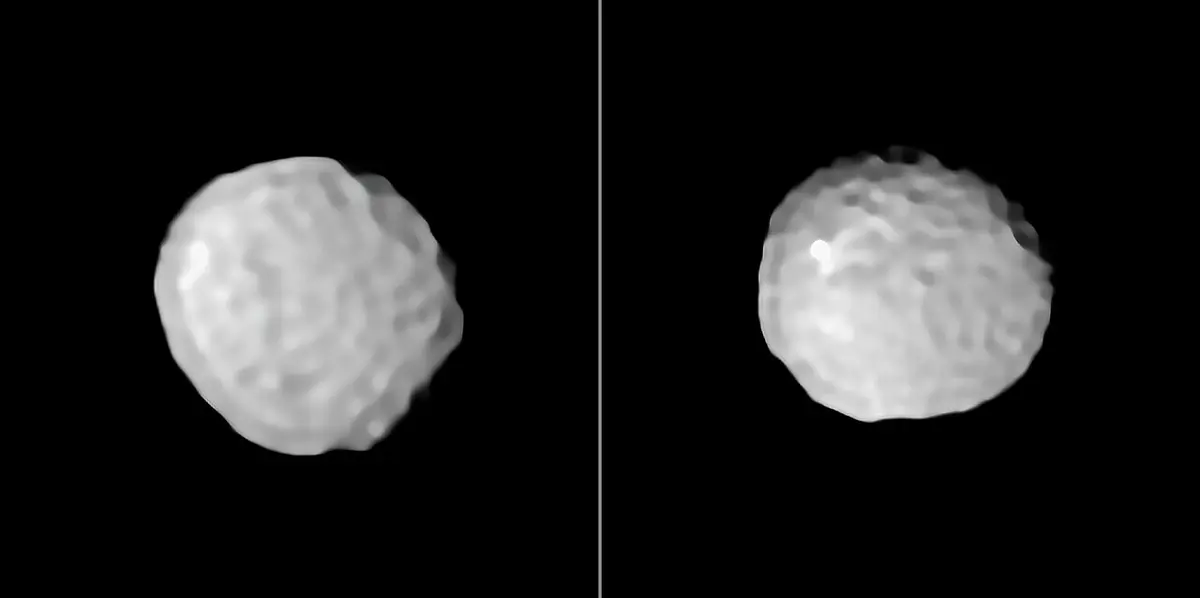
In 1803, working on what was left of the same solution, Wollaston found yet another new metal, rhodium.
Where palladium is found
In the universe. Like all elements heavier than iron, palladium was made when atomic nuclei caught neutrons, in giant stars and in collisions of dead stars (Heavier than iron).
In the Earth’s crust. Palladium is very rare. A little is found as grains of pure metal, often mixed with gold, in river gravels; miners in Brazil long ago called this whitish gold “worthless gold”. Almost all palladium today comes as a by-product of mining nickel and platinum, from the nickel ores of Norilsk in Siberia and from the ancient rocks of the Bushveld in South Africa.
In 2025 the world mined about 190 tonnes of palladium. Russia mined the most (about 84 tonnes, over two-fifths), then South Africa (about 70 tonnes), with Canada, Zimbabwe and the United States far behind (USGS, 2026). Recycling adds a lot more: in 2025 about 140 tonnes of palladium and platinum together were recovered from scrap, much of it from old catalytic converters (USGS).
In Nepal. No palladium is mined in Nepal, though it is one of the precious metallic minerals in your books Grade 8: Metallic minerals.
In your body. None that matters: palladium has no use in any living thing.
What palladium is like
- A soft, silvery-white metal, a little whiter than platinum. It is malleable and ductile: it can be beaten into leaf a few hundred times thinner than paper Grade 9: Malleable.
- Light for a precious metal. Its density is 12.0 g/cm³, little more than half that of platinum (21.5) or gold (19.3).
- Melts at 1,555 °C, the lowest of the platinum group metals, but higher than iron.
- Does not tarnish in air at room temperature. Heated strongly in air (to about 800 °C), its surface turns into a thin film of palladium oxide (PdO).
- The most reactive of its family, though still very unreactive: it does not react with water or dilute acids, but it dissolves in aqua regia and slowly in concentrated nitric acid, which leaves platinum alone.
The metal that drinks hydrogen
Palladium absorbs hydrogen. The hydrogen molecules (H₂) that touch the metal split into single atoms. These atoms are so small that they slip into the gaps between the palladium atoms and spread through the whole piece. At room temperature, about two of every three gaps fill up. The metal swells a little, but stays solid and shiny. Heat it, and the hydrogen atoms come out again and join back into H₂ gas.
Pure hydrogen through a wall of metal
Because only hydrogen atoms are small enough to travel through palladium, a thin sheet of hot palladium works like a filter that lets only hydrogen through. Every other gas, oxygen, nitrogen, carbon monoxide, carbon dioxide, water vapor, stays behind. Hydrogen purifiers built this way give very pure hydrogen, for laboratories and for some electronics factories Grade 9: Hydrogen gas.
Why can hydrogen pass through a sheet of palladium when nitrogen cannot?
Pick an answer to see why.
Palladium at work
Cleaning car exhaust
The biggest use of palladium, most of it, is in the catalytic converters of petrol cars (see platinum for the inside of one). There, tiny particles of palladium act as a catalyst Grade 10: Catalyst: poisonous carbon monoxide and unburnt fuel react with oxygen on its surface, and come out as carbon dioxide and water:
2CO + O₂ → 2CO₂
Palladium does the same job as platinum in most petrol cars, while rhodium deals with the nitrogen oxides. Car makers choose between palladium and platinum partly by price. In 2021 palladium cost over US$2,400 an ounce, more than twice as much as platinum; by 2025 it cost a little less than platinum (USGS).
In a catalytic converter, carbon monoxide reacts with oxygen on palladium. What happens to the palladium?
Pick an answer to see why.
Joining carbon atoms
Chemists who make medicines, dyes and the materials of phone screens often need to join two carbon atoms of two different molecules. This is hard, because carbon atoms are not keen to react. In the 1960s and 1970s, Richard Heck, Ei-ichi Negishi and Akira Suzuki found how to do it neatly with a palladium catalyst: both carbon atoms are held on one palladium atom, so they meet and join only where the chemist wants. These cross-coupling reactions won the Nobel Prize in Chemistry in 2010 and are now used in factories to make medicines such as naproxen, a painkiller, and losartan, for high blood pressure.
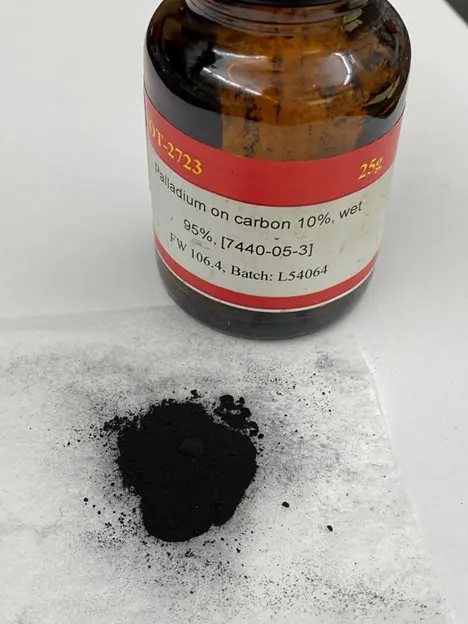
Palladium powder spread on charcoal (palladium on carbon) is also one of the commonest catalysts for adding hydrogen to molecules (hydrogenation). Vanaspati ghee is made with a cheaper nickel catalyst, but the idea is the same Grade 10: Hydrogenation.
In your phone
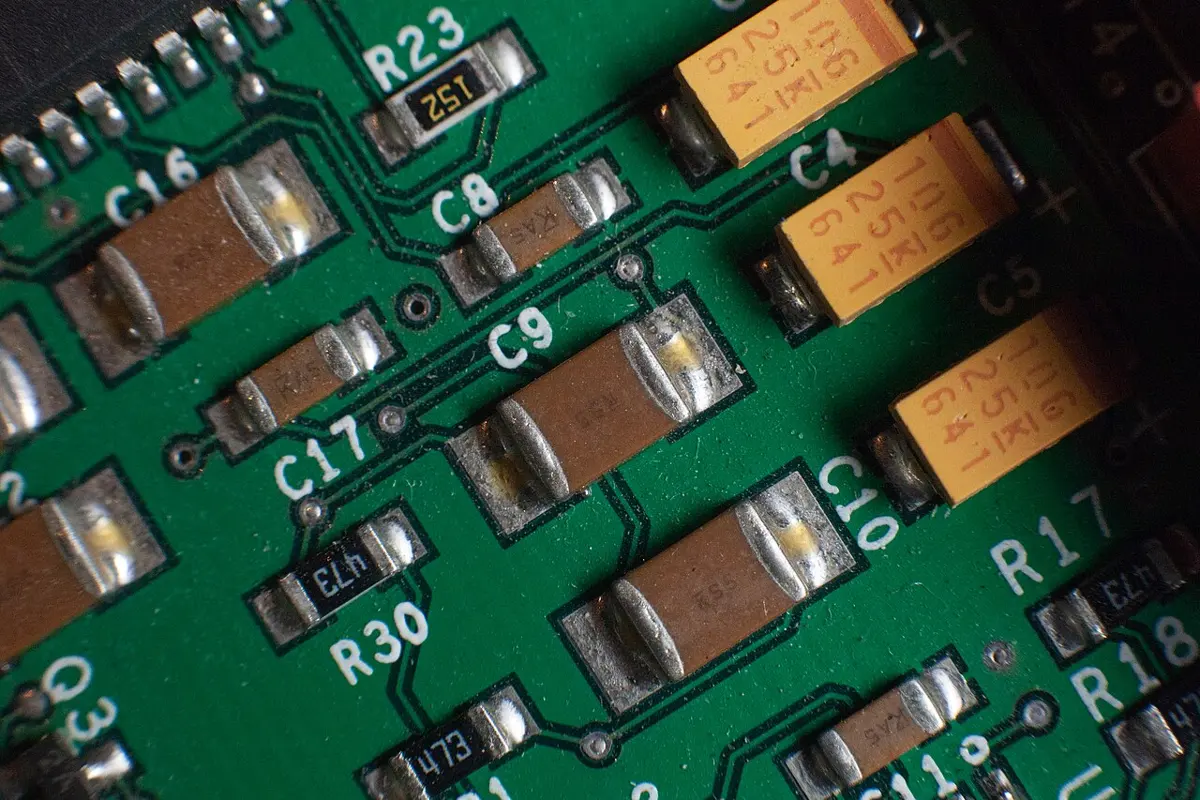
A phone or laptop holds hundreds of tiny multilayer ceramic capacitors, each smaller than a grain of rice. Inside each are many very thin layers of metal separated by layers of ceramic. In some of them the metal layers are palladium, or palladium mixed with silver; many newer ones use cheaper nickel instead. Palladium is also used to coat the contacts of connectors, which must never rust.
Jewelry and teeth
- White gold. Gold mixed with palladium loses its yellow color and becomes a soft white, without the nickel that gives some people a skin rash. Palladium is also made into rings on its own: it looks like platinum but weighs much less.
- Dentistry. Many dental crowns and bridges are made of alloys containing palladium, which are strong, do not corrode in the mouth and cost less than gold.
Isotopes of palladium
Natural palladium is a mixture of six stable isotopes. The most common are palladium-106 (27%), palladium-108 (26%) and palladium-105 (22%); the others are palladium-110, -104 and a little palladium-102. Their average gives palladium’s atomic mass, 106.42 Grade 9: Atomic mass.
Palladium-103 is radioactive, with a half-life of 17 days, and is made for hospitals. Doctors place dozens of tiny palladium-103 “seeds”, each about the size of a grain of rice, inside a cancer of the prostate gland, where their radiation destroys the tumor from within over a few months and then fades away.
Palladium-107 decays very slowly, with a half-life of about 6.5 million years. There was some when the Solar System formed, but it has all decayed. Scientists have found extra silver-107, which it decays into, inside some meteorites: a sign that those meteorites formed very early, while some palladium-107 was still left.
Palladium and your health
Your body has no need for palladium. The metal is not very poisonous, and it is safe in jewelry and teeth for most people. A few people are allergic to it, often the same people who are allergic to nickel, its neighbor in group 10, and they may get a rash from it.
Soluble palladium compounds such as palladium chloride are poisonous if swallowed in large amounts, and are handled with care in laboratories.
Surprising facts and records
- Named after an asteroid. Only one other element is: cerium, named after Ceres, the first asteroid found, a year before Pallas (Ceres is now called a dwarf planet).
- Hydrogen sponge. No other metal soaks up hydrogen so readily at room temperature and gives it back so easily.
- Price swings. Palladium cost about US$1,000 an ounce in 2024 and about US$2,400 three years earlier (USGS yearly averages).
In your science books
- Grade 8: the 2n² rule, groups and periods and precious metallic minerals, where palladium is named.
- Grade 9: hydrogen gas, variable valency, atomic mass and properties of metals.
- Grade 10: the modern periodic table, electronic configuration, catalysts and hydrogenation.
- Going further: how catalysts lower the hill and where heavy atoms are made.
More to explore
- Nobel Prizes with palladium in them: joining carbon atoms with palladium (2010, cross-coupling) and surface chemistry (2007, how gases react on metal catalysts such as those in a car’s converter).
- Its family: nickel and platinum in group 10, and its partners in the platinum group, ruthenium and rhodium.
- Play: find palladium in Guess the Element and the Periodic Table Jigsaw.
- Read more: palladium at the Royal Society of Chemistry and at PubChem.