
- Atomic number
- 70
- Atomic mass
- 173.05
- Shells
- 2, 8, 18, 32, 8, 2
- Configuration
- 1s² 2s² 2p⁶ 3s² 3p⁶ 4s² 3d¹⁰ 4p⁶ 5s² 4d¹⁰ 5p⁶ 6s² 4f¹⁴
- In the table
- period 6, group none (f-block), f-block
- Kind
- Lanthanide
- Valency
- 3 (Yb³⁺) and 2 (Yb²⁺)
- State at 25 °C
- solid
- Melts · boils
- 819 °C · 1,196 °C
- Density
- 6.9 × as heavy as water
- Known since
- 1878
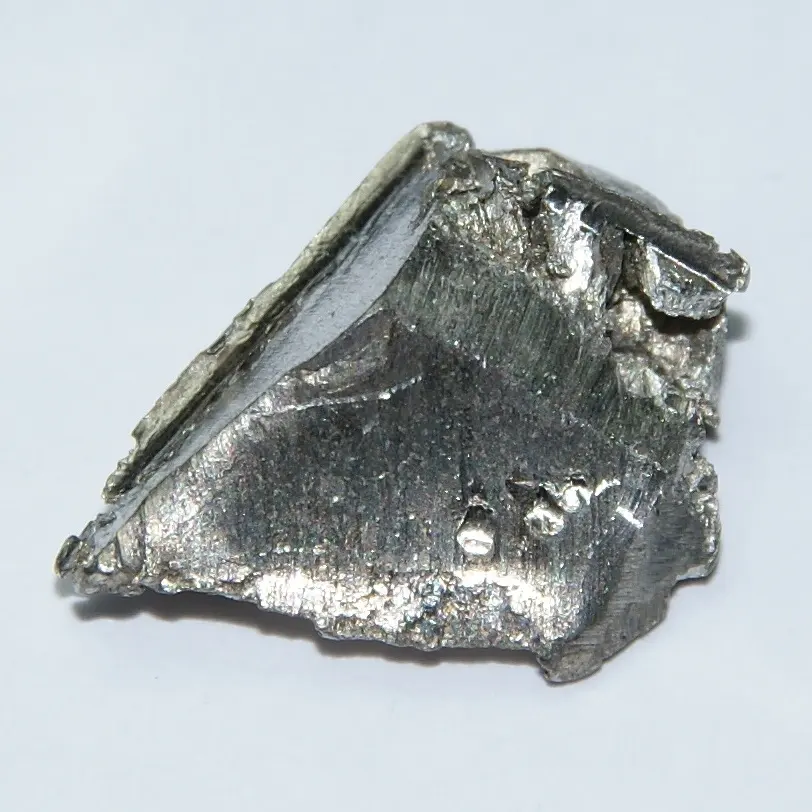
Your phone knows the time to a fraction of a second because it listens to atomic clocks far away, in satellites and laboratories. The best of today’s clocks are better still: if one had been started when the universe began, nearly 14 billion years ago, it would still be right to within about a second. Several of these record clocks count the light of ytterbium atoms (say ih-TUR-bee-um). Ytterbium is the fourteenth lanthanide, a soft silvery metal.
The ytterbium atom
A ytterbium atom has 70 protons and 70 electrons. Natural ytterbium is a mixture of seven isotopes. The commonest, ytterbium-174 (about a third), has 104 neutrons: 70 + 104 = 174. The atomic mass, 173.05, is the average of the mixture Grade 9: Atomic mass.
By shells its electrons are 2, 8, 18, 32, 8, 2: the fourth shell, N, now holds its full 2 × 4² = 32 (Bohr and Bury’s 2n² rule). In subshells ytterbium ends 6s² 4f¹⁴: the 4f subshell, which fills along the whole lanthanide row, is completely full Grade 10: The Aufbau principle.
Its place and valency
- Period 6, the fourteenth lanthanide (f-block), between thulium (69) and lutetium (71) (fifteen near-twins).
- Usually it loses three electrons and becomes Yb³⁺, with a valency of 3: ytterbium oxide is Yb₂O₃. But a full 4f is especially stable, so ytterbium also forms Yb²⁺, losing only its two 6s electrons, with a valency of 2 Grade 9: Variable valency.
Why can ytterbium form a Yb²⁺ ion, when most lanthanides form only 3+ ions?
Pick an answer to see why.
How ytterbium was found and named
The story begins at the quarry at Ytterby, in Sweden, whose black rock gave chemists one new element after another (erbium’s story). In 1878 the Swiss chemist Jean Charles Galissard de Marignac, in Geneva, heated erbium nitrate until it broke down and treated what was left with water. He got two oxides: the pink one of erbium, and a white one, which he knew must belong to a new element. He called it ytterbia, after the village, and its element ytterbium. The symbol is Yb.
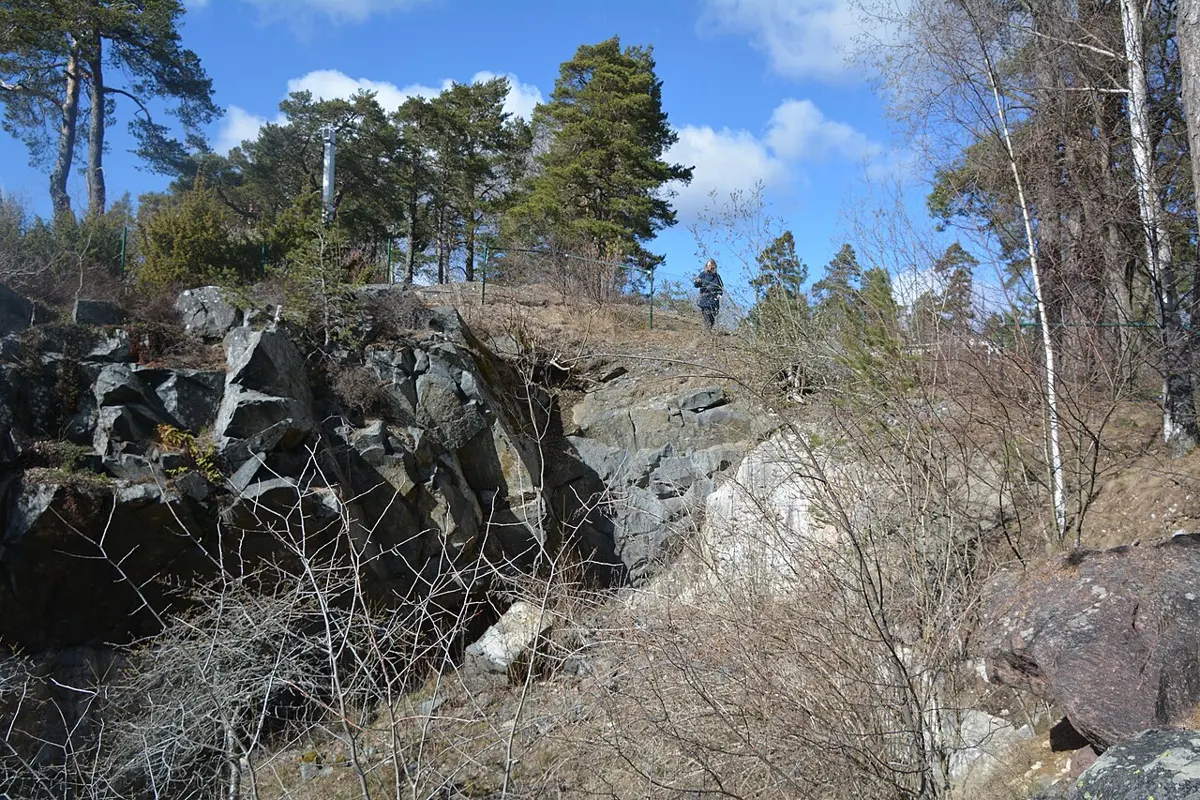
Ytterbia was not pure either. In 1907 the French chemist Georges Urbain split it into two: the real ytterbium, and lutetium (lutetium’s story). Pure ytterbium metal was made only in 1953.
Where ytterbium is found
In the universe, ytterbium is made in stars by catching neutrons (Catching neutrons).
In the Earth’s crust there are about 3 grams in a tonne of rock, several times more than of its neighbors thulium and lutetium. It is mined with the other rare earths from minerals such as monazite and xenotime, and from clays in southern China, which supplies most of it.
In Nepal and in your body. Nepal mines no rare earths. Your body has no use for ytterbium.
What ytterbium is like and how it reacts
- A soft, silvery metal that can be hammered and drawn into wire Grade 9: Properties of metals. In air it slowly forms a thin layer of oxide that protects it.
- Light for a lanthanide. Its density is 6.9 g/cm³, while its neighbors thulium and lutetium are over 9. It also melts at only about 820 °C, against 1,545 °C for thulium. In a metal, each atom gives some electrons to the shared “sea” of free electrons that holds it together. Most lanthanides give three; ytterbium, holding on to its full 4f, gives only two. With less glue between them, its atoms sit farther apart.
- With water, slowly when cold and faster when hot, giving hydrogen Grade 9: Reactive metals and water:
2Yb + 6H₂O → 2Yb(OH)₃ + 3H₂ - With dilute acids, quickly, giving hydrogen and a colorless solution of Yb³⁺. Its compounds are white or colorless: Yb³⁺ takes in only infrared light, which our eyes cannot see.
The ytterbium clock
Every clock counts something that repeats: a pendulum’s swings, the vibrations of a quartz crystal in a watch. Since 1967 the world’s second has been defined by atoms of cesium: one second is exactly 9,192,631,770 waves of the microwaves that cesium atoms take in.
The more ticks a clock counts in a second, the more finely it can divide time. A ytterbium clock counts the waves of yellow light, of a color that ytterbium atoms take in exactly, about 518 trillion of them every second: more than 50,000 times as many as cesium’s microwaves.
To make one, scientists cool about ten thousand ytterbium atoms with lasers to a hundred-thousandth of a degree above absolute zero, so they hardly move, and hold them still in a pattern of laser light, like eggs in a tray. A second, very steady laser is tuned until the atoms take in its light, and its waves are counted. In 2013 two ytterbium clocks at NIST, in the USA, ticked so evenly that their ticks matched to within two parts in a billion billion (10¹⁸).
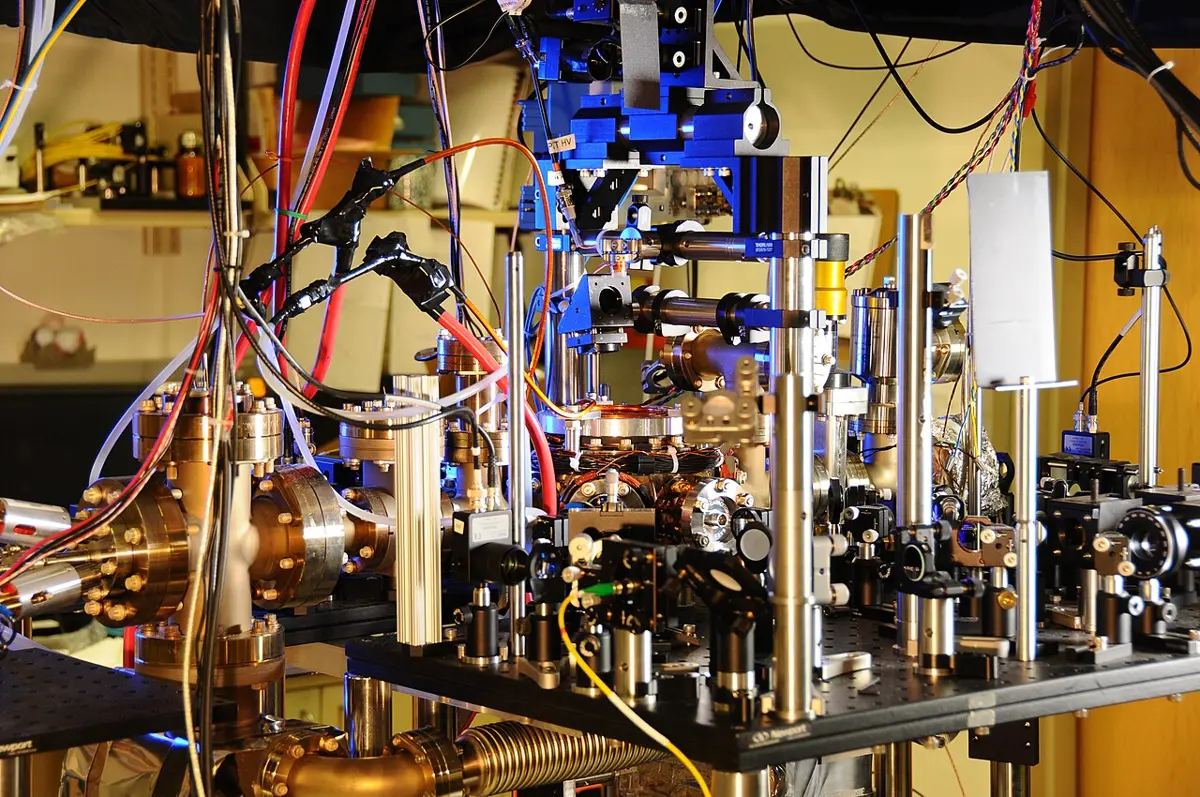
Clocks of strontium and ytterbium are now about a hundred times better than cesium clocks, and the world’s experts on measurement plan to redefine the second with such an optical clock, perhaps around 2030. Clocks so exact can even feel gravity: a clock raised even a little higher ticks very slightly faster, as Einstein predicted.
Other uses
- Powerful lasers. Glass fibers with a little ytterbium make some of the most powerful and efficient lasers, giving infrared light of about 1,030–1,080 nm Grade 9: Infrared rays. They cut and weld steel in factories.
- X-rays without electricity. Ytterbium-169, made in a nuclear reactor, gives out gamma rays and is used, like thulium-170, to take pictures through metal. Its half-life is 32 days.
- Stronger steel. A little ytterbium improves some stainless steels.
Ytterbium and your health
Ytterbium has no known job in the body and is of low toxicity, though its compounds can irritate the skin and eyes. As a fine powder the metal can catch fire.
In your science books
- Grade 8: Bohr and Bury’s 2n² rule.
- Grade 9: atomic mass, variable valency, the properties of metals, infrared rays and GPS.
- Grade 10: the Aufbau principle and the lanthanides.
- Going further: where ytterbium is made.
More to explore
- Nobel Prizes: atomic clocks and traps for single atoms and laser cooling, with which the clock’s atoms are cooled.
- Its neighbors: thulium before it and lutetium after it, which hid in its oxide; cesium, whose clocks define the second; erbium and yttrium, with the story of Ytterby; lanthanum, with the story of the whole row.
- Play: find ytterbium in Guess the Element, the Periodic Table Jigsaw and Higher or Lower.
- Read more: ytterbium at the Royal Society of Chemistry and at PubChem.