
- Atomic number
- 48
- Atomic mass
- 112.41
- Shells
- 2, 8, 18, 18, 2
- Configuration
- 1s² 2s² 2p⁶ 3s² 3p⁶ 4s² 3d¹⁰ 4p⁶ 5s² 4d¹⁰
- In the table
- period 5, group 12 (IIB), d-block
- Kind
- Transition metal
- Valency
- 2 (Cd²⁺)
- State at 25 °C
- solid
- Melts · boils
- 321 °C · 767 °C
- Density
- 8.7 × as heavy as water
- Known since
- 1817
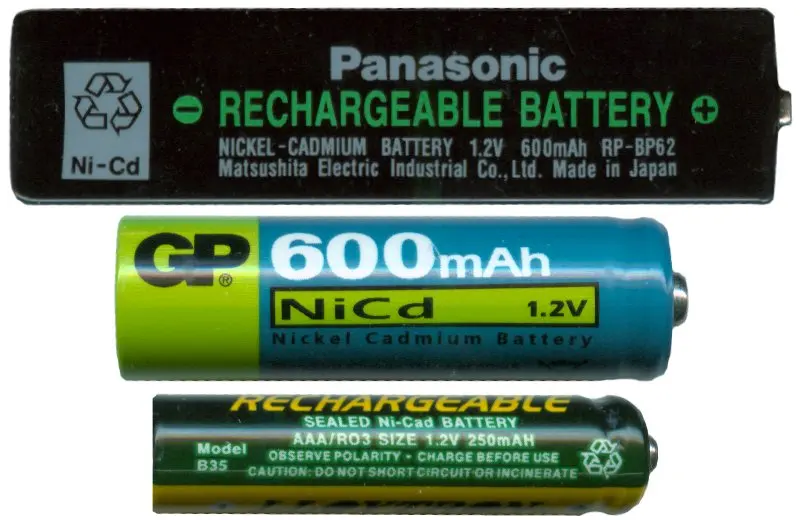
Look at an old cordless drill, an emergency light or the battery pack of an old phone, and you may find the letters Ni-Cd: nickel and cadmium. Look at a tube of artists’ paint labeled “cadmium yellow” or “cadmium red”, and it is the same metal again. And if you have studied Minamata, where mercury poisoned a whole town, there is a second story like it from Japan, where the poison was cadmium.
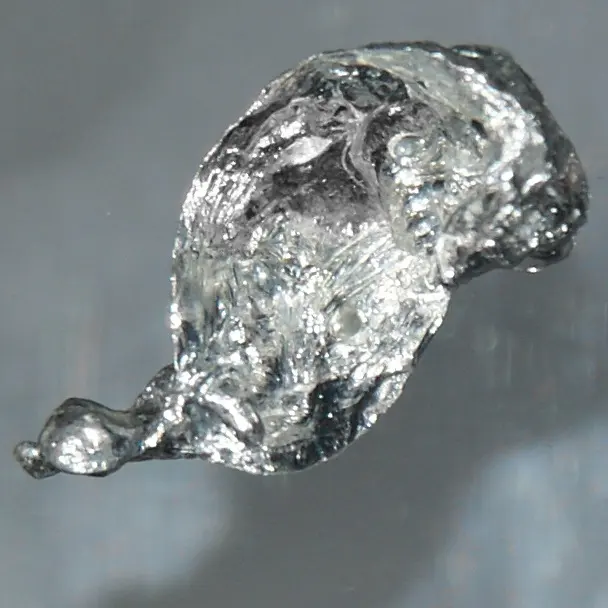
Cadmium is a soft, bluish-white metal that is almost always found hidden inside zinc ore. It is useful, and it is one of the most harmful metals to living things. Here is its story.
The cadmium atom
Every cadmium atom has 48 protons, so cadmium’s atomic number is 48, and a neutral atom has 48 electrons. The commonest kind of cadmium atom has 66 neutrons, so its mass number is 48 + 66 = 114.
By the 2n² rule Grade 8: Bohr and Bury’s rule, the first three shells hold 2, 8 and 18 electrons. The N shell could hold 32, but after 18 electrons the next two go into a fifth shell, O, so cadmium is 2, 8, 18, 18, 2.
In subshells Grade 10: The Aufbau principle, 5s fills before 4d, and cadmium is exactly what the rule predicts, with both full:
1s² 2s² 2p⁶ 3s² 3p⁶ 4s² 3d¹⁰ 4p⁶ 5s² 4d¹⁰
Its place in the periodic table
- Period 5, because its electrons are in five shells.
- Group 12, called IIB in the older naming. It sits between silver (47) and indium (49).
- d-block, because its last electrons go into the 4d subshell. Like zinc above it, cadmium is usually counted with the transition metals Grade 10: Metals, though its d subshell is already full.
Above cadmium in group 12 is zinc, and below it is mercury. Members of a group behave alike because they have the same number of outer electrons Grade 8: Characteristics of groups. Cadmium gives up its two 5s electrons to become Cd²⁺, so its valency is 2, just like zinc in Zn²⁺. Cadmium oxide is CdO, cadmium chloride CdCl₂ and cadmium sulphate CdSO₄ Grade 9: The criss-cross method.
What is the formula of cadmium sulphide, made of Cd²⁺ and S²⁻ ions?
Pick an answer to see why.
How cadmium was found and named
In the early 1800s, German pharmacies sold zinc oxide, a white powder used in ointments. They made it by heating a zinc mineral, zinc carbonate. Some batches came out yellow instead of white, and a test on them gave a yellow solid, as the poison arsenic does, so some officials feared the medicine held arsenic.
Friedrich Stromeyer, a chemistry professor in Göttingen who also inspected the region’s pharmacies, looked into it in 1817. He found no arsenic. The yellow came from a substance nobody had seen before. He separated it as a brown oxide, heated that with carbon (lamp black), and got a bluish-gray metal: a new element. Two other German chemists found it in zinc samples at almost the same time and announced it the next year.
The name. The zinc carbonate was known by an old name, cadmia in Latin (from Greek kadmeia), so Stromeyer named the metal cadmium, symbol Cd. The word goes back to Cadmus, the hero of a Greek legend who founded the city of Thebes, near where the mineral was found. Nepali has no word of its own for cadmium.
Where cadmium is found
In the universe. Cadmium, like other elements heavier than iron, was built inside stars, mostly giant stars that slowly add neutrons to atoms one at a time (Heavier than iron).
In the Earth’s crust. Cadmium is rare: only about a tenth of a gram in every tonne of ordinary rock, hundreds of times less than zinc. It has just one real mineral of its own, yellow greenockite, cadmium sulphide (CdS), and that is never found in amounts worth mining.
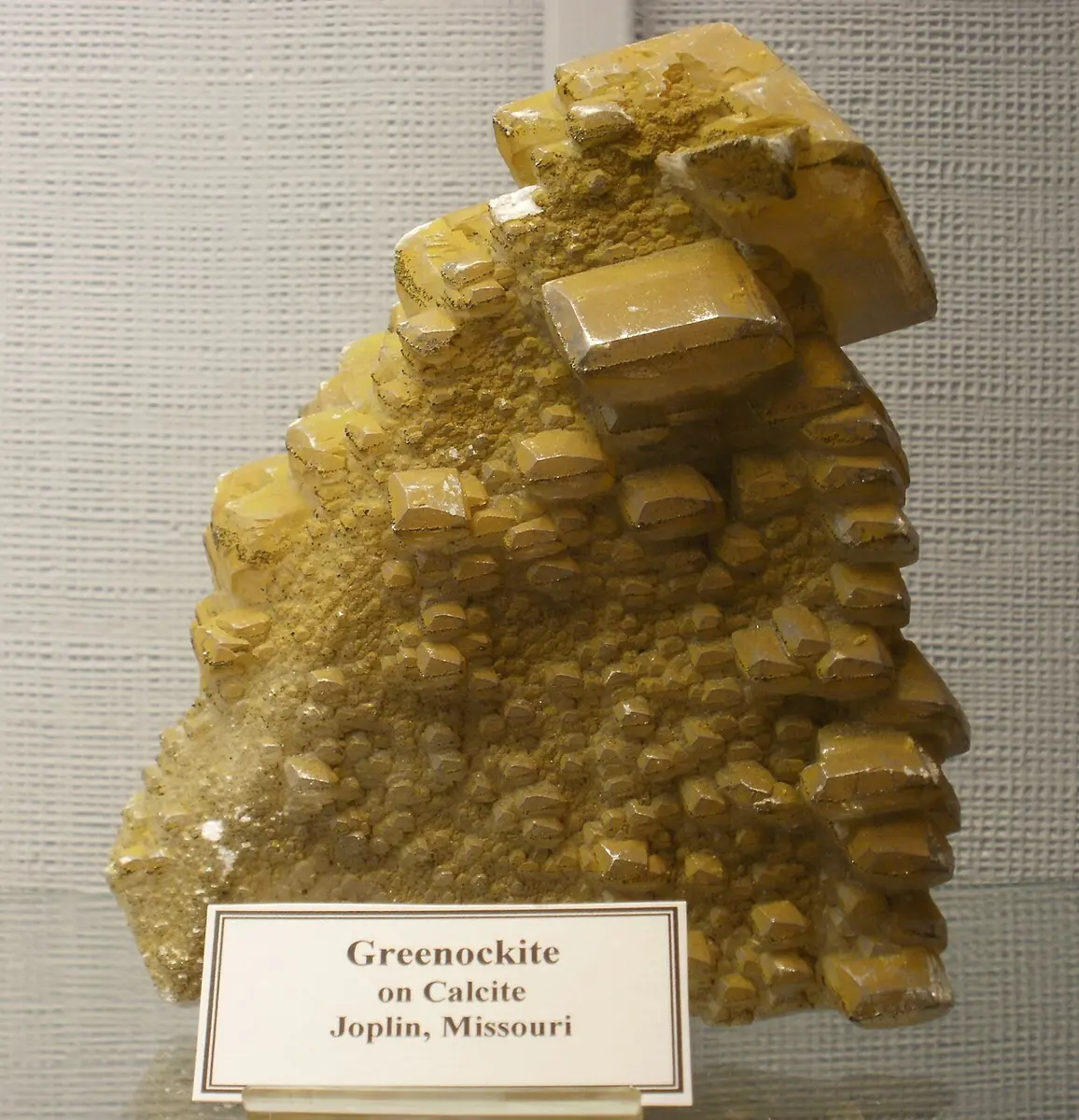
Instead, cadmium hides in zinc ore. Cd²⁺ and Zn²⁺ ions carry the same charge and are nearly the same size, so when crystals of zinc blende (ZnS) grow underground, a few cadmium ions take zinc’s place. A typical zinc ore holds about 0.3% as much cadmium as zinc. So cadmium is not mined for itself: it comes out as a by-product when zinc is refined. In 2024 the world produced about 24,000 tonnes of cadmium (a few hundred times less than zinc), nearly two-fifths of it in China, followed by South Korea, Canada and Japan.
In Nepal. Nepal has zinc and lead ores, such as those at Lari near Ganesh Himal, which may hold a little cadmium too, but none is mined. All the cadmium in Nepal arrives inside imported batteries, paints and electronics.
In your body. An adult carries a few tens of milligrams of cadmium, mostly in the kidneys and liver, taken in with food (and with tobacco smoke). The body has no use for any of it.
What cadmium is like
- Color. A silvery metal with a faint bluish shine.
- Soft. It can be cut with a knife and bent by hand, softer than zinc.
- Heavy. Its density is 8.69 g/cm³, a little less than copper’s.
- Melts at 321 °C, lower than most metals: lower than zinc (420 °C), almost the same as lead (327 °C). It boils at 767 °C, and cadmium vapor is very poisonous to breathe.
- Conducts heat and electricity well, as metals do, but not as well as copper or silver.
The group 12 metals all melt at low temperatures for metals: zinc at 420 °C, cadmium at 321 °C and mercury, at −39 °C, is a liquid. Their d subshells are full, so they have only their two s electrons to share in the “sea” of free electrons that holds a metal together Grade 9: What is inside a metal, and the bonding is weaker than in the transition metals beside them.
How cadmium reacts
Cadmium is a little less reactive than zinc, but still above hydrogen in the reactivity series.
With air. At room temperature cadmium slowly gets a dull coat. Heated in air, it burns to a brown powder, cadmium oxide Grade 9: Metals react with oxygen:
2Cd + O₂ → 2CdO
This is the brown oxide Stromeyer separated, and a little of it, mixed into zinc oxide, was what had turned the pharmacies’ white powder yellow.
With dilute acids. It dissolves slowly in dilute hydrochloric or sulphuric acid and gives off hydrogen Grade 9: Metals and dilute acids:
Cd + 2HCl → CdCl₂ + H₂
Zinc pushes it out. Zinc is more reactive, so zinc metal displaces cadmium from its compounds Grade 10: Single displacement reaction:
Zn + CdSO₄ → ZnSO₄ + Cd
Zinc refineries use exactly this. They dissolve the roasted ore in sulphuric acid, then stir zinc dust into the zinc sulphate solution: the cadmium (and copper) in it comes out as a dark sludge, which is collected and refined into pure cadmium.
A zinc refinery adds zinc dust to its zinc sulphate solution to remove the cadmium. Why does this work?
Pick an answer to see why.
The yellow sulphide
Pass hydrogen sulphide gas (H₂S, with its rotten-egg smell) into a solution of a cadmium salt, and a bright yellow solid falls out: cadmium sulphide.
CdSO₄ + H₂S → CdS + H₂SO₄
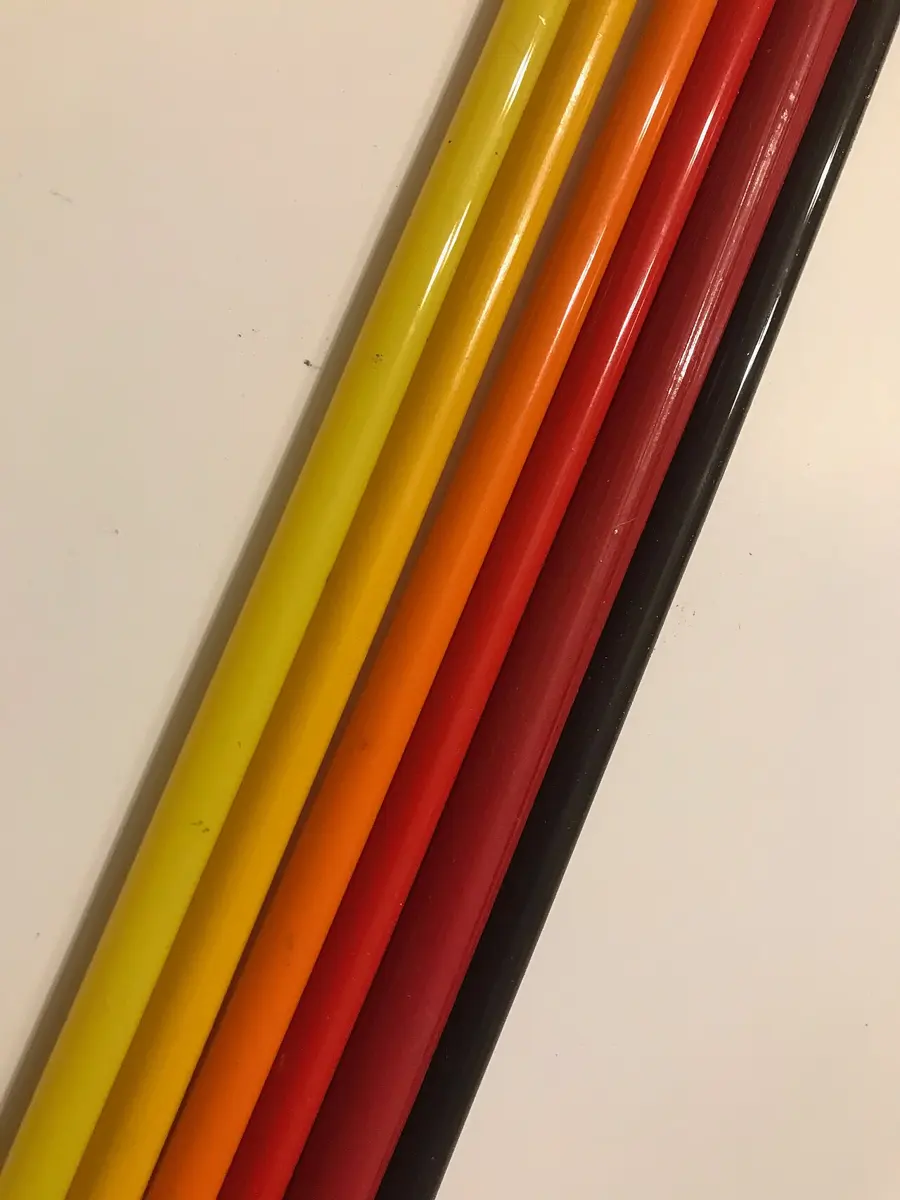
Chemists once used this yellow precipitate to test for cadmium. The same compound, made in factories and ground fine, is the paint cadmium yellow. Mixed with cadmium selenide (CdSe), it turns orange and then deep red.
Cadmium in daily life
Batteries. Most cadmium goes into nickel–cadmium (Ni-Cd) batteries, first made in 1899 by the Swedish inventor Waldemar Jungner. Each cell gives 1.2 volts and can be recharged hundreds of times. They last long and give large currents, so they powered cordless tools, emergency lights and early mobile phones. Today, lithium-ion and nickel–metal hydride batteries have replaced them in most things, because cadmium is poisonous; Ni-Cd cells are still used where reliability matters most, such as in aircraft and railway signals.
Solar panels. Most solar panels, like those on Nepali rooftops, are made of silicon Grade 9: Solar electricity. The main other kind is a thin film of cadmium telluride (CdTe), a few thousandths of a millimeter thick, laid on glass. It is a growing use of cadmium. The cadmium is locked inside a stable compound between sheets of glass, and the panels are collected and recycled at the end of their life.

Coatings. Like zinc, cadmium can be plated onto steel to keep it from rusting. It is still used on some bolts and parts of aircraft and oil platforms, where nothing else does as well, but less than before.
Quantum dots. Crystals of cadmium selenide only a few millionths of a millimeter across glow with a color that depends on their size: the smallest blue, larger ones green, the largest red. Their discovery won the Nobel Prize in Chemistry in 2023. Many “QLED” television screens use such dots, though many makers now use dots of indium phosphide instead, which contain no cadmium.
Cadmium catches neutrons
One of cadmium’s eight natural isotopes, cadmium-113 (about 12% of cadmium atoms), has a rare talent: its nucleus swallows slow-moving neutrons more readily than almost any other natural nucleus. That makes cadmium useful in nuclear reactors.
In a reactor, each uranium nucleus that splits gives out two or three neutrons, and each of those can split another nucleus Grade 9: Nuclear fission. If too many go on to split more, the reaction runs away; if too few, it dies out. So reactors have control rods, often an alloy of silver, indium and cadmium, that can be lowered between the fuel rods. The deeper they go, the more neutrons they catch.
Why are control rods made of materials like cadmium and boron?
Pick an answer to see why.
The same talent helped prove that the neutrino exists, a particle so ghostly it passes through the whole Earth. In 1956, scientists put tanks of water with cadmium chloride dissolved in it beside a reactor; a neutrino hitting the water made a tiny flash, and a few millionths of a second later a cadmium nucleus caught the neutron it released and made a second flash. That pair of flashes was the neutrino’s signature, and it won the Nobel Prize in Physics in 1995.
Cadmium and your health
Iron, zinc and copper are needed by your body; cadmium is not. It is a heavy metal, like lead and mercury Grade 9: Harmful effects of mercury and lead, and it is especially dangerous because the body can hardly get rid of it. Most of what you take in stays in your kidneys for decades, slowly adding up and damaging them. Cadmium also weakens bones, and breathing its dust or fumes causes lung cancer.
Most people take in cadmium in two ways:
- Food. Plants take up cadmium from the soil, especially soil polluted by mines or by too much phosphate fertilizer, which carries a little cadmium. Rice, leafy vegetables, liver, kidneys and shellfish can hold the most.
- Tobacco smoke. Tobacco plants are very good at pulling cadmium out of the soil. Smokers have several times more cadmium in their blood than non-smokers.
Surprising facts and records
- The color of a meter. Heated cadmium vapor gives a sharp red light. In 1907 scientists defined the ångström, a unit for tiny lengths, by its wavelength, and in 1927 the meter was given as about 1.55 million of these red waves. Krypton’s orange light took over in 1960 (Krypton).
- A standard of voltage. From 1911 to 1990, laboratories checked their voltmeters against the Weston cell, a battery made with cadmium and mercury that gives a very steady 1.0186 volts.
- Banned, mostly. Since 2006 the European Union has forbidden cadmium in almost all new electronics, and since 2017 in the batteries of cordless tools too.
In your science books
- Grade 8: the 2n² rule, groups and periods and displacement reactions.
- Grade 9: writing formulas, nuclear fission, properties of metals, heavy metals: mercury and lead and solar electricity.
- Grade 10: electronic configuration, metals in the periodic table and single displacement.
- Going further: why each element has its own lines, inside a nucleus: fission and where the atoms in your body came from.
More to explore
- Nobel Prizes with cadmium in them: quantum dots (2023, cadmium selenide and cadmium sulphide crystals) and the neutrino (1995, caught with cadmium chloride in water).
- Neighbors: cadmium’s group-mates zinc and mercury, and silver beside it.
- Play: find cadmium in Guess the Element and the Periodic Table Jigsaw.
- Read more: cadmium at the Royal Society of Chemistry and at PubChem.