
- Atomic number
- 43
- Atomic mass
- 96.91
- Shells
- 2, 8, 18, 13, 2
- Configuration
- 1s² 2s² 2p⁶ 3s² 3p⁶ 4s² 3d¹⁰ 4p⁶ 5s² 4d⁵
- In the table
- period 5, group 7 (VIIB), d-block
- Kind
- Transition metal
- Valency
- up to 7 (as in the pertechnetate ion, TcO₄⁻), also 4
- State at 25 °C
- solid
- Melts · boils
- 2,157 °C · 4,265 °C
- Density
- 11.0 × as heavy as water
- Known since
- 1937
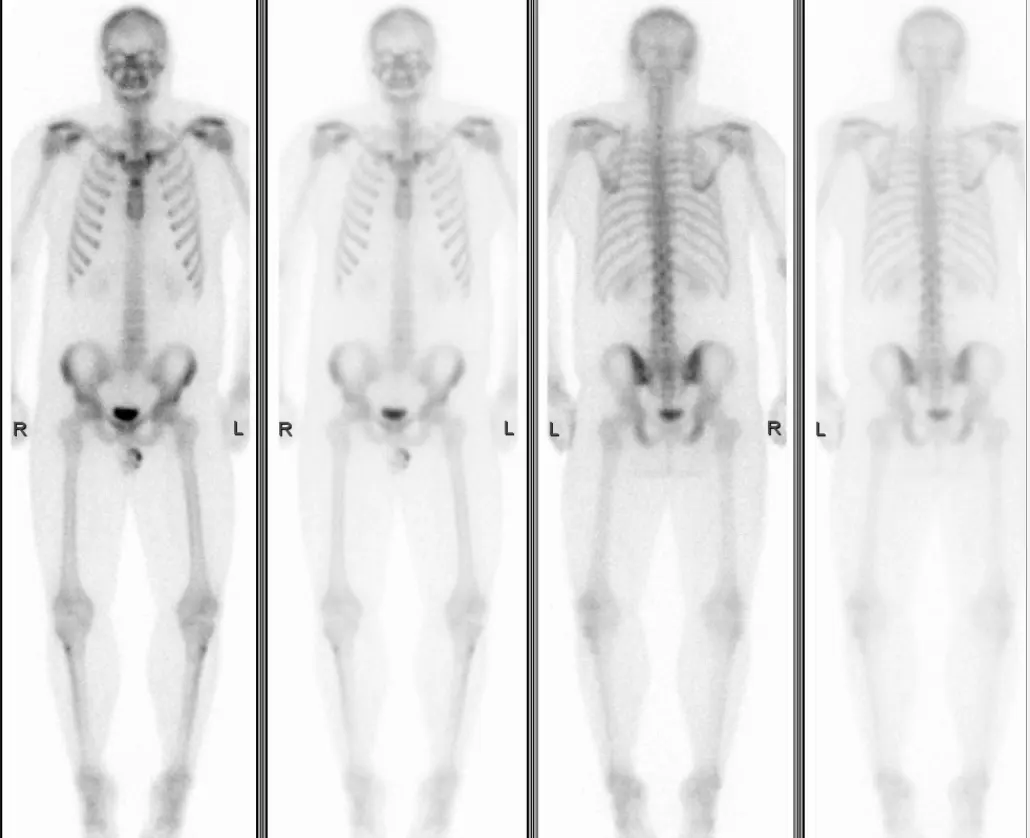
A doctor wants to know whether a cancer has spread into a patient’s bones. A tiny amount of a liquid is injected into a vein. Over the next few hours it collects wherever bone is growing or mending, and it gives out gamma rays. A special camera catches the rays, and a picture of the whole skeleton appears, with any trouble spots glowing darker.
The liquid carries technetium, an element that you will not find in any rock, river or living thing on Earth. Every scrap of it was made by people. It was the first element ever made artificially, and today it is used in more scans than any other radioactive substance. Here is its story.
The technetium atom
A technetium atom has 43 protons, so technetium’s atomic number is 43, and 43 electrons. Its best-known kind, technetium-99, has 56 neutrons: mass number 43 + 56 = 99.
Its shells are 2, 8, 18, 13, 2 Grade 8: Bohr and Bury’s rule, and its electrons fill the subshells in exactly the order the Aufbau principle predicts:
1s² 2s² 2p⁶ 3s² 3p⁶ 4s² 3d¹⁰ 4p⁶ 5s² 4d⁵
Unlike its neighbors niobium and molybdenum, technetium has no exception: the 5s subshell is full and 4d is half full.
Its place in the periodic table
- Period 5, because its electrons are in five shells.
- Group 7, called VIIB in the older naming, with manganese above it and rhenium below.
- d-block: a transition metal Grade 10: Metals.
Its valency
Like manganese, technetium can use all seven of its outer electrons (5s² 4d⁵), so its highest valency is 7. In water it is usually found as the pertechnetate ion, TcO₄⁻, the twin of the permanganate ion, MnO₄⁻, in the purple potassium permanganate (KMnO₄) used to wash vegetables and clean wounds. It also has a valency of 4, as in technetium dioxide, TcO₂.
What is the valency of technetium in its oxide Tc₂O₇?
Pick an answer to see why.
The empty box: how technetium was found
Mendeleev’s gap
When Dmitri Mendeleev arranged the elements in 1869–1871, he left gaps for elements nobody had found yet, and described some of them in advance Grade 10: Mendeleev’s periodic table. One gap was just below manganese, between molybdenum and ruthenium. He called the missing element eka-manganese, “one below manganese”.
The other gaps were soon filled: gallium in 1875, scandium in 1879, germanium in 1886. Element 43 was not. Chemists searched minerals for it for over sixty years. In 1925 three German chemists, Walter Noddack, Ida Tacke and Otto Berg, announced it under the name masurium, but no one else could find it in their minerals, and the claim was not accepted. (They did find element 75, rhenium, the next one down in group 7.)
Made, not found
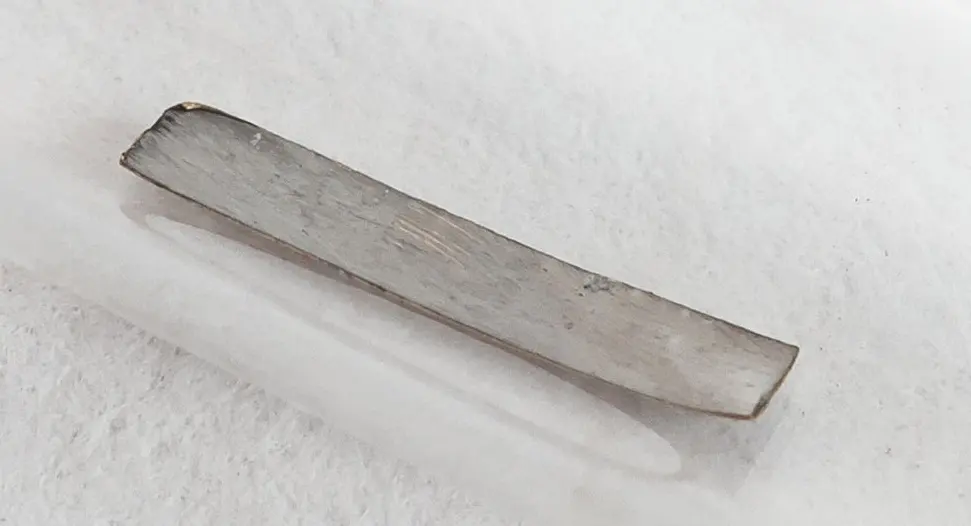
In 1936, the young Italian physicist Emilio Segrè visited the laboratory of Ernest Lawrence in Berkeley, California, where Lawrence had built a cyclotron, a machine that speeds up particles and fires them at a target. Segrè asked for some of its old parts, which had become radioactive. Lawrence posted him a strip of molybdenum from the cyclotron, which had been hit by fast deuterons (nuclei of heavy hydrogen, one proton and one neutron).
Molybdenum has 42 protons. If a nucleus of it took in the deuteron’s proton, it would have 43. In 1937, at the University of Palermo in Sicily, Segrè and the chemist Carlo Perrier dissolved the strip and separated the radioactive atoms from the molybdenum. They behaved like manganese and rhenium, not like any known element: element 43 at last. It was the first element made by people before it was found in nature.
In 1947 they named it technetium, from the Greek technetos, “artificial”, and gave it the symbol Tc. Nepali books use the English name, टेक्निसियम.

Why there is none left on Earth
Every kind of technetium atom is radioactive: its nucleus is unstable and sooner or later breaks down, giving out radiation and becoming a different element Grade 9: Radioactive elements. Technetium is the lightest element with no stable atoms at all. Below lead, only one other element is like that: promethium (61).
How fast a radioactive substance decays is measured by its half-life: the time it takes for half of its atoms to decay (Half-life). The longest-lived kinds of technetium have half-lives of about 4 million years. That sounds long, but the Earth is about 4,500 million years old.
A few atoms do form naturally even today, when uranium atoms in uranium ores split, but far too few to have been found by the chemists of the 1920s. And technetium shines in the light of some old giant stars, which must have made it recently, since it would have decayed long ago: proof that stars are still making elements (An element that shouldn’t be there).
Why is there almost no technetium in the Earth’s rocks?
Pick an answer to see why.
Where technetium comes from today
Technetium is now made by the tonne, without anyone wanting it. When uranium-235 nuclei split in a nuclear power station Grade 9: Nuclear fission, about 6 of every 100 fissions leave an atom that becomes technetium-99. So every gram of uranium-235 that splits leaves behind about 27 milligrams of it in the used fuel.
Technetium-99 has a half-life of about 211,000 years, so it is one of the long-lasting parts of nuclear waste that must be stored safely, and it moves easily in water as pertechnetate, which makes it harder to keep in place.
What technetium is like
- A silvery-gray metal, looking much like platinum, though usually made as a gray powder.
- Heavy: density about 11 g/cm³, nearly as dense as lead.
- Melts at 2,157 °C.
- Tarnishes slowly in moist air, and dissolves in nitric acid, but not in hydrochloric acid.
- Protects steel. A tiny amount of pertechnetate in water stops steel from rusting very well. But it is radioactive, so this can only be used in closed systems that people do not touch.
Because of its radioactivity, technetium has no use in daily life except one, and that one is enormous.
Technetium in hospitals
The technetium that doctors use is a special form, technetium-99m (the “m” stands for metastable: “almost stable”). Its nucleus has the same 43 protons and 56 neutrons as technetium-99, but it holds a little extra energy. It gets rid of that energy by giving out a gamma ray, and becomes ordinary technetium-99 (Gamma rays).
Technetium-99m is close to perfect for pictures of the inside of the body:
- Its gamma rays have just the right energy: strong enough to get out of the body to the camera, weak enough to be stopped by the camera’s detector Grade 9: Gamma rays.
- It gives out gamma rays and no alpha or beta particles, which would harm the body’s cells more without helping the picture.
- Its half-life is 6 hours: long enough to prepare it, inject it and take pictures, short enough that it is almost gone in a day.
- Technetium can be attached to many different molecules, each of which goes to a different organ: bones, the heart muscle, the kidneys, the lungs, the thyroid gland.
The “moly cow”
A substance with a 6-hour half-life cannot be kept on a shelf or shipped across the world: by the time it arrived, little would be left. So hospitals are sent its parent instead. Molybdenum-99, made in a few nuclear reactors around the world, decays into technetium-99m with a half-life of about 66 hours (2.75 days).
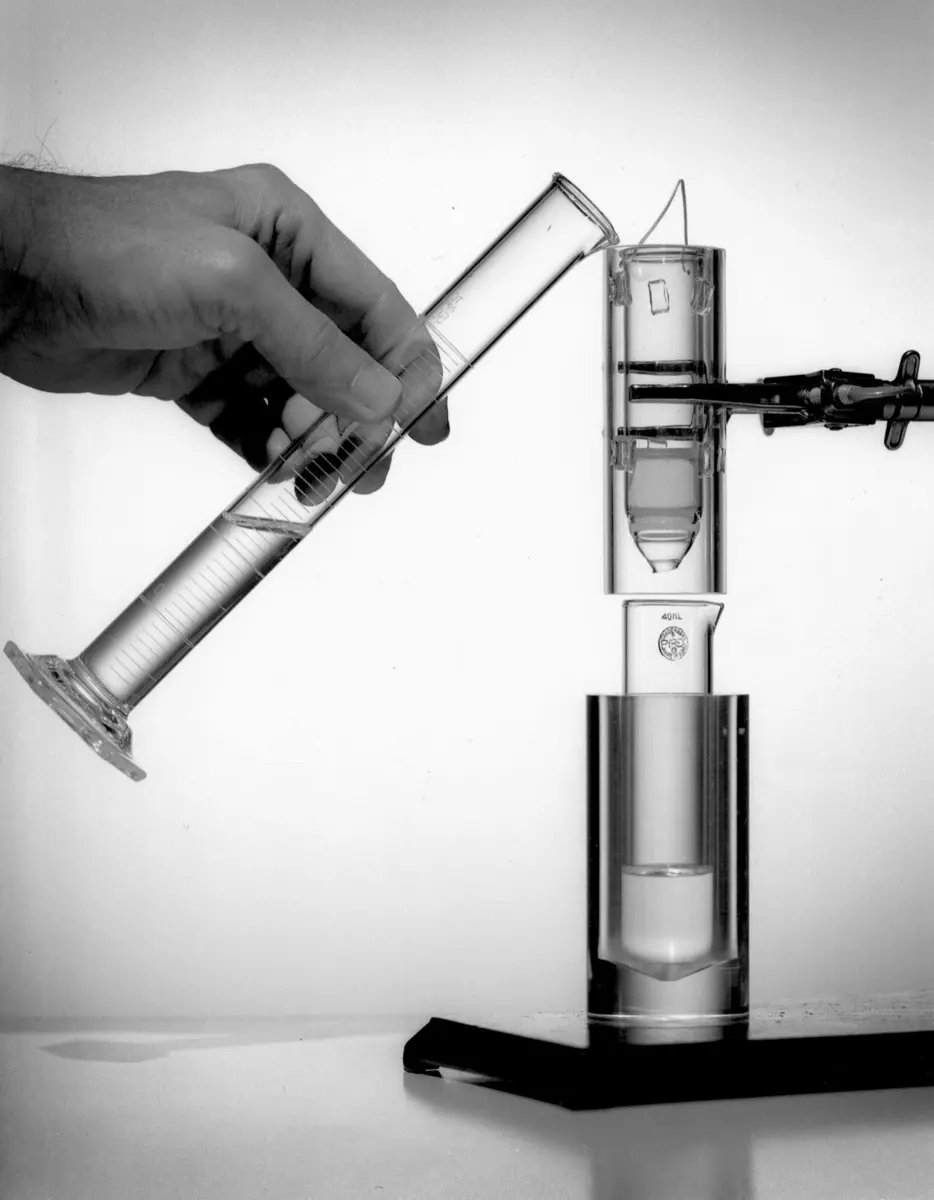
The molybdenum-99 is held on a small column inside a heavy shield, the technetium generator. Each morning, a technician runs salt water through it, and the salt water washes out the technetium-99m that has formed overnight as pertechnetate, while the molybdenum stays behind. Because it is “milked” every day, people call it the moly cow. After about a week, too little molybdenum-99 is left, and a fresh generator arrives.
Today technetium-99m is used in about 30 to 40 million scans a year around the world (counts differ), about four of every five scans in nuclear medicine Grade 9: Nuclear medicine. In Nepal, a few hospitals have nuclear medicine departments for such scans; Chitwan Medical College opened one in 2020.
Technetium and your health
Technetium has no use in the body, and like any radioactive substance it can damage cells. In a scan the amount is tiny, its rays mostly leave the body, and it fades within a day, so the radiation dose is small. Doctors weigh it against what the scan can tell them.
Surprising facts and records
- The first made-by-people element. Technetium was made in 1937, before it was found in nature, though a few atoms of it were in uranium ores all along.
- The lightest radioactive-only element. Every element before it has at least one stable kind of atom.
- Seen in the stars. In 1952, the astronomer Paul Merrill found technetium’s lines in the light of some giant stars, which must have made it within the last few million years.
- From a cyclotron’s scrap. Element 43 was found in a discarded strip of molybdenum from a machine in California, posted to Italy.
In your science books
- Grade 8: the 2n² rule.
- Grade 9: radioactive elements, nuclear fission and gamma rays.
- Grade 10: Mendeleev’s periodic table, the Aufbau principle and transition metals.
- Going further: half-lives, gamma rays and technetium in giant stars.
More to explore
- Nobel Prizes nearby: the first radioactive atoms made by people (1935, Irène and Frédéric Joliot-Curie, two years before technetium) and MRI (2003, another way to see inside the body, without radiation).
- Its neighbors: molybdenum, the parent of hospital technetium, before it; manganese above it; and uranium, whose fission makes it.
- Play: find technetium in Guess the Element, the Periodic Table Jigsaw and Higher or Lower.
- Read more: technetium at the Royal Society of Chemistry and at PubChem.