
- Atomic number
- 8
- Atomic mass
- 16
- Shells
- 2, 6
- Configuration
- 1s² 2s² 2p⁴
- In the table
- period 2, group 16 (VIA), p-block
- Kind
- Non-metal
- Valency
- 2 (the oxide ion, O²⁻, as in MgO; two shared pairs, as in H₂O)
- State at 25 °C
- gas
- Melts · boils
- −219 °C · −183 °C
- Density
- 1.1 × as heavy as air
- Known since
- 1774
Hold your breath. After about a minute, your body starts to insist that you breathe again. It is not asking for air in general, but for one gas in it: oxygen. Every cell in your body burns its food with oxygen, all day and all night, and your brain can be harmed after only a few minutes without it.
Oxygen is also what makes a fire burn, what turns an iron nail rusty and a cut apple brown, and, joined to hydrogen, what makes water. It is the commonest element in the Earth’s crust and in your own body. Yet for most of the Earth’s history, the air had almost none of it. Here is its story.
The oxygen atom
Every oxygen atom has 8 protons, so oxygen’s atomic number is 8. A neutral atom has 8 electrons. Most oxygen atoms also have 8 neutrons, so their mass number is 8 + 8 = 16.
By the 2n² rule Grade 8: Bohr and Bury’s rule, the electrons are arranged 2, 6. In subshells, 1s² 2s² 2p⁴ Grade 10: Shells, subshells and orbitals.
With 6 outer electrons, oxygen is 2 short of an octet, so its valency is 8 − 6 = 2 Grade 8: Valency. It gets those two electrons in one of two ways:
- it takes them from a metal, becoming the oxide ion, O²⁻, as in magnesium oxide, MgO Grade 9: Formation of magnesium oxide;
- it shares two pairs with other non-metals, as in water, H₂O Grade 9: Formation of a water molecule.
Its place in the periodic table
- Period 2, because its electrons are in two shells.
- Group 16, called VIA in the older naming, because it has 6 outer electrons.
- p-block, because its last electrons go into a p subshell.
Oxygen is a non-metal, and after fluorine it is the most electronegative element: the one that pulls hardest on shared electrons Grade 10: Electronegativity. Below it in group 16 are sulphur, selenium, tellurium and polonium. Sulphur is oxygen’s closest relative: it also has valency 2, and many metals are found in the ground as sulphides as well as oxides.
O₂ and O₃
The oxygen in the air is made of molecules of two atoms, O₂. Each atom needs two more electrons, so the two atoms share two pairs: a double bond, O=O.
Oxygen also comes as ozone, O₃, three atoms joined together: a pale blue gas with a sharp smell. Two forms of the same element, like O₂ and O₃ (or diamond and graphite for carbon), are called allotropes.
How many electrons does an oxygen atom gain to become an oxide ion?
Pick an answer to see why.
How oxygen was found and named
For two thousand years, air was thought to be a single element. Then, in the 1770s, three chemists found that it is a mixture, and that only one part of it keeps a flame or a mouse alive.
- Carl Wilhelm Scheele, a Swedish pharmacist, made oxygen first, around 1771–1772, by heating saltpeter, mercuric oxide and other compounds. He called it “fire air”. But his book about it was not printed until 1777.
- Joseph Priestley, an English minister and scientist, made it on 1 August 1774 by focusing sunlight with a large lens onto red mercuric oxide. A candle burned in it with a dazzling flame, and a mouse lived in a jar of it much longer than in ordinary air. He breathed some himself and wrote that his chest felt “peculiarly light and easy”. He published first, so he is usually given the credit Grade 9: Oxygen gas.
- Antoine Lavoisier in Paris understood what it really was: an element, which burning things and breathing animals take out of the air. Before him, burning was thought to release a substance called “phlogiston”; Lavoisier showed that burning things gain weight, because they join with oxygen.
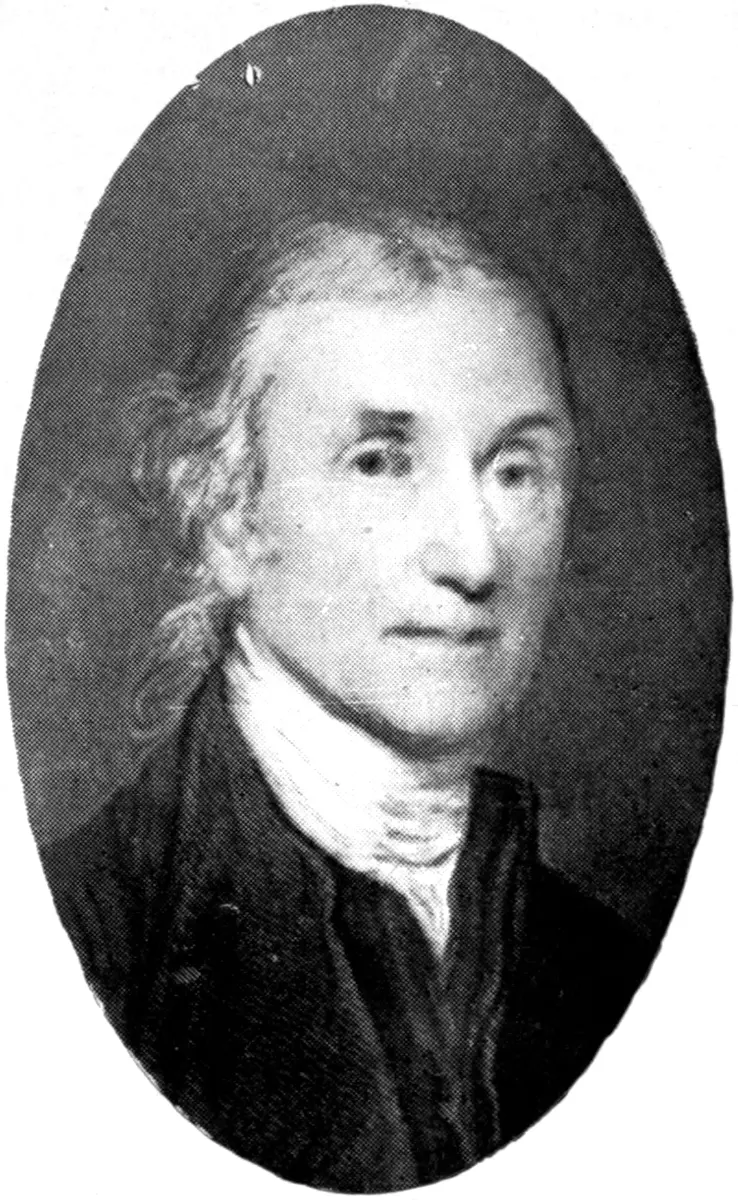
The name. Lavoisier named it oxygène in 1777, from the Greek oxys (sharp, sour) and genes (making): the “acid-maker”, because he believed every acid contains oxygen. He was wrong: hydrochloric acid, HCl, has none. What all acids share is hydrogen Grade 8: Acids give hydrogen ions. But the name stuck. Its symbol is O.
Nepali books write अक्सिजन. The plain Nepali word is प्राणवायु, “the air of life”. The Nepali Brihat Shabdakosh also has अम्लजन, built from Sanskrit like the Greek name: अम्ल (acid) and जन (born, made).
Where oxygen is found
In the universe. Oxygen is the third most common element in the universe, after hydrogen and helium. It is made inside stars, when helium nuclei join carbon nuclei, and scattered when big stars explode (Helium into carbon).
In the Earth’s crust. By mass, nearly half of the crust is oxygen, more than any other element: rocks are mostly oxygen joined to silicon, aluminium, iron and calcium. Sand (silica, SiO₂) is more than half oxygen, and limestone (CaCO₃) almost half.
In water. 16 g of every 18 g of water is oxygen: 89%.
In the air. Oxygen is 21% of the air by volume Grade 9: Gases around us.
In your body. About 65% of your mass is oxygen, more than any other element, mostly in the water you are made of.
Where the air’s oxygen came from
The young Earth’s air had almost no oxygen. It all came from living things. By about 2.7 to 3 billion years ago, many geologists think, tiny cyanobacteria (blue-green algae) in the sea began to use sunlight to split water, and gave off oxygen as waste. This is photosynthesis, which every green plant does today:
6CO₂ + 6H₂O → C₆H₁₂O₆ + 6O₂ (with sunlight and chlorophyll)
At first the oxygen was used up by iron dissolved in the sea, which rusted and sank as layers of red rock. About 2.4 billion years ago, oxygen at last began to build up in the air: the Great Oxidation Event (How life changed the air). It took more than a billion years more to reach anything like today’s 21%.
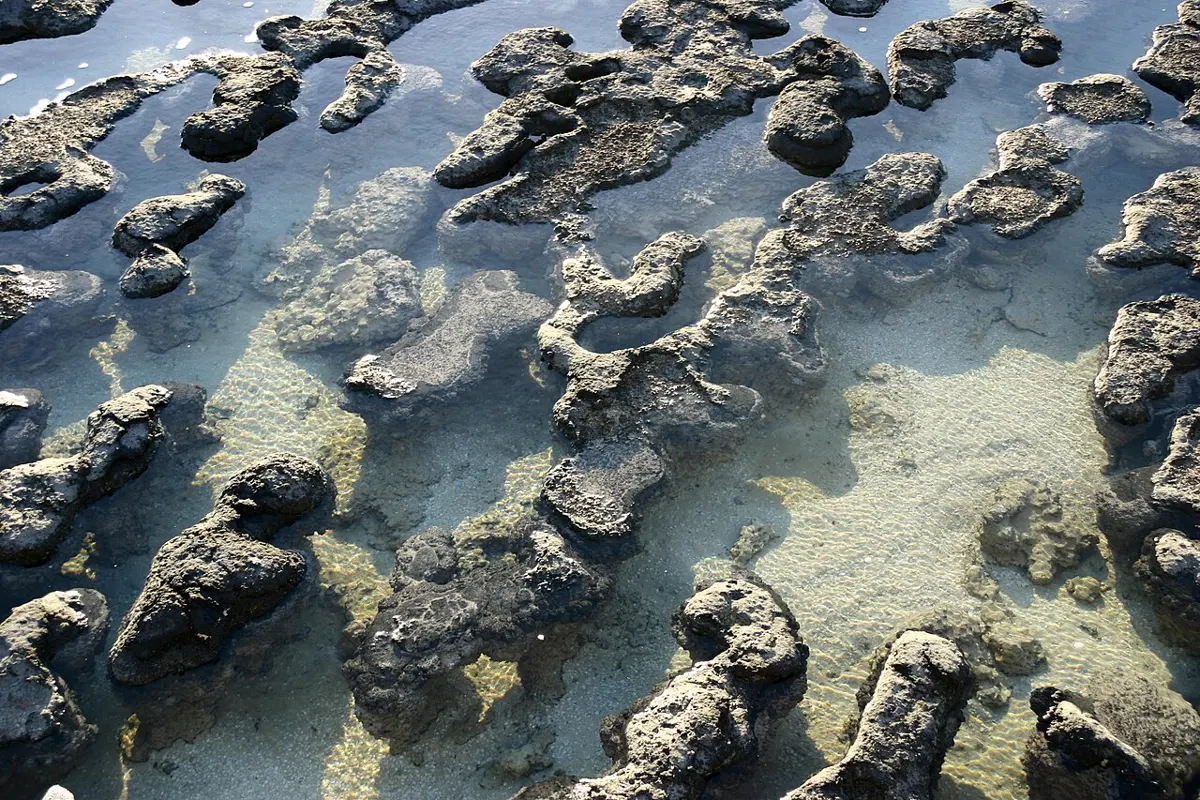
Today, plants on land and tiny phytoplankton in the sea make the oxygen; scientists estimate that about half of it comes from the sea.
What oxygen is like
- A colorless gas with no smell and no taste Grade 9: Physical properties of oxygen.
- A little heavier than air: a liter weighs about 1.43 g, against 1.29 g for air.
- Slightly soluble in water: a liter of water at 20 °C holds only about 9 mg of oxygen, about thirty times less than a liter of air. That is enough for fish, but it is why they need gills that pass a lot of water.
- Supports burning but does not burn itself.
- Neutral: no effect on litmus.
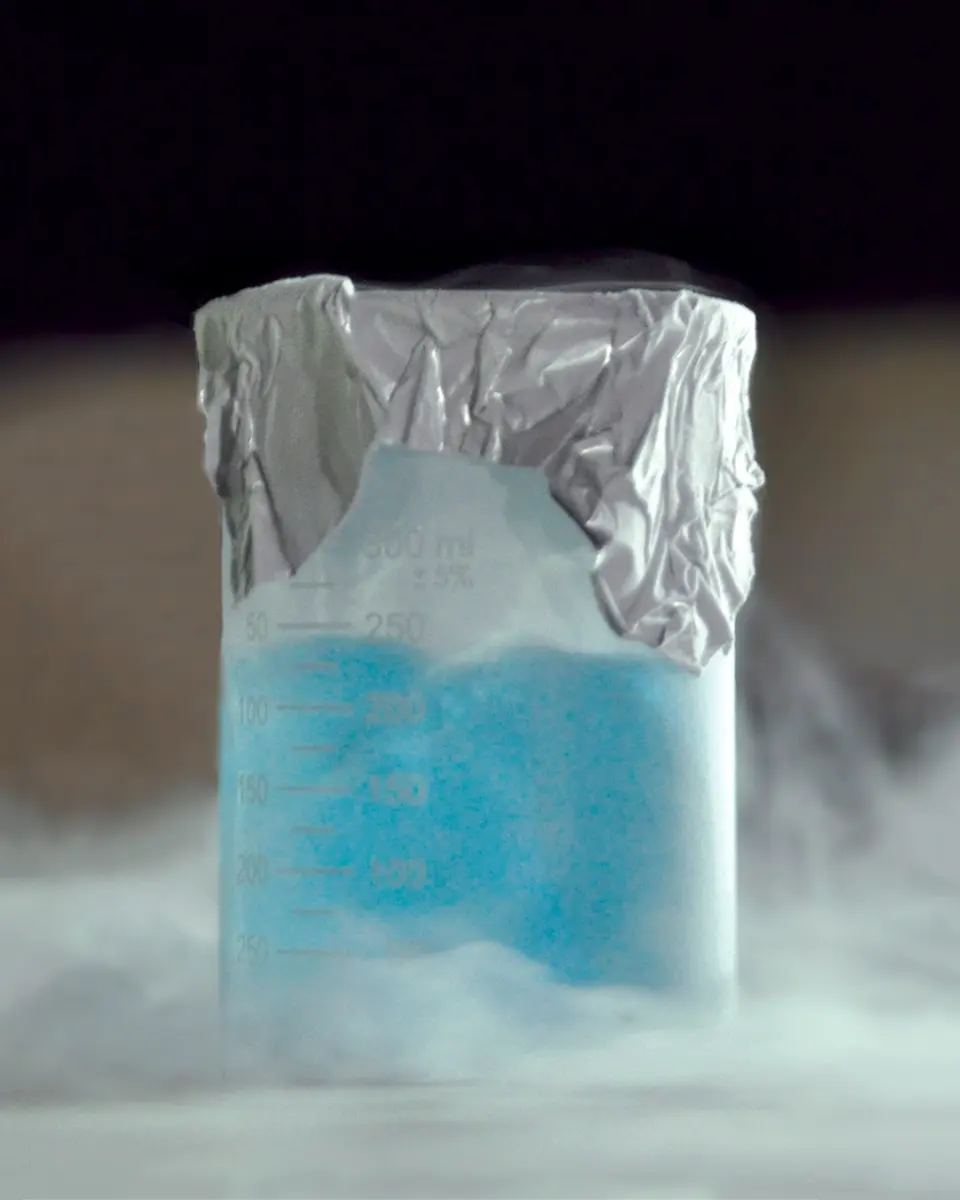
- Pale blue as a liquid (it turns liquid at −183 °C) and as a solid (it freezes at −219 °C).
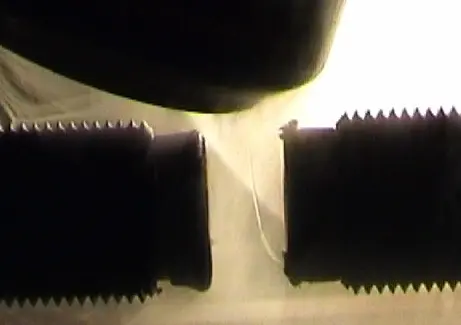
- Attracted to a magnet as a liquid. Pour liquid oxygen between the poles of a strong magnet, and it hangs there; liquid nitrogen runs straight through.
How oxygen reacts
Oxygen joins with almost every other element. Joining with oxygen is called oxidation, and the compound formed is an oxide Grade 9: Chemical properties of oxygen.
Metals form basic oxides. Magnesium ribbon burns with a dazzling white flame and leaves white magnesium oxide; with water, metal oxides give bases Grade 9: Metals react with oxygen:
2Mg + O₂ → 2MgO
Non-metals form acidic oxides, which give acids with water:
C + O₂ → CO₂ S + O₂ → SO₂
Fuels burn. Burning (combustion) is fast oxidation that gives out heat and light. The methane of biogas or the LPG in a kitchen cylinder burns to carbon dioxide and water:
CH₄ + 2O₂ → CO₂ + 2H₂O + energy
A fire needs three things: fuel, heat and oxygen. Take any one away and it goes out. That is why a blanket smothers a fire, and why a candle under an upturned glass soon dies.
Respiration is the same reaction done slowly, step by step, inside your cells, with glucose as the fuel (Respiration: what goes in, what comes out):
C₆H₁₂O₆ + 6O₂ → 6CO₂ + 6H₂O + energy
Slow oxidation is everywhere: iron rusts (with water too), a cut apple turns brown, oil and ghee go rancid, and copper slowly turns green.
Oxygen “supports burning”. Does oxygen gas itself burn?
Pick an answer to see why.
Making oxygen
In a school laboratory, oxygen is made from hydrogen peroxide with a pinch of black manganese dioxide as a catalyst, and collected over water Grade 9: Laboratory preparation:
2H₂O₂ → 2H₂O + O₂
The test is simple: a glowing splint bursts back into flame in oxygen Grade 9: Test for oxygen.
In factories, air is cooled until it turns liquid, then warmed slowly: nitrogen boils off first at −196 °C, and oxygen is left, boiling at −183 °C. This is fractional distillation of liquid air. Smaller oxygen concentrators, used in hospitals and homes, pass air through a material that soaks up nitrogen and lets oxygen through.
Oxygen in daily life and in Nepal
- Steel. The biggest use: oxygen blown through molten iron burns out the extra carbon and turns it into steel.
- Welding and cutting. Acetylene burning in pure oxygen gives a flame of over 3,000 °C, hot enough to cut steel.
- Hospitals. Patients with pneumonia, asthma attacks or injured lungs breathe extra oxygen. In the second wave of COVID-19, in May 2021, hospitals in Nepal and India ran desperately short of oxygen cylinders.
- Rockets. Liquid oxygen burns the fuel in many rocket engines, since there is no air in space.
- Clean water. Bubbling air or oxygen through sewage helps bacteria break down the waste.
Thin air in the Himalaya
The air on a mountain is still 21% oxygen. But the higher you go, the less air there is above you to press down, so each breath holds fewer molecules of everything, oxygen included.
In Kathmandu each breath holds about 84% of the oxygen it would at sea level; at Everest Base Camp, about half; on the summit, about a third. Trekkers who climb too fast above about 2,500 m can get altitude sickness: headache, sickness, breathlessness, and sometimes dangerous fluid in the lungs or brain. The cure is to go up slowly, and to go down if it gets worse.
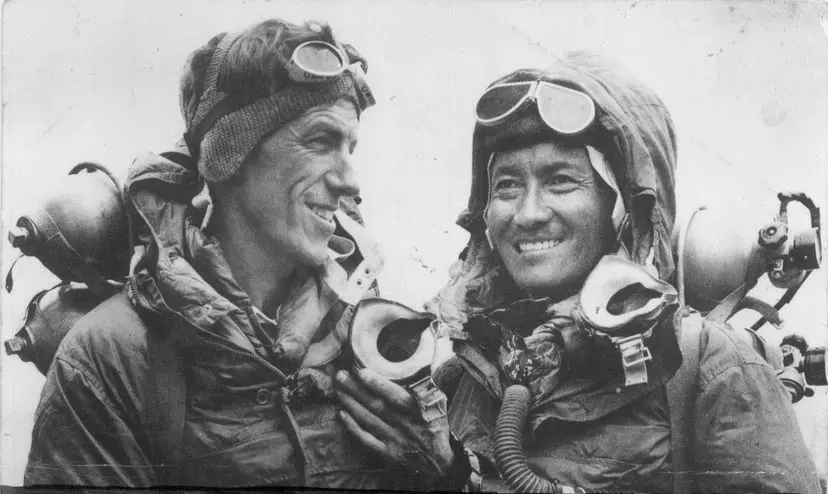
The first climbers to reach the top of Everest, Tenzing Norgay and Edmund Hillary in 1953, used oxygen cylinders. Experts doubted that anyone could climb it without them until Reinhold Messner and Peter Habeler did, in 1978. People whose families have lived high on the Tibetan plateau for thousands of years, such as Tibetans and many Sherpas, cope with thin air far better than lowlanders. Part of the reason is a version of a gene called EPAS1, which helps control how the body responds to too little oxygen; the way cells sense oxygen won the Nobel Prize in Medicine in 2019.
The ozone layer
High above the clouds, between about 15 and 35 km, sunlight turns some oxygen into ozone, O₃. This ozone layer absorbs most of the Sun’s harmful ultraviolet rays Grade 9: Ozone. Chemicals called CFCs, once used in fridges and sprays, thinned it, until the world agreed to stop making them in 1987; it is now slowly healing (Ozone).
Isotopes of oxygen
Natural oxygen is a mixture of three stable isotopes: oxygen-16 (8 neutrons), with a little oxygen-18 (10 neutrons) and even less oxygen-17 (9 neutrons).
Water made with heavy oxygen-18 evaporates a little more slowly than ordinary water. So the snow that falls in a cold age has a little less oxygen-18 than snow in a warm age, and by measuring it in ice dug from deep in the glaciers of Antarctica and Greenland, scientists read the Earth’s temperatures going back hundreds of thousands of years.
Oxygen and your health
At rest, an adult takes in about a quarter of a liter of oxygen every minute, and much more when running. In the lungs, oxygen passes into the blood and joins hemoglobin in the red blood cells, which carries it to every cell Grade 10: Red blood cells. There it burns glucose in respiration, and the carbon dioxide made goes back to the lungs to be breathed out.
Too much oxygen can harm, too: divers who breathe pure oxygen deep under water can have fits, so they use special mixtures.
Surprising facts and records
- The most common element in the Earth’s crust, in the oceans and in your body.
- A magnet for liquid. Liquid oxygen is drawn to a magnet; liquid nitrogen is not.
- Just the right amount. The air’s 21% sits between two limits: below about 17%, breathing gets hard for people not used to it; above about 25%, many things that burn would catch fire far too easily.
In your science books
- Grade 8: the 2n² rule, valency and acids give hydrogen ions.
- Grade 9: oxygen gas (its preparation, test, properties and uses), ozone, magnesium oxide, water’s covalent bonds and metals and oxygen.
- Grade 10: subshells, electronegativity, red blood cells and roasting and calcination.
- Going further: how life changed the air, respiration, life without oxygen and where oxygen atoms are made.
More to explore
- Nobel Prizes with oxygen in them: how cells sense oxygen (2019), the ozone layer (1995), the light-catching machine of photosynthesis (1988) and ATP, the energy of respiration (1997).
- Play: make water, carbon dioxide and ozone in Molecule Kitchen, or find oxygen in Guess the Element.
- Read more: oxygen at the Royal Society of Chemistry and at PubChem.