
- Atomic number
- 74
- Atomic mass
- 183.84
- Shells
- 2, 8, 18, 32, 12, 2
- Configuration
- 1s² 2s² 2p⁶ 3s² 3p⁶ 4s² 3d¹⁰ 4p⁶ 5s² 4d¹⁰ 5p⁶ 6s² 4f¹⁴ 5d⁴
- In the table
- period 6, group 6 (VIB), d-block
- Kind
- Transition metal
- Valency
- 6 (WO₃); also 4, 5 and others
- State at 25 °C
- solid
- Melts · boils
- 3,422 °C · 5,930 °C
- Density
- 19.3 × as heavy as water
- Known since
- 1783
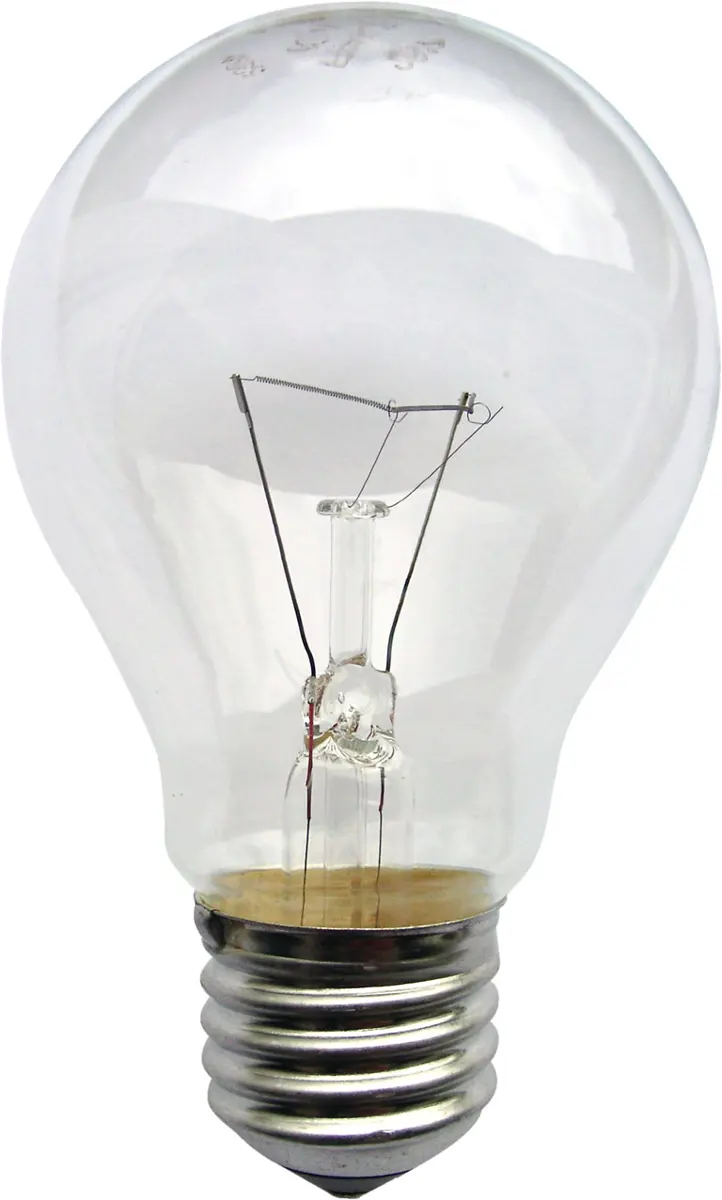
For more than a hundred years, the light in most homes came from a thin coil of wire inside a glass bulb, glowing white-hot. That wire was tungsten. At the temperature the wire glows at, almost every other metal would melt.
Today LED lamps have taken over, in Nepal as in most places. But tungsten is still at work: in the tip of almost every drill bit that cuts rock or steel, in the X-ray machine at the hospital, in welding torches, and in the walls of machines built to copy the Sun. Here is the story of the metal with the highest melting point of all.
The tungsten atom
Every tungsten atom has 74 protons, so tungsten’s atomic number is 74, and a neutral atom has 74 electrons. The most common kind of tungsten atom has 110 neutrons: mass number 74 + 110 = 184.
The 74 electrons fill six shells: 2, 8, 18, 32, 12, 2. As in all the transition metals, the outermost shell (P, with 6s²) begins before the shell inside it (O) is full: the 5d subshell, which belongs to the O shell, is still filling. In subshells Grade 10: The Aufbau principle, the inside 68 electrons fill everything up to 4f¹⁴, and then:
… 6s² 4f¹⁴ 5d⁴
Its place in the periodic table
- Period 6, because its electrons are in six shells.
- Group 6, called VIB in the older naming, with chromium and molybdenum above it. All three have six outer electrons and a highest valency of 6.
- d-block: a transition metal Grade 10: Metals.
Its most common valency is 6, as in the yellow tungsten trioxide, WO₃, and the tungstate ion, WO₄²⁻, in its ores. It also forms compounds with valency 4 and 5 Grade 9: Variable valency.
Chromium, at the top of group 6, has the outer electrons 4s¹ 3d⁵ (Chromium). What are tungsten’s, at the bottom of the same group?
Pick an answer to see why.
How tungsten was found and named
Tungsten has two names, and the stories of both are about heavy stones.
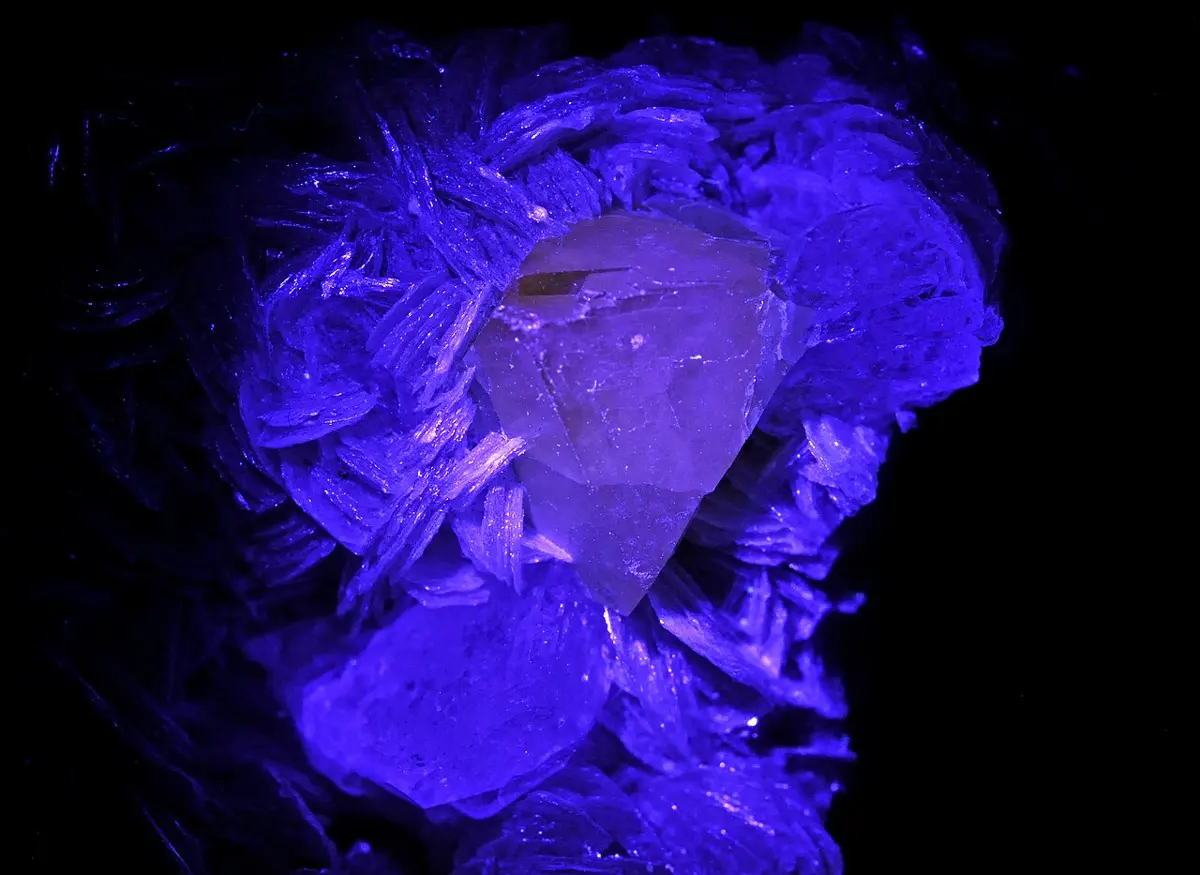
“Heavy stone.” In Sweden, miners called a very heavy white mineral tung sten, “heavy stone”. In 1781 the Swedish chemist Carl Wilhelm Scheele made a new acid from it, tungstic acid, and guessed that it held a new metal. The mineral is now called scheelite (calcium tungstate, CaWO₄), after him.
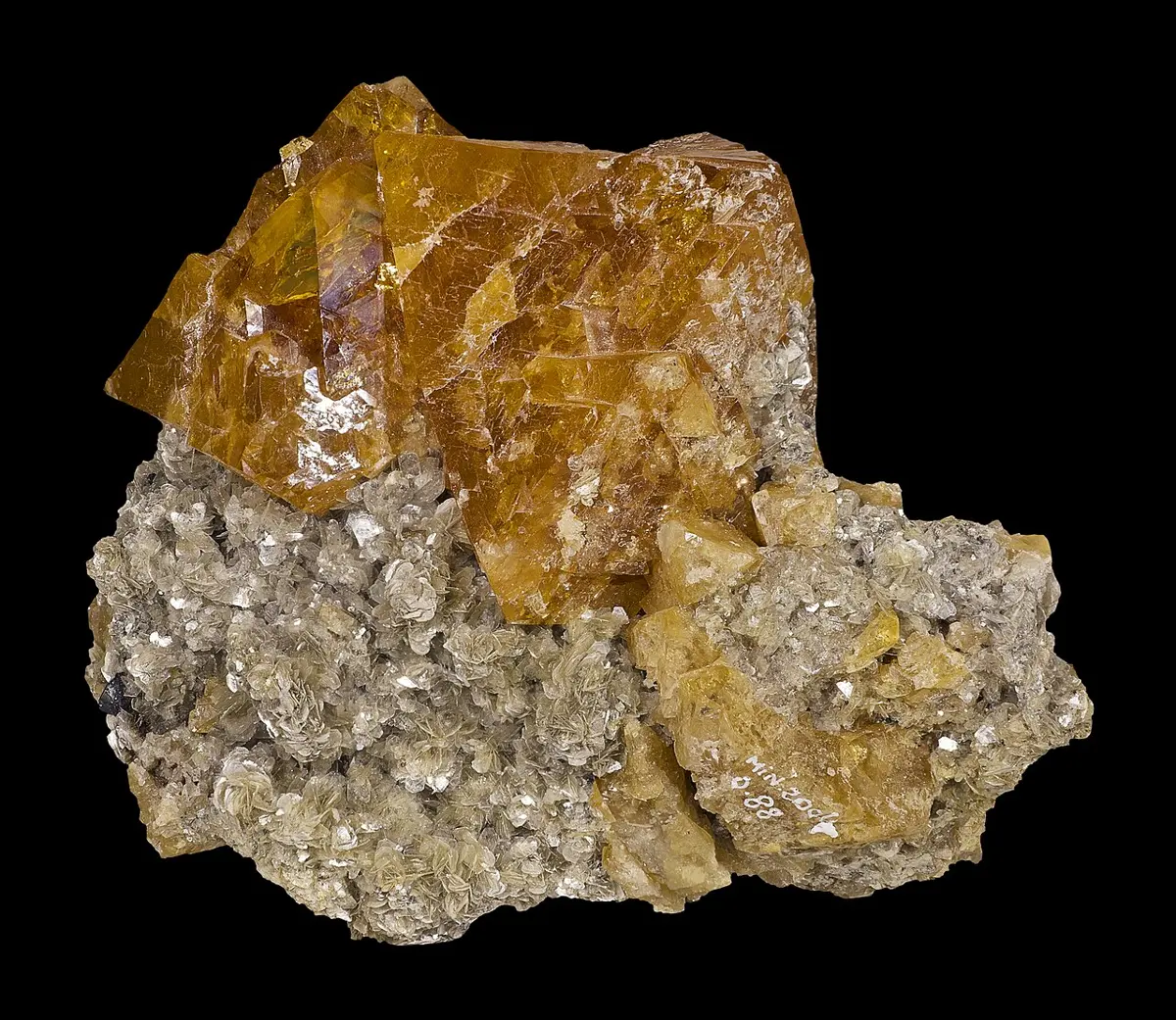
“Wolf’s foam.” Centuries earlier, tin smelters in Germany had noticed that when a certain black mineral was mixed with their tin ore, they got much less tin: it seemed to “eat” the tin, as a wolf eats sheep. They called it wolf rahm, “wolf’s foam” or “wolf’s cream”, and it became wolframite, (Fe,Mn)WO₄.
1783, the metal. Two Spanish brothers, Juan José and Fausto Elhuyar, working in the town of Bergara, made the same acid from wolframite. Then they heated it with charcoal and got the metal itself, so they are credited with the discovery. They called it wolfram.
English and French kept the name tungsten. German and many other languages say wolfram, and so does the symbol: W. It is one of the few symbols that has nothing to do with the English name, like Fe for iron and Pb for lead.
Where tungsten is found
In the universe. Like every element heavier than iron, tungsten was made when atoms caught neutrons, slowly inside giant stars or in a flash when dead stars collided (Heavier than iron: catching neutrons).
In the Earth’s crust. Tungsten is rare: about 1 gram in every tonne of rock. It is mined from scheelite and wolframite, which formed where hot water rising from cooling granite left them in veins (Ores: where hot water ran). Even good ore is only a percent or two tungsten oxide. In 2025 the world’s mines produced about 85,000 tonnes of tungsten, about 79% of it in China, far ahead of Vietnam and Kazakhstan (USGS, 2026). China also has about half of all known reserves, which is why many countries worry about their supply.
In your body. None that matters. Humans don’t use tungsten, though a few bacteria do, in some of their enzymes: it is the heaviest element any living thing is known to use.
What tungsten is like
- A gray-white metal, shiny when fresh.
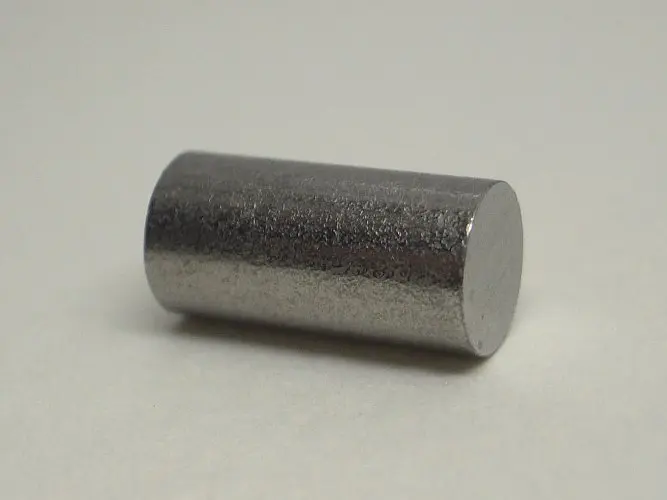
- The highest melting point of any metal: 3,422 °C. Only carbon stays solid at a higher temperature, and carbon does not melt at ordinary pressure: it turns straight to gas.
- Very heavy. Its density, 19.3 g/cm³, is almost exactly that of gold, and 1.7 times that of lead. A tungsten ball the size of a cricket ball would weigh nearly 4 kg.
- Very strong when hot. At high temperatures it stays stronger than any other metal, and it hardly expands when heated.
- Hard and brittle when impure; very pure tungsten can be drawn into wire.
Why so high? Tungsten’s six outer electrons all take part in holding its atoms together, so the bonds between them are unusually strong. Pulling the atoms apart, to melt them, takes a great deal of energy. Metals with fewer bonding electrons, like tin and lead, melt in a cooking fire Grade 9: Melting and boiling points of metals.
How tungsten reacts
At room temperature tungsten hardly reacts with anything: air, water and most acids leave it alone. But red-hot tungsten burns in air to yellow tungsten trioxide:
2W + 3O₂ → 2WO₃
That is why the filament of a bulb must be kept away from air. Heated with carbon at about 2,200 °C, tungsten forms tungsten carbide, one of the hardest substances made:
W + C → WC
Getting the metal out
Tungsten can’t be made by heating its ore with carbon, as iron is, because the carbon would join with it as tungsten carbide. Instead the ore is treated with chemicals to make pure tungsten trioxide, which is reduced with hydrogen gas Grade 10: Reduction:
WO₃ + 3H₂ → W + 3H₂O
The tungsten comes out as a gray powder. Its melting point is far too high for an ordinary furnace, so the powder is pressed into bars and heated until the grains weld together (sintering), then hammered and drawn while hot. This way of making things from metal powder is called powder metallurgy. Turning brittle tungsten into fine, bendable wire this way was worked out by William Coolidge in the USA in 1906–1910, and it made strong, long-lasting tungsten filaments possible.
Why is the inside of a filament bulb filled with argon and nitrogen instead of air?
Pick an answer to see why.
Tungsten in daily life and in Nepal
The filament bulb
A filament bulb works by the heating effect of electric current Grade 9: Heating effect: the current heats a very thin, long tungsten wire, wound into a coil, until it glows white, at about 2,500 °C. In Nepali a bulb is a बल्ब, or चिम Grade 8: Electric bulb.
- 1879. Thomas Edison and Joseph Swan made the first long-lasting bulbs with filaments of carbon, which glowed a dim orange and blackened the glass.
- 1904. Sándor Just and Franjo Hanaman, in Hungary, patented a tungsten filament, brighter and longer-lasting.
- 1910–1913. Coolidge’s drawn tungsten wire, and Irving Langmuir’s idea of coiling it and filling the bulb with gas instead of a vacuum, gave the bulb most of us grew up with.
But a filament bulb is a heater that also gives light: less than 5% of its energy comes out as light, the rest as heat, mostly infrared rays Grade 9: Infrared rays. A 9 W LED lamp gives as much light as a 60 W filament bulb. Around 2010, in the years of load-shedding, the Nepal Electricity Authority ran a program to replace filament bulbs with energy-saving lamps, and many countries have since stopped selling ordinary filament bulbs. The white light of LEDs became possible with the blue LED (Nobel Prize in Physics 2014).
Hard tools
About 60% of all tungsten goes into tungsten carbide (WC). Its grains, held together with a little cobalt, make cutting tips much harder than steel. The tips of masonry drill bits for drilling into brick and concrete, the teeth of saws that cut steel, the bits of the machines that drill tunnels and wells, and the ball of a ball-point pen are often tungsten carbide.
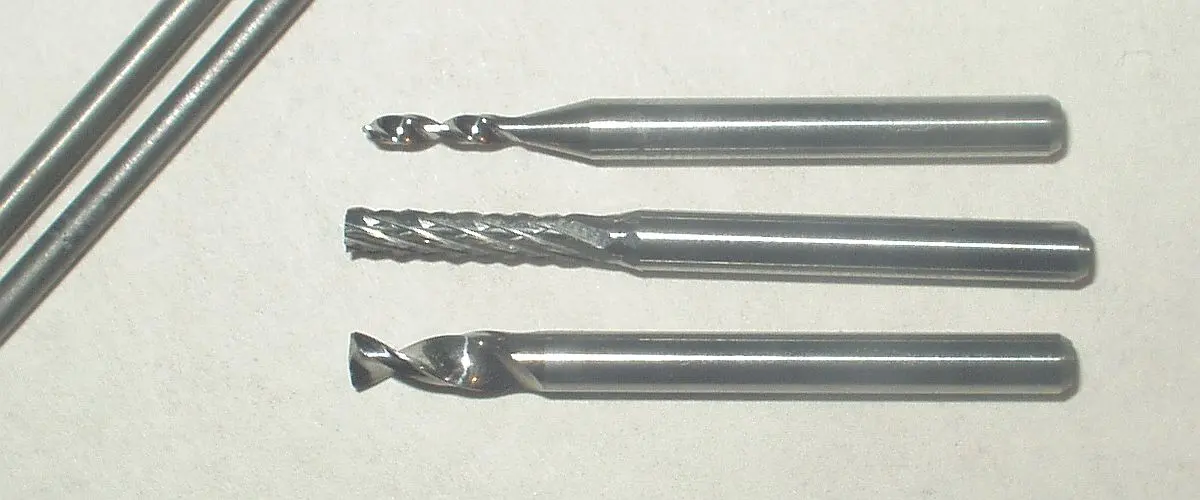
Steels. Mixed into steel, tungsten keeps the steel hard even when it gets hot in use: high-speed steel, for drills and lathe tools, can be up to 18% tungsten Grade 8: Steel.
X-rays, welding and heavy weights
- X-rays. In an X-ray tube, fast electrons crash into a block of tungsten and give out X-rays Grade 9: X-ray imaging. Tungsten is used because it can take the heat, and its heavy atoms give out X-rays well (Nobel Prize in Physics 1901).
- Welding. In TIG welding, the arc jumps from a tungsten rod that does not melt.
- Weight in a small space. Tungsten is used for balancing weights in aircraft and racing cars, heavy darts, and shields against radiation, instead of poisonous lead.
- Fusion. The inner walls of experimental fusion reactors, which try to join hydrogen nuclei as the Sun does, are lined with tungsten, because it can stand the heat.
Isotopes of tungsten
Natural tungsten is a mixture of five isotopes, all with 74 protons: tungsten-180, 182, 183, 184 and 186. The commonest is tungsten-184 (about 31%), then 186 and 182, which is why the atomic mass is 183.84. Tungsten-180, only about 0.1% of the mixture, was found in 2004 to be radioactive, with a half-life of about 1.8 × 10¹⁸ years, a hundred million times the age of the universe. In a whole gram of tungsten, about two of its atoms decay each year.
Tungsten and your health
Your body neither needs tungsten nor is much harmed by the small amounts around us. The dangers at home are from the bulb, not the metal.
Surprising facts and records
- The highest melting point of any metal, 3,422 °C, and among the highest boiling points of any element, over 5,500 °C.
- Wartime metal. Because tungsten made hard steel and armor-piercing shells, it was fought over in both World Wars. In the Second World War, Portugal, with Europe’s great wolframite mine at Panasqueira, was pressed by both sides to sell its tungsten to them.
- The color of the old bulb. A filament at about 2,500 °C is far cooler than the Sun’s surface (about 5,500 °C), so its light is more orange: it gives a continuous spectrum with more red than blue (Three kinds of spectrum).
In your science books
- Grade 8: the electric bulb and steel.
- Grade 9: melting points of metals, ductile metals, the heating effect of current, resistance, nitrogen in bulbs, X-rays and infrared rays.
- Grade 10: electronic configuration, transition metals and reduction.
- Going further: where ores come from, spectra and elements heavier than iron.
More to explore
- Nobel Prizes with tungsten in them: X-rays (1901, today’s X-ray tubes have tungsten targets), metathesis (2005, Richard Schrock’s catalysts used molybdenum and tungsten) and blue LEDs (2014, the lamps that replaced the tungsten bulb).
- The other members of its group: chromium.
- Play: find tungsten in Guess the Element and the Periodic Table Jigsaw.
- Read more: tungsten at the Royal Society of Chemistry and at PubChem.