
- Atomic number
- 11
- Atomic mass
- 22.99
- Shells
- 2, 8, 1
- Configuration
- 1s² 2s² 2p⁶ 3s¹
- In the table
- period 3, group 1 (IA), s-block
- Kind
- Alkali metal
- Valency
- 1 (Na⁺)
- State at 25 °C
- solid
- Melts · boils
- 98 °C · 883 °C
- Density
- floats on water
- Known since
- 1807
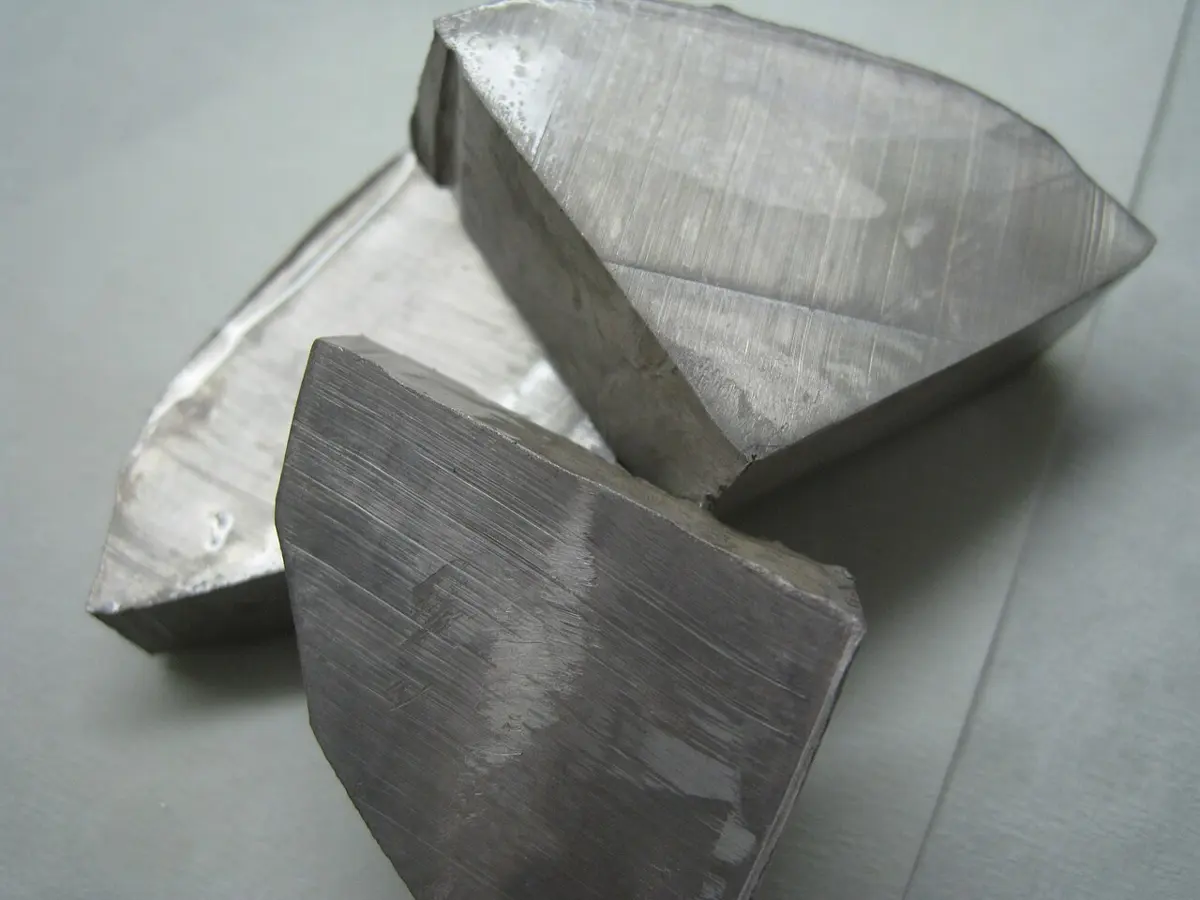
Every time you add a pinch of नुन to your dal, you are eating a metal: sodium. Pure sodium is a soft, silvery metal that you could cut with a kitchen knife, and that fizzes, melts and can burst into flame when it touches water. Joined with chlorine, a poisonous green gas, it becomes the salt that every person needs to live.
Here is the story of that strange metal, from its atom to the yellow flash you see when salty water boils over onto a gas stove.
The sodium atom
A sodium atom has 11 protons, so its atomic number is 11, and 11 electrons. Every natural sodium atom also has 12 neutrons, so its mass number is 11 + 12 = 23.
By the 2n² rule the K shell takes 2 electrons, the L shell 8, and the last one goes into the M shell: 2, 8, 1 Grade 8: Bohr and Bury’s rule. In subshells it is 1s² 2s² 2p⁶ 3s¹ Grade 10: The Aufbau principle.
That single outer electron decides everything about sodium. If the atom gives it away, what is left is 2, 8: the same full shells as the noble gas neon (Neon’s shells, everywhere). So sodium loses it very easily, and becomes the sodium ion, Na⁺, with 11 protons but only 10 electrons Grade 9: Cations. Its valency is 1.
Its place in the periodic table
- Period 3, because its electrons are in three shells. It is the first element of period 3.
- Group 1 (IA), because it has one outer electron.
- s-block, because that electron is in an s subshell.
Sodium is an alkali metal, in the family of lithium, potassium, rubidium, cesium and francium Grade 8: Characteristics of groups. All are soft, light, shiny metals that react quickly with air and water and make alkalis. Going down the group, the outer electron is further from the nucleus and lost more easily, so the metals get more reactive: sodium is more reactive than lithium above it, and less than potassium below it Grade 10: Chemical reactivity.
Which of these has the same electronic configuration as a neon atom?
Pick an answer to see why.
How sodium was found and named
People have used two sodium compounds for thousands of years: salt from the sea and from salt rocks, and soda (sodium carbonate), dug from the dry lakes of Egypt as natron or made from the ash of plants, for making glass and washing. The ancient Egyptians even dried their mummies with natron. But no one could get a metal out of them, because sodium holds on to the other atoms in its compounds very tightly.
In October 1807, in London, the English chemist Humphry Davy tried a new tool: electricity. He melted caustic soda (sodium hydroxide) and passed a strong current through it from a huge battery, a voltaic pile. Little shiny globules of a new metal appeared at the negative wire, and some burst into flame. A few days earlier he had made potassium the same way from caustic potash. He named the new metal sodium, after soda.
So why is its symbol Na? Many chemists in other countries called it natrium, from natron. When the Swedish chemist Jöns Jacob Berzelius gave the elements their short symbols, he used the Latin names: so sodium is Na, and potassium (kalium) is K Grade 8: Symbols from Latin names. Nepali writes it सोडियम; its compounds have old Nepali names, such as नुन for salt and सज्जीखार for washing soda.
Where sodium is found
In the universe. Sodium is made in the cores of big stars, where carbon atoms fuse together at hundreds of millions of degrees, and is scattered when the star explodes (Each fuel needs a hotter core). The Sun has plenty: two dark lines in the yellow of sunlight, the D lines, are sodium’s (The barcode in sunlight).
In the Earth’s crust, sodium is the sixth most common element, about 2½ per cent of the rocks. It is never found as the metal, which is far too reactive. It is in many rock minerals, and, because its compounds dissolve so easily in water, rain and rivers have been washing it into the sea for billions of years.
In the sea. A liter of sea water holds about 35 g of dissolved salts, most of it sodium chloride. Where ancient seas dried up, they left thick layers of rock salt, the mineral halite Grade 8: Minerals. The pink “Himalayan” rock salt sold in Nepal is one of them: it is mined in the Salt Range of Pakistan, south of the Himalaya, from a sea that dried up more than 500 million years ago, and a trace of iron makes it pink. You can see a big lump of it at Science Playground (Himalayan Pink Salt).
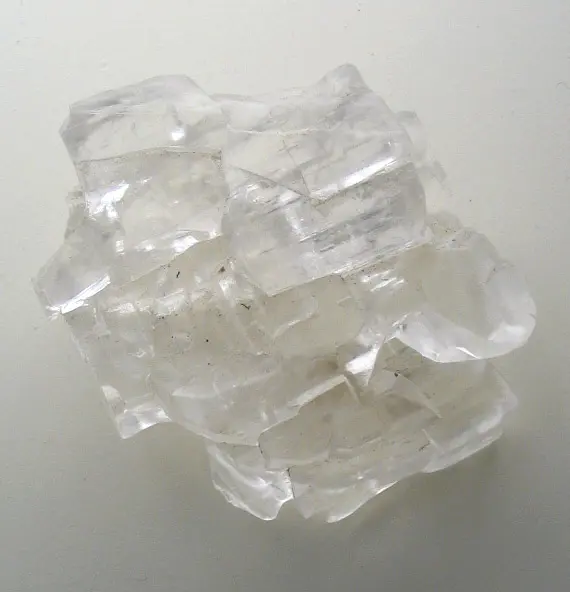
In 2024 the world produced about 280 million tonnes of salt, most of all in China (about 55 million tonnes), the USA (40 million) and India (28 million) (USGS, 2025).
In Nepal. Nepal has no sea, and for centuries much of the salt eaten in its hills came from the salt lakes of Tibet. Traders carried it south over the high passes on yaks, sheep and goats, and exchanged it for rice and other grain. Tibetan salt had no iodine, and goiter was common in the hills. When cheaper sea salt from India arrived on new roads, the old salt caravans faded away; today nearly all Nepal’s salt comes from India, with iodine added (आयोडिनयुक्त नुन).
In your body. An adult body holds about 100 g of sodium, as sodium ions dissolved in the blood and the fluid around the cells (see below).
What sodium is like
- A soft, silvery metal. It can be cut with a knife, like cold butter. A fresh cut shines brightly but turns dull within seconds, as the air attacks it Grade 9: Most metals are hard.
- Lighter than water: its density is 0.97 g/cm³, so it floats.
- Melts at 98 °C, below the boiling point of water, and boils at 883 °C.
- A good conductor of heat and electricity, like every metal.
- Stored under paraffin oil (kerosene), to keep air and water away from it.
Why is sodium so soft, and why does it melt so easily? In a metal, the atoms give their outer electrons to a shared “sea” of free electrons, which holds the positive ions together Grade 9: What is inside a metal. A sodium atom gives only one electron, and its ion is large, so the glue between its ions is weak. Iron gives more, and holds together far more strongly.
How sodium reacts
Sodium is one of the most reactive metals. It sits near the top of the reactivity series, far above hydrogen.
With air, a fresh surface turns dull in seconds, as a white crust of sodium oxide forms Grade 9: Metals react with oxygen:
4Na + O₂ → 2Na₂O
With water, a small piece floats, melts into a shiny ball, and races about on the surface with a hiss, getting smaller until it is gone. It gives off hydrogen and leaves sodium hydroxide, an alkali Grade 9: Very reactive metals react with water:
2Na + 2H₂O → 2NaOH + H₂
The reaction gives out so much heat that the sodium melts, and the hydrogen may catch fire with a yellow-orange flame. A bigger piece can explode.
Why does sodium melt into a ball when it reacts with water, while magnesium does not?
Pick an answer to see why.
With chlorine, hot sodium burns with a bright yellow flame, and white smoke of sodium chloride forms:
2Na + Cl₂ → 2NaCl
Each sodium atom gives its outer electron to a chlorine atom: sodium becomes Na⁺ (2, 8), chlorine becomes Cl⁻ (2, 8, 8), and the opposite charges hold them together in an electrovalent bond Grade 9: Formation of sodium chloride.
A soft metal that explodes in water, plus a poisonous gas, makes the salt on your plate. The compound is nothing like the elements it is made of. In a salt crystal there are no separate NaCl molecules: every sodium ion is surrounded by six chloride ions, and every chloride ion by six sodium ions (Not everything is made of molecules).
The yellow flame
Spill salty water from a boiling pot onto a gas flame and the blue flame flashes bright yellow. That is sodium. The heat pushes sodium’s outer electron up to a higher energy level; when it drops back, it gives out yellow light of one exact color, at a wavelength of 589 nm (Why each element has its own lines). This flame test is so sensitive that a trace of sodium, even from your fingers, colors a flame yellow.
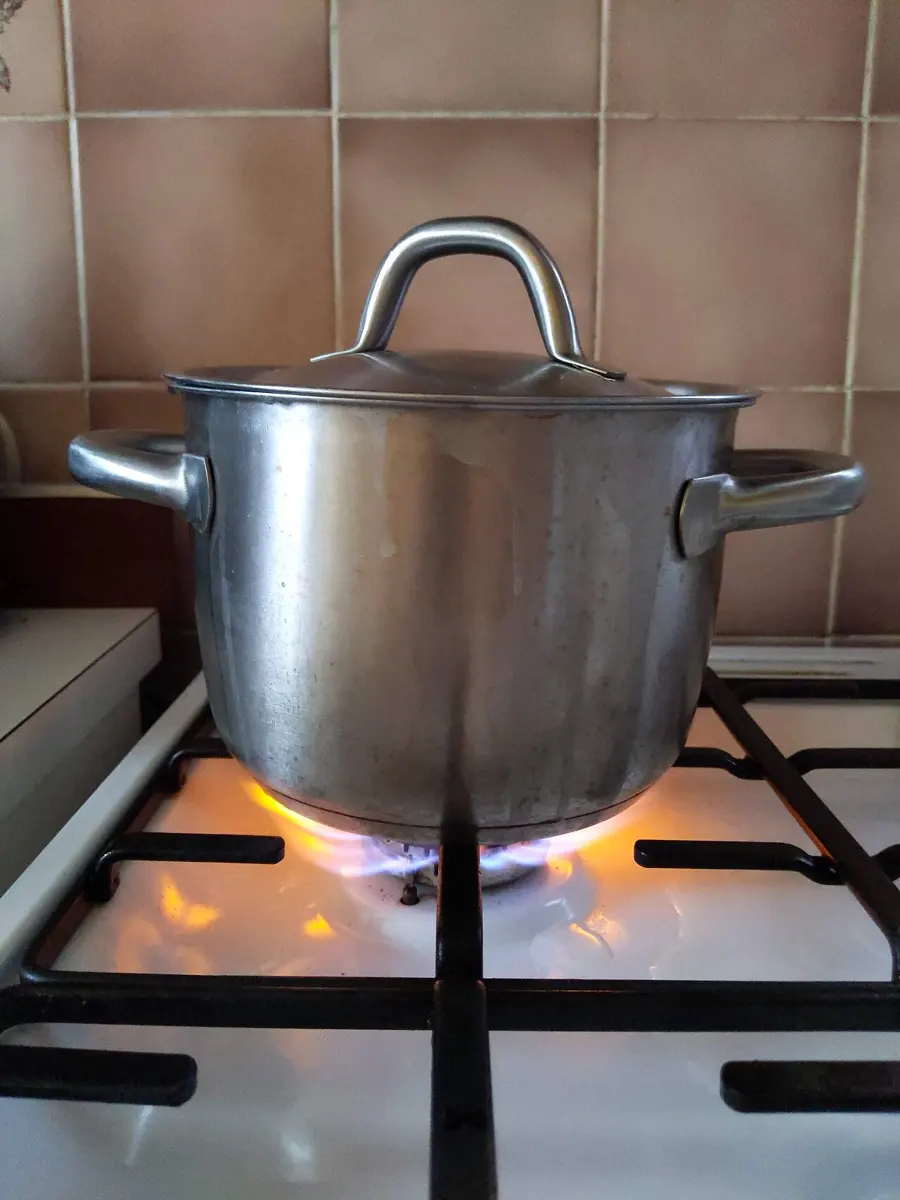
A drop of salty water on a gas flame turns it yellow. Which part of the salt gives the color?
Pick an answer to see why.
Sodium’s useful compounds
| Compound | Formula | Nepali name | Uses |
|---|---|---|---|
| sodium chloride (common salt) | NaCl | नुन | food, keeping pickles and meat, making the other compounds |
| sodium hydroxide (caustic soda) | NaOH | soap, paper, cleaning drains | |
| sodium carbonate (washing soda) | Na₂CO₃ | सज्जीखार | washing, softening hard water, glass |
| sodium bicarbonate (baking soda) | NaHCO₃ | खाने सोडा | baking, antacids, fire extinguishers |
| sodium hypochlorite | NaOCl | bleach; a few drops make drinking water safe |
Most of them start from salt (Uses of salts, Uses of bases). An acid and a base also make salt: hydrochloric acid and sodium hydroxide neutralize each other Grade 8: Acids react with bases:
HCl + NaOH → NaCl + H₂O
How sodium metal is made
Because sodium holds on to chlorine so tightly, no ordinary chemical can pull them apart. Like Davy, factories use electricity: they pass a current through melted salt, at about 600 °C (calcium chloride is mixed in, so that salt, which melts at 801 °C, melts at a lower temperature). This is electrolysis of molten salt, in a Downs cell.
- At the negative electrode (cathode), each sodium ion takes an electron and becomes a sodium atom: Na⁺ + e⁻ → Na. The liquid sodium floats up and is collected.
- At the positive electrode (anode), chloride ions give up electrons and join in pairs as chlorine gas: 2Cl⁻ − 2e⁻ → Cl₂.
Sodium in daily life
- Street lamps. A sodium lamp glows yellow-orange: the sodium vapor inside gives out mostly its own yellow light. It makes much light for little electricity, so for decades sodium lamps lit roads around the world; most are now being replaced by LEDs.
- Nuclear power. Some nuclear reactors are cooled with liquid sodium, which carries heat well and stays liquid over a wide range of temperatures.
- Airbags. The first car airbags filled with nitrogen from sodium azide, NaN₃, which breaks up in a flash (How an airbag works).
- Batteries. Sodium-ion batteries, which work like lithium-ion ones but with cheaper sodium, have begun to be sold.

Keeping food. Salt has kept food from going bad since long before fridges. Bacteria and molds need water; salt draws water out of them and out of the food, so they cannot grow. That is how अचार and dried fish last for months Grade 10: Natural food preservatives.
Salt water conducts. Pure water hardly conducts electricity, but salt water does: the Na⁺ and Cl⁻ ions are free to move and carry the current Grade 9: Electric current.
Sodium and your body
Your body can’t live without sodium. Sodium ions in your blood and body fluids:
- keep the right amount of water in your blood and cells;
- carry nerve signals: when a nerve fires, sodium ions rush into the nerve cell through tiny gates in its skin, and then a pump pushes them out again (Ion channels, The sodium pump);
- help muscles, including the heart, contract.
You lose sodium every day in sweat and urine, and get it back from salt and food. In diarrhea, the body loses water and sodium fast, and a child can die of it. Oral rehydration salts (ORS), sold in Nepal as जीवनजल (Jeevan Jal), replace both: the WHO’s recipe for one liter of water has 2.6 g of sodium chloride, 13.5 g of glucose, and a little potassium chloride and sodium citrate. The glucose helps the gut take up the sodium, and the water follows it.
Too much salt
The World Health Organization advises adults to eat less than 5 g of salt a day, about one level teaspoon, which holds 2 g of sodium. A survey in 2019 found that adults in Nepal eat about 9 g a day on average, and a study in Pokhara found about 13 g: two or three times the limit. Too much sodium makes the body hold extra water in the blood, which raises blood pressure Grade 10: High blood pressure, and high blood pressure leads to heart attacks and strokes.
Most of the salt we eat is not from the salt jar at the table: it is cooked into dal and tarkari, and hidden in pickles, instant noodles, chips and other packet foods.
Surprising facts and records
- A sea of salt. If all the salt in the oceans were taken out and spread over the land, it would make a layer about 150 m thick, as tall as a 40-storey building.
- One isotope only. Every natural sodium atom is sodium-23, so its atomic mass, 22.99, is almost a whole number. Radioactive sodium-24, made in reactors, with a half-life of 15 hours, is used to trace leaks in pipes.
- Sodium in the sky. About 90 km above the ground there is a thin layer of sodium atoms, left by burning meteors. Big telescopes shine a yellow laser up into it to make an artificial “star” that helps them correct the twinkling of real stars.
- The coldest gas. In 1995 Wolfgang Ketterle cooled a cloud of sodium atoms to less than a millionth of a degree above absolute zero, until the atoms behaved as one: a new state of matter (The coldest stuff in the universe).
In your science books
- Grade 8: atoms and symbols (Na from natrium), the 2n² rule, characteristics of groups, bases and salts.
- Grade 9: cations, formation of sodium chloride, properties of metals and very reactive metals and water.
- Grade 10: the Aufbau principle, reactivity down a group, food preservatives and blood pressure.
- Going further: salt crystals, why salt melts at 801 °C, sodium’s lines in sunlight and airbags.
More to explore
- Nobel Prizes with sodium in them: the sodium pump (1997), ion channels (1991, the gates that let sodium into nerve cells), the structure of salt crystals (1915), laser cooling (1997) and the coldest gas (2001, made of sodium atoms).
- Play: make salt, caustic soda and baking soda in Molecule Kitchen, or find sodium in Guess the Element and the Periodic Table Jigsaw.
- Read more: sodium at the Royal Society of Chemistry and at PubChem.