
- Atomic number
- 114
- Atomic mass
- 290.19
- Shells
- 2, 8, 18, 32, 32, 18, 4
- Configuration
- 1s² 2s² 2p⁶ 3s² 3p⁶ 4s² 3d¹⁰ 4p⁶ 5s² 4d¹⁰ 5p⁶ 6s² 4f¹⁴ 5d¹⁰ 6p⁶ 7s² 5f¹⁴ 6d¹⁰ 7p² (predicted)
- In the table
- period 7, group 14 (IVA), p-block
- Kind
- Other metal
- Valency
- Not measured; expected 2, like lead’s Pb²⁺
- State at 25 °C
- expected to be a solid
- Melts · boils
- not known · not known
- Known since
- 1999

For fifty years, the elements after uranium had been getting harder and harder to keep: each new one fell apart faster than the last. But in the 1960s, physicists predicted that somewhere ahead, around 114 protons, the trend should turn round, and there might be an island of stability, where heavy nuclei last much longer. Element 114, flerovium, was made to look for that island.
The flerovium atom
A flerovium atom has 114 protons (atomic number 114) and 114 electrons. Its longest-lasting known kind, flerovium-289, has 289 − 114 = 175 neutrons.
Its electrons end in the 7p subshell Grade 10: The Aufbau principle:
… 7s² 5f¹⁴ 6d¹⁰ 7p²
The shells are 2, 8, 18, 32, 32, 18, 4: four outer electrons. So flerovium is in period 7 and group 14 (the old group IVA), under carbon, silicon, germanium, tin and lead Grade 10: Features of the modern periodic table. Going down group 14, the elements change from a non-metal (carbon), through the metalloids (silicon, germanium), to the metals tin and lead Grade 10: Metals, non-metals and metalloids. Lead usually uses only its two p electrons, as Pb²⁺; flerovium is expected to hold its s electrons even more tightly, so valency 2.
The island of stability
A nucleus is held together by the strong pull between its protons and neutrons, and pushed apart by the protons repelling each other. The more protons, the stronger the push, which is why heavy nuclei split or give out alpha particles so quickly.
But protons and neutrons in a nucleus are arranged in shells, a little like electrons in an atom. A nucleus with a full shell of protons or of neutrons (a magic number: 2, 8, 20, 28, 50, 82, 126) is extra stable, just as an atom with a full electron shell, a noble gas, is extra stable. Lead-208, with 82 protons and 126 neutrons, is “doubly magic” and is the heaviest stable nucleus. In the 1960s, calculations suggested that the next full shells would come at 114 protons and 184 neutrons, and that flerovium-298 might last a very long time.
Flerovium-289, the longest-lasting kind made so far, has 175 neutrons. How many more neutrons would it need to reach the predicted magic number, 184?
Pick an answer to see why.
Made at Dubna
The Flerov Laboratory of Nuclear Reactions, at the Joint Institute for Nuclear Research in Dubna, near Moscow, worked with the Lawrence Livermore National Laboratory in the USA. A team led by Yuri Oganessian fired calcium-48 nuclei (20 protons) at plutonium-244 (94 protons): 94 + 20 = 114. Calcium-48 has many neutrons for so light a nucleus, which helps the new nucleus come out with more neutrons, nearer the island.
In late 1998, after about 40 days of firing, roughly 5 × 10¹⁸ (five billion billion) calcium nuclei, they saw one atom, which lasted about 30 seconds: very long for so heavy an element. That atom has never been seen again, and what it really was is still not known. In 1999 the team made more atoms, of kinds that were later confirmed by other laboratories, and in 2011 IUPAC and IUPAP agreed that Dubna and Livermore had discovered element 114.
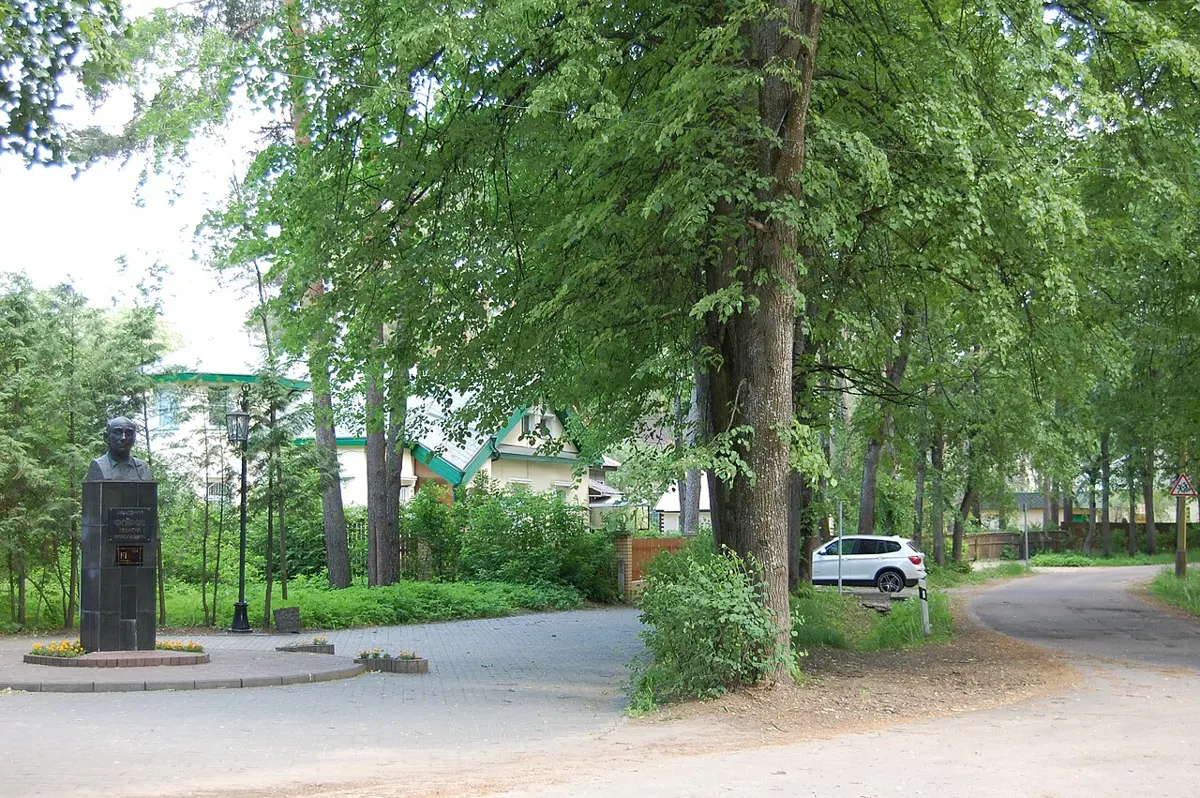
The team named it flerovium, symbol Fl, after their laboratory, which itself is named after Georgy Flerov (1913–1990), who led it from its start in 1957. In 1940 Flerov and Konstantin Petrzhak had discovered that heavy nuclei can split in two all by themselves, spontaneous fission, which is how many superheavy atoms end. IUPAC approved the name in May 2012. One suggestion that was not chosen: atlantisium, after the legendary sunken island of Atlantis, for the island of stability.
What has been measured, and what is only predicted
Flerovium-289 has a half-life of only about 2 seconds. That is short, but the lighter kinds of flerovium, with fewer neutrons, last only thousandths or tenths of a second: each step towards 184 neutrons makes the nucleus steadier, as the island predicts. No one has yet made a kind with enough neutrons to reach its center.
What has been measured: how its nuclei decay, and, since 2007, how single atoms behave on gold. The latest experiment, at the GSI laboratory in Germany, published in 2022 by a team that included scientists from India, sent eight atoms through a channel lined with gold. Five stuck to the gold at room temperature, so flerovium can form a bond with gold, as a metal does. Three went all the way to the coldest end and stuck only to ice. The team concluded that flerovium is a metal, but a very volatile one, and the least reactive element of group 14: it holds on to gold less firmly than mercury does, but more firmly than the noble gas radon.
What is only predicted: a density of about 11.4 g/cm³, close to lead’s 11.3, and a low melting point; some calculations say flerovium could even be a liquid at room temperature, which no other group 14 element is.
In your science books
- Grade 9: the structure of an atom and radioactive elements.
- Grade 10: features of the modern periodic table, metals, non-metals and metalloids and the Aufbau principle.
- Going further: alpha decay, fission and half-life.
More to explore
- Its neighbors: lead, above it in group 14, nihonium before it and moscovium after it; copernicium, whose chemistry was first tested on atoms that came from flerovium.
- Play: find flerovium in Guess the Element and the Periodic Table Jigsaw.
- Read more: flerovium at the Royal Society of Chemistry and at PubChem.