
Explore Our Exhibits
150+ exhibits across physics, optics, sound, magnetism, mathematics, and more. Many are hands-on, and every one is designed to spark a question.
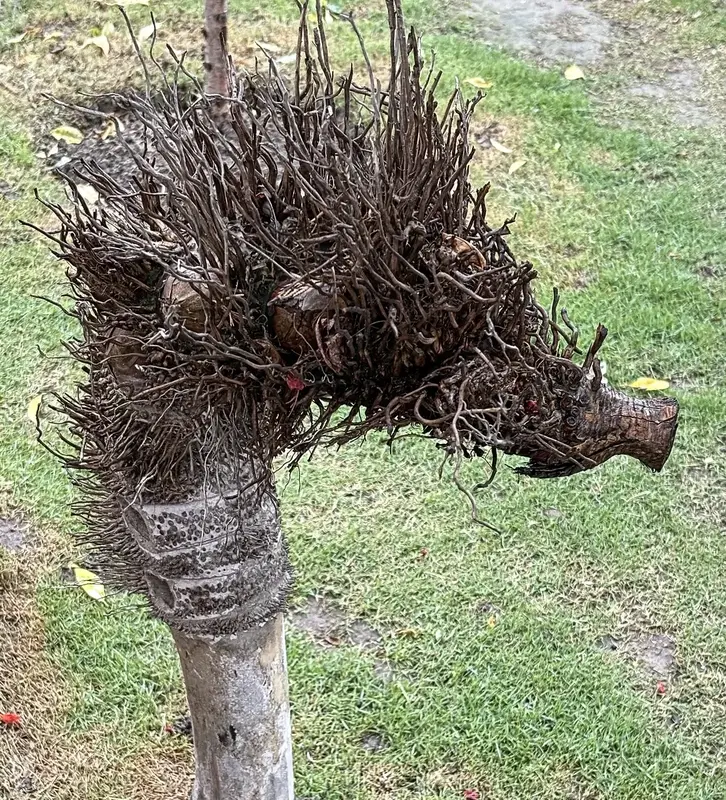
The Bamboo Horse
This is an artistic representation of a bamboo rhizome — the underground stem from which bamboo roots and shoots grow. Hidden beneath the soil, roots and rhizomes can form intricate, beautiful patterns that we rarely get to see.
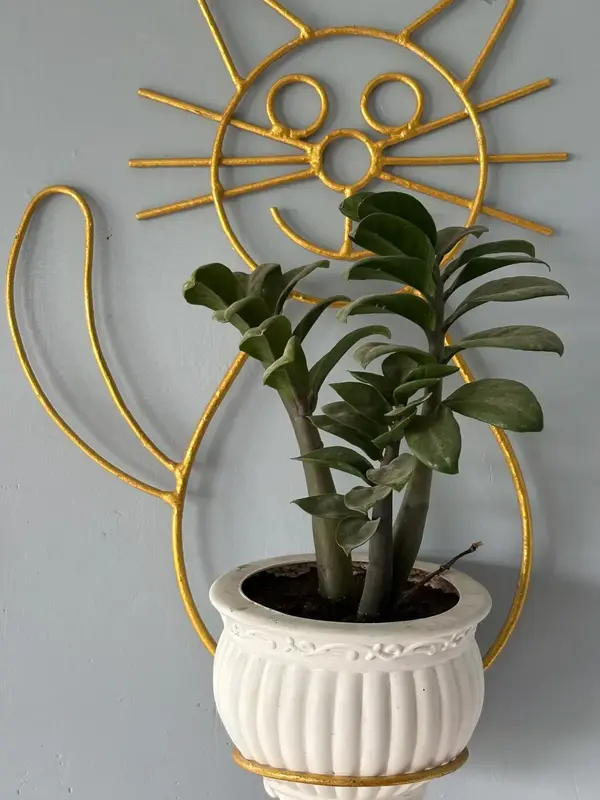
The Wire Cat Planter
A ZZ plant (Zamioculcas zamiifolia) displayed in an artistic wire container. Simple art can transform the way we see everyday objects.
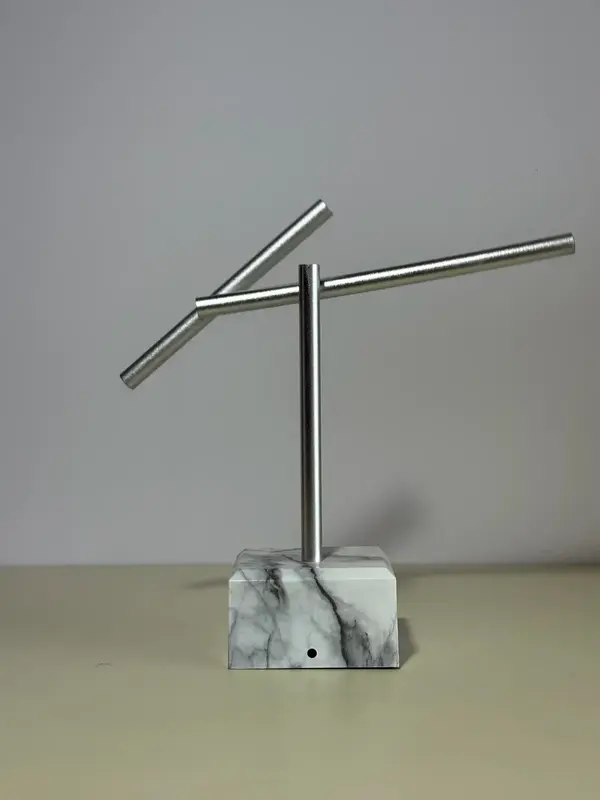
Chaotic Pendulum
This double pendulum — a pendulum swinging from the end of another pendulum — moves in a way that never quite repeats itself, tracing an endlessly changing pattern from what looks like a very simple starting setup.
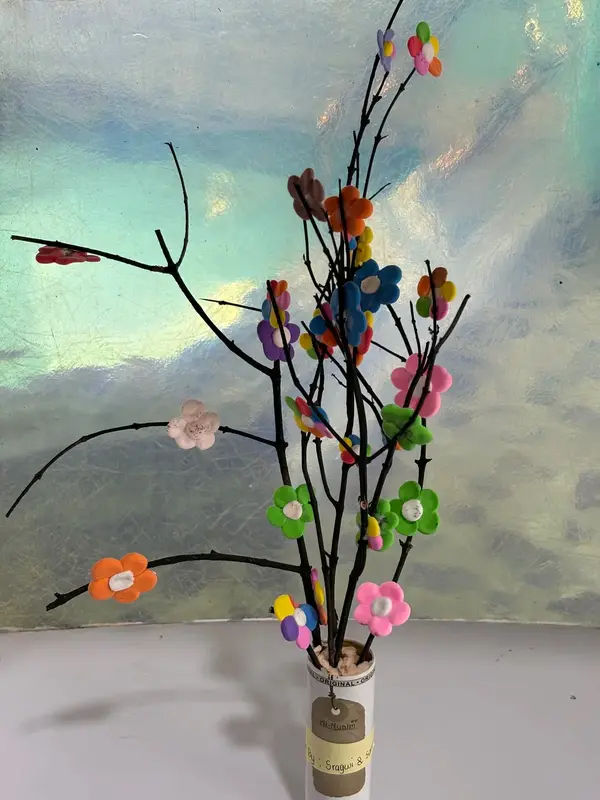
Clay Flower Bouquet
Saanvi, an eight-year-old, is passionate about play-dough craft. She created this beautiful piece and gifted it to the Science Playground.
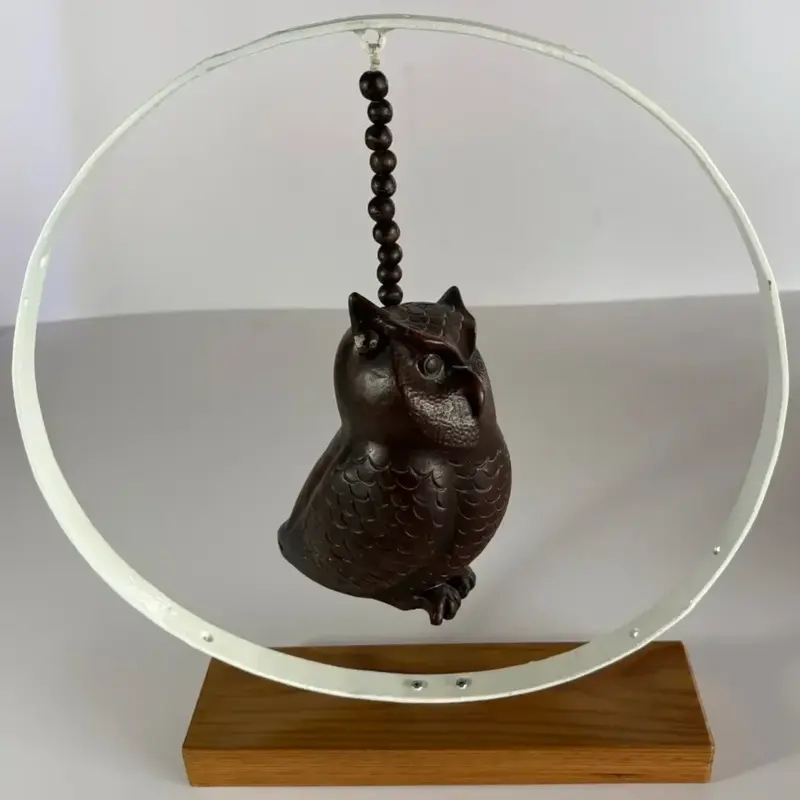
The Clay Owl
A clay owl hangs on a string of beads inside a ring: a pendulum. Give it a gentle push and it swings to and fro, each swing taking the same time whether it swings far or only a little. The time depends only on how long the string is, not on how heavy the owl is. Twist it and it turns back and forth too: the string winds up and unwinds.
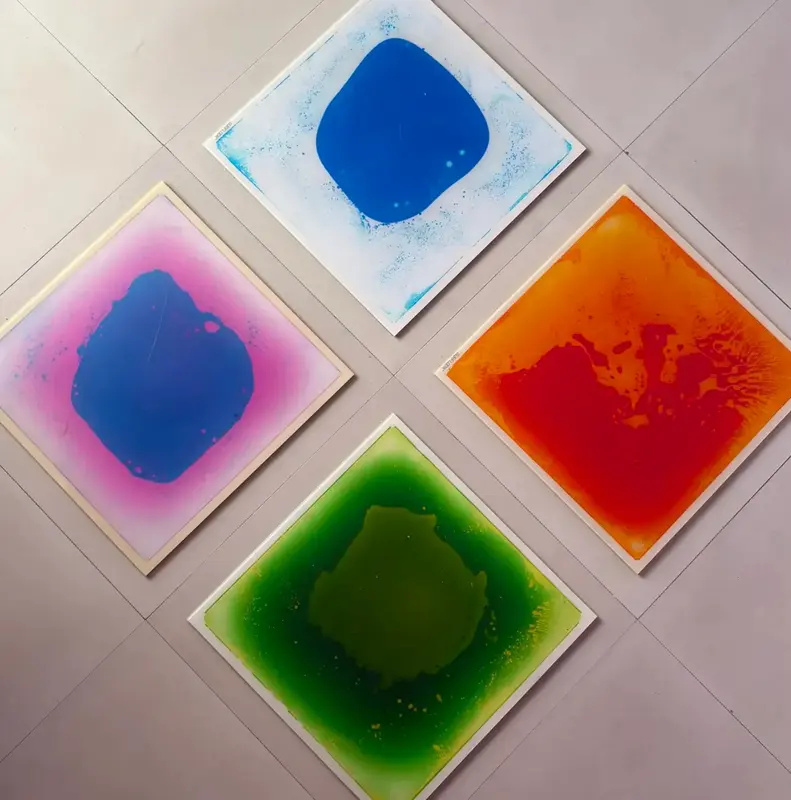
Color Tile Mosaic
Step on these color tiles and watch the patterns change beneath your feet. Pressure pushes the coloured liquid inside the tile from one area to another, creating flowing shapes and patterns. Every step produces a slightly different design, turning simple movement into changing art.
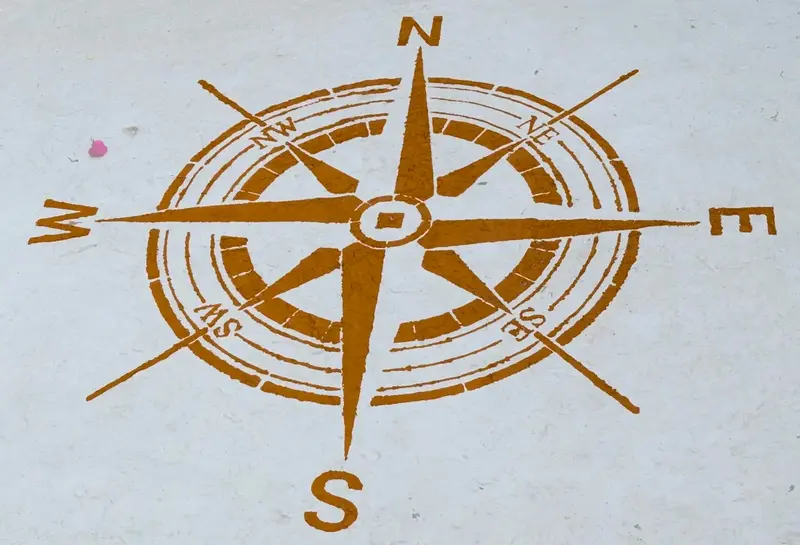
The Compass Rose
This compass rose marks the four cardinal directions — north, south, east and west — and the four intermediate directions between them. For centuries, compass roses have helped people describe direction and navigate maps, land and sea.
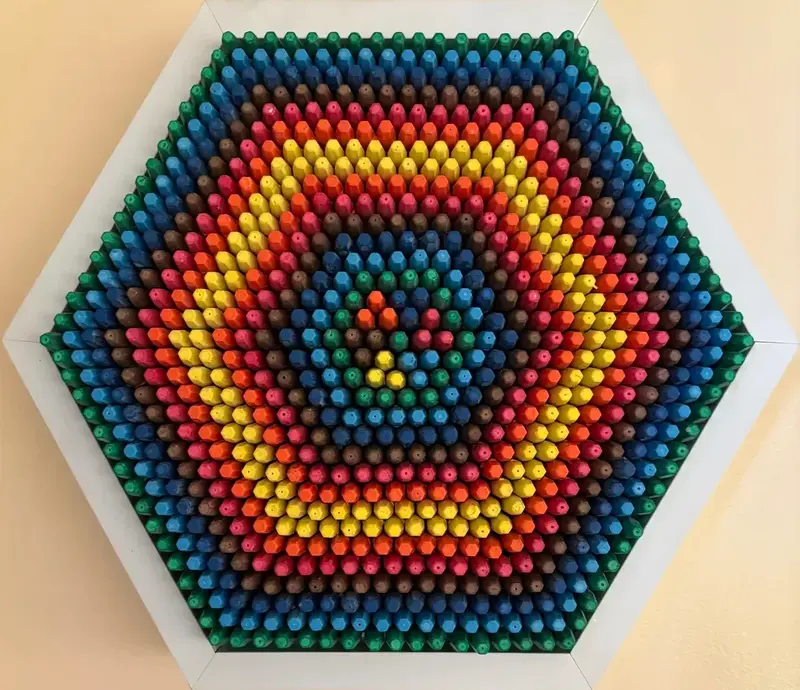
Art with Hexagons
This artwork is made from 817 hexagonal crayons packed together to form a larger hexagon. Regular hexagons fit together without gaps or overlaps, forming a tessellation. Starting with one crayon at the centre, 16 successive rings build the larger pattern. It is a simple example of how geometry, packing and colour can come together to create art. 817 is a centered hexagonal number.
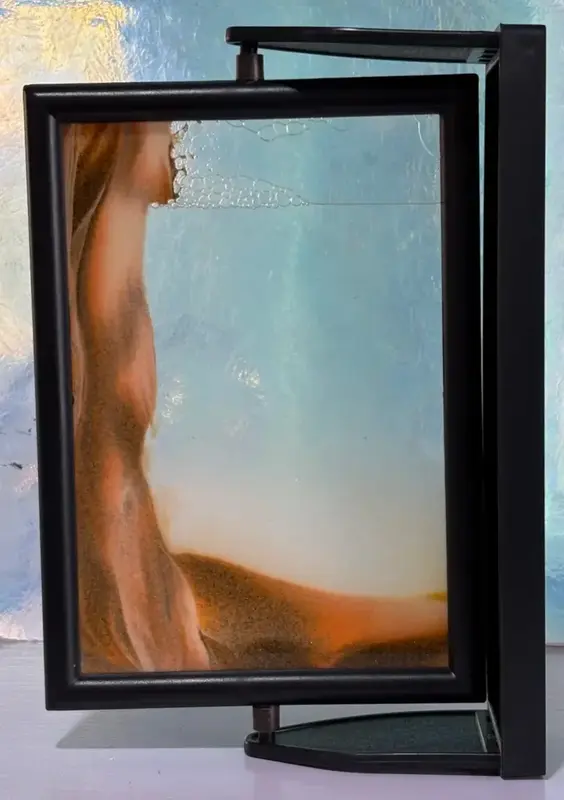
Falling Sand Art
Turn the frame over and gravity pulls the sand downward through the liquid. Air bubbles slow and redirect the flow, causing the sand to settle into hills, valleys and other changing patterns. Each turn creates a new landscape, making this a simple combination of physics and art.
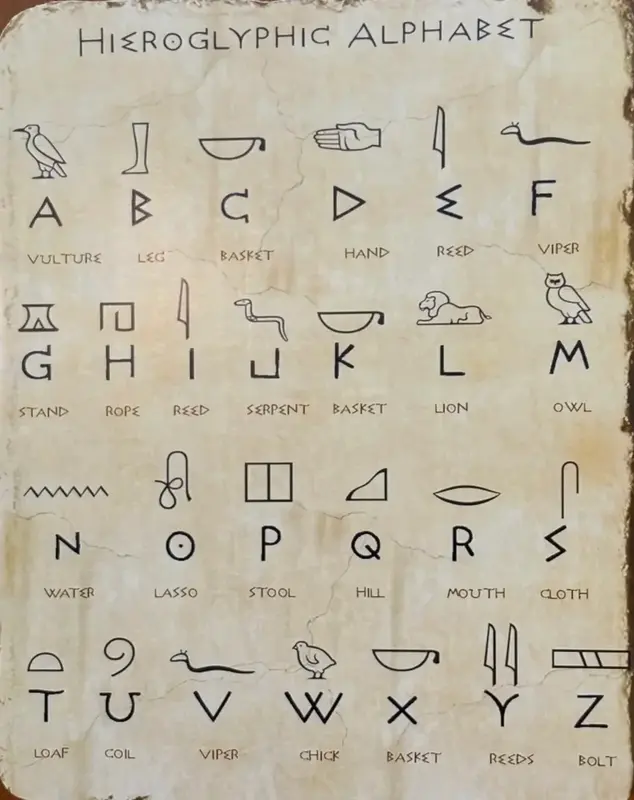
Egyptian Hieroglyphs
Ancient Egyptian hieroglyphic writing was not an alphabet like English. It used hundreds of signs that could represent sounds, whole words, or clues to a word’s meaning. Among them were about 24 single-consonant signs, sometimes called uniliteral signs, which function somewhat like alphabetic letters.
Modern “hieroglyphic alphabet” charts match these signs to English letters as a convenient learning tool, but the correspondence is only approximate. Ancient Egyptian writing usually did not record vowels.
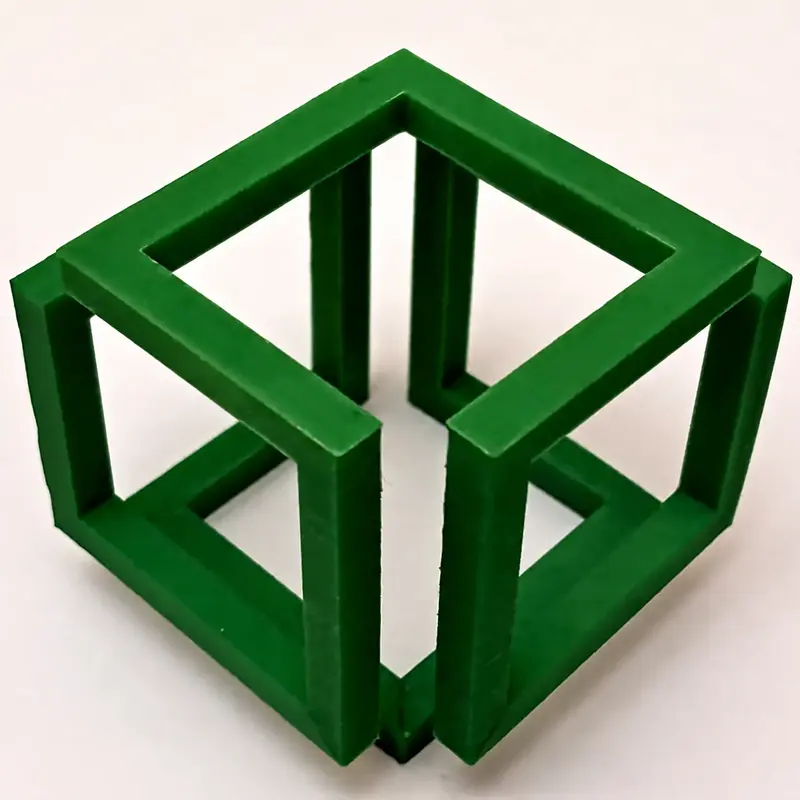
Infinity Cube
Follow any arm of this cube and the path continues around the structure, eventually returning to where it began. Because the arms are connected into a continuous loop, you can keep tracing the path indefinitely — hence the name Infinity Cube. This simple geometric form inspired the logo of the Science Playground.
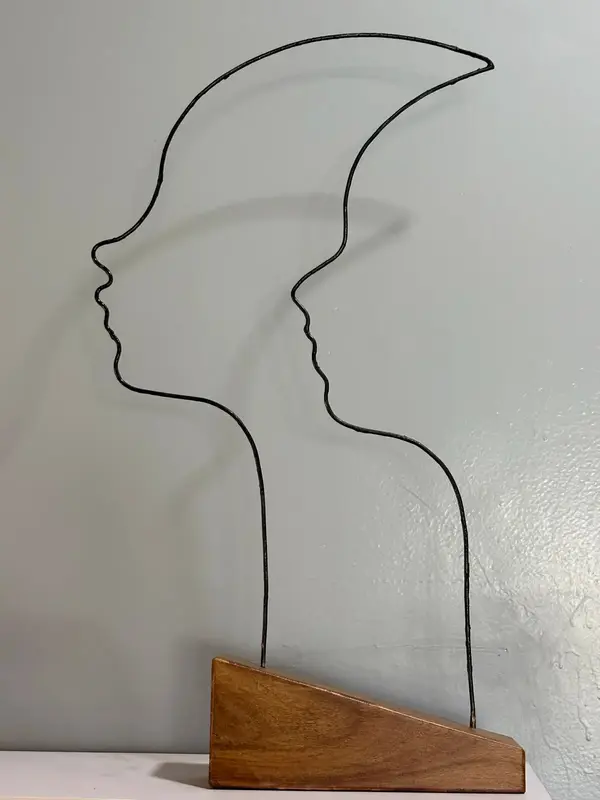
The Iron Face
How quickly did you see the two faces? Our brains constantly search for familiar patterns, allowing us to recognize meaningful shapes even when very little information is present.
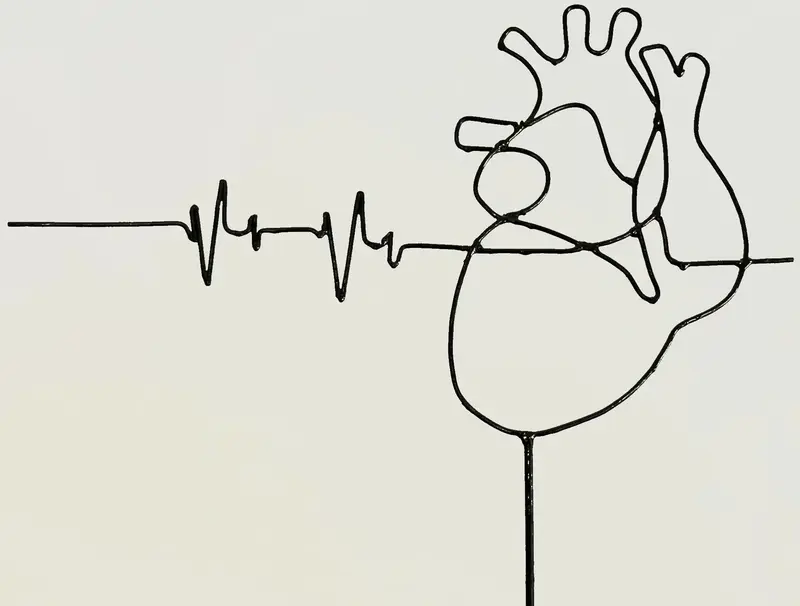
The Iron Heart
This wire artwork combines the shape of the human heart with a stylized electrocardiogram (ECG) trace. An ECG records the electrical activity that coordinates each heartbeat, turning the heart’s rhythm into a visible pattern.
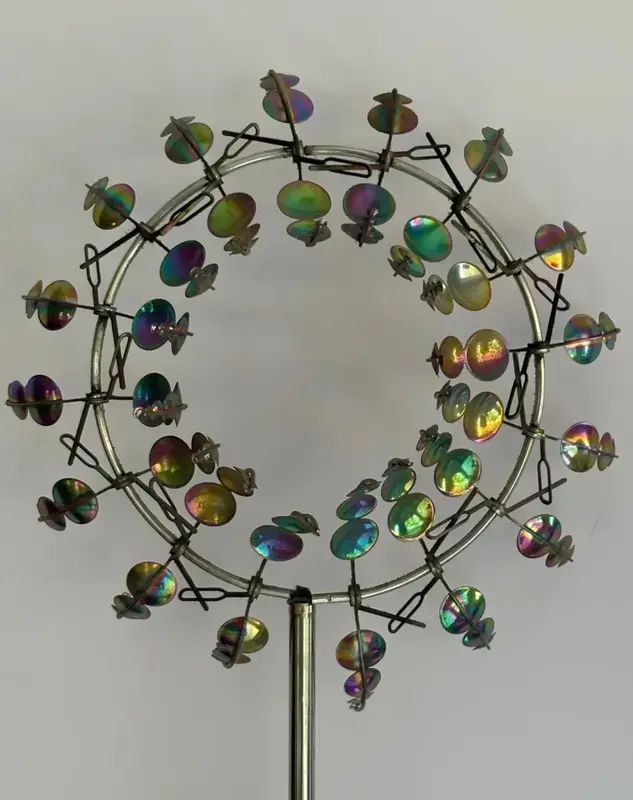
Kinetic Sculpture
This sculpture comes alive with the wind. Moving air pushes its lightweight parts, causing them to spin and shift in changing patterns. It may be smaller than it appears in the photograph, but its constantly changing motion makes it surprisingly mesmerizing to watch.
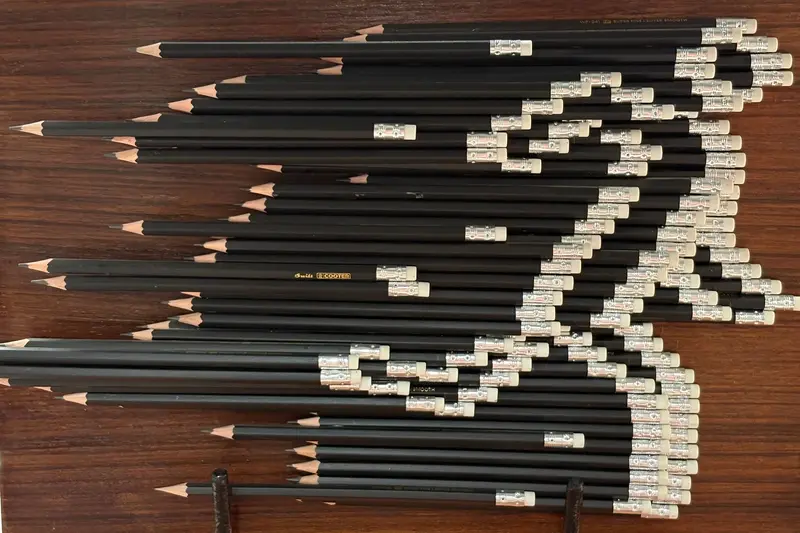
The Pencil Figure
Instead of drawing with the pencils, the pencils themselves form this artwork. By arranging pencils at different positions, the eraser ends create the silhouette of a running person. The image appears because our brains quickly group the separate pencil ends into a familiar human form.
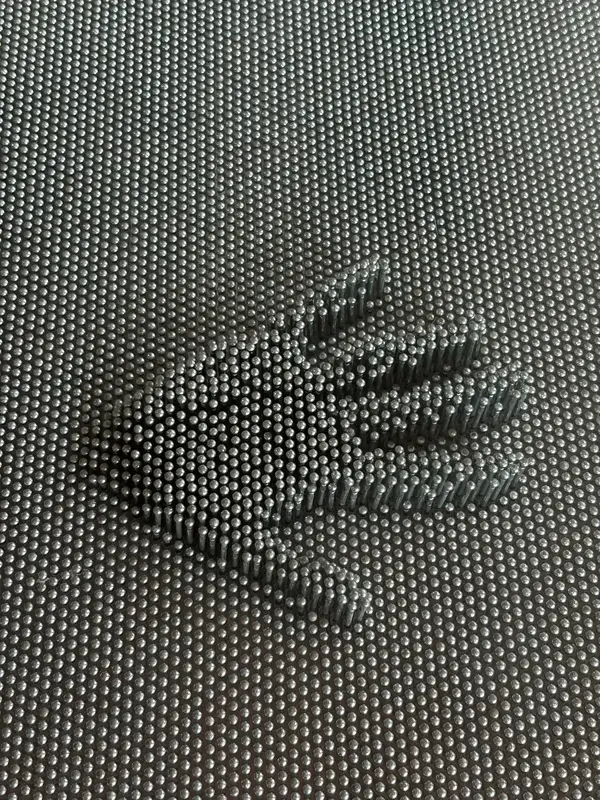
Pin Impression Board
Almost 10,000 closely packed pins can slide independently in and out. Press your hand, face or another object against one side, and the pins move to different depths, reproducing its shape as a three-dimensional impression.
The idea is somewhat similar to a dot-matrix printer, where an image is built from many tiny points. But instead of forming a 3D shape, a dot-matrix printer uses small, rapidly moving pins to strike an ink ribbon and make dots on paper.
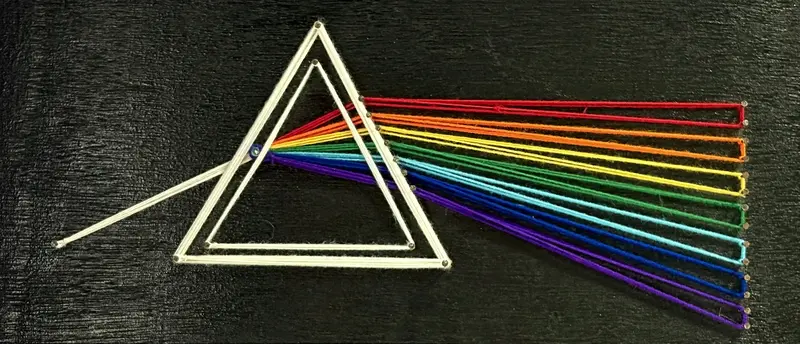
String Prism
This string artwork shows white light entering a prism and spreading into a spectrum of colours. The prism bends different wavelengths of light by slightly different amounts, separating the light into colours from red to violet. This process is called dispersion.
This artwork is a simplified representation. In reality, the colours form a continuous spectrum rather than a few distinct bands.
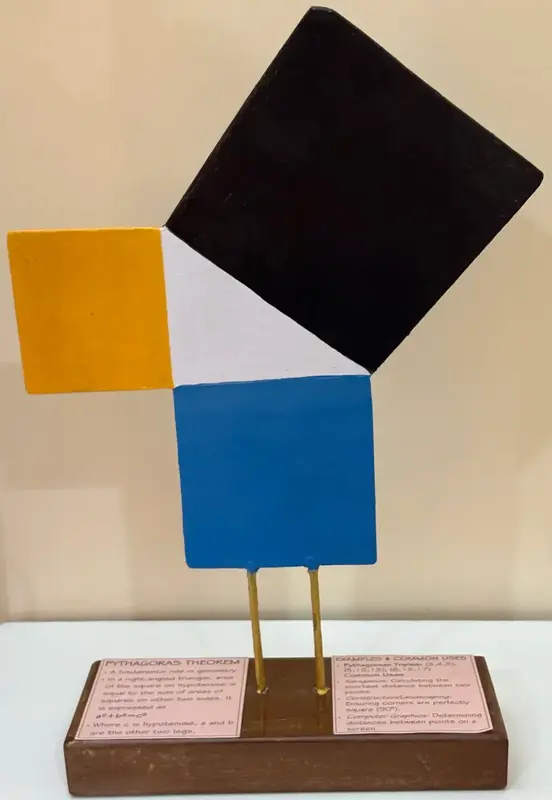
Pythagoras in Squares
A sculptural tribute to Pythagoras, the ancient Greek thinker whose name is attached to one of the most famous and useful theorems in all of mathematics.
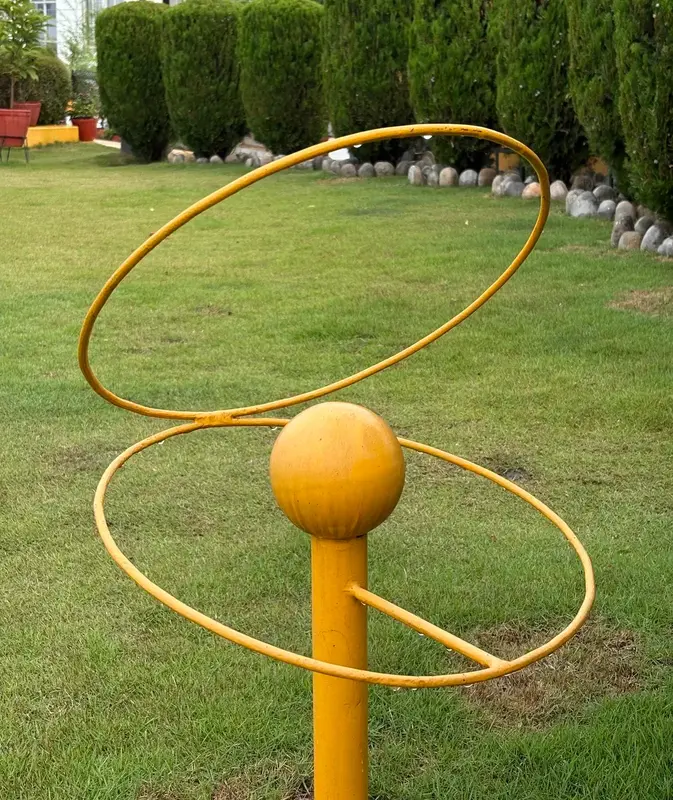
Bouncing Rings
Set the rings spinning and they seem to bounce up and down, even though each ring is simply rotating around the central axis. Because the rings are tilted, their changing position and perspective create an illusion of vertical motion. Our brain interprets the continuously changing shapes as a bouncing movement.
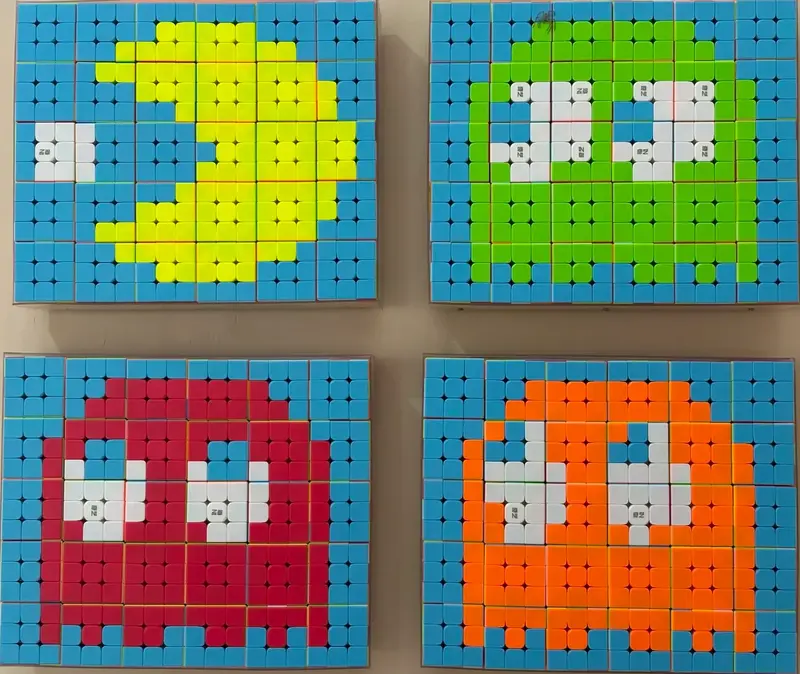
Pac-Man Cube Mosaic
Twisting this classic puzzle scrambles its colored squares across every face, and solving it means working every layer back until each face shows just one solid color again.
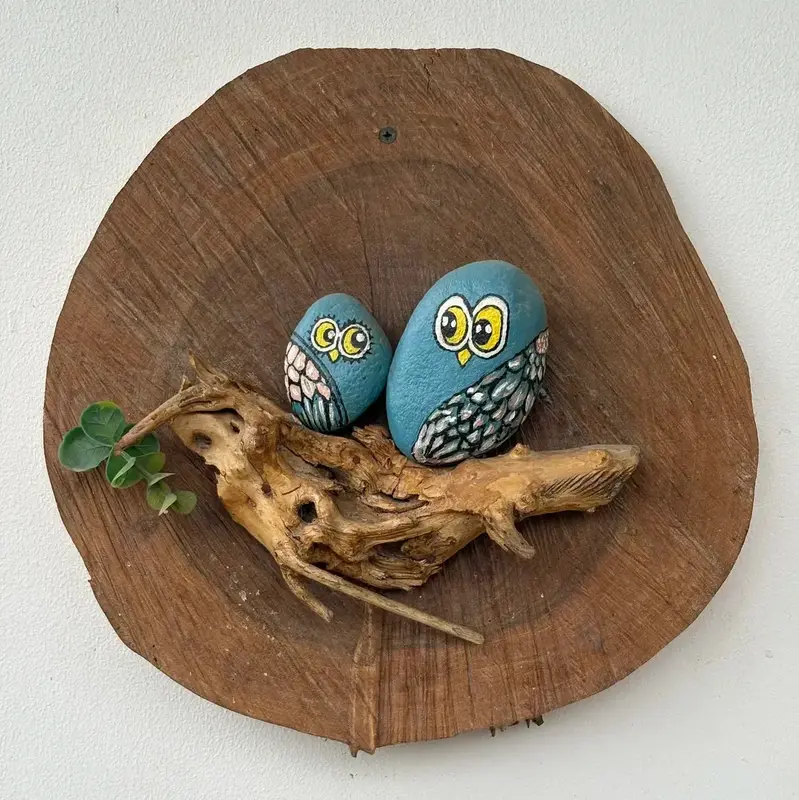
Painted Stone Owls
Nature provides the shapes; imagination supplies the characters. Smooth stones become owls, while a twisted piece of wood becomes their perch. The scene invites us to look at ordinary natural objects and imagine what else they might become.
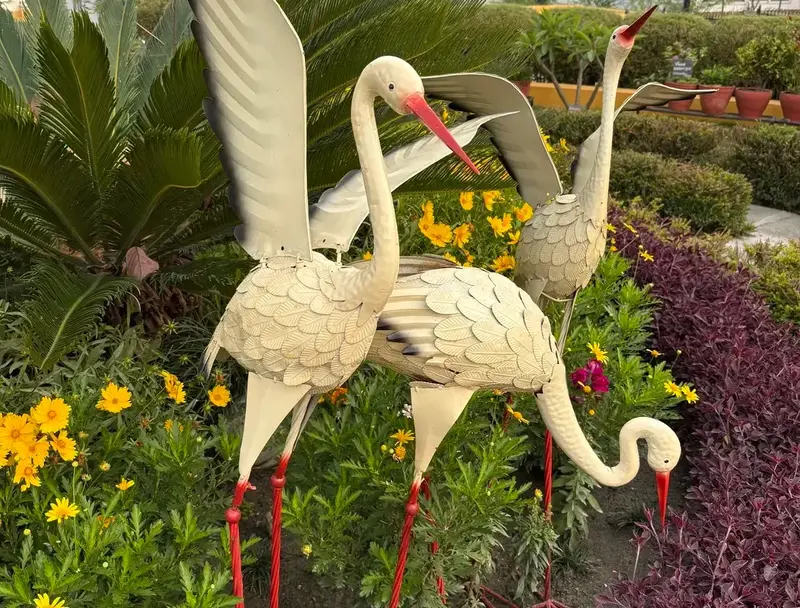
Cranes in the Garden
Long legs, curved necks and outstretched wings make these metal birds instantly recognizable. Their forms show how a few carefully chosen shapes can suggest posture, balance and movement.
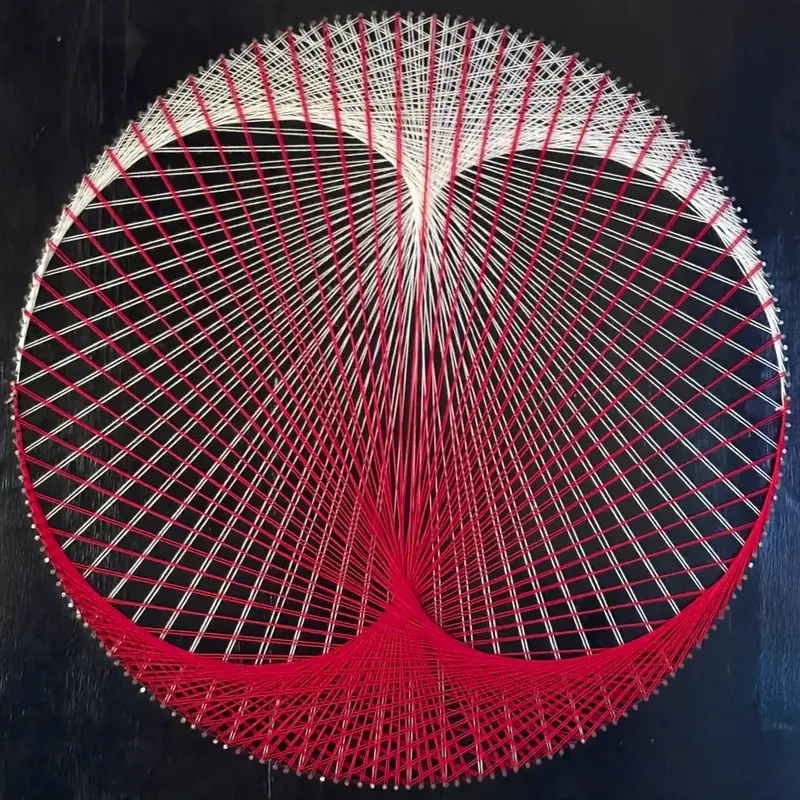
String Art
Every thread in this artwork is straight, yet together they create the appearance of a smooth curved shape called a nephroid. The curve emerges as the envelope of many carefully arranged straight lines.
A nephroid is a two-cusped mathematical curve that can also be generated by rolling one circle around the outside of another. Remarkably, the same shape appears in optics as a caustic — a bright curve formed when parallel rays of light reflect from the inside of a circular surface.
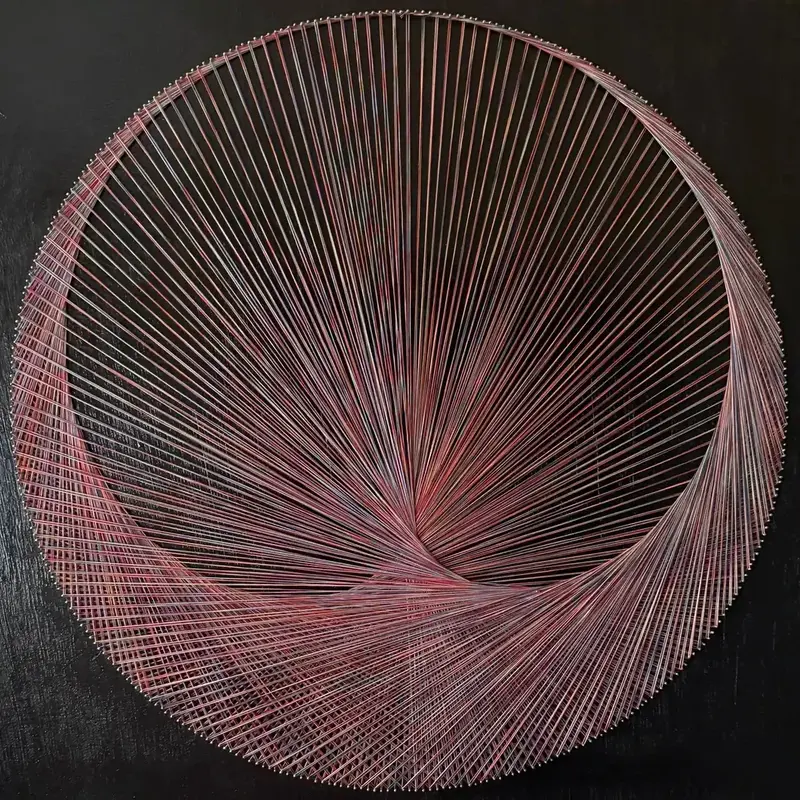
String Heart
A complex curve emerges from nothing more than straight lines and a simple rule.
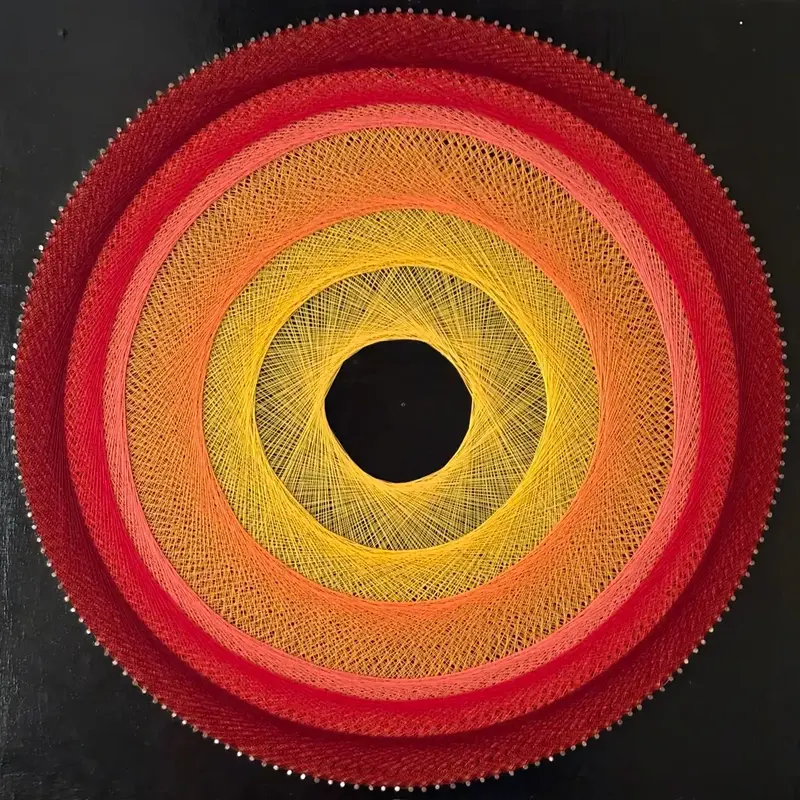
Thread Tunnel
Layer upon layer of coloured thread creates the illusion of a glowing tunnel or vortex receding into the surface. Nothing here actually curves inward — the sense of depth comes from changing line density, overlap and colour. Our visual system turns a flat arrangement of threads into something that seems almost three-dimensional.
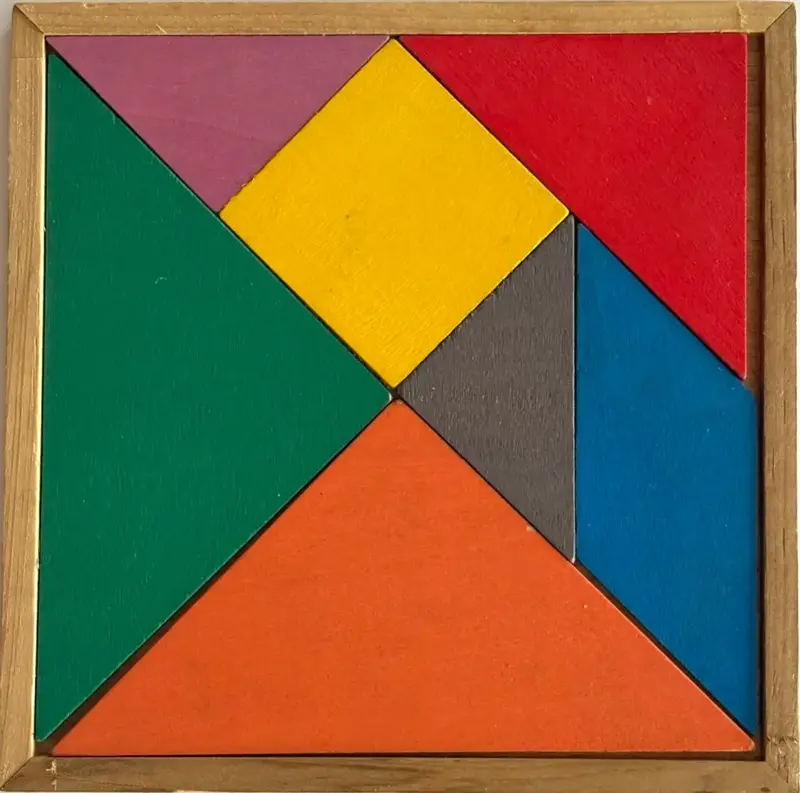
Tangram Puzzle
This ancient puzzle uses just seven flat geometric pieces — triangles, a square, and a parallelogram — that can be rearranged into thousands of different recognizable pictures, from animals to people to abstract shapes.
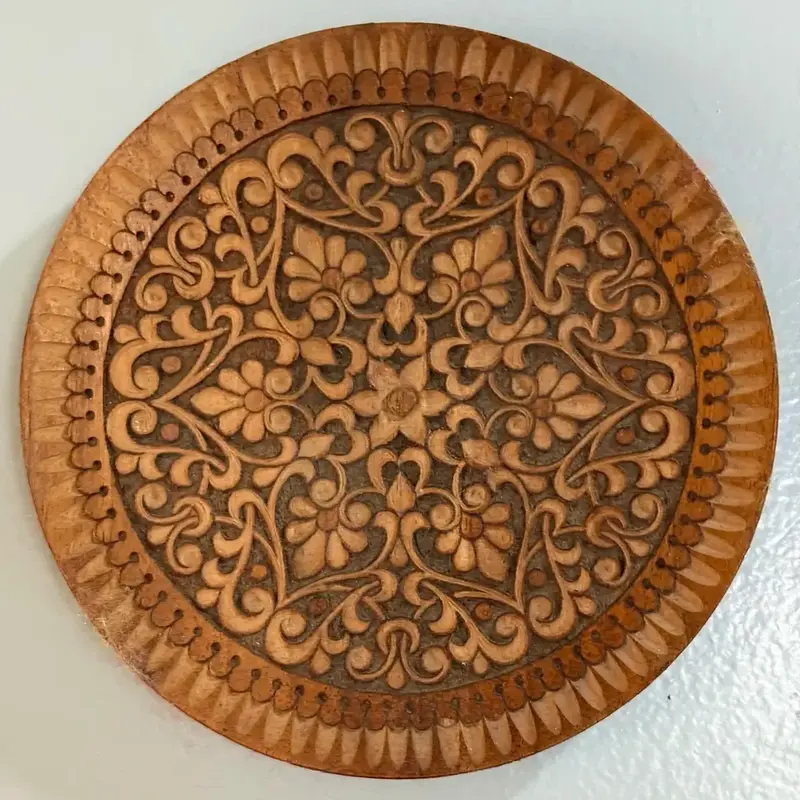
Wood Carving from Uzbekistan
This hand-carved wooden panel reflects a long Central Asian tradition of decorating wood with repeating floral and geometric motifs. The design is built around symmetry and repetition, with leaves, flowers and curling forms arranged into a balanced circular pattern.
What looks purely decorative also reveals an underlying geometry: repeated units, radial symmetry and careful spacing turn a flat piece of wood into a richly structured design.
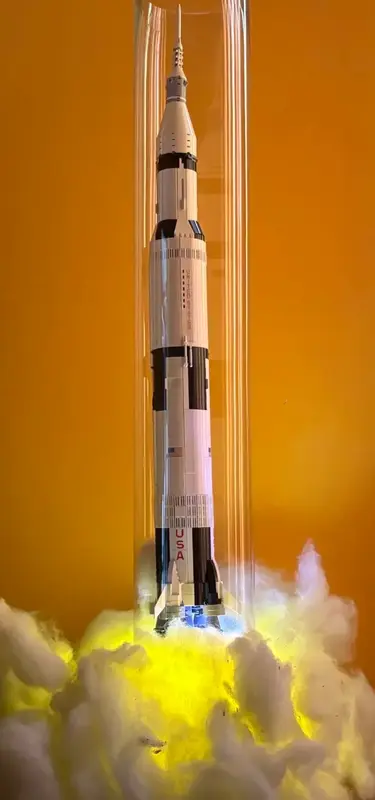
Saturn V - LEGO Model
A model of the Saturn V, the most powerful rocket ever successfully flown, shows the towering, multi-stage design NASA used to launch astronauts all the way to the Moon. The real Saturn V stood about 111 metres tall and carried the Apollo 11 crew on the first mission to land humans on the Moon in 1969.
Building it from LEGO is a reminder that even the most complex machines are assembled from many smaller parts working together.
To explore the Moon and the rest of the solar system yourself, try Explore with NASA: fly along with spacecraft, find the Apollo landing sites on Moon Trek, and see where the Space Station is right now.
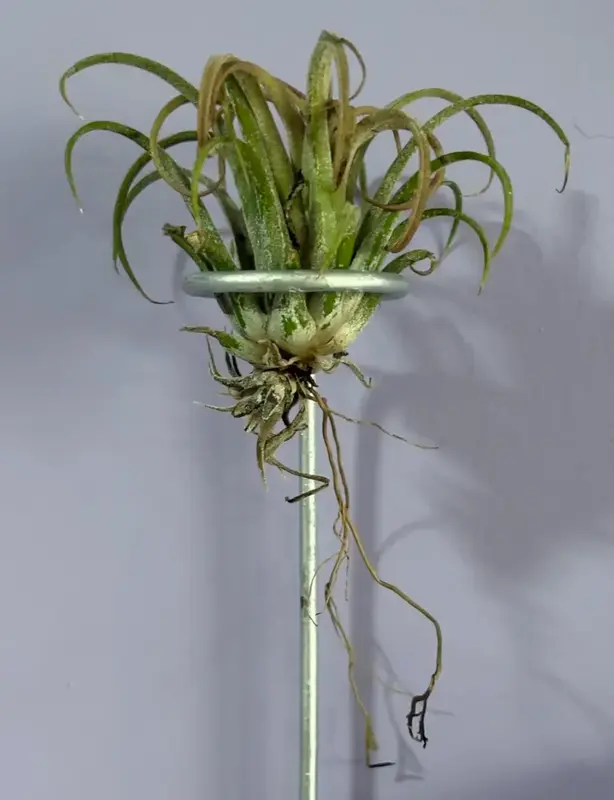
The Air Plant
Air plants (Tillandsia) do not need soil. Instead of using roots mainly to absorb water and nutrients, they take in much of what they need through specialized scales on their leaves called trichomes. Their roots are used mostly for anchoring the plant to trees, rocks or other surfaces.
In nature, many air plants grow as epiphytes — plants that live on other plants for support without parasitizing them.
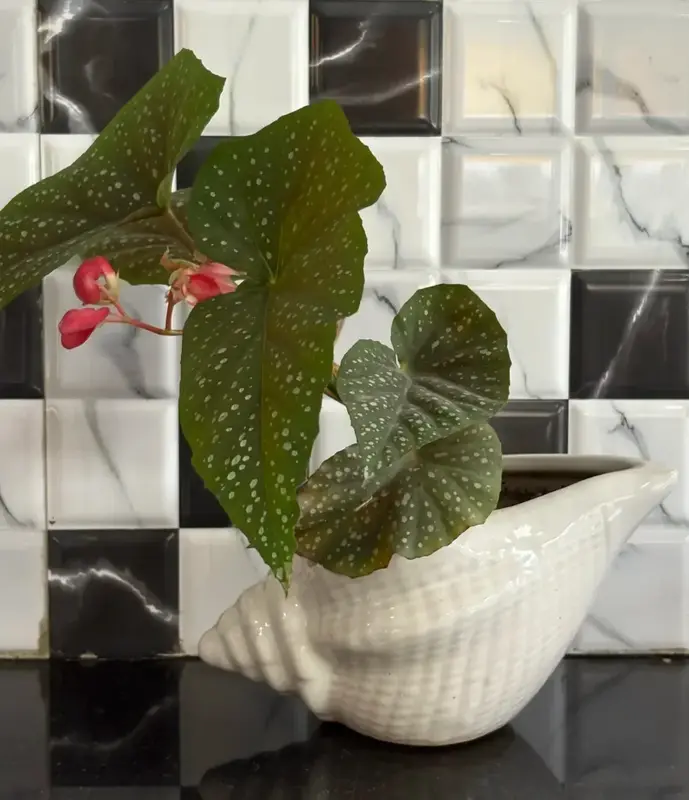
Polka-Dot Begonia
This begonia’s leaves carry a natural pattern of silvery spots or streaks, a pigmentation quirk that’s become one of the most eye-catching features gardeners breed for.
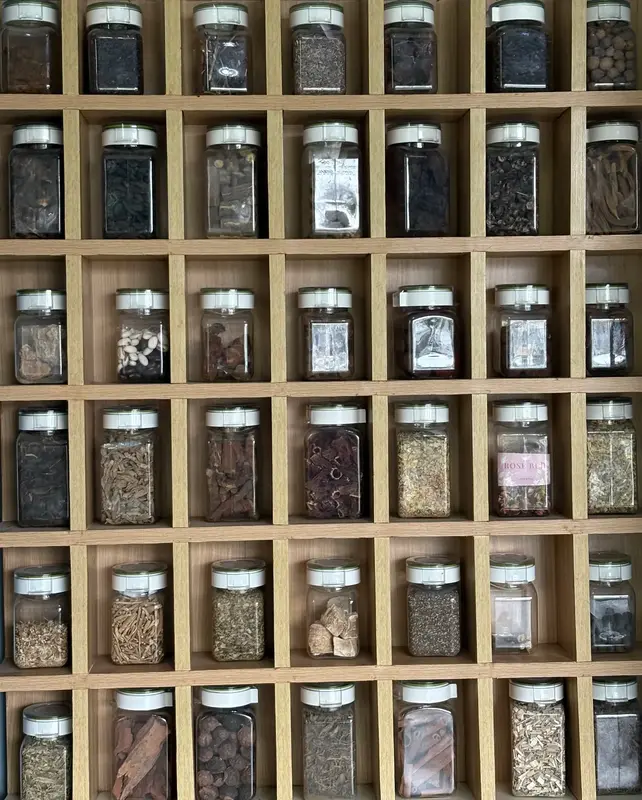
Medicinal and Culinary Herbs of Nepal
This collection contains dried herbs and plant products used in cooking, traditional remedies, or both. All of the plants represented here are found in Nepal.
Look for the yellow dot: it means the living plant can also be found growing in the Science Playground garden.
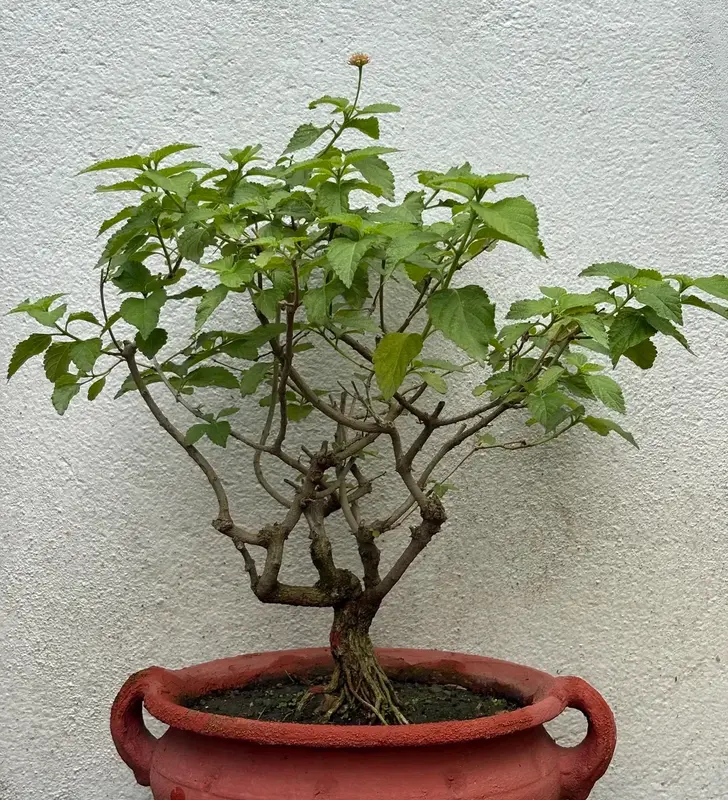
Lantana Bonsai
This lantana is one of several bonsai plants in the Science Playground. Bonsai is the art of growing ordinary trees and shrubs in miniature by carefully pruning branches and roots and controlling their growth in containers. The plants are not genetically dwarf — they are trained to remain small while developing the character of mature trees.
Lantana is well suited to bonsai because it branches readily, develops a woody trunk and can flower even at a small size.
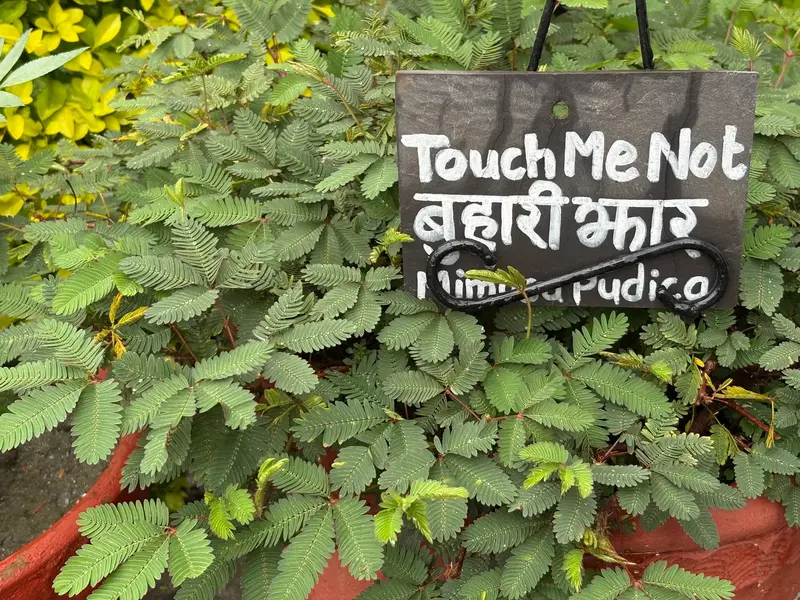
Touch-Me-Not Plant
Brush a finger against this plant’s leaves and they fold shut within seconds — a rare example of rapid movement in the plant world, triggered by a sudden shift in water pressure inside its cells.
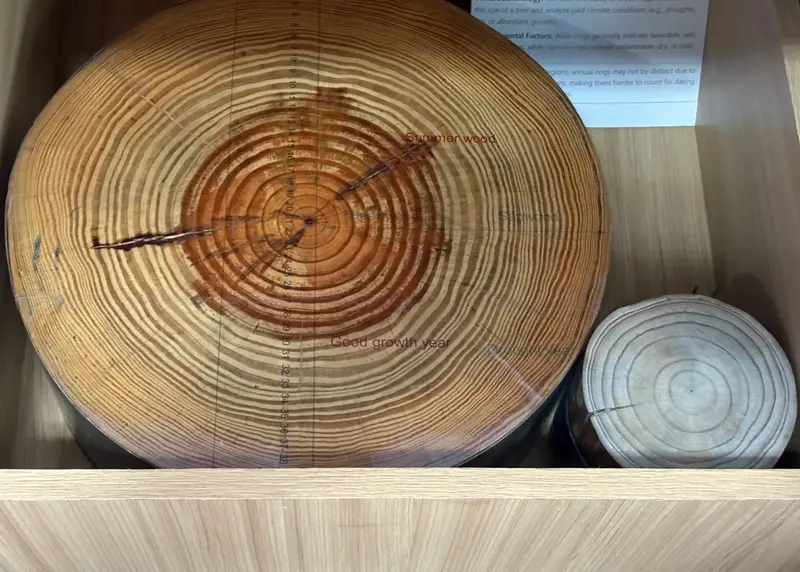
Tree Ring Cross-Section
Sliced across the trunk, a tree reveals a ring for every year it grew — wider rings mark good growing years, narrower ones mark drought or stress, turning a cross-section into a readable record.
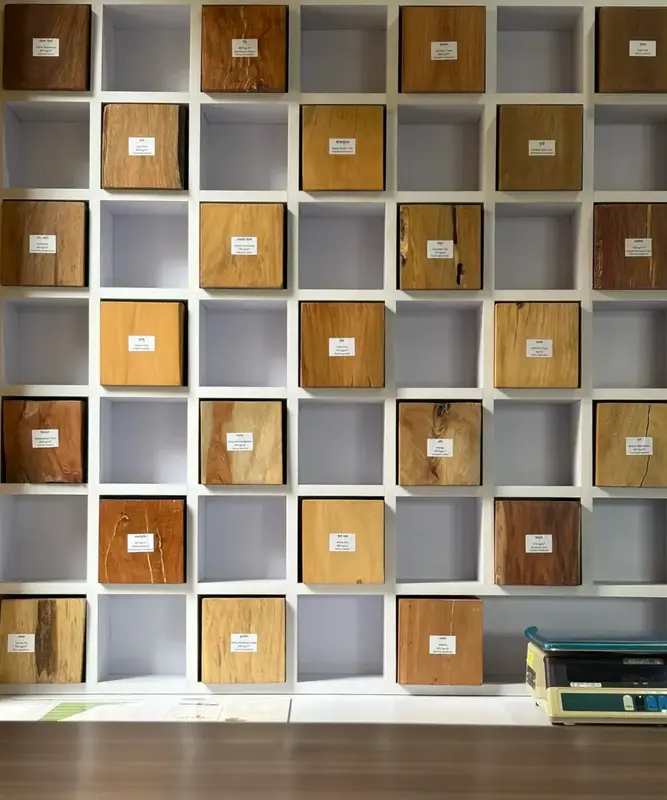
Woods of Nepal
This display gathers wood samples from trees native to Nepal, showing how grain, color, and density can vary dramatically from one species to the next.
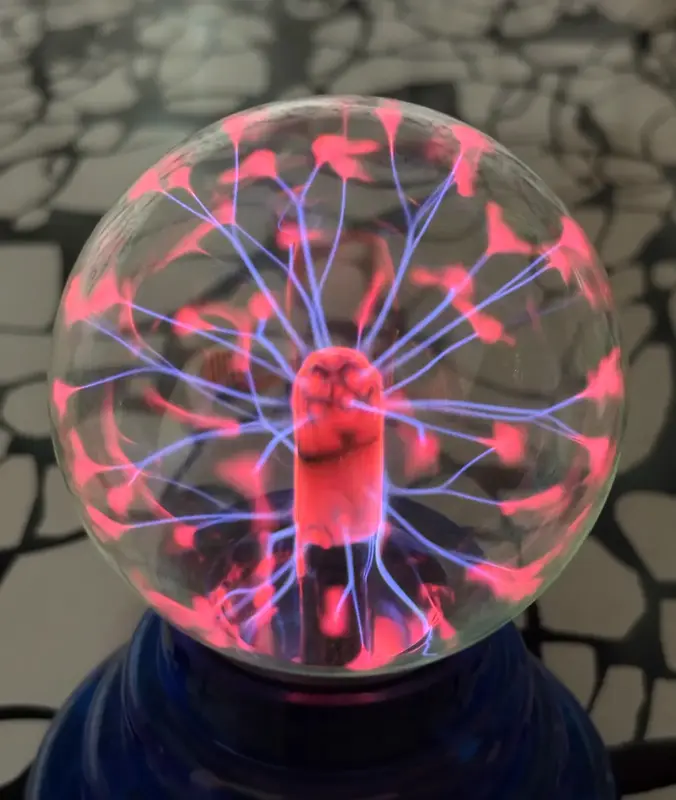
Plasma Ball
Glowing tendrils of electricity dance from a charged sphere at the center out to the glass surface, and touching the glass draws the current to gather right where your hand is.
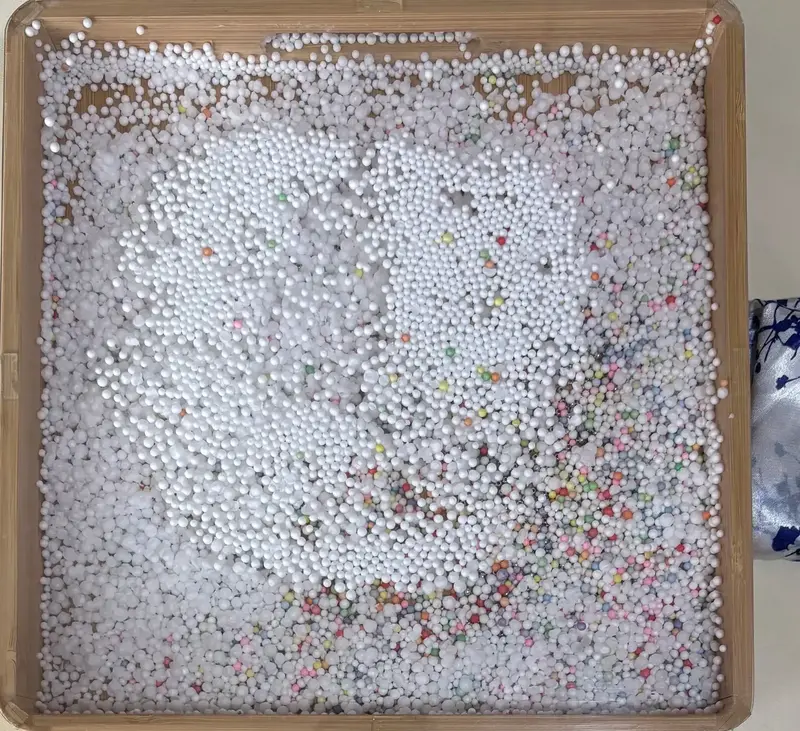
Static Electricity
These lightweight foam beads respond dramatically to electric charge. When static electricity builds up, the beads can be attracted, repelled and made to jump or cling to surfaces.
The effect comes from electric forces between charged objects. Because the beads are so light, even a small electrostatic force can move them easily.
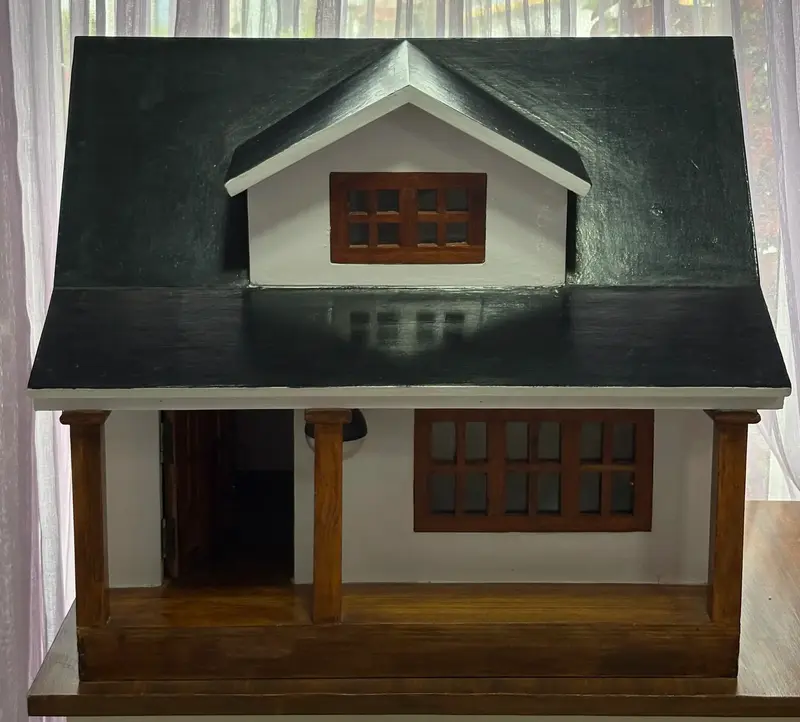
Solar House Model
Everything in this model house is powered by electricity generated from sunlight. Solar panels convert light energy into electrical energy, which can run lights and other devices. A battery can store some of that energy so the house can continue operating when sunlight is weak or unavailable.
It is a small demonstration of how a home can use renewable energy instead of relying entirely on electricity from the grid.
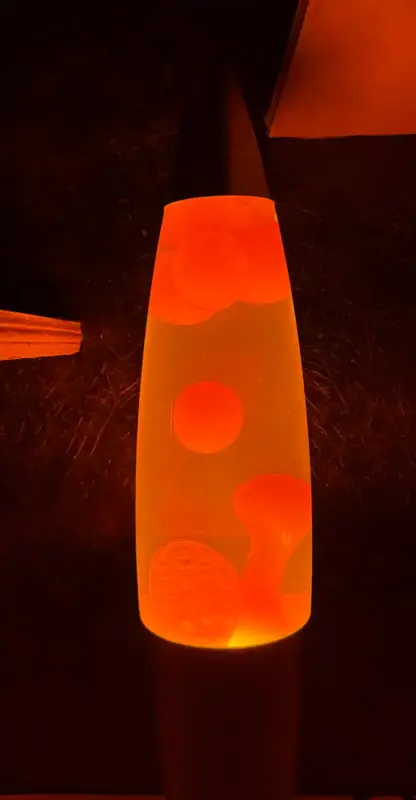
Lava Lamp — Convection in Motion
A lava lamp is a simple demonstration of convection. Heat from the lamp warms the wax at the bottom, causing it to expand and become less dense than the surrounding liquid. The warmer wax rises. As it cools near the top, it becomes denser and sinks again.
This continuous cycle of rising and falling material forms a convection current — the same basic process that occurs in fluids such as air and water.
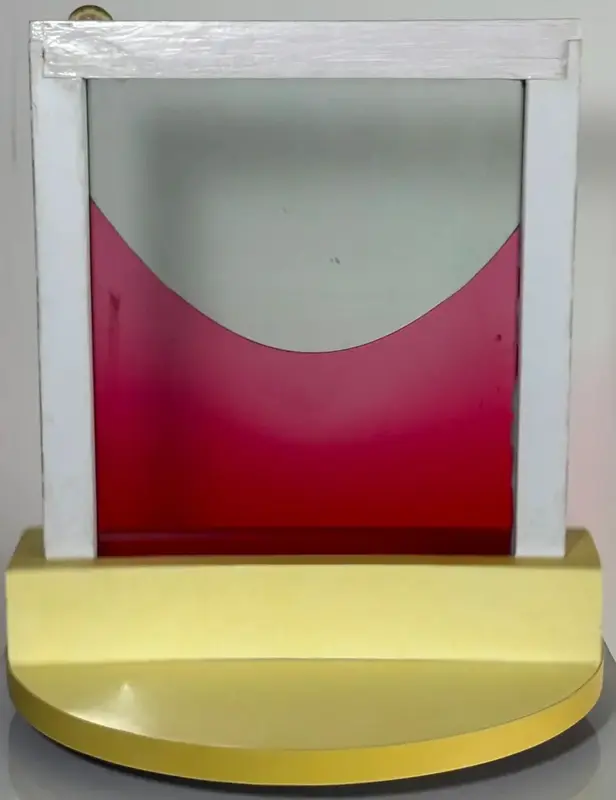
Water Parabola
Spin the base and watch the flat surface of the red water rise at the sides and dip in the middle. The faster it spins, the deeper the curve.
The water is being carried round in a circle, and to move in a circle it needs a push towards the middle. That push comes from the water further out, which can only push harder if it is deeper. So the surface climbs towards the edges, and its shape is a parabola, the same curve a thrown ball follows.
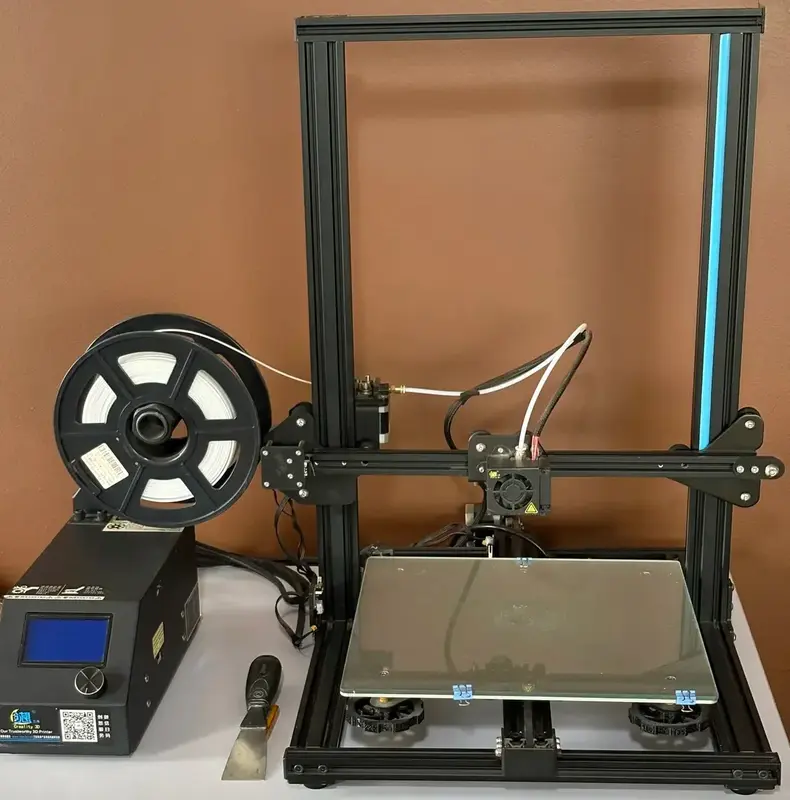
3D Printer
A 3D printer builds objects layer by layer from a digital model. This type of printer melts a thin plastic filament and pushes it through a heated nozzle, drawing each layer before moving upward to add the next one.
The process is called fused filament fabrication (FFF), or FDM. It turns a computer-designed object into a real, three-dimensional form.
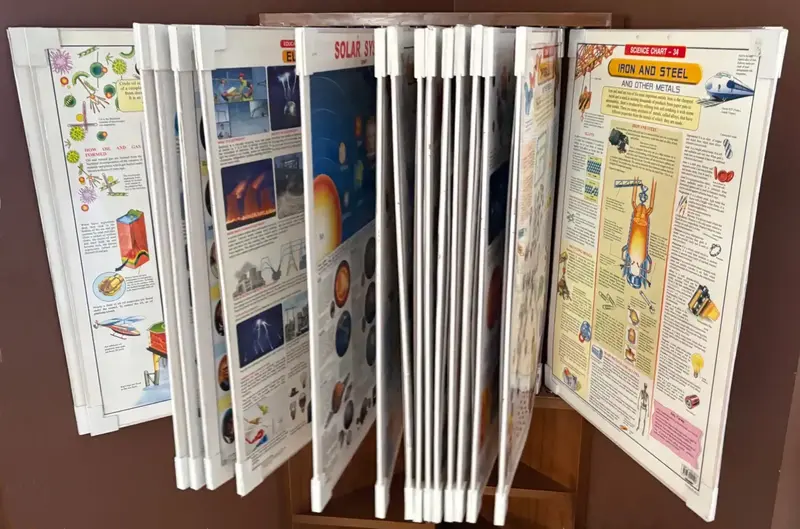
The Giant Science Book
Flip through these oversized pages to explore posters on many different science topics — from space and energy to materials, nature and technology. Each page offers a quick visual introduction to a new idea, making this a book you can browse at your own pace.
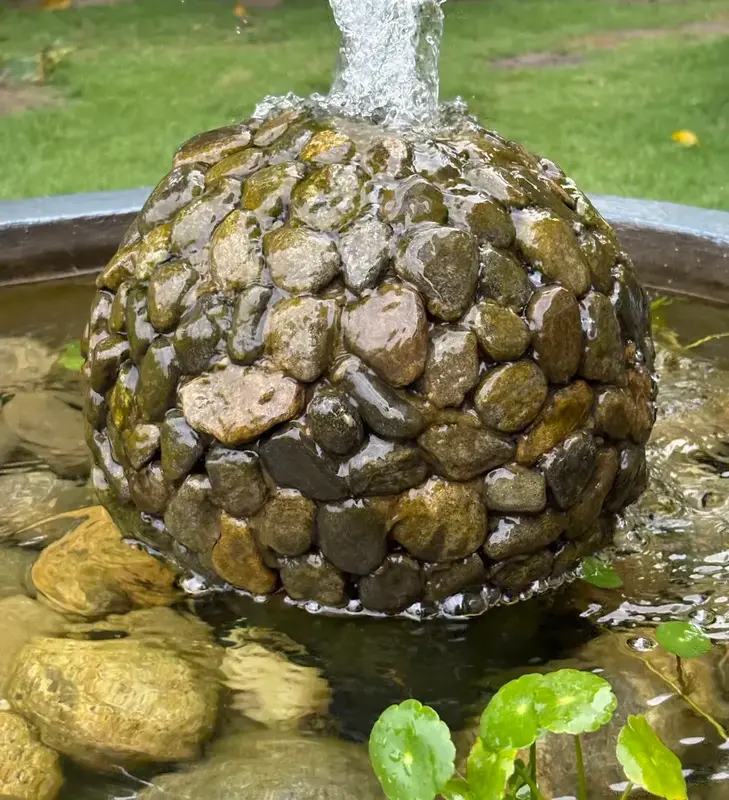
The Ecosystem Pond
This small pond hosts a self-sustaining mix of plants, water, and organisms, showing in miniature how a real ecosystem balances producers, consumers, and decomposers to keep itself running.
This pond is home to guppies, small livebearing fish that give birth to fully formed young instead of laying eggs. Look closely and you may spot many tiny fry swimming among the plants.
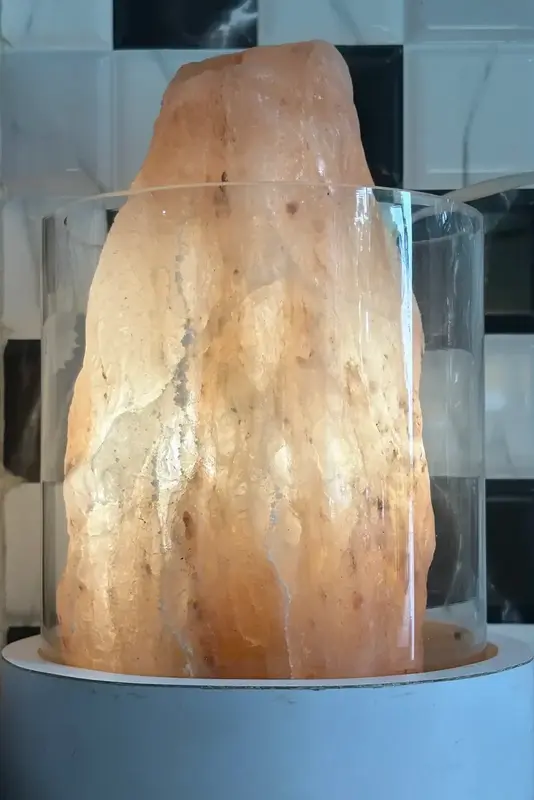
Himalayan Pink Salt
This rock salt gets its pink color from trace minerals like iron oxide trapped inside it — deposited millions of years ago when an ancient sea evaporated and left its dissolved salt behind as solid rock.
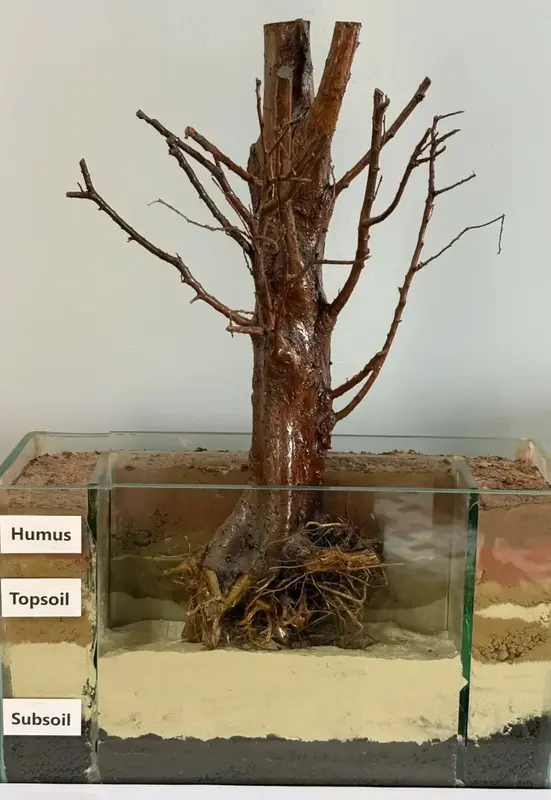
Soil Layers
Soil is built in layers, called horizons, that differ in colour, texture, organic matter and mineral content. Near the surface, decomposed plant material forms humus, which enriches the topsoil below. Deeper subsoil usually contains less organic matter and more minerals washed down from above.
Plant roots are often most abundant near the surface, but many can grow much deeper in search of water and nutrients.
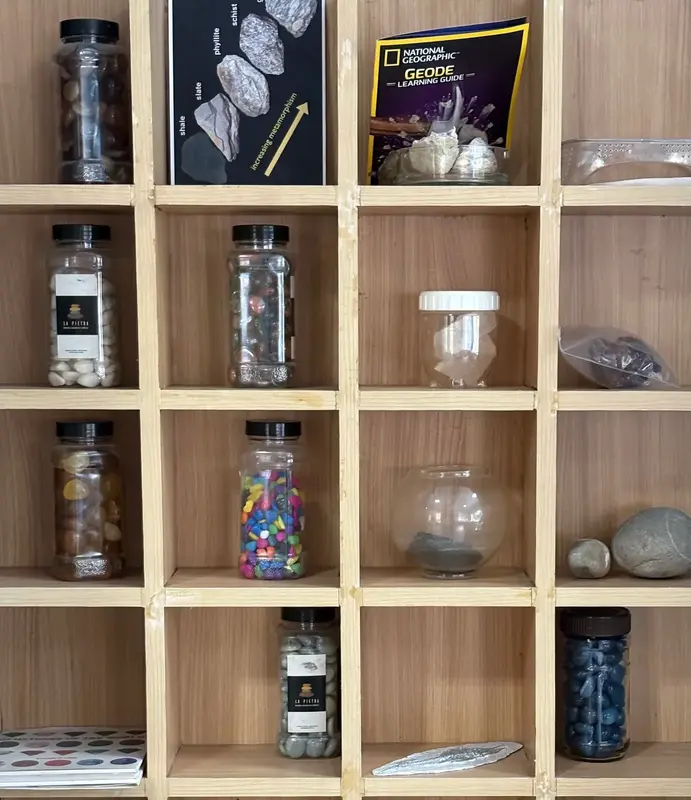
Stone & Mineral Collection
Among these specimens is a real geode — a hollow rock cavity lined with crystals that grew from mineral-rich fluids — and pumice, a volcanic rock full of tiny gas bubbles that became trapped as lava cooled rapidly.
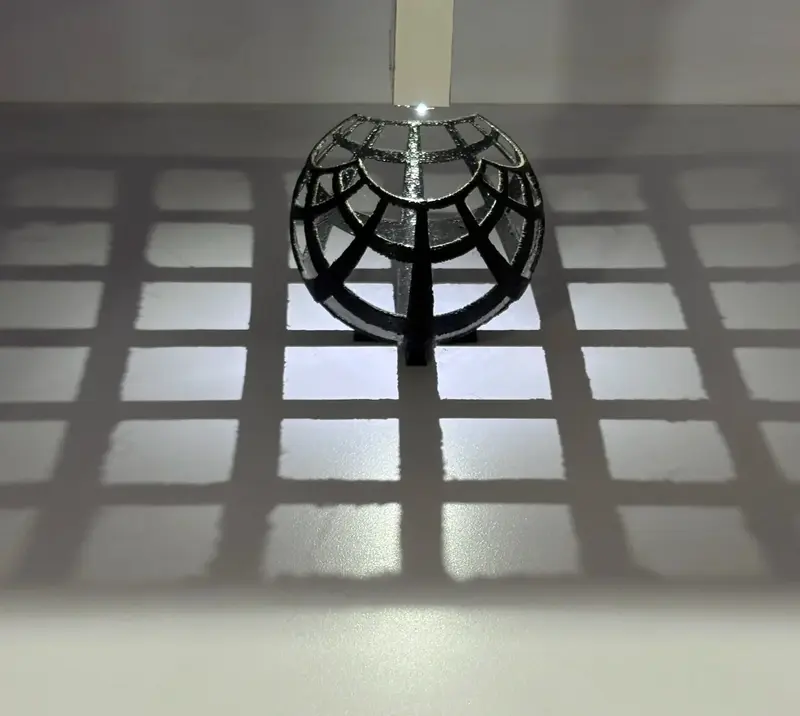
Stereographic Map Projection
A stereographic projection maps points on a sphere onto a flat plane by drawing straight lines from a single point on the sphere through the surface to the plane.
The projection preserves angles and local shapes, but areas and distances become increasingly distorted farther from the centre. It is widely used in mathematics, astronomy and cartography.
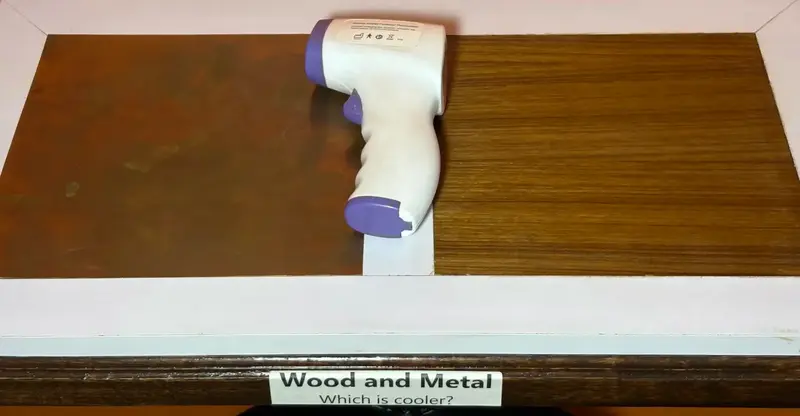
Which Feels Cooler?
Touch two different materials sitting at exactly the same room temperature, and one will feel noticeably colder than the other — not because of its actual temperature, but because of how fast it pulls heat away from your skin.
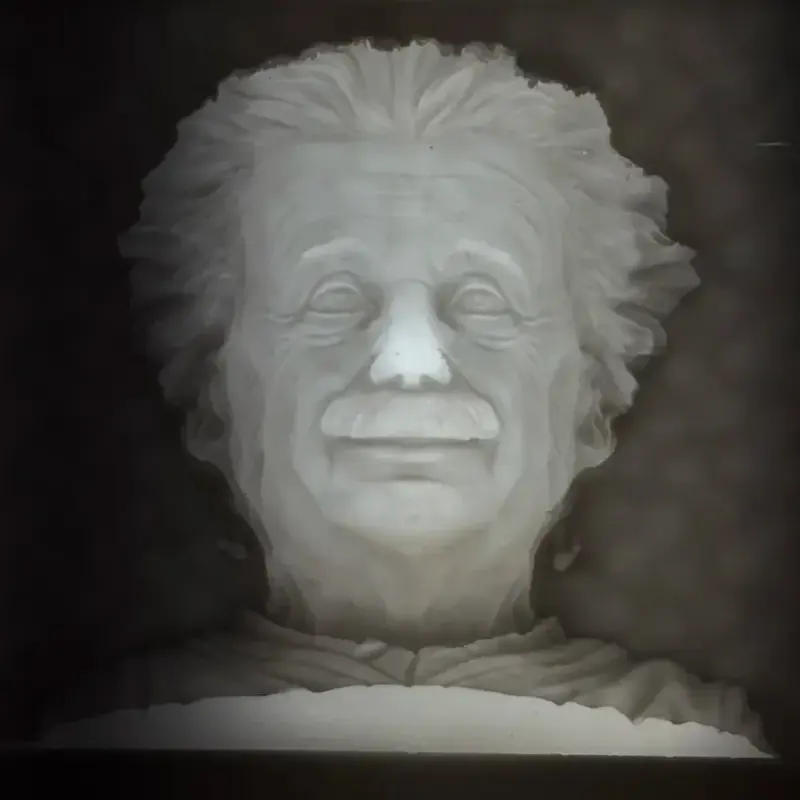
The Hollow Face Illusion
This face is actually concave — it curves inward — but your brain often sees it as a normal face projecting outward. Our visual system is so strongly tuned to expect faces to be convex that it can override the depth information from our eyes.
Move from side to side and the face may seem to turn and follow you. The illusion is a striking example of how perception depends not only on what our eyes see, but also on what our brain expects.
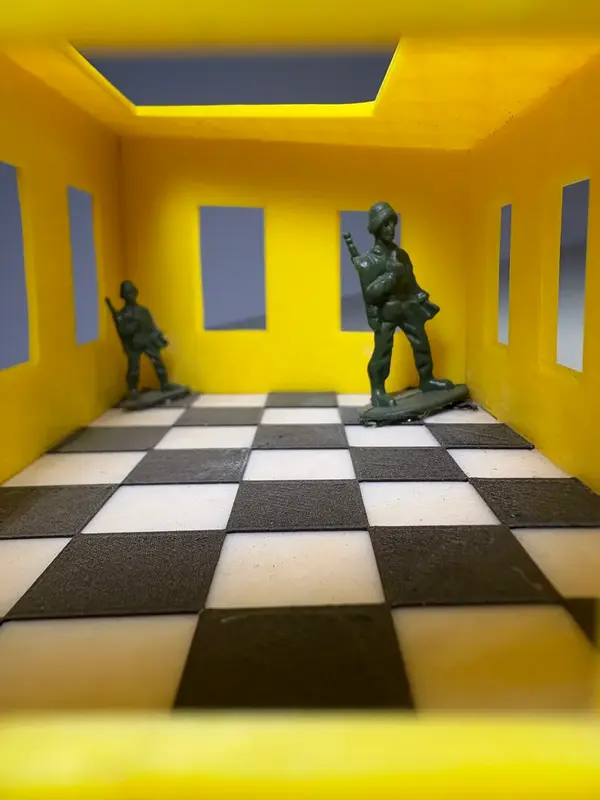
The Ames Room
In the Ames rooms, two objects of the same size can appear dramatically different in height. The illusion is a classic example of forced perspective and how strongly our perception depends on assumptions about depth and space.
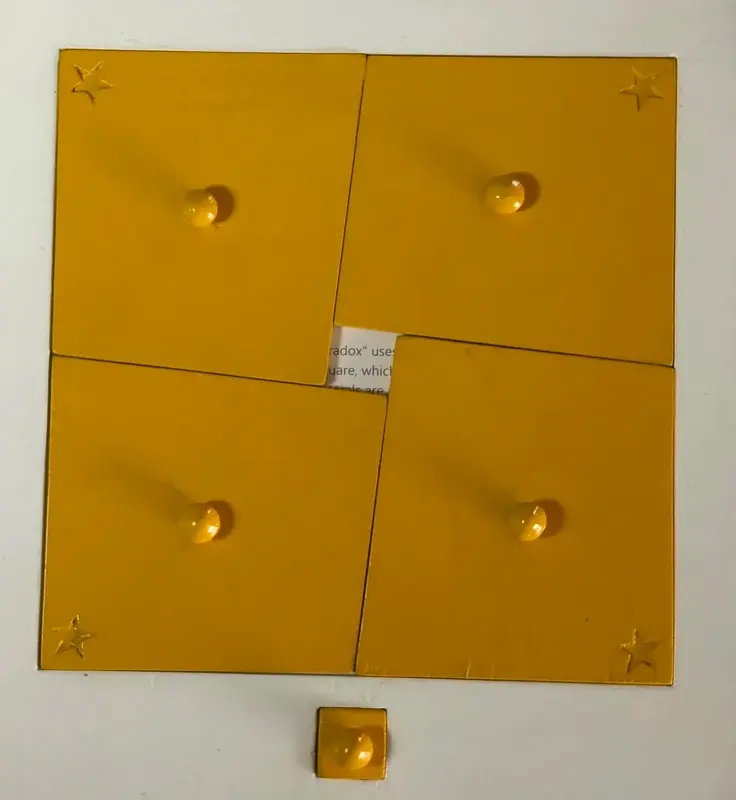
The Area Illusion
Rearrange these pieces and a small square seems to appear or disappear. Nothing has actually been created or lost — the trick is in the geometry. The pieces do not form exactly the same large shape in both arrangements; tiny changes in angles and alignment create a small difference in total area.
This is a classic dissection paradox, showing how easily our eyes can overlook small geometric differences.
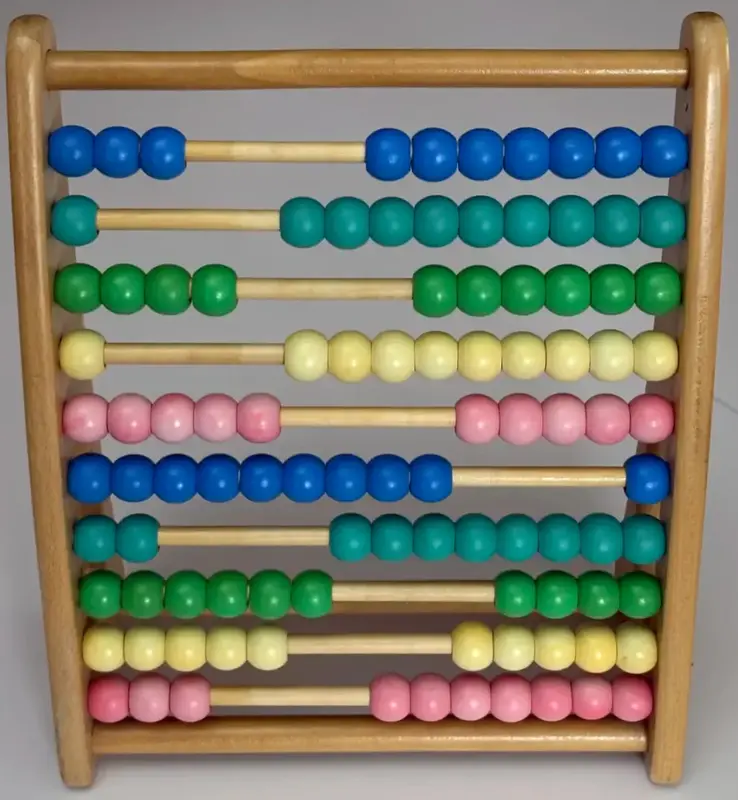
Classic Bead Abacus
The abacus is one of the oldest calculating tools. Numbers are represented by moving beads along rods, with each row or column standing for a different place value. By shifting the beads according to simple rules, you can perform addition, subtraction, multiplication and division.
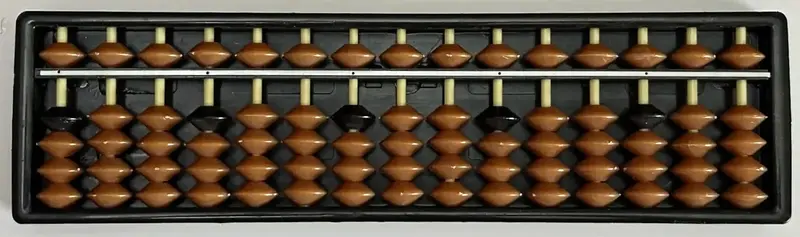
Soroban Abacus
A Japanese-style soroban abacus, with beads arranged for rapid mental calculation.
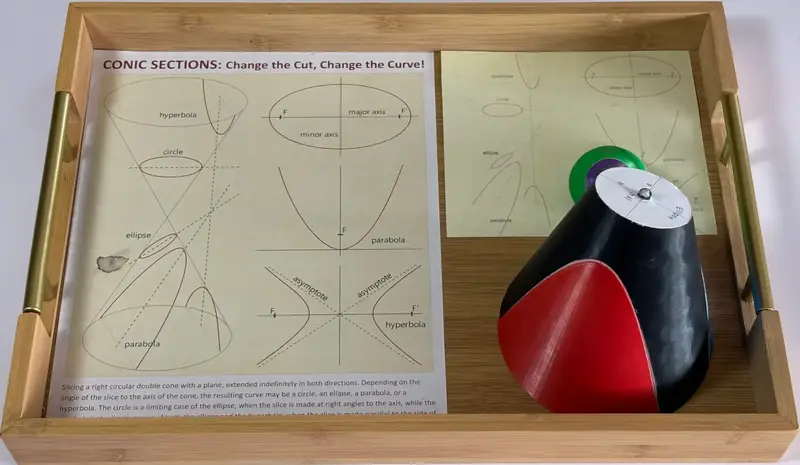
Conic Sections Model
Slice a cone with a flat plane, and the shape of the cut depends on the angle of the slice. A cut perpendicular to the cone’s axis gives a circle; a tilted cut through one side gives an ellipse; a steeper cut parallel to the cone’s side gives a parabola; and a cut through both halves of a double cone gives a hyperbola.
These four curves appear throughout mathematics, physics, astronomy and engineering — from planetary orbits to satellite dishes and telescope mirrors.
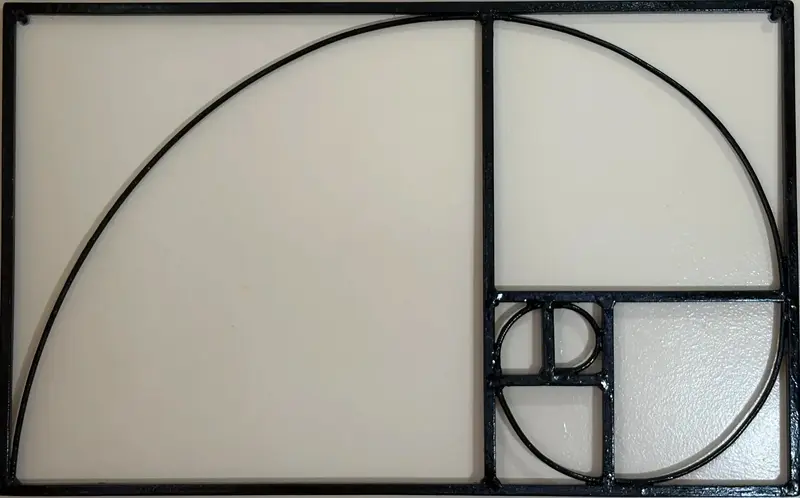
The Fibonacci Spiral
This pattern is built from squares whose side lengths follow the Fibonacci sequence — 1, 1, 2, 3, 5, 8, 13… Drawing a quarter-circle inside each square creates the familiar Fibonacci spiral.
As the sequence grows, the ratio of neighbouring Fibonacci numbers approaches the golden ratio, . The Fibonacci spiral therefore closely approximates a golden spiral, although the two are not mathematically identical.
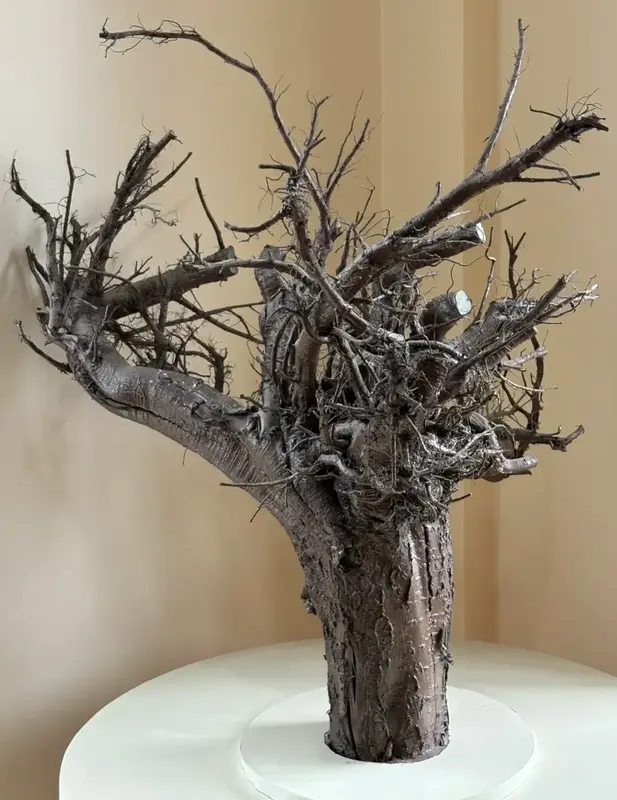
Fractal-Like Tree Root
This natural root structure shows how branching patterns can repeat at different scales: large roots divide into smaller roots, which divide again into finer branches. Such patterns are often described as fractal-like because similar forms appear again and again as you look more closely.
Real roots are not perfect mathematical fractals, but their branching geometry is a beautiful example of how nature creates complex forms from simple repeated growth rules.
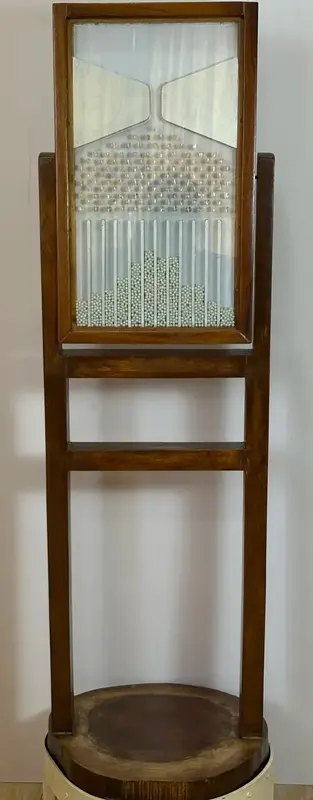
Galton Board
Drop a ball through a triangle of pegs and it bounces left or right at random — but drop hundreds of balls, and they always pile up into the same smooth, bell-shaped curve at the bottom.
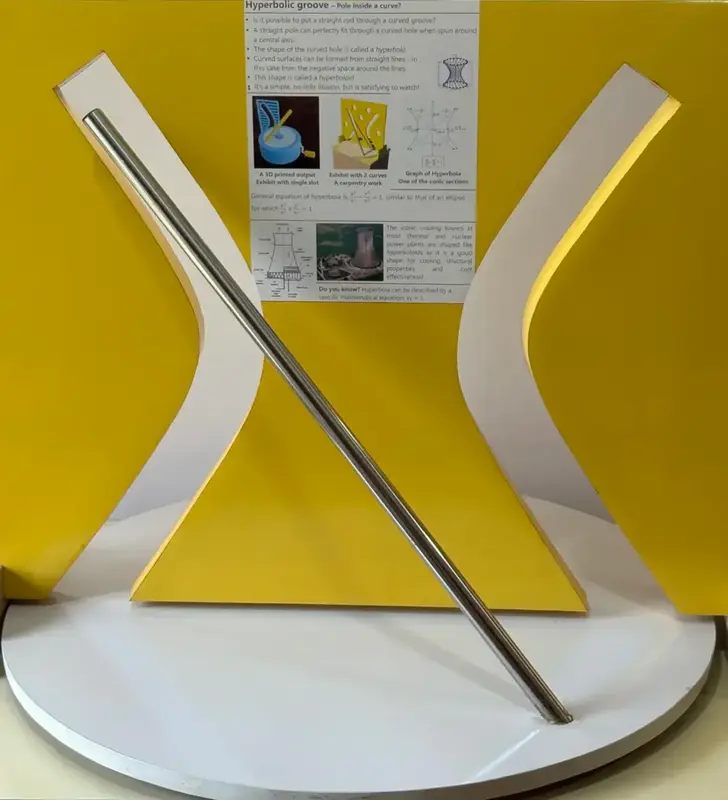
Hyperbolic Groove: A Straight Rod Through a Curved Slot
Turn the base and the straight rod slides through the curved slot without ever touching it. How can something straight fit through a curve?
As it turns, the slanted rod sweeps out a curved surface called a hyperboloid, the shape of a cooling tower. Cut that surface down the middle, through its axis, and the cut edge is a hyperbola: exactly the shape of the slot. So at every moment some part of the rod is passing through the slot’s plane, and always at a point on that curve.
A hyperboloid is a ruled surface: a curved surface made entirely of straight lines. That is why cooling towers can be built from straight steel bars.
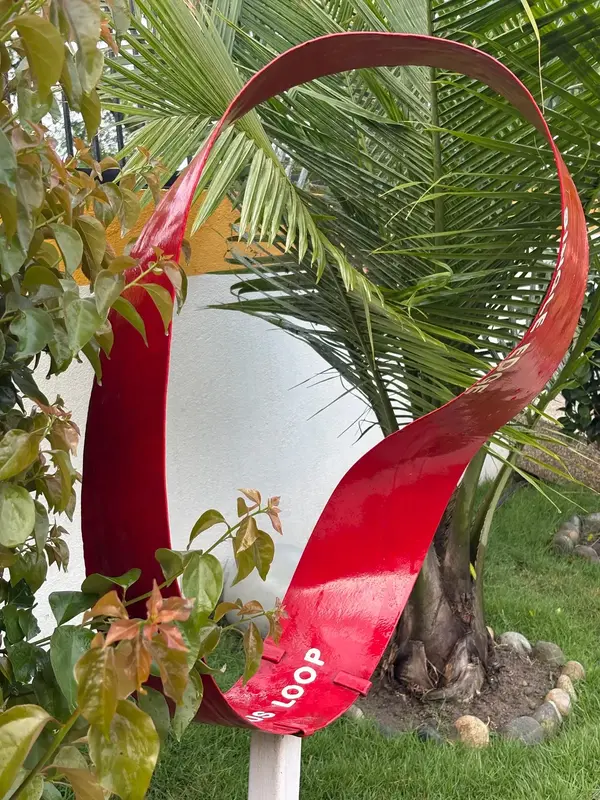
The Möbius Strip
This sculpture is based on a Möbius strip — a surface made by giving a strip a half-twist and joining its ends. Remarkably, an ideal Möbius strip has only one continuous side and one boundary edge.
Trace a path along its surface and you can travel all the way around without ever crossing an edge, eventually returning to your starting point from the “other side.” It is a simple object with surprising properties that connect geometry, topology and art.
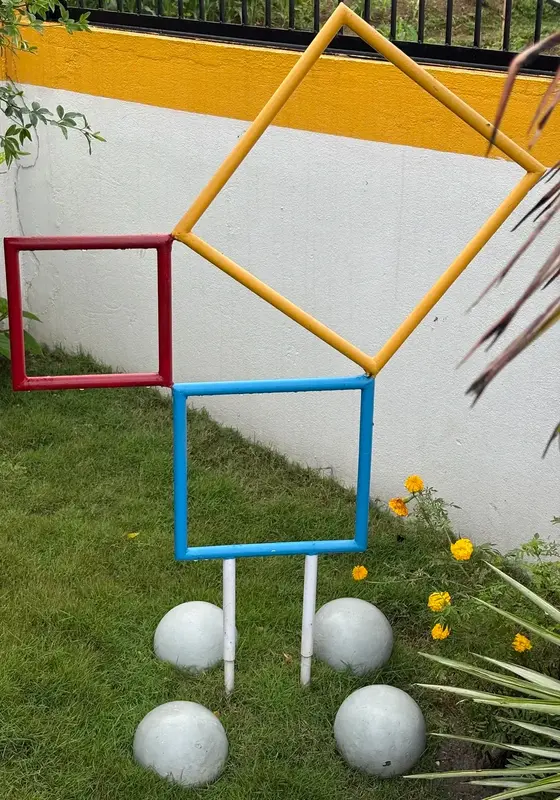
Pythagoras in the Garden
Three squares are built on the three sides of a right-angled triangle. The Pythagorean theorem tells us that the area of the square on the longest side, the hypotenuse, is exactly equal to the combined areas of the other two squares.
This sculpture turns one of geometry’s most famous relationships into a three-dimensional artwork.
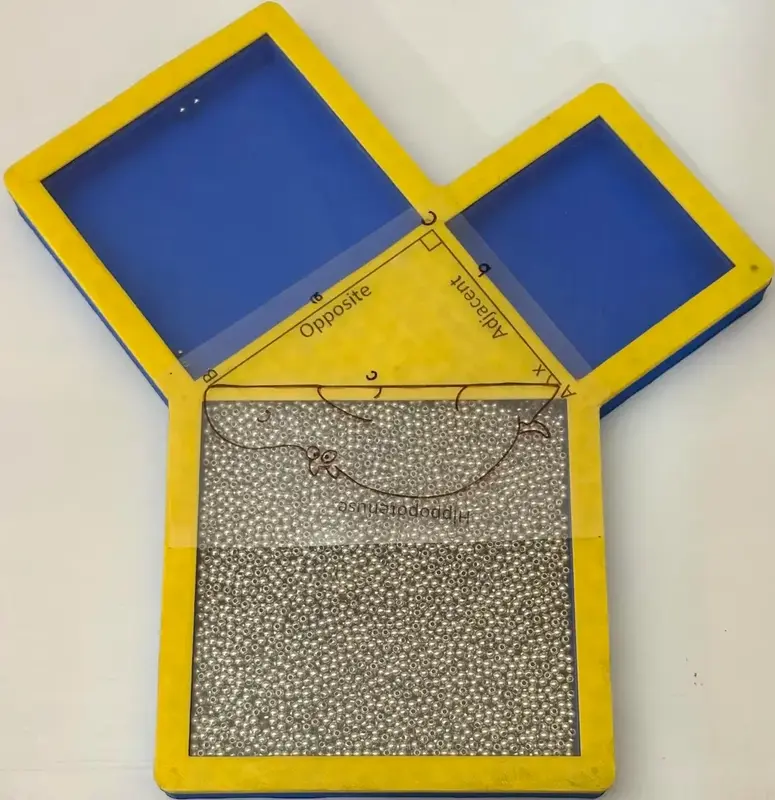
Pythagoras in Beads
This hands-on model demonstrates the Pythagorean theorem using area. The square on the hypotenuse contains enough beads to exactly fill the two squares built on the other sides of the right triangle.
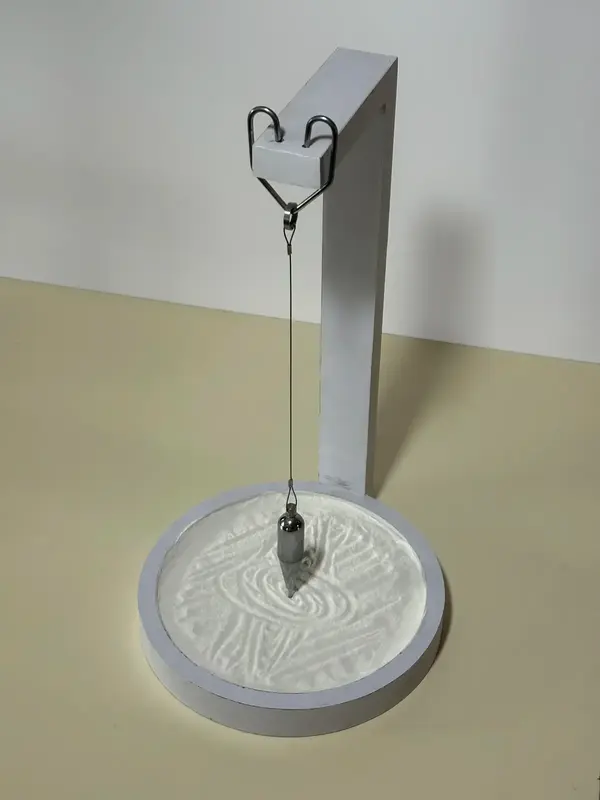
Sand Lissajous Pendulum
A pendulum swinging in two directions at once traces a looping curve in a bed of sand, and the exact shape it draws depends on the ratio between its two swing frequencies.
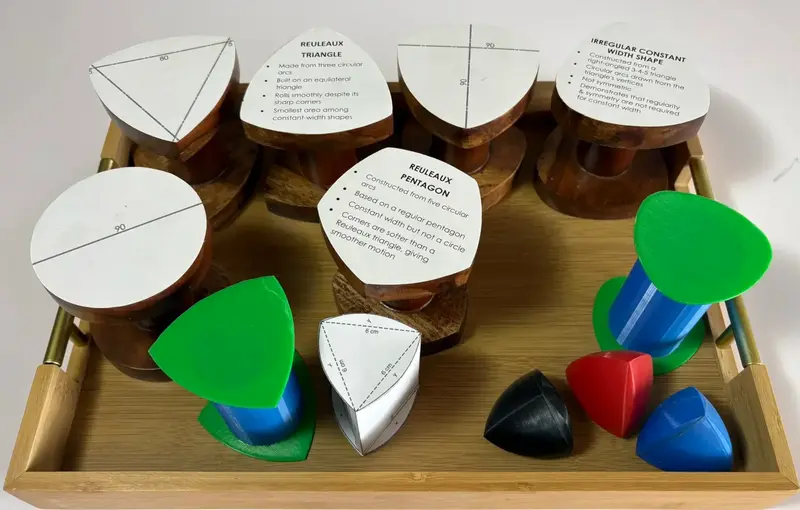
Geometric Shapes Set
A circle has the same width in every direction, but it is not the only shape with this property. Shapes such as the Reuleaux triangle and other curves of constant width also keep the same distance between two parallel supporting lines, no matter how they are rotated.
That means they can roll smoothly between two parallel surfaces even though they are not circular. The exhibit shows that equal width in every direction does not necessarily mean “circle.”
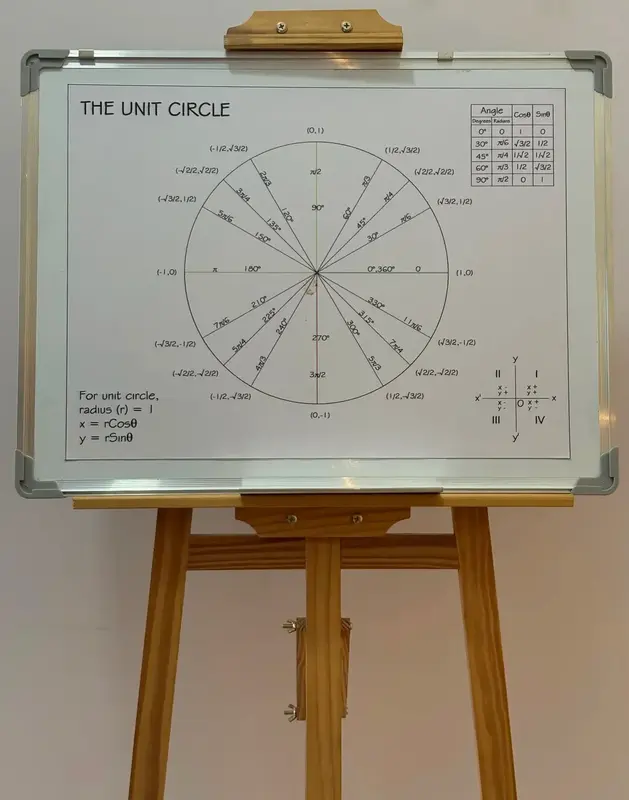
The Unit Circle
A circle with a radius of exactly one unit, marked with angles around its rim, shows how sine, cosine, and the other trigonometric ratios are really just coordinates of a point moving around a circle.
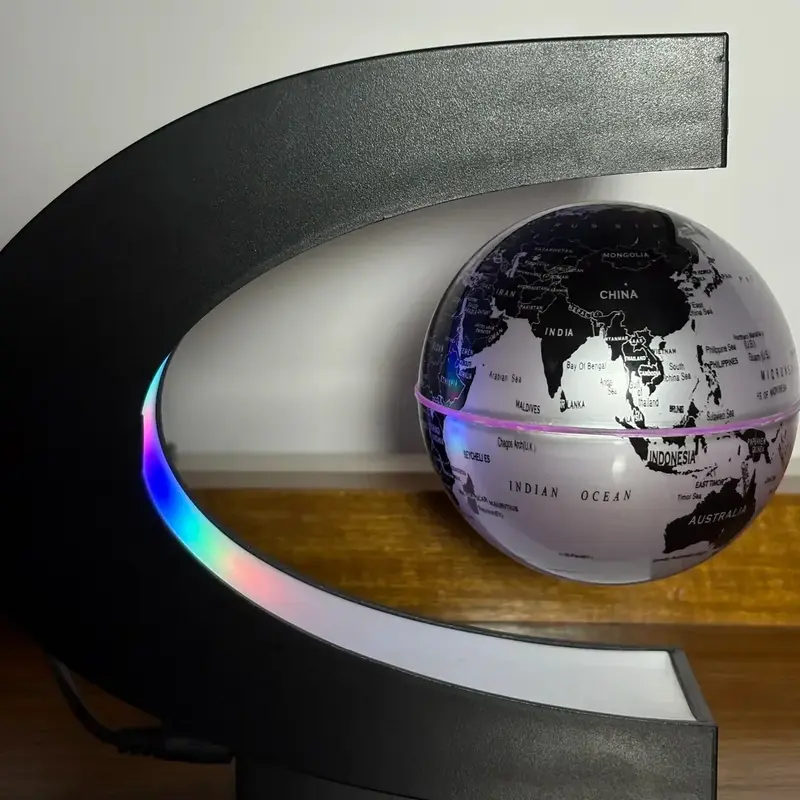
Magnetic Levitation
This globe floats in mid-air with nothing touching it. A magnet inside it is pulled up by an electromagnet hidden in the top of the C-shaped arm, and a small sensor and circuit keep it there.
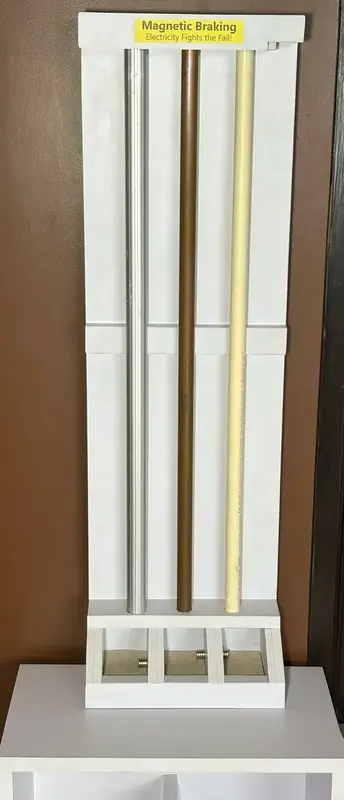
Magnetic Braking
Drop a magnet down a metal tube and, instead of falling freely, it drifts down slowly — the moving magnet induces electric currents in the metal that create a drag force opposing its own fall.
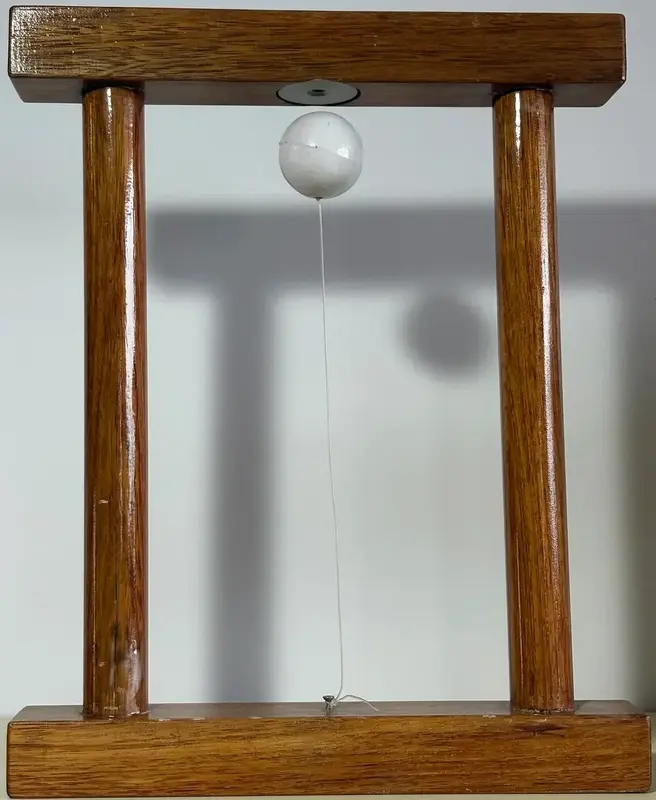
How Far Can a Magnet Pull?
A single magnet suspended by a thread, showing how far its pull reaches through open air.
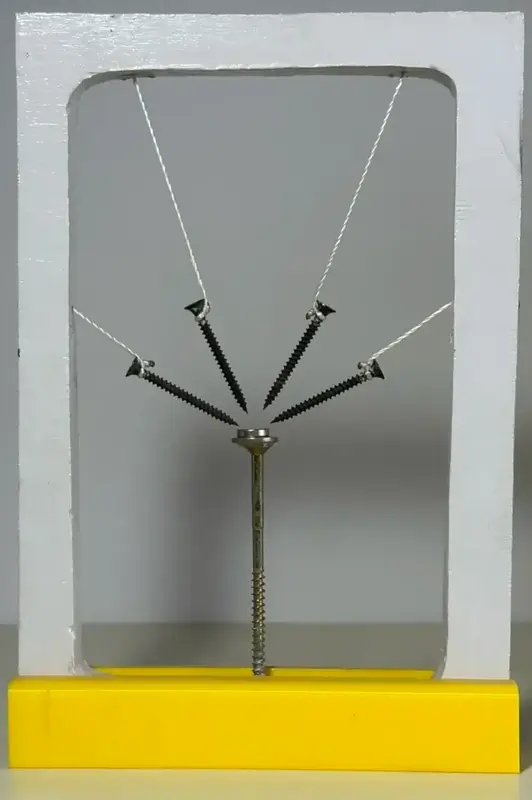
Magnetic Lines of Force
The nails are pulled toward the central magnet and line up roughly along the direction of its magnetic field. Their arrangement gives a visible clue to the otherwise invisible magnetic field lines, sometimes called lines of force.
The nails themselves also become temporarily magnetized, helping them align with the field.
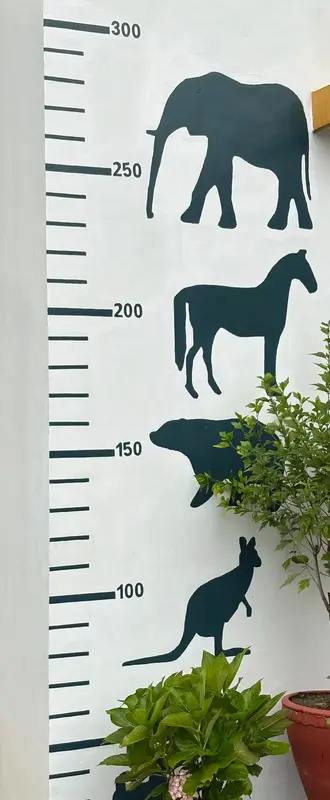
How Tall Are You?
Stand beside the scale and compare your height with some of the world’s animals. The markings show height in centimetres — from a poodle to an elephant.
The silhouettes here are an artistic comparison rather than an exact biological scale.
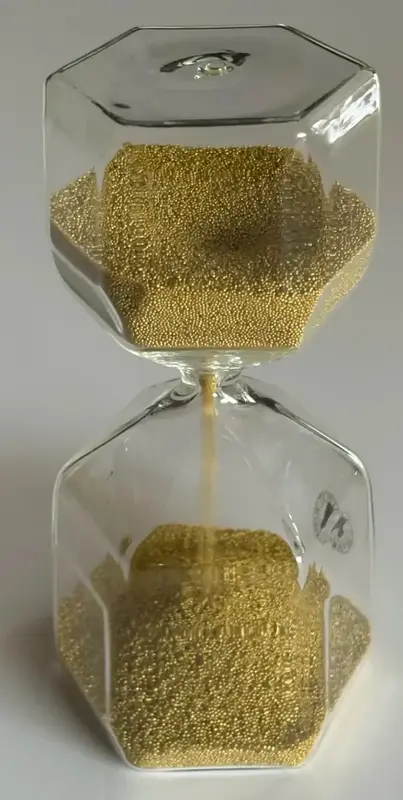
The Hourglass
Grains trickle at a steady rate from the top chamber to the bottom through a narrow neck, marking off a fixed span of time no matter how the hourglass is tilted or handled.
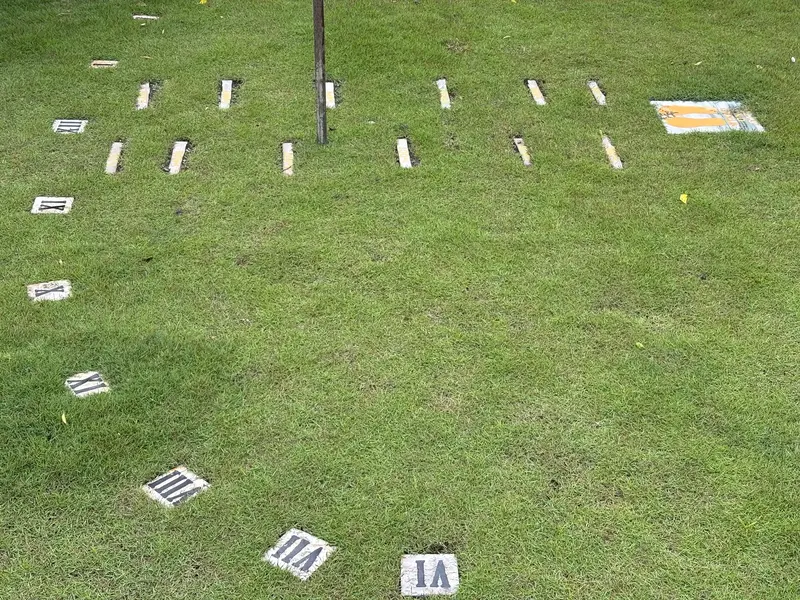
Analemmatic Sundial
This is an analemmatic sundial specially calibrated for Kathmandu. Unlike an ordinary sundial, the shadow-caster is you.
Stand on the marker for the current month. Your body becomes the gnomon, and your shadow points to the time on the hour scale.
As Earth rotates, the Sun appears to move across the sky, so your shadow moves too. The month positions are needed because the Sun’s path changes through the year, changing the length and direction of shadows.
A sundial shows local solar time, so it may differ slightly from the time on your watch.
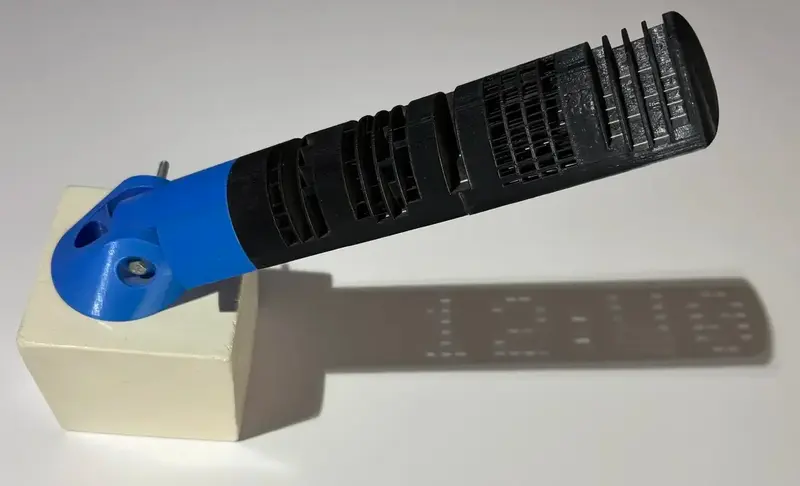
The Solar Digital Clock
This 3D-printed sundial uses sunlight and carefully shaped openings to project the time as glowing digits inside its shadow.
As the Sun moves across the sky, light enters from a different angle, so different parts of the internal pattern line up to form different numbers.
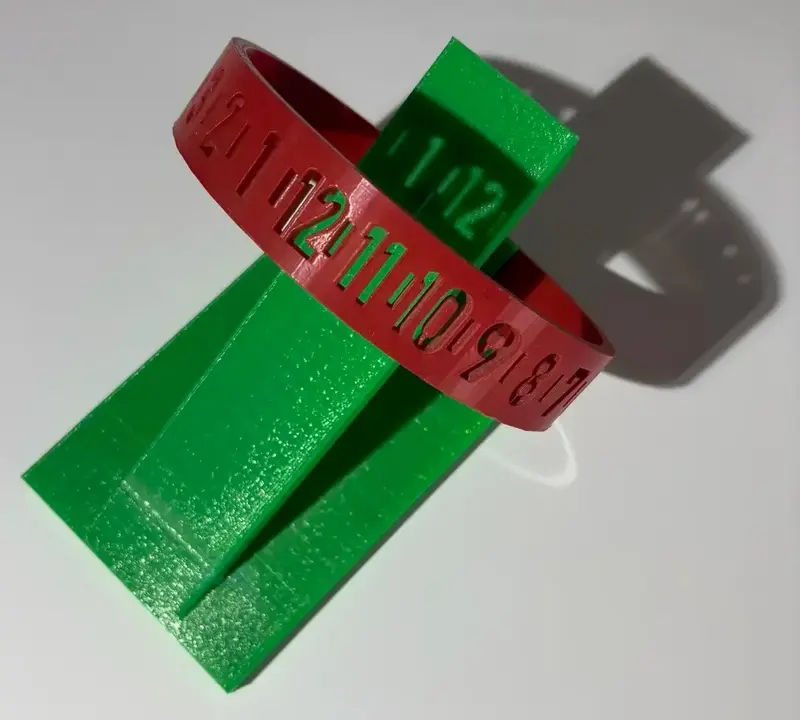
The Solar Ring Clock
This sundial tells time using sunlight passing through numbered openings in a ring.
As the Sun moves across the sky, light shines through a different number and projects it onto the central surface, showing the approximate hour.
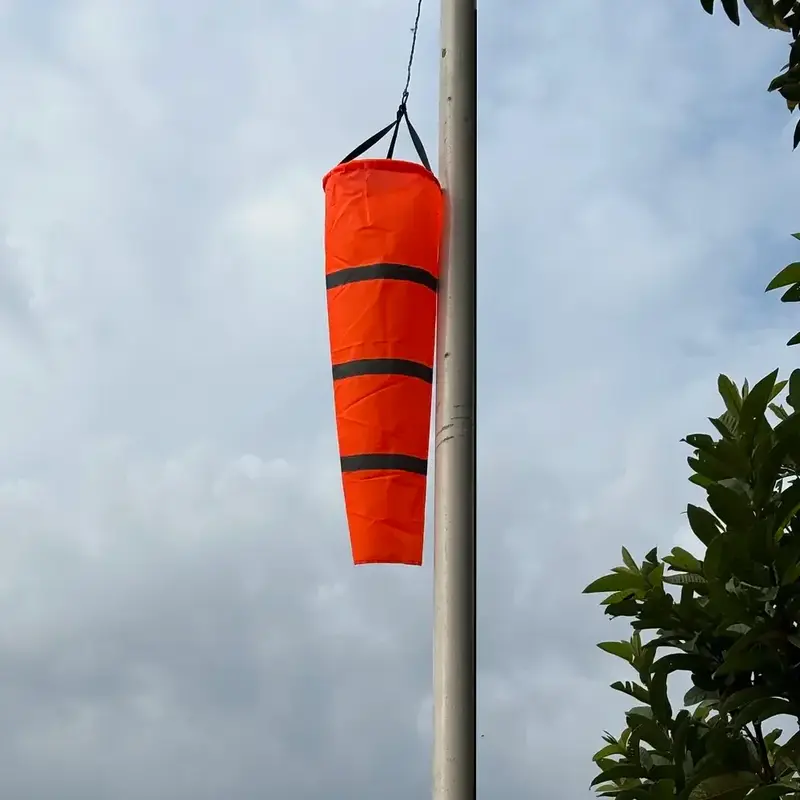
The Wind Sock
A windsock shows both wind direction and a rough idea of wind speed.
The open end faces into the wind, while the narrow end points downwind. As the wind gets stronger, the windsock lifts and stretches out more horizontally.
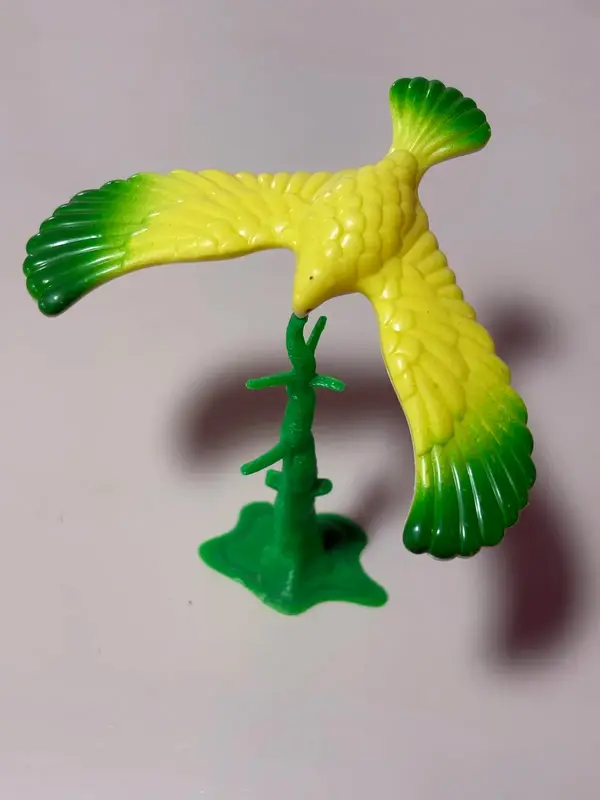
The Balancing Bird
How can this bird balance on just its beak?
Its wings are weighted so that the bird’s centre of mass lies below the point of support. If the bird tilts, gravity pulls its centre of mass back underneath the support point, making the balance stable.
That is why the bird can perch on a fingertip or tiny stand without falling.
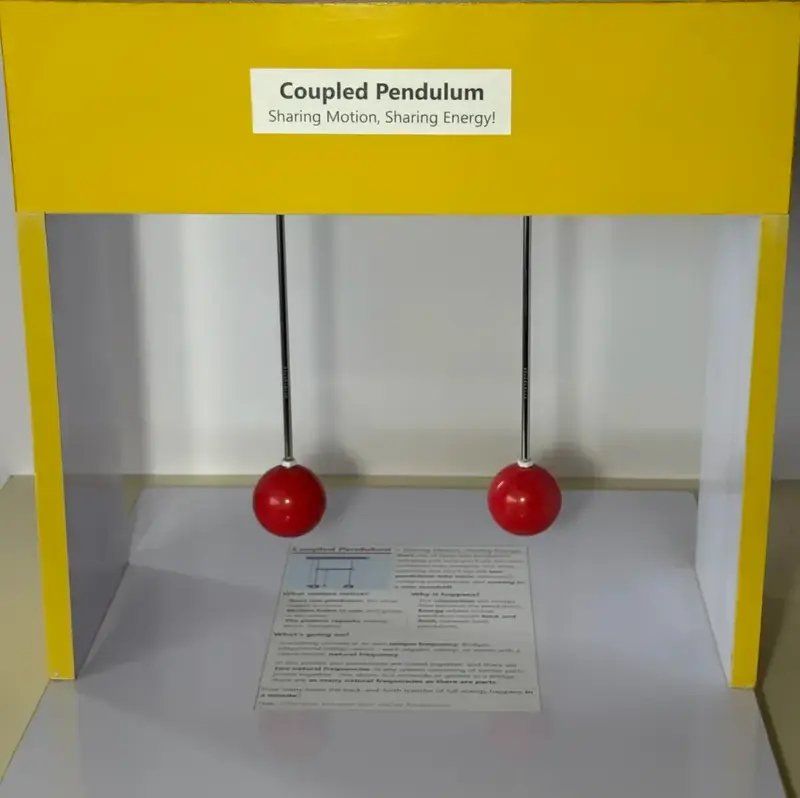
Coupled Pendulums
These two pendulums are connected through a common support, so the motion of one can influence the other.
Start one pendulum swinging while the other is still. Gradually, the first swing becomes smaller while the second grows larger. The energy is being transferred back and forth between them through the coupling.
After a while, the motion can return to the first pendulum and the cycle repeats.
You’ll find a small pair indoors and a big pair on a steel frame in the garden. Try both and compare how fast the swing passes between them.
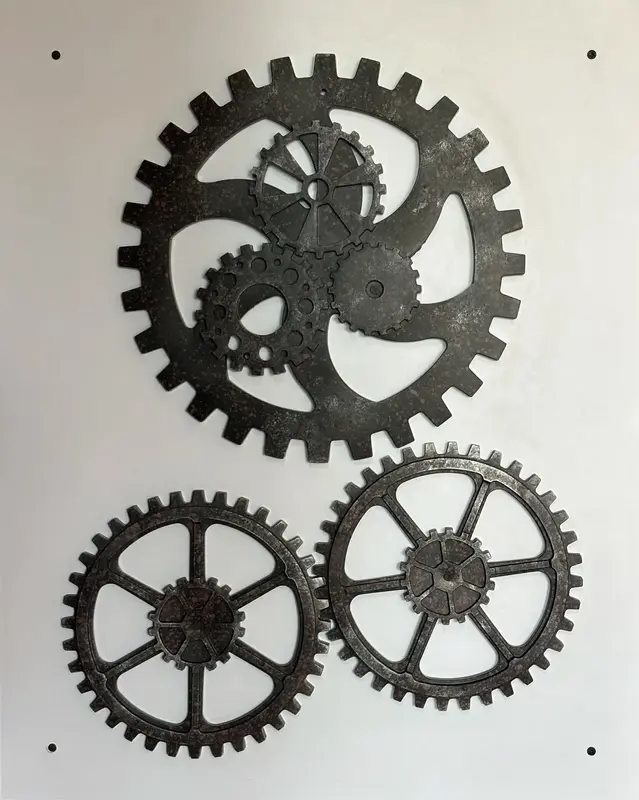
Gears - Motion Passed Along
When two gears mesh, turning one makes the other turn in the opposite direction.
A small gear driving a larger gear makes the larger one turn more slowly but with greater torque. A large gear driving a smaller one makes the smaller gear turn faster.
The speed ratio depends on the number of teeth on the gears.
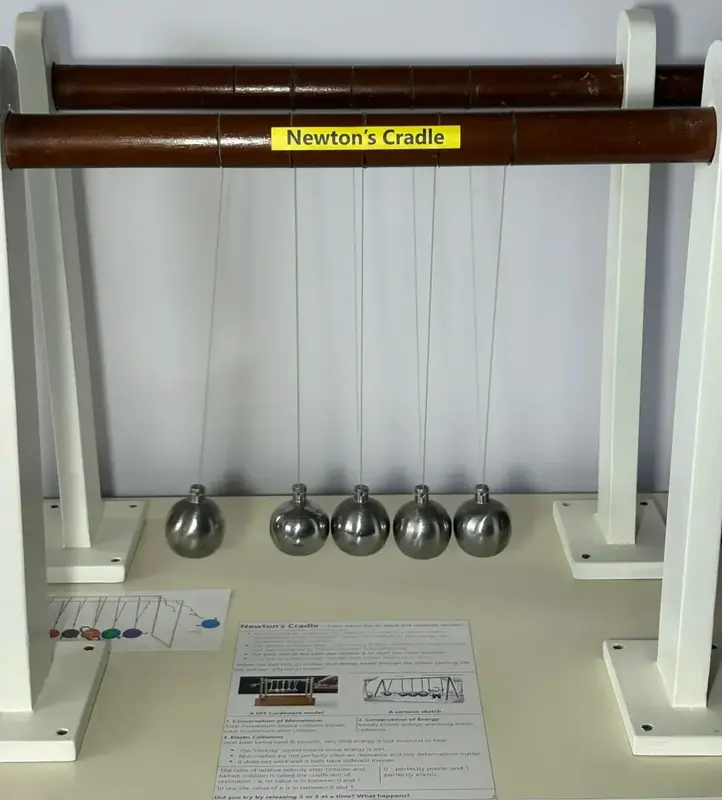
Newton’s Cradle
Lift one ball and release it. When it strikes the others, a ball at the opposite end swings out.
During the collision, momentum is transferred through the row of balls. The total momentum of the system is conserved. Because the collisions are also nearly elastic, most of the kinetic energy is transferred as well.
Energy is lost gradually to air resistance and sound each swing, which is why the balls eventually settle down instead of swinging forever.
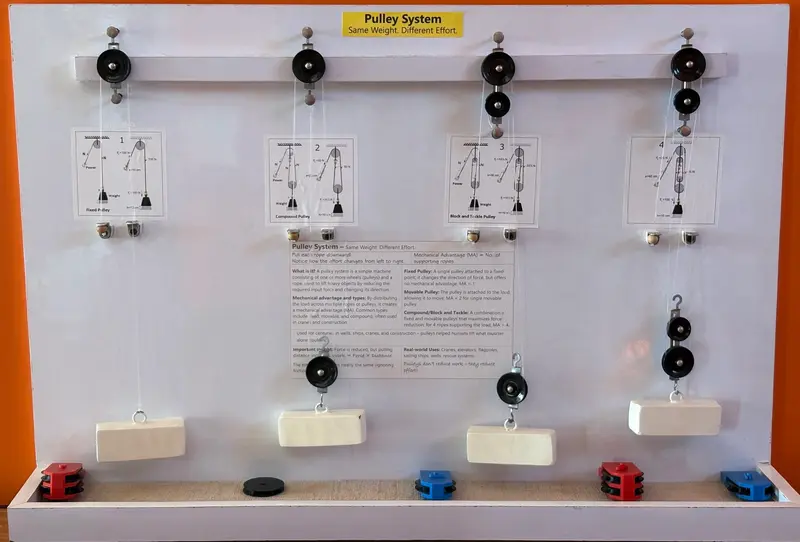
Pulley Systems
Pulleys can make a load easier to lift by changing the direction of the force or by sharing the load between several sections of rope.
A fixed pulley mainly changes the direction of your pull. A movable pulley reduces the force needed, and a block-and-tackle with several supporting rope sections reduces it even further.
The trade-off is distance: the less force you use, the farther you must pull the rope. In real pulleys, friction means the advantage is slightly less than the ideal value.
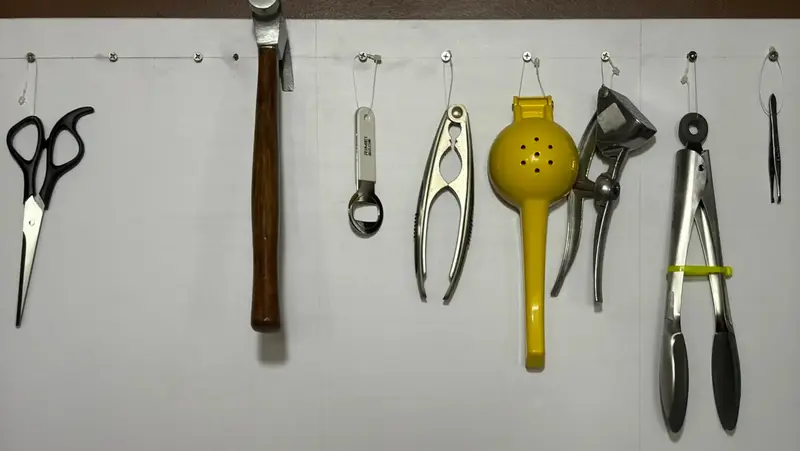
Simple Machines Around Us
Many everyday tools work because they use one or more simple machines.
A lever helps us multiply force or change the direction of a force. A wedge concentrates force along a sharp edge to cut or split.
Scissors combine levers and wedges. A claw hammer can act as a lever when pulling out a nail. Bottle openers, nutcrackers and squeezers also use leverage to make a task easier.
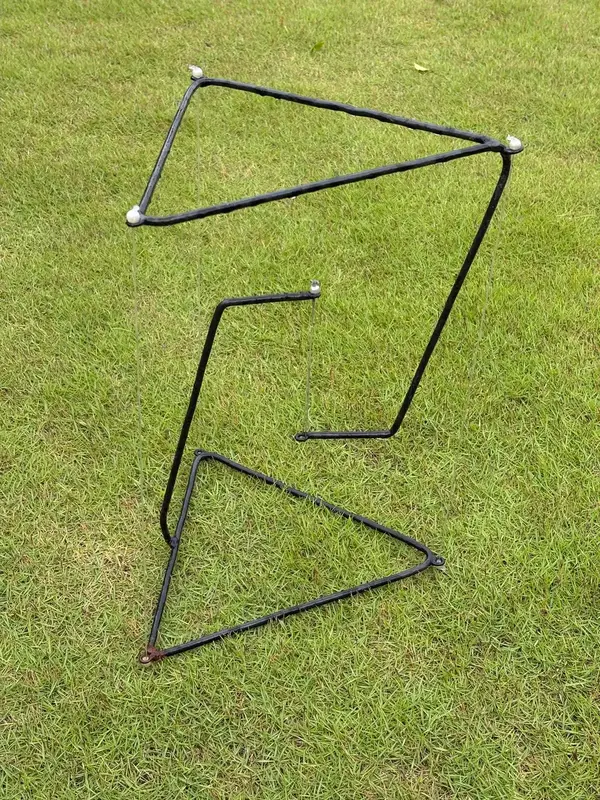
Tensegrity — Floating in Balance
This structure seems to defy gravity, but it is held up by a balance of tension and compression.
The rigid bars are in compression, while the thin strings are in tension. Together they distribute the forces so that the upper part remains suspended and stable.
The name tensegrity comes from tensional integrity — a structure held together by a network of tensioned elements.
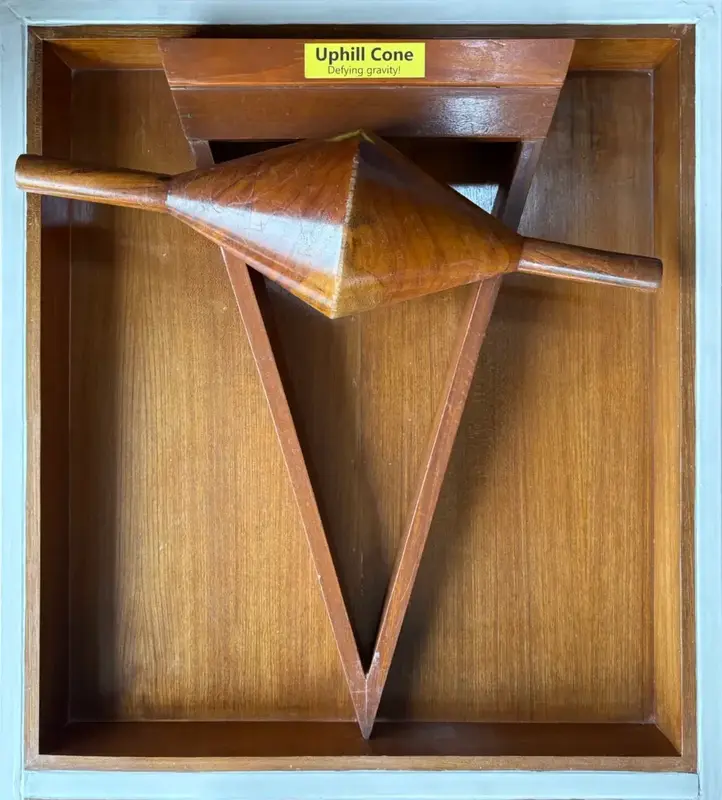
Uphill Cone - Defying Gravity?
This double cone appears to do the impossible: it rolls uphill by itself.
Is gravity being defeated, or is something else happening?
Look carefully at the shape of the cone and the way the rails change as they spread apart.
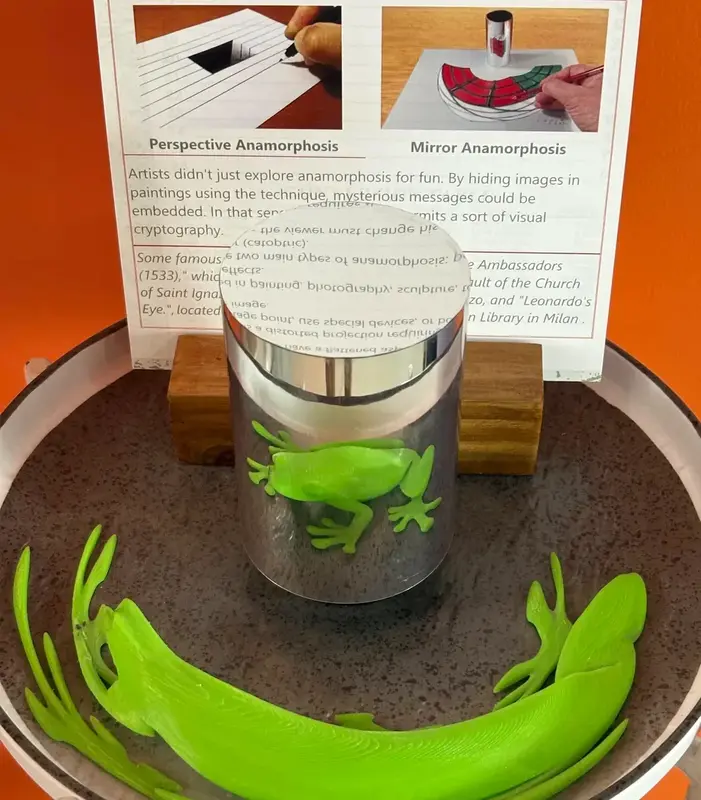
Anamorphic Illusion — A Hidden Image Revealed
The stretched green shape looks distorted, but in the cylindrical mirror it becomes a recognizable image.
This effect is called anamorphosis — a picture that appears correct only when viewed from a special angle or in a specially shaped mirror.
Artists and puzzle-makers have used anamorphosis for centuries to create secret images, visual surprises and optical illusions.
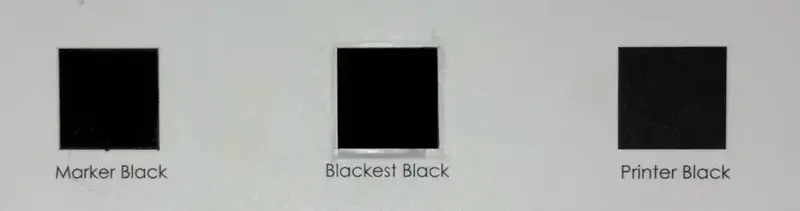
The Blackest Black
The center square appears much blacker than the other squares. Why?
It is an opening that leads into a black box designed to trap light. Light that goes in bounces again and again off the dark walls inside, and some of it is absorbed at every bounce. Almost none finds its way back out to your eyes, so the opening looks much blacker than ordinary black ink or paint.
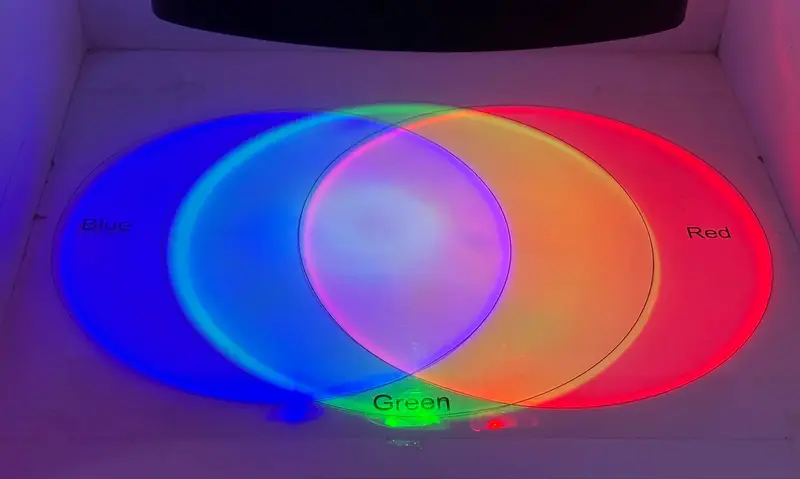
Color Mixing with Light
Red, green and blue are the primary colors of light. When beams of colored light overlap, they mix additively:
- Red + Green = Yellow
- Green + Blue = Cyan
- Blue + Red = Magenta
- Red + Green + Blue = White
This is different from mixing paints or inks, which works by subtractive color mixing.
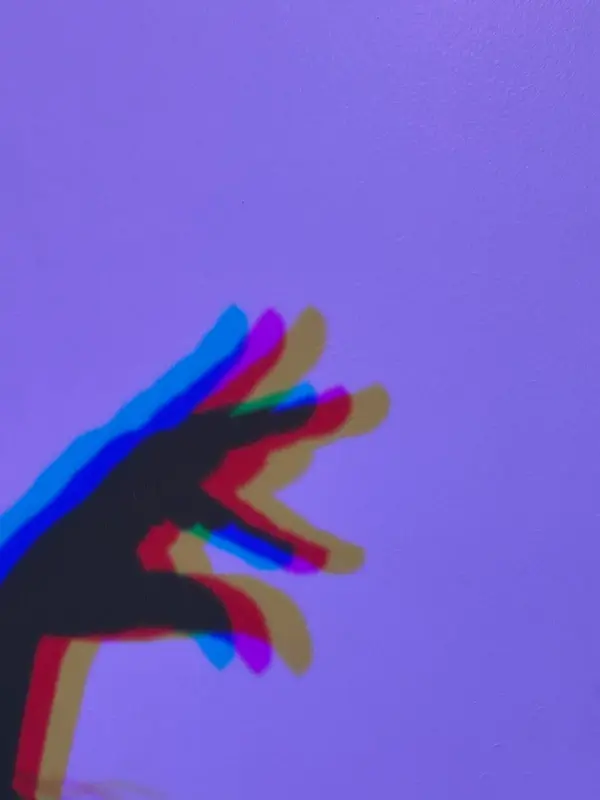
Colored Shadows
Shadows need not always be black. When red, green and blue lights shine from different directions, an object can block one light while the others still reach the screen. The remaining lights mix to make colored shadows.
These shadow colors are the complementary colors of the blocked light:
- block red → you see cyan
- block green → you see magenta
- block blue → you see yellow
Where all three lights are blocked, the shadow is dark. Where all three lights overlap, they make nearly white light.
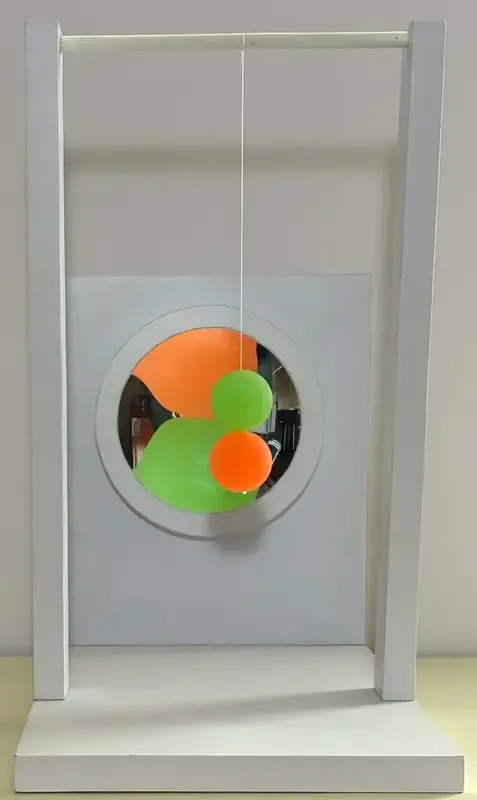
The Concave Mirror — A Swinging Reflection
A concave mirror curves inward, causing reflected light rays to come together. Depending on how far an object is from the mirror, its image can appear larger, smaller, upright or upside down.
Watch the swinging pendulum and its reflection. As the pendulum moves, the curved mirror changes where its image appears, creating a surprising sense of motion and depth.
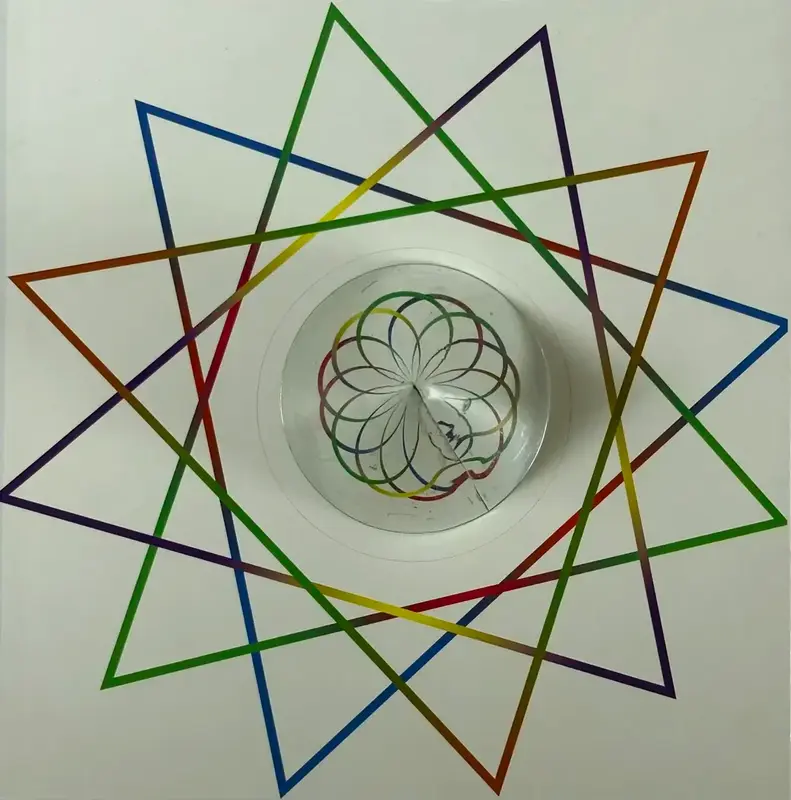
The Conic Mirror
A star can turn into a rose when seen in a conical mirror — and a rose can turn back into a star.
The mirror reshapes the reflected image, revealing a hidden pattern that looks different in direct view.
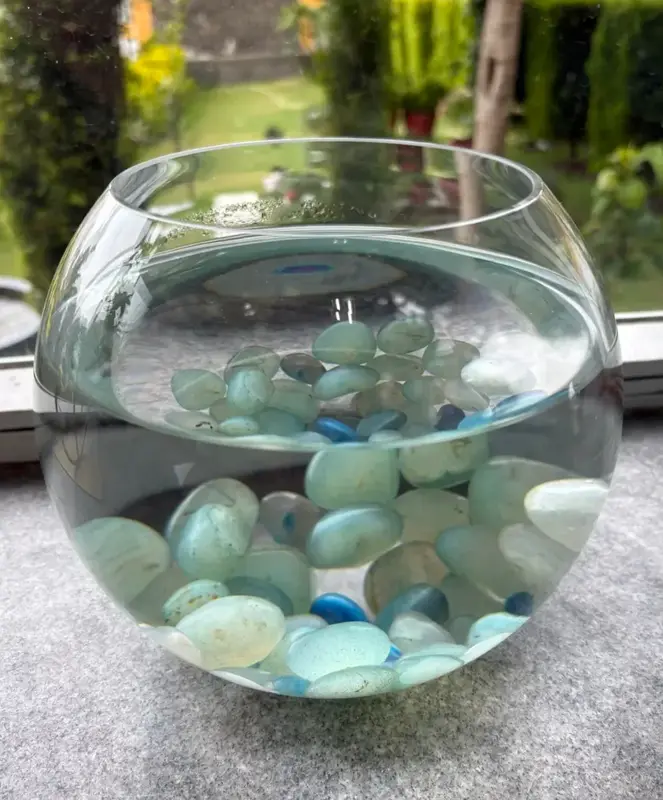
The Water Bowl Magnifier
A bowl filled with water can act like a lens. Light bends as it passes between air, glass and water — a process called refraction.
Because the bowl is curved, it can make objects seen through it appear larger, smaller or distorted, depending on where you look from.
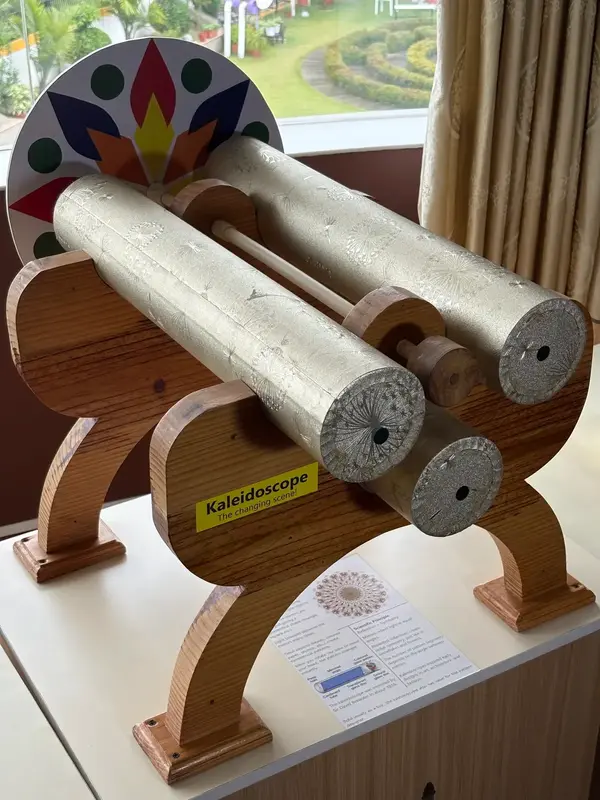
The Kaleidoscope
A kaleidoscope creates beautiful repeating patterns using multiple reflections. Small colored shapes are reflected again and again between mirrors, turning simple pieces into intricate designs.
These three kaleidoscopes use different mirror arrangements. Changing the angle by rotating the knob changes the patterns you see.
The word “kaleidoscope” comes from Greek for “observer of beautiful forms.”
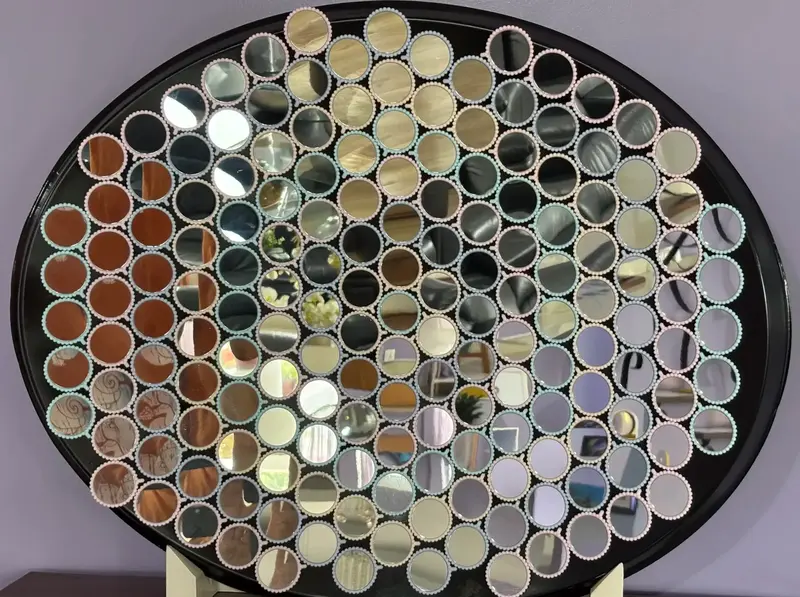
All Eyes on Me
These are plane mirrors, but they are mounted on a curved surface. When you stand at the marked viewing point, each mirror is tilted just right to reflect your eye back to you.
That is why you see many little images of yourself at once.
The effect works because of the law of reflection: the angle at which light arrives at a mirror equals the angle at which it leaves.
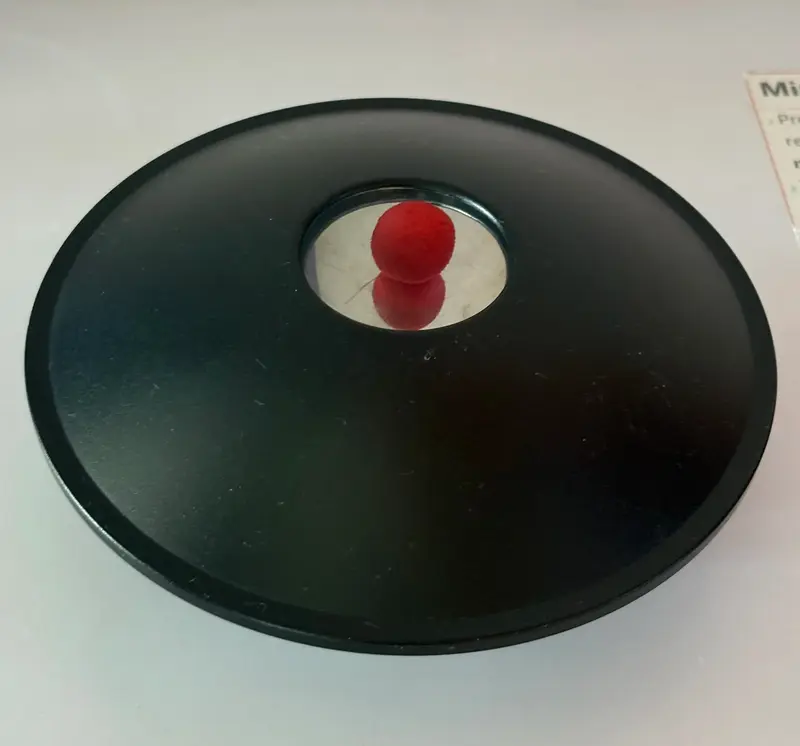
The Mirascope — A Real Image in Mid-Air
Yes — the ball you see hovering above the opening is a real image.
Inside are two facing concave mirrors. Light from the object reflects between them and is brought together above the opening, forming an image that appears to float in space.
Unlike an ordinary mirror image, the light rays actually converge at the location of the image. That is what makes it a real image.
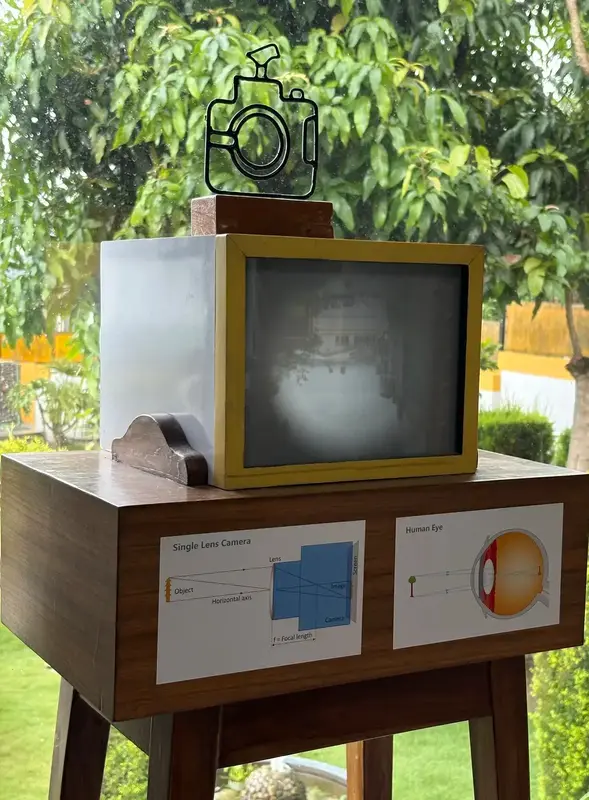
The Single Lens Camera
A single small lens or pinhole projects the outside world, upside down, onto a screen inside a darkened box — the same basic idea every camera, including your eye, is built on. This is a real image — light actually converges on the screen.
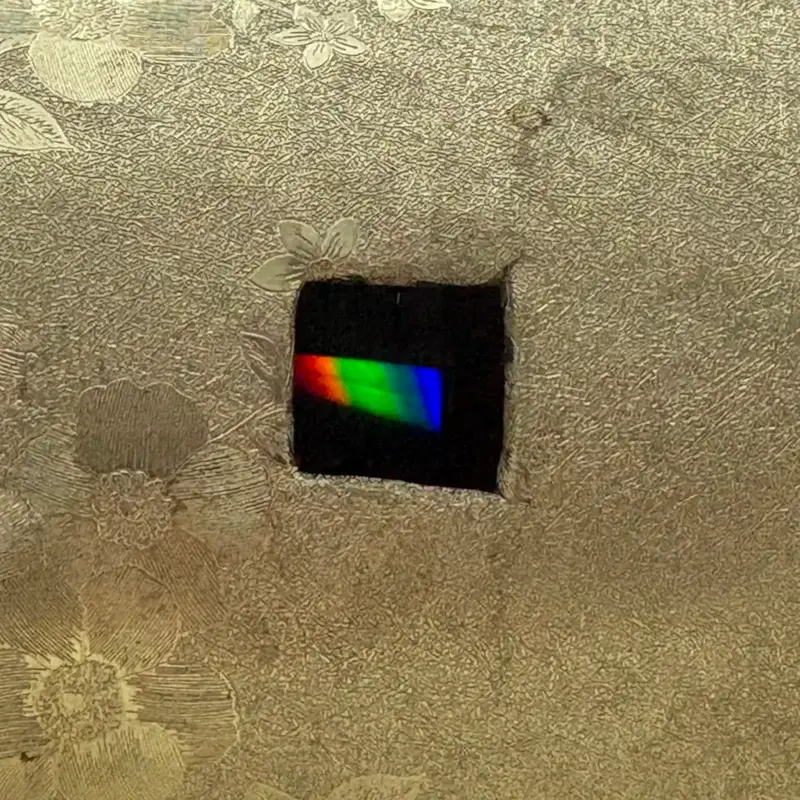
The Spectroscope
Looking through this handheld tube splits ordinary light into a full spread of rainbow colors, revealing that “white” light is actually a mix of every color at once.
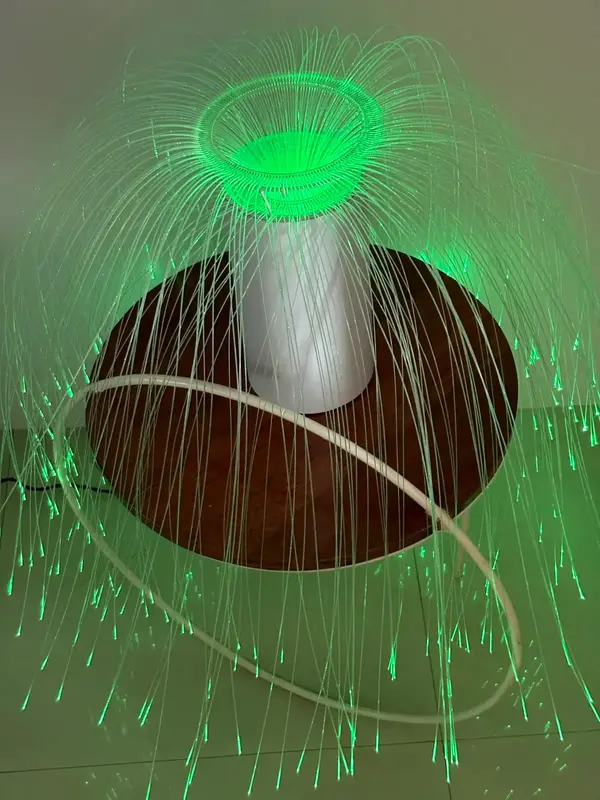
Total Internal Reflection
Hundreds of thin plastic optical fibers fan out from a lamp, and each one glows only at its tip. The light goes in at one end and comes out at the other, even though the fibers bend and droop on the way. Inside each fiber the light hits the wall at a slant and reflects completely, as if from a perfect mirror, again and again, so none escapes from the sides.
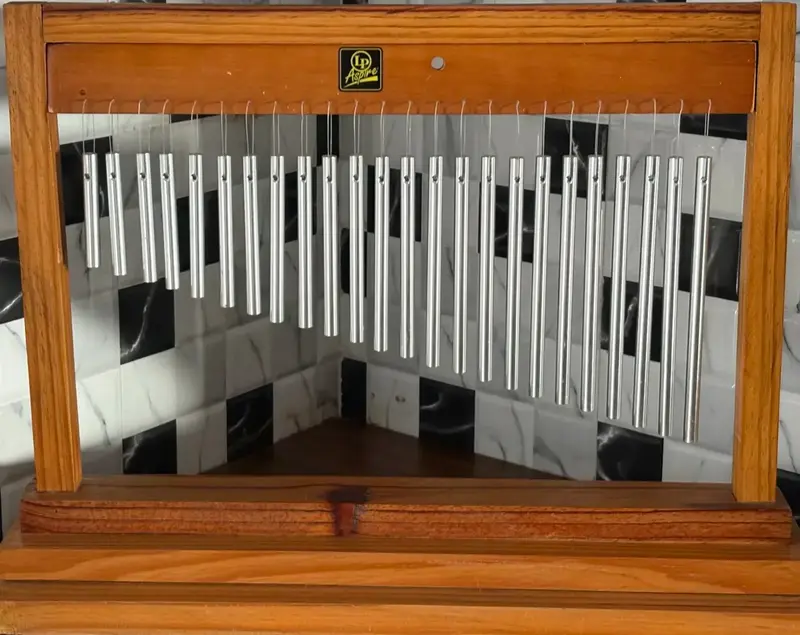
The Chime Instrument
A set of metal bars, each cut to a different length, rings out a different musical pitch when struck — shorter bars ring higher, longer bars ring lower.
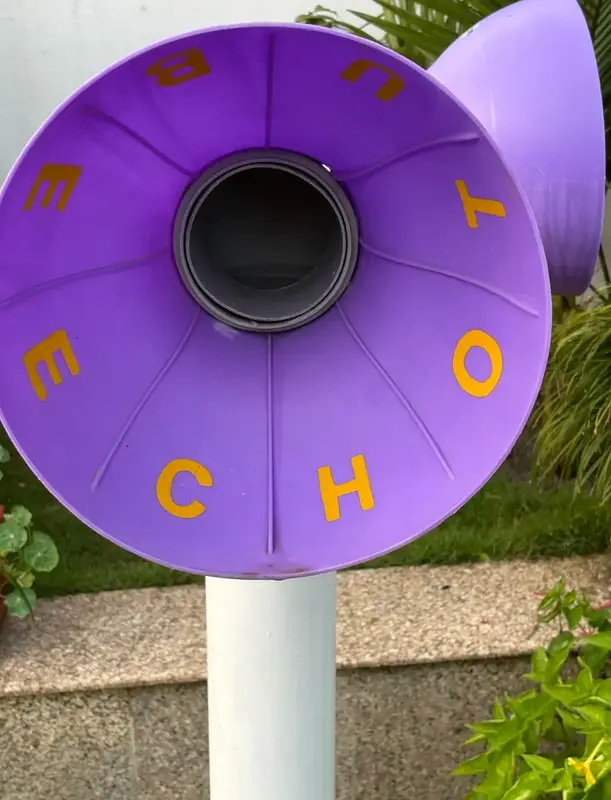
The Echo Tube
Speak or clap into the tube. A moment later, you hear your sound return as an echo.
The tube is about 38 metres long, so the sound travels roughly 76 metres to the far end and back. At about 343 m/s, that takes around 0.22 seconds.
The delay changes slightly with air temperature, because the speed of sound changes.
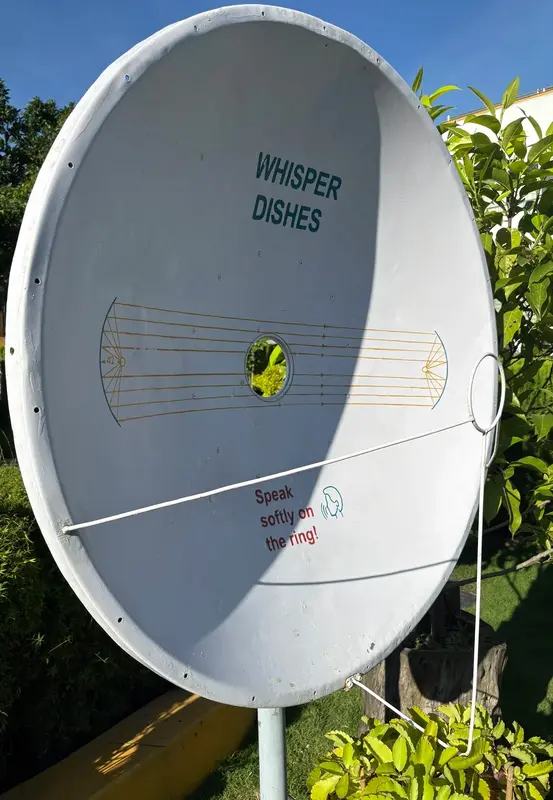
Whisper Dishes — Send a Whisper Across the Garden
Speak softly at the ring of one dish, and someone listening at the ring of the dish across the garden hears you clearly, even though people standing in between may hear almost nothing.
These large dishes are shaped like parabolic reflectors. Sound waves at the focus of one dish spread out, reflect from the curved surface, and travel toward the other dish.
The second dish gathers those waves and reflects them toward its own focus, making the whisper much easier to hear.
The same geometric idea is used in satellite dishes, radio telescopes and directional microphones.
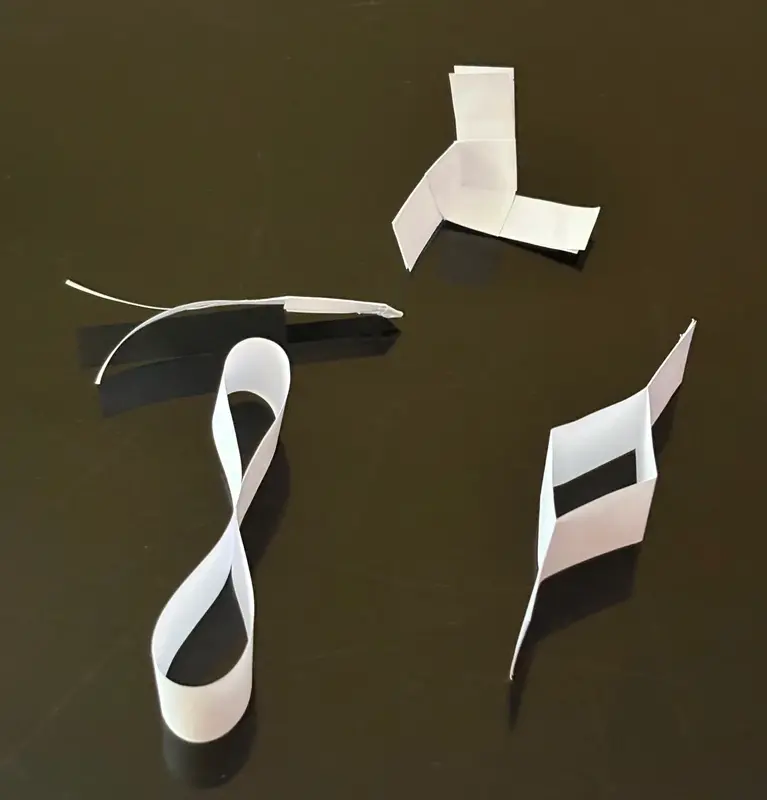
Flying Paper Shapes
Strips of paper folded in different ways fall in very different ways: some spin like helicopter blades, some tumble, and some glide.
As a shape falls, air pushes up on its surfaces. The shape decides whether that push makes it turn, flip, or slide sideways. Maple and many other tree seeds use the same trick to fall slowly and drift farther from their parent tree.
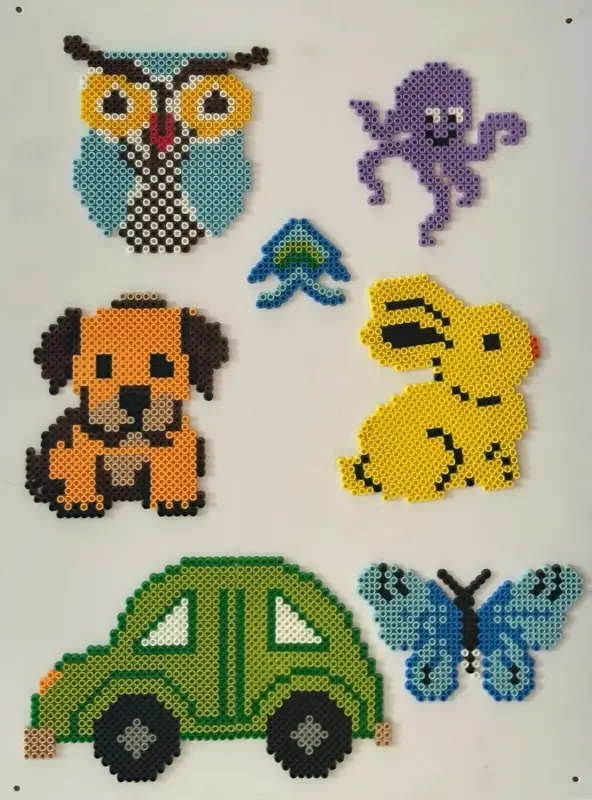
Bead Art
Each picture is made from hundreds of tiny colored beads set on a grid, then ironed so they fuse together.
Every bead is like a pixel on a screen: a single dot of one color. Up close you see separate dots; from farther away, your eyes blend them into smooth shapes.
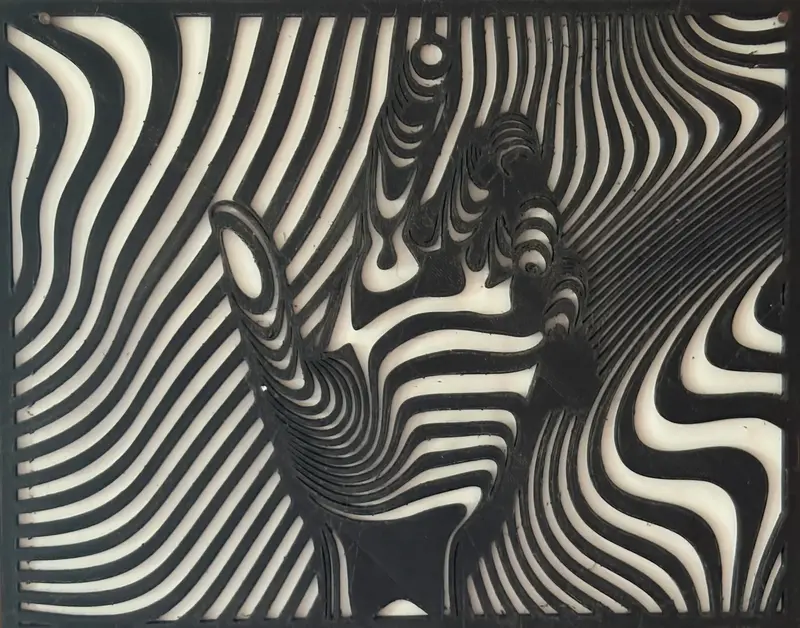
A Hand in the Waves
This picture is only black and white wavy lines, yet a hand seems to rise out of it.
Where the lines bend, your brain reads them as the surface of a curved object, the same way contour lines on a map show hills. No shading is needed: the direction of the lines alone creates the 3D shape.
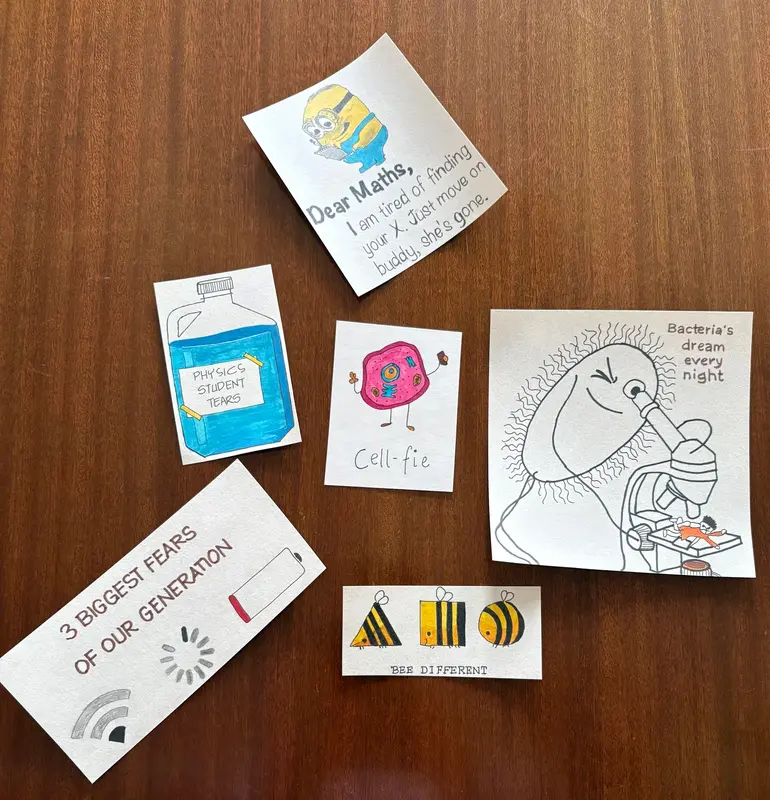
Science Comics Hunt
Funny science comics are hidden all around Science Playground: on walls, beside exhibits, and in corners you might walk right past. They turn ideas from math, biology, and physics into jokes.
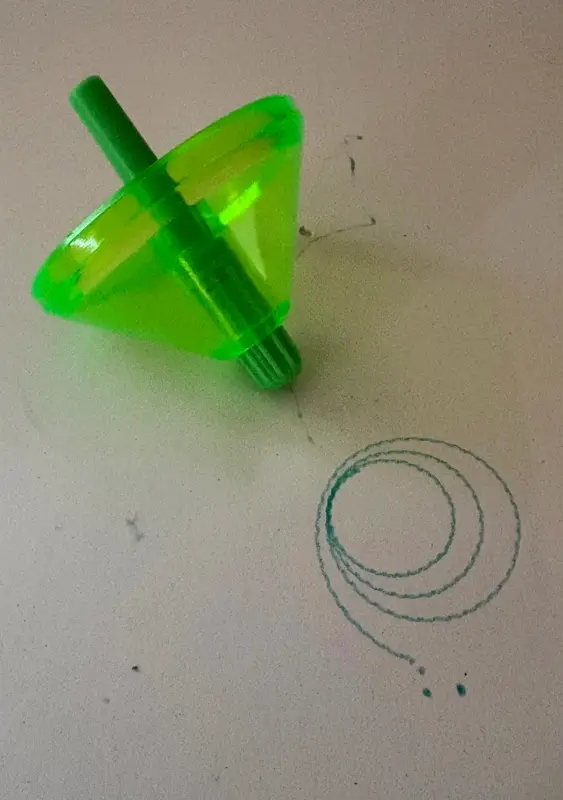
Spin Art Top
This spinning top has a marker for a tip, so it draws its own path as it spins.
A fast top stays nearly still. As it slows, it starts to wobble and wander, and its circle becomes loops and spirals. The drawing is a record of how the top’s motion changed as it lost energy.
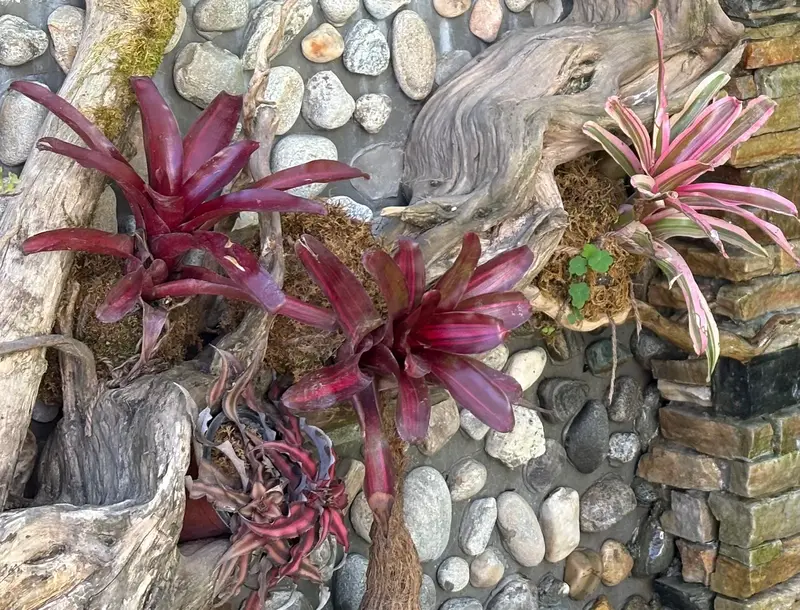
Bromeliads and Air Plants
These plants grow on driftwood and stones, not in soil. In the wild they perch on trees and rocks as epiphytes.
Many bromeliads catch rainwater in a cup at the center of their leaves, and tiny animals can live in these little pools. Air plants take in water and nutrients through tiny scales on their leaves; their roots only hold on.
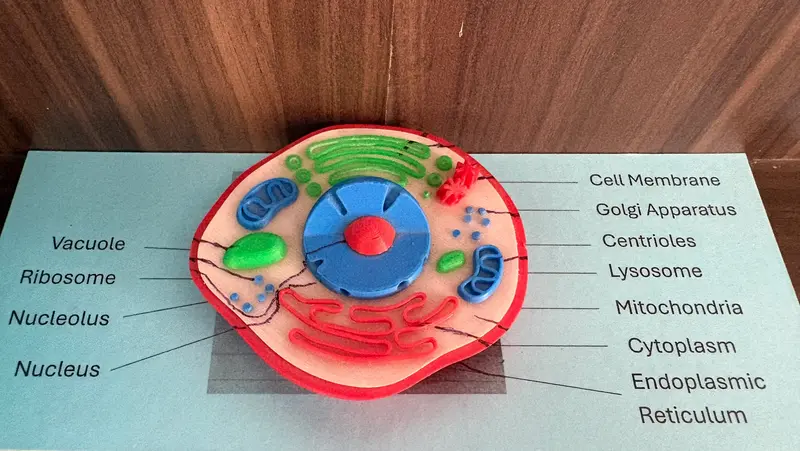
Animal Cell Model
Every animal, including you, is built from cells far too small to see. This model makes one big enough to study, with its main parts labeled.
The nucleus holds the cell’s instructions (DNA), the mitochondria release energy from food, and ribosomes build proteins. Animal cells have no cell wall and no chloroplasts: compare it with the plant cell model.
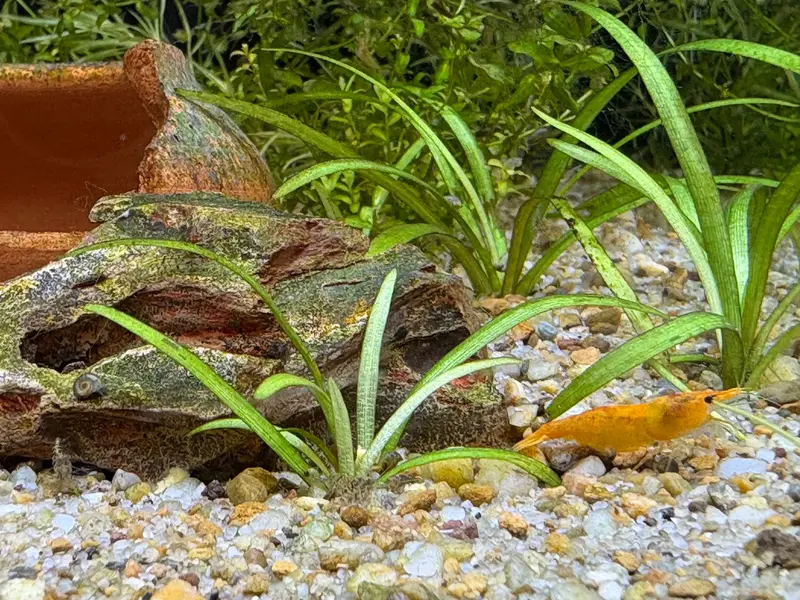
Shrimp Tank with a Sandfall
The small shrimp in this tank are crustaceans, relatives of crabs and lobsters. They wear their skeleton on the outside and must shed it (molt) to grow.
The “sandfall” is sand lifted by rising air bubbles and poured down the rocks like a waterfall. The same kind of air-lift pump moves water through many aquariums.

Inside the Body
This soft model shows the organs inside your chest and belly: lungs, heart, liver, stomach, and intestines.
Food travels from the mouth down the esophagus to the stomach, then through about 6 meters of small intestine, where most of it is absorbed, and on to the large intestine.
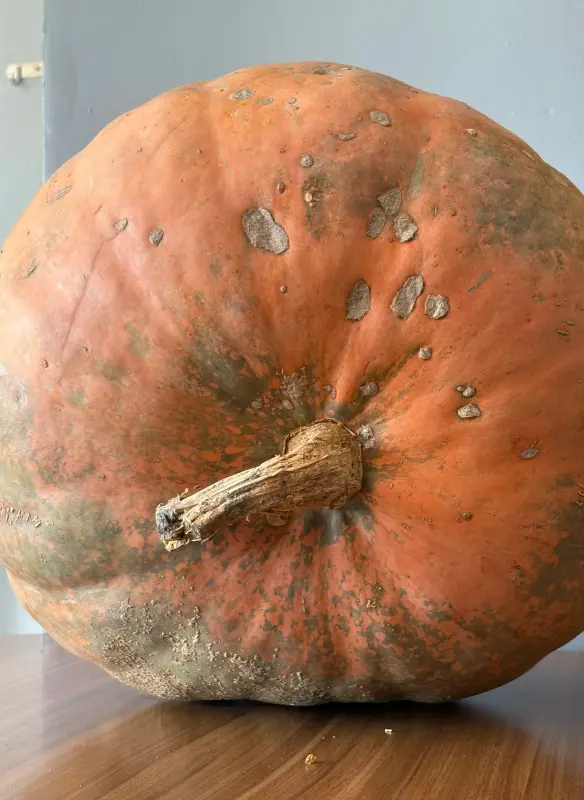
A Giant Pumpkin
A pumpkin is a fruit, and botanically a kind of berry, grown from a single flower.
Pumpkin vines have separate male and female flowers. Bees carry pollen between them; only then can the female flower swell into a pumpkin like this one, packed with seeds.
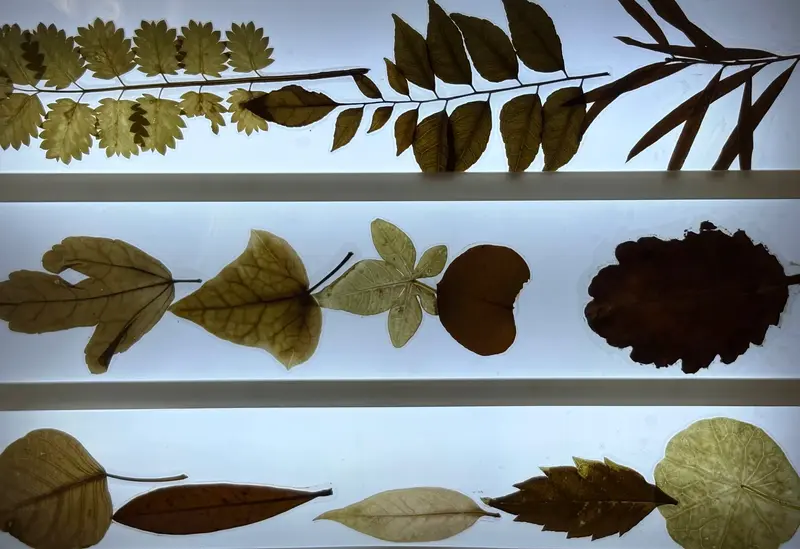
Leaf Shapes and Veins
Pressed leaves, lit from behind so their veins show clearly.
Some leaves are one simple blade; others are compound, split into many leaflets. Dicot leaves usually have a branching net of veins, while grasses and other monocots have straight, parallel ones. Botanists use these clues to identify plants.
The Paludarium
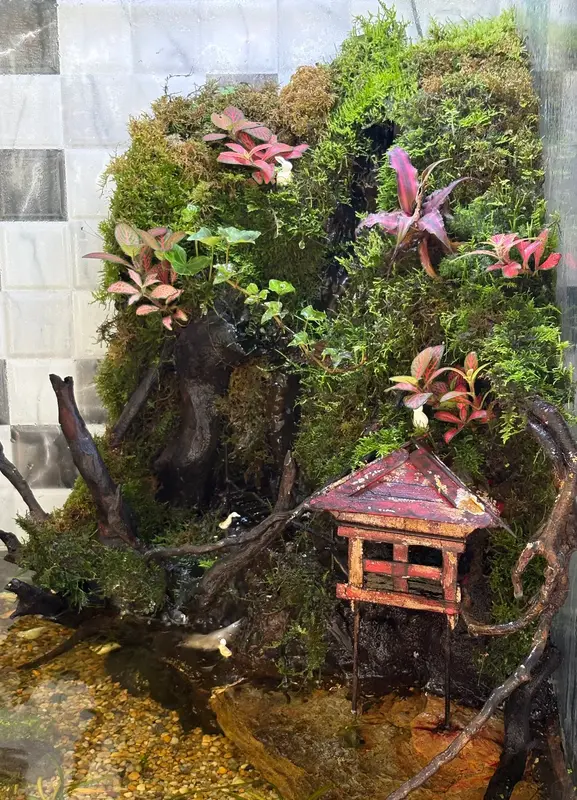
A paludarium is part aquarium, part terrarium: water below and land above, like a tiny rainforest riverbank.
Mosses, ferns, and bromeliads grow on the rocks and wood, fed by moisture rising from the water. Plants, water, and small creatures together make a little ecosystem you can watch.
Plant Cell Model
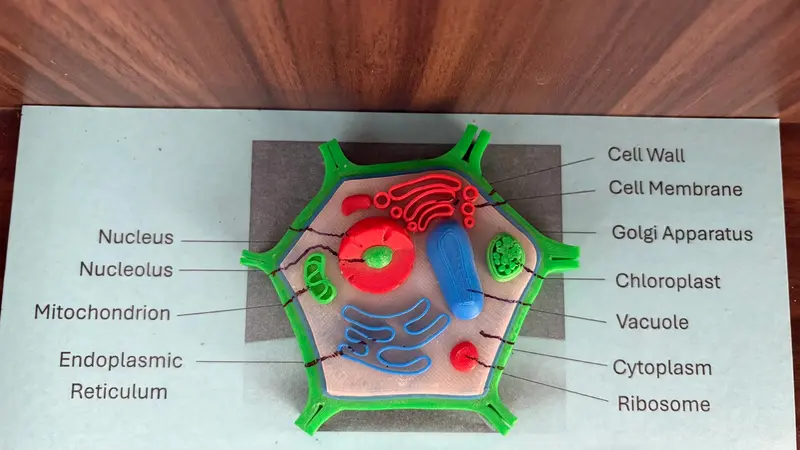
A plant cell has most of the same parts as an animal cell, plus three extras: a stiff cell wall, green chloroplasts that make food from sunlight, and a large vacuole that stores water and keeps the cell firm.
The cell wall is why plant cells tend to be boxy, and why a plant can stand up without bones.
Plant Terrarium
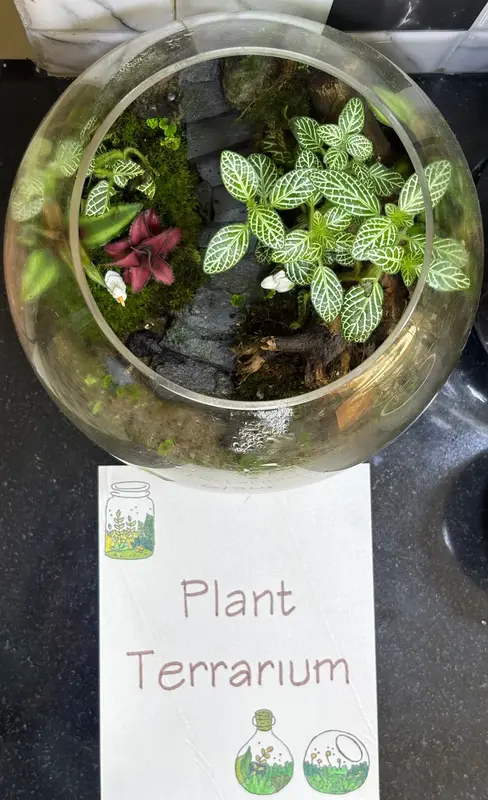
A terrarium is a small garden in a glass container. The plants give off water that collects on the glass and trickles back to the soil, the water cycle in miniature, so it needs very little care.
Low-growing plants that like damp air, such as fittonia and moss, do well inside.
The Spiral of Life on Earth
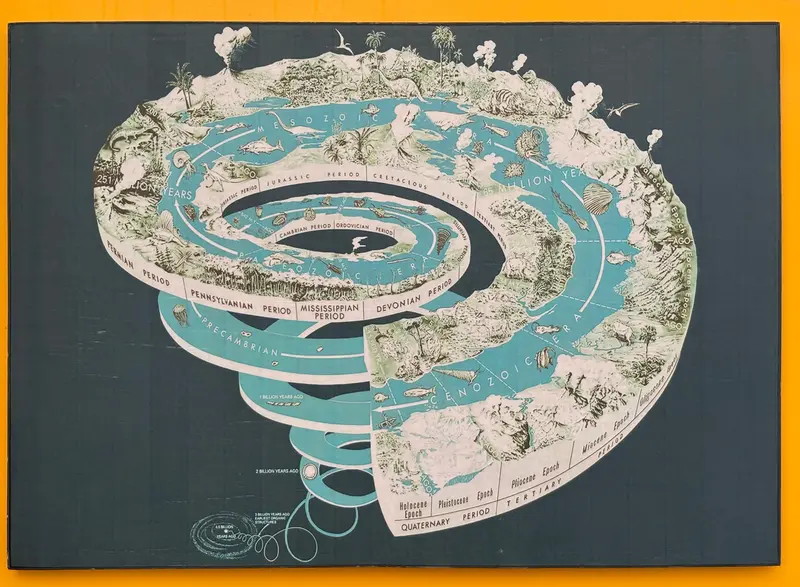
This spiral shows Earth’s 4.6-billion-year history, from its formation at the center to today at the outer tip.
For most of that time, life was only single cells. Plants and animals appear much later, dinosaurs later still, and humans only at the very end of the spiral.
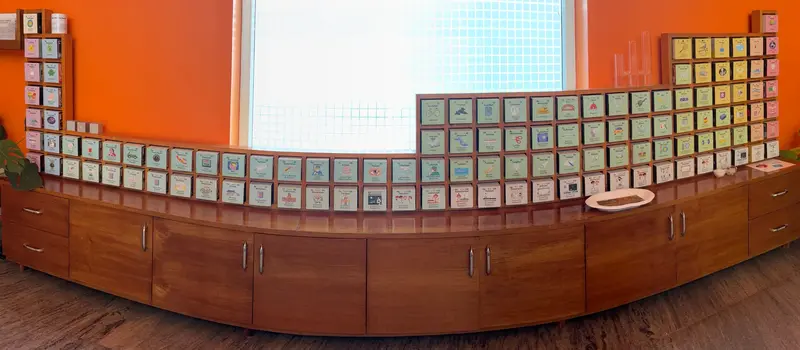
The Giant Periodic Table
Everything around you is built from about 118 elements, and this periodic table, about 13 feet (4 meters) long, arranges all of them. Each element is a cube you can turn, with information about the element on all six faces.
Elements in the same column behave in similar ways; each row adds a new shell of electrons. The table is so orderly that chemists once predicted missing elements, and their properties, before anyone had found them.
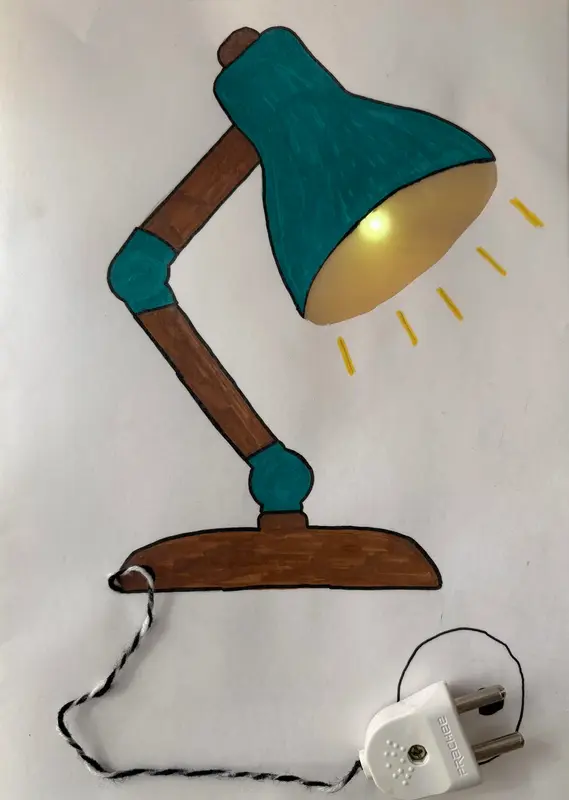
The Fun Circuit
The lamp in this drawing really lights up, because it is part of a real circuit.
Electricity flows only around a closed loop: from the power source, through the light, and back again. Break the loop anywhere and the light goes out. A switch simply opens and closes that loop.
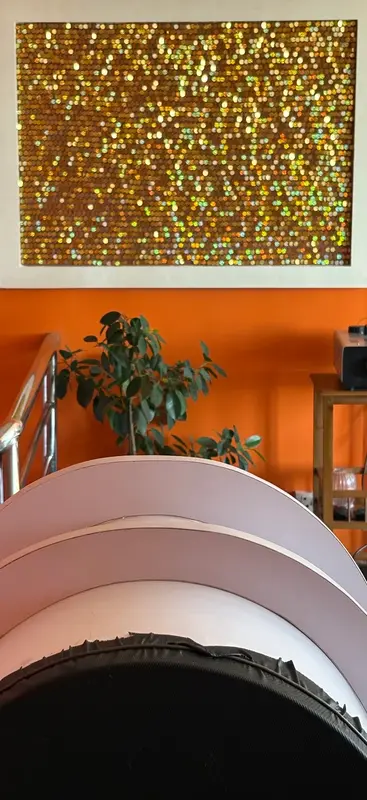
The Air Cannon
Hit the back of this drum and it fires a doughnut-shaped ring of spinning air, called a vortex ring, across the room.
The ring holds together as it travels, so it can ripple the sequin wall several meters away. You can’t see the ring, but you can see what it does when it arrives.
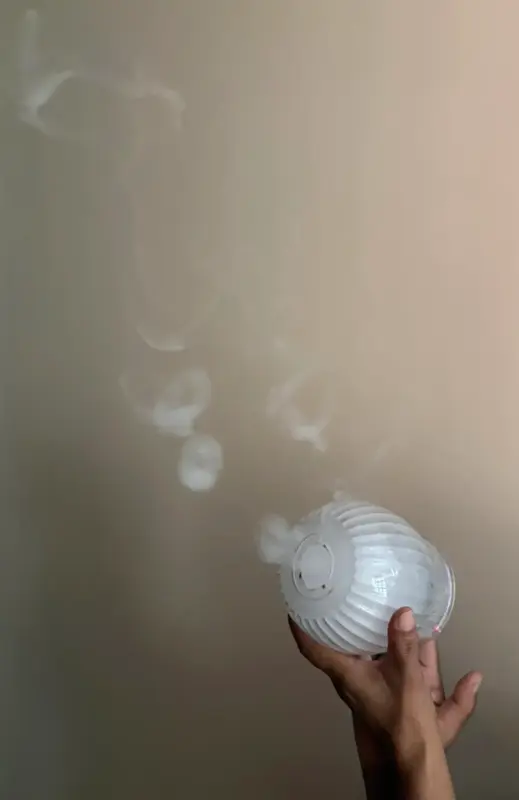
Smoke Rings
Fill the launcher with mist, give it a tap, and out comes a vortex ring you can see: a doughnut of air spinning around itself as it glides forward.
The spinning keeps the ring together. Dolphins blow bubble rings in water the same way, and volcanoes sometimes puff out giant smoke rings.
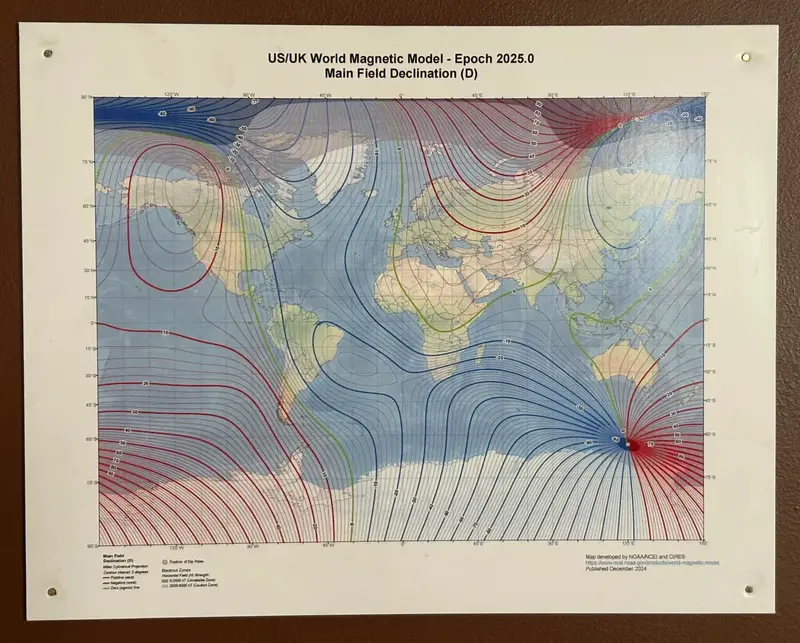
Earth’s Magnetic Field
A compass needle points to magnetic north, which is not quite the same as true north. The difference, called declination, changes from place to place, and this map shows it for the whole world.
Earth’s magnetic field slowly shifts, so scientists update this map every five years. In Nepal the difference is close to zero, so a compass points almost exactly north.
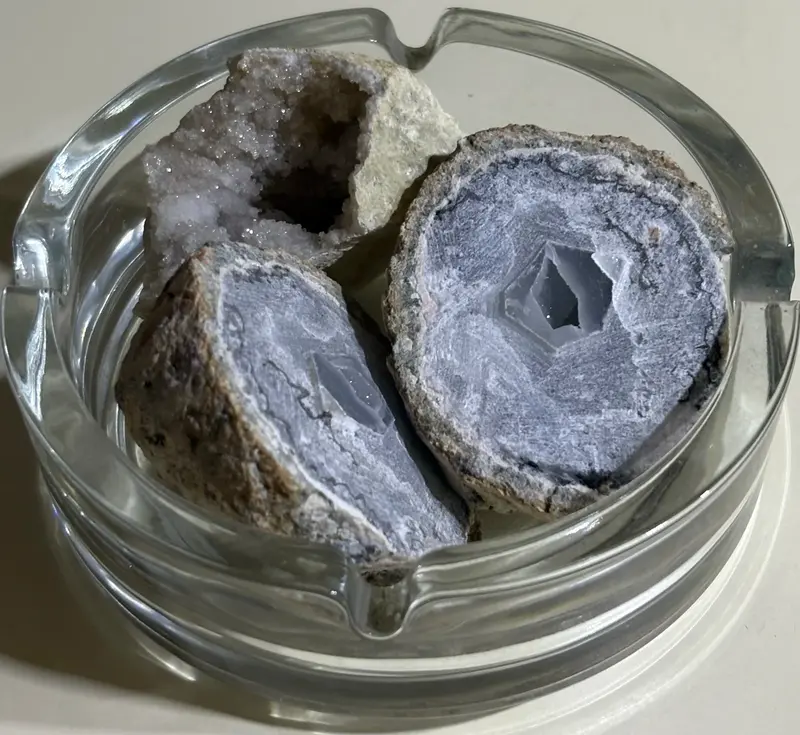
Geodes
From the outside a geode looks like a plain, round rock. Break it open and it is hollow, lined with crystals.
It began as a hollow space in rock. Over thousands of years, water carrying dissolved minerals seeped in, and the minerals slowly built up as crystals, growing inward from the walls.
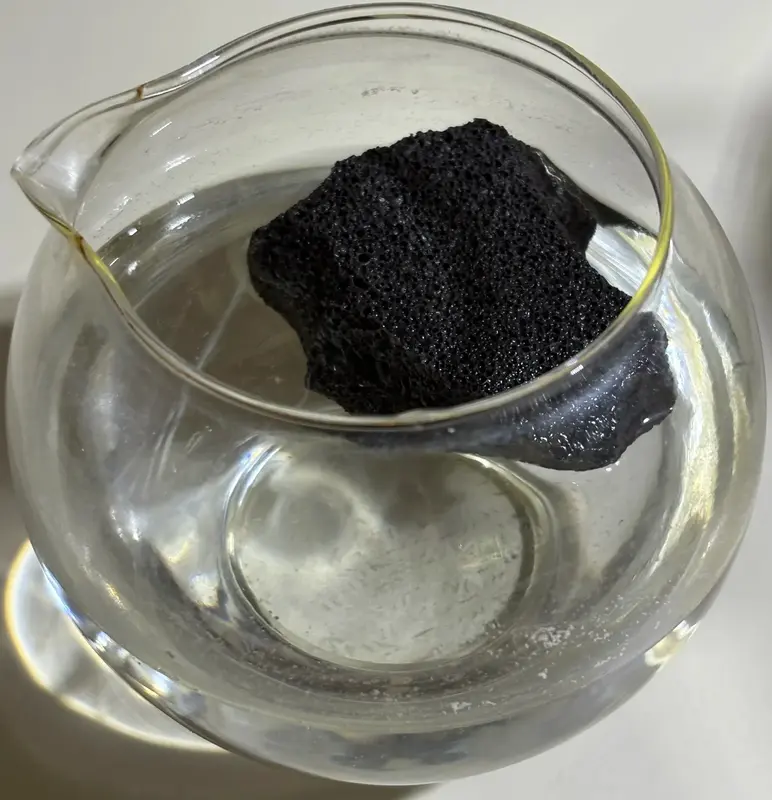
The Rock That Floats
Most rocks sink, but pumice can float.
Pumice forms when frothy lava full of gas bursts out of a volcano and cools so fast that the bubbles are trapped inside. The rock is full of tiny air pockets, which make it lighter than the same amount of water.
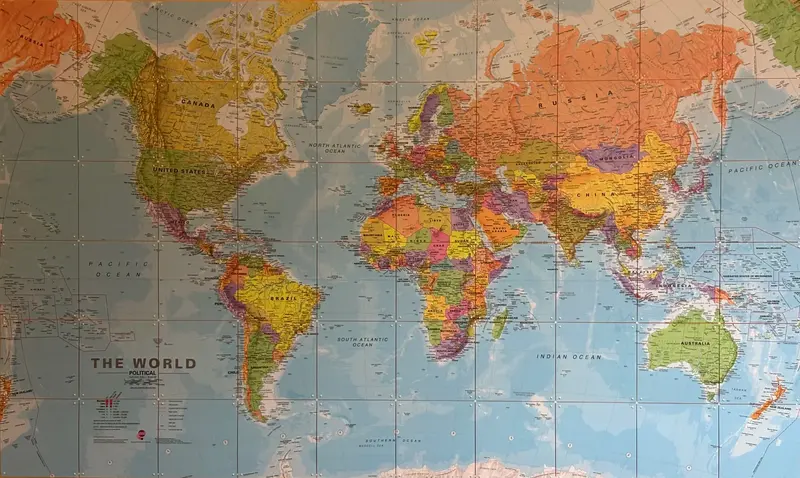
The Big World Map
Earth is round, and a flat map can’t show it without stretching something.
On many world maps, places near the poles look far bigger than they are: Greenland looks about as big as Africa, but Africa is about 14 times larger. Every flat map chooses what to get right and what to distort.
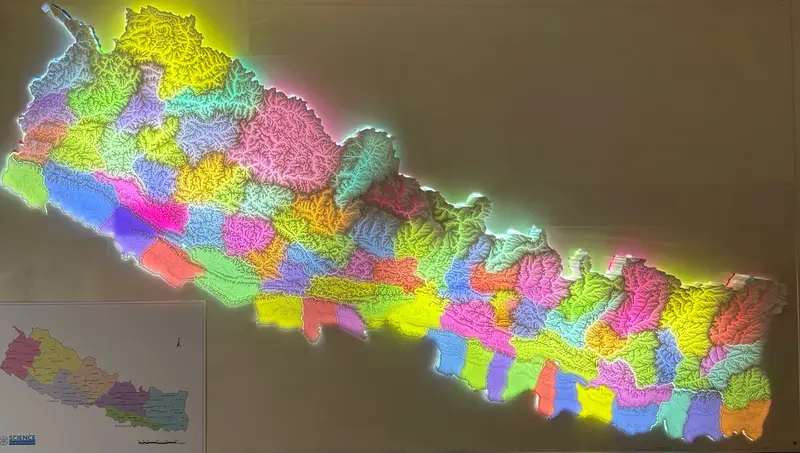
3D Map of Nepal
Nepal rises from about 60 meters above sea level in the Terai to 8,849 meters at the top of Mount Everest, all within about 200 kilometers. This raised map lets you see and feel that climb.
The heights are exaggerated so the hills and mountains stand out; at true scale, even the Himalayas would be barely a bump.
Learn all 77 districts and Nepal’s famous places in our online map game.
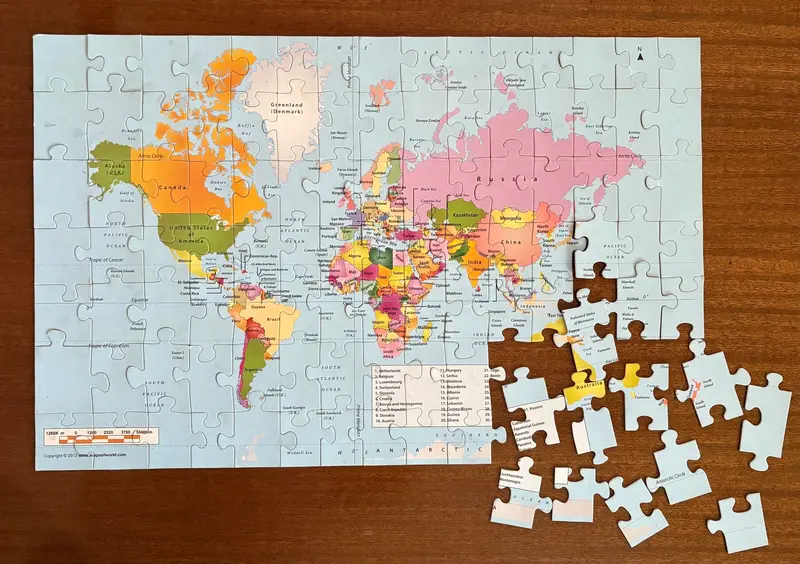
World Map Jigsaw
Put the world together, one piece at a time.
The continents fit together in more ways than one: the coast of South America and the coast of Africa match like puzzle pieces, one of the first clues that the continents were once joined and have slowly drifted apart.
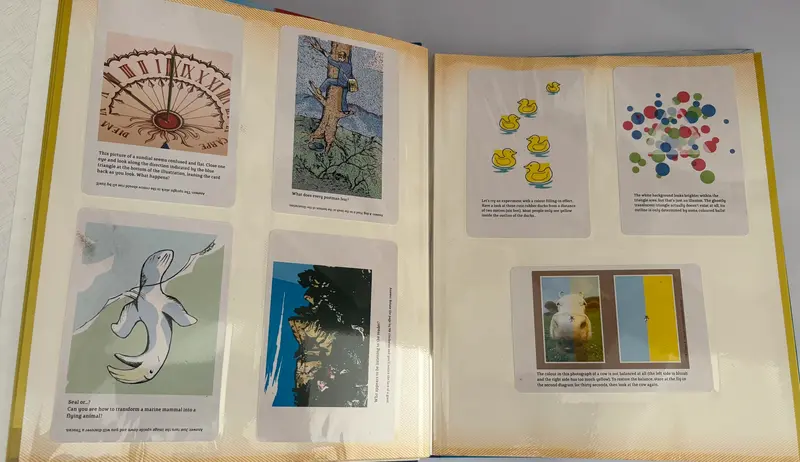
Illusion Album
A book of optical illusions, each with a short explanation.
Illusions aren’t mistakes by your eyes: they show the shortcuts your brain takes to understand what you see quickly. Most of the time those shortcuts help; here, they’re caught in the act.
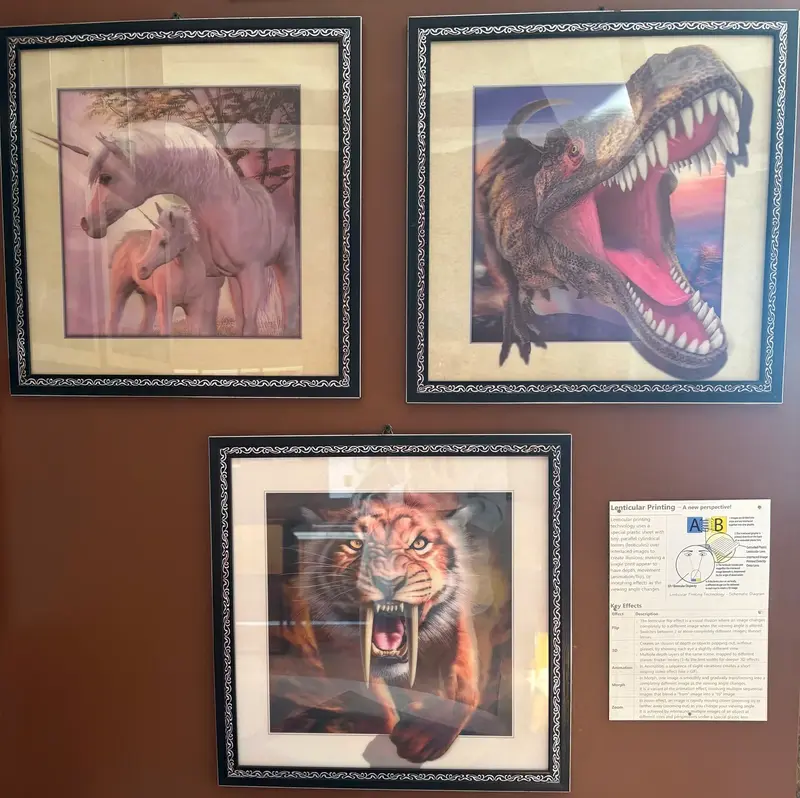
3D Pictures Without Glasses
These animals seem to leap out of their frames, with no special glasses needed.
The surface is covered in thin ridges, each a tiny lens. Each lens sends a slightly different picture to your left eye and your right eye, and your brain combines them into depth.
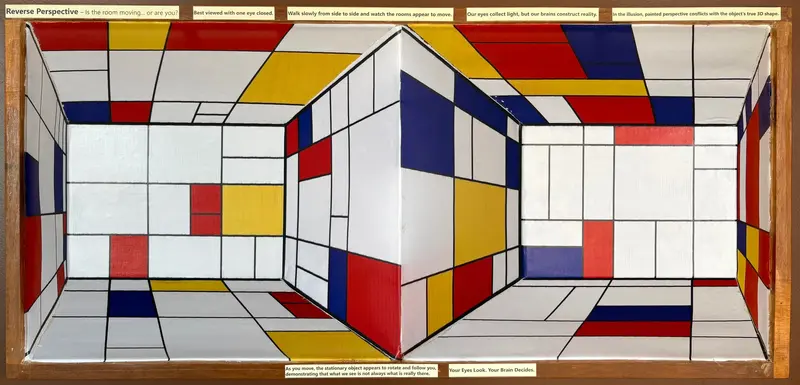
Reverse Perspective
The parts of this picture that look farthest away actually stick out toward you.
The painting is drawn as if it were a deep room, and your brain believes the drawing over the real shape. When you move, the picture seems to turn and follow you.
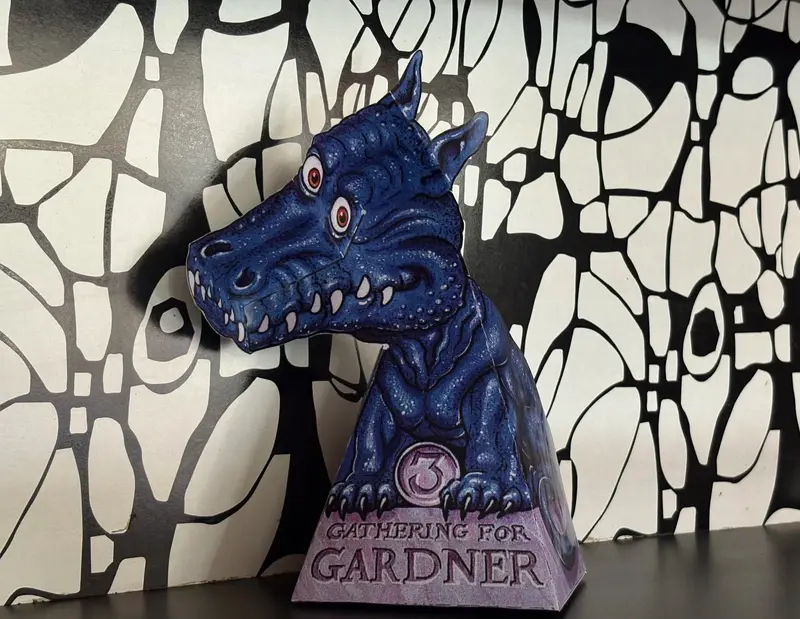
Thinky the Dragon
Move your head, and this dragon turns to watch you.
Its face is actually hollow, pushed in instead of out. Your brain is so used to faces that bulge outward that it reads the hollow face as a normal one, and then the only way to make sense of it as you move is to see it turn.
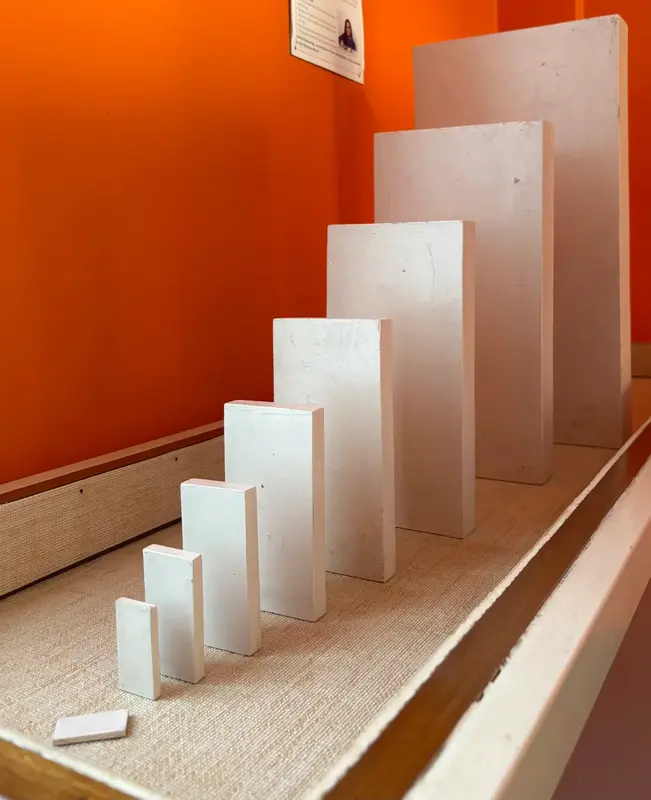
Growing Dominoes
A falling domino can knock over one about one and a half times its size, so each domino here is bigger than the last.
Growing by the same factor at every step is exponential growth. Keep going, and within a few dozen steps the dominoes would be taller than a skyscraper, all started by a push on the smallest one.
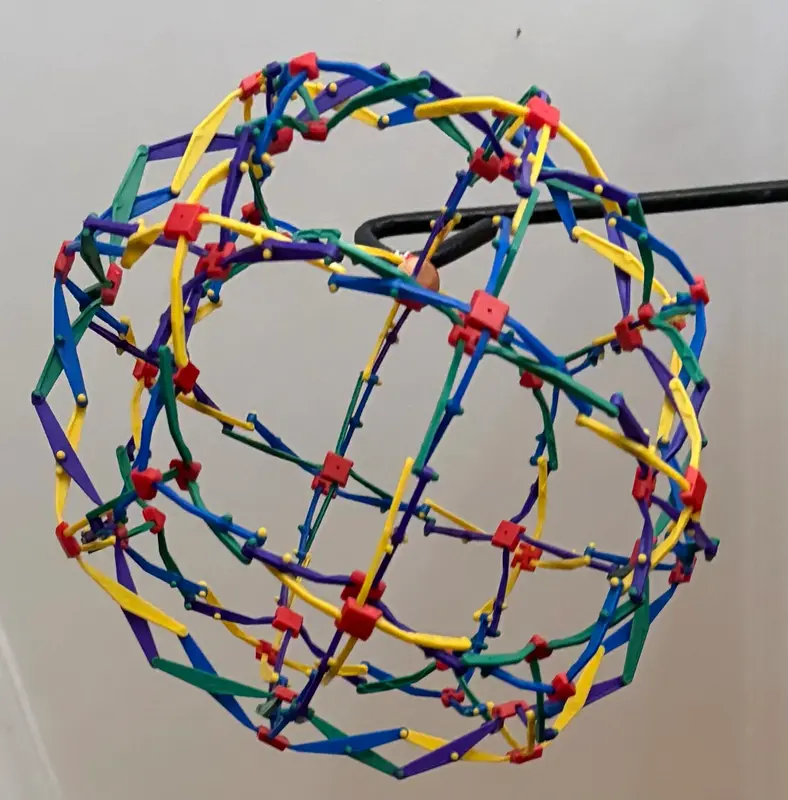
The Expanding Sphere
The Hoberman sphere is a kinetic structure patented by Chuck Hoberman that resembles a geodesic dome, but is capable of folding down to a fraction of its normal size by the scissor-like action of its joints.
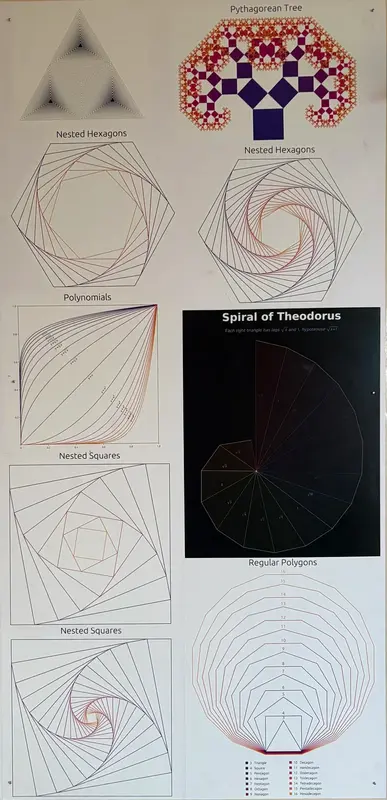
Patterns from Straight Lines
Every design on this board is built from straight lines and simple shapes, yet spirals and curves appear.
Turn a square a little and draw it again, over and over, and a spiral emerges. The spiral of Theodorus is built from right triangles whose long sides measure √2, √3, √4, and so on. The Pythagoras tree grows from squares and right triangles.
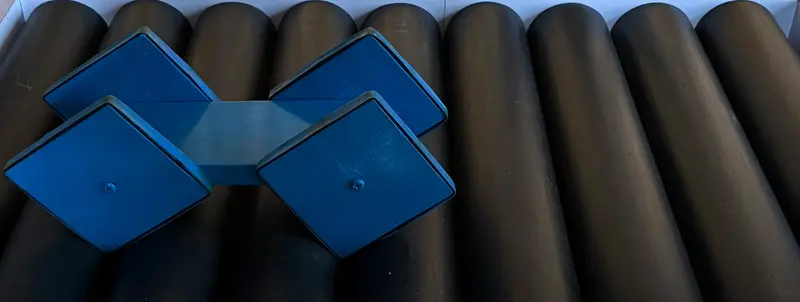
Square Wheels
Square wheels can roll smoothly, on the right road.
This road is a row of curved bumps with exactly the right shape (upside-down catenaries, the curve a hanging chain makes). As each square wheel rolls over a bump, its center stays at the same height, so the ride is smooth.
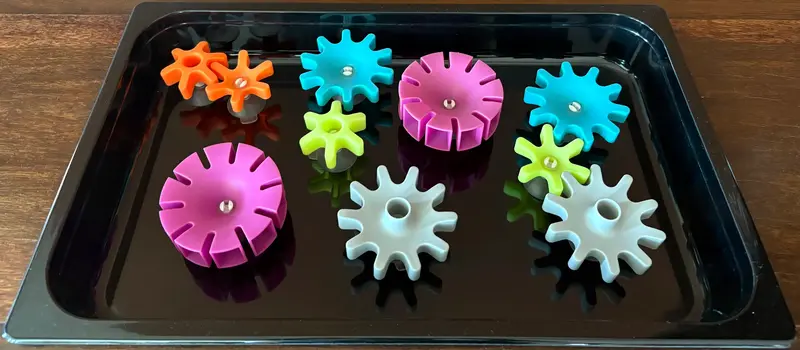
Build a Gear Train
Fit the gears together and turn one: every gear that touches it turns too, each in the opposite direction to its neighbor.
A big gear turning a small one makes the small one spin faster; a small gear turning a big one makes it turn slower but with more force. Bicycles, clocks, and cars all rely on this.
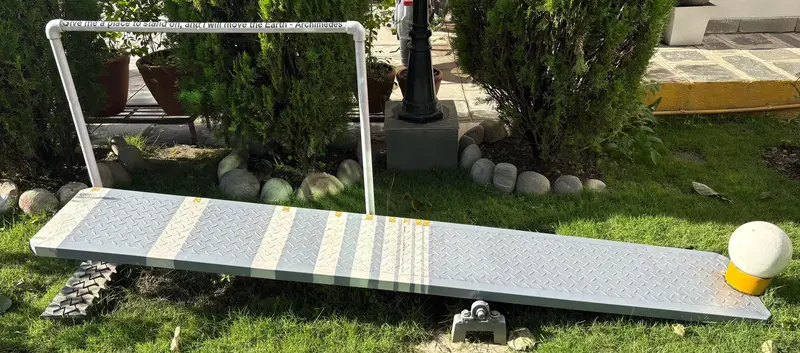
Walk Your Weight
This long plank rests on a pivot, making it a lever you can walk on, and it works as a weighing scale. The marks along it are weights.
The farther you walk from the pivot, the more turning effect (torque) your weight has. The plank tips when your turning effect matches the one on the other side, so a heavier person tips it closer to the pivot and a lighter one has to walk farther. The mark where it tips shows your weight. Old market scales, called steelyards, weigh things the same way.
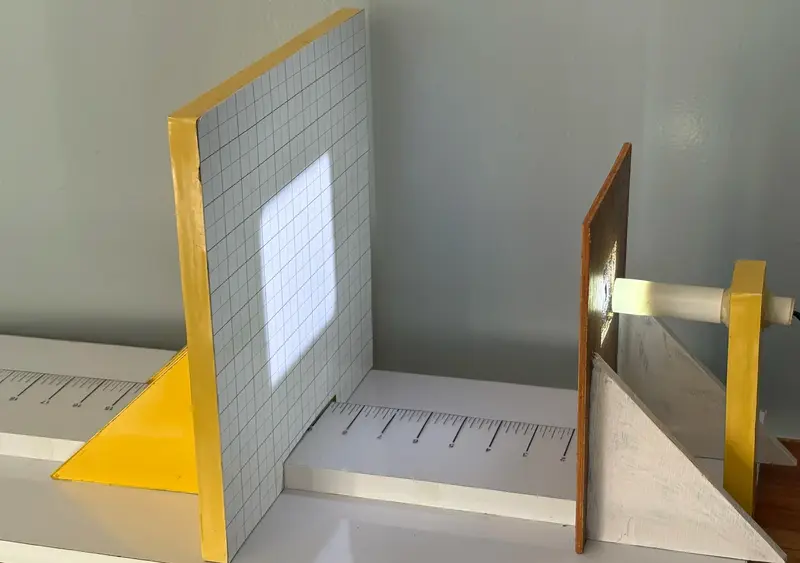
The Inverse Square Law
Light spreads out as it travels. Move the screen twice as far from the lamp, and the same light covers four times the area, so each square gets only a quarter as bright.
This rule, the inverse square law, also describes gravity and sound. It is how astronomers estimate the distance to stars from how bright they look.
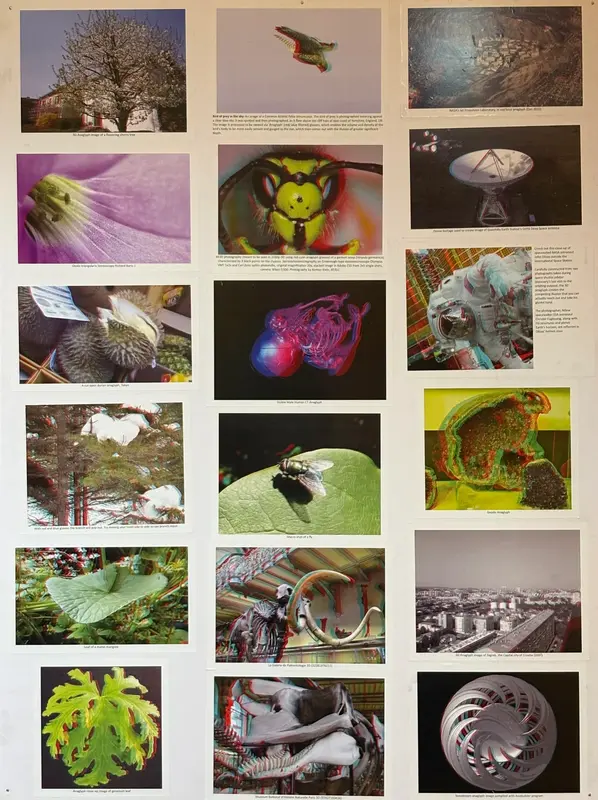
3D Photo Gallery
These photos look blurry and red and blue, until you put on the 3D glasses.
Each photo holds two slightly different views, one in red and one in cyan. The colored glasses let each eye see only one of them, and your brain merges the two views into depth, just as it does with the world around you.
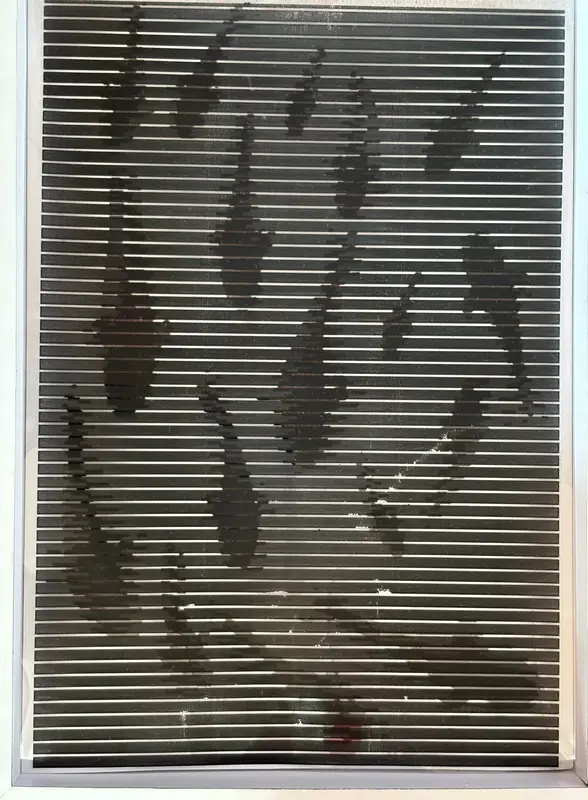
Striped Animation
Slide the striped sheet across the picture, and the fish start to swim.
The picture underneath hides several drawings sliced into thin strips and woven together. The black stripes cover all but one set of strips at a time; as you move them, the drawings show one after another, like frames of a film.
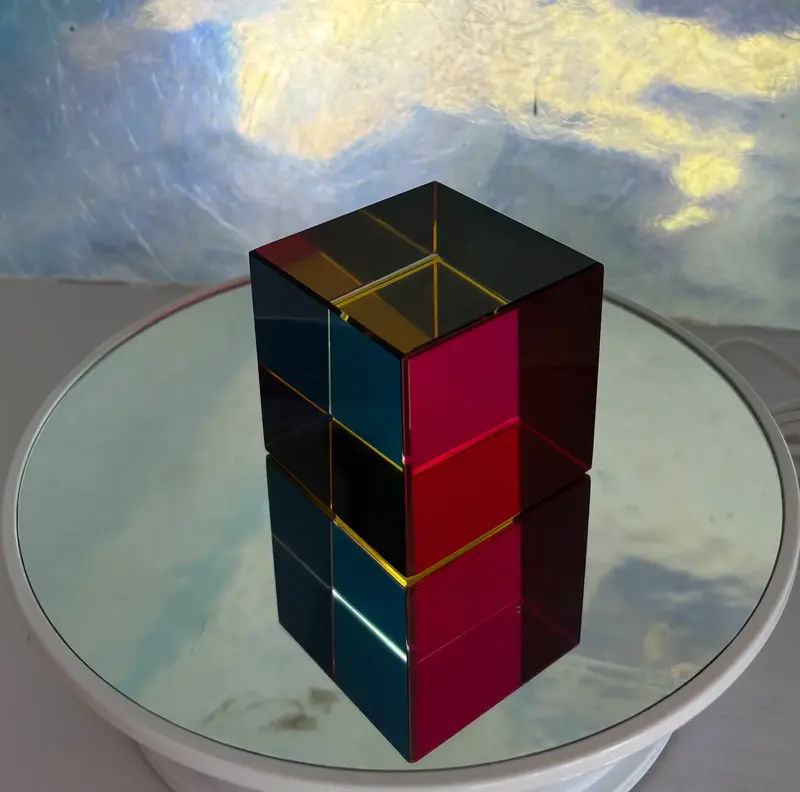
The Color Cube
A clear block made of colored layers, sitting on a mirror.
Where two colored layers overlap, each takes away (absorbs) some colors of light, and what gets through is a new color. Turn the cube and the colors change as light passes through different layers.
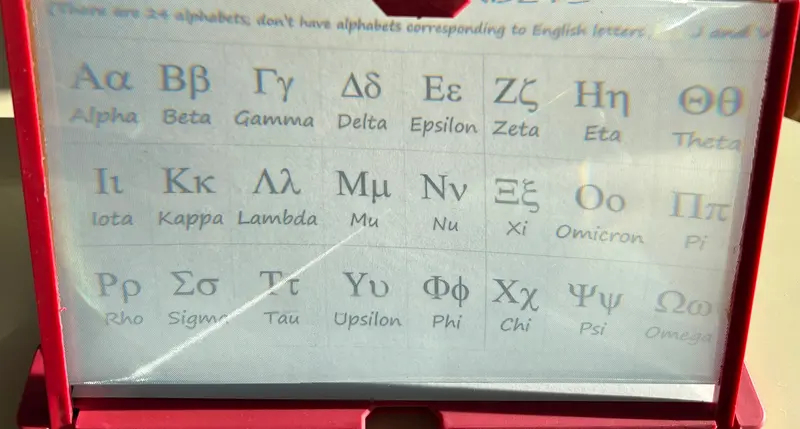
The Fresnel Lens
This thin, flat sheet magnifies like a thick glass lens.
A Fresnel lens keeps only the curved surfaces of an ordinary lens, cut into thin rings and laid flat. It bends light the same way, with much less material. Lighthouses use huge Fresnel lenses to send their beams far out to sea.
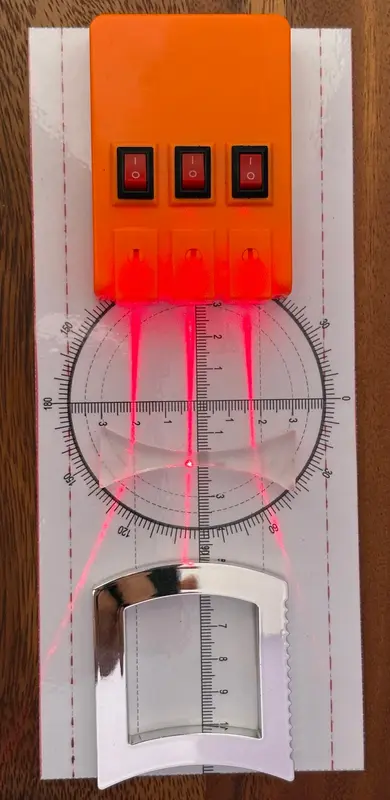
Rays of Light
Three laser beams show how light travels in straight lines until something changes its path.
Place a lens, a mirror, or a block in the beams and watch them bend (refract) or bounce (reflect). A convex lens brings the beams together at a point, the focus; a concave lens spreads them apart.
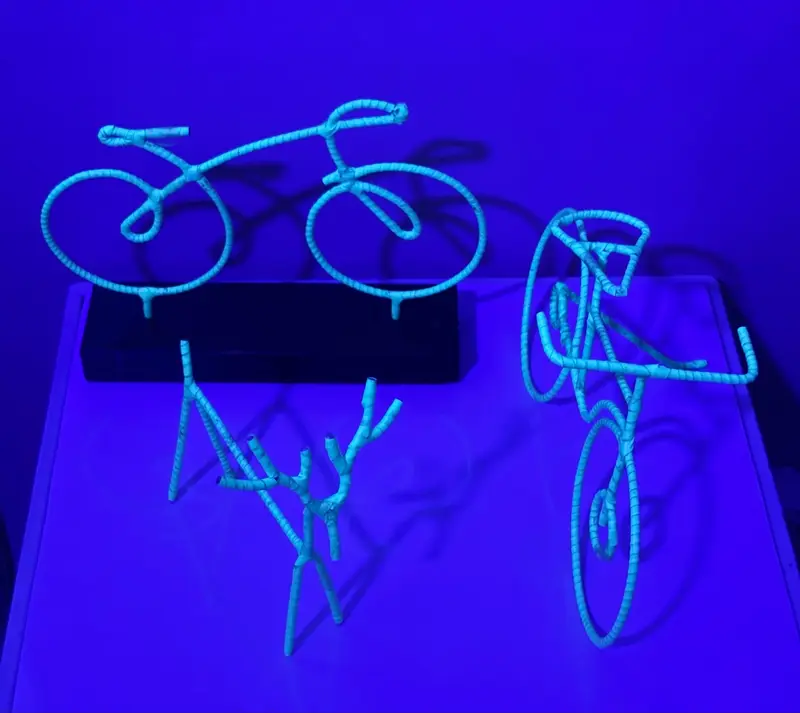
Glowing Wire Sculptures
Under the special lamp, these wire sculptures glow in the dark.
The lamp gives off ultraviolet light, which our eyes can’t see. The coating on the wire absorbs it and gives it back as visible light, which is why the shapes seem to light up by themselves.
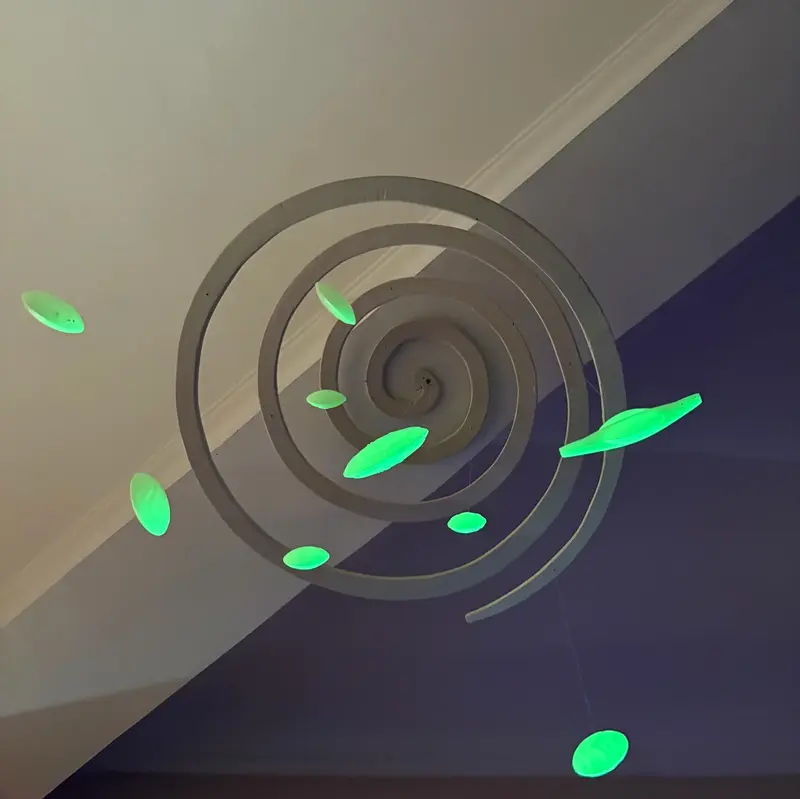
Glow-in-the-Dark Planets
These planets keep glowing after the lights go off.
Their paint stores energy from light and releases it slowly as a soft glow, called phosphorescence. The glow fades as the stored energy runs out, until light charges it again.
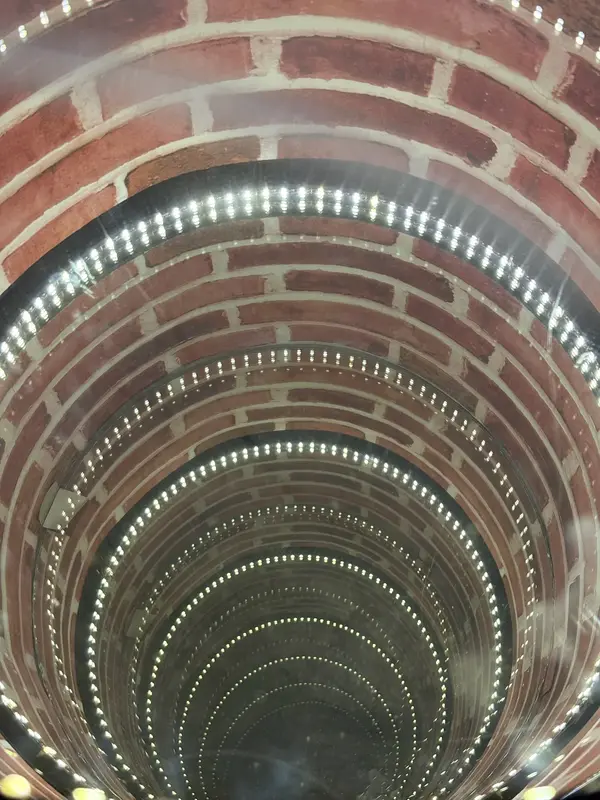
The Infinity Well
Look down and see a tunnel of lights that seems to go on forever.
There are two mirrors facing each other: a normal mirror at the bottom and a see-through one on top. Light bounces back and forth between them, and each bounce makes another, fainter copy of the lights, farther down the tunnel.
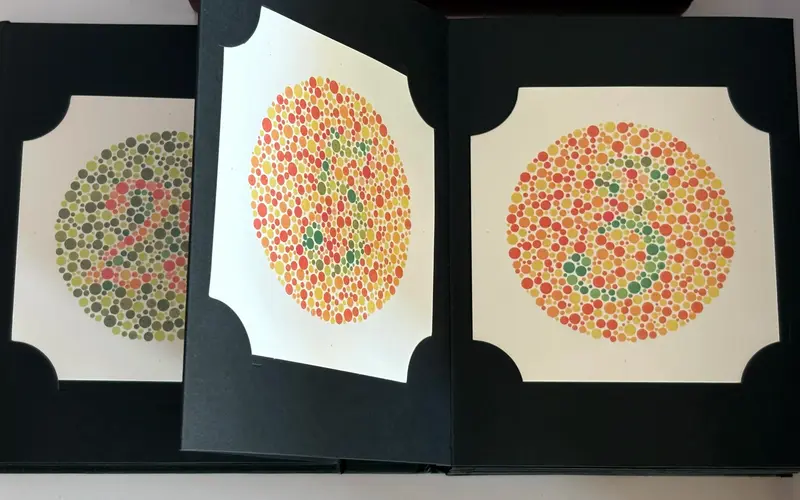
Color Vision Test
Most people see a number hidden in each circle of dots, but some people see a different number, or none at all.
This is the Ishihara test for color vision. About 1 in 12 men and 1 in 200 women have trouble telling some reds and greens apart, because of differences in the color-sensing cells in their eyes.
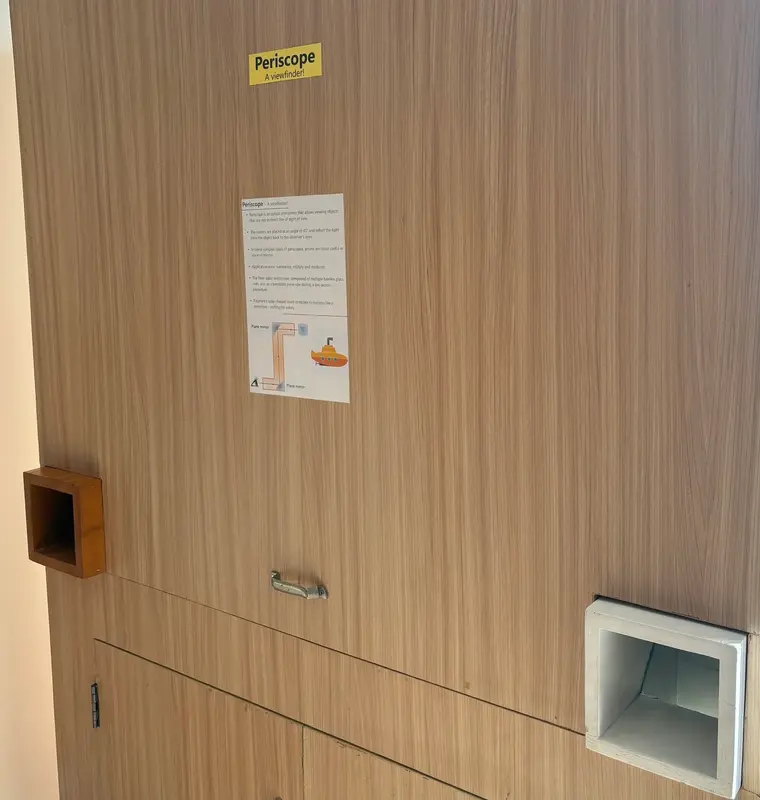
The Periscope
Look into one window and see out of the other, even though they’re at different heights.
Inside are two mirrors, each tilted at 45 degrees. Light enters the top, reflects down off the first mirror, then off the second mirror into your eye. Submarines use periscopes to see above the water.
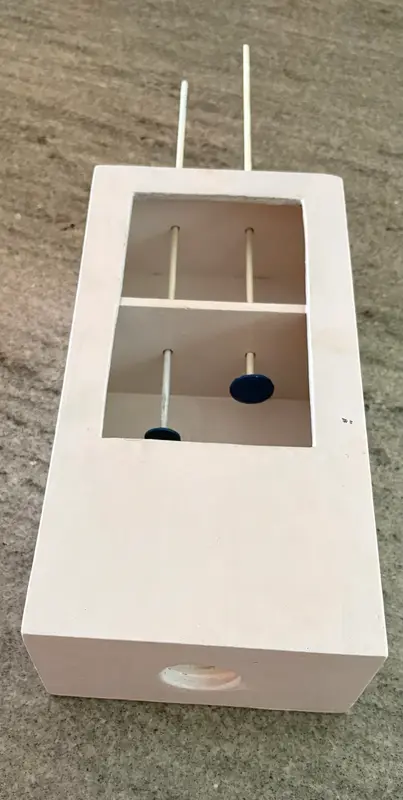
Judging Distance
Look through the hole with one eye and try to line up the rods. It’s surprisingly hard.
Your two eyes see the world from slightly different places, and your brain uses that difference to judge depth. With only one eye, it has to rely on weaker clues like size and shadows.
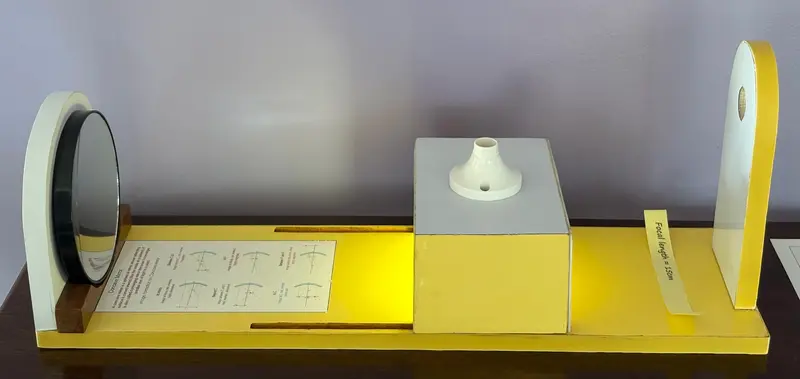
Catch a Real Image
A concave mirror gathers light from an object and brings it together again, making a picture of the object in the air in front of it: a real image.
Put a screen in the right place and the image appears on it, upside down. Move the object and the image moves too. Telescopes and projectors use the same idea.
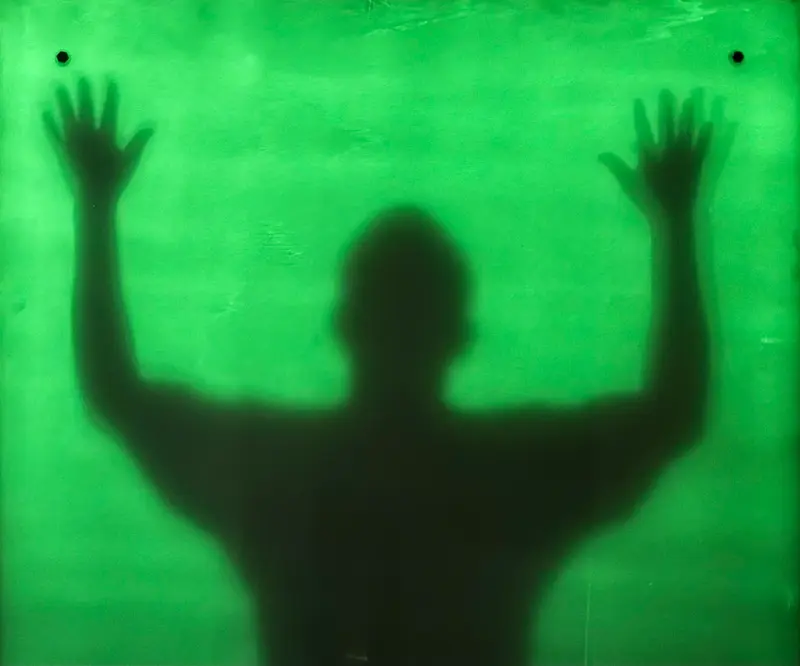
The Shadow Catcher
Stand in front of the glowing wall, wait for the flash, and step away: your shadow stays behind.
The wall is coated with a paint that stores light and slowly glows it back. Where your body blocked the flash, the wall wasn’t charged, so your shadow remains as a dark shape until the glow fades.
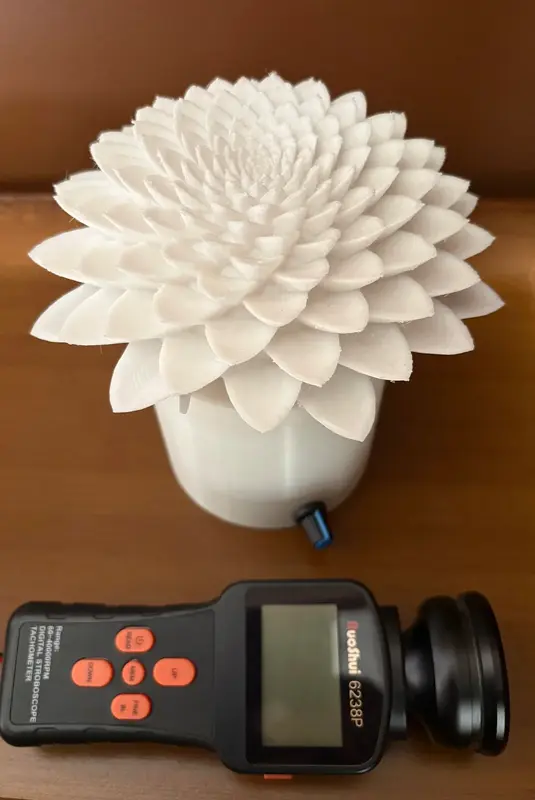
The Blooming Flower
Spin this 3D-printed flower under a flashing light, and its petals seem to bloom and grow before your eyes.
The petals are arranged in spirals. A strobe light flashes once per turn, and each flash shows the flower a little further along, so your brain joins the still views into movement, like frames of a film.
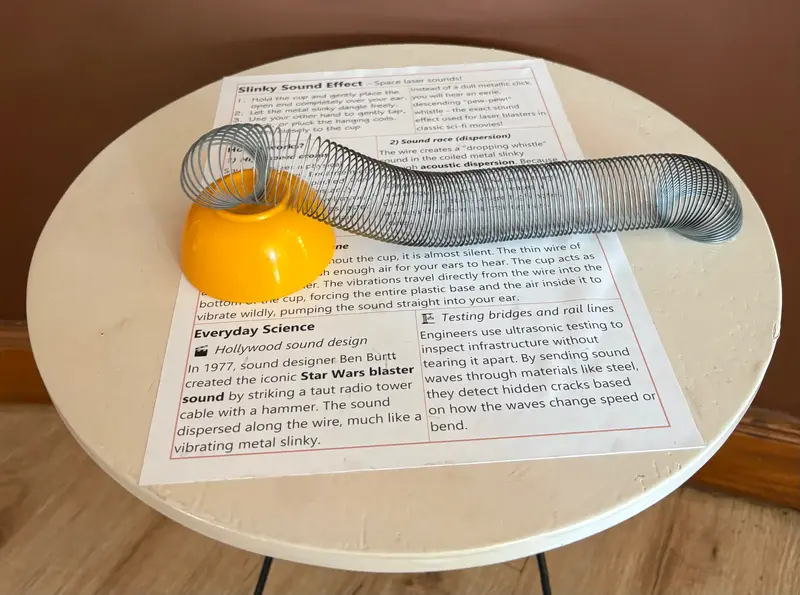
Space Blaster Sounds
Tap the spring and it makes a “pew-pew” space-laser sound. The blasters in the first Star Wars film (1977) were made the same way: sound designer Ben Burtt struck a long steel guy-wire holding up a radio mast, and recorded the sound that came along it.
A tap sends many different pitches down the long spring. High pitches travel along it faster than low ones, so they arrive at the cup first, and the sound sweeps downward: pew!
Galileo Thermometer
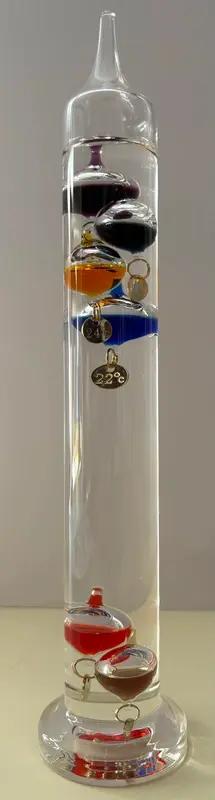
Colored glass bulbs float or sink in a tall tube of clear liquid, and they tell the temperature.
When the liquid warms up it becomes slightly less dense, so fewer bulbs can float. Each bulb carries a temperature tag: the lowest bulb among those still floating shows the current temperature.
The Storm Glass
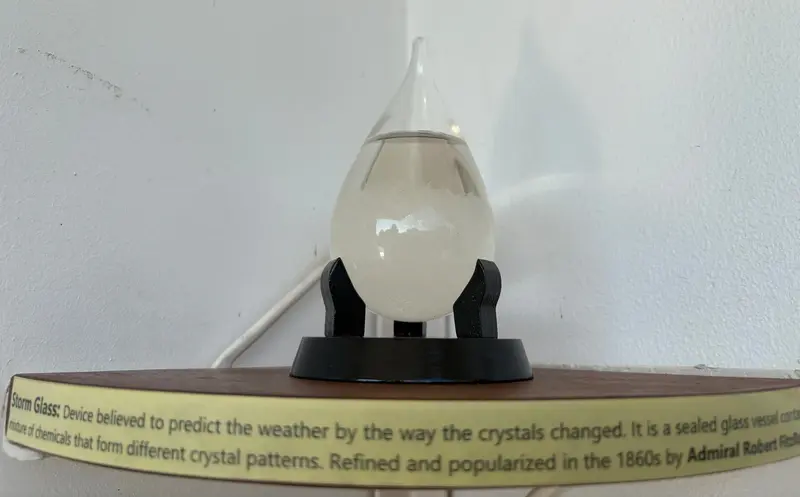
A sealed glass of liquid in which crystals form, grow, and dissolve as the days change.
In the 1860s, Admiral Robert FitzRoy, a pioneer of weather forecasting, popularized storm glasses as a way to predict weather. Today we know the crystals mostly respond to temperature, so the glass isn’t a reliable forecast, but it’s lovely to watch.
The Science Library
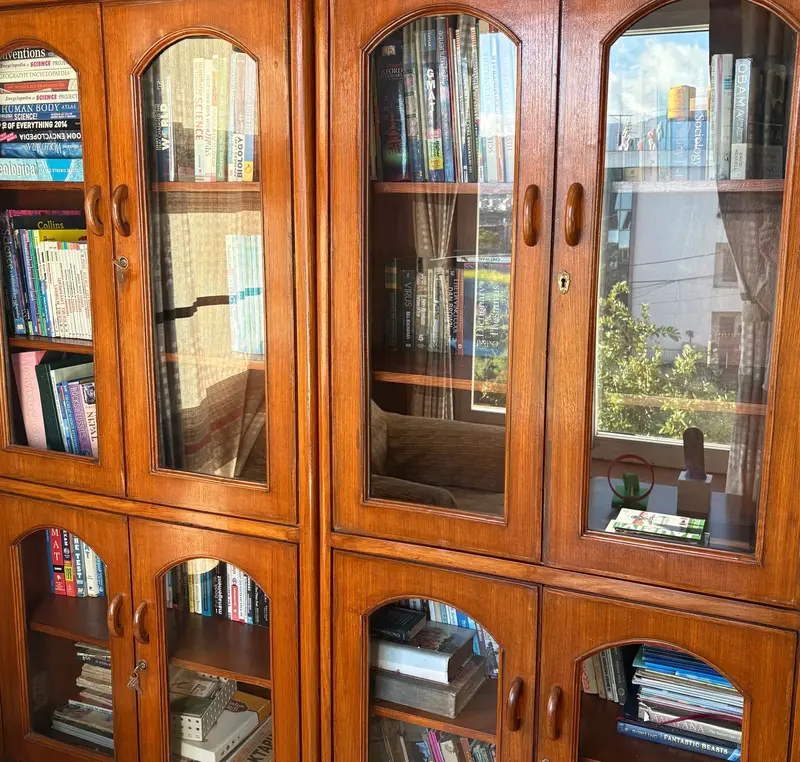
Shelves of science books for every age, from picture books about animals and space to encyclopedias and books for curious teenagers.
An exhibit shows you what happens; a good book can help you find out why, and what else scientists have discovered about it.
The Theater
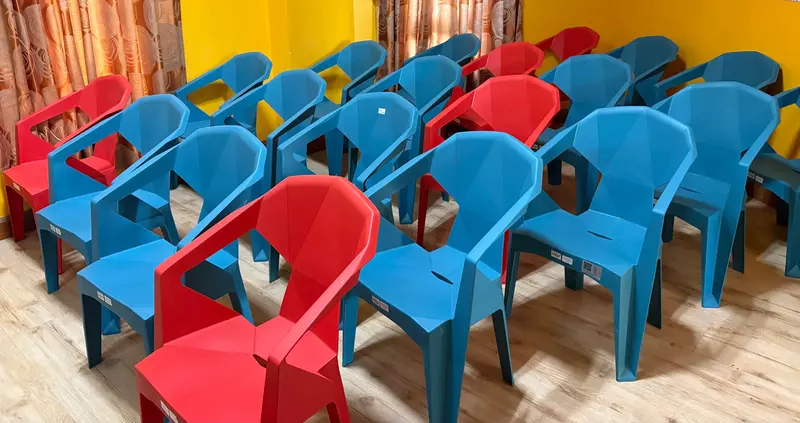
Our small theater is where groups gather for science shows, short films, and talks before or after exploring the exhibits.
School groups can use it for an introduction to their visit, or to share what they discovered at the end.