
- Atomic number
- 25
- Atomic mass
- 54.94
- Shells
- 2, 8, 13, 2
- Configuration
- 1s² 2s² 2p⁶ 3s² 3p⁶ 4s² 3d⁵
- In the table
- period 4, group 7 (VIIB), d-block
- Kind
- Transition metal
- Valency
- 2, 4 and 7 (Mn²⁺ as in MnSO₄; MnO₂; KMnO₄)
- State at 25 °C
- solid
- Melts · boils
- 1,246 °C · 2,061 °C
- Density
- 7.3 × as heavy as water
- Known since
- 1774
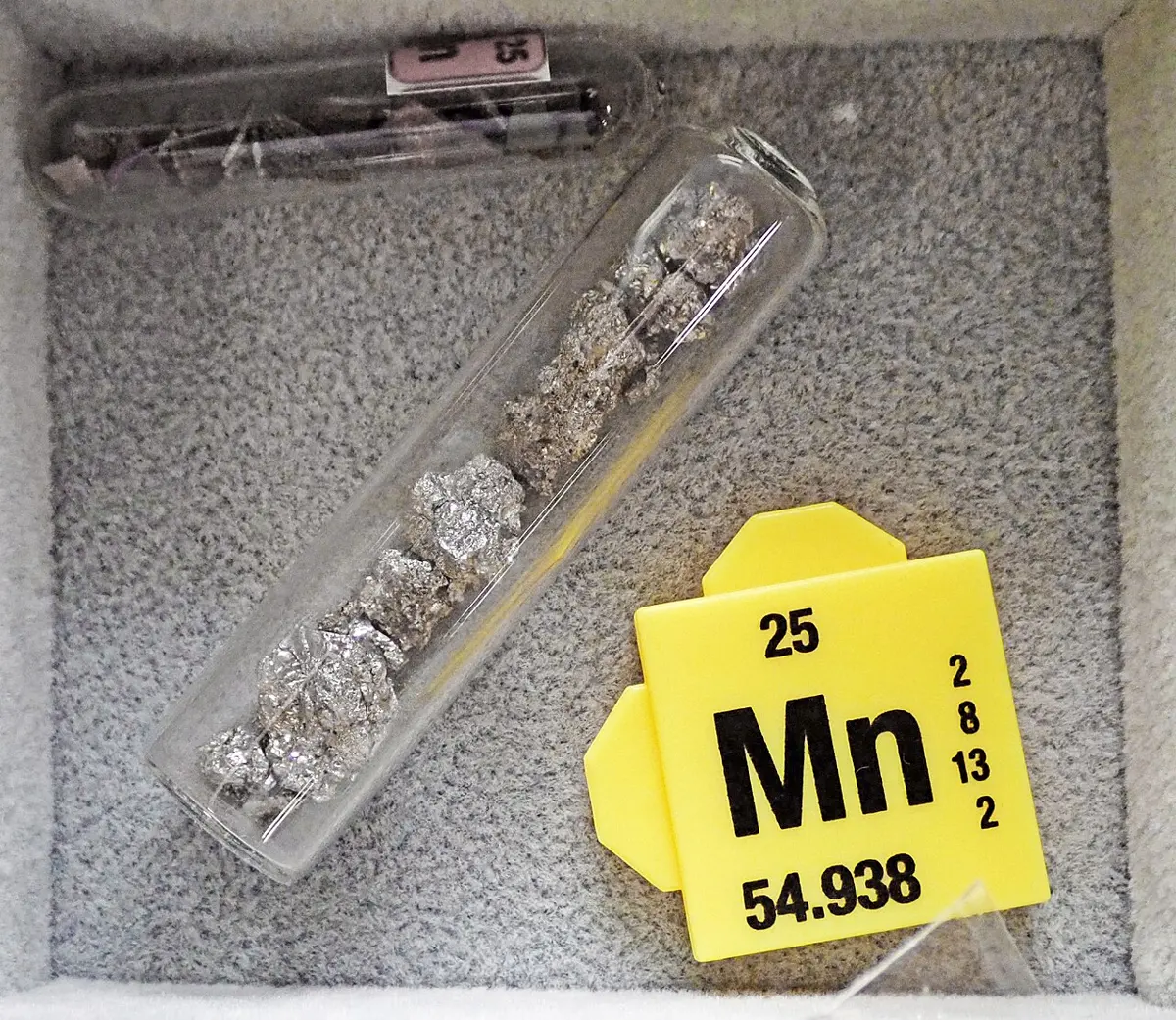
Cut open an old torch battery (with an adult’s help) and you will find a black, sooty paste packed round a carbon rod. That paste is mostly manganese dioxide. In the Grade 9 laboratory you meet the same black powder again: a pinch of it makes hydrogen peroxide froth with oxygen. And a few purple crystals of potassium permanganate dropped into water color the whole beaker.
But most manganese you will never see. It is hidden inside steel: almost every rod, nail and roofing sheet has a little in it, and steel could hardly be made without it. Here is the story of the metal that works behind iron.
The manganese atom
A manganese atom has 25 protons, so its atomic number is 25, and 25 electrons. Every natural manganese atom has 30 neutrons, so its mass number is 25 + 30 = 55.
In shells, its electrons are 2, 8, 13, 2. As with iron, the M shell stops short of its 18 because the 4s subshell fills before 3d Grade 10: The Aufbau principle. After argon’s 18 electrons, 4s takes 2, and the last 5 go into 3d:
1s² 2s² 2p⁶ 3s² 3p⁶ 4s² 3d⁵
The 3d subshell has five boxes (orbitals), so manganese has exactly one electron in each: its 3d is half full. A half-full subshell is especially stable, and that explains a lot about manganese.
Its place in the periodic table
- Period 4, because its electrons are in four shells.
- Group 7, called VIIB in the older naming, between chromium (24) and iron (26).
- d-block, because its last electrons go into a d subshell: manganese is a transition metal Grade 10: Metals.
Below it in group 7 are technetium (43), the first element ever made artificially (in 1937), because its atoms are all radioactive and almost none have survived in the Earth, and rhenium (75), one of the rarest metals in the crust.
Many valencies
Manganese has seven outer electrons that can take part in bonds: two in 4s and five in 3d. That is why it is in group 7. It can use two of them, four, six or all seven, so it has many valencies Grade 9: Variable valency. The common ones are:
- 2, as the ion Mn²⁺ in manganese(II) sulphate (MnSO₄): the atom has lost its two 4s electrons and kept its half-full 3d, so Mn²⁺ is very stable;
- 4, in black manganese dioxide (MnO₂);
- 7, in purple potassium permanganate (KMnO₄).
Each one has its own color, as Figure 2 shows.
How many electrons are in the outermost shell of a manganese atom?
Pick an answer to see why.
How manganese was found and named
Black paint. People used manganese long before anyone knew it was an element. Prehistoric painters in the caves of southern France drew with black pigments of manganese oxide over 20,000 years ago. Later, glassmakers in Egypt and Rome learned that a little black pyrolusite (natural MnO₂) took the greenish tint out of glass, and they called it “glassmakers’ soap”.
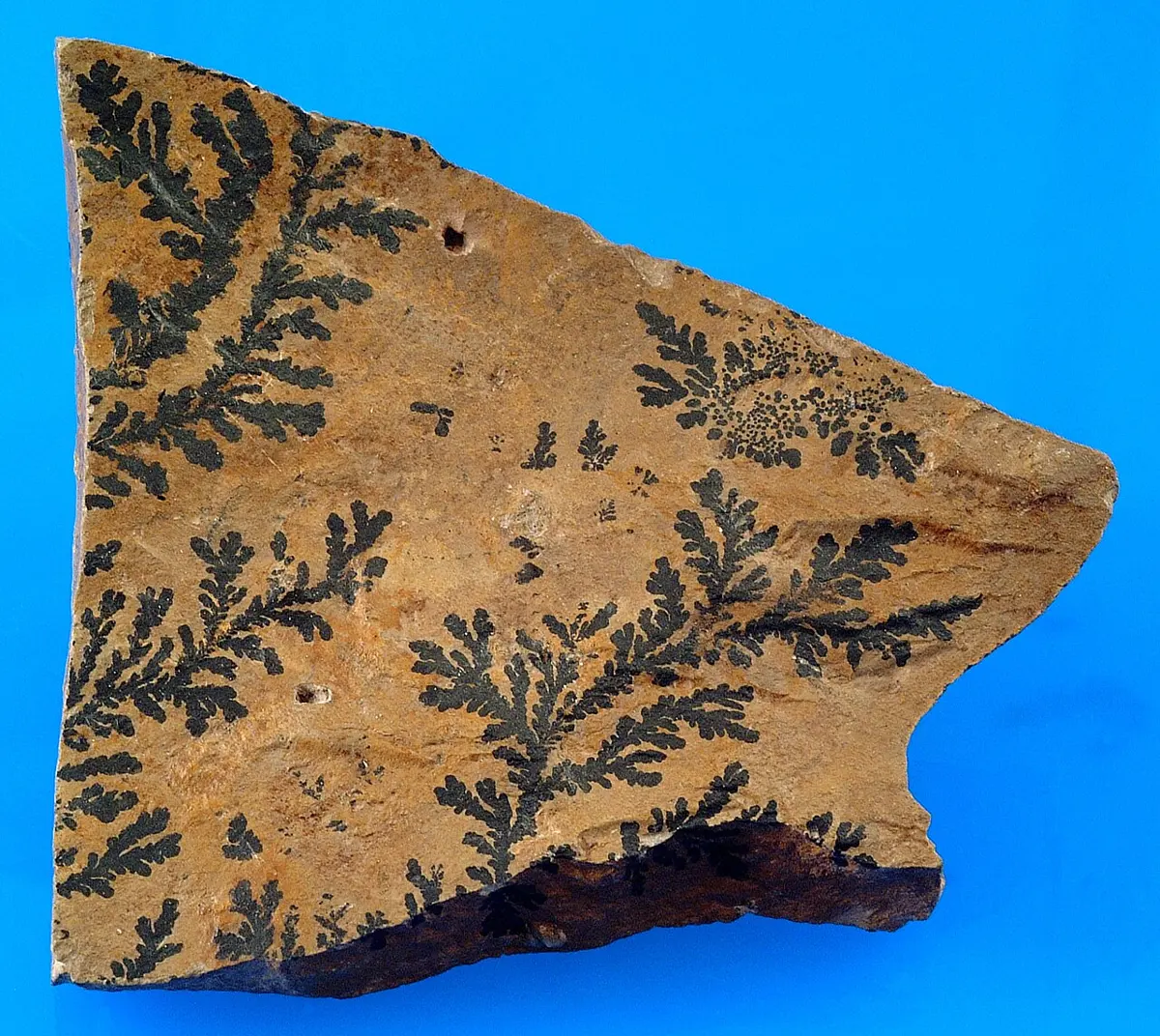
The metal. In 1774 the Swedish chemist Carl Wilhelm Scheele showed that pyrolusite held an unknown metal, and the same year his friend Johan Gottlieb Gahn got it out. He heated the ore with charcoal, which took away its oxygen Grade 10: Reduction, and found small beads of a new, brittle metal:
MnO₂ + 2C → Mn + 2CO
The name. In ancient Greece there was a region called Magnesia, and two black minerals from there were both called magnes. One pulled iron: it was lodestone, and gives us the word magnet. The other did not, and was used on glass: it was pyrolusite. Over the centuries “magnesia” became the name of the black mineral and, by a muddle of spellings, manganese. A white powder from the same region, “magnesia alba”, gave its name to magnesium. So magnet, magnesium and manganese all come from one place. The symbol is Mn, to keep it apart from Mg.
Where manganese is found
In the universe. Manganese, like iron, is made in the hot cores of big stars just before they explode as supernovae, which scatter it into space (Cooking in stars up to iron).
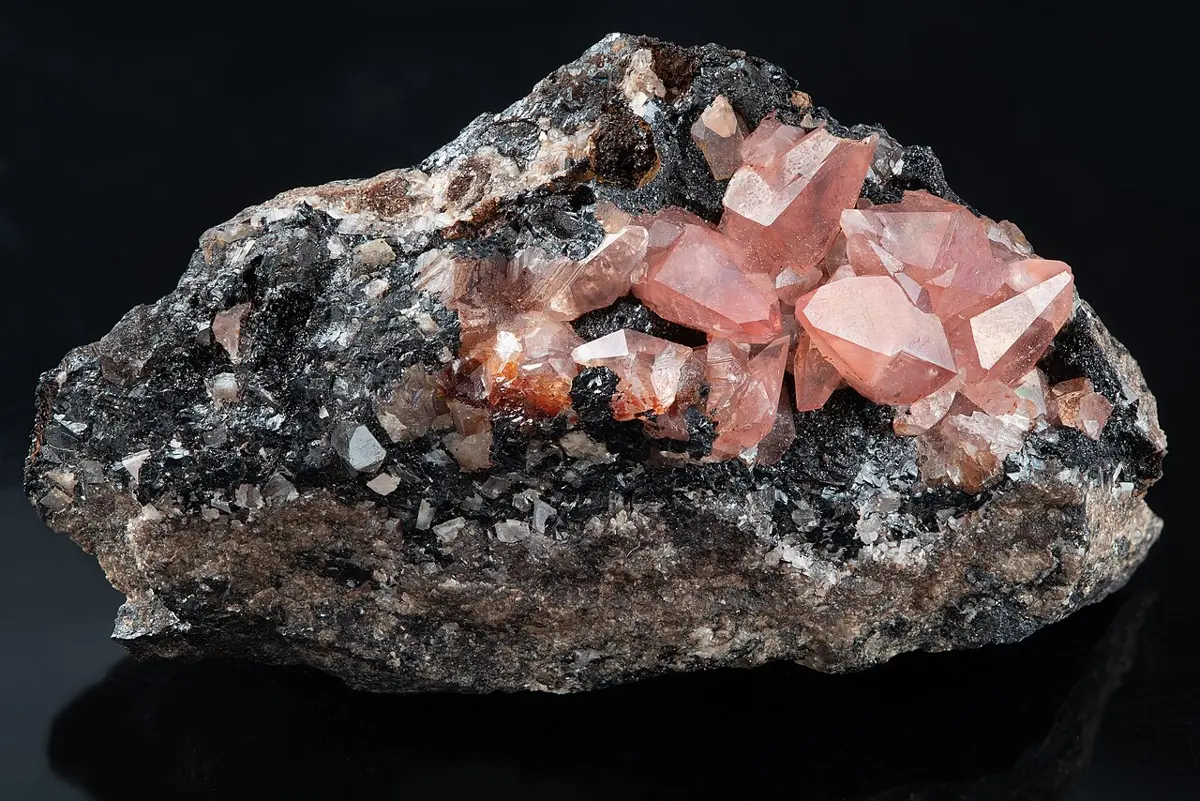
In the Earth’s crust. Manganese is fairly common: about 0.1% of the crust, the 12th most common element. The main ores are pyrolusite (MnO₂) and the pink rhodochrosite (manganese carbonate, MnCO₃). In 2025 the world mined about 20 million tonnes of manganese. South Africa mined over a third of it, then Gabon, Ghana and Australia; South Africa also holds about 70% of all the manganese known on land (USGS, 2026).
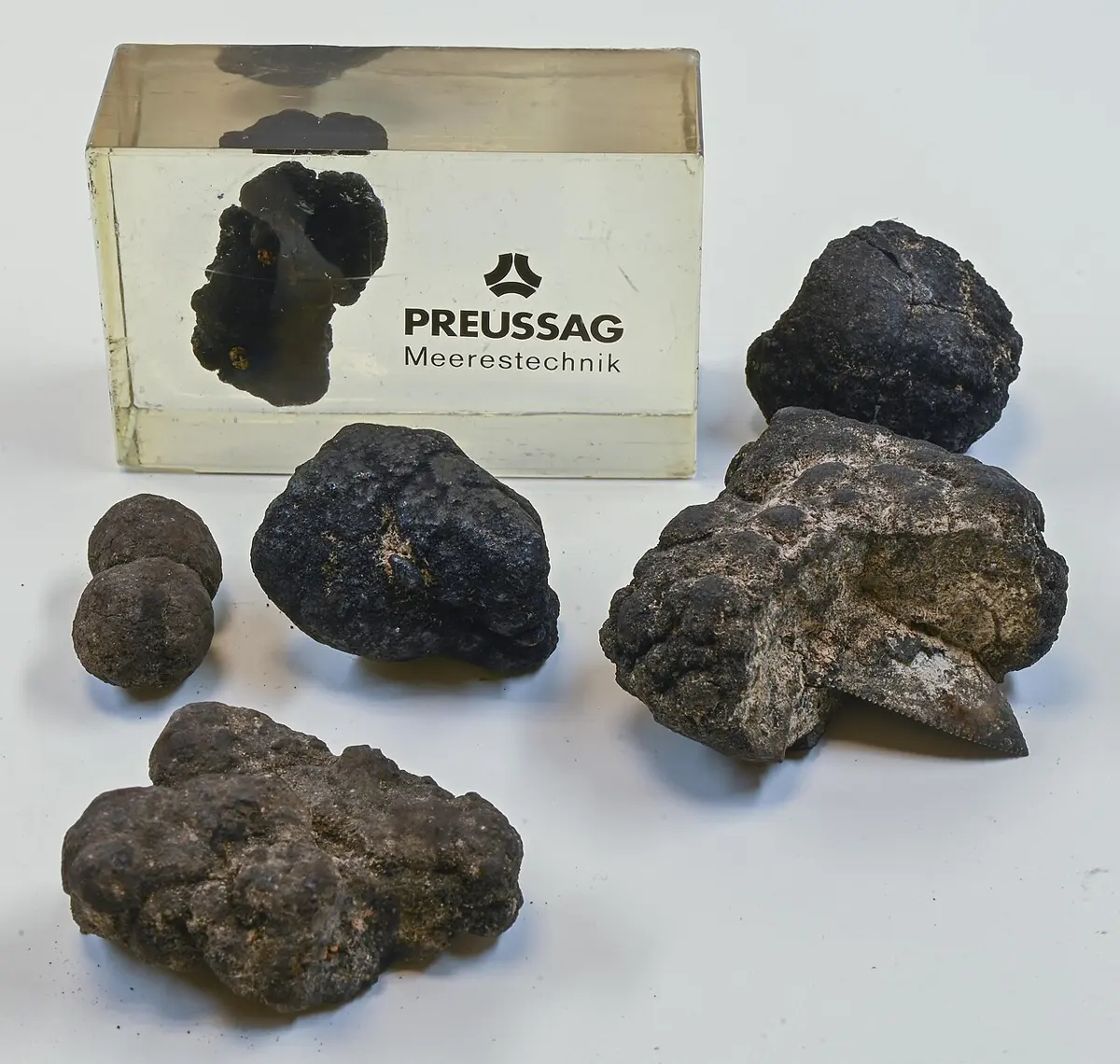
On the ocean floor. Large parts of the deep sea floor are scattered with black, potato-sized lumps called manganese nodules. They grow round a shell or a grain of rock by a few millimeters every million years, and are about a quarter manganese, with nickel, copper and cobalt too. Nobody yet mines them, and scientists worry about what mining would do to life on the sea floor.
In your body. An adult holds only about 12 milligrams of manganese, mostly in the bones, yet cannot live without it (see below).
What manganese is like
- Color. Pure manganese is a silvery-gray metal that looks a lot like iron.
- Hard but brittle. It is harder than iron, but it shatters when hit. Pure manganese is almost never used on its own; its value is in what it does for other metals.
- High melting point: 1,246 °C.
- Not magnetic. It sits next to iron, but a magnet doesn’t pick it up.
How manganese reacts
Manganese is more reactive than iron, and even than zinc: in the reactivity series it comes between aluminium and zinc. So:
- in moist air its surface slowly darkens, like iron rusting;
- heated in air, it combines with oxygen to form oxides;
- it reacts with dilute acids, giving a salt and hydrogen Grade 9: Metals and dilute acids:
Mn + 2HCl → MnCl₂ + H₂
Manganese is also one of the very few metals that give hydrogen with very dilute nitric acid, which gives oxides of nitrogen with most metals.
A strip of manganese is dipped in a solution of zinc sulphate. What happens?
Pick an answer to see why.
Manganese dioxide: the catalyst you have used
When you make oxygen in the laboratory, from hydrogen peroxide or by heating potassium chlorate, you add a little black manganese dioxide Grade 9: Oxygen without heating:
2H₂O₂ → 2H₂O + O₂ (with MnO₂)
At the end the MnO₂ is still there, unchanged, so it is a catalyst: it speeds the reaction up without being used up Grade 10: Catalyst. It works on its surface, where the peroxide molecules break apart. A fine powder, with more surface, works faster than a lump.
Potassium permanganate: a little goes a long way
Potassium permanganate (KMnO₄) forms dark purple, almost black crystals. A few grains turn a whole bucket of water pink, which is why the Grade 8 book uses them to show water moving as it is heated Grade 8: Convection in water.
Permanganate is a strong oxidizing agent: it gives oxygen to other substances, or takes electrons from them. Many germs cannot survive it, so a weak pink solution has long been used to disinfect wells, wounds and fish tanks. When it reacts, the manganese goes from valency 7 to a lower one, and the purple disappears: it fades to colorless (Mn²⁺) in acid, or leaves brown MnO₂.
Manganese in steel
Nearly nine-tenths of all manganese goes into iron and steel Grade 8: Steel. Ordinary steel has only about 1%, but it does three jobs:
- It takes out sulphur. Iron ore and coke always bring a little sulphur. In plain iron it forms iron sulphide, which makes red-hot steel crack as it is rolled. Manganese grabs the sulphur first, as harmless manganese sulphide.
- It takes out oxygen, which would leave bubbles and weak spots.
- It makes steel stronger and tougher.
In 1856 the British metallurgist Robert Mushet showed that adding manganese rescued steel made in the new Bessemer converters, which had been too brittle to use. Steelworks have added it ever since. They don’t use pure manganese, which is costly: ore of manganese and iron is smelted together into ferromanganese, an alloy of the two, which is stirred into the molten steel.
Manganese in daily life
Batteries. In an ordinary dry cell (the zinc–carbon or the alkaline kind), the zinc can gives up electrons, and the manganese dioxide round the carbon rod takes them in. Without MnO₂, hydrogen would build up on the rod and the cell would soon stop. Many lithium-ion batteries, the kind in phones and electric cars, have manganese in their positive side too (The battery in your pocket).
Aluminium cans. A drinks can is not pure aluminium: about 1% manganese makes it stronger and keeps it from corroding. Duralumin, for airplanes, has manganese too Grade 8: Alloys used in daily life.
Cheaper stainless steel. Stainless steel needs nickel, which is costly. Many cheaper stainless steels replace part of the nickel with manganese.
Farming. Manganese is one of the plant micronutrients Grade 9: Nutrients for plants. A plant short of it gets yellow leaves with green veins, and manganese sulphate is added to some fertilizers and animal feeds.
Manganese and the oxygen you breathe
Inside every green leaf, sunlight splits water into hydrogen and oxygen. The machine that does it holds a tiny cluster of four manganese atoms with a calcium atom and some oxygen. It pulls electrons out of water, one at a time, until two water molecules give up a molecule of oxygen, O₂. Almost all the oxygen in the air was set free this way, by manganese, in plants and algae (Inside a light-catching machine).
Manganese and your health
Your body needs a little manganese: about 2.3 milligrams a day for a man and 1.8 milligrams for a woman (US guidelines). It is part of enzymes (substances that speed up the body’s chemical reactions) that:
- build bones and cartilage;
- help release energy from food;
- protect cells from damage by the oxygen they use.
Whole grains such as brown rice and millet, wheat flour (atta), nuts, chickpeas and lentils, green leafy vegetables and tea are all good sources, so people who eat a varied diet almost never run short.
Too much is harmful, but not from food. Miners, steel workers and welders who breathe in manganese dust and fumes for years can get manganism, a disease of the brain that makes people shake and walk stiffly, like Parkinson’s disease. It was first described in 1837, in men who ground manganese ore. Today such workers wear masks and their air is checked.
Isotopes of manganese
Natural manganese has only one isotope, manganese-55, with 25 protons and 30 neutrons. That is why its atomic mass, 54.94, is so close to a whole number: there is no mixture to average, unlike copper (63.55) or chlorine (35.45) Grade 9: Atomic mass. (It is not exactly 55, because the mass of a nucleus is a little less than the masses of its protons and neutrons added up.)
Surprising facts and records
- The spy ship’s cover story. In the early 1970s the American billionaire Howard Hughes had a huge ship built, saying it would scoop manganese nodules from the deep sea. It was a cover: the ship was really built for the CIA, to lift a sunken Soviet submarine from the Pacific. The story set off a real rush of interest in mining the nodules.
- Steel needs it, and no substitute has been found. The US Geological Survey says manganese has no satisfactory substitute in steel.
In your science books
- Grade 8: alloys: steel and duralumin and convection with permanganate.
- Grade 9: variable valency, making oxygen with manganese dioxide, metals and dilute acids and plant micronutrients.
- Grade 10: electronic configuration, transition metals, reduction with carbon and catalysts.
- Going further: where the atoms in your body came from.
More to explore
- Nobel Prizes with manganese in them: the plant’s light-catching machine (1988; the manganese cluster that splits water is in the same machine), lithium-ion batteries (2019), neutrons that showed manganese oxide’s hidden magnets (1994) and quasicrystals (2011, first seen in an alloy of aluminium and manganese).
- Play: find manganese in Guess the Element and the Periodic Table Jigsaw.
- Read more: manganese at the Royal Society of Chemistry and at PubChem.