
- Atomic number
- 78
- Atomic mass
- 195.08
- Shells
- 2, 8, 18, 32, 17, 1
- Configuration
- 1s² 2s² 2p⁶ 3s² 3p⁶ 4s² 3d¹⁰ 4p⁶ 5s² 4d¹⁰ 5p⁶ 6s¹ 4f¹⁴ 5d⁹
- In the table
- period 6, group 10 (VIIIB), d-block
- Kind
- Transition metal
- Valency
- 2 and 4 (platinous Pt²⁺, platinic Pt⁴⁺)
- State at 25 °C
- solid
- Melts · boils
- 1,768 °C · 3,825 °C
- Density
- 21.5 × as heavy as water
- Known since
- 1735
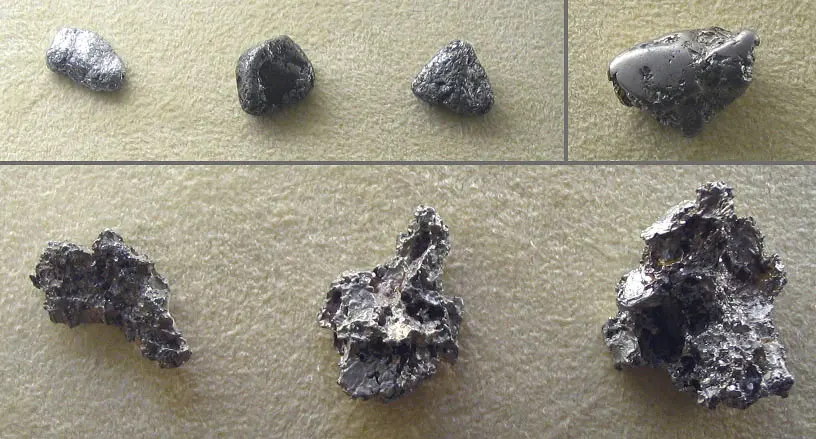
Platinum is the metal of expensive rings and watches, rarer than gold and heavier. But most platinum is not worn by anyone. It sits, unseen, under cars and buses, inside the box in the exhaust pipe, where a thin coating of it turns poisonous gases into harmless ones. It is in the spark plugs of engines, in the tips of pacemakers, and in a medicine that cures most people of one kind of cancer.
All of this comes from two things: platinum almost never reacts itself, but it is very good at making other substances react. Here is its story.
The platinum atom
A platinum atom has 78 protons, so platinum’s atomic number is 78, and 78 electrons. Platinum is a mixture of several isotopes; the most common, platinum-195, has 117 neutrons.
The shells hold 2, 8, 18 and 32 electrons, then 17 in the fifth shell, and just one in the sixth: 2, 8, 18, 32, 17, 1 Grade 8: Bohr and Bury’s rule.
Its electronic configuration
Following the Aufbau order Grade 10: The Aufbau principle, 6s fills, then 4f, then 5d, so you would expect platinum to end 6s² 4f¹⁴ 5d⁸. The real atom moves one electron from 6s into 5d:
1s² 2s² 2p⁶ 3s² 3p⁶ 4s² 3d¹⁰ 4p⁶ 5s² 4d¹⁰ 5p⁶ 6s¹ 4f¹⁴ 5d⁹
In the heavy atoms of period 6, the 6s and 5d subshells have almost the same energy, so the electrons settle in whichever way is a little more stable. Platinum’s family is famous for disagreeing: nickel, above it, keeps the expected 4s² 3d⁸; palladium, in the middle, moves both its s electrons into d (4d¹⁰); and platinum moves just one.
How many electrons are in the outermost shell of a platinum atom?
Pick an answer to see why.
Its place in the periodic table
- Period 6, because its electrons are in six shells. It sits between iridium (77) and gold (79).
- Group 10, the last of the three columns called VIIIB in the older naming, below nickel and palladium.
- d-block, so platinum is a transition metal Grade 10: Metals.
Platinum gives its name to a family of six rare, heavy, unreactive metals found together in the same ores, the platinum group metals: ruthenium, rhodium and palladium in period 5, and osmium, iridium and platinum in period 6.
In compounds, platinum is usually Pt²⁺ (valency 2, platinous) or Pt⁴⁺ (valency 4, platinic) Grade 9: Variable valency.
How platinum was found and named
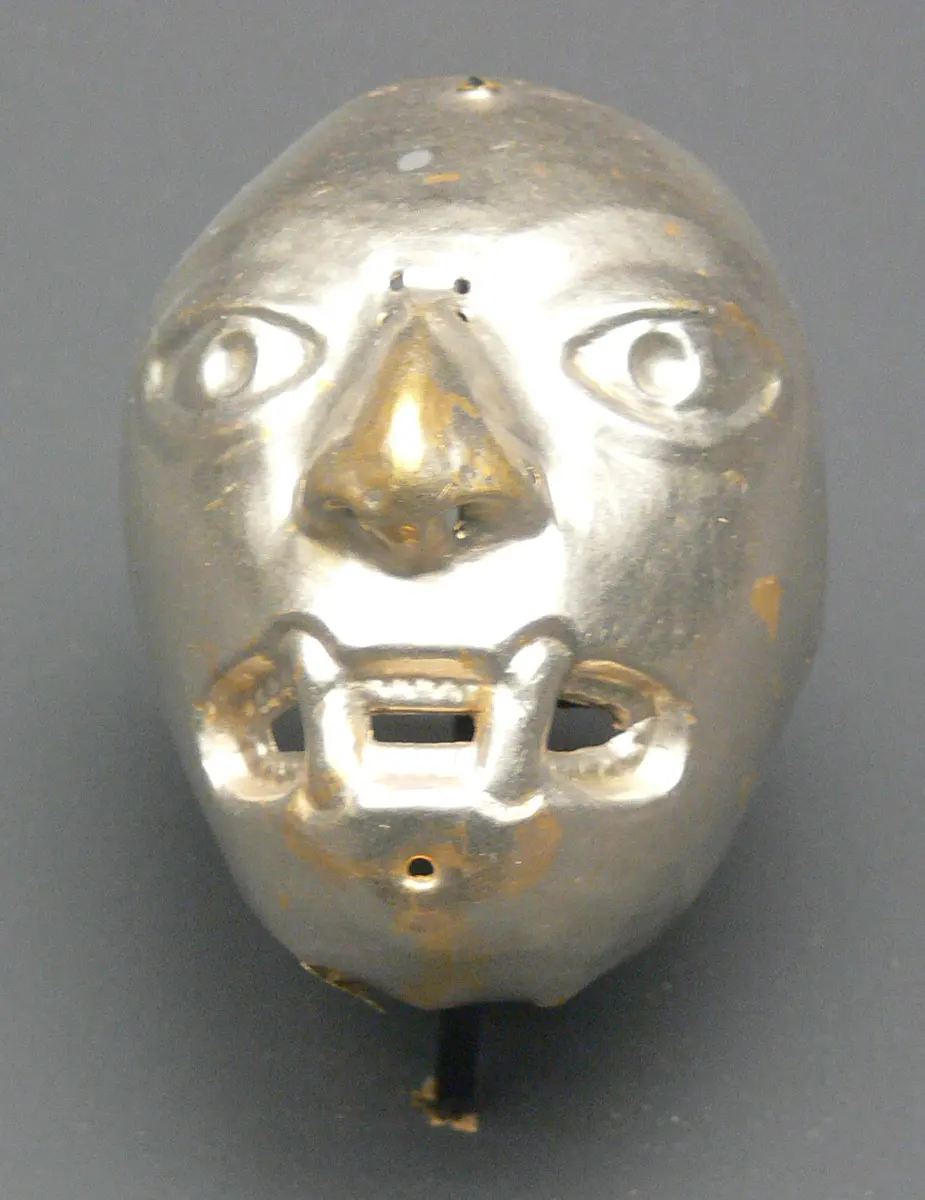
About 2,000 years ago, people of the La Tolita culture, on the Pacific coast of today’s Ecuador and Colombia, made small ornaments and masks of platinum. Their furnaces could not melt it, so they mixed tiny grains of platinum with a little gold, which melts more easily, and heated and hammered the mixture into a solid piece.
Europeans first met platinum in the gold mines that Spain ran in South America. To the miners it was a nuisance: heavy gray grains that turned up with the gold, could not be melted, and spoiled it when mixed in. It is said that some were thrown back into the rivers. They called it platina, “little silver”, a joke at its expense, and from it came the name platinum and the symbol Pt.
- In 1735, the Spanish naval officer Antonio de Ulloa, on a scientific expedition in South America, saw it. On his way home his ship was captured by the British navy, and he was taken to London, where scientists of the Royal Society were fascinated by his account. He described the metal in a book in 1748.
- Around 1750, samples brought to England were studied, and European scientists agreed it was a new metal.
- Melting it took decades. It melts at 1,768 °C, far hotter than any furnace of the time. The French chemist Lavoisier managed in the 1780s, by blowing pure oxygen into a fire to make it burn hotter. Only in 1859 could two French chemists, Deville and Debray, melt it by the kilogram, with a flame of hydrogen and oxygen.
Nepali uses the English name: प्लेटिनम.
Where platinum is found
In the universe. Platinum is one of the elements made when neutron stars, the dead cores of huge stars, crash into each other and fling out matter rich in neutrons (In a flash, when dead stars collide). Such a crash was seen in 2017, with gravitational waves and telescopes together (Gravitational waves).
In the Earth’s crust. Platinum is one of the rarest metals: ordinary rock has less than a hundredth of a gram in each tonne. Like gold, it is found as the pure metal, in grains and nuggets in river gravel Grade 10: Minerals: native metals, but almost all of it now comes from rock deep underground. In 2024 the world mined about 170 tonnes of platinum, roughly twenty times less than gold (about 3,300 tonnes). About seven tenths came from South Africa, from one huge body of ancient rock, the Bushveld Complex; most of the rest from Russia and Zimbabwe (USGS).
What platinum is like
- Color. A silvery-white metal, a little grayer than silver, that keeps its shine for ever.
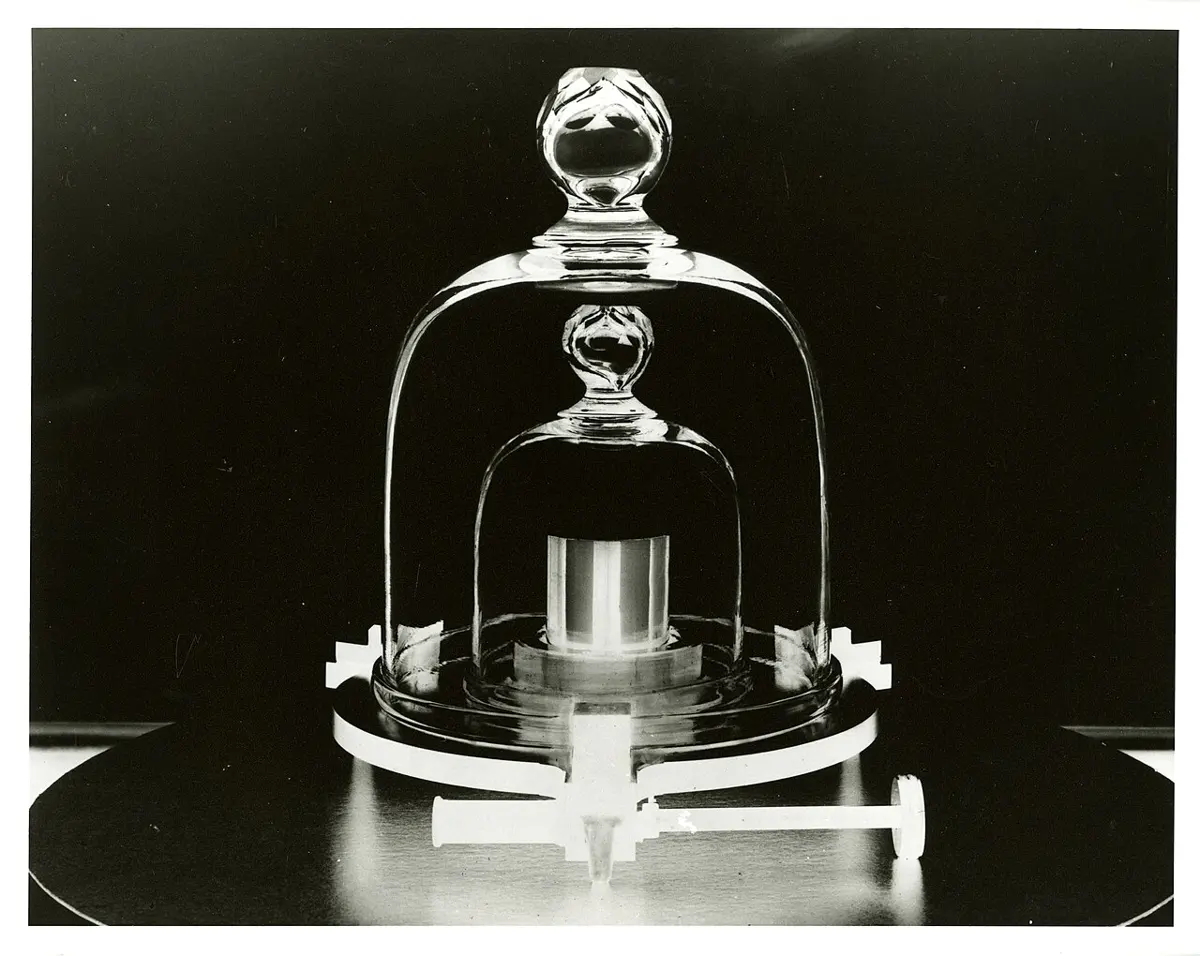
- Very heavy. Its density is 21.5 g/cm³: a cube of platinum 1 cm on each side weighs 21.5 g, and a one-liter bottle of it would weigh 21.5 kg. Only osmium and iridium, two of its own family, are denser.
- Melts at 1,768 °C, higher than iron (1,538 °C).
- Malleable and ductile, like gold: it can be drawn into wires finer than a hair Grade 9: Ductile.
- Never rusts or tarnishes, even when red-hot in air.
How platinum reacts
Platinum is one of the least reactive metals, near the bottom of the reactivity series, with gold:
- it does not react with oxygen, even when heated;
- it does not react with water or with acids, even concentrated ones, with one exception: aqua regia, a mixture of concentrated nitric and hydrochloric acids, which also dissolves gold.
That is why, like gold, it is found as the free metal in nature Grade 10: Native metals, and why chemists use platinum dishes and wires for experiments that would eat away other metals.
A catalyst
Platinum’s most useful property is not about itself. Gases that touch a platinum surface stick to it for a moment. While they are held there, their bonds are loosened, and they react with each other far more easily than in the open air. Then the products leave, and the platinum is ready again, unchanged. A substance that speeds up a reaction without being used up is a catalyst Grade 10: Catalyst.
In Döbereiner’s lighter, what happens to the platinum?
Pick an answer to see why.
Platinum in daily life
Catalytic converters. A petrol engine’s exhaust carries poisonous carbon monoxide (CO), unburnt fuel, and nitrogen oxides, which make smog and acid rain Grade 8: Acid rain. Almost every petrol car made today has a catalytic converter in its exhaust pipe: a ceramic honeycomb with thousands of thin channels, coated with tiny particles of platinum, palladium and rhodium. As the hot gas rushes through, on the metal surface:
2CO + O₂ → 2CO₂
and unburnt fuel burns to carbon dioxide and water, while nitrogen oxides are split back into nitrogen and oxygen. This is the biggest single use of platinum. A converter only works with unleaded petrol: lead from old leaded petrol coats the platinum and stops it working, which is one reason leaded petrol was given up around the world. The scientist who explained exactly how CO and oxygen react on platinum, Gerhard Ertl, won the Nobel Prize in Chemistry in 2007.
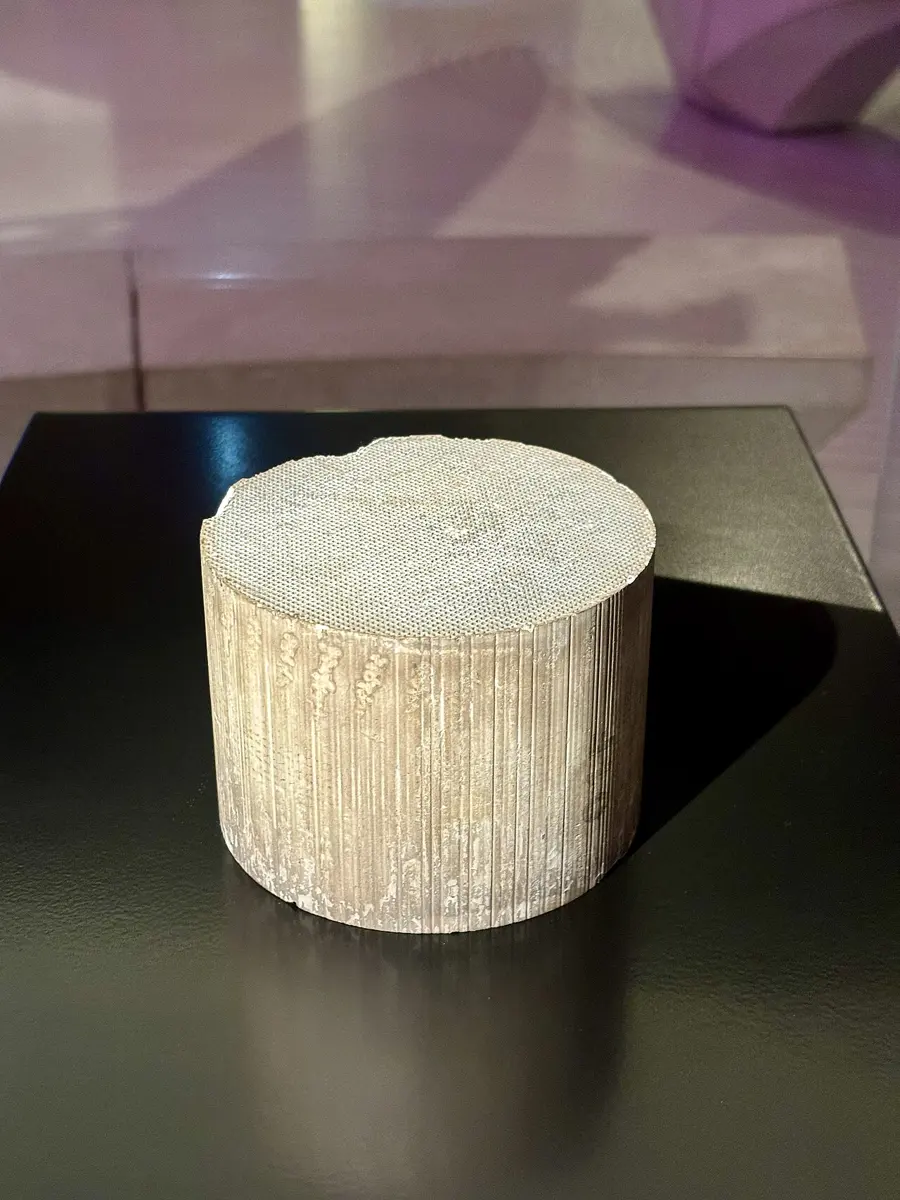
Why is the platinum in a catalytic converter spread over a honeycomb with thousands of thin channels, not used as one solid block?
Pick an answer to see why.
Making fertilizer. Nitric acid, for fertilizers and explosives, is made by burning ammonia in air over a gauze of platinum and rhodium wire (the Ostwald process). The ammonia itself comes from the Haber process (Bread from air).
Fuel cells. In a hydrogen fuel cell, platinum helps hydrogen and oxygen combine to make electricity directly, with only water as the waste.
Medicine. In 1965 the American scientist Barnett Rosenberg was passing electricity through bacteria between platinum electrodes and saw that they stopped dividing. The cause was a compound of platinum formed from the electrodes: cisplatin. Cancer cells also divide, and cisplatin stops them by binding to their DNA. Since the late 1970s it and similar platinum drugs have been used against many cancers; for cancer of the testes, which once killed most of the young men whose cancer had spread, most are now cured.
Jewelry and more. Platinum rings and chains, the tips of long-life spark plugs, electrodes in pacemakers, and precise thermometers: the electrical resistance of a platinum wire changes so exactly with temperature that it is used to measure it.
Isotopes of platinum
Natural platinum is a mixture of six isotopes: mostly platinum-195 (about 34%), platinum-194 (33%) and platinum-196 (25%), with a little platinum-198, -192 and -190. So its atomic mass is 195.08 Grade 9: Atomic mass. Platinum-190 is very slightly radioactive: half of it takes about 450 billion years to decay, over thirty times the age of the universe.
Platinum and your health
The body has no use for platinum, and the metal itself is harmless: it does not dissolve or react inside the body, which is why it is used in pacemaker wires and in dental work.
Platinum compounds are a different matter. Cisplatin is powerful because it is poisonous to dividing cells, so it also harms healthy ones; patients may feel sick and lose hair, and doctors watch their kidneys and hearing. Workers who breathe dust of some platinum salts can develop asthma and skin allergies.
Surprising facts and records
- Rarer than gold. Each year about twenty times less platinum is mined than gold.
- A noble gas met its match. In 1962 Neil Bartlett made the first compound of a noble gas, xenon, using platinum hexafluoride (PtF₆), a gas so eager for electrons that it took one even from xenon Grade 10: Noble gases.
- Fit for a king. King Louis XVI of France is said to have called platinum the only metal fit for kings.
- From the stars. Every platinum atom was made in a few seconds in some of the most violent events in the universe, long before the Earth formed.
In your science books
- Grade 8: precious metallic minerals, acid rain and the 2n² rule.
- Grade 9: variable valency and properties of metals.
- Grade 10: the kilogram, electronic configuration, native metals, catalysts and surface area.
- Going further: how catalysts lower the hill and where heavy atoms are made.
More to explore
- Nobel Prizes with platinum in them: surface chemistry (2007, how platinum cleans exhaust gas), gravitational waves (2017, the star crash that makes platinum) and bread from air (1918, the ammonia that platinum turns into nitric acid).
- Play: find platinum in Guess the Element and the Periodic Table Jigsaw.
- Read more: platinum at the Royal Society of Chemistry and at PubChem.