
- Atomic number
- 77
- Atomic mass
- 192.22
- Shells
- 2, 8, 18, 32, 15, 2
- Configuration
- 1s² 2s² 2p⁶ 3s² 3p⁶ 4s² 3d¹⁰ 4p⁶ 5s² 4d¹⁰ 5p⁶ 6s² 4f¹⁴ 5d⁷
- In the table
- period 6, group 9 (VIIIB), d-block
- Kind
- Transition metal
- Valency
- 3 and 4 (as in IrCl₃ and IrO₂); also others
- State at 25 °C
- solid
- Melts · boils
- 2,446 °C · 4,428 °C
- Density
- 22.6 × as heavy as water
- Known since
- 1803
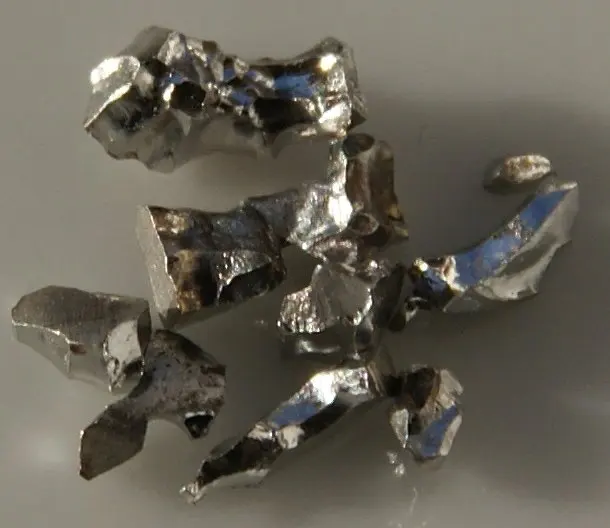
Sixty-six million years ago, a rock about 10 km across, bigger than Mount Everest is tall, hit the Earth. The dust it threw up settled over the whole planet as a thin layer of clay. Most of the dinosaurs died out. Scientists worked this out, in 1980, by measuring a rare metal in that thin layer of clay: iridium (say “ih-RID-ee-um”).
Iridium is also the metal that resists corrosion best of all, it sparks the fuel in many car and motorbike engines, and for 130 years it helped define the kilogram. Here is its story.
The iridium atom
An iridium atom has 77 protons, so iridium’s atomic number is 77, and a neutral atom has 77 electrons. The most common kind, iridium-193, has 116 neutrons: mass number 77 + 116 = 193.
By the 2n² rule Grade 8: Bohr and Bury’s rule, the shells are 2, 8, 18, 32, 15, 2. In subshells Grade 10: The Aufbau principle, the first 70 electrons fill everything up to 6s² and then 4f¹⁴, and the last seven go into 5d:
1s² 2s² 2p⁶ 3s² 3p⁶ 4s² 3d¹⁰ 4p⁶ 5s² 4d¹⁰ 5p⁶ 6s² 4f¹⁴ 5d⁷
That follows the Aufbau order exactly, like cobalt at the top of its group (4s² 3d⁷). Its neighbors are not so regular: rhodium, above it, keeps only one 5s electron, and platinum, next to it, only one 6s electron.
Its place in the periodic table
- Period 6, because its electrons are in six shells. It sits between osmium (76) and platinum (78).
- Group 9, the middle of the three columns that older tables call VIIIB, below cobalt and rhodium.
- d-block: a transition metal Grade 10: Metals.
Iridium is one of the six platinum group metals: ruthenium, rhodium and palladium in period 5, and osmium, iridium and platinum in period 6. They are rare, unreactive, and found together.
Its valency
Iridium has a variable valency Grade 9: Variable valency. The commonest are 3, as in iridium chloride, IrCl₃, and 4, as in the black oxide IrO₂.
How many electrons are in the outermost shell of an iridium atom?
Pick an answer to see why.
How iridium was found and named
In 1803, the English chemist Smithson Tennant was working with his friend William Hyde Wollaston on a large batch of platinum ore from South America. They dissolved it in aqua regia, a mixture of concentrated nitric and hydrochloric acids, which leaves a little black powder behind. Others had taken the powder for graphite. Tennant treated it again and again with acids and alkalis, and found in it two new metals.
One gave off a sharp smell, and he named it osmium. The other formed salts of many different colors as it dissolved in hydrochloric acid, reds, blues, greens and yellows, so he named it after Iris, the Greek goddess of the rainbow: iridium. He announced both in 1804. (The same Greek word gives iris, the colored part of your eye.)
Iridium’s symbol is Ir. Nepali uses the English name: इरिडियम.
Nobody could melt the metal at first. In 1813, a group of chemists including Humphry Davy at last melted a little of it with the current from a huge bank of batteries.
Where iridium is found
In the universe. Like all elements much heavier than iron, iridium was made by atomic nuclei catching neutrons, in giant stars and in collisions of dead stars (Heavier than iron).
In the Earth. Iridium is one of the rarest elements in the crust. Estimates differ, from about one part in a billion to less than a tenth of that, but all agree it is far rarer than gold. Most of the Earth’s iridium is not in the crust at all. When the young Earth was molten, iridium dissolved in the iron that sank to the middle, so it is in the core. Meteorites, which never melted like this, hold hundreds of times more iridium than the crust Grade 8: Meteorites.
Iridium is found as small grains of natural alloys with osmium and platinum, and in the ores of platinum and nickel. Most of it comes from South Africa, as a by-product of platinum mining, with Russia next. Only about 7 tonnes are produced in a whole year, so little that in 2024 it cost about twice as much as gold (USGS).
In Nepal and in your body. None is mined in Nepal, and no living thing needs it.
The layer that ended the dinosaurs
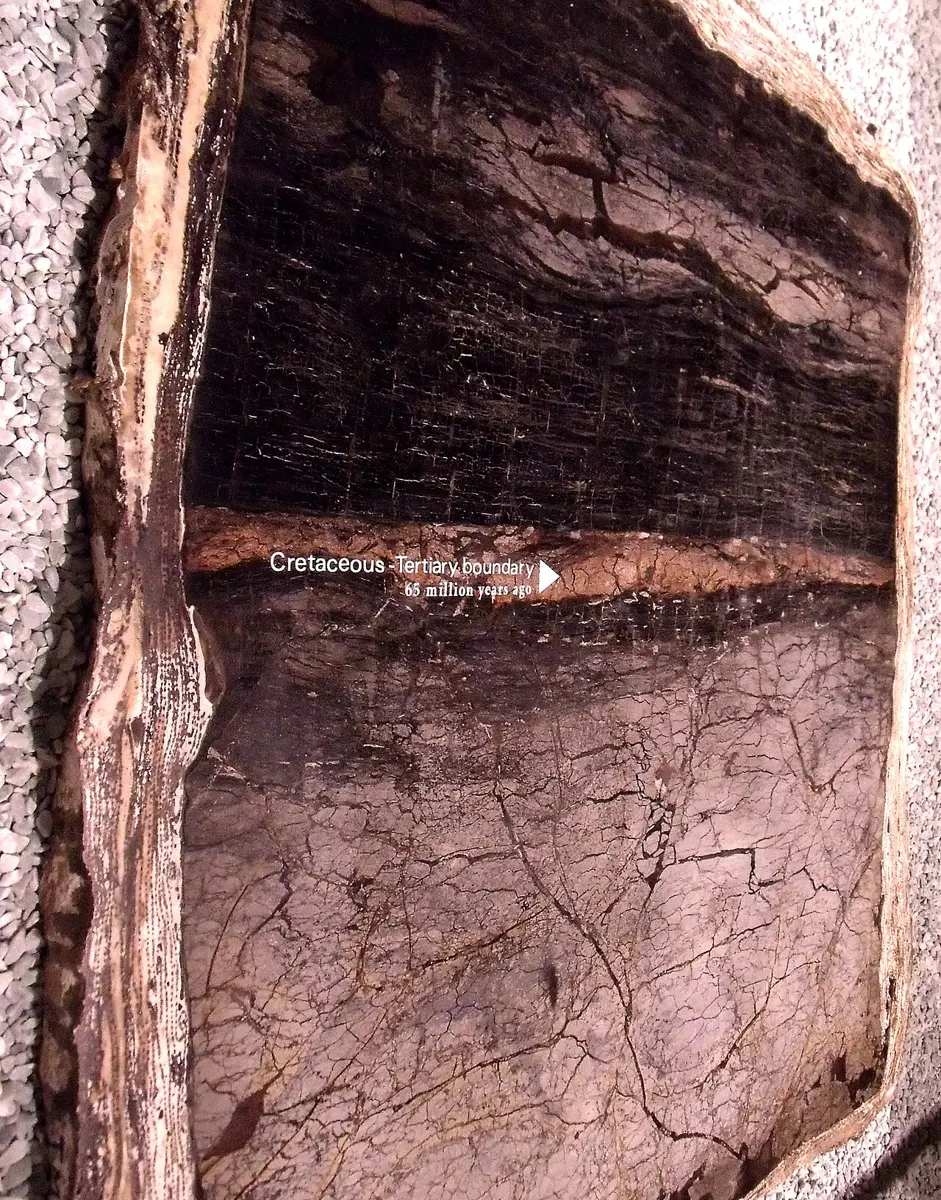
In the late 1970s, the American geologist Walter Alvarez was studying a thin layer of clay, about a centimeter thick, in the limestone rocks near Gubbio, in Italy. Below it were the fossils of many kinds of tiny sea creatures; above it, almost none Grade 9: Fossils. He wanted to know how long the clay had taken to settle. His father, the physicist Luis Alvarez, had an idea: measure iridium. Dust from space falls on the Earth slowly and steadily, and it carries iridium, so the amount of iridium in the clay would tell how many years of dust it held.
With the chemists Frank Asaro and Helen Michel they measured it, and found about 30 times more iridium in the clay than in the rock around it, far too much for slow space dust. In 1980 they suggested the answer: a huge asteroid Grade 8: Asteroids, about 10 km across, had hit the Earth. Its iridium, turned to dust, spread round the world and settled in one thin layer. The dust and smoke would have blocked out the sunlight for months or years, and many plants, and the animals that ate them, died.
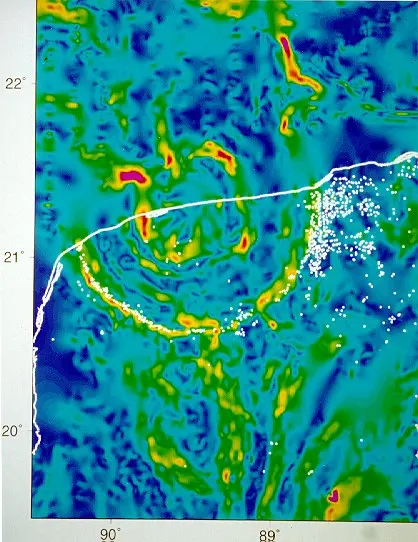
Many scientists doubted it at first. But the iridium-rich layer has since been found in more than a hundred places around the world, always at the same point among the fossils: above the last dinosaurs, below the age of mammals (Matching layers far apart). In 1991, scientists showed that the crater itself lies buried under the Yucatán Peninsula of Mexico: the Chicxulub crater, about 180 km wide and about 66 million years old.
Not every question is settled. At the same time, huge volcanic eruptions were pouring out the lava that formed the Deccan Traps of India, and some scientists think they too played a part (How species end). But almost all agree that the asteroid struck, and that it was the main cause.
Why did a high amount of iridium in the clay point to an asteroid?
Pick an answer to see why.
What iridium is like
- A hard, silvery-white metal with a faint yellow tint.
- The second densest element: about 22.56 g/cm³, a hair less than osmium (22.59) (Figure 5). Some tables give slightly lower figures for it.
- Melts at 2,446 °C Grade 9: High melting points.
- Hard and brittle. It is very hard to hammer, roll or shape, so it is often used as a small part of an alloy, or as a tiny tip.
- The most corrosion-resistant metal of all. No single acid dissolves it, not even aqua regia, which dissolves gold and platinum.
How iridium reacts
At room temperature, a piece of iridium reacts with nothing around it: not air, not water, not acids. It is near the very bottom of the reactivity series, with platinum and gold. Heated strongly in air, it slowly forms a thin film of black iridium dioxide:
Ir + O₂ → IrO₂
Its compounds are the colorful salts that gave it its name: depending on its valency and the atoms joined to it, an iridium compound can be red, brown, green, yellow or blue.
Iridium at work
Spark plugs
A petrol engine fires its fuel with a spark, which jumps across a small gap at the tip of a spark plug thousands of times a minute. Each spark eats away a tiny amount of the metal. Ordinary plugs have a nickel alloy tip about 2.5 mm thick. Iridium plugs have a tip only about half a millimeter thick, which needs less voltage to spark and, because iridium wears so slowly, still lasts several times longer. Many cars, motorbikes and small aircraft use them.
Crucibles, screens and hydrogen
- Crucibles. Some crystals for lasers and electronics are grown from melts hotter than 2,000 °C. Few containers survive that without reacting with the melt: iridium crucibles do.
- Phone screens. Many OLED screens of phones and televisions make their red and green light with compounds of iridium, which turn electricity into light very efficiently.
- Making chlorine and hydrogen. Electrodes coated with iridium oxide last for years in the harsh conditions of electrolysis. One common kind of machine for splitting water into hydrogen and oxygen with electricity needs iridium at its positive electrode. In 2024 Nepal adopted a Green Hydrogen Policy, hoping one day to use its hydroelectricity to make hydrogen this way.
The kilogram and the meter
From 1889, the world’s standards of length and mass were made of platinum with 10% iridium Grade 10: Fundamental units: a bar for the meter, used until 1960, and a small cylinder for the kilogram, used until 2019. Pure platinum is soft; the iridium made the alloy hard, so it would not wear or bend, and it never rusts. You can read the kilogram’s story on the platinum page.
Isotopes of iridium
Natural iridium is a mixture of two stable isotopes: about 37.3% iridium-191 and 62.7% iridium-193.
A man-made radioactive isotope, iridium-192, gives out strong gamma rays and has a half-life of about 74 days. Engineers use a small pellet of it to take gamma-ray photographs of welds in pipelines, bridges and boilers, to find hidden cracks. Doctors place tiny iridium-192 sources inside or beside a tumor for a few minutes, to kill cancer cells from close up (brachytherapy).
Iridium and your health
Your body has no use for iridium, and there is almost none in food. The metal is so unreactive that it is harmless, which is why it can be used in medical implants such as the tips of pacemaker wires. Iridium-192 is dangerous only because it is radioactive: lost sources have badly burnt people who picked them up, so they are kept in heavy shielded containers.
Surprising facts and records
- The highest valency ever seen. In 2014, chemists made the ion IrO₄⁺, in which iridium uses nine valencies, the highest of any element.
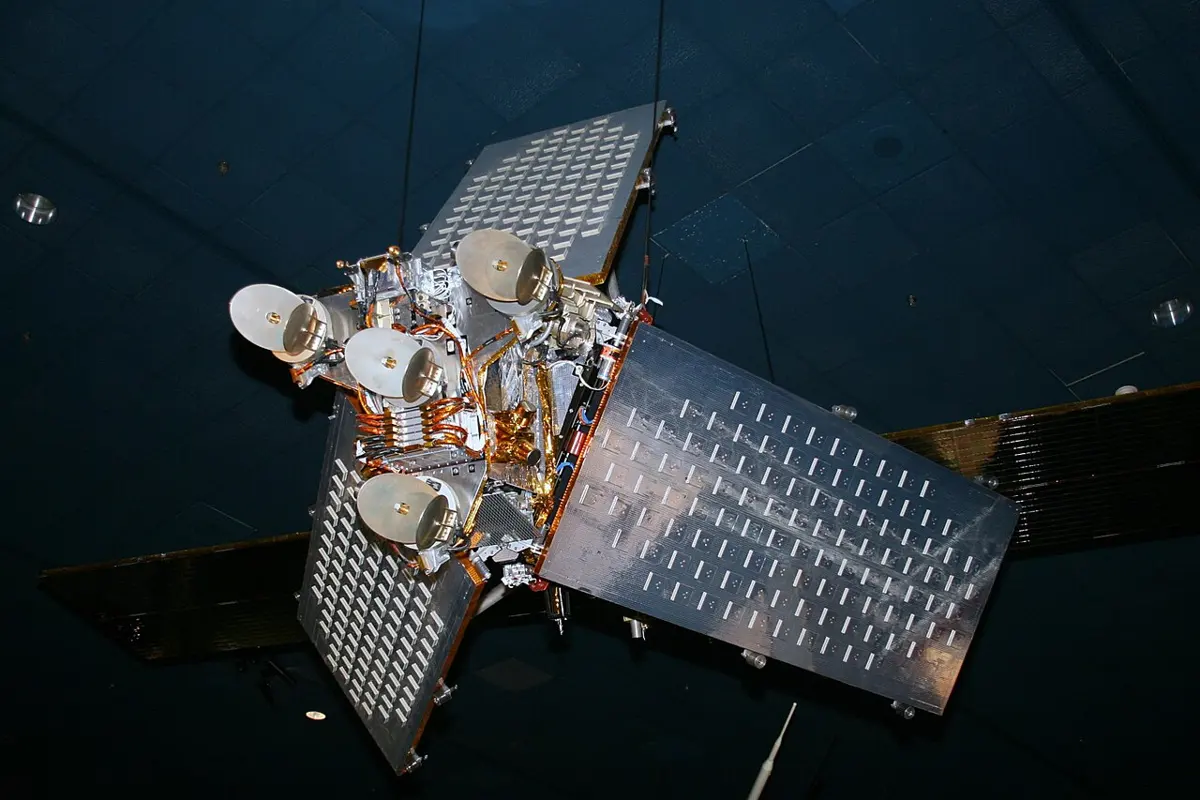
- Satellites named after it. In the 1990s, a company planned a network of 77 satellites for phones that work anywhere on Earth, and named it Iridium, after the element with 77 electrons. In the end it needed only 66, but kept the name. Sunlight glinting off the old satellites’ flat antennas made brief bright “Iridium flares” in the night sky.
- A Nobel experiment. In 1958, the German physicist Rudolf Mössbauer discovered that iridium-191 nuclei can give out and take in gamma rays without recoiling, a discovery that won him the Nobel Prize in Physics in 1961.
- Rarer than gold, and in 2024 about twice as dear.
In your science books
- Grade 8: the 2n² rule, asteroids and meteorites.
- Grade 9: variable valency, atomic mass, high melting points and fossils.
- Grade 10: fundamental units, electronic configuration and transition metals.
- Going further: one thin layer, all over the world, how species end and where heavy atoms are made.
More to explore
- Its family and neighbors: cobalt and rhodium above it in group 9; osmium, found with it in 1803; and platinum, its partner in the old kilogram.
- Play: find iridium in Guess the Element and the Periodic Table Jigsaw.
- Read more: iridium at the Royal Society of Chemistry and at PubChem.