
- Atomic number
- 75
- Atomic mass
- 186.21
- Shells
- 2, 8, 18, 32, 13, 2
- Configuration
- 1s² 2s² 2p⁶ 3s² 3p⁶ 4s² 3d¹⁰ 4p⁶ 5s² 4d¹⁰ 5p⁶ 6s² 4f¹⁴ 5d⁵
- In the table
- period 6, group 7 (VIIB), d-block
- Kind
- Transition metal
- Valency
- 7 (as in Re₂O₇); also 4, 6 and others
- State at 25 °C
- solid
- Melts · boils
- 3,186 °C · 5,596 °C
- Density
- 20.8 × as heavy as water
- Known since
- 1925
Watch a big passenger jet climb away from Tribhuvan International Airport. Deep inside each engine, a ring of small metal blades spins thousands of times a minute in a blast of burning gas hotter than the melting point of the metal they are made of. They survive because cool air flows through tiny channels inside them, and because their metal has been strengthened with a few percent of one of the rarest elements on Earth: rhenium (say “REE-nee-um”).
Rhenium was also the last stable element to be discovered, in 1925. Every element found after it is radioactive. Here is its story.
The rhenium atom
A rhenium atom has 75 protons, so rhenium’s atomic number is 75, and a neutral atom has 75 electrons. The most common kind, rhenium-187, has 112 neutrons: mass number 75 + 112 = 187.
By the 2n² rule Grade 8: Bohr and Bury’s rule, the shells are 2, 8, 18, 32, 13, 2. The fourth shell (N) is full, with all the 32 it can hold. The fifth (O) has 13, and is still filling as period 6 goes on, while two electrons already sit in the sixth (P).
Its electronic configuration
In the Aufbau order Grade 10: The Aufbau principle, the first 70 electrons fill every subshell up to 6s², and then the fourteen places of 4f. The last five go into 5d:
1s² 2s² 2p⁶ 3s² 3p⁶ 4s² 3d¹⁰ 4p⁶ 5s² 4d¹⁰ 5p⁶ 6s² 4f¹⁴ 5d⁵
This time the rule works exactly: rhenium ends 6s² 5d⁵, just as manganese ends 4s² 3d⁵. Its five d electrons sit one in each of the five d orbitals, a half-full d subshell.
How many electrons are in the outermost shell of a rhenium atom?
Pick an answer to see why.
Its place in the periodic table
- Period 6, because its electrons are in six shells. It sits between tungsten (74) and osmium (76).
- Group 7, called VIIB in older tables, with manganese and technetium above it.
- d-block, because its last electrons go into a d subshell: a transition metal Grade 10: Metals.
Its valency
Rhenium can use any number of its seven outer electrons, so it has a variable valency Grade 9: Variable valency: few elements have as many. Its favorite is the highest, 7, as in its yellow oxide, Re₂O₇, and in the perrhenate ion, ReO₄⁻, which looks just like manganese’s purple permanganate, MnO₄⁻, but is colorless.
In rhenium’s oxide Re₂O₇, oxygen has a valency of 2. What is the valency of rhenium?
Pick an answer to see why.
How rhenium was found and named
When Dmitri Mendeleev drew up his periodic table in 1869–1871, group 7 held only one known element, manganese. He left two gaps below it Grade 10: Mendeleev’s periodic table and named the missing elements eka-manganese (“one below manganese”) and dvi-manganese (“two below”), using the Sanskrit words for one and two. Element 75, rhenium, was dvi-manganese.
- 1908. The Japanese chemist Masataka Ogawa announced a new element in thorianite, a mineral from Sri Lanka, and named it nipponium, after Japan. He thought it was eka-manganese, element 43. Nobody could confirm it, and the claim was forgotten. In 2004, a fresh look at his old photographs of its spectrum showed that what he had found was really element 75.
- 1925. In Berlin, the German chemists Walter Noddack, Ida Tacke (who married Noddack the next year) and Otto Berg found element 75 in minerals such as gadolinite and columbite, and in platinum ore. They recognized it by the X-rays it gave out, whose energy follows from the number of protons. They named it rhenium after the river Rhine (Rhenus in Latin), in the west of Germany, where Ida Tacke grew up.
- 1928. To prove it, they worked through about 660 kg of the mineral molybdenite and got about one gram of rhenium.

Rhenium’s symbol is Re. Nepali uses the English name: रेनियम. It was the last element with a stable isotope to be found: hafnium came in 1923, and every element found since 1925 is radioactive.
Where rhenium is found
In the universe. Rhenium is far heavier than iron, so no star could make it by fusion. It was built by atomic nuclei catching neutrons, in giant stars and when dead stars collide (Heavier than iron).
In the Earth’s crust. Rhenium is one of the rarest elements of all: about one part in a billion, or roughly a gram in every thousand tonnes of rock. It has no ore of its own. It hides, a fraction of a percent at most, inside molybdenite (MoS₂), the ore of molybdenum, which is mined along with copper. When molybdenite is roasted in air Grade 10: Roasting, the rhenium turns into its oxide, Re₂O₇, which becomes a gas at a low temperature and goes up the chimney. It is caught from the dust and fumes.
In 2024 the whole world produced about 62 tonnes of new rhenium, nearly half of it in Chile, from its huge copper mines, with the United States and Poland next (USGS). About 25 tonnes more were recycled from old jet engine parts and used catalysts.
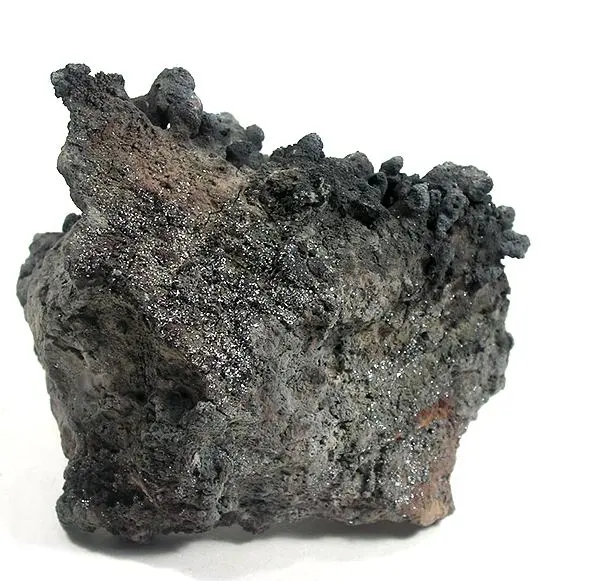
On a volcano. In the 1990s, scientists found the first true rhenium mineral, rheniite (rhenium sulphide, ReS₂), growing as thin crystals round hot gas vents on the Kudriavy volcano, on an island between Japan and Russia. The volcano breathes out tens of kilograms of rhenium a year.
In Nepal and in your body. No rhenium is mined in Nepal, and no living thing needs it.
What rhenium is like
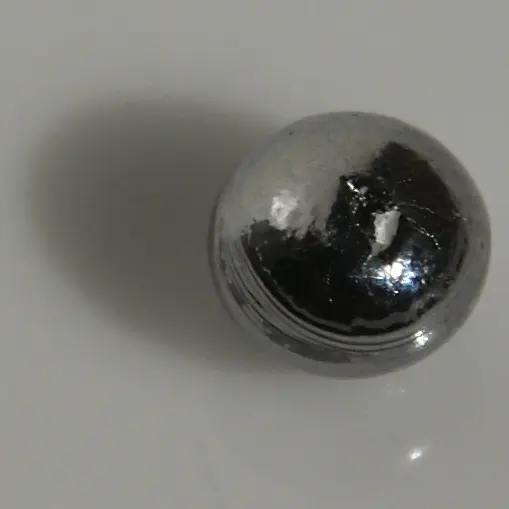
- A silvery-gray metal, usually made as a powder and pressed into shape.
- Very heavy: its density is about 21 g/cm³, more than gold. Only osmium, iridium and platinum are denser.
- Melts at 3,186 °C Grade 9: High melting points. Only tungsten among the metals melts at a higher temperature.
- Boils at about 5,600 °C, one of the highest boiling points of any element. (Measurements at such temperatures are hard: some put tungsten’s boiling point a little above rhenium’s, some below.)
- Tough when hot. Most metals with very high melting points, like tungsten, crack easily when cold. Rhenium can be bent, rolled and drawn into wire, and it stays strong at temperatures that soften other metals.
How rhenium reacts
At room temperature a solid piece of rhenium does not react with air, water, or even hydrochloric or sulphuric acid. Heated in air, it burns to its yellow oxide, which turns to a vapor easily:
4Re + 7O₂ → 2Re₂O₇
That is why rhenium must be kept away from air when it is very hot, and why a high melting point alone does not make it useful in a hot flame: the metal would slowly burn away as a gas. In the engines below, other metals around it protect it.
Re₂O₇ dissolves in water to make perrhenic acid, and its salts, the perrhenates, are how rhenium is usually sold, as white crystals of ammonium perrhenate. The metal is made from them by heating with hydrogen, which takes away the oxygen Grade 10: Reduction.
Rhenium at work
In jet engines
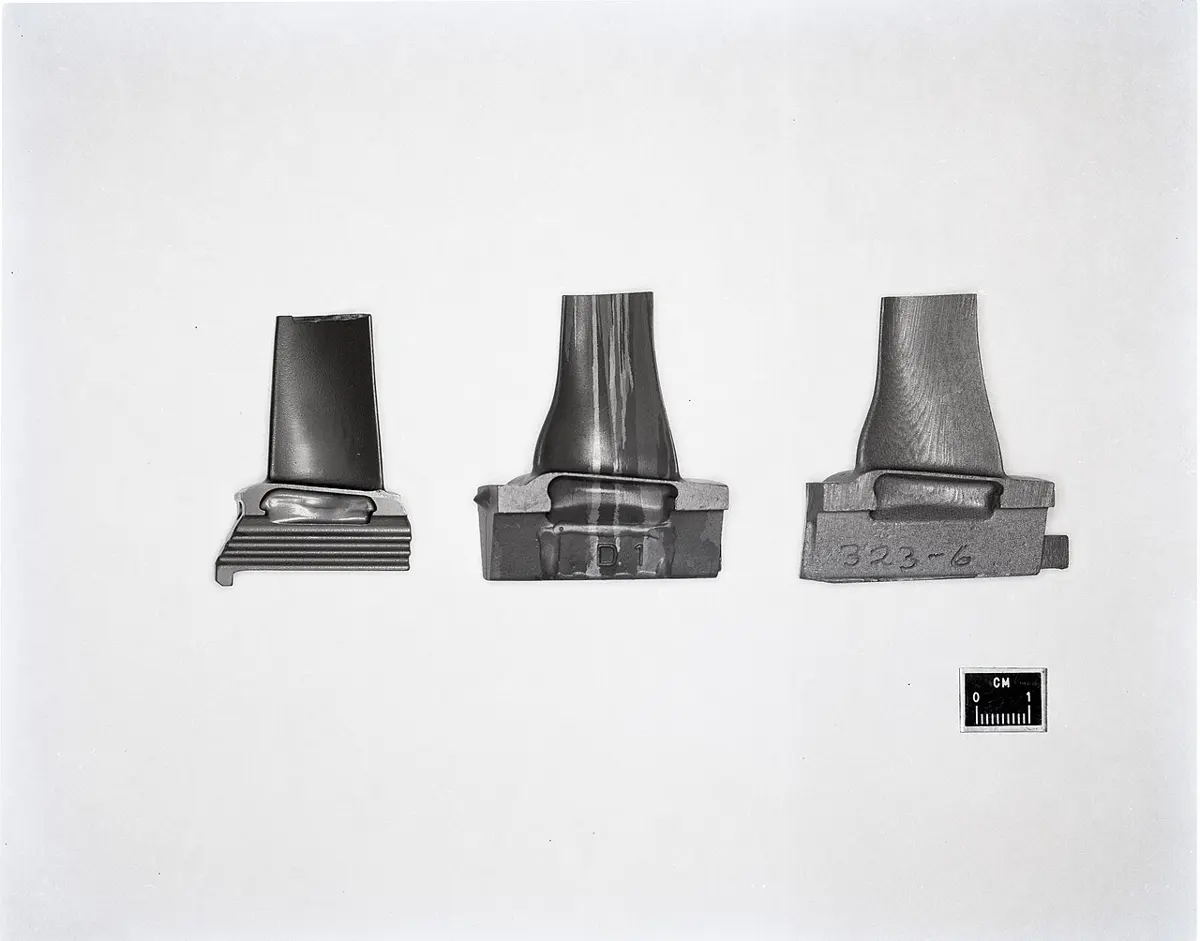
Most rhenium, about three quarters of it, goes into superalloys: special alloys of nickel, with cobalt, chromium, aluminium, tungsten and other metals, used for the hottest parts of jet engines and of the gas turbines that make electricity in some countries.
The blades just behind the engine’s burner spin in gas far hotter than the melting point of the nickel alloy. Coatings and cooling air keep the metal itself a couple of hundred degrees below its melting point, but even so it is close to melting, and the force of spinning pulls on them all the time. A hot metal under a steady pull slowly stretches, like toffee, a little more every hour. This slow stretching is called creep. If a blade stretched until it touched the engine’s casing, the engine would be destroyed.
Rhenium’s big, heavy atoms, about 3% or 6% of the alloy, sit among the nickel atoms and slow down creep: they make it harder for layers of atoms to slide past each other. The best blades are also cast as a single crystal, a whole blade in which every atom lines up in one pattern.
Making better petrol
Most of the rest of the world’s rhenium goes into catalysts Grade 10: Catalyst. In oil refineries, a catalyst of platinum and rhenium reshapes the straight-chain molecules of a part of crude oil into ring-shaped and branched ones Grade 10: The alkanes. These burn smoothly in a car engine instead of exploding too early, so they make high-octane petrol without adding lead. The rhenium keeps the platinum working longer: without it, the platinum is soon covered with soot.
Heat, X-rays and light
- X-ray machines. The X-rays in a hospital come from a disc that is hit by fast electrons and becomes white-hot. The disc is usually tungsten with a little rhenium, which stops it cracking.
- Measuring great heat. Two wires, one of tungsten–rhenium alloy and another with a different amount of rhenium, joined at one end make a thermocouple: it gives a tiny voltage that tells the temperature, up to about 2,200 °C, in furnaces far too hot for any thermometer.
- Switches. Rhenium makes electrical contacts that last: when a spark forms on its surface, the oxide it makes just turns to gas and leaves the surface clean.
Isotopes of rhenium
Natural rhenium is a mixture of two isotopes: about 37.4% rhenium-185, which is stable, and 62.6% rhenium-187, which is radioactive. Rhenium is one of only three elements (with indium and tellurium) in which the radioactive isotope is the more common one.
Rhenium-187 decays so slowly that half of it takes more than 40 billion years to decay, about three times the age of the universe. In each decay, a neutron in its nucleus turns into a proton and gives out an electron, a beta particle (Beta decay). With 76 protons, the atom is now osmium-187.
Geologists use this as a clock (A clock inside the atom). In a mineral that held rhenium but no osmium when it formed, the more osmium-187 has built up beside the rhenium-187, the older the mineral. Rhenium–osmium dating tells the age of ores, of meteorites and of oil.
A rhenium-187 atom gives out a beta particle. Which element is it now?
Pick an answer to see why.
Doctors use a man-made radioactive isotope, rhenium-188, to treat some kinds of cancer: its beta particles travel no more than about a centimeter in the body, so they harm the tumor and not much else.
Rhenium and your health
Your body has no use for rhenium, and there is almost none in food. Very little is known about its effects, because hardly anyone ever meets it: the solid metal is not thought to be harmful, but as with any metal powder, its dust should not be breathed in.
Surprising facts and records
- Four bonds at once. Until 1964, chemists thought two atoms could be joined by at most a triple bond, like the two nitrogen atoms in N₂ Grade 9: Double and triple bonds. Then the American chemist Albert Cotton showed that the two rhenium atoms in the ion Re₂Cl₈²⁻ are held by a quadruple bond, four bonds at once.
- One of the rarest, yet it is not even the dearest: it is cheaper than gold, because so little of it is wanted.
- The last stable element to be found, in 1925. Every element discovered since then is radioactive.
- Found twice. Ogawa’s nipponium and the Noddacks’ rhenium were the same element, 17 years apart.
In your science books
- Grade 8: the 2n² rule and groups and periods.
- Grade 9: variable valency, atomic mass, nuclear fission and high melting points.
- Grade 10: Mendeleev’s gaps, electronic configuration, transition metals, roasting and catalysts.
- Going further: beta decay, clocks inside atoms and where heavy atoms are made.
More to explore
- Its family: manganese and technetium, above it in group 7; and its neighbors tungsten, which melts higher, and osmium, which rhenium-187 turns into.
- Play: find rhenium in Guess the Element and the Periodic Table Jigsaw.
- Read more: rhenium at the Royal Society of Chemistry and at PubChem.