
- Atomic number
- 95
- Atomic mass
- 243.06
- Shells
- 2, 8, 18, 32, 25, 8, 2
- Configuration
- 1s² 2s² 2p⁶ 3s² 3p⁶ 4s² 3d¹⁰ 4p⁶ 5s² 4d¹⁰ 5p⁶ 6s² 4f¹⁴ 5d¹⁰ 6p⁶ 7s² 5f⁷
- In the table
- period 7, group none (f-block), f-block
- Kind
- Actinide
- Valency
- 3 (Am³⁺) is the most stable; also 2, 4, 5 and 6
- State at 25 °C
- solid
- Melts · boils
- 1,176 °C · 2,011 °C
- Density
- 13.7 × as heavy as water
- Known since
- 1944
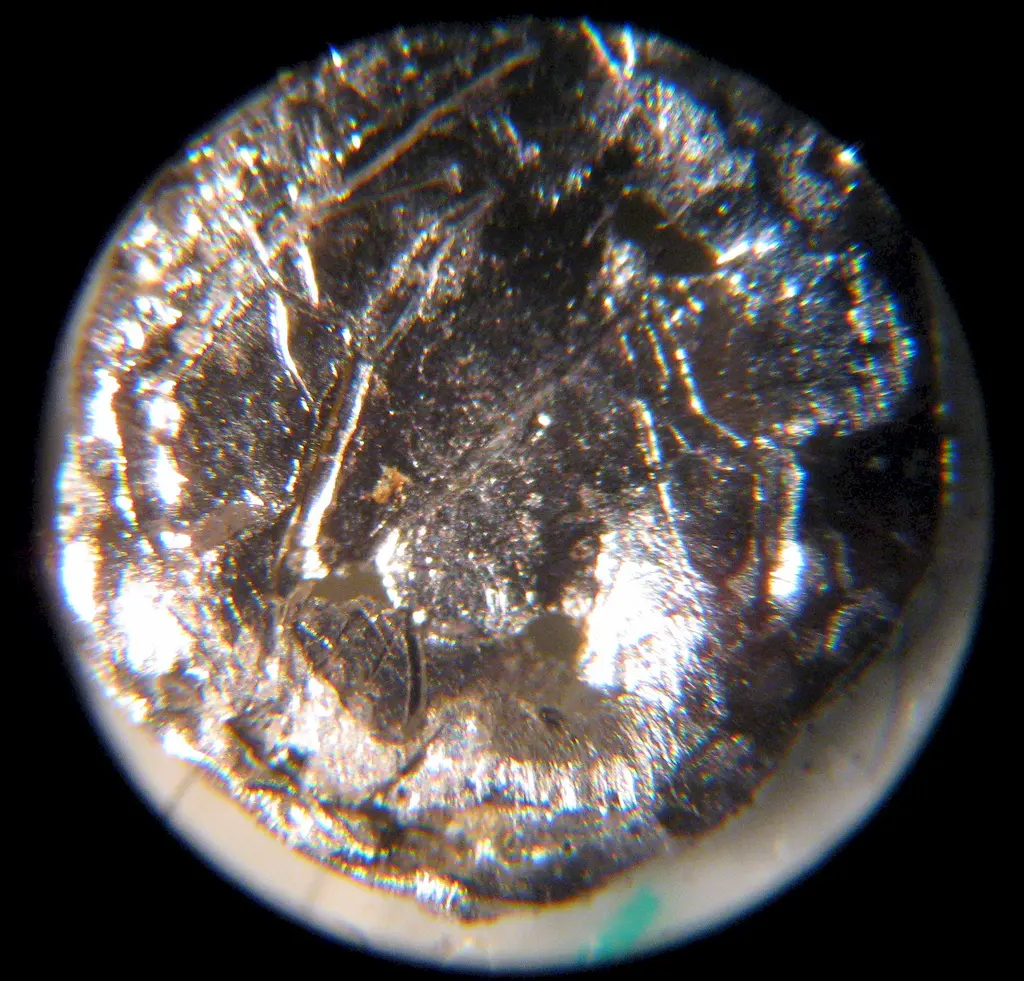
Look up at the ceiling of a hotel, an office or a modern home, and you may see a round white box: a smoke alarm. Many of them hold a speck of a metal that does not exist in nature and was first made in 1944: americium, element 95. Few people know that their home may hold an element made by people.
The americium atom
An americium atom has 95 protons (atomic number 95) and 95 electrons. The kind in smoke alarms, americium-241, has 146 neutrons: 95 + 146 = 241. By shells, the electrons are 2, 8, 18, 32, 25, 8, 2, and in subshells Grade 10: The Aufbau principle:
… 6p⁶ 7s² 5f⁷
Its 5f subshell holds seven electrons, one in each of its seven orbitals: it is exactly half full, which makes it extra stable. The same is true of europium, the element directly above it among the lanthanides (4f⁷).
Americium is in period 7, the seventh of the actinides in the f-block Grade 10: Features of the modern periodic table, and a metal. The actinides before it give away many different numbers of electrons; americium mostly gives away three, forming Am³⁺, just as the lanthanides do. Its other valencies, 2, 4, 5 and 6, appear only in special conditions Grade 9: Variable valency.
An americium-241 atom gives out an alpha particle (2 protons and 2 neutrons). What does it become?
Pick an answer to see why.
How americium was made and named
In late 1944, at the University of Chicago, Glenn Seaborg, Ralph James, Leon Morgan and Albert Ghiorso left plutonium in a nuclear reactor for a long time. Its nuclei caught one neutron, then another, becoming plutonium-240 and then plutonium-241, which gave out a beta particle: a neutron turned into a proton, and element 94 became element 95 (A neutron becomes a proton). It was found a few months after curium, element 96, the next element in the table.
The first samples weighed only a few millionths of a gram, too small to see, and were found by their radioactivity. The discovery was secret during the Second World War. In November 1945 Seaborg was the guest on Quiz Kids, an American radio show for children, and a young listener asked him whether any new elements had been made during the war. So children heard about americium and curium before most scientists did.
The team noticed that americium sits directly below europium, named after Europe, so they named it after the Americas, where it was made. Its symbol is Am.
Where americium is found
The longest-lasting kind, americium-243, has a half-life of about 7,400 years, and americium-241 about 432 years: far too short for any americium from the Earth’s birth to be left. Only unmeasurably tiny traces form in uranium ores. All the americium we use is made in nuclear reactors, where it builds up in the used fuel from the plutonium there, and is separated from it in small amounts.
What americium is like
What has been measured:
- It is a silvery, shiny metal, softer than the actinides before it, that tarnishes slowly in air.
- It melts at 1,176 °C.
- It is radioactive: americium-241 gives out alpha particles and weak gamma rays.
What is uncertain: its density and boiling point. Americium is so rare that few samples of the pure metal have ever been made. The Royal Society of Chemistry gives a density of about 12 g/cm³; other tables, PubChem among them, give 13.7. For the boiling point, tables give anything from about 2,000 °C to 2,600 °C, and the higher figure is only calculated. The figures on this page’s facts card are one source’s values, not settled ones.
How a smoke alarm works
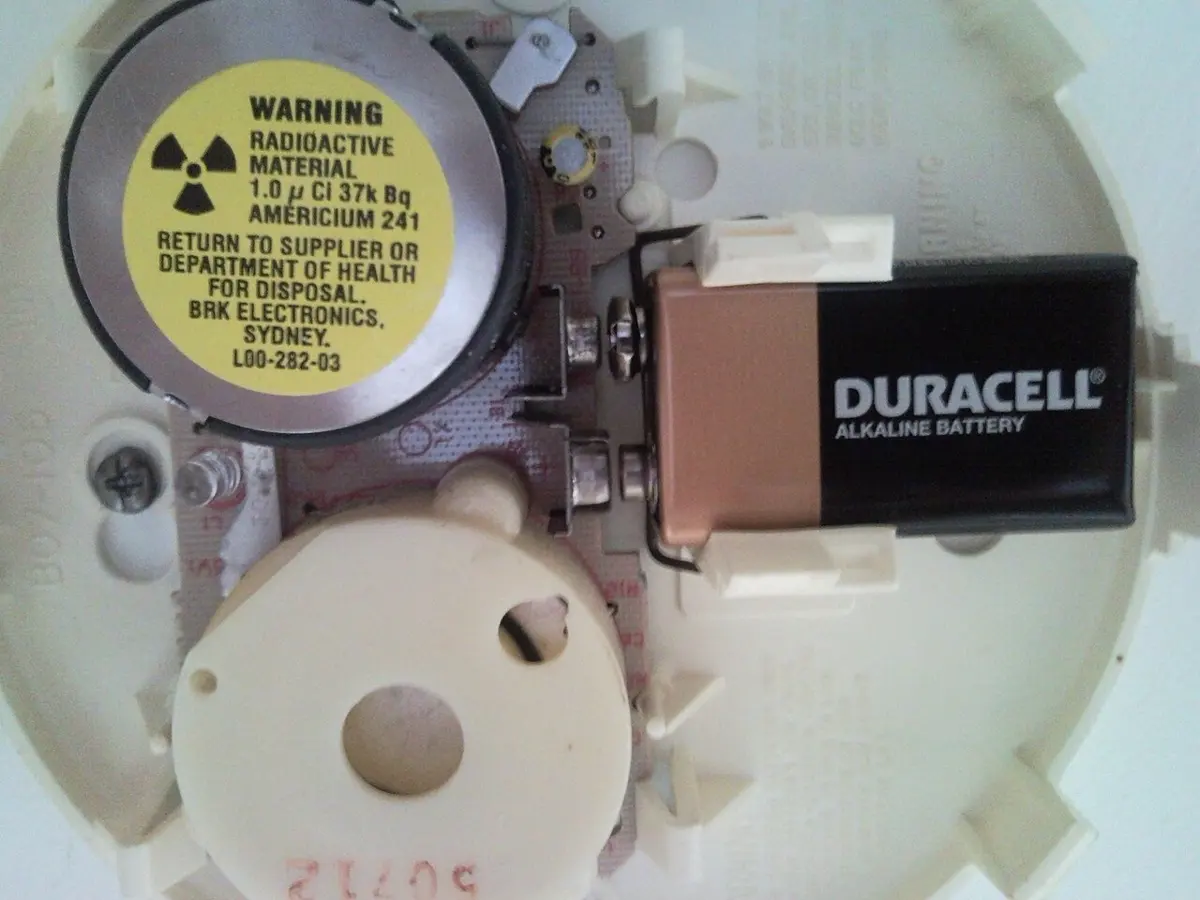
There are two kinds of smoke alarm. One kind shines a beam of light and sounds when smoke scatters it. The other kind, the ionization smoke alarm, uses americium.
Inside it is a small chamber of air between two metal plates, connected to a battery. On one plate is a sealed speck of americium-241. Its alpha particles fly a few centimeters through the air, knocking electrons off the air molecules they hit and leaving ions behind Grade 9: Ion. The positive ions drift to one plate and the negative ones to the other, so a tiny, steady electric current flows across the air.
When smoke gets in, its particles catch the ions. Fewer ions reach the plates, the current drops, and a circuit that watches the current sounds the alarm.
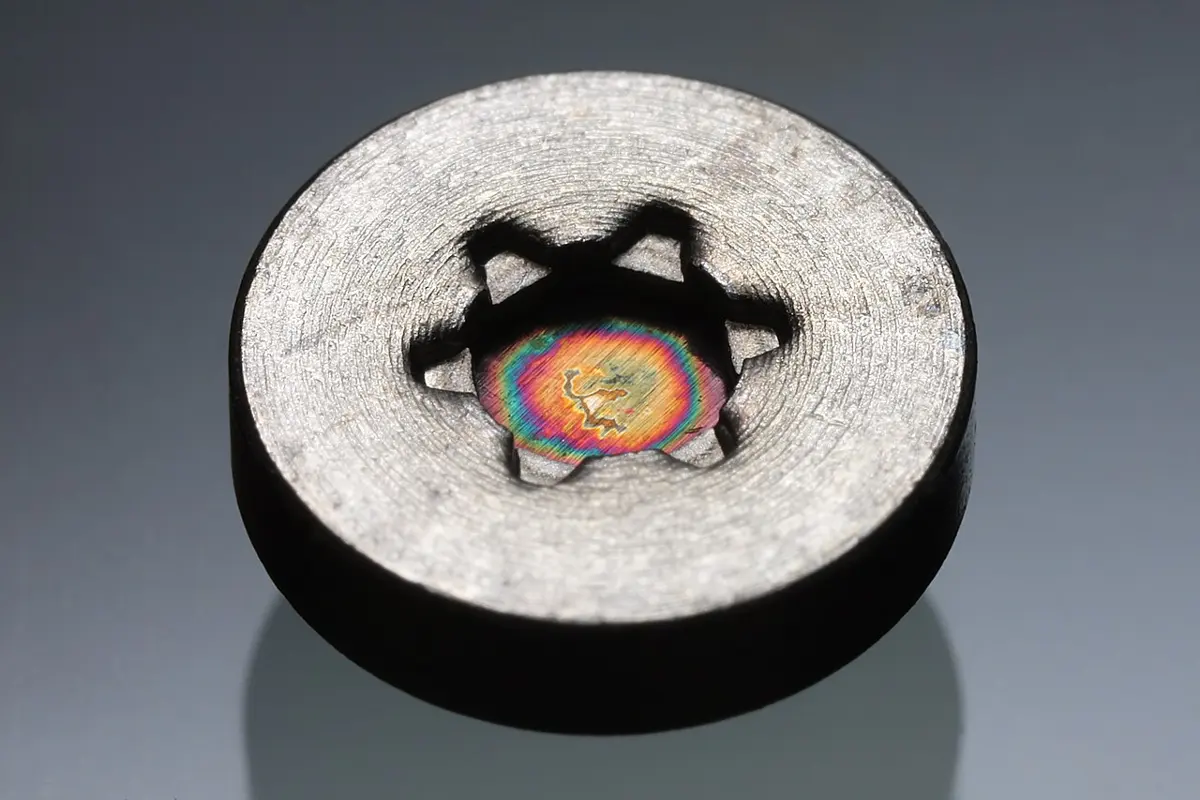
How much americium is in one? Most smoke alarms hold about 0.3 millionths of a gram (0.3 micrograms), a speck far smaller than a grain of sand. Its alpha particles cannot get out through the chamber’s walls, and the little gamma radiation that escapes is tiny. The US Nuclear Regulatory Commission found that people with two of these alarms at home get less than a hundred-thousandth of the radiation they receive each year from natural sources.
Why does an ionization smoke alarm sound when smoke gets in?
Pick an answer to see why.
Other uses
Americium-241 also measures the thickness of glass, metal foil and paper in factories (the thicker the sheet, the fewer of its rays get through), and mixed with beryllium it makes a source of neutrons for testing rocks deep in oil wells. The European Space Agency is building nuclear batteries that would run on americium-241, as American spacecraft run on plutonium-238: it gives out less heat, but its longer half-life means it lasts longer, and it can be taken from the used fuel of power stations.
Americium and your health
The body has no use for americium. If it is swallowed or breathed in, it settles in the bones and liver, where its alpha particles damage the cells around it for many years. Outside the body, its alpha particles cannot get through the outer layer of your skin. In a smoke alarm, sealed and on the ceiling, it does no harm, and an alarm that warns of a fire in time saves lives.
In your science books
- Grade 9: ions, radioactive elements and variable valency.
- Grade 10: the actinides and the Aufbau principle.
- Going further: alpha decay, beta decay and what ionizing radiation does.
More to explore
- Nobel Prizes: Seaborg and McMillan’s prize (1951) for the elements beyond uranium.
- Its neighbors: plutonium, from which it is made, neptunium, which it decays into, curium, found just before it, and europium, the element above it.
- Play: find americium in Guess the Element and the Periodic Table Jigsaw.
- Read more: americium at the Royal Society of Chemistry and at PubChem.