
- Atomic number
- 32
- Atomic mass
- 72.63
- Shells
- 2, 8, 18, 4
- Configuration
- 1s² 2s² 2p⁶ 3s² 3p⁶ 4s² 3d¹⁰ 4p²
- In the table
- period 4, group 14 (IVA), p-block
- Kind
- Metalloid
- Valency
- 4 (GeO₂, GeCl₄); also 2
- State at 25 °C
- solid
- Melts · boils
- 938 °C · 2,833 °C
- Density
- 5.3 × as heavy as water
- Known since
- 1886
The videos on your phone reach Nepal as flashes of light, racing through thin threads of glass in cables that come in from India and China. Inside every thread is a trace of germanium, and without it the light would leak away. A firefighter’s thermal camera, which sees a person through smoke by the heat of their body, looks out through a lens of germanium, a lens that you cannot see through at all.
Germanium is also the element of the very first transistor, built in 1947, the tiny switch that is now in every phone and computer by the billion. And like gallium, it is an element that Mendeleev described before anyone had found it. Here is its story.
The germanium atom
Every germanium atom has 32 protons, so germanium’s atomic number is 32, and a neutral atom has 32 electrons. Germanium has five natural isotopes; the most common has 42 neutrons, mass number 32 + 42 = 74.
Its shells and subshells
By the 2n² rule Grade 8: Bohr and Bury’s rule, the shells fill as 2, 8, 18, leaving 4 electrons for the N shell: 2, 8, 18, 4.
In subshells Grade 10: The Aufbau principle, germanium has one more electron than gallium, and it also goes into 4p:
1s² 2s² 2p⁶ 3s² 3p⁶ 4s² 3d¹⁰ 4p²
The N shell holds 4s² 4p²: 4 valence electrons, just like carbon (2s² 2p²) and silicon (3s² 3p²) above it.
Its place in the periodic table
- Period 4, because its electrons are in four shells.
- Group 14, called IVA in the older naming: carbon, silicon, germanium, tin and lead, the carbon family.
- p-block, because its last electrons go into a p subshell.
Down group 14 the elements change from a non-metal (carbon) to metals (tin and lead). Silicon and germanium, in between, are metalloids: they look like metals, but break like glass, and they conduct electricity only a little Grade 10: Metalloids.
Gaining or losing four electrons takes too much energy, so germanium mostly shares its four valence electrons in covalent bonds, like silicon Grade 9: Covalent bond. Its usual valency is 4, as in germanium dioxide (GeO₂) and germanium tetrachloride (GeCl₄). It can also show valency 2, as in GeO.
Which element has the same number of valence electrons as germanium?
Pick an answer to see why.
How germanium was predicted, found and named
In 1871 Dmitri Mendeleev described an element missing from his table below silicon. He called it eka-silicon, and predicted its atomic mass (about 72), its density (5.5 g/cm³), its oxide (EsO₂) and even its chloride, a liquid boiling below 100 °C Grade 10: The gaps that came true.
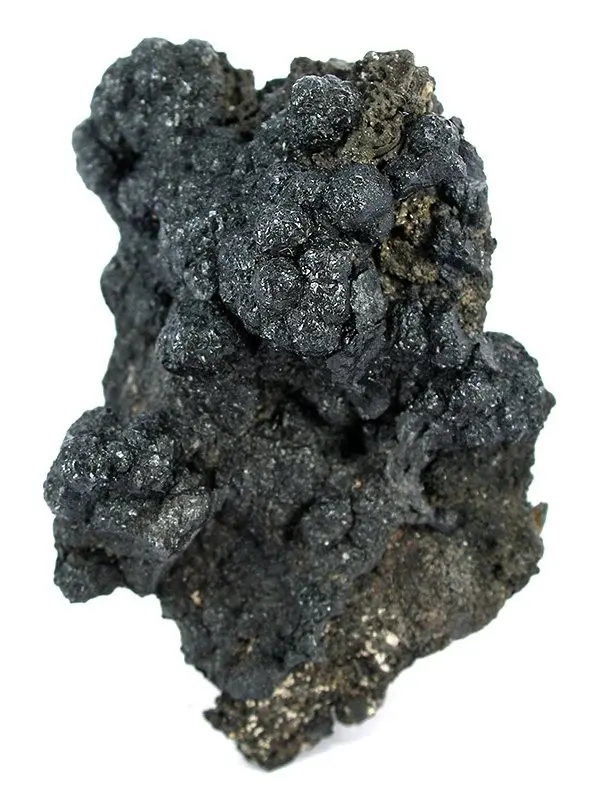
In 1885 a miner at the Himmelsfürst silver mine, near Freiberg in Saxony, Germany, found an unusual dark, metallic-looking mineral. The professors at Freiberg’s Mining Academy saw it was new and named it argyrodite, from the Greek for “silver-containing”. The chemist Clemens Winkler analyzed it: about 75% silver, 18% sulphur, and 7% that he could not account for. In February 1886, after months of work, he separated the missing 7%: a new element.
At first Winkler thought it might fit below antimony. But as he measured its properties, it became clear that this was Mendeleev’s eka-silicon. His germanium had an atomic mass of 72.3, a density of 5.35 g/cm³, an oxide GeO₂ and a liquid chloride, GeCl₄, boiling at 86 °C: almost exactly what Mendeleev had predicted fifteen years before.
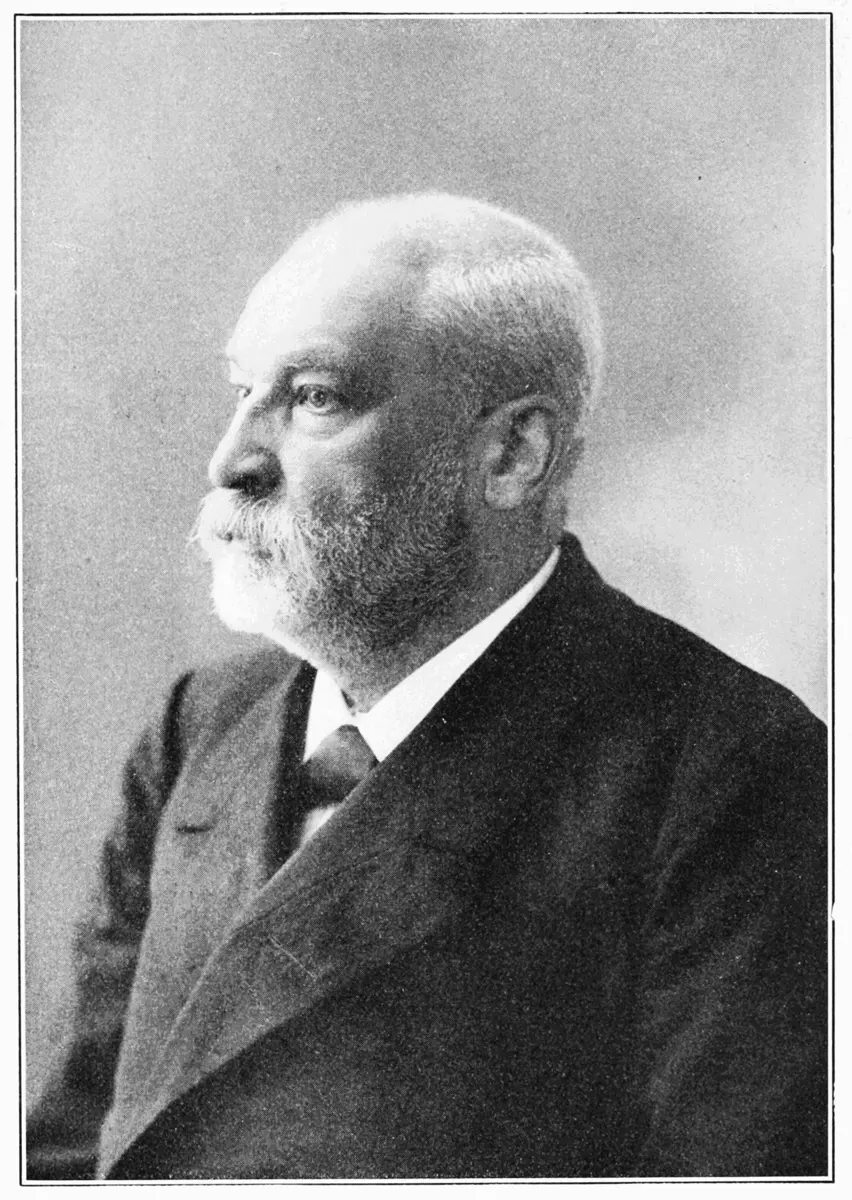
The name. Gallium had been named after France; Winkler named his element after his own country, from Germania, the Latin for Germany. The symbol is Ge.
Where germanium is found
In the universe. Most germanium was made inside aging giant stars, as lighter atoms slowly caught neutrons (Slowly, in giant stars).
In the Earth’s crust. Germanium is scarce: only about 1.5 grams in every tonne of rock. Its own minerals, such as argyrodite, are rare and never mined for it. Instead, it is collected as a by-product: from the dust and leftovers of zinc refining, since zinc ores hold a little germanium, and from the ash of certain kinds of coal.
So little is made that no one knows the exact amount. The last time the US Geological Survey estimated it, in 2019, the world refined about 130 tonnes, two thirds of it in China. Since 2023 China has limited sales of germanium abroad, and in 2025 its price was over 4,000 US dollars a kilogram (USGS, 2026).
In Nepal and in your body. None is produced in Nepal, and germanium has no known use in the body.
What germanium is like
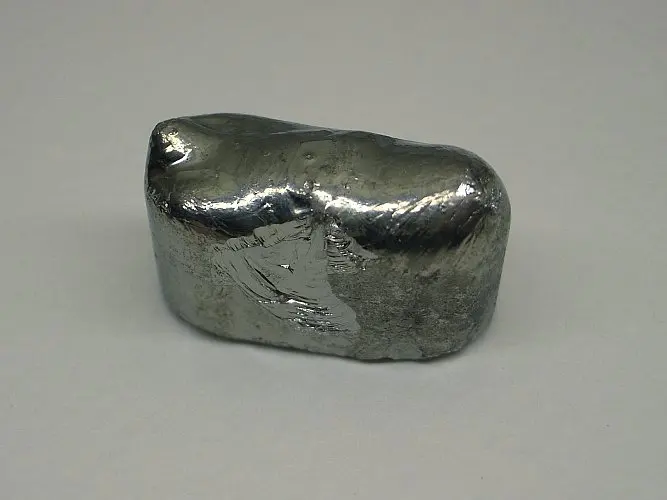
- Grayish-white and shiny, like a metal.
- Hard but brittle: it shatters when struck, like glass.
- Melts at 938 °C, and its density is 5.32 g/cm³.
- Expands when it freezes, like water, silicon and gallium.
- Its atoms are arranged as in diamond: each atom is joined to four others by covalent bonds, in a strong three-dimensional network.
A semiconductor
In a metal, outer electrons wander freely, so metals conduct electricity well Grade 9: Metals conduct electricity. In germanium, all four outer electrons of each atom are held in bonds, so at first sight it should not conduct at all. But the hold is not very strong. At room temperature, the jiggling of the atoms shakes a few electrons free, and these can carry a small current. So germanium is a semiconductor.
Heat germanium and more electrons are shaken free, so it conducts better when it is warmer: the opposite of a metal, whose resistance rises as it warms. Add a tiny amount of another element, such as gallium or arsenic, and you can control very precisely how it conducts. That control is what makes transistors possible (Silicon).
A germanium crystal is warmed from 20 °C to 60 °C. What happens to the current through it, at the same voltage?
Pick an answer to see why.
Clear to infrared, dark to your eyes
Visible light cannot pass through germanium: a germanium window looks like a dark gray mirror. But infrared, the invisible heat radiation that every warm thing gives out Grade 9: Infrared rays, passes straight through it. Germanium also bends infrared very strongly, so it makes excellent lenses for infrared.

That is why the front lens of most thermal cameras is germanium. Firefighters use these cameras to find people in smoke, doctors and airports to spot fevers, and rescuers to search for people under the rubble after an earthquake.
How germanium reacts
Germanium is not very reactive.
- Air and water. It does not tarnish in air at room temperature and does not react with water. Heated strongly in air, it forms white germanium dioxide:
Ge + O₂ → GeO₂
- Acids and alkalis. Unlike gallium, it is not attacked by dilute acids or dilute alkalis. Only hot, concentrated sulphuric or nitric acid dissolves it, slowly.
- Chlorine. Heated in chlorine, it forms germanium tetrachloride, a colorless liquid that boils at 86 °C:
Ge + 2Cl₂ → GeCl₄
Germanium dioxide is a lot like silicon dioxide, the substance of sand and quartz. Melted with silica, it makes a glass, and that glass bends light more strongly than ordinary glass, a property used in camera and microscope lenses and in optical fibers.
How germanium is made pure
For transistors and detectors, germanium must be extremely pure, because even a few stray atoms change how it conducts. The steps:
- The dust from zinc smelters is treated to give impure germanium dioxide.
- This is turned into germanium tetrachloride, which, being a liquid that boils at 86 °C, is purified by distillation Grade 10: Distillation.
- The pure tetrachloride is turned back into germanium dioxide with water, and the oxide is reduced by hot hydrogen Grade 10: Reduction:
GeO₂ + 2H₂ → Ge + 2H₂O
- Finally, the germanium is purified by zone refining.
Zone refining was invented by William Pfann at Bell Laboratories in the USA in the early 1950s, to make germanium for transistors. Passed through the heater again and again, germanium can be made so pure that only about one atom in ten thousand million is something else, among the purest materials ever made.
In zone refining, why do the impurities end up at one end of the bar?
Pick an answer to see why.
Germanium in daily life
The first transistors
In December 1947, at Bell Laboratories in the USA, John Bardeen and Walter Brattain, in William Shockley’s group, pressed two gold contacts onto a slab of germanium and found that a small signal could control a bigger current. It was the first transistor, and it won them the Nobel Prize in Physics in 1956. The first transistor radios of the 1950s were germanium, and in 1958 Jack Kilby made the first integrated circuit, a whole circuit in one chip, on a strip of germanium (Nobel Prize 2000).
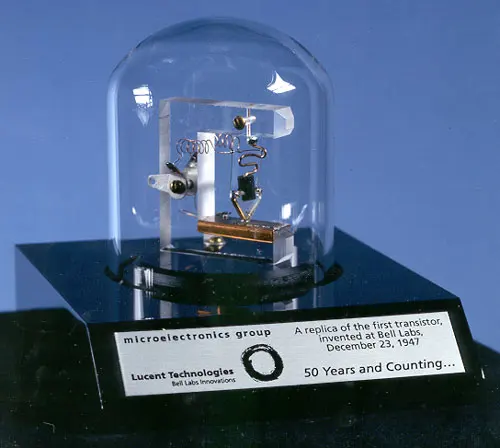
During the 1960s and 1970s, silicon took over. Germanium transistors leak current and misbehave when they get warm, and silicon, which is far more common, forms a tough skin of its own oxide that is very useful in making chips. But germanium is coming back in a new way: some of the fastest chips, such as the radio chips in phones, mix a little germanium into the silicon.
Optical fibers
The glass threads of an optical fiber have a core, through which the light travels, and a cladding around it. A little germanium dioxide is mixed into the core, so that its glass bends light slightly more than the cladding’s. Light meeting the edge of the core at a slant is then totally reflected, again and again, and stays inside Grade 10: Total internal reflection.
Nepal’s internet comes in through such cables, laid along its highways and connected to the rest of the world through India and, since 2018, through China Grade 10: Optical fibers in telecommunication.
And more
- Solar cells in space. The best solar cells, on satellites and Mars rovers, are layers of gallium compounds built on a thin slice of germanium (Gallium).
- Radiation detectors. Large crystals of very pure germanium, kept cold with liquid nitrogen, measure gamma rays so precisely that they can tell which radioactive element sent them.
- Silver that doesn’t tarnish. About 1% germanium in silver jewelry keeps it from turning black.
- Plastic bottles. In Japan, germanium dioxide is used as the catalyst in making the clear PET plastic of drink bottles.
Isotopes of germanium
Natural germanium is a mixture of five isotopes, all with 32 protons.
Germanium-76 is radioactive, but so slowly that its half-life is more than 10²¹ years, a hundred billion times the age of the universe.
Germanium and your health
The body does not need germanium, and the element itself is of low toxicity: germanium lenses and chips are safe to handle.
Surprising facts and records
- Thought to be a poor metal. Until the late 1930s, germanium was thought to be just a metal that conducted badly. Only during the Second World War, when germanium crystals were used to detect radar signals, did scientists see that it was something new: a semiconductor.
- One of Mendeleev’s closest predictions. For eka-silicon he even predicted the boiling point of its chloride to be below 100 °C, and germanium tetrachloride boils at 86 °C.
In your science books
- Grade 8: the 2n² rule and groups in the periodic table.
- Grade 9: covalent bonds, infrared rays, metals conduct electricity and atomic mass.
- Grade 10: Mendeleev’s gaps (eka-silicon), metalloids, distillation and reduction in metallurgy, and optical fibers.
- Going further: why light can’t get through a brick and where the atoms in your body came from.
More to explore
- Nobel Prizes with germanium in them: the transistor (1956, the first one was germanium), the chip and the tiny laser (2000, Kilby’s first chip was germanium) and optical fibers (2009, the glass that carries the internet).
- Elements next door: silicon above it, tin below it, and gallium, its neighbor, also predicted by Mendeleev.
- Play: find germanium in Guess the Element and the Periodic Table Jigsaw.
- Read more: germanium at the Royal Society of Chemistry and at PubChem.