
- Atomic number
- 36
- Atomic mass
- 83.8
- Shells
- 2, 8, 18, 8
- Configuration
- 1s² 2s² 2p⁶ 3s² 3p⁶ 4s² 3d¹⁰ 4p⁶
- In the table
- period 4, group 18 (0), p-block
- Kind
- Noble gas
- Valency
- 0 (it forms only a few compounds, with fluorine)
- State at 25 °C
- gas
- Melts · boils
- −157 °C · −153 °C
- Density
- 2.9 × as heavy as air
- Known since
- 1898
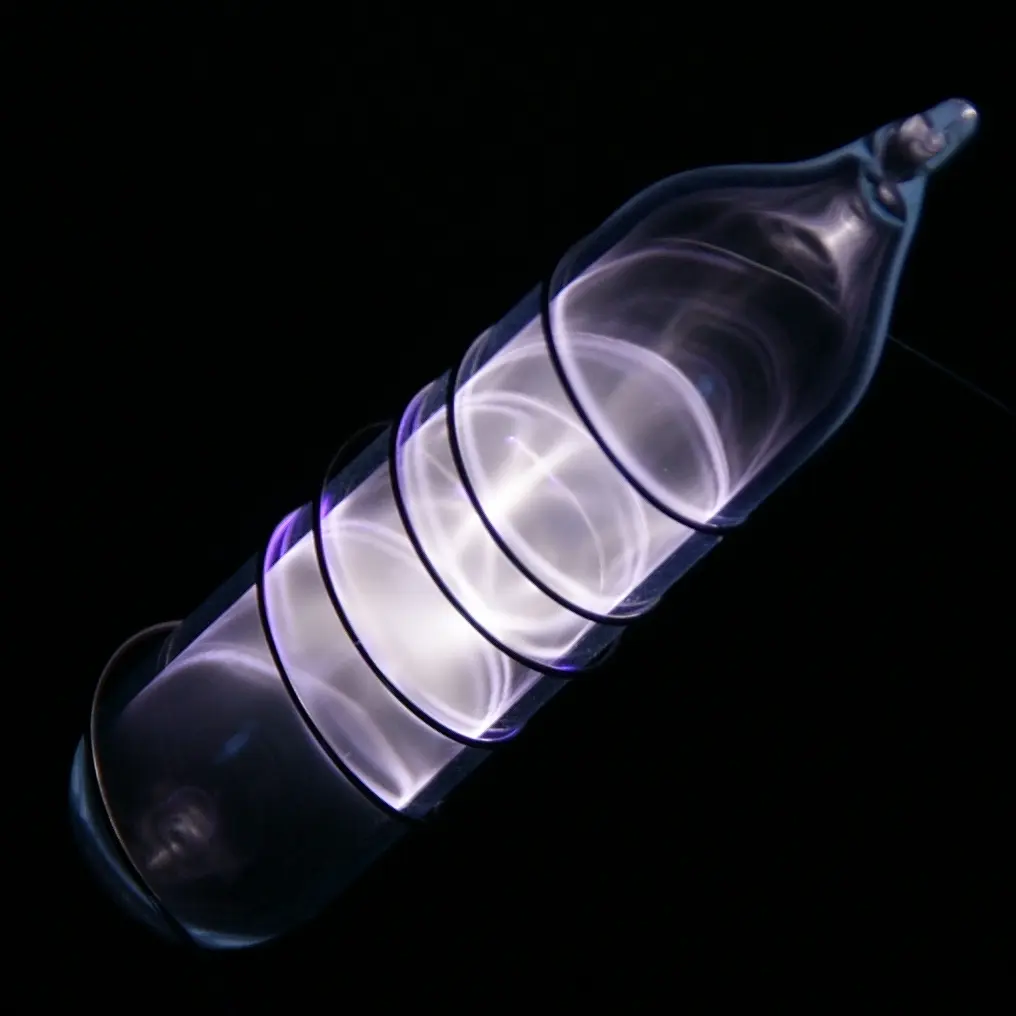
In the Superman stories, a green rock called kryptonite, from Superman’s home planet Krypton, can knock the hero down. Kryptonite is made up. But the name comes from a real element, krypton, and you are breathing some of it right now.
Krypton is so rare, and so unwilling to join with anything, that no one noticed it until 1898. Its name means “the hidden one”. For 23 years, the light of krypton atoms decided how long a meter is. Here is its story.
The krypton atom
A krypton atom has 36 protons, so krypton’s atomic number is 36, and 36 electrons. The commonest kind of krypton atom has 48 neutrons, so its mass number is 36 + 48 = 84.
By the 2n² rule the K, L and M shells can hold 2, 8 and 18 electrons Grade 8: Bohr and Bury’s rule. Krypton fills all three and puts the last 8 in the N shell: 2, 8, 18, 8.
In Grade 10 you write electrons in subshells Grade 10: The Aufbau principle. After argon (2, 8, 8), the next electrons go into 4s, then the ten places of 3d (which fill the M shell up to 18), then 4p:
1s² 2s² 2p⁶ 3s² 3p⁶ 4s² 3d¹⁰ 4p⁶
So krypton’s outer shell holds 4s² 4p⁶, eight electrons: an octet Grade 9: Octet and octet rule. An atom with a full outer shell has no electron it wants to lose and no room it wants to fill, so krypton’s valency is 0. Krypton gas is made of single atoms, Kr.
Krypton has 36 electrons. Which is its arrangement in shells?
Pick an answer to see why.
Its place in the periodic table
- Period 4, because its electrons are in four shells. It is the last element of the period, which runs from potassium (19) to krypton (36), after bromine.
- Group 18, called group 0 in the older naming many books use, at the far right of the table.
- p-block, because its last electrons go into a p subshell.
Krypton is the fourth of the noble gases or inert gases: helium, neon, argon, krypton, xenon and radon Grade 8: Position of inert gases. All are colorless gases of single atoms with a full outer shell. Going down the group the atoms get bigger, and the outer electrons sit further from the nucleus. That matters, as you will see: big krypton atoms can just be made to react.
How krypton was found and named
In 1894 William Ramsay and Lord Rayleigh had found argon in the air, and in 1895 Ramsay found helium. They did not fit any group of the periodic table, so a new group was needed, with gaps in it. Ramsay was sure the missing gases were hiding in the air, mixed with argon.
Working at University College London with the young chemist Morris Travers, he took liquid air and let it boil away slowly. The lightest gases boil off first; a heavier gas, if there was one, would be left behind at the end. On 30 May 1898 they looked at the last little bit of gas left in the flask, about 25 cm³ (a small spoonful of gas). In a spectroscope (an instrument that spreads light into its colors) it showed a bright yellow line and a bright green line that no known element gave. It was a new element.
Within weeks they found neon among the lightest gases, and in July 1898 xenon, heavier still, in the krypton.
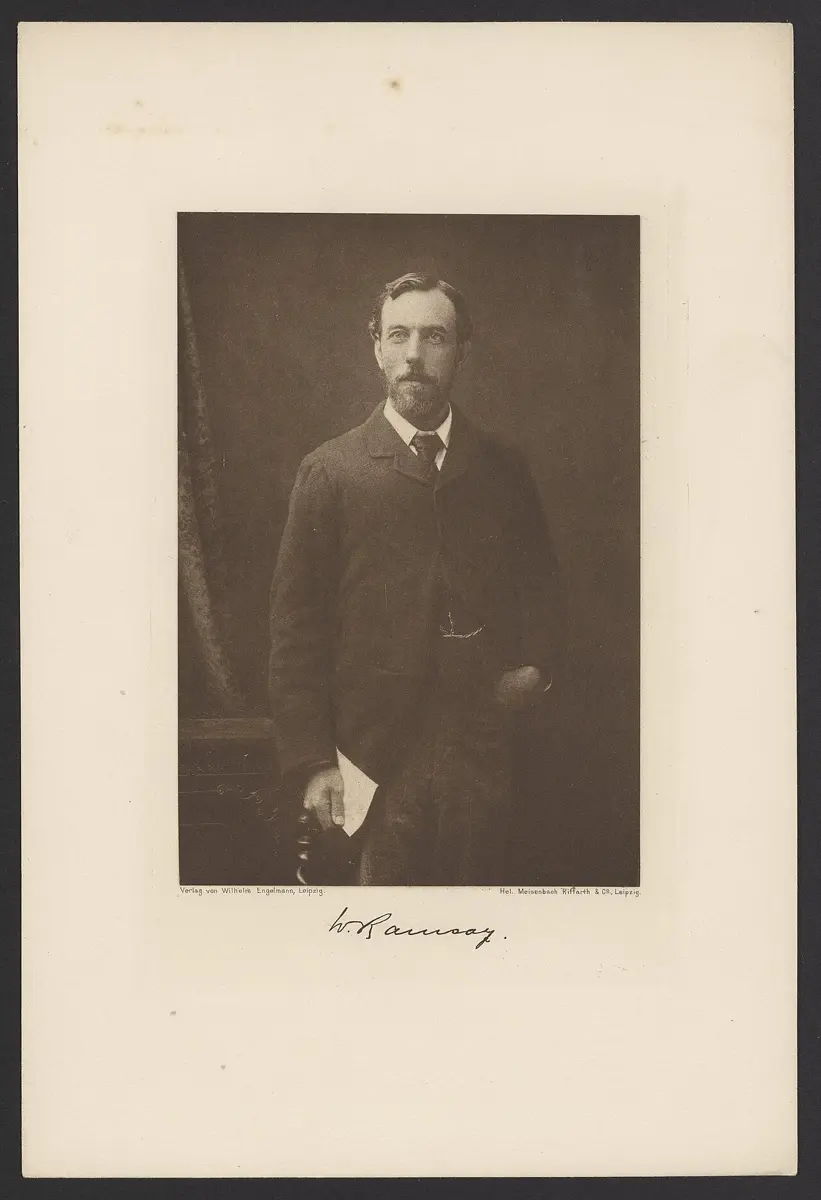
The name. From the Greek kryptos, hidden: the same word as in cryptography, writing in secret code. Its symbol is Kr. Nepali books write it क्रिप्टन; it has no older Nepali name.
Where krypton is found
In the universe. Krypton atoms are heavier than iron, so they can’t be made in the ordinary burning of a star’s core. They are built up when atoms catch neutrons one after another, slowly inside giant stars and in a flash when stars explode or dead stars collide (Heavier than iron).
In the air. About 1 part in a million of the air is krypton Grade 9: Gases around us. A room 4 m by 4 m by 3 m holds about 50 milliliters of it: a fifth of a glass. Most of the krypton on Earth is in the air; the rocks hold very little.
How it is collected. Factories that make liquid oxygen and nitrogen cool air until it turns liquid, and then separate the gases by their boiling points (fractional distillation). Krypton boils at −153 °C, higher than nitrogen (−196 °C) and oxygen (−183 °C), so it collects with the liquid oxygen, along with xenon. Further distillation separates the two. It takes about a million liters of air to give one liter of krypton, so krypton is expensive.
What krypton is like
- A colorless gas with no smell or taste, made of single atoms.
- Heavy. A liter weighs about 3.7 g at 0 °C, nearly three times as much as a liter of air (1.3 g).
- A very short liquid. It turns liquid at −153 °C and freezes at −157 °C: it is a liquid for only about 4 degrees. Solid krypton is white.
- It doesn’t burn and doesn’t help anything burn.
- It glows whitish when electricity passes through it at low pressure. Its light has many lines across the spectrum, strongest in the yellow and green, which together look nearly white.
Why is krypton heavier than neon or argon, and why does it boil at a higher temperature? Its atoms are heavier (84 against 20 and 40) and bigger, with more electrons. Even single atoms with no charge pull on each other a little, and bigger atoms, with more electrons, pull harder. So it takes a higher temperature to pull liquid krypton apart into a gas (Molecules with no charged ends): helium boils at −269 °C, neon at −246 °C, argon at −186 °C, krypton at −153 °C and xenon at −108 °C.
How krypton reacts: hardly at all
For 65 years after it was found, no one could make krypton react with anything. In 1962 the chemist Neil Bartlett made the first compound of a noble gas, with xenon, krypton’s heavier neighbor. A year later, in 1963, chemists made krypton difluoride, KrF₂, by passing electric sparks through krypton and fluorine gas at very low temperatures:
Kr + F₂ → KrF₂
It is a colorless solid that slowly falls apart again into krypton and fluorine at room temperature. Only fluorine, the most reactive element of all, can pull electrons from krypton’s full outer shell, and even then the compound barely holds together.
Neil Bartlett made a xenon compound in 1962, and a krypton compound followed in 1963. Why can’t chemists do the same with neon?
Pick an answer to see why.
Krypton and the meter
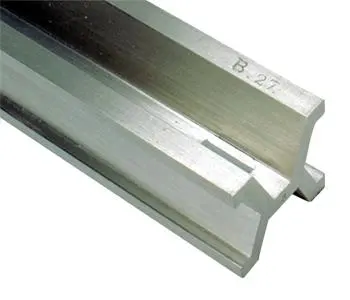
How long is a meter? For a long time the answer was a metal bar. From 1889 the meter was the distance between two fine lines on a bar of platinum and iridium kept near Paris, and every country’s measuring sticks were copied, step by step, from copies of it. But a bar can be scratched, can bend a tiny bit, and grows with the heat; and to check a ruler against it you had to take the ruler to the bar.
Light from atoms was a better idea. Every krypton atom is exactly like every other, so the light they give out has exactly the same colors everywhere in the world. The color of light is set by its wavelength, the length of one wave Grade 9: Words used for waves. In 1960 the world’s scientists agreed: one meter is 1,650,763.73 wavelengths of one orange-red line of krypton-86 Grade 10: Fundamental units. Any good laboratory could now make its own meter with a krypton lamp.
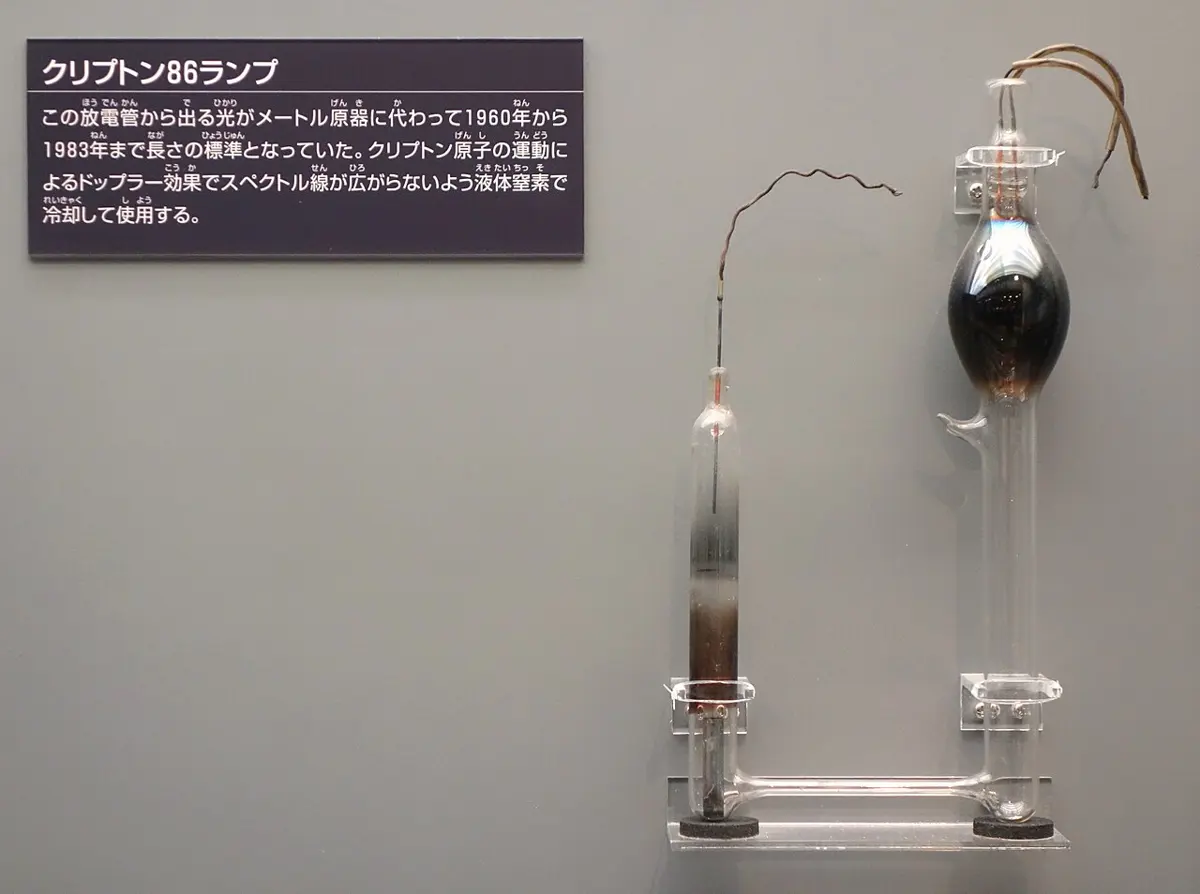
In 1983 the meter changed again: it is now the distance light travels in empty space in 1/299,792,458 of a second. Since clocks can measure time even more exactly than lamps can give a color, length is now measured through time.
Krypton in daily life
Krypton is costly, so it is used only where a little of it does something no cheaper gas can.
Lamps and flashes
- Bulbs. An old-style bulb gives light from a very hot thin wire, which slowly turns to vapor and thins until it breaks. Filling the bulb with krypton instead of argon slows this: the heavy krypton atoms bounce the escaping metal atoms back to the wire, and carry less heat away. So some torch bulbs and car bulbs were filled with krypton; they could run hotter and brighter. LEDs have now replaced most of them.
- Tube lights. Some energy-saving fluorescent tubes hold a mixture of argon and krypton.
- Flashes and lasers. Krypton lamps give very bright flashes for high-speed photography, and krypton lasers give bright red and other colors for light shows. Krypton fluoride lasers give ultraviolet light, 248 nm, used to print the tiny patterns on computer chips.
Windows that keep the heat in
In cold countries, many new windows are double-glazed: two panes of glass with a sealed gap between them. Still gas in the gap carries heat across far more slowly than glass does. Air in the gap works; argon works better; krypton works better still, letting through only about a third as much heat as air. Its heavy atoms move more slowly and carry less heat across. Because krypton costs so much, only some of the most expensive windows use it.
Pushing satellites
Some satellites push themselves along with electric thrusters: they knock electrons off atoms of a gas, and an electric field throws the charged atoms out of the back at great speed. The first Starlink internet satellites, launched from 2019, used krypton, which is much cheaper than xenon, the usual gas; later ones switched to argon.
Isotopes of krypton
Natural krypton is a mixture of six isotopes (same 36 protons, different numbers of neutrons): krypton-78, 80, 82, 83, 84 and 86. Krypton-84 is the commonest, more than half of all krypton atoms. Krypton-78 is very slightly radioactive, but it decays so slowly (a half-life of over 10²¹ years, far longer than the age of the universe) that it counts as stable.
Two radioactive kinds of krypton are useful:
- Krypton-85 (half-life about 10.8 years) is made when uranium splits in a nuclear reactor Grade 9: Nuclear fission, and leaks out when used fuel is cut open to take the plutonium out. Measuring krypton-85 in the air downwind has revealed secret plutonium factories.
- Krypton-81 (half-life over 200,000 years) is made in the air by cosmic rays. Rain carries a little into the ground; in water that has been underground for a very long time, some of it has decayed. Measuring how much is left tells scientists the age of very old groundwater, hundreds of thousands of years old.
Krypton and your health
Krypton has no job in the body and is not poisonous: you breathe a tiny amount in and out all day. But like any gas, a lot of it in a closed space would push out the oxygen you need.
Surprising facts and records
- Krypton is in the fission equation. When a uranium-235 nucleus splits, one of the commonest pairs it makes is barium and krypton Grade 9: Nuclear fission.
- Krypton on Mars. Mars’s thin air holds about 0.3 parts per million of krypton.
In your science books
- Grade 8: the 2n² rule, valency and inert gases.
- Grade 9: octet and octet rule, the gases of the air, nuclear fission, wavelength and metric prefixes.
- Grade 10: fundamental units, the Aufbau principle and non-metals and noble gases.
- Going further: where krypton is made, why bigger atoms boil higher, why each element has its own lines and fission.
More to explore
- The other noble gases: helium, neon, argon and xenon.
- See the bright lines of glowing gases with the Spectroscope at Science Playground (The Spectroscope).
- Play: find krypton in Guess the Element, the Periodic Table Jigsaw and Higher or Lower.
- Read more: krypton at the Royal Society of Chemistry and at PubChem.