
- Atomic number
- 79
- Atomic mass
- 196.97
- Shells
- 2, 8, 18, 32, 18, 1
- Configuration
- 1s² 2s² 2p⁶ 3s² 3p⁶ 4s² 3d¹⁰ 4p⁶ 5s² 4d¹⁰ 5p⁶ 6s¹ 4f¹⁴ 5d¹⁰
- In the table
- period 6, group 11 (IB), d-block
- Kind
- Transition metal
- Valency
- 1 and 3 (aurous Au⁺, auric Au³⁺)
- State at 25 °C
- solid
- Melts · boils
- 1,064 °C · 2,856 °C
- Density
- 19.3 × as heavy as water
- Known since
- ancient times
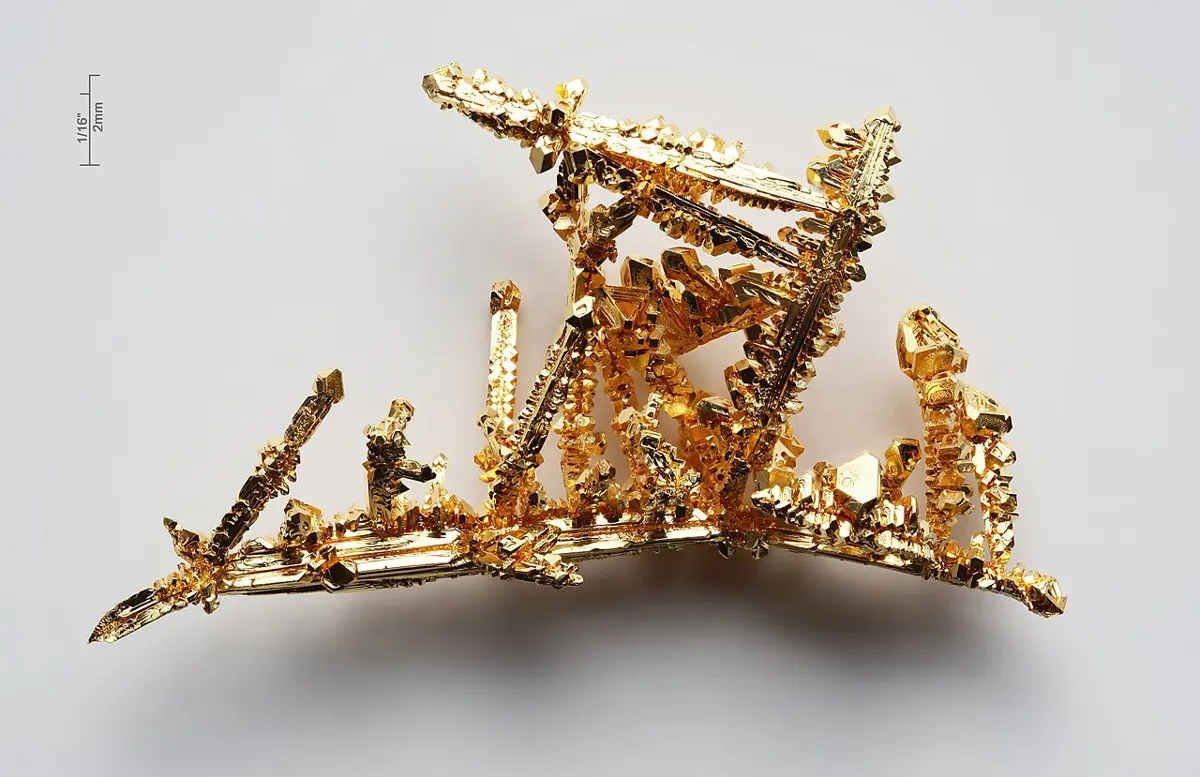
In Nepal, gold (सुन) is part of every big moment of life: the gold tilhari on a bride’s necklace, earrings given at a naming ceremony, the jewelry a family keeps for hard times. Its price, in rupees per tola, is in the newspaper every day.
Gold is loved because it never changes. A gold coin buried for two thousand years comes out of the ground as bright as the day it was made. It is so soft that one gram can be beaten into a sheet a meter across, and so rare that all the gold ever mined would fit in a cube 22 meters on each side. And every atom of it was made in some of the most violent events in the universe. Here is its story.
The gold atom
A gold atom has 79 protons, so gold’s atomic number is 79, and 79 electrons. All natural gold atoms are the same kind: gold-197, with 118 neutrons.
By the 2n² rule Grade 8: Bohr and Bury’s rule, the shells hold 2, 8, 18 and 32 electrons, then 18 in the fifth shell, and one is left for the sixth: 2, 8, 18, 32, 18, 1.
Its electronic configuration
Following the Aufbau order Grade 10: The Aufbau principle, 6s fills, then 4f, then 5d, so you would expect gold to end 6s² 4f¹⁴ 5d⁹. Like copper and silver above it, gold instead moves one electron into the d subshell to fill it:
1s² 2s² 2p⁶ 3s² 3p⁶ 4s² 3d¹⁰ 4p⁶ 5s² 4d¹⁰ 5p⁶ 6s¹ 4f¹⁴ 5d¹⁰
How many electrons are in the outermost shell of a gold atom?
Pick an answer to see why.
Its place in the periodic table
- Period 6, because its electrons are in six shells. It sits between platinum (78) and mercury (80).
- Group 11, called IB in the older naming, below copper and silver: the coinage metals.
- d-block, so gold is a transition metal Grade 10: Metals.
Gold can lose its 6s electron to become Au⁺ (valency 1, aurous), or two more from 5d to become Au³⁺ (valency 3, auric), as in auric chloride, AuCl₃ Grade 9: Variable valency. But gold gives up its electrons very unwillingly, which is the secret of its whole character.
How gold was found and named
Gold was probably the first metal people noticed, because it lies in rivers as shining yellow grains and nuggets, the pure metal, not hidden in an ore. It is soft enough to hammer into shape cold.
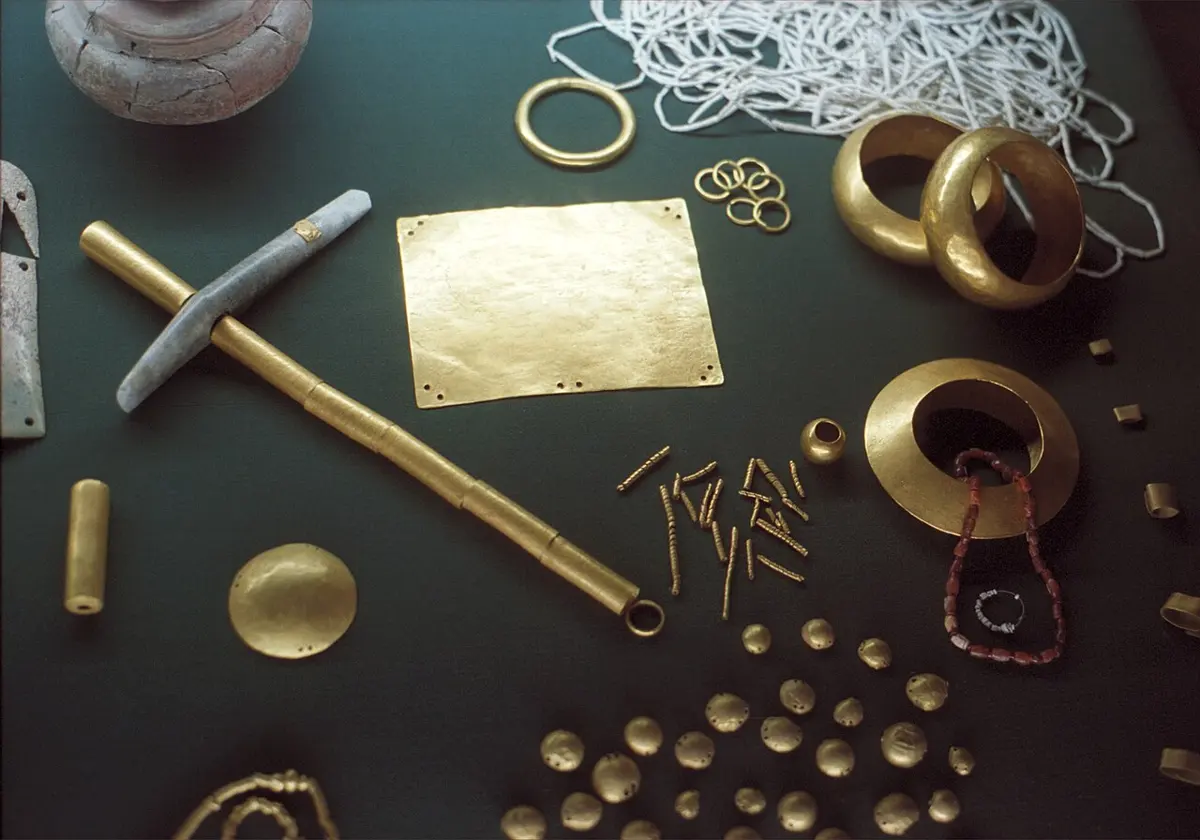
- About 6,500 years ago (4600–4200 BCE), people at Varna, on the Black Sea coast of Bulgaria, buried their dead with bracelets, beads and ornaments of gold: the oldest worked gold yet found in such quantity.
- About 2600 BCE, the royal graves of Ur, in what is now Iraq, held cups, helmets and headdresses of gold.
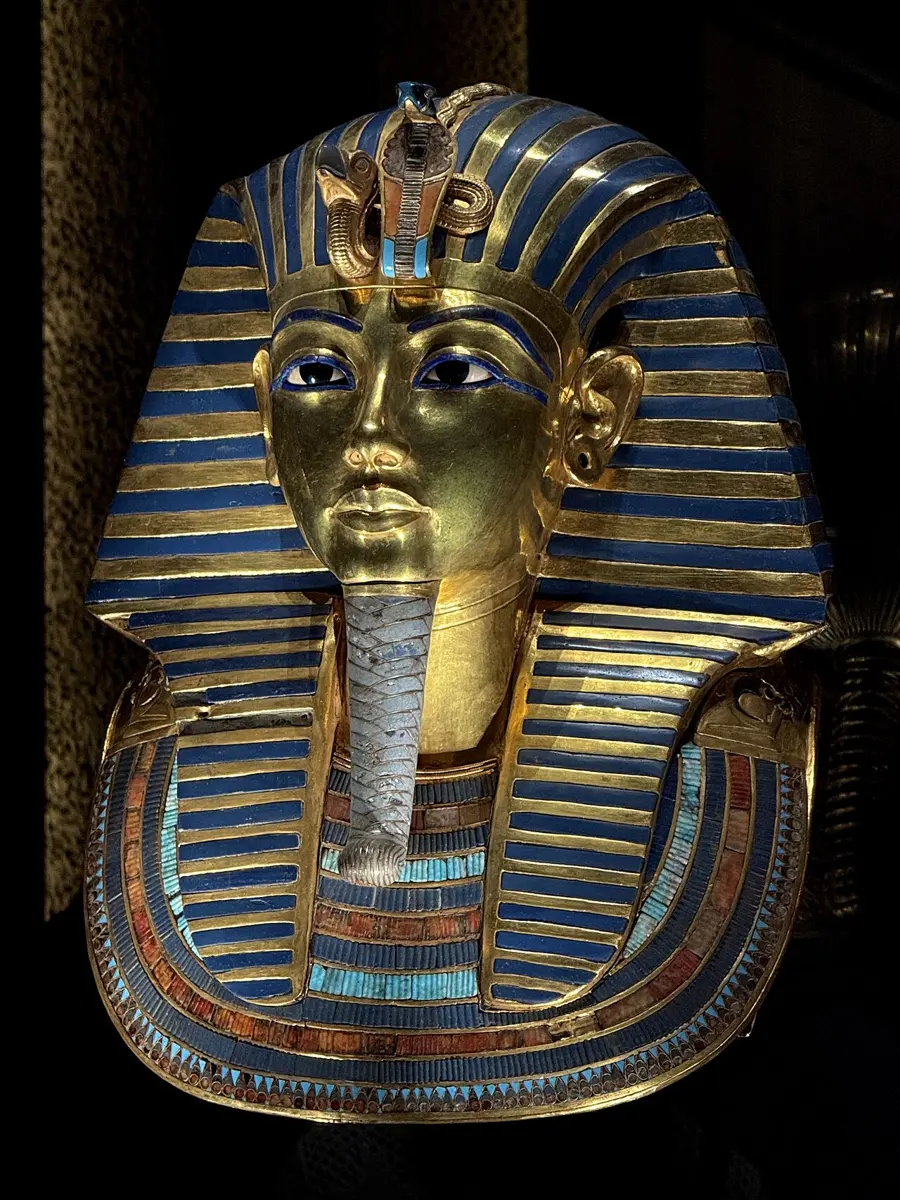
- In 1323 BCE, the young Egyptian pharaoh Tutankhamun was buried with a mask of beaten gold, about 10 kg, inside a coffin of solid gold weighing about 110 kg.
- About 600 BCE, the kingdom of Lydia, in today’s Turkey, made some of the first coins, from electrum, a natural mixture of gold and silver; its king Croesus later struck coins of nearly pure gold.
The name. The English “gold” comes from an old word meaning yellow or bright. The symbol Au is from the Latin aurum. Nepali सुन comes from Sanskrit सुवर्ण, “of a good color”, and a goldsmith is a सुनार, from स्वर्णकार, a worker of gold.
Where gold is found
In the universe. Gold is far heavier than iron, and no ordinary star can make it. Most of it was probably forged when two neutron stars, the tiny, heavy cores left after huge stars explode, crashed into each other. In 2017 astronomers watched such a crash for the first time, through the gravitational waves it sent out and the light of its explosion, and saw the signs of freshly made heavy elements, gold among them (In a flash, when dead stars collide). The gold in a tilhari was made that way, long before the Sun was born.
In the Earth. When the young Earth was molten, heavy metals sank towards the center Grade 8: A young, violent Earth, and most of the Earth’s gold went down with the iron into the core. The crust has only a few milligrams of gold in a tonne of rock. It is mined where hot water from deep underground gathered it into veins in quartz rock, and where rivers have worn those rocks away and left the heavy gold in their sand and gravel as placer (alluvial) gold (Gold, Sorted by a river).
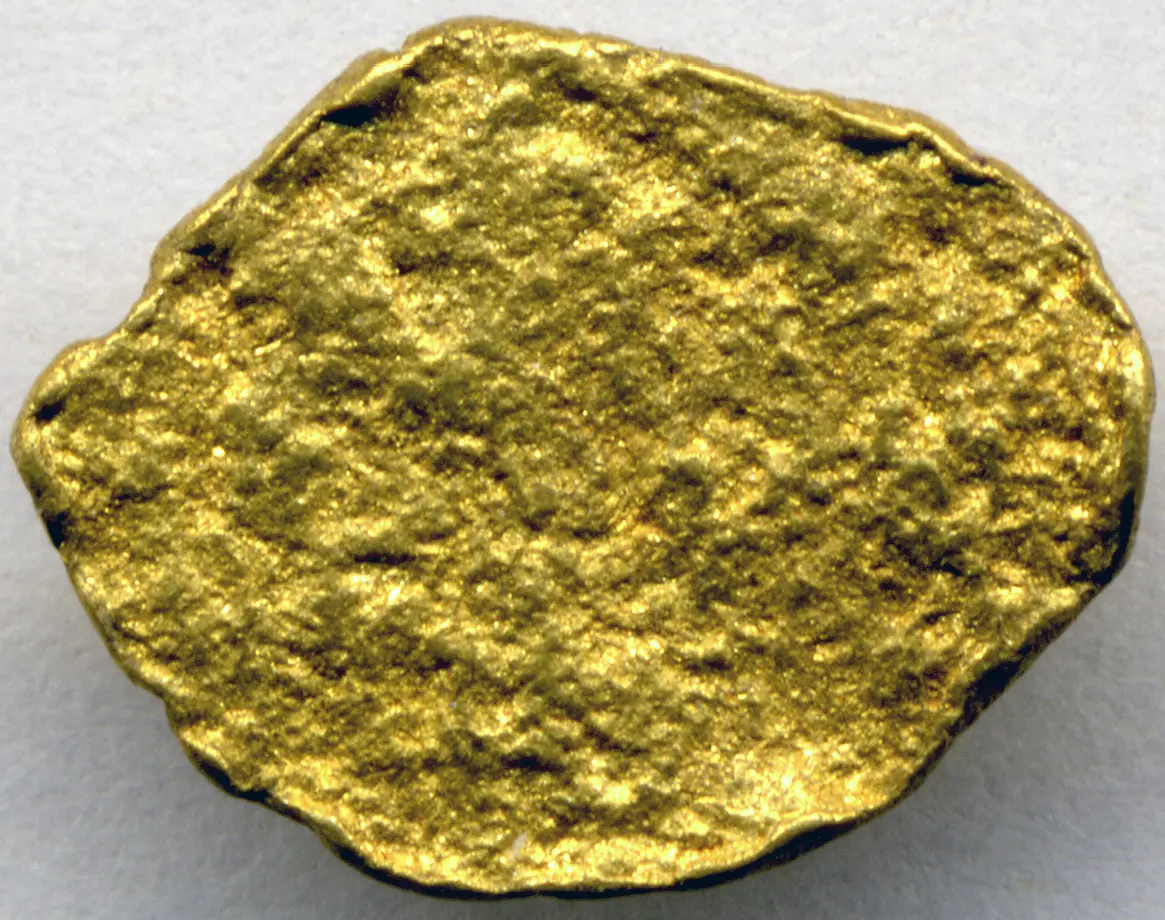
In 2024 the world mined about 3,300 tonnes of gold; the most came from China, Russia and Australia. About 216,000 tonnes have been mined in all of history (as of 2024), and most of it is still around, as jewelry, coins and bars.
In Nepal. Specks of gold are found in the sand of rivers such as the Kali Gandaki, Sunkoshi and Rapti Grade 8: Minerals in Nepal, and people have long panned it there by hand. But there is no large gold mine, and almost all the gold sold in Nepal is imported.
In your body. None that it needs: gold has no job in any living thing.
What gold is like
- Color. Gold and copper are the only common metals that aren’t silvery. Pure gold is a deep, warm yellow.
- The most malleable and ductile metal (Malleable, ductile). One gram, a piece smaller than a grain of maize, can be beaten into a sheet of about one square meter, about 50 nanometers thick, more than a thousand times thinner than a hair. Such thin gold leaf even lets light through: held up to a window, it glows green-blue. The same gram can be drawn into a wire more than 2 km long.
- Very heavy. Its density is 19.3 g/cm³, nearly twenty times that of water: a 1-liter bottle filled with gold would weigh over 19 kg.
- Melts at 1,064 °C, a little below copper.
- A good conductor of electricity, after silver and copper, and it never forms a coat of oxide that would block a current.
- Unchanging. It doesn’t rust, tarnish or corrode, in air, water or the human body.
Why is gold yellow?
Metals shine because their free electrons send back the light that falls on them. Silver sends back all the colors of light almost equally, so it looks white. Gold sends back red, orange, yellow and green well, but absorbs much of the blue and violet. White light minus some of its blue looks yellow.
Why gold absorbs blue is a story from Einstein’s relativity. Gold’s nucleus, with 79 protons, pulls so hard that its inner electrons move at more than half the speed of light. That changes the sizes of the outer subshells and brings the 5d and 6s levels close together, so a little energy, the energy of blue light, is enough to lift an electron from one to the other. In silver the gap is bigger, so it takes ultraviolet light, which we can’t see, and silver stays white.
How gold reacts
Gold sits at the very bottom of the reactivity series Grade 9: The reactivity series:
… (H) > Cu > Hg > Ag > Au
It holds its electrons so tightly that air, water, sulphur and acids can’t take them. It doesn’t react with dilute hydrochloric or sulphuric acid Grade 9: Metals and dilute acids, or even with strong nitric acid on its own.
Gold does dissolve in aqua regia, “royal water”, a mixture of one part concentrated nitric acid to three parts concentrated hydrochloric acid. The nitric acid pulls a few electrons from the gold, and the chloride ions of the hydrochloric acid grab the gold ions as they form, so more and more can dissolve.
Which of these can dissolve gold?
Pick an answer to see why.
From river and rock to pure gold
Because gold is already a metal, getting it is mostly a matter of separating it from sand and rock, not breaking down a compound.
- Panning. Gold is about seven times as dense as sand. Swirl river sand with water in a shallow pan, and the light sand washes over the edge while the heavy gold sinks to the bottom.
- Cyanide. In big mines the ore is ground to powder and mixed with a weak solution of sodium cyanide and air, which dissolves even tiny specks of gold; the gold is then taken out of the solution. The cyanide is deadly, and spills from mines have poisoned rivers.
- Mercury. Many small-scale miners around the world still mix gold-bearing sand with mercury, which dissolves the gold into a soft lump, an amalgam. Heating it drives the mercury off as a poisonous vapor (see below).
- Refining. The rough gold is made pure by electro-refining, like copper Grade 10: Electro-refining, and the purest bars are 99.99% gold.
Gold in daily life and in Nepal
Jewelry and carats. Pure gold is too soft for jewelry worn every day, so it is mixed with copper and silver Grade 8: Alloys. Purity is counted in carats out of 24: 24 carat is pure gold, 22 carat is 22 parts gold in 24 (91.7%), and 18 carat is 75%. In Nepal gold is weighed in tolas: one tola is about 11.66 grams.
A ring is 18 carat gold. What fraction of it is gold?
Pick an answer to see why.
What the world does with gold. In 2024 about two-fifths of the gold sold became jewelry; about a fifth was bought by central banks, the banks that look after a country’s money, which keep gold as a safe store of value; about a quarter went into bars, coins and funds for investors; and less than a tenth went into electronics.
Electronics and space. Every phone and computer has gold on its connectors and inside its chips, because a gold contact never corrodes and always conducts. Astronauts’ visors carry a thin film of gold that reflects the Sun’s heat, and the mirrors of the James Webb Space Telescope are coated with gold, which reflects infrared light superbly Grade 8: Uses of spherical mirrors.
Gilded temples. Nepal’s most famous golden roofs, doors and statues are not solid gold. They are gilded: copper or bronze covered with a very thin layer of gold, which shines for centuries and keeps the copper from turning green. The roofs of Pashupatinath are gilded copper, as are the roofs and doors of the Golden Temple (Hiranya Varna Mahavihar) in Patan and the Golden Gate of Bhaktapur (Copper’s craft).

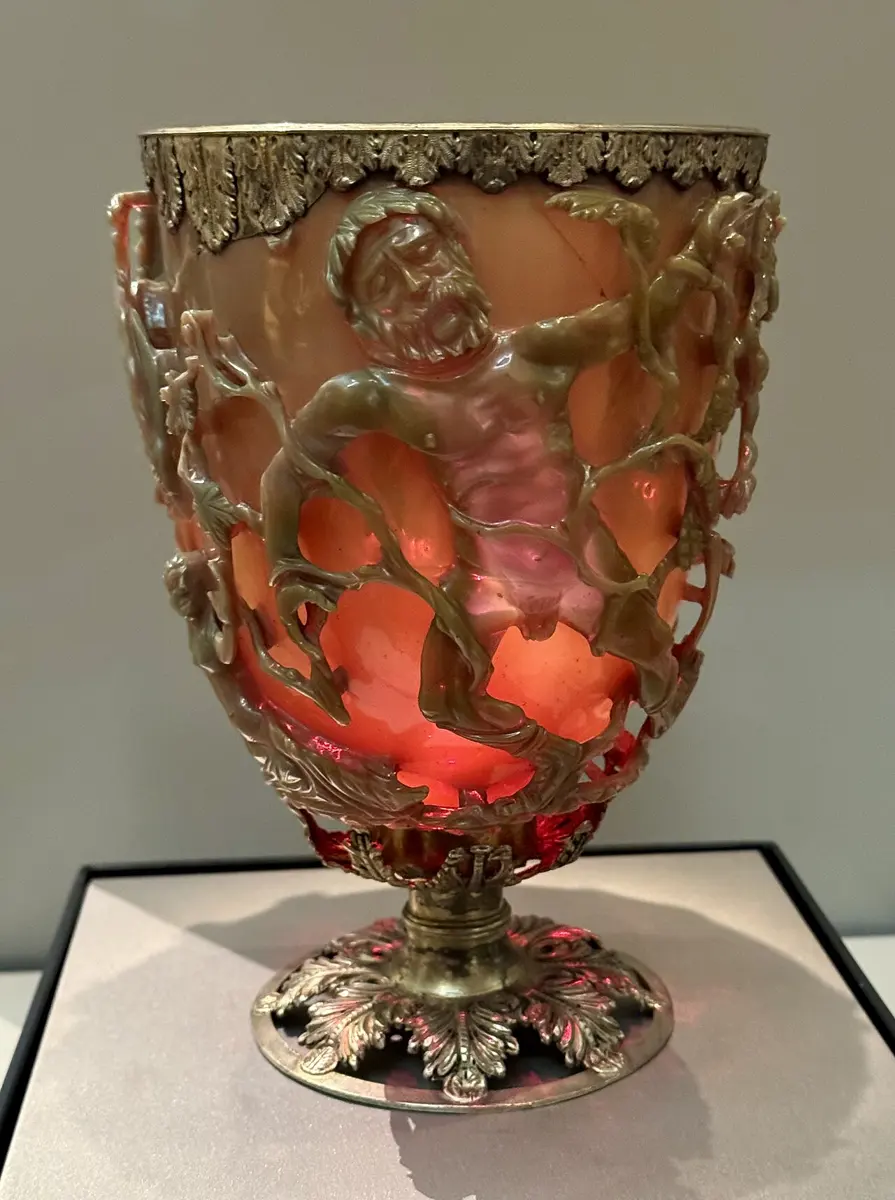
Colors from tiny gold. Gold broken into specks a few millionths of a millimeter across is not yellow at all, but red or purple. Roman glassmakers, without knowing why, put traces of gold and silver into the glass of the Lycurgus Cup: lit from the front it is jade green, lit from behind it glows red. The same effect, color set by size, is behind the Nobel Prize in Chemistry 2023.
Isotopes of gold
Gold has only one stable isotope, gold-197. So, unlike copper or silver, its atomic mass, 196.97, is almost exactly a whole number: there is no mixture to average Grade 9: Atomic mass. A radioactive isotope, gold-198, with a half-life of 2.7 days, can be made in nuclear reactors and has been used to treat some cancers.
Gold and your health
Gold metal is harmless: it doesn’t react with the body, which is why it is used in dental crowns and why thin gold leaf can decorate sweets. Some gold compounds were once used as medicines for arthritis. But the ways gold is mined and worked can be dangerous.
Surprising facts and records
- All the gold in one cube. The 216,000 tonnes ever mined would make a cube about 22 meters on each side, smaller than many school buildings.
- Gold in the sea. Seawater holds a few grams of gold in every million tonnes, a lot of gold in all the oceans together, but far too thinly spread to collect. In the 1920s the German chemist Fritz Haber tried to extract it to pay his country’s war debts, and found far less than he hoped.
- The gold foil that found the nucleus. In 1909 Ernest Rutherford’s students fired tiny particles at gold beaten thinner than a thousandth of a millimeter, and a few bounced straight back: the discovery of the nucleus Grade 9: Structure of an atom. Gold was chosen because no other metal can be beaten so thin.
- An Olympic gold medal is mostly silver, with at least 6 grams of gold on the outside.
In your science books
- Grade 8: the 2n² rule, alloys and carats, minerals in Nepal, the young Earth and mirrors in space.
- Grade 9: Rutherford’s gold foil, variable valency (aurous and auric), malleable and ductile metals, the reactivity series and mercury.
- Grade 10: electronic configuration, gold, found free and electro-refining.
- Going further: gold from colliding stars and gold sorted by rivers.
More to explore
- Nobel Prizes with gold in them: Rutherford (1908; the gold foil came after), gravitational waves (2017, the crash of neutron stars that made gold), quantum dots (2023, gold-colored glass), microscopes that see atoms (1986, single gold atoms seen) and the transistor (1956, built with gold foil contacts).
- Play: find gold in Guess the Element, Higher or Lower and the Periodic Table Jigsaw.
- Read more: gold at the Royal Society of Chemistry and at PubChem.