
On a hot day, drop a handful of ice cubes into a glass of water, stir, and put a thermometer in. It reads 0 °C. Wait ten minutes. The room is at 30 °C, so heat is flowing into the glass the whole time, and you can see the ice getting smaller. But the thermometer still reads 0 °C. It goes on reading 0 °C until the very last piece of ice has melted. Only then does the water begin to warm up.
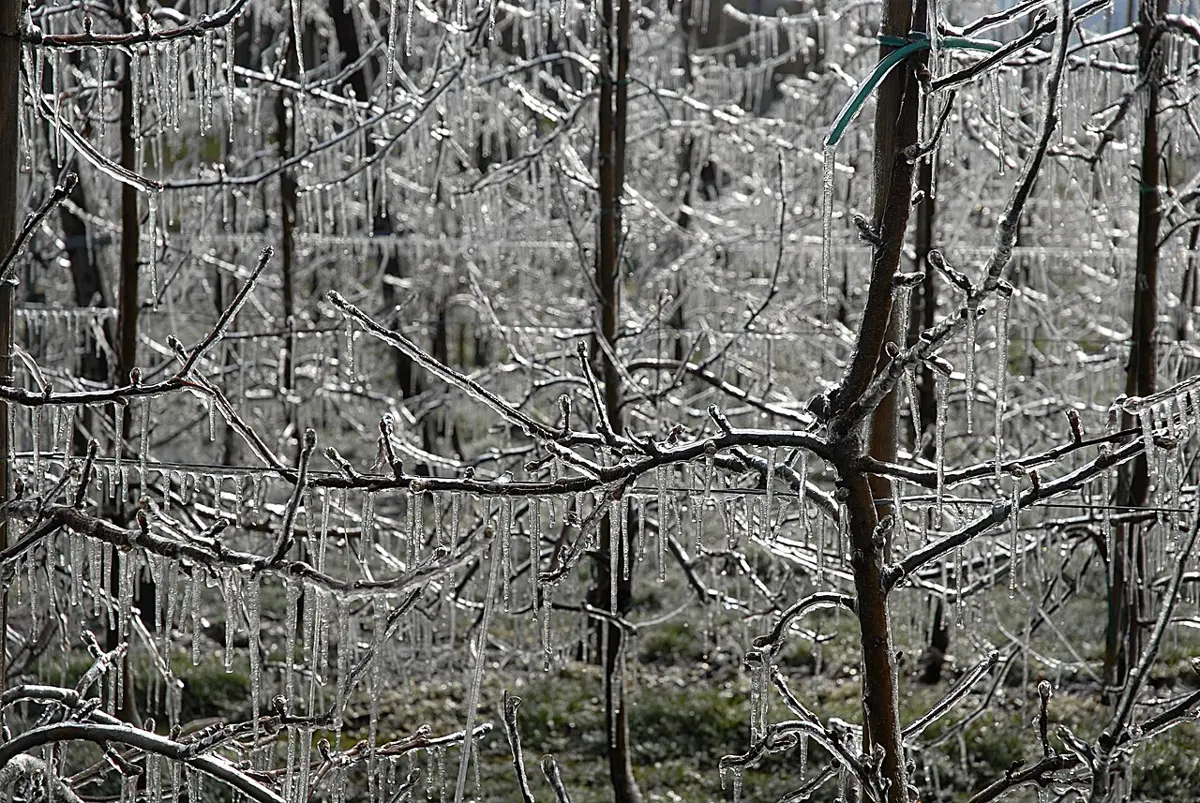
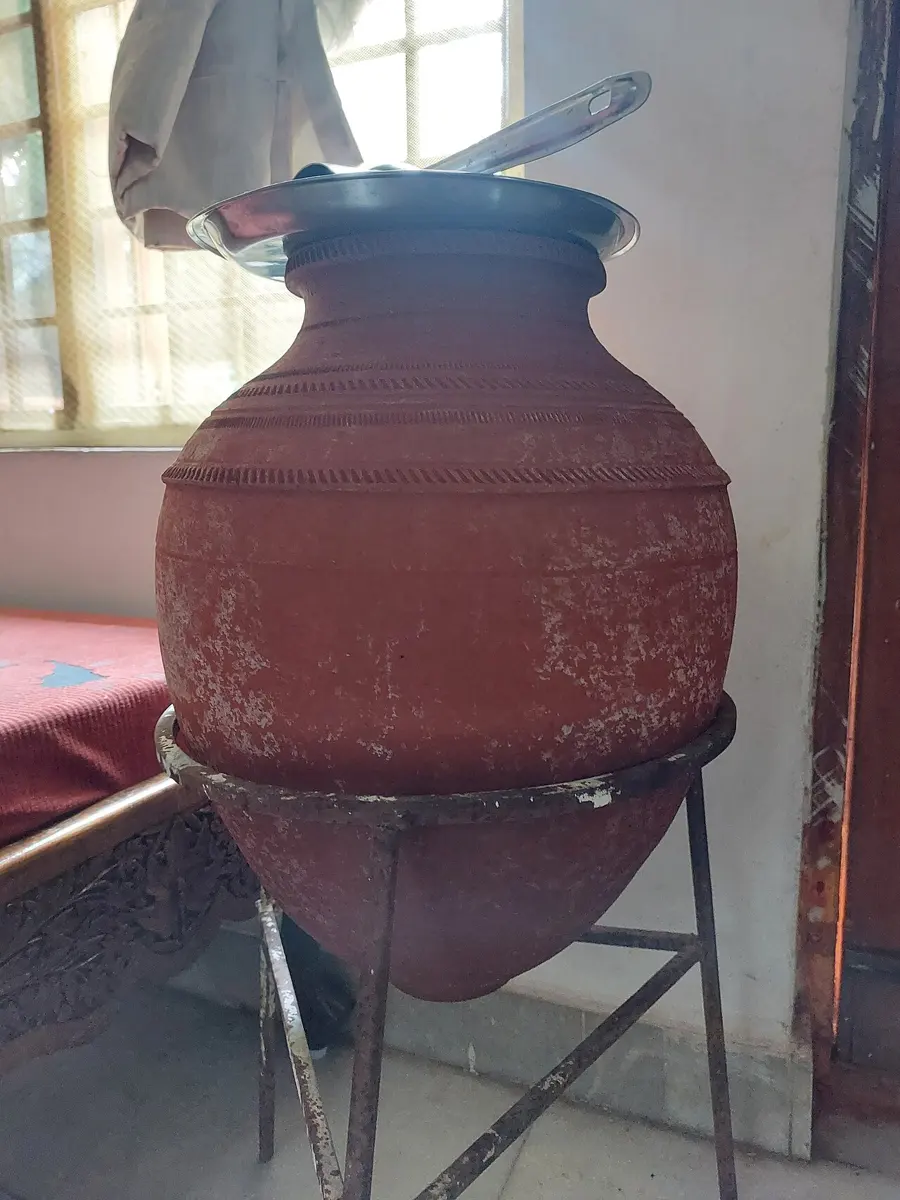
So where is the heat going? It isn’t making anything hotter. In this topic you will build a model of the tiny particles in ice, water and steam that explains it, and then use the model to predict what happens when any pure substance is heated or cooled. On the way you will find out why steam burns worse than boiling water, why a clay matka keeps water cool, and why fruit farmers spray their trees with water on a freezing night.
Particles that never stop
In Grade 7 you learned that matter comes in three states, solid, liquid and gas, and that its particles are packed tightly in a solid and more loosely in a liquid and a gas. In Grade 8 you saw that heating a metal makes its particles vibrate faster, and that is how heat travels along it Grade 8: Conduction. Now put these ideas together into one model. It has three rules.
- All matter is made of tiny particles, atoms or molecules. In water, each particle is one H₂O molecule (What a formula tells you).
- The particles are always moving. The hotter the substance, the faster they move. Temperature measures how fast the particles are moving on average.
- The particles pull on each other. Neighboring particles attract each other. (The pull is electric: it comes from the charges inside the particles.) Try to push two particles into each other, though, and they push apart.
The state of a substance depends on a tug of war between rules 2 and 3: the particles’ motion trying to scatter them, and their pull trying to hold them together.
- In a solid, the pull wins. Each particle is held in its place by its neighbors. It can only vibrate about that place, so a solid keeps its shape.
- In a liquid, the particles move fast enough to slide past each other, but not fast enough to escape. They still touch and still pull on each other, so a liquid keeps its volume but flows to take the shape of its container.
- In a gas, the particles move so fast that they have broken free of each other. They fly about in straight lines, far apart, until they hit another particle or a wall, so a gas spreads out to fill any space it is in.
What happens to the water molecules when a block of ice melts?
Pick an answer to see why.
A gas fills its whole container, but a liquid lies at the bottom. Which rule of the model explains why?
Pick an answer to see why.
Heating ice, minute by minute
Here is an experiment you can do in your school laboratory, with your teacher. It shows the puzzle from the start of this topic clearly.
Here are readings like the ones you might get in Bhaktapur, with 200 g of ice (made up for this book, but typical):
| Time (min) | 0 | 2 | 4 | 6 | 8 | 10 | 12 | 14 | 16 | 18 | 20 | 22 | 24 | 26 | 28 | 30 | 32 | 34 |
|---|---|---|---|---|---|---|---|---|---|---|---|---|---|---|---|---|---|---|
| Temperature (°C) | −10 | 0 | 0 | 0 | 0 | 0 | 1 | 15 | 29 | 42 | 55 | 67 | 78 | 87 | 93 | 95 | 95 | 95 |
| In the beaker | ice | ice and water | ice and water | ice and water | ice and water | ice and water | water | water | water | water | water | water | water | water | water | boiling | boiling | boiling |
The flame gave heat at the same rate the whole time. But the temperature did not rise steadily:
- At first, the ice warmed up quickly, from −10 °C to 0 °C.
- Then, for about 10 minutes, the temperature stayed at 0 °C while the ice melted. Heat was going in all the time, but the temperature didn’t rise.
- Once all the ice had melted, the water warmed up, steadily at first. It warmed more slowly as it got hotter, because a hot beaker loses heat to the air faster.
- When the water began to boil, the temperature stayed at 95 °C, however long the water boiled.
The temperature at which a solid melts is its melting point: 0 °C for ice. The temperature at which a liquid boils is its boiling point: 100 °C for water at sea level. (In Bhaktapur, about 1,400 m up, the air pressure is lower and water boils at about 95 °C: see Boiling below 100 °C.) A graph like yours, of temperature against time while a substance is heated steadily, is a heating curve. Its flat parts are the puzzle.
In the experiment, between 2 and 10 minutes, the flame was heating the beaker, but the thermometer stayed at 0 °C. Why?
Pick an answer to see why.
Where the heat goes
Energy can’t disappear. So where does the heat go while the ice is melting? The model answers it.
- While the ice warms up, from −10 °C to 0 °C, the heat makes the molecules vibrate faster in their places. Faster particles mean a higher temperature, so the thermometer rises.
- At 0 °C, the molecules are vibrating so hard that a little more energy lets one break out of its place, away from the neighbors holding it. Now all the heat goes into breaking molecules free, one after another, not into making them move faster. Their average speed stays the same, so the temperature stays the same. That is the flat part of the graph.
- When every molecule is free, the ice has all melted. Now the heat makes the molecules in the water move faster, and the temperature rises again.
- At the boiling point, the molecules move fast enough that, with a little more energy, they can tear themselves right away from the liquid, into the gas. Again all the heat goes into pulling molecules apart, not speeding them up, and the temperature stays the same until all the water has boiled away.
Think of lifting a heavy bag of rice from the floor onto a high shelf. You put a lot of energy into it, but when it is on the shelf it isn’t moving any faster than before. The energy has gone into lifting it away from the Earth, against the Earth’s pull. In the same way, the energy that melts ice goes into pulling the molecules apart against their pull on each other. It is stored there, ready to come out again when the molecules come back together.
Because this heat goes in without making the thermometer rise, the Scottish chemist Joseph Black, who discovered it, called it latent heat, from the Latin for “hidden”. Latent heat is the energy taken in when a substance melts or boils (or given out when it freezes or condenses) without any change in its temperature.
While ice is melting at 0 °C, what happens to the energy it takes in?
Pick an answer to see why.
Look at the graph in the widget. Which part takes the most energy?
Pick an answer to see why.
How much energy?
Here are the numbers for 1 gram of water.
| To do this to 1 g of water | Energy needed |
|---|---|
| warm the ice by 1 °C | 2.1 J |
| melt the ice, at 0 °C | 334 J |
| warm the water by 1 °C | 4.2 J |
| boil the water away, at 100 °C | 2,260 J |
Melting 1 g of ice takes 334 J. That is as much energy as it takes to warm the same gram of water by about 80 °C (334 ÷ 4.2 ≈ 80). So melting ice takes in a lot of energy without getting any warmer. (You will meet the numbers for warming, 4.2 J for 1 g of water by 1 °C, in Grade 10, as its specific heat capacity, 4,200 J/(kg °C).)
Boiling takes almost 7 times as much energy as melting. The model says why. When ice melts, each molecule only has to break out of its fixed place: in the water it still touches its neighbors and still feels their pull. When water boils, each molecule has to tear itself completely away from all its neighbors and fly off on its own.
To find the energy for any amount, multiply by the mass:
Taking the heat away
Everything works backwards when you cool a substance down.
Put water in a freezer. Heat flows out of the water into the cold air, and the molecules slow down, so the temperature falls. At 0 °C, the molecules are slow enough for their pull to catch them: one by one, they lock into fixed places, and the water freezes. As each molecule is caught, it gives out the same energy it took in when it broke free, 334 J for every gram. So while water is freezing, it keeps giving out heat, and its temperature stays at 0 °C until all of it has frozen. Only then does the ice cool below 0 °C.
The temperature at which a liquid freezes is its freezing point. For a pure substance it is the same as its melting point: water freezes, and ice melts, at 0 °C. In the same way, when steam is cooled, it condenses into water at 100 °C, giving out 2,260 J for every gram. You can watch it all in the widget above: press Cool.
Which cools a glass of nimbu pani more: 40 g of ice at 0 °C, or 40 g of water at 0 °C?
Pick an answer to see why.
Leaving early: evaporation
Wet clothes dry on a line, and a puddle dries up in the sun, though neither ever gets anywhere near 100 °C. How can water become a gas without boiling?
In a liquid, the molecules don’t all move at the same speed. They bump into each other all the time, and at any moment some are slow and a few are very fast. Temperature is only their average speed. Now and then, one of the very fastest molecules at the surface is moving upwards fast enough to break away from its neighbors and fly off into the air. That is evaporation: a liquid turning into a gas from its surface, at any temperature below its boiling point.
The molecules that escape are the fastest ones. The ones left behind are, on average, slower, so the liquid gets colder. Evaporation takes latent heat out of the liquid: for water at body temperature, about 2,400 J for every gram that evaporates.
This is why you feel cold when you come out of a bath, why sweating cools you on a hot day, and why fanning a wet face feels so good: moving air carries away the escaped molecules before they can come back, so more evaporate. It’s also how a matka works. On a hot, dry day in the Terai, the water in a matka can be several degrees cooler than the air, with no electricity at all.
Why does wet skin feel colder in a breeze?
Pick an answer to see why.
The same model for every pure substance
Water is not special. Every pure substance, a substance made of only one kind of particle, behaves the same way. Each has its own melting point and boiling point, and at each one its temperature stays the same until the change of state is complete. What differs is how strongly its particles pull on each other. The stronger the pull, the more energy the particles need to break free, so the higher the melting and boiling points.
| Substance | Melting point (°C) | Boiling point (°C) | At room temperature, 25 °C |
|---|---|---|---|
| nitrogen (most of the air) | −210 | −196 | gas |
| ethanol (the alcohol in hand sanitizer) | −114 | 78 | liquid |
| mercury | −39 | 357 | liquid |
| water | 0 | 100 | liquid |
| iron | 1,538 | 2,862 | solid |
(The boiling points are at sea-level air pressure.)
If you want to know why the particles of some substances pull on each other so much harder than others, so that salt melts at 801 °C but ice at 0 °C, that is a topic in Going Further, Grades 9–12: Why Does Salt Melt at 801 °C but Ice at 0 °C?
Questions
A pan of water is boiling hard on a stove. You turn the flame up higher. What happens?
Pick an answer to see why.
Which takes the most energy?
Pick an answer to see why.
A substance is heated steadily, and its temperature stays at 54 °C for several minutes before rising again. What is most likely happening during those minutes?
Pick an answer to see why.
Use the particle model to explain each part of the heating curve of ice from −10 °C until it has boiled away. For each part, say what happens to the speed of the molecules, to their arrangement, and to the temperature.
Answer
- Ice warming, −10 °C to 0 °C: the molecules vibrate faster in their fixed places. Their arrangement doesn’t change. The temperature rises.
- Ice melting, at 0 °C: the energy breaks molecules out of their fixed places, one by one. Their average speed stays the same, so the temperature stays at 0 °C. The arrangement changes from fixed places to molecules that slide past each other, still close together.
- Water warming, 0 °C to 100 °C: the molecules move faster, still close together and sliding past each other. The temperature rises.
- Water boiling, at 100 °C: the energy tears molecules completely away from the liquid into the gas. Their average speed stays the same, so the temperature stays at 100 °C until all the water has gone. In the steam, the molecules are far apart and fly about freely.
Draw four boxes and show the water molecules in each, as dots, with short or long arrows for how fast they move: a. ice at −10 °C, b. ice and water at 0 °C, c. water at 50 °C, d. steam at 110 °C.
Answer
- a.Dots in neat rows filling the box’s lower part, each with a tiny double arrow: vibrating in place.
- b.Part of the box with dots in neat rows (the ice), each vibrating in place, and the rest with dots just as close together but jumbled (the water), sliding past each other. Ice and water are both at 0 °C, so their molecules move equally fast on average: draw their arrows about the same length, a little longer than in a.
- c.Dots close together but jumbled, at the bottom of the box, with arrows a little longer than in b.
- d.Only a few dots, far apart, spread through the whole box, each with a long arrow in a different direction.
In every box the dots are the same size: the molecules themselves don’t change.
A student cools some melted lauric acid, a pure substance, in a test tube, and reads the temperature every minute:
| Time (min) | 0 | 1 | 2 | 3 | 4 | 5 | 6 | 7 | 8 | 9 | 10 | 11 | 12 |
|---|---|---|---|---|---|---|---|---|---|---|---|---|---|
| Temperature (°C) | 70 | 62 | 55 | 49 | 45 | 44 | 44 | 44 | 44 | 44 | 43 | 39 | 35 |
a. Draw a graph of the readings. b. What is the freezing point of lauric acid? c. What is happening in the test tube between 5 and 9 minutes, and why does the temperature not fall then, although the test tube is losing heat to the air? d. What would you expect the melting point of lauric acid to be?
Answer
- a.The temperature falls quickly at first, then less quickly, then the line is flat at 44 °C from 5 to 9 minutes, then falls again.
- b.44 °C, where the curve is flat.
- c.The lauric acid is freezing: its molecules are slowing enough to be caught by their neighbors’ pull and lock into fixed places. As each one locks in, it gives out its latent heat. That heat makes up for the heat lost to the air, so the temperature stays at 44 °C until all of it is solid. Then it cools again.
- d.Also 44 °C: a pure substance melts and freezes at the same temperature.
In a cold-storage room for vegetables, the air is kept just above 0 °C. On a very cold night, the room’s owner puts a few big tubs of water inside. Explain how this can stop the vegetables from freezing.
Answer
If the room cools to 0 °C, the water in the tubs begins to freeze before the vegetables do (the water inside vegetables has things dissolved in it, so it freezes a little below 0 °C). Freezing water gives out 334 J for every gram, and a tub holds many kilograms of water, so it gives out a great deal of heat. While the water is freezing, it stays at 0 °C and keeps warming the air around it, holding the room near 0 °C instead of letting it fall further. This is the same idea as spraying fruit trees on a frosty night.
Ram says, “When you put ice in a drink, the cold from the ice flows into the drink.” Rewrite his explanation correctly, using the words heat, melt and latent heat.
Answer
Heat flows from the warmer drink into the ice, never “cold” from the ice into the drink. The ice uses that heat, its latent heat of melting, 334 J for every gram, to melt, without getting any warmer. Then the meltwater, at 0 °C, takes in more heat from the drink as it warms up. The drink has lost all that heat, so it is colder.
Design a way to keep 2 liters of drinking water as cool as possible for a day-long school picnic in the sun, without a fridge or ice box. Use at least two ideas from this topic and from Grade 8, and say how each one helps.
Answer
Good answers use several ideas, for example:
- Freeze some of the water the night before (in a bottle not quite full, as water expands when it freezes). Through the day the ice takes in heat as it melts, 334 J for every gram, and the water stays near 0 °C as long as any ice is left.
- Wrap the bottle in a wet cloth and keep it in the shade or a breeze: water evaporating from the cloth takes heat from the bottle. Keep the cloth wet.
- Use a clay matka instead of a bottle, for the same reason.
- Keep it out of the sun, in the shade or under a light-colored cloth: from Grade 8, dark things take in more radiation, and light-colored, shiny ones reflect it Grade 8: Radiation.
- Insulate it with newspaper, cloth or a vacuum flask, to slow down heat conduction from the hot air. (But don’t combine insulation with a wet cloth: the wet cloth must be open to the air to evaporate.)
Where to go next
- What does a molecule look like? Build the molecules whose pull on each other you met here, and see their shapes. What Does a Molecule Look Like?
- Can you make a hand warmer? Some changes give out heat, others take it in. A reusable hand warmer gives out latent heat as a liquid inside it freezes. Design one. Can You Make a Hand Warmer?
- Where does plastic come from? Plastics are made of long chains, which soften over a range of temperatures instead of melting sharply. How they are made from oil and gas. Where Does Plastic Come From?