
- Atomic number
- 9
- Atomic mass
- 19
- Shells
- 2, 7
- Configuration
- 1s² 2s² 2p⁵
- In the table
- period 2, group 17 (VIIA), p-block
- Kind
- Halogen
- Valency
- 1 (the fluoride ion, F⁻, as in NaF and CaF₂)
- State at 25 °C
- gas
- Melts · boils
- −220 °C · −188 °C
- Density
- 1.3 × as heavy as air
- Known since
- 1886
Squeeze toothpaste onto your brush and you are using fluorine, or rather fluoride, the safe, tamed form of it, which helps keep your teeth from decaying. The same element is in the non-stick coating of a frying pan, the gas in many refrigerators, and about one in five of the medicines a chemist sells.
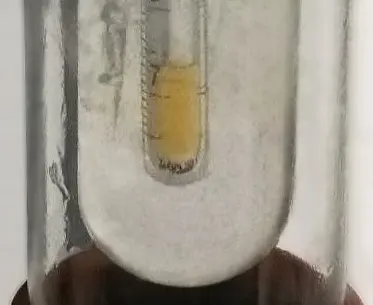
But fluorine on its own is something else entirely. It is the most reactive element of all: a pale yellow gas that sets steel wool on fire, reacts fiercely with even water, and injured and killed several of the chemists who tried to make it. Here is how such a fierce element ended up in your bathroom.
The fluorine atom
Every fluorine atom has 9 protons, so fluorine’s atomic number is 9. A neutral atom has 9 electrons. Every natural fluorine atom also has 10 neutrons, so its mass number is 9 + 10 = 19.
By the 2n² rule Grade 8: Bohr and Bury’s rule, the electrons are arranged 2, 7. In subshells, 1s² 2s² 2p⁵ Grade 10: The Aufbau principle.
Fluorine is one electron short of an octet. So it grabs one electron from almost anything, becoming the fluoride ion, F⁻, with the same electrons as neon (2, 8). Its valency is 1 Grade 8: Valency. With a metal it forms ionic fluorides such as sodium fluoride (NaF) and calcium fluoride (CaF₂); with non-metals it shares one pair, as in hydrogen fluoride (HF) and in its own molecule, F₂.
Its place in the periodic table
- Period 2, because its electrons are in two shells.
- Group 17, called VIIA in the older naming, because it has 7 outer electrons.
- p-block, because its last electron goes into a p subshell.
Group 17 is the halogens, the most reactive non-metals Grade 10: Non-metals. The name means “salt-makers”: they join with metals to make salts, such as common salt, sodium chloride. Fluorine heads the group, above chlorine, bromine and iodine.
Why fluorine is the most reactive
A fluorine atom is small: its 7 outer electrons are in the second shell, close to the nucleus, with only the 2 electrons of the K shell in between. So its 9 protons pull very hard on any electron that comes near. That makes fluorine the most electronegative element of all Grade 10: Electronegativity, and the most reactive. Going down the group, the atoms get bigger and the outer shell farther from the nucleus, so chlorine, bromine and iodine pull less and less hard Grade 10: Chemical reactivity.
Fluorine and chlorine both have 7 outer electrons. Why is fluorine more reactive?
Pick an answer to see why.
How fluorine was found and named
Fluorine’s story starts with a mineral, fluorspar (fluorite, calcium fluoride, CaF₂). Since the 1500s, miners had added it to metal ores in the furnace, because it helped them melt and flow: in Latin, fluere. Around 1670, glassworkers in Nuremberg, Germany, found that fluorspar mixed with acid could etch glass, eating pictures into it. In 1771 the Swedish chemist Carl Scheele showed that the etching was done by a new acid, which we call hydrofluoric acid, HF.
Chemists soon suspected that it held a new element, like chlorine in hydrochloric acid. In 1812 the French scientist André-Marie Ampère suggested the name fluor, and the English chemist Humphry Davy made it fluorine, to match chlorine. Its symbol is F.
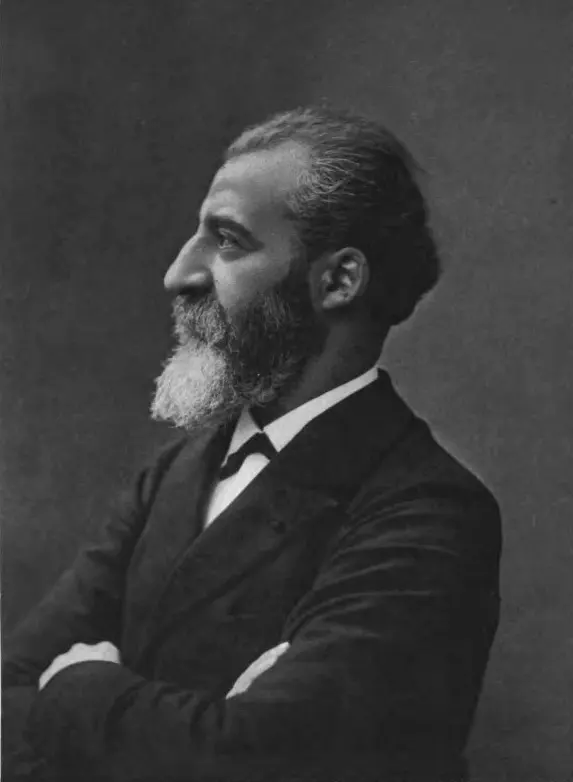
Getting the element itself out was another matter. For the next seventy years, everything that was tried failed, because fluorine attacked every container it was made in, and the chemists too.
Nepali uses the English name, फ्लोरिन, and फ्लोराइड for the fluoride in toothpaste.
Where fluorine is found
In the universe. Fluorine is surprisingly rare in the universe, much rarer than its neighbors oxygen and neon, because inside stars its nuclei are easily destroyed by the very reactions that make them.
In the Earth’s crust. Fluorine is the 13th most common element in the crust, about 0.06% of it. Because it is so reactive, it is never found as the element, only in compounds:
- fluorite or fluorspar, CaF₂, the main ore, often in beautiful purple, green or yellow cubes;
- cryolite, Na₃AlF₆, once vital for making aluminium;
- fluorapatite, a calcium phosphate in the rocks that phosphate fertilizers are made from.
The world mined about 9.5 million tonnes of fluorspar in 2024, about 60% of it in China, with Mexico and Mongolia next (US Geological Survey).
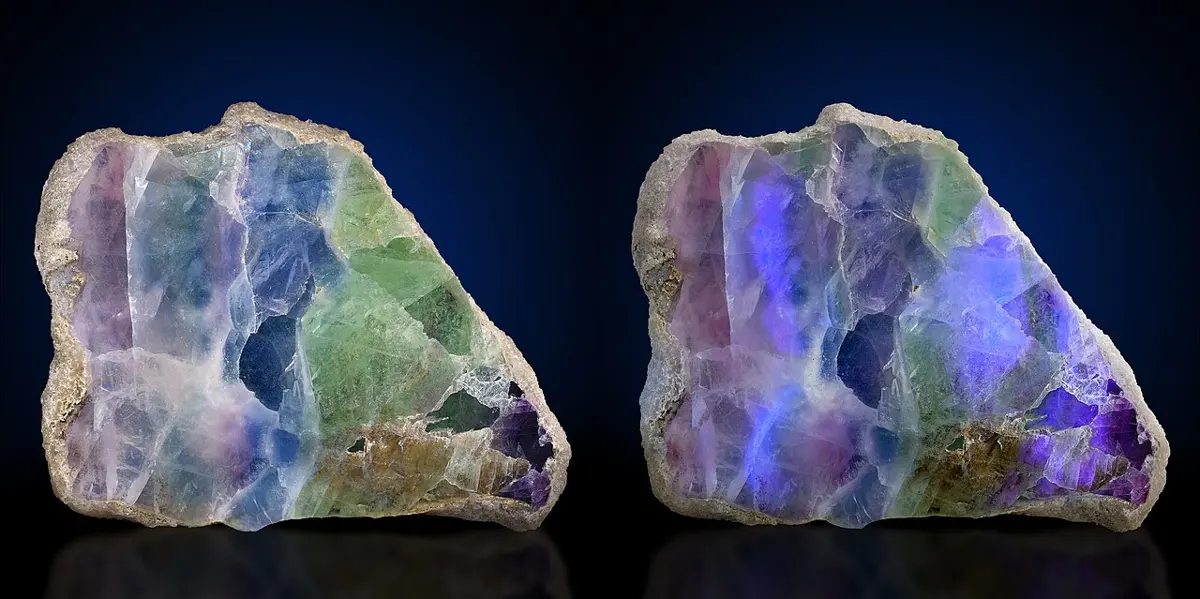
Fluorite is number 4 on the Mohs scale of hardness: a steel knife can scratch it Grade 8: Properties of minerals.
In your body. An adult body holds about 3 grams of fluorine, as fluoride, almost all of it in the bones and teeth.
What fluorine is like
- A pale yellow gas, made of F₂ molecules, with a sharp, choking smell. It is very poisonous.
- A little heavier than air.
- Very cold to liquefy: it turns into a bright yellow liquid at −188 °C and freezes at −220 °C.
- Never found free in nature: it is made from its compounds with electricity, as Moissan did. (Making it by ordinary chemical reactions was only managed in 1986.)
Fluorine is the smallest halogen and the first in each pattern of the group: its boiling point is the lowest, its color the palest (Why halogens boil at different temperatures).
How fluorine reacts
Fluorine reacts with almost every element, usually violently, often with a flame. Only helium, neon and argon resist it.
With hydrogen, it explodes, even in the dark and in the cold, making hydrogen fluoride:
H₂ + F₂ → 2HF
With metals, it forms fluorides; steel wool bursts into flame in it:
2Na + F₂ → 2NaF
Even water reacts fiercely with fluorine, giving off oxygen:
2F₂ + 2H₂O → 4HF + O₂
Even noble gases. In 1962 chemists found that the “inert” gas xenon forms compounds with fluorine, such as XeF₄. Fluorine pulls so hard that it can take a share of even xenon’s electrons.
A more reactive halogen pushes out a less reactive one. Fluorine takes the place of chlorine in dry sodium chloride, just as chlorine takes the place of bromine in a bromide; the order in group 17 is F > Cl > Br > I. (In a solution, fluorine attacks the water first.)
Hydrofluoric acid etches glass. HF dissolves the silica (SiO₂) that glass is made of:
SiO₂ + 4HF → SiF₄ + 2H₂O
That is how the inside of frosted bulbs and the marks on laboratory glassware are made.
Which pair would react, with the first element pushing the second out of its compound?
Pick an answer to see why.
Fluorine in daily life
Fluorine gas itself is made, by Moissan’s method of electrolysis, mostly to be turned straight into other compounds. Fluorine’s compounds are everywhere.
Toothpaste. Most toothpaste contains a fluoride, such as sodium fluoride, usually 1,000 to 1,500 parts per million. Some countries also add a little fluoride to tap water.
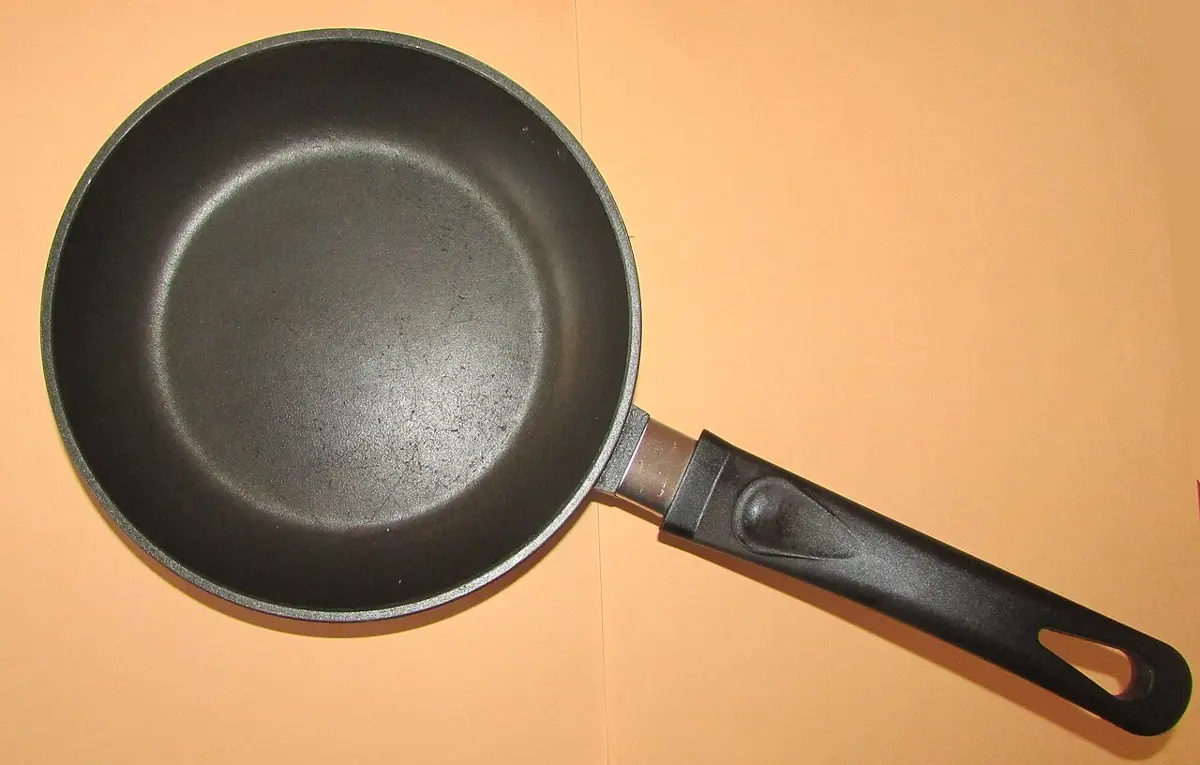
Non-stick pans. The coating is PTFE (Teflon), a long chain of carbon atoms, each wrapped in fluorine atoms. The carbon–fluorine bond is so strong that hardly anything sticks to or reacts with it. It was found by accident in 1938 (Non-stick pans). PTFE also makes the white tape plumbers wrap around pipe threads.
Fridges and air conditioners. The gases inside them were once CFCs (chlorofluorocarbons), which turned out to destroy the ozone layer, and were banned under the Montreal Protocol of 1987 Grade 9: Depletion of the ozone layer. Their replacements, HFCs, contain fluorine but no chlorine, so they spare the ozone; but they trap heat strongly, so they too are being phased out.
Medicines. About one in five medicines contains fluorine. A fluorine atom in the right place can make a medicine last longer in the body or work better.
Electricity and energy. Every lithium-ion battery, in phones and electric cars, has a fluorine compound in its liquid. Uranium for nuclear power stations is enriched as a fluorine gas, uranium hexafluoride. Another, sulphur hexafluoride, insulates the switches of high-voltage electricity substations.
Aluminium. Aluminium is made by passing electricity through aluminium oxide dissolved in molten cryolite, which lets it melt at about 950 °C instead of over 2,000 °C.
Isotopes of fluorine
All natural fluorine is one isotope, fluorine-19. That is why its atomic mass, 18.998, is so close to a whole number: there is no mixture to average. (It is a tiny bit less than 19 because, when protons and neutrons join in a nucleus, a little of their mass is turned into the energy that holds them together.)
A radioactive isotope, fluorine-18, is made in hospitals in a machine called a cyclotron. With a half-life of only about 110 minutes, it is attached to a kind of sugar and injected; cells that use a lot of sugar, such as cancer cells, take up more, and a PET scanner sees where the fluorine-18 has gathered. It must be used within hours of being made.
Fluorine and your health
Scientists still argue about whether the body truly needs fluoride, as it needs iron or iodine, but a little of it is certainly good for teeth. Tooth enamel, the hardest substance in your body, is made of a calcium phosphate. When you eat something sweet, the bacteria on your teeth turn the sugar into acid, which dissolves a little enamel. Between meals, your saliva puts the minerals back. Fluoride helps that repair, and the enamel it rebuilds, fluorapatite, resists acid better.
Too much fluoride is harmful. Children who swallow too much while their teeth are forming get white or brown patches on them (dental fluorosis). Where drinking water is naturally very rich in fluoride, as in parts of India, China and East Africa, years of drinking it can make bones stiff and painful (skeletal fluorosis). The World Health Organization advises no more than 1.5 mg of fluoride per liter of drinking water.
Surprising facts and records
- The most electronegative element, 3.98 on Pauling’s scale, the highest of all (Pauling and the chemical bond).
- Always the winner. In every compound, the shared electrons are pulled towards the fluorine, so fluorine always counts as the negative partner. No other element manages that.
- Forever chemicals. The carbon–fluorine bond is so strong that some fluorine compounds, used for stain-proof cloth and fire-fighting foam, hardly break down at all in nature. Called PFAS, they are now found in water and in people’s blood all over the world, and many countries are restricting them.
- Superacids. Mixtures of fluorine compounds make the strongest acids known, over a billion times stronger than concentrated sulphuric acid (superacids).
In your science books
- Grade 8: the 2n² rule, valency and the hardness of minerals.
- Grade 9: negative ions, ozone and CFCs and ways to protect the ozone layer.
- Grade 10: subshells, non-metals and the halogens, electronegativity and reactivity down a group.
- Going further: non-stick pans, why the halogens boil at different temperatures and fluorite’s crystal.
More to explore
- Nobel Prizes with fluorine in them: the ozone layer (1995, how CFCs destroy it), superacids (1994, made with antimony pentafluoride) and electronegativity (1954, Pauling’s scale, with fluorine at the top). Moissan’s own prize of 1906 doesn’t have a full story page yet.
- Play: find fluorine in Guess the Element and the Periodic Table Jigsaw.
- Read more: fluorine at the Royal Society of Chemistry and at PubChem.