
- Atomic number
- 2
- Atomic mass
- 4
- Shells
- 2
- Configuration
- 1s²
- In the table
- period 1, group 18 (0), s-block
- Kind
- Noble gas
- Valency
- 0 (it forms no ordinary compounds)
- State at 25 °C
- gas
- Melts · boils
- not known · −269 °C
- Density
- lighter than air
- Known since
- 1868
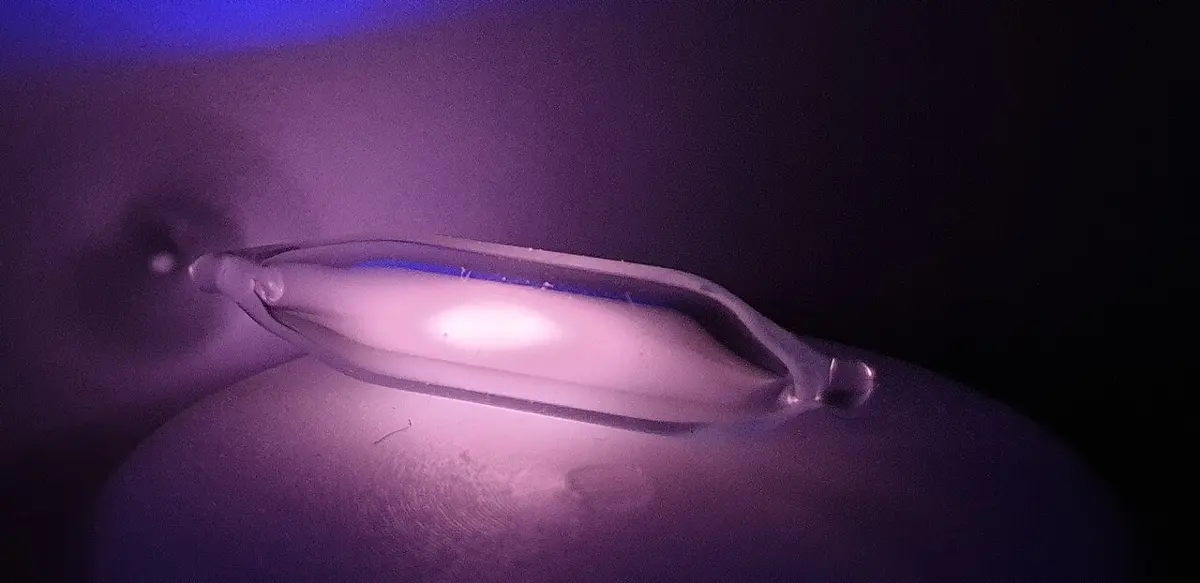
Let go of a shiny party balloon and it rises out of reach. Fill the same balloon with air from your lungs and it sinks. The difference is helium, a gas lighter than air that never burns, never rusts anything, and joins with nothing at all.
Helium is also the only element that was found in the Sun before it was found on Earth, and the coldest liquid there is: it keeps the giant magnets of hospital MRI scanners working. Here is its story.
The helium atom
A helium atom has 2 protons, so its atomic number is 2, and 2 electrons. Almost every helium atom also has 2 neutrons, so its mass number is 2 + 2 = 4. A helium nucleus, two protons and two neutrons, is a very tightly bound little package; you will meet it again below, as the alpha particle.
Both electrons sit in the K shell, which holds only two. So helium’s one shell is completely full: shells 2, subshells 1s². Two electrons in the first shell are called a duplet Grade 9: Duplet and duplet rule.
A full outer shell is what makes an atom stable. Helium has no electron to lose easily, and no room to take one, so it doesn’t form bonds: its valency is 0.
Its place in the periodic table
- Period 1, because it has one shell. Period 1 has only hydrogen and helium.
- Group 18 (group 0 in the older naming), at the far right, with the other noble gases or inert gases: neon, argon, krypton, xenon and radon Grade 8: Position of inert gases.
- Its two electrons are in an s subshell, so it is really an s-block element. It is placed in group 18 anyway, because it behaves like the noble gases, not like the metals of group 2.
Helium has 2 electrons in its outer shell, like beryllium and magnesium. Why isn’t it in group 2?
Pick an answer to see why.
Found in the Sun
Helium was found in the Sun’s light, with a spectroscope: an instrument that spreads light into its colors, its spectrum. Every element, glowing hot, gives out light of a few exact colors, seen as bright lines, as personal as a fingerprint (Why each element has its own lines).
On 18 August 1868 a total eclipse of the Sun was seen across India. With the bright disc of the Sun hidden by the Moon, astronomers could look at the thin layer of glowing gas around its edge. One of them, the Frenchman Pierre Janssen, at Guntur in southern India, saw a bright yellow line. Two months later, in London, the English astronomer Norman Lockyer saw the same line without an eclipse.
The line was close to the famous yellow pair of sodium, but not on it, and it matched no element known on Earth. Lockyer decided that it came from a new element, and with the chemist Edward Frankland named it helium, from helios, the Greek word for the Sun. Its symbol is He.
Many scientists doubted an element that existed only in the Sun. Then in 1895 the Scottish chemist William Ramsay heated a uranium mineral, cleveite, with acid, and found a gas whose spectrum showed the same yellow line. In Sweden, Per Teodor Cleve and Nils Langlet found it in the same mineral that year, and measured its atomic mass. Helium was real, and on Earth: 27 years after it was seen in the Sun.
You can see the colored lines of glowing gases for yourself with the Spectroscope exhibit at Science Playground (The Spectroscope).
Where helium is found
In the universe. Helium is the second most common element: about a quarter of all ordinary matter, after hydrogen. Most of it was made in the first few minutes after the Big Bang, when protons and neutrons joined into helium nuclei (The first three minutes). Stars, including the Sun, have been adding more ever since, by fusing hydrogen.
On the Earth, helium is rare. The air holds only about 5 parts in a million. Helium atoms are so light and fast that they leak away into space, and since helium joins with nothing, no compound holds it down.
So where does the Earth’s helium come from? From radioactivity. Deep in the rocks, uranium and thorium slowly decay, and one of the ways they do is by shooting out an alpha particle: two protons and two neutrons, a helium nucleus (Alpha decay). It picks up two electrons and becomes a helium atom. Over hundreds of millions of years this helium collects underground, trapped with natural gas, which in some places is a few per cent helium. That is the only place we can get it from.
In 2024 the world took about 180 million cubic meters of helium from natural gas, nearly all of it in the USA (about 80 million) and Qatar (about 64 million), with smaller amounts from Russia and Algeria (USGS, 2025).
What helium is like
- A colorless gas with no smell or taste, made of single atoms, He (not molecules like H₂ or O₂).
- Very light: a liter weighs about 0.18 g at 0 °C, about 7 times lighter than air. Only hydrogen is lighter.
- It doesn’t burn, and it joins with nothing: no helium compound is stable in ordinary conditions.
- It boils at −269 °C, just 4 degrees above absolute zero (−273 °C), the coldest anything can be. That is lower than any other substance.
- It never freezes on its own. Even at absolute zero, liquid helium stays liquid unless it is squeezed at about 25 times the pressure of the air.
Why so hard to liquefy? A gas turns liquid when its particles slow down enough to cling together. Helium atoms have a full shell and only two electrons, so the pull between them is the weakest of any atoms; only extreme cold lets them cling.
Floating balloons
A balloon floats when it weighs less than the air it pushes aside Grade 10: Floating in the air. A liter of air weighs about 1.2 g; a liter of helium about 0.17 g at room temperature. So each liter of helium can lift about 1 g, the difference.
Hydrogen is lighter than helium and cheaper. Why are passenger airships and party balloons filled with helium instead?
Pick an answer to see why.
How helium reacts: it doesn’t
Helium is the least reactive element of all. It doesn’t burn, doesn’t dissolve much in water, and doesn’t join with oxygen, metals or acids. Chemists have made compounds of xenon and krypton since 1962, but a compound of helium that lasts has been made only by crushing it with sodium at more than a million times the pressure of the air (in 2017).
That makes helium useful exactly where nothing must react: around hot welding, in making computer chips and glass fibers for the internet, and in testing for leaks.
Liquid helium and superfluids
In 1908 the Dutch physicist Heike Kamerlingh Onnes, in Leiden, became the first to turn helium into a liquid, at −269 °C. Three years later, using it to cool metals, he found that mercury loses all its resistance to electricity at −269 °C: superconductivity.
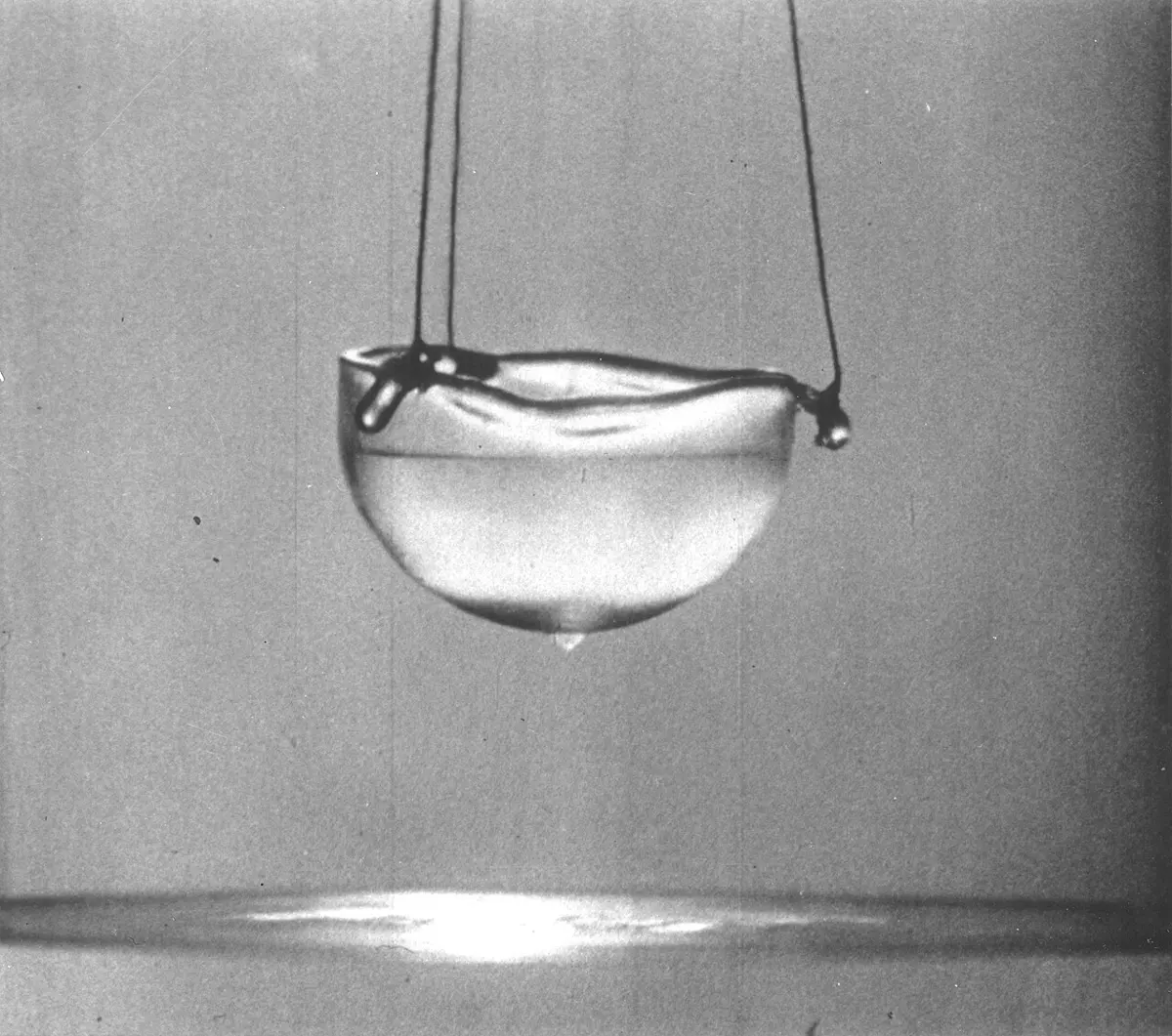
Cool liquid helium two degrees more, below −271 °C, and it turns into a superfluid, a liquid with no friction at all. It flows through cracks too fine for any other liquid, and it creeps up the walls of its container in a thin film, over the rim and down the outside.
Helium in daily life
- MRI scanners. The strong magnet of an MRI scanner is a coil of superconducting wire, which works only when kept at about −269 °C, so it sits in a bath of liquid helium. Most MRI scanners in hospitals, in Kathmandu as anywhere, depend on it (MRI). In the USA in 2024, about a sixth of all helium used went into MRI scanners.
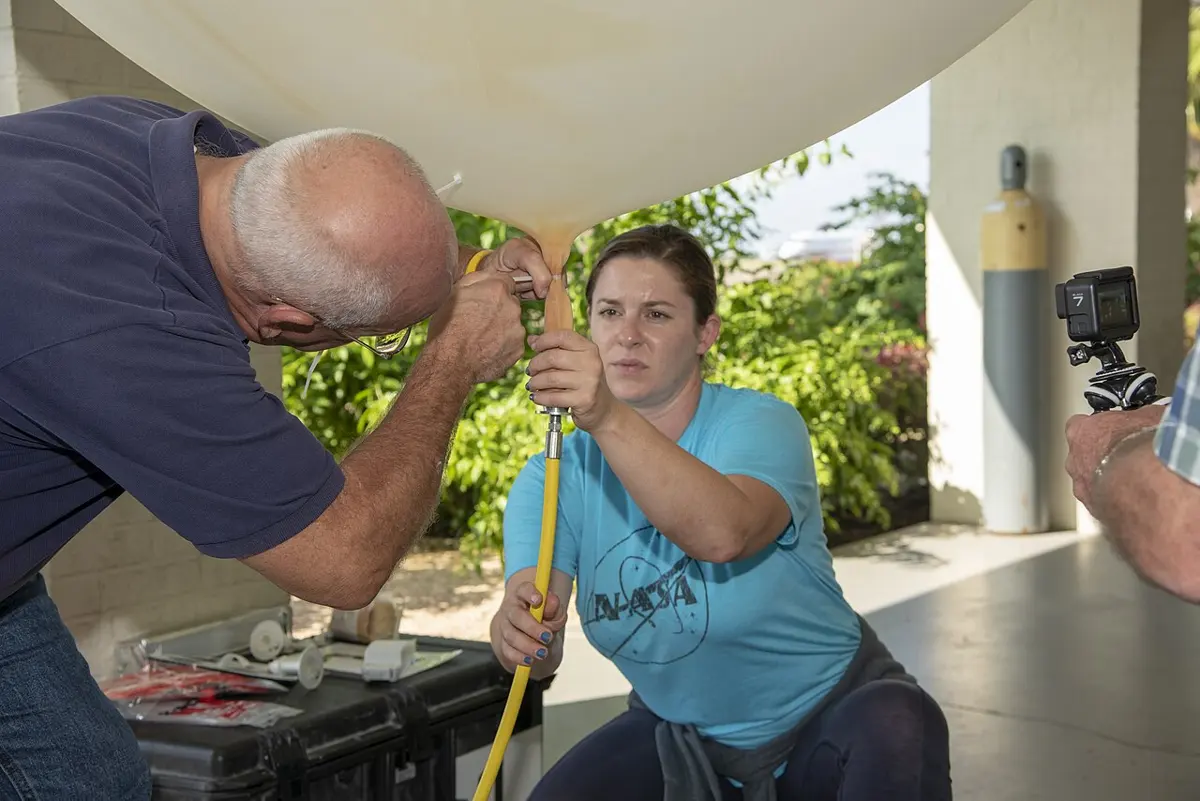
- Lifting gas. Weather balloons carry instruments up to 30 km to measure the air every day; airships and party balloons use it too.
- Science. The magnets of the Large Hadron Collider, the world’s biggest machine for smashing atoms together, are cooled by superfluid helium to −271 °C.
- Diving. Deep-sea divers breathe a mixture of helium and oxygen instead of air, because nitrogen breathed at high pressure makes divers confused, like being drunk.
- Welding, computer chips and optical fibers, where it keeps air away from hot metal and glass, and leak testing, because its tiny atoms escape through the smallest crack.
Isotopes of helium
Natural helium is almost all helium-4 (2 protons, 2 neutrons). About one atom in a million is helium-3, with just one neutron. Helium-3 is made in the Sun’s core on the way from hydrogen to helium-4 Grade 9: Nuclear reaction in the Sun. It too becomes a superfluid, but only a few thousandths of a degree above absolute zero (Superfluid helium-3).
Helium and your health
Your body has no use for helium, and helium itself is not poisonous: it passes in and out of your lungs unchanged. Its danger is that it takes the place of oxygen.
Breathe a little helium and your voice sounds high and squeaky. Sound travels nearly three times faster in helium than in air, so the hollow spaces of your mouth and throat ring at higher notes; your vocal cords vibrate just as before.
Surprising facts and records
- Discovered in space first: the only element found outside the Earth before it was found on it.
- The lowest boiling point of any substance, −269 °C, and the only element that never freezes at ordinary pressure.
- Every alpha particle is a helium nucleus. In 1908, Ernest Rutherford and Thomas Royds caught alpha particles in a sealed glass tube and saw helium’s yellow line appear in it (Rutherford).
- Two numbers, one element. Helium is about a quarter of the universe but only five millionths of the air.
In your science books
- Grade 8: the first 20 elements and the inert gases.
- Grade 9: the duplet rule, fusion in the Sun, nuclear fusion and radioactive emission.
- Grade 10: the modern periodic table, subshells, floating in the air and the life of a star.
- Going further: what stars are made of (helium found in sunlight), the first three minutes, alpha decay and helium into carbon.
More to explore
- Nobel Prizes with helium in them: Rutherford (1908, alpha particles are helium), superfluid helium-3 (1996), superconductors and superfluids (2003), MRI (2003, magnets cooled by liquid helium) and neutrinos from the Sun (2002, the Sun making helium).
- See it: the Spectroscope at Science Playground. Play: find helium in Guess the Element and the Periodic Table Jigsaw.
- Read more: helium at the Royal Society of Chemistry and at PubChem.