
- Atomic number
- 26
- Atomic mass
- 55.84
- Shells
- 2, 8, 14, 2
- Configuration
- 1s² 2s² 2p⁶ 3s² 3p⁶ 4s² 3d⁶
- In the table
- period 4, group 8 (VIIIB), d-block
- Kind
- Transition metal
- Valency
- 2 and 3 (ferrous Fe²⁺, ferric Fe³⁺)
- State at 25 °C
- solid
- Melts · boils
- 1,538 °C · 2,861 °C
- Density
- 7.9 × as heavy as water
- Known since
- ancient times
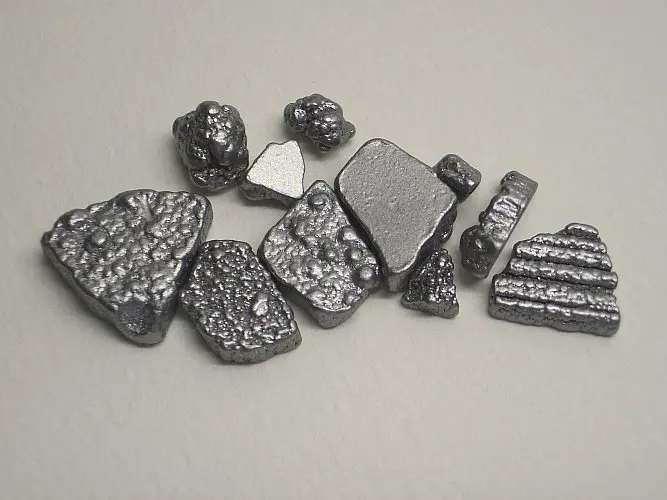
Look around you: the rods (छड) inside every concrete building, the corrugated roof sheets (जस्तापाता), the nails, the pressure cooker, the bicycle, the bus, the khukuri. Almost all of it is steel, which is mostly iron. More than nine-tenths of all the metal people use, by weight, is iron.
And iron is inside you too. Your blood is red because of it, and without it not one breath you take would reach your muscles. Here is the story of the metal that built the modern world.
The iron atom
An iron atom has 26 protons, so its atomic number is 26, and 26 electrons. Most iron atoms have 30 neutrons, so their mass number is 26 + 30 = 56.
In shells, its electrons are 2, 8, 14, 2. That looks odd: why does the M shell stop at 14, when it can hold 18, while the N shell already has 2? The answer is in the subshells Grade 10: The Aufbau principle. After argon’s 18 electrons, the 4s subshell fills first (2 electrons, as in calcium), and only then does 3d, part of the M shell, begin to fill. Iron has 6 electrons in 3d:
1s² 2s² 2p⁶ 3s² 3p⁶ 4s² 3d⁶
So the M shell holds 2 + 6 (3s, 3p) + 6 (3d) = 14, and the N shell holds the 2 in 4s.
Two ions: ferrous and ferric
Iron can lose its electrons in two ways Grade 9: Variable valency:
- It loses its two 4s electrons and becomes Fe²⁺, the ferrous ion (valency 2), as in ferrous sulphate (FeSO₄), the iron in iron tablets.
- It loses one more, from 3d, and becomes Fe³⁺, the ferric ion (valency 3), as in ferric oxide (Fe₂O₃), the red-brown of rust. Fe³⁺ is especially stable because its 3d subshell is then exactly half full, one electron in each of its five boxes.
Which electrons does an iron atom lose first when it becomes Fe²⁺?
Pick an answer to see why.
Its place in the periodic table
- Period 4, because its electrons are in four shells.
- Group 8, the first of the three columns that older tables call group VIIIB (with cobalt and nickel).
- d-block, because its last electrons go into a d subshell: iron is a transition metal Grade 10: Metals.
Iron, cobalt and nickel sit side by side and are alike: hard, gray, magnetic metals. They are the only three elements that are strongly magnetic at room temperature.
How iron was found and named
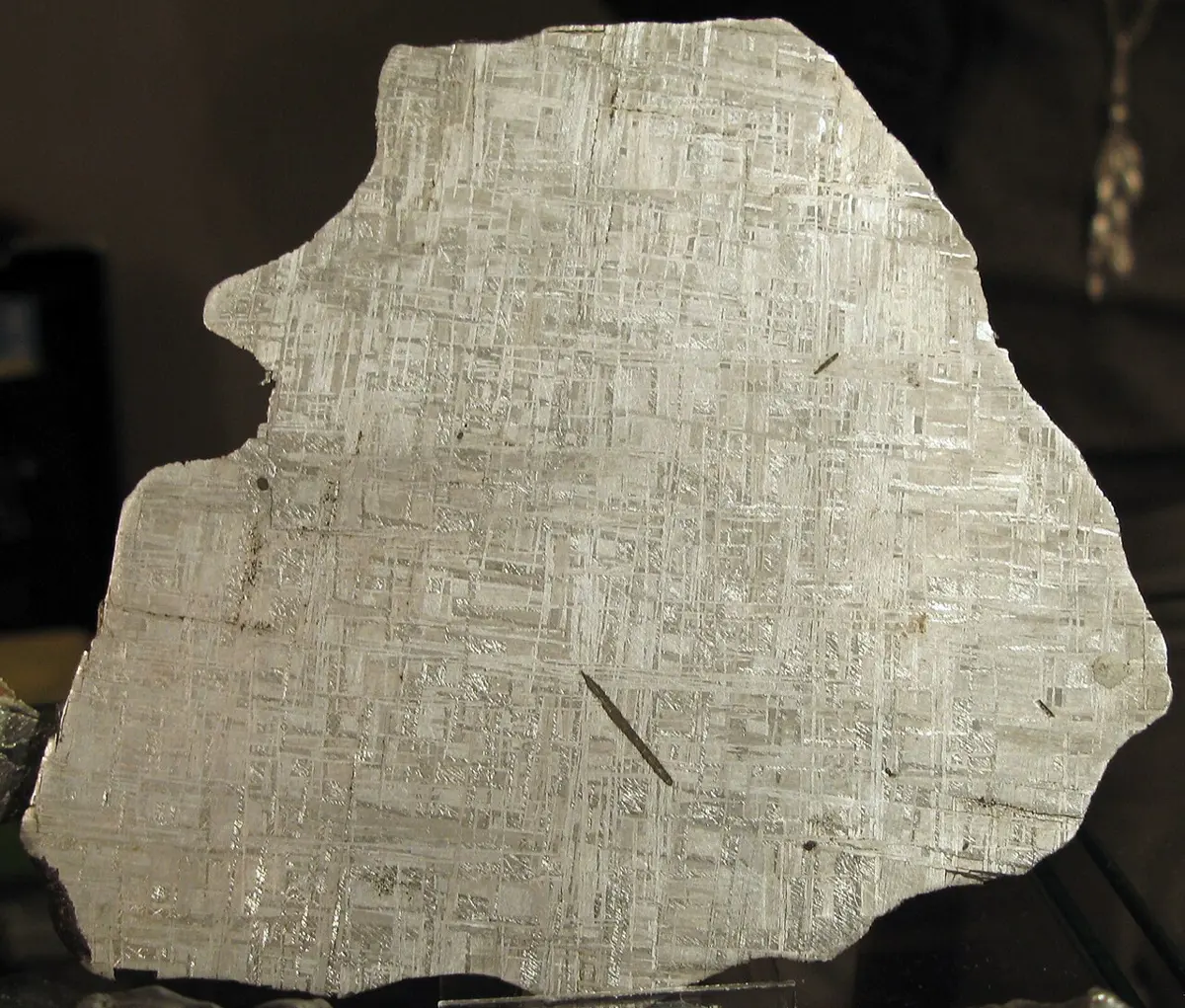
Iron from the sky. The first iron people ever worked came from meteorites, lumps of iron and nickel fallen from space. Beads hammered from meteorite iron, over 5,000 years old, have been found in a grave in Egypt; the dagger buried with the pharaoh Tutankhamun around 1323 BCE has a blade of meteorite iron. It was rarer than gold.
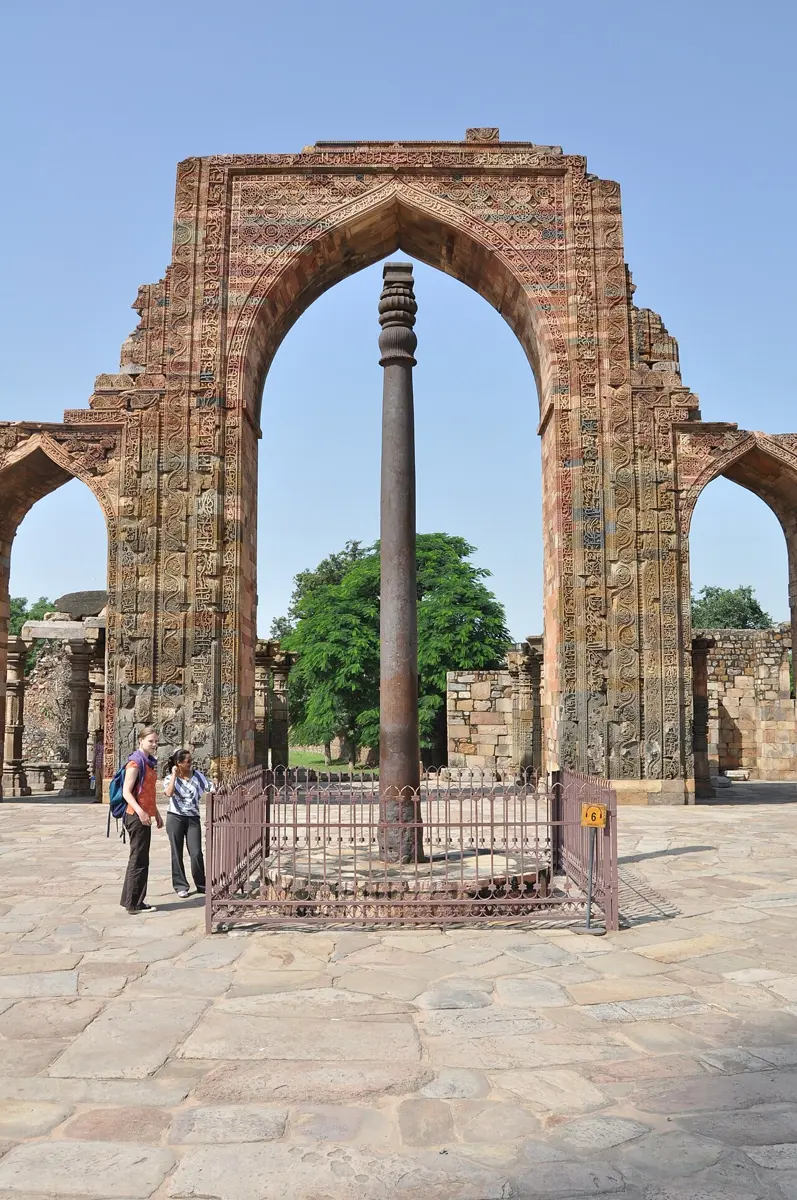
Iron from rock. Iron ores are everywhere, but iron melts at 1,538 °C, far hotter than copper, so early smiths could not melt it. They learned instead to heat ore with charcoal until a spongy lump of iron formed, then hammer out the slag. Iron smelting began in Anatolia (today’s Turkey) about 3,200 to 3,500 years ago, and over the next centuries spread to Europe, Africa and South Asia. Iron was harder than bronze, and its ores far more common than copper’s and tin’s: this was the start of the Iron Age.
The name. “Iron” is an old English word. The symbol Fe comes from the Latin ferrum Grade 8: Symbols from Latin names, which also gives the words ferrous and ferric. Nepali has its own word, फलाम, and also लोहा, from Sanskrit लोह.
Where iron is found
In the universe. Iron is where the stars stop. Big stars make heavier and heavier elements by fusing lighter ones, giving out energy at each step, until their cores are iron. Fusing iron gives out no energy, so the core collapses and the star explodes as a supernova, scattering iron into space (Why fusion stops at iron). That is why iron is one of the most common heavy elements in the universe.
In the Earth. By mass, iron is the most common element in the whole Earth, about a third of it, because most of it sank to the center when the young Earth was molten. The Earth’s core is mostly iron with some nickel: a solid inner core and a liquid outer core, whose swirling currents make the Earth’s magnetic field, the one your compass needle follows. In the crust, iron is the fourth most common element, about 5%. The red and yellow of soils, rocks and fired bricks is iron oxide.
Ores. The main ores are hematite (Fe₂O₃), magnetite (Fe₃O₄), limonite and siderite Grade 10: Ores of iron. In 2025 the world mined about 2.6 billion tonnes of iron ore, holding about 1.6 billion tonnes of iron; Australia mined over a third of it, then Brazil, India and China (USGS, 2026).
In Nepal. Iron ore is found in several places, such as Phulchoki in Lalitpur and Thoshe in Ramechhap Grade 8: Minerals in Nepal. For centuries iron was smelted from such ores by hand in small charcoal furnaces in Nepal’s hills. Today no iron ore is mined on a large scale; Nepal’s steel mills make rods and sheets from imported iron, steel and scrap.
What iron is like
- A shiny, silvery-gray metal when pure, and quite soft. Almost all the “iron” you see is steel, made much harder by a little carbon.
- Heavy: its density is 7.87 g/cm³, nearly eight times that of water.
- Melts at 1,538 °C and boils at 2,861 °C.
- Strongly magnetic Grade 8: Magnets. Heated above about 770 °C it stops being magnetic, and becomes magnetic again as it cools Grade 8: Heating a magnet.
- Conducts heat and electricity, though only about a sixth as well as copper.
- Malleable and ductile, especially when red-hot, which is why a blacksmith heats it in the आरन (forge) before hammering it.
Why is iron magnetic? Each iron atom acts like a tiny magnet, because of the unpaired electrons in its 3d subshell (four of its six). In iron, neighboring atoms line up their tiny magnets in the same direction, in regions called domains. A magnet brought near lines the domains up with each other, and the iron is pulled Grade 8: Molecular theory of magnetism.
How iron reacts
Iron is a moderately reactive metal: in the reactivity series it is below zinc and above lead, copper and hydrogen.
With dilute acids it gives hydrogen and a ferrous salt Grade 9: Metals and dilute acids:
Fe + 2HCl → FeCl₂ + H₂
With water: not with cold water, but red-hot iron reacts with steam, giving hydrogen and black iron oxide:
3Fe + 4H₂O → Fe₃O₄ + 4H₂
With sulphur: a mixture of iron filings and sulphur powder can be separated with a magnet; heat it, and it glows and becomes iron sulphide (FeS), a new compound that a magnet no longer pulls apart:
Fe + S → FeS
With copper sulphate: iron is more reactive than copper, so an iron nail in blue copper sulphate solution gets a coat of copper, and the solution turns pale green Grade 10: Single displacement:
Fe + CuSO₄ → FeSO₄ + Cu
Rusting
Leave iron or steel outside and it slowly turns into flaky, orange-brown rust. Rust is hydrated iron(III) oxide, Fe₂O₃·xH₂O, where x (the amount of water in it) varies:
4Fe + 3O₂ + 2xH₂O → 2Fe₂O₃·xH₂O
Iron rusts only when it has both air (oxygen) and water. You can prove it with three test tubes, each with an iron nail:
Salt makes rusting faster, so iron rusts quickly near the sea and on roads salted in snowy countries. Unlike the thin, tight oxide on aluminium, rust is flaky: it falls off, exposing fresh iron underneath, so rusting goes on until the iron has crumbled away.
Ways to stop rusting all keep air and water away, or give up another metal instead:
- Painting, as on gates, bridges and buses;
- Oiling and greasing, as on bicycle chains and tools;
- Galvanizing: coating with zinc, as on जस्तापाता. Zinc is more reactive than iron, so even where the coating is scratched, the zinc corrodes first and the iron is saved. That is why Nepali calls the roof sheets जस्ता, “zinc”, though they are mostly steel;
- Tinning, as on tin cans;
- Alloying: stainless steel contains at least about 10% chromium, which forms an invisible protective layer Grade 8: Steel.
Shyam keeps a steel spade in his shed in Pokhara and another one by the beach in Chennai, both oiled once a year. Which rusts faster, and why?
Pick an answer to see why.
From ore to steel
Iron is taken from its ore in a blast furnace, a steel tower lined with heat-proof brick, 30 meters or more tall, which runs day and night for years Grade 10: Smelting.
- Hematite (the ore), coke (nearly pure carbon, made from coal) and limestone are tipped in at the top.
- Hot air is blasted in near the bottom. The coke burns, making the furnace white-hot, about 2,000 °C where the air enters: C + O₂ → CO₂. Higher up, the carbon dioxide meets more hot coke and becomes carbon monoxide: CO₂ + C → 2CO.
- Carbon monoxide reduces the ore, taking away its oxygen Grade 10: Reduction:
Fe₂O₃ + 3CO → 2Fe + 3CO₂ - The limestone breaks down to lime (CaO), which joins with the sand in the ore to make a molten glassy waste, slag (CaSiO₃). Molten iron trickles to the bottom; the lighter slag floats on it. Both are drained off.
The iron from a blast furnace, pig iron or cast iron, contains about 3 to 4% carbon, which makes it hard but brittle: it cracks if hit. To make steel, oxygen is blown through the molten iron, burning off most of the carbon, until less than about 2% is left (usually much less). Steel is strong and tough. Different steels, with different amounts of carbon and of other metals (chromium, nickel, manganese), are made for different jobs. In 2025 the world made about 1.9 billion tonnes of steel, about half of it in China (USGS, 2026). Much steel is made from recycled scrap: steel can be melted and used again and again without getting worse.
Iron in daily life and in Nepal
Building. Steel rods (छड) inside concrete carry the pull that concrete alone can’t, and steel beams frame bridges and tall buildings. Galvanized steel sheets roof houses from the Terai to the high hills.
Machines and transport. Cars, buses, trains and their rails, bicycles, ships and machines are mostly steel. Electromagnets, transformers and motors have cores of soft iron, which is easily magnetized and loses its magnetism as soon as the current stops.
In the kitchen. The iron कराही and ताप्के, steel pressure cookers, plates and spoons. Cooking in an iron pan really does add a little iron to the food.
The khukuri
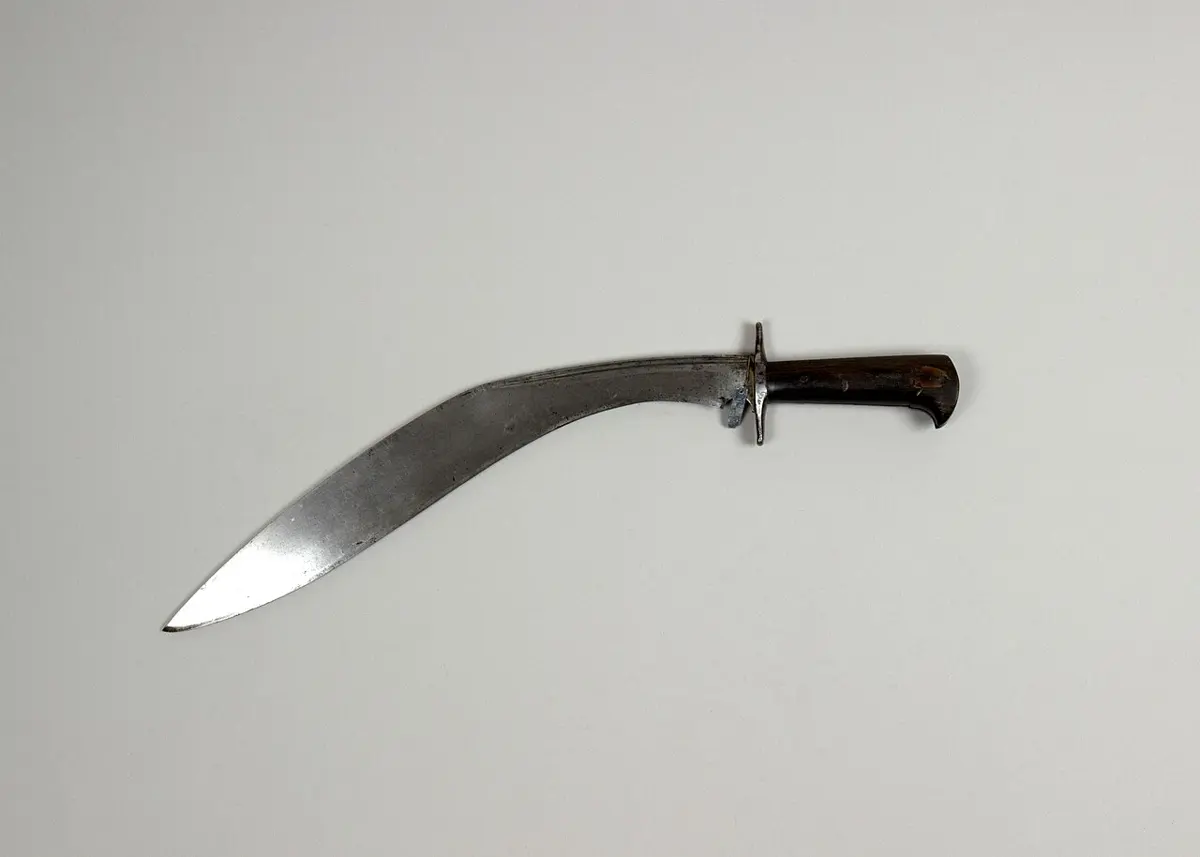
Nepal’s khukuri (खुकुरी), with its forward-curved blade, is forged by blacksmiths, traditionally of the Kami (Biswakarma) community. Many are made from the leaf springs of old trucks, which are a tough spring steel. The smith heats the steel in the आरन until it glows, hammers it into shape, and then hardens the edge by heating it again and quenching it in water, so that the edge is hard and keeps sharp while the back of the blade stays tough and does not snap.
Iron and your health
An adult’s body holds only about 4 grams of iron, enough for one small nail. About two-thirds of it is in hemoglobin, the red protein that fills your red blood cells Grade 9: Metals required for the human body. Each hemoglobin molecule has four heme groups, each with one iron atom at its center, and each iron atom can hold one molecule of oxygen. In your lungs, hemoglobin picks up oxygen; in your muscles and organs it lets it go. Heme is also what makes blood red.
Iron is also in myoglobin, which stores oxygen in muscles, and in many enzymes that release energy from food. Red blood cells last about 120 days; when they are broken down, the body keeps their iron and uses it again.
How much you need, a day (US National Institutes of Health): teenage boys 11 mg, teenage girls 15 mg; adult men 8 mg, women 18 mg until about 50, because women lose iron in monthly bleeding; pregnant women 27 mg.
Good sources: meat, fish and eggs (whose “heme iron” is easily absorbed); green leafy vegetables such as spinach and mustard greens, lentils, beans, soybeans, and whole grains. Vitamin C (lemon, oranges, guava, tomato) eaten at the same meal helps the body take in the iron from plants; tea drunk with a meal reduces it.
Too little iron causes anemia: too little hemoglobin, so too little oxygen reaches the body. Signs: tiredness, pale skin and nails, breathlessness when active, poor concentration. It is common in Nepal: in the 2022 Nepal Demographic and Health Survey, about 43% of children aged 6 months to 5 years and 34% of women were anemic. Pregnant women in Nepal are given iron tablets free.
Isotopes of iron
Natural iron is a mixture of four stable isotopes: iron-54, iron-56, iron-57 and iron-58. Iron-56, with 30 neutrons, is by far the most common.
Surprising facts and records
- The red planet. Mars is red because its dust is rich in iron oxide: the whole planet is, in a sense, rusty.
- Rust made our iron ore. Most of the world’s iron ore lies in rocks called banded iron formations, laid down on the sea floor more than 2 billion years ago, when the first oxygen made by living things turned the iron dissolved in the sea into rust (Rusting the sea).
- Hand warmers that you shake to make them hot are packets of iron powder rusting very fast (The packet that rusts).
- The Eiffel Tower in Paris is made of about 7,300 tonnes of iron, and is repainted about every seven years to stop it rusting.
In your science books
- Grade 8: symbols from Latin names (Fe from ferrum), magnets, steel and minerals in Nepal.
- Grade 9: variable valency (ferrous and ferric), metals and acids and iron in the body.
- Grade 10: electronic configuration, transition metals, ores of iron, smelting, single displacement and how a steel ship floats.
- Going further: why fusion stops at iron, rusting the sea and hand warmers.
More to explore
- Nobel Prizes with iron in them: making ammonia (1918, on an iron catalyst), surface chemistry (2007, how that iron catalyst works, and how iron rusts), giant magnetoresistance (2007, layers of iron and chromium that read hard disks) and how cells sense oxygen (2019, the signal to make more red blood cells).
- See the Earth’s Magnetic Field exhibit at Science Playground.
- Play: make rust and iron sulphate in Molecule Kitchen, or find iron in Guess the Element and the Periodic Table Jigsaw.
- Read more: iron at the Royal Society of Chemistry and at PubChem.