
- Atomic number
- 86
- Atomic mass
- 222.02
- Shells
- 2, 8, 18, 32, 18, 8
- Configuration
- 1s² 2s² 2p⁶ 3s² 3p⁶ 4s² 3d¹⁰ 4p⁶ 5s² 4d¹⁰ 5p⁶ 6s² 4f¹⁴ 5d¹⁰ 6p⁶
- In the table
- period 6, group 18 (0), p-block
- Kind
- Noble gas
- Valency
- 0 (a noble gas); a few compounds with fluorine
- State at 25 °C
- gas
- Melts · boils
- −71 °C · −62 °C
- Density
- 7.5 × as heavy as air
- Known since
- 1900
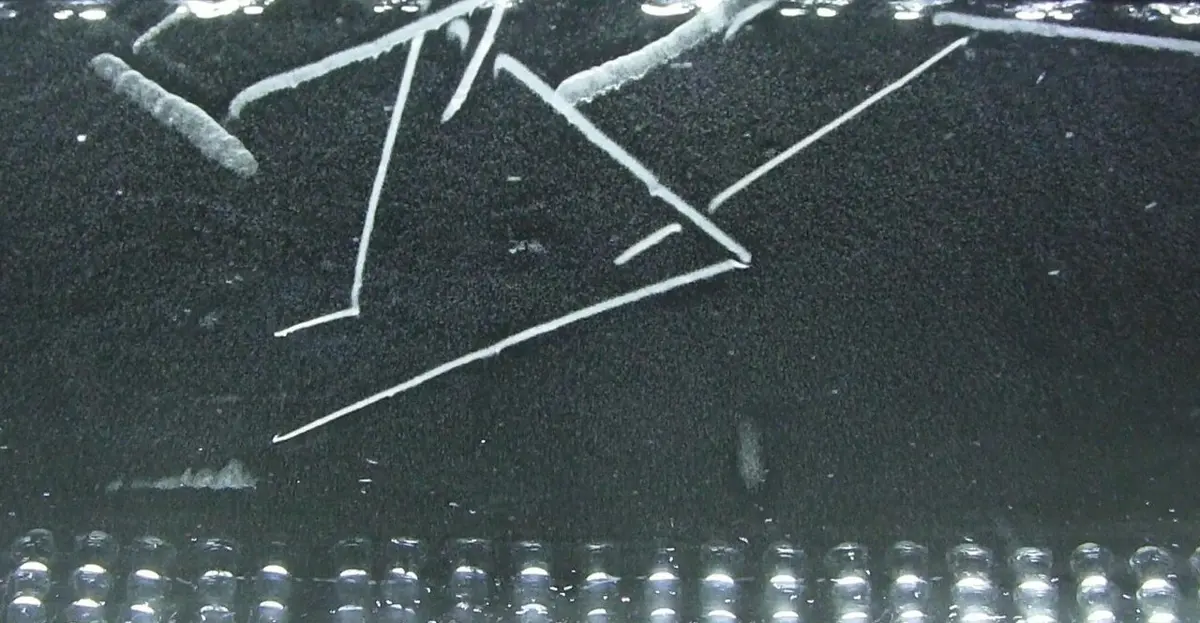
You are breathing radon right now. It is in the air of every room in Nepal, and every room in the world: a gas you can’t see, smell or taste, which seeps out of the ground. Every radon atom is radioactive. Breathed in day after day, year after year, it slowly harms the lungs: in many countries it is the second most common cause of lung cancer, after smoking.
Radon is also a puzzle for chemists: it is a noble gas, like the neon and argon in your books, the most unreactive kind of element there is. Here is how an element can be both completely unreactive and dangerous, and what you can do about it.
The radon atom
Every radon atom has 86 protons, so radon’s atomic number is 86, and a neutral atom has 86 electrons. The most common kind, radon-222, has 136 neutrons: mass number 86 + 136 = 222.
The electrons fill six shells: 2, 8, 18, 32, 18, 8. The outermost shell holds eight electrons (6s² 6p⁶): a complete octet Grade 9: Octet and octet rule. An atom with a full outer shell has no need to lose, gain or share electrons, so radon, like the other noble gases, hardly reacts with anything. Its valency is 0.
Its place in the periodic table
- Period 6, because its electrons are in six shells.
- Group 18, also called group 0 because of its valency, at the bottom of the noble gases (or inert gases) Grade 8: Position of inert gases: helium, neon, argon, krypton, xenon and radon.
- p-block, because its last electrons go into the 6p subshell Grade 10: Non-metals.
A stable atom with an unstable nucleus
Here is the puzzle. Radon’s electrons are perfectly settled; its nucleus is not. A nucleus is held together by a strong pull between its protons and neutrons, against the push of its protons on each other. Beyond bismuth (83 protons), no nucleus has enough neutrons to hold together for ever Grade 9: Nuclear stability. Radon has 86, so every radon atom is radioactive: sooner or later its nucleus breaks down and throws out radiation Grade 9: Radioactive elements.
Chemistry, the way atoms react, is about the electrons. Radioactivity is about the nucleus. The two are completely separate.
Radon has a full outer shell of eight electrons. Which statement is true?
Pick an answer to see why.
How radon was found and named
Radon was found by people studying the new radioactive elements, around 1900:
- 1899. Pierre and Marie Curie noticed that radium made the air around it radioactive. In Canada, Ernest Rutherford and Robert Owens found that thorium gave off a radioactive gas, which Rutherford called an emanation (something that flows out).
- 1900. In Germany, Friedrich Ernst Dorn showed that radium gives off a radioactive gas too, “radium emanation”. Most books credit him with finding radon; some give the credit to Rutherford and Owens, for the thorium gas a year earlier, which is another form of the same element.
- About 1908–1910. In London, William Ramsay, who had already discovered most of the other noble gases, and Robert Whytlaw-Gray collected a tiny amount of the gas, measured how dense it was (the heaviest gas known), and placed it at the bottom of the noble gases. They called it niton, from the Latin for “shining”, because it glows.
The name radon (from radium, with the -on of argon and neon) has been used since 1923, and the symbol is Rn. Rutherford and Frederick Soddy’s studies of the thorium gas showed that radioactive atoms turn into other elements (Nobel Prize in Chemistry 1908).
Where radon comes from
From uranium, step by step. Almost all rocks and soils hold a little uranium. Uranium-238 decays very slowly, over billions of years, through a chain of other radioactive atoms. One of them is radium-226. When a radium nucleus gives out an alpha particle (2 protons and 2 neutrons), it becomes radon-222 (Alpha decay):
Radium is a solid, locked in the rock. Radon is a gas, so it can escape: through cracks and pores in rock and soil, and into water underground.
Radon is always being made. Radon-222 has a half-life of only 3.8 days (below). All the radon in the air today was made within the last few weeks. It never runs out, because uranium-238, with a half-life of 4.5 billion years, keeps making more.
In the open air, radon mixes into the atmosphere and is very thin: usually 5 to 15 becquerels per cubic meter (WHO). Indoors it can build up, from about 10 to, in rare houses, over 10,000.
What is a becquerel? Radon is measured by its radioactivity. One becquerel (Bq) is one atom decaying every second. So “100 Bq/m³” means that in each cubic meter of air, 100 radon atoms decay every second. That is about 50 million radon atoms in the cubic meter, among some 25 million million million million molecules of air. A tiny amount: the danger is not how much radon there is, but what its radiation does inside your lungs.
In Nepal. Scientists at the Nepal Academy of Science and Technology (NAST) measured radon for months in homes across the Kathmandu Valley. They found from 8 to 787 Bq/m³, with an average of about 80 (Thapa and Shah, 2014). The highest were in crowded, poorly aired houses. A later study of houses in the Kathmandu Valley found an average of about 68. Much more radon pours out of the ground in some places in the hills: near the hot springs of Syabru-Bensi in Rasuwa, which lie on a great fault, scientists have measured very strong flows of radon and carbon dioxide out of the ground; in places the carbon dioxide pours out as strongly as on active volcanoes.
What radon is like
- A colorless gas with no smell and no taste. You can never tell it is there without a detector.
- The heaviest noble gas: a liter weighs about 9.7 g at 0 °C, about 7.5 times as much as a liter of air. That is one reason it collects low down, in ground floors and basements.
- Boils at −62 °C and freezes at −71 °C. Cooled to a solid, it glows, yellow at first and orange-red as it is cooled further, from its own radiation.
- Dissolves a little in water, so well water and spring water can carry it.
How it reacts. Hardly at all. Like xenon above it, it can be made to join with fluorine, the most reactive non-metal: a radon fluoride was made in 1962. Studying its chemistry is hard, because every sample decays within weeks.
A clock that runs out: half-life
A radon-222 nucleus may decay in the next second or in a month: no one can say when. But in a crowd of radon atoms, half of them decay every 3.8 days. This time is the half-life (A clock inside the atom). Each radon-222 atom gives out an alpha particle and becomes polonium-218:
A detector shows 400 Bq/m³ in a closed, empty room. The room is sealed so that no new radon gets in. After about how many days will it read 100 Bq/m³?
Pick an answer to see why.
Radon and your health
Breathing radon is not like an X-ray, which passes through you in a moment. Most of the radon you breathe in, you breathe out again. The harm comes from its daughters: radon decays into polonium-218, then lead-214, bismuth-214 and polonium-214, all solids, which stick to specks of dust in the air and to the lining of your airways. There they give out alpha particles, which can’t even get through a sheet of paper, but deliver all their energy to the few cells next to them, and can damage the DNA in those cells. Over many years, a damaged cell can grow into a cancer.
What the World Health Organization (WHO) says:
- Radon causes between 3% and 14% of all lung cancers in a country, depending on how much radon its homes have and how many people smoke.
- The risk rises by about 16% for every 100 Bq/m³ more radon in a home, breathed for many years.
- It is far worse for smokers: their risk from radon is about 25 times that of non-smokers.
- Countries should aim to keep homes below 100 Bq/m³, and where that is not possible, below 300.
In the USA, the Environmental Protection Agency estimates that radon causes about 21,000 deaths from lung cancer each year, and that it is the leading cause of lung cancer in people who have never smoked. Radon is also the biggest part of the natural radiation each of us receives, about half of it.
Testing and fixing
You can’t smell radon, so the only way to know is to measure it, and because it changes from day to day and season to season, for three months or more. The cheapest detectors are small plastic cups holding a sheet of special plastic: each alpha particle that hits it leaves a tiny scar, and a laboratory counts the scars. The Kathmandu study used detectors of this kind.
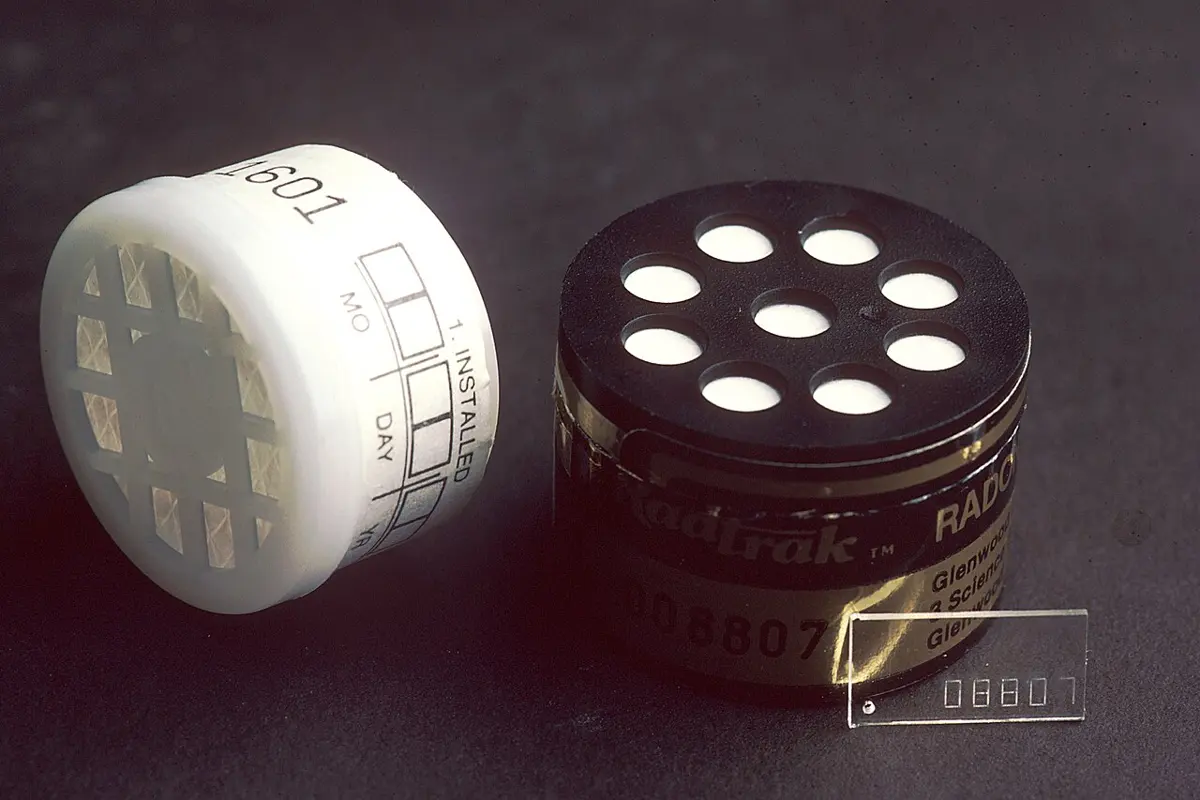
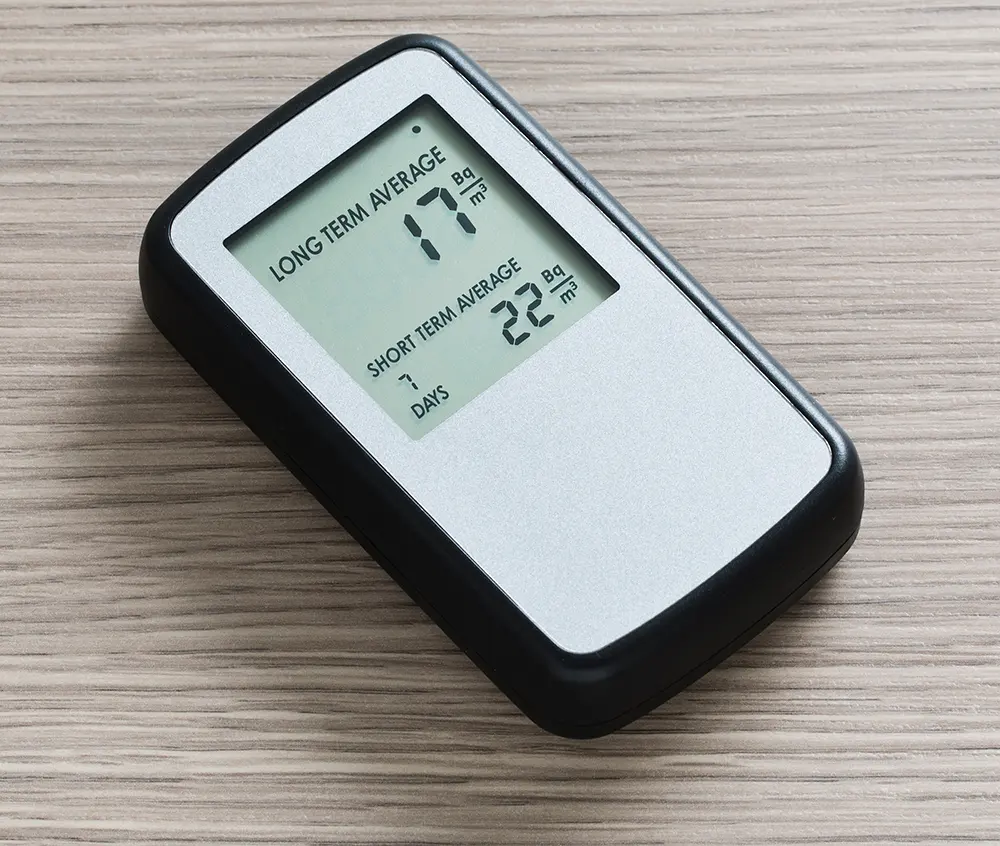
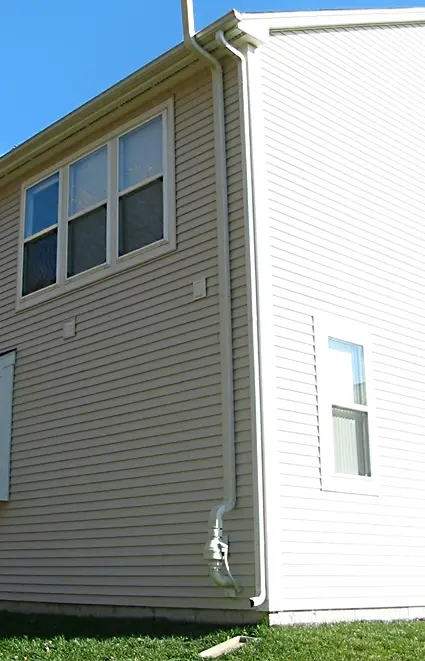
Most homes need nothing more than fresh air. Where radon is high, there are three simple fixes (Figure 5):
Uses of radon
Because it is radioactive, radon has had a few uses:
- Cancer treatment, in the past. Tiny sealed tubes of radon (“seeds”) were placed inside tumors to kill the cancer cells with radiation. Safer sources are used today.
- Following water and air. Radon in water or air shows where it has come from the ground: scientists use it to find where groundwater flows into rivers and the sea, and to trace how air moves.
- Earthquakes. The radon in wells and springs has sometimes risen before an earthquake, as new cracks opened underground. It has been studied for decades, but it does not give a reliable warning: no one can yet predict when an earthquake will strike (Earthquakes: where and how big, but not when).
Surprising facts and records
- One of the rarest gases in the air. Even though radon is made all the time, it decays so fast that there is only about one radon atom in every 10²¹ particles of air.
- A glowing solid. Frozen radon glows by itself, from the energy of its own radiation.
- Granite houses. In some granite areas, such as Cornwall in England, many homes have high radon, because granite holds more uranium than most rocks.
In your science books
- Grade 8: the inert gases in the periodic table.
- Grade 9: the octet rule, nuclear stability and radioactive elements.
- Grade 10: electronic configuration and non-metals and the noble gases.
- Going further: alpha decay, from uranium to lead, half-life as a clock and predicting earthquakes.
More to explore
- Nobel Prizes with radon in them: radioactivity (1903, Becquerel and the Curies), Rutherford’s elements that transform (1908, the thorium gas) and radium (1911, the element that makes radon).
- Its relatives: uranium and radium, which make it, lead, where its chain ends, and the other noble gases, helium, neon and argon.
- Play: find radon in Guess the Element and the Periodic Table Jigsaw.
- Read more: radon at the Royal Society of Chemistry, at PubChem, and the WHO’s fact sheet on radon and health.