
- Atomic number
- 109
- Atomic mass
- 277.15
- Shells
- 2, 8, 18, 32, 32, 15, 2
- Configuration
- 1s² 2s² 2p⁶ 3s² 3p⁶ 4s² 3d¹⁰ 4p⁶ 5s² 4d¹⁰ 5p⁶ 6s² 4f¹⁴ 5d¹⁰ 6p⁶ 7s² 5f¹⁴ 6d⁷
- In the table
- period 7, group 9 (VIIIB), d-block
- Kind
- Transition metal
- Valency
- not yet known (expected 3, like iridium)
- State at 25 °C
- solid
- Melts · boils
- not known · not known
- Known since
- 1982
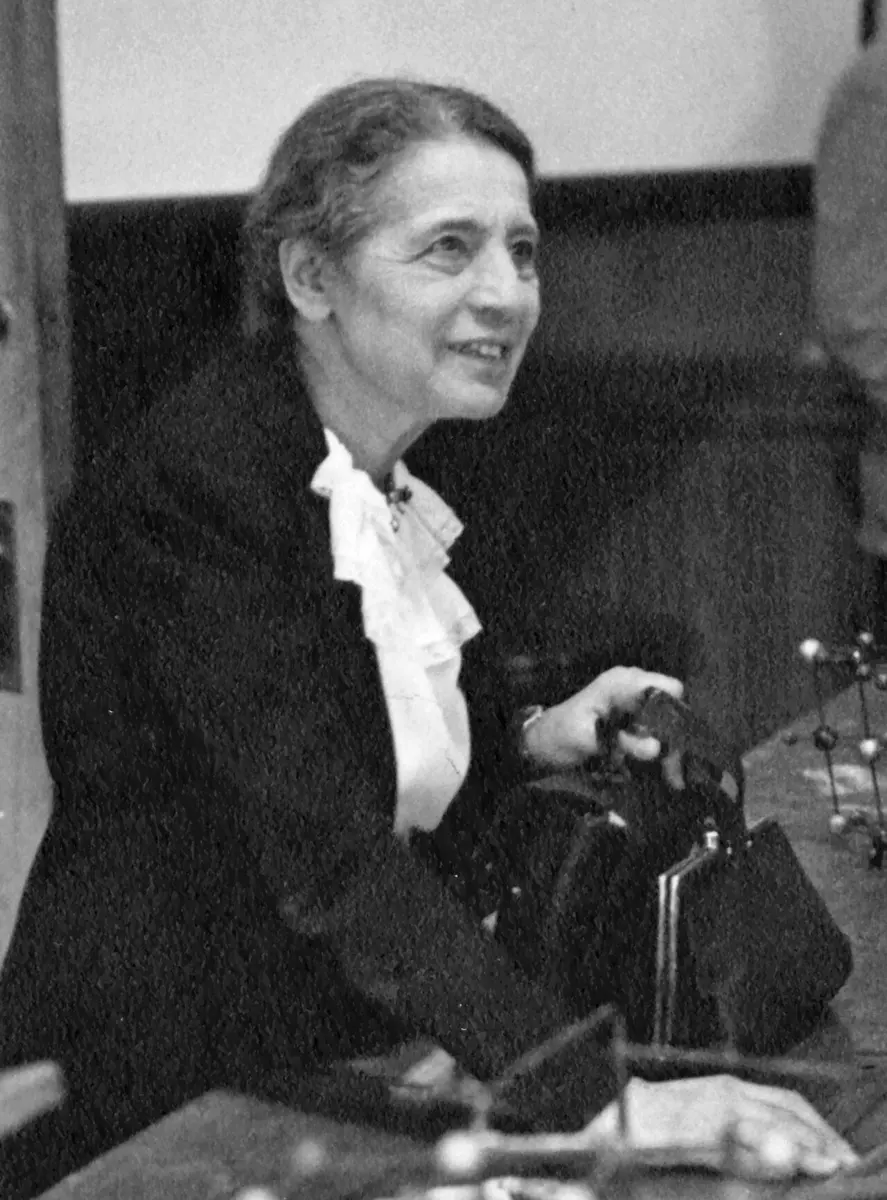
On 29 August 1982, in a laboratory in Darmstadt, Germany, one atom of a new element landed in a detector. A few thousandths of a second later it began to decay. That single atom was enough to discover element 109, meitnerium, named after Lise Meitner, one of the physicists who explained how a uranium nucleus splits.
The meitnerium atom
A meitnerium atom has 109 protons (atomic number 109) and 109 electrons. The atom seen in 1982 was meitnerium-266, with 266 − 109 = 157 neutrons. By shells the electrons are 2, 8, 18, 32, 32, 15, 2, and in subshells Grade 10: The Aufbau principle:
… 7s² 5f¹⁴ 6d⁷
It belongs in period 7 and group 9, under cobalt, rhodium and iridium Grade 10: Features of the modern periodic table. That is only its place by its electrons: no one has yet tested whether it behaves like them.
The first atom of element 109 was meitnerium-266. How many particles were there in its nucleus altogether?
Pick an answer to see why.
One atom in a week
The team at the GSI laboratory, led by Peter Armbruster and Gottfried Münzenberg, fired iron nuclei (26 protons) at a thin target of bismuth (83): 83 + 26 = 109. Only very rarely do the two nuclei join. After about a week of firing, a separator sent one new atom into the detector.
How can a single atom prove a new element? By what it does next. The atom stayed where it landed, and the detector recorded each of its decays at that same spot: an alpha particle, then another, then a split into two pieces. Each step had the energy and timing expected of a known kind of atom, so the chain could be traced back to its start.
The chance that such a chain happened by accident was found to be tiny. A team at Dubna, near Moscow, made meitnerium in 1985, and Darmstadt saw more atoms in 1988. In 1992 the international working group gave the discovery to Darmstadt.
Who was Lise Meitner?
Lise Meitner (1878–1968) was born in Vienna, Austria, and earned her doctorate in physics there in 1906, when few universities accepted women at all. She moved to Berlin and worked for some thirty years with the chemist Otto Hahn; together they found the element protactinium.
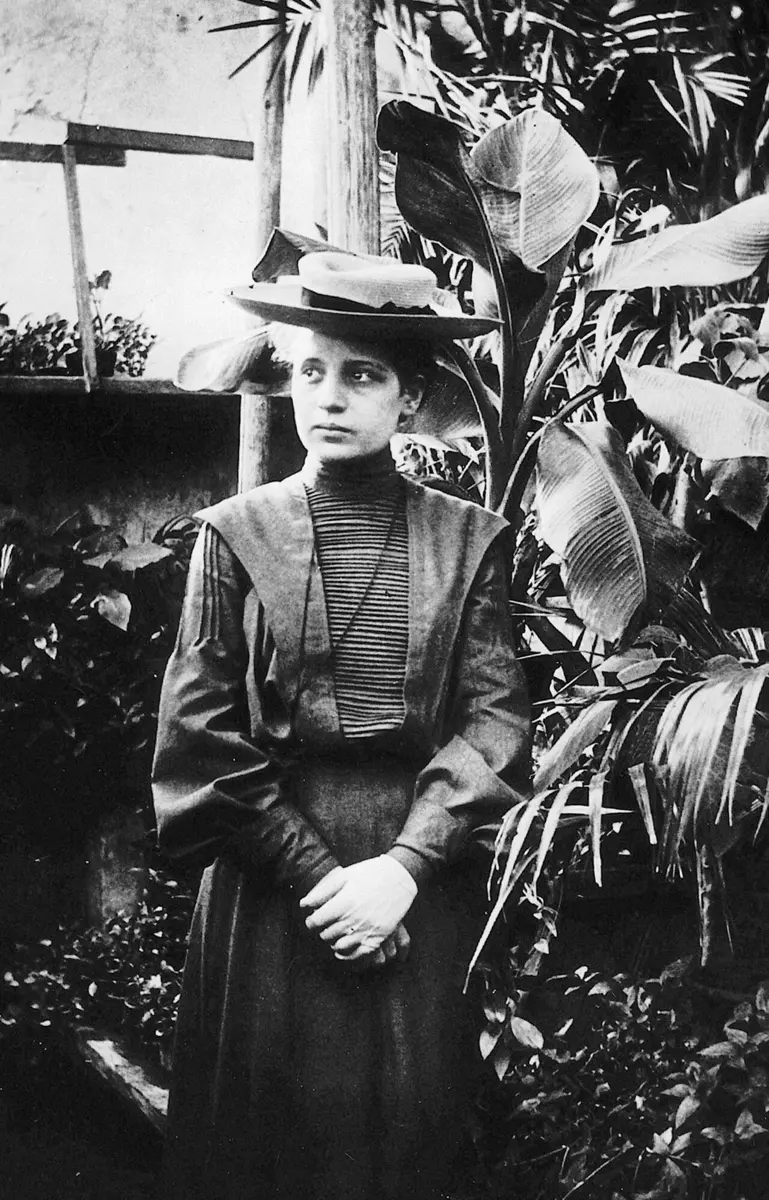
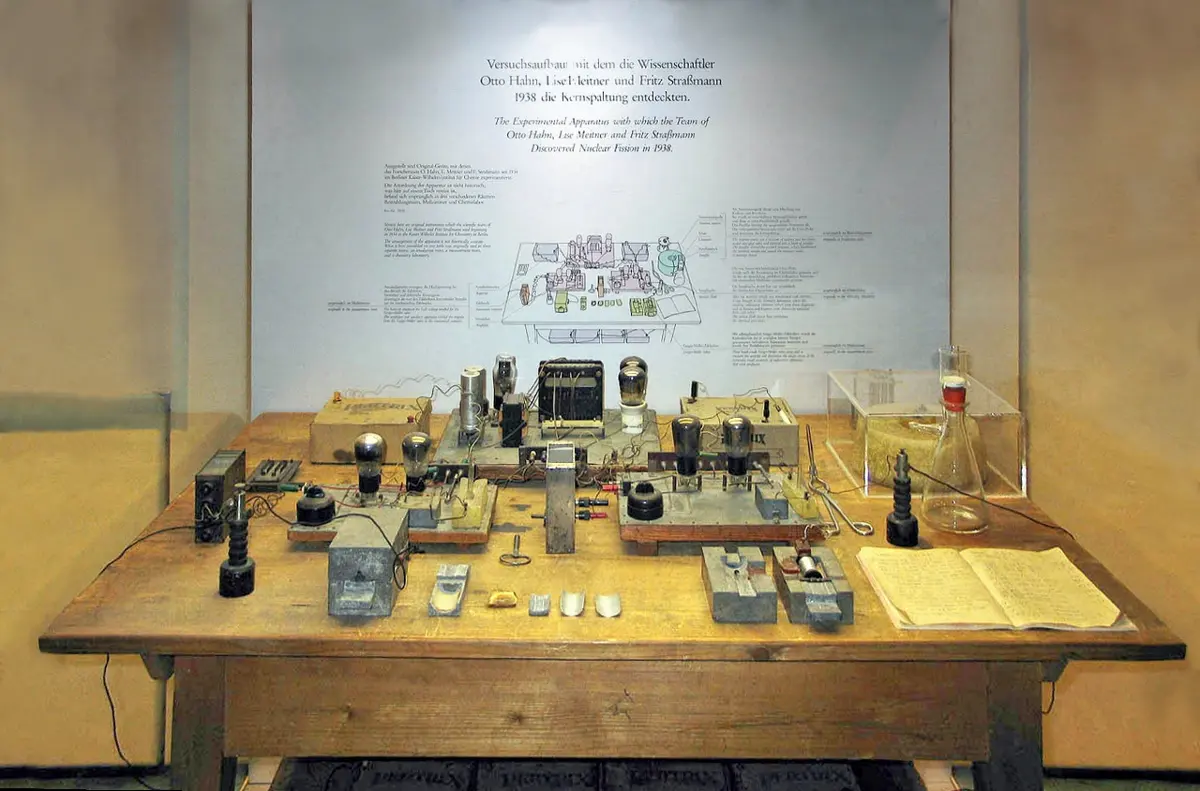
In 1938, because her family was Jewish, she had to flee Nazi Germany to Sweden. A few months later, Hahn and Fritz Strassmann in Berlin found barium among the products of uranium hit by neutrons, and could not explain it. Meitner and her nephew Otto Frisch did: the uranium nucleus had split in two. The full story is in Going Further, Fission. Hahn alone received the 1944 Nobel Prize in Chemistry; Meitner never received one.
The Darmstadt team proposed the name meitnerium, symbol Mt, in 1992. No other name was ever suggested for element 109, and IUPAC made it official in 1997. It is the only element named after one real woman alone: curium honors both Marie and Pierre Curie.
What is known, and what isn’t
What has been measured: only how its atoms decay. The longest-lasting known kind, meitnerium-278, has a half-life of a few seconds (measurements range from about 4 to 8 seconds), and it is made only at the end of the decay of heavier elements.
What is only predicted: everything else. Meitnerium should be a solid, silvery noble metal, like iridium, slow to react; its most stable valency in water should be 3; and it should be very dense, about 27–28 g/cm³ by calculation, against iridium’s 22.6. It is the first element in the table whose chemistry has never been tested: its atoms are made too rarely, and the compounds of its family tried so far only turn into a gas at temperatures far too high for the experiments.
In your science books
- Grade 9: radioactive elements and nuclear fission.
- Grade 10: features of the modern periodic table and the Aufbau principle.
- Going further: alpha decay and fission, with Meitner’s story.
More to explore
- Nobel Prizes: Hahn’s prize (1944) for the discovery of fission.
- Its neighbors: hassium and darmstadtium, the elements either side of it, iridium, rhodium and cobalt, above it in group 9, and protactinium, which Meitner and Hahn found.
- Play: find meitnerium in Guess the Element and the Periodic Table Jigsaw.
- Read more: meitnerium at the Royal Society of Chemistry and at PubChem.