
- Atomic number
- 18
- Atomic mass
- 39.95
- Shells
- 2, 8, 8
- Configuration
- 1s² 2s² 2p⁶ 3s² 3p⁶
- In the table
- period 3, group 18 (0), p-block
- Kind
- Noble gas
- Valency
- 0 (it forms no ordinary compounds)
- State at 25 °C
- gas
- Melts · boils
- −189 °C · −186 °C
- Density
- 1.4 × as heavy as air
- Known since
- 1894
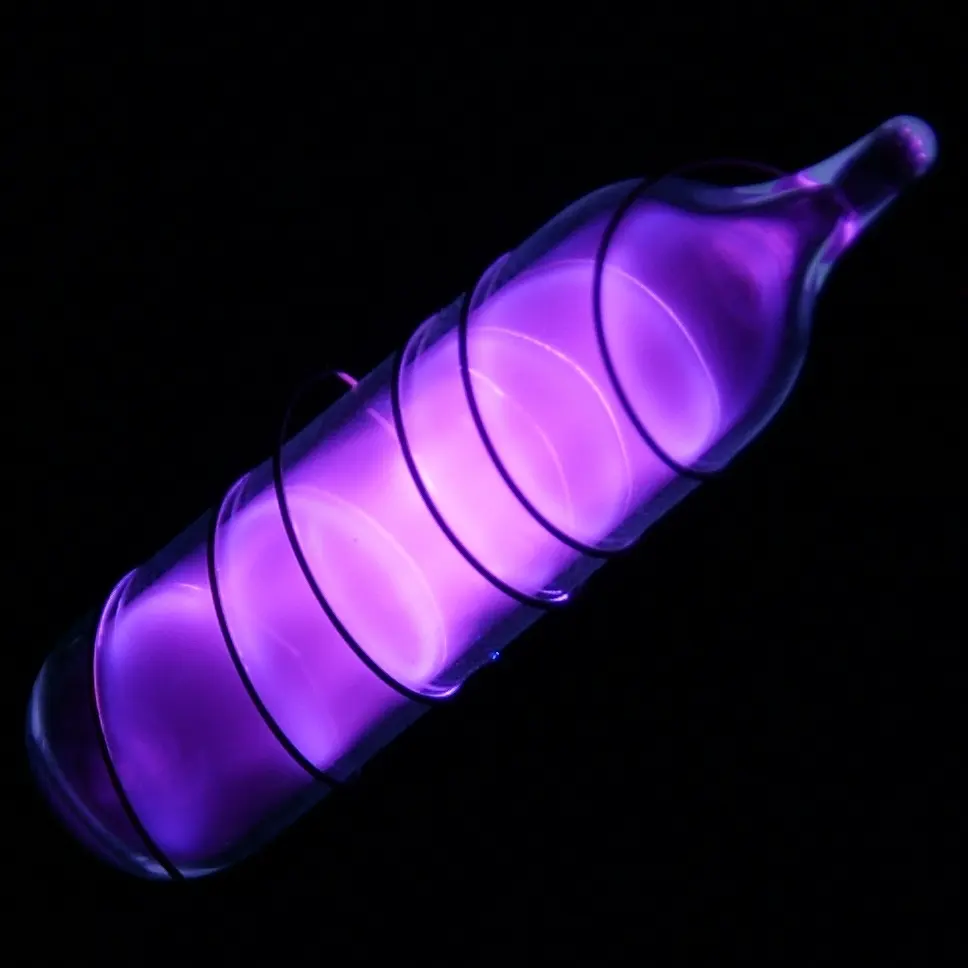
Take a deep breath. Nearly one part in a hundred of that air is argon. It is the third most common gas in the air after nitrogen and oxygen, more than twenty times as common as carbon dioxide. An ordinary room, 4 m by 4 m by 3 m, holds about 450 liters of it.
You breathe it in and out all day, and it does nothing at all: it joins with nothing in your body, or anywhere else. That laziness is exactly what makes it useful, in light bulbs, in welding, and in keeping old documents safe. And it hid in plain sight until 1894, when a difference in weight of one part in two hundred gave it away.
The argon atom
An argon atom has 18 protons, so argon’s atomic number is 18, and 18 electrons. Almost every argon atom on Earth has 22 neutrons, so its mass number is 18 + 22 = 40.
By the 2n² rule the shells would be 2, 8 and then 8 Grade 8: Bohr and Bury’s rule: 2, 8, 8. In subshells it is 1s² 2s² 2p⁶ 3s² 3p⁶ Grade 10: The Aufbau principle: the 3s and 3p subshells are both full.
The M shell could hold 18 electrons, so why does argon’s stop at 8? Because the next subshell to fill is 4s, not 3d: 4s has the lower energy. So the next element, potassium, starts a new shell, and argon ends the period with eight outer electrons, an octet Grade 9: Octet and octet rule.
Its place in the periodic table
- Period 3, because its electrons are in three shells. It is the last element of the period, after chlorine.
- Group 18, called group 0 in the older naming many books use, at the far right of the table.
- p-block, because its last electrons go into a p subshell.
Argon is the third of the noble gases or inert gases: helium, neon, argon, krypton, xenon and radon Grade 8: Position of inert gases. With a full outer shell, an argon atom has no electron it wants to lose and no room it wants to fill, so its valency is 0 Grade 8: Valency. Even two argon atoms don’t join: argon gas is made of single atoms, Ar, not molecules.
A potassium ion, K⁺, has 19 protons and 18 electrons. Is it an argon atom?
Pick an answer to see why.
How argon was found and named
A bubble that would not go
In 1785 the English scientist Henry Cavendish passed electric sparks, again and again, through air mixed with extra oxygen, over a solution that soaked up what formed. The sparks made the nitrogen join with oxygen, and the products dissolved. Almost all the gas disappeared, but a tiny bubble was always left, which nothing he did would make react. He wrote it down, and for over a hundred years no one followed it up.
Too heavy by a little
In 1892 the English physicist Lord Rayleigh (John William Strutt) was weighing gases very precisely. He made nitrogen in two ways: by taking oxygen, carbon dioxide and water vapor out of air, and by breaking up chemicals such as ammonia. The nitrogen from air was always about 0.5% heavier: a liter of it weighed about 1.257 g, a liter of chemical nitrogen about 1.251 g. The difference was tiny, but it never went away.
The Scottish chemist William Ramsay joined him. Ramsay passed “nitrogen” from air over red-hot magnesium, which joins with nitrogen to make a solid, magnesium nitride, again and again until no more would react. About one part in a hundred of the gas was left over, a gas heavier than nitrogen that would react with nothing. In its spectrum it showed red and green lines no one had seen before. In August 1894 they announced a new element in the air.
The name. Since it would do nothing, they named it from the Greek argos, idle or lazy. Its symbol was A until 1957, when chemists changed it to Ar. In Nepali it is simply आर्गन.
Argon was the first noble gas found on Earth, and it left a gap: it did not fit any group in the periodic table, so a whole new group was needed. Within four years Ramsay found helium, neon, krypton and xenon to fill it. In 1904 Rayleigh won the Nobel Prize in Physics and Ramsay the Nobel Prize in Chemistry, in the same year, for the noble gases.
Where argon is found
In the air. Argon is 0.93% of dry air: after nitrogen (78%) and oxygen (21%), it is the third most common gas Grade 9: Gases around us.
From the rocks. Here is a surprise: almost all the argon in the air came out of rocks. Rocks contain a little potassium-40, a radioactive isotope of potassium. Over billions of years its atoms slowly decay, and about one in nine of them becomes argon-40 (A clock inside the atom). The argon seeps out of the rocks and volcanoes into the air, and since it reacts with nothing, it stays there. Argon is so common in our air because it has been piling up for four and a half billion years.
In the universe. Stars make a different argon, mostly argon-36, in the cores of big stars and their explosions (Getting the atoms out). Mars’s thin air is about 2% argon.
How it is collected. Argon is a by-product of the factories that make liquid oxygen and nitrogen. They cool air until it turns to liquid, then let it warm slowly and collect each gas as it boils off: fractional distillation. Nitrogen boils at −196 °C, argon at −186 °C and oxygen at −183 °C, so argon comes off between the two. Because air is so full of it, argon is the cheapest of the noble gases.
What argon is like
- A colorless gas with no smell or taste, made of single atoms.
- Heavier than air: a liter weighs about 1.78 g at 0 °C, while a liter of air weighs 1.29 g. So argon sinks and spreads along the floor.
- Liquid for only a few degrees: it boils at −186 °C and freezes at −189 °C.
- It doesn’t burn and doesn’t help anything burn.
- It dissolves in water about as well as oxygen does, so fish and water plants hold some argon too, doing nothing.
- It glows a soft violet when electricity passes through it at low pressure.
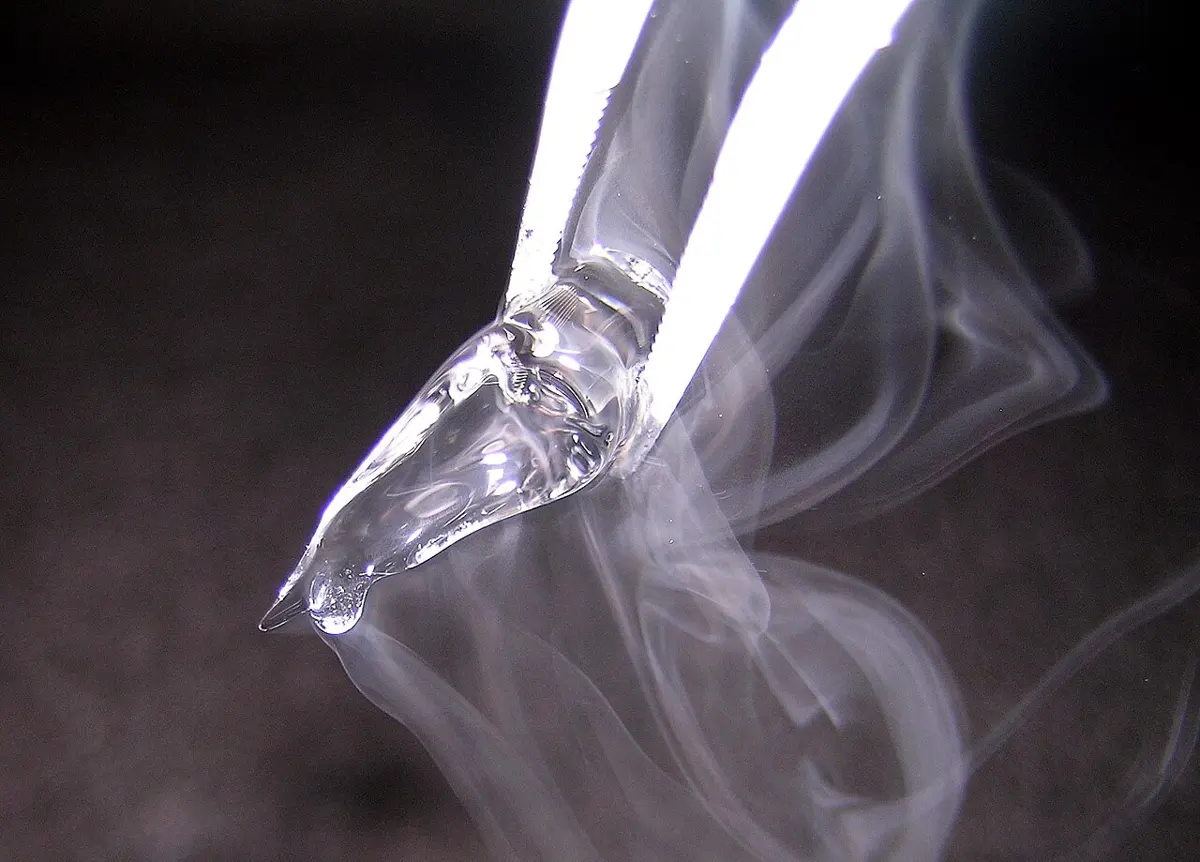
Does argon ever react? In ordinary conditions, never. In 2000, chemists in Helsinki, Finland, made the first known compound of argon, HArF (argon fluorohydride), by shining ultraviolet light on frozen argon with a little hydrogen fluoride. It falls apart if warmed above about −256 °C, so argon still earns its name.
Argon in daily life
Argon is used wherever something hot must be kept away from oxygen, and nitrogen is not lazy enough.
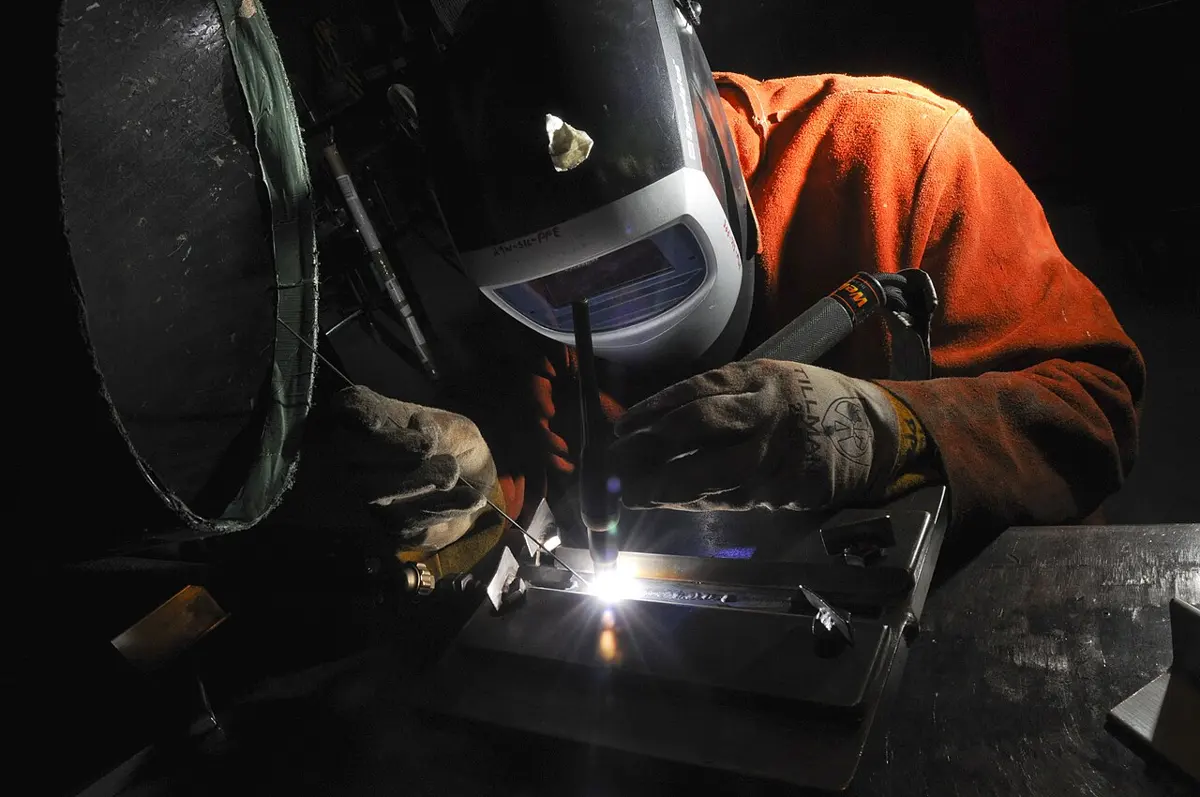
Welding. When steel or aluminium is welded, the metal is white-hot and would burn in air. In TIG and MIG welding, a stream of argon flows out of the torch around the weld and keeps the air away.
Light bulbs. The tungsten filament of an old-style bulb glows at about 2,500 °C. In air it would burn up at once. In a vacuum, tungsten atoms slowly boil off it, and the filament grows thin and breaks. Filled with argon (often with a little nitrogen, Uses of nitrogen), the bulb lasts much longer: the argon atoms bump the escaping tungsten atoms back. Argon is used because it is cheap and, being heavy, slows down the escaping tungsten better than nitrogen alone.
Tube lights. A tube light (fluorescent lamp) holds a little argon and a drop of mercury. The current starts in the argon; the mercury vapor then gives out ultraviolet light, which the white coating inside the tube turns into visible light.
Other uses.
- Making steel, titanium and silicon. Argon is bubbled through molten steel to stir and clean it. The pure silicon crystals for computer chips, and reactive metals like titanium, are made under argon.
- Windows. The gap between the two panes of a double-glazed window is often filled with argon, which carries heat less well than air.
- Food and wine. Argon keeps air out of some packed foods and of wine in barrels.
- Old documents. Since the early 2000s, the original Declaration of Independence and the Constitution of the United States have been kept in cases filled with argon, so that nothing in the air can attack the old paper.
- Glowing toys. The Plasma Ball at Science Playground holds a mixture of noble gases at low pressure, which glows where the current flows through it (Plasma Ball).
Why are filament bulbs filled with argon and not with ordinary air?
Pick an answer to see why.
Isotopes of argon
Argon in the air is a mixture of three stable isotopes: about 99.60% argon-40 (22 neutrons), 0.34% argon-36 and 0.06% argon-38. That is why argon’s atomic mass is so close to 40 Grade 9: Atomic mass.
Dating rocks. Potassium-40 decays into argon-40 with a half-life of 1.25 billion years. When lava cools into rock, the gas escapes, so the new rock starts with no argon. From then on, argon made by decay is trapped in its crystals. By measuring how much argon-40 a volcanic rock holds for its potassium, geologists can tell its age: the potassium–argon clock, used to date volcanic rocks and the bones of early humans buried between them (Reading the clock).
Catching neutrinos. Raymond Davis caught neutrinos from the Sun by counting the few atoms of radioactive argon-37 they made in a huge tank of a chlorine-rich liquid (Nobel Prize in Physics 2002). Today the biggest neutrino detectors are filled with liquid argon.
Argon and your health
Argon has no job in the body and is not poisonous. But it is dangerous in one way: like any gas, a lot of it in a closed space pushes out the oxygen you need, and being heavier than air, it gathers in low places such as pits, tanks and pipes. You cannot see it or smell it, and you feel no warning before you collapse.
Surprising facts and records
- The temperature standard. The temperature at which solid, liquid and gaseous argon exist together, −189.34 °C (83.8058 K), is one of the fixed points used to define the world’s temperature scale.
- Banned in sport. Since 2014, breathing argon to train the body as if at high altitude has been on the World Anti-Doping Agency’s list of banned methods for athletes.
- More argon than you would think. The air holds about 66 trillion tonnes of argon, all of it, near enough, from the radioactive decay of potassium in rocks.
In your science books
- Grade 8: the first 20 elements, the 2n² rule, valency, inert gases and period 3.
- Grade 9: octet and octet rule, atomic mass and the gases of the air.
- Grade 10: the Aufbau principle, Mendeleev’s trouble with atomic weight and noble gases.
- Going further: the potassium–argon clock, why each element has its own lines and why single atoms boil so low.
More to explore
- Nobel Prizes: neutrinos from the Sun (2002, argon atoms made by neutrinos), attosecond pulses of light (2023, made by shining a laser through argon) and the radioactive emanation (1908, a new noble gas recognized by its likeness to argon).
- Play: find argon in Guess the Element, the Periodic Table Jigsaw and Higher or Lower.
- Read more: argon at the Royal Society of Chemistry and at PubChem.