
- Atomic number
- 42
- Atomic mass
- 95.95
- Shells
- 2, 8, 18, 13, 1
- Configuration
- 1s² 2s² 2p⁶ 3s² 3p⁶ 4s² 3d¹⁰ 4p⁶ 5s¹ 4d⁵
- In the table
- period 5, group 6 (VIB), d-block
- Kind
- Transition metal
- Valency
- 6 (as in MoO₃), also 4 (as in MoS₂) and others
- State at 25 °C
- solid
- Melts · boils
- 2,623 °C · 4,639 °C
- Density
- 10.2 × as heavy as water
- Known since
- 1778
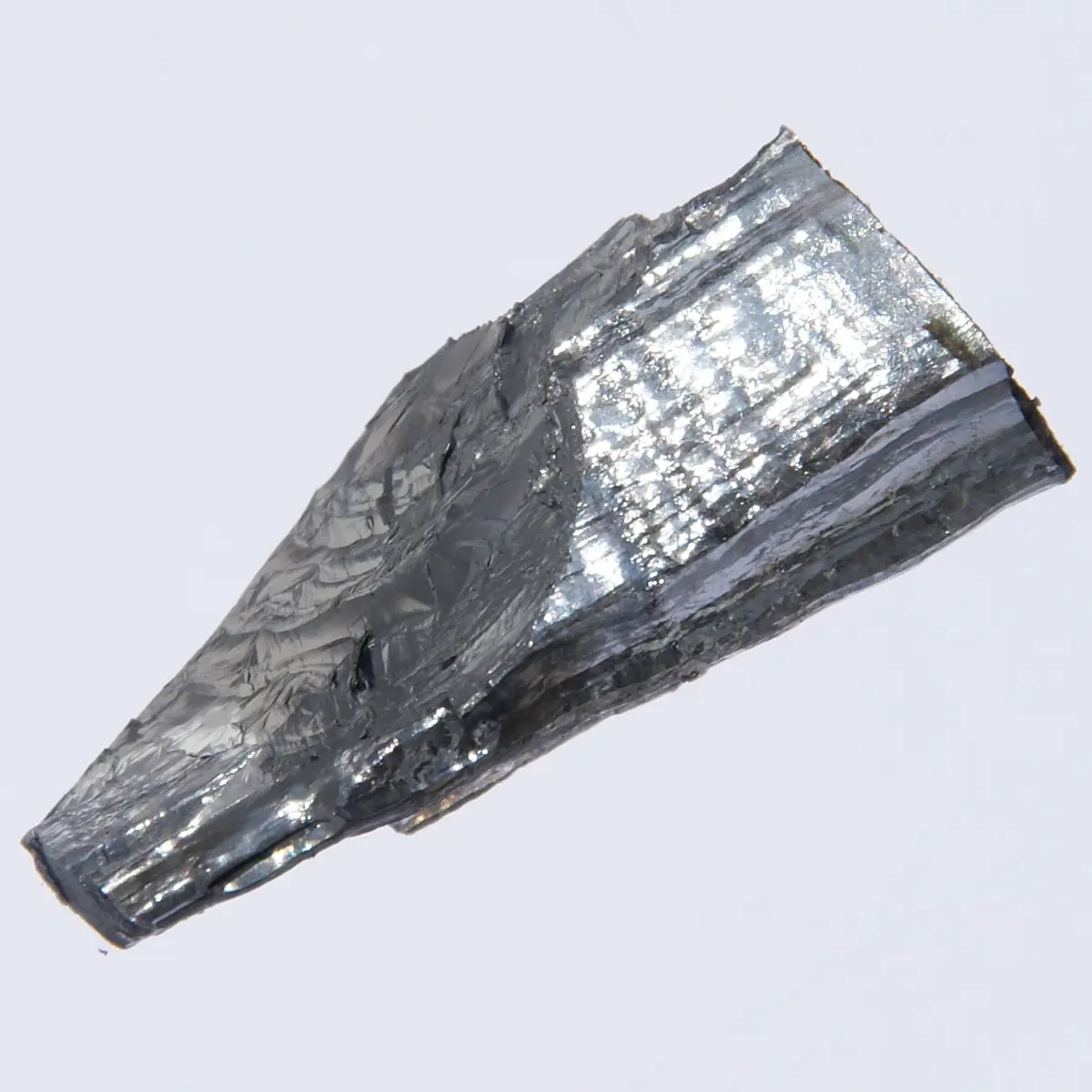
Look at a bean or pea plant pulled out of the ground, and you may see small, round lumps on its roots. Inside them, bacteria are doing something no factory can do without great heat and pressure: they take nitrogen from the air and turn it into food for the plant. The tool they do it with holds a single atom of a metal most people have never heard of.
The same metal makes the steel of drill bits, engine parts and gas pipelines tough, keeps the grease in a car’s wheels working when it gets hot, and is in the dal you ate today. It is molybdenum (say “mo-LIB-de-num”). Here is its story.
The molybdenum atom
A molybdenum atom has 42 protons, so molybdenum’s atomic number is 42, and 42 electrons. The most common kind, molybdenum-98, has 56 neutrons: mass number 42 + 56 = 98.
Its shells are 2, 8, 18, 13, 1 Grade 8: Bohr and Bury’s rule. As in niobium before it, the outer electrons go into 5s and 4d, the 4d being part of the N shell Grade 10: The Aufbau principle.
Its electronic configuration
From the filling order you would expect 5s² 4d⁴. The real atom is:
1s² 2s² 2p⁶ 3s² 3p⁶ 4s² 3d¹⁰ 4p⁶ 5s¹ 4d⁵
One electron moves from 5s into 4d, because then the 4d subshell is exactly half full: each of its five orbitals holds one electron, and a half-full d subshell is especially stable. Chromium, directly above molybdenum, does exactly the same (4s¹ 3d⁵). Tungsten, below it, does not: a reminder that the transition metals don’t always follow one pattern down a group.
How many electrons are in the outermost shell of a molybdenum atom?
Pick an answer to see why.
Its place in the periodic table
- Period 5, because its electrons are in five shells.
- Group 6, called VIB in the older naming, with chromium above it and tungsten below.
- d-block: a transition metal Grade 10: Metals.
Its valency
Molybdenum can use all six outer electrons (5s¹ 4d⁵), so its highest valency is 6, as in molybdenum trioxide, MoO₃. In its ore, molybdenum disulphide (MoS₂), it has a valency of 4, and it has others in between. Like other transition metals, it has a variable valency Grade 9: Variable valency.
In molybdenum disulphide, MoS₂, sulphur has a valency of 2. What is the valency of molybdenum in it?
Pick an answer to see why.
How molybdenum was found and named
For centuries, people used a soft, black, shiny mineral to make marks on paper and to grease things. It looked just like graphite, the “lead” in a pencil, and also like the lead ore galena, so it was mixed up with both. Its old name, molybdena, comes from the Greek molybdos, “lead”.
- 1778. The Swedish chemist Carl Wilhelm Scheele, who also discovered oxygen Grade 9: Oxygen gas, treated the mineral with acid and showed that it was neither graphite nor a lead ore. He got a white oxide from it, the oxide of a new metal, but could not get the metal out.
- 1781. A fellow Swede, Peter Jacob Hjelm, ground the oxide with charcoal and linseed oil and heated it strongly. The carbon took the oxygen away Grade 10: Reduction, and he had the first molybdenum metal, as a powder.
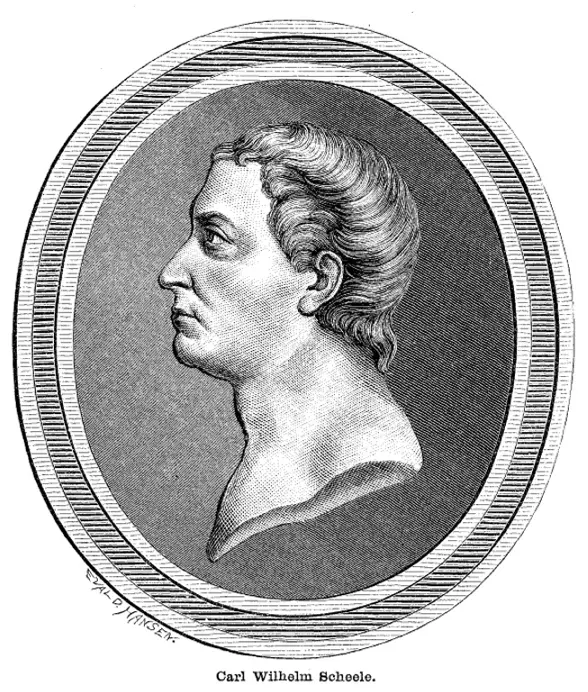
So the metal is named after a metal it is not. The symbol is Mo. The black mineral is now called molybdenite, MoS₂. Nepali books use the English name, मोलिब्डेनम.
Where molybdenum is found
In the universe. Molybdenum is heavier than iron, so it was built when atomic nuclei caught neutrons, in giant stars and in collisions of dead stars (Heavier than iron).
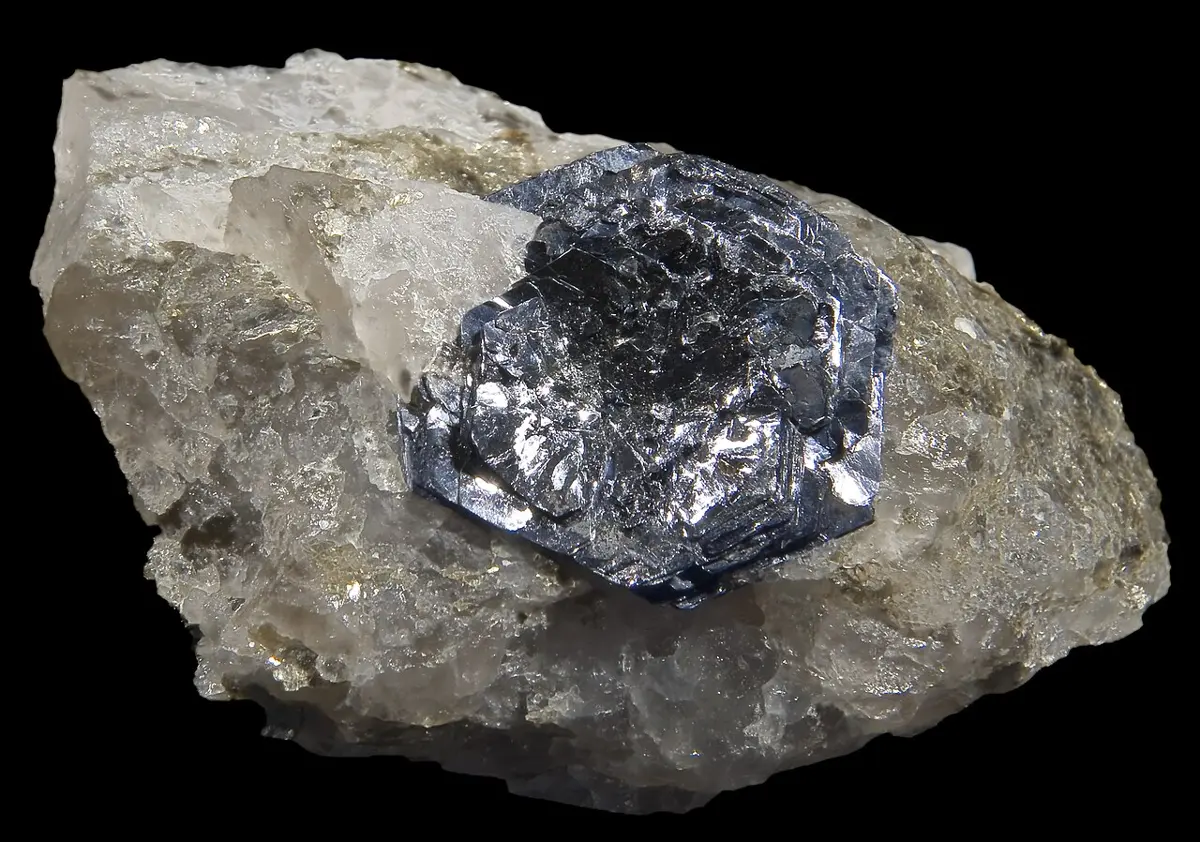
In the Earth’s crust. Molybdenum is rare: about 1 gram in every tonne of rock. It is never found as the metal. Its main ore is molybdenite, found in huge, low-grade bodies of rock, often together with copper ores, where hot water once deposited both. So much molybdenum comes as a by-product of copper mining: the molybdenite is floated off from the copper minerals Grade 10: Concentration.
In 2025 the world mined about 260,000 tonnes of molybdenum. China mined the most (over a third), followed by Chile, the United States and Peru (USGS, 2026).
In Nepal. No molybdenum is mined in Nepal. But it matters to every Nepali field and plate, as you will see.
From ore to metal
The ore is concentrated and then roasted in air, which turns the sulphide into an oxide Grade 10: Roasting:
2MoS₂ + 7O₂ → 2MoO₃ + 4SO₂
Most molybdenum oxide goes straight into steel furnaces. To make the pure metal, the oxide is heated in hydrogen, which takes the oxygen away:
MoO₃ + 3H₂ → Mo + 3H₂O
The metal comes out as a gray powder. Because molybdenum melts only at 2,623 °C, the powder is usually pressed hard into bars and heated until the grains stick together, rather than melted.
What molybdenum is like
- A hard, silvery-gray metal, heavier than iron: its density is 10.2 g/cm³.
- Melts at 2,623 °C. Among the metals, only tungsten, rhenium, osmium and tantalum melt at a higher temperature.
- Stays strong when hot, and expands very little when heated: less than half as much as steel. That is why it is used in furnaces, in the hot parts of glass factories, and once held the glowing filaments of old light bulbs.
- Conducts electricity about a third as well as copper.
- Hard to attack at room temperature: air, water and most acids leave it alone. But when red-hot in air it slowly turns into white molybdenum oxide, which evaporates away, so hot molybdenum parts are kept in a vacuum or in a gas without oxygen.
How molybdenum works in steel
Steel is iron with a little carbon Grade 8: Steel. Add a little molybdenum, from a quarter of a percent to a few percent, and the steel becomes harder, tougher, and stays strong when hot. About three-quarters of all molybdenum goes into steel and cast iron:
- Tool steels and high-speed steels for drill bits and cutting tools, which get very hot as they cut and must not go soft. Molybdenum can do this job in place of the costlier, heavier tungsten.
- Strong steels for engine parts, gears, car axles, bicycle frames (“chromoly”, chromium–molybdenum steel), and the high-pressure pipelines that carry oil and gas.
- Stainless steel. Ordinary stainless steel can be pitted by salt. A stainless steel with 2–3% molybdenum resists it much better, so it is used for boats, for factories that handle chemicals, and for surgical tools and implants.
Why is molybdenum added to the steel of a drill bit?
Pick an answer to see why.
Molybdenum, the slippery mineral
Molybdenite feels greasy, like graphite, and for the same reason. Its crystal is made of layers: a sheet of molybdenum atoms between two sheets of sulphur atoms. The atoms in each layer are bonded firmly, but the layers are held to each other only weakly, so they slide over one another.
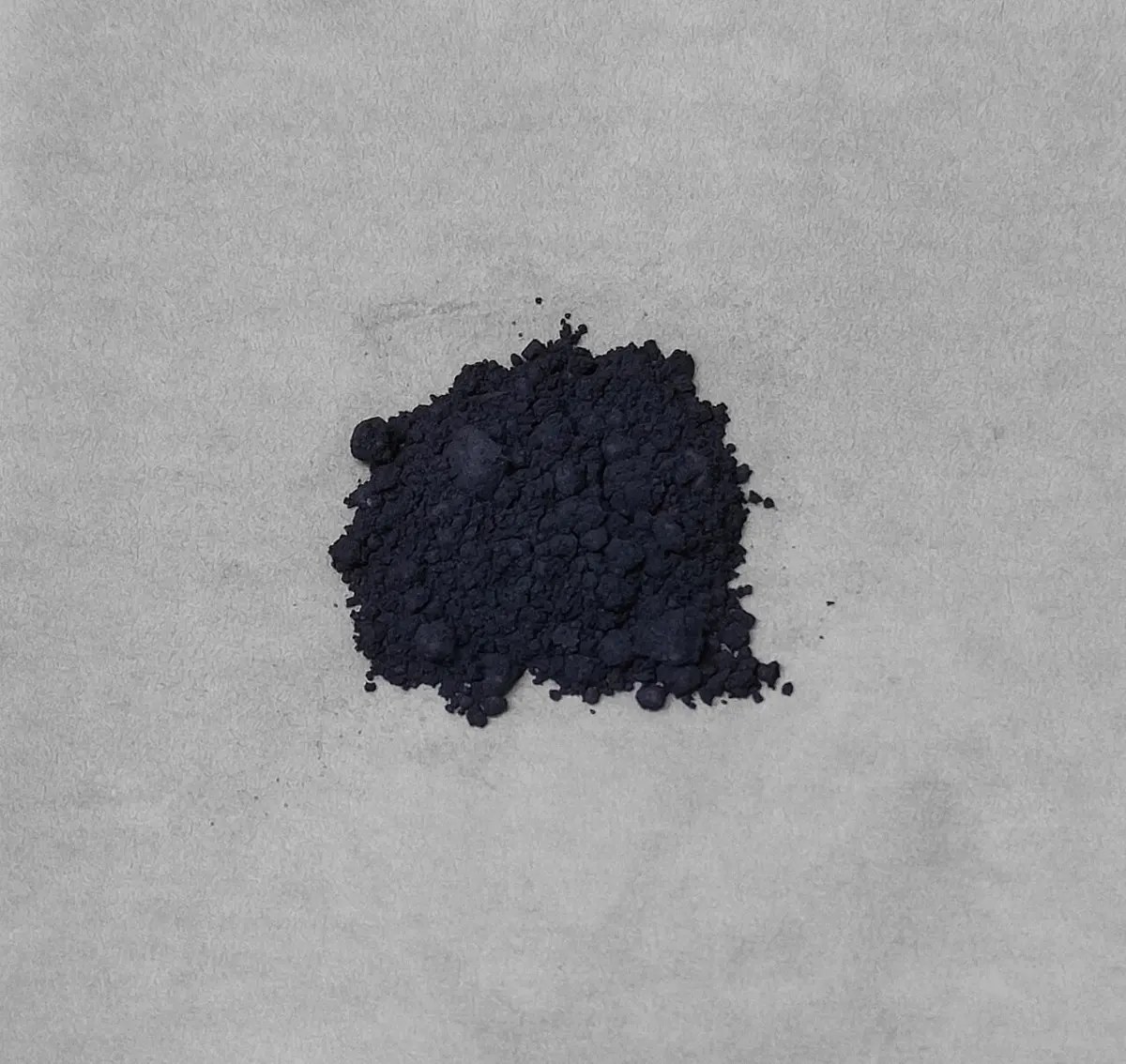
So powdered MoS₂ is a solid lubricant. Mixed into grease (“moly grease”), it keeps the parts of car joints, machines and bicycle chains sliding even when the grease is squeezed out or gets too hot: a thin film of molybdenum disulphide stays on the metal. It works in a vacuum too, where oil would evaporate, so it is used on spacecraft.
Molybdenum compounds are also important catalysts (Catalysts). With cobalt, MoS₂ helps take the sulphur out of petrol and diesel at refineries. Less sulphur in fuel means less sulphur dioxide from vehicles, and so less acid rain.
Molybdenum and living things
The nitrogen-fixing tool
Air is about four-fifths nitrogen, but plants cannot use nitrogen gas: its two atoms are held by a very strong triple bond. Plants need nitrogen as ammonium or nitrate compounds in the soil. Breaking N₂ apart takes a lot of energy. A factory does it in the Haber process, at about 450 °C and 200 times the pressure of the air Grade 9: Nitrogen and hydrogen.
Bacteria do it at the temperature of the soil. Rhizobium bacteria living in the root nodules of beans, peas, lentils, soybeans and gram Grade 8: Rhizobium, and some bacteria living freely in soil and water, use an enzyme (a protein that speeds up a reaction in a living thing) called nitrogenase. At its heart sits a small cluster of iron and sulphur atoms with one molybdenum atom. There, nitrogen molecules are split and turned into ammonia:
N₂ + 3H₂ → 2NH₃ (in a factory)
In the bacteria, the hydrogen comes not as a gas but from the plant’s food, and the energy from the plant’s sugar.
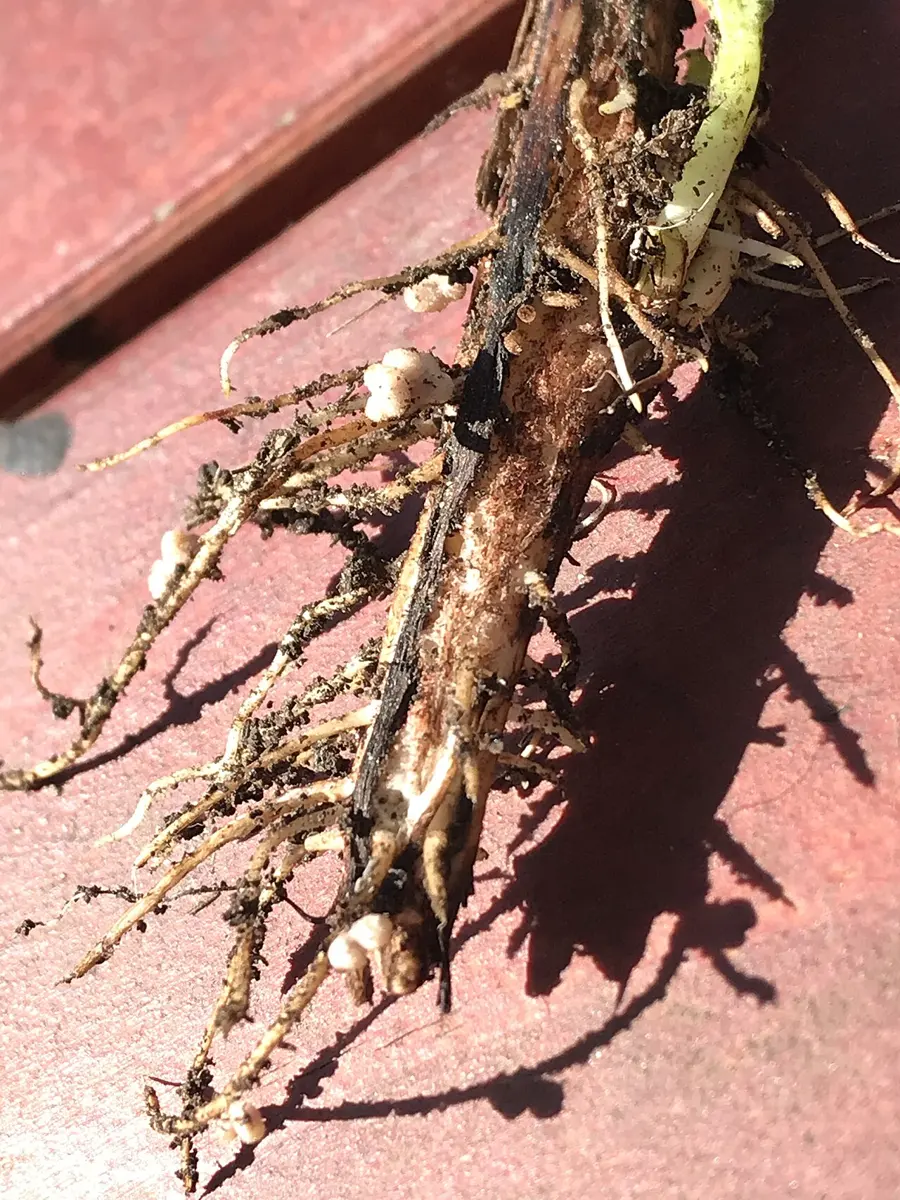
So a field of beans, gram or lentils makes the soil richer in nitrogen, and farmers grow them in rotation with rice, maize and wheat. Molybdenum is one of the micronutrients plants need Grade 9: Micronutrients: only a tiny amount, but without it, beans and peas make few nodules and turn pale for lack of nitrogen. In very acid soils, molybdenum is locked up where roots cannot take it, and cauliflower and cabbage show a disorder called whiptail, in which the leaves grow as thin, twisted strips. Lime spread on acid soil frees the molybdenum Grade 9: Test the soil; a spray of a molybdenum salt also cures it.
Molybdenum and your health
Your body needs only a trace of molybdenum: about 45 micrograms a day for an adult (45 millionths of a gram). It is part of a few enzymes, among them one that clears sulphites (harmful sulphur compounds) out of the body, and one that turns waste from old cells into uric acid, which is passed out in urine.
Legumes are among the richest foods in molybdenum, so dal, beans, chickpeas, peas and peanuts give plenty; grains, nuts and milk give some too. With a normal diet, people get more than they need, and a shortage is almost unknown. Very large amounts, beyond 2 milligrams a day (the safe upper limit for adults), can stop the body using copper; cattle grazing on soils very rich in molybdenum get sick that way.
Molybdenum in daily life
- Steel: tools, engines, pipelines, stainless steel (above).
- Grease and catalysts: molybdenum disulphide (above).
- X-rays for breast scans. In an X-ray tube, electrons crash into a metal target. A molybdenum target gives out X-rays of lower energy than the usual tungsten one, which show soft tissue better, so it is used for mammography, the X-ray check for breast cancer Grade 9: X-rays. In 1922, Arthur Compton used X-rays from a molybdenum target in the experiment that showed light can bounce off electrons like a particle (Compton’s Nobel Prize).
- Medicine’s favorite isotope. Molybdenum-99, made in nuclear reactors, decays into technetium-99m, which hospitals use for tens of millions of scans a year (see technetium).
Isotopes of molybdenum
Natural molybdenum is a mixture of seven isotopes, from molybdenum-92 to molybdenum-100 Grade 9: Atomic mass. The commonest, molybdenum-98, is only about a quarter of the atoms, so molybdenum’s atomic mass, 95.95, is an average over all seven. Molybdenum-100 is radioactive, but its half-life is so long, far longer than the age of the universe, that it counts as stable for every use.
Surprising facts and records
- Named after a different metal. Molybdenum means “lead”, because its ore looked like one of lead’s.
- An atom in a cloud of iron. The heart of nitrogenase, with seven iron atoms, nine sulphur atoms, one carbon and one molybdenum, is one of the most complicated metal clusters in nature. Chemists worked out its full structure only in 2011.
- Six bonds between two atoms. Two molybdenum atoms in a gas can be joined by a sextuple bond, six shared pairs of electrons, the most bonds ever found between two atoms.
- A Nobel Prize catalyst. Richard Schrock’s molybdenum catalysts help molecules swap partners (Metathesis, 2005).
In your science books
- Grade 8: the 2n² rule, steel and alloys and Rhizobium in root nodules.
- Grade 9: variable valency, the Haber process, plant micronutrients, testing the soil and X-rays.
- Grade 10: the Aufbau principle, transition metals, concentration, roasting and reduction.
- Going further: catalysts and where the heavy elements were made.
More to explore
- Nobel Prizes with molybdenum in them: metathesis (2005, Schrock’s molybdenum catalysts), the Compton effect (1927, X-rays from a molybdenum target), bread from air (1918, the Haber process that does in a factory what nitrogenase does in a nodule) and graphene (2010, which led to sheets of MoS₂ one layer thick).
- Its neighbors: niobium before it, technetium after it, chromium above it and tungsten below it.
- Play: find molybdenum in Guess the Element, the Periodic Table Jigsaw and Higher or Lower.
- Read more: molybdenum at the Royal Society of Chemistry and at PubChem.