
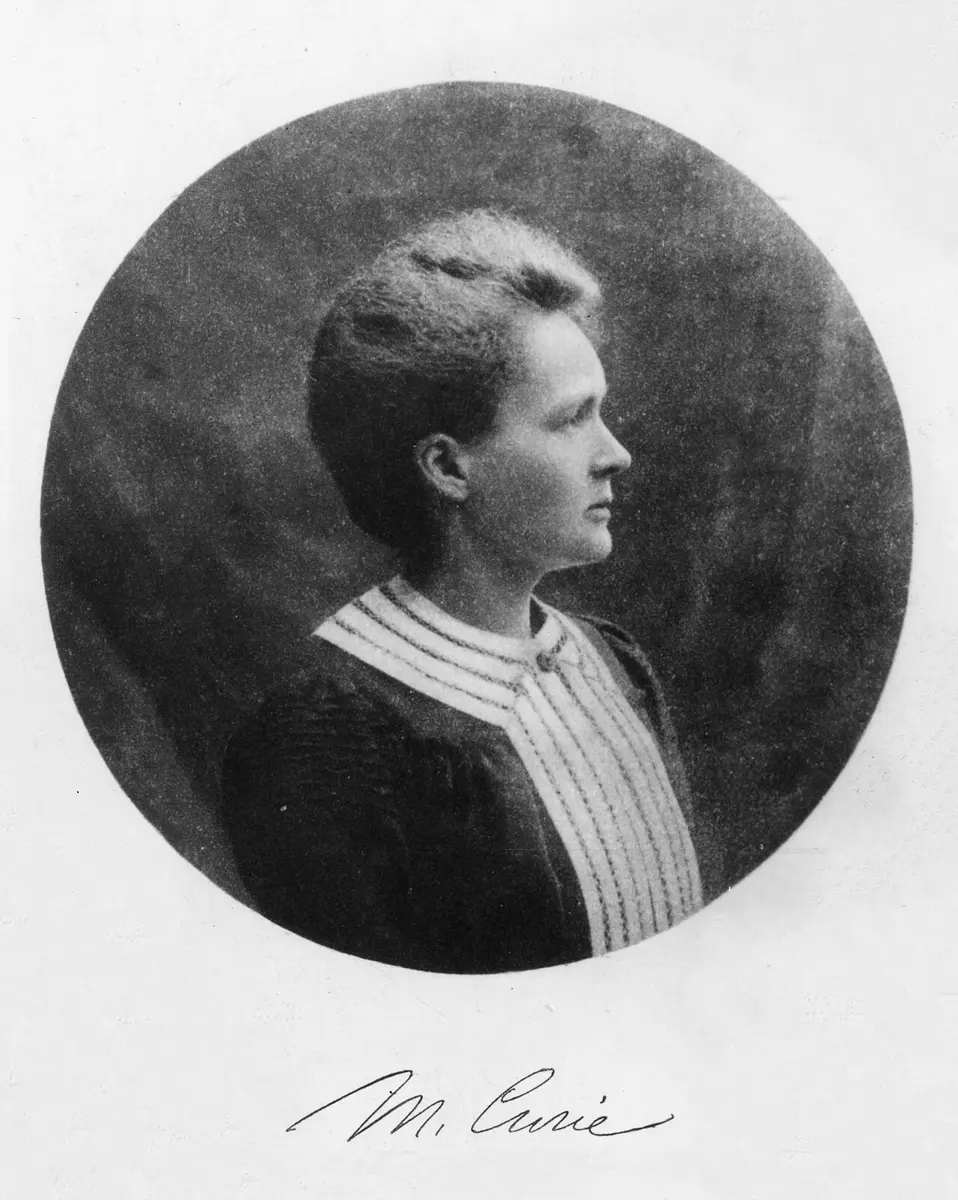
Marie Curie
1867–1934, born in Poland
A teacher’s daughter from Warsaw who moved to Paris to study, and became the first person to win two Nobel Prizes.
Photo: Wikimedia Commons, Public domain
Look at the periodic table on your classroom wall. Each box is an element, a substance made of only one kind of atom. Number 84 is polonium and number 88 is radium. Nobody had ever seen either of them, or even guessed they were there, until 1898.
They were found in a new way. Marie Curie tracked them down by measuring their invisible rays, when there was far too little of them to weigh. Then she spent years getting a speck of one of them pure. In 1911 she won the Nobel Prize in Chemistry for it, her second Nobel Prize.
The problem: rays from a rock
In 1896, the French physicist Henri Becquerel found that uranium, a heavy metal, gives off rays all by itself. Nobody shines a light on it or heats it, yet the rays go through black paper and fog a photographic plate. They also make the air around the uranium conduct electricity, which air normally does not.
Nobody knew what these rays were or whether other elements gave them off too. In 1897 Marie Curie, a young Polish scientist in Paris, chose them for her doctoral research.
How the rays could be measured
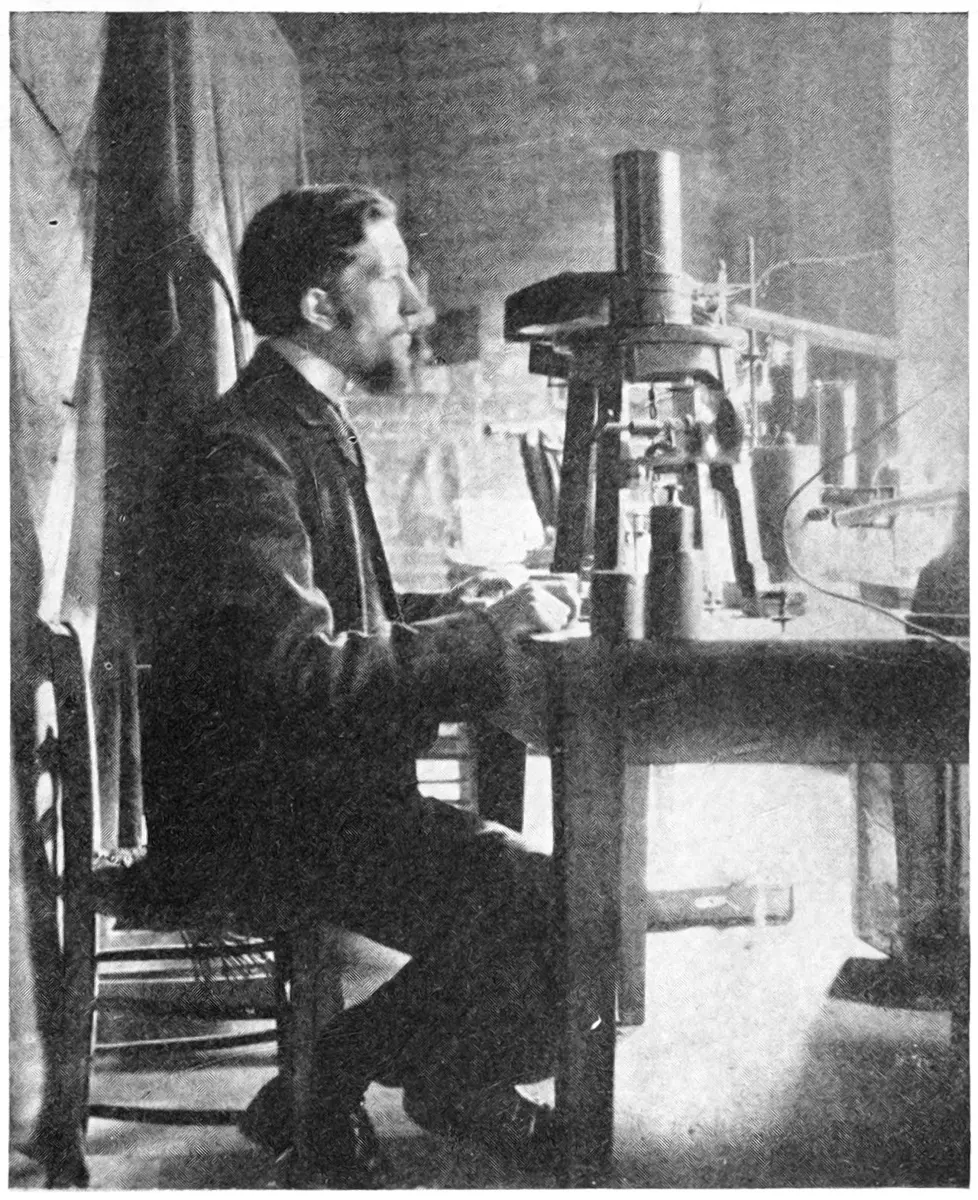
Marie Curie did not just look at fogged photographs. She measured the rays exactly, with an instrument built by her husband Pierre Curie and his brother Jacques.
A sample was spread on a metal plate, with a second plate above it, and a battery joined to the two plates. Air is normally an insulator, so no current flows across the gap. But the rays knock electrons off the molecules of the air between the plates. The air is now full of charged particles, called ions, and a tiny current flows across the gap. The stronger the rays, the bigger the current. Pierre’s instrument could measure even this tiny current precisely.
With this, Marie Curie could put a number on how strongly anything gave off rays. She called this property radioactivity: the word is hers.
The clue: a rock too strong for its uranium
Marie Curie tested every element she could get. Only two gave off rays: uranium and thorium. And she found a simple rule. The strength of the rays depended only on how much uranium or thorium a sample contained. It did not matter whether the uranium was a powder, a solution, or joined to other elements in a compound, or whether it was hot or cold.
A chemical reaction changes how atoms are joined together, but it did not change the rays. So the rays had to come from inside the atoms themselves.
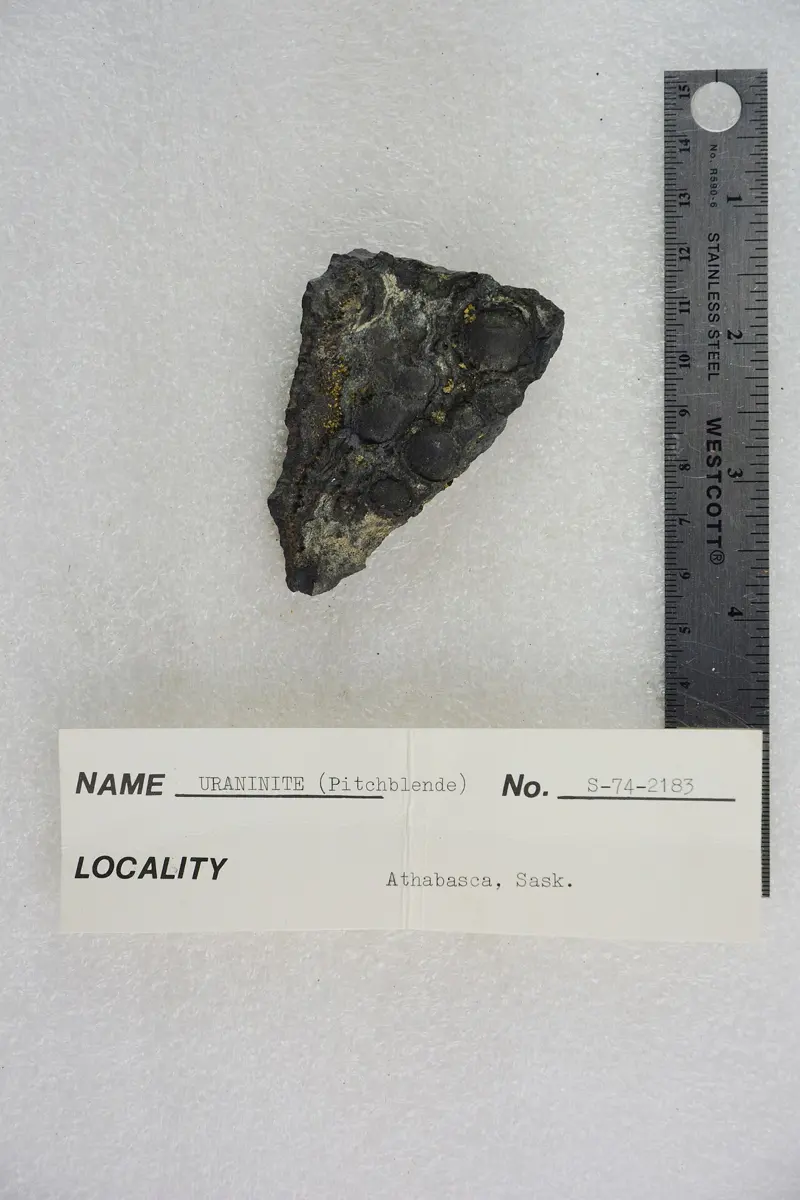
Then she measured some minerals, the natural rocks that uranium is dug out of. One of them, pitchblende, a heavy black rock, gave off about four times stronger rays than pure uranium oxide, even though it is mostly uranium oxide itself. Another, chalcolite, was about twice as strong as uranium. To be sure, she made chalcolite in the laboratory from pure chemicals. Her own chalcolite was only about half as strong as uranium, exactly what its uranium content predicted.
Why did Marie Curie think pitchblende contained a new element?
Pick an answer to see why.
Why it was so hard
Pierre Curie stopped his own research to join her. They hoped the new element might make up a few per cent of the rock. It turned out to be far, far less.
- There was almost nothing of it. A tonne of pitchblende waste contains only a few tenths of a gram of radium. That is less than one part in a million. Polonium is about 5,000 times rarer still.
- It hid inside a look-alike. Elements in the same group of the periodic table behave alike in chemical reactions. Radium is in the same group as barium, so wherever barium went in an experiment, radium went with it. Polonium stayed with bismuth, its neighbor in the table, in the same way.
- They could not weigh or see it. At first there was far too little to weigh on a balance. The only way to follow it was to measure its rays.
What they did, step by step
1. Following the rays (1898)
The Curies invented a new way of hunting for elements. They dissolved pitchblende and split it into parts by ordinary chemical reactions, then measured the rays of each part. The part with the strongest rays was kept and split again. The rays showed where the unknown element had gone, as a smell leads a dog.
- July 1898: polonium. The rays followed the bismuth. The Curies announced a new element and named it polonium, after Marie’s homeland, Poland. At the time Poland was not on the map as a country: it had been divided between Russia, Prussia and Austria.
- December 1898: radium. A second radioactive part followed the barium. With their colleague Gustave Bémont, the Curies announced a second element, radium, from the Latin word for a ray. A chemist, Eugène Demarçay, heated some of it in a flame and looked at its light through a spectroscope, which spreads light into its colors. He saw a line of color that no known element gives: a sign of a new element.
2. Tonnes of rock in a shed (1899–1902)
To get enough radium, they needed tonnes of pitchblende. The mines at St Joachimsthal took the uranium out of the ore to color glass yellow and green, and threw the rest away. That waste still held the radium, so the Curies had it sent to Paris by the tonne.
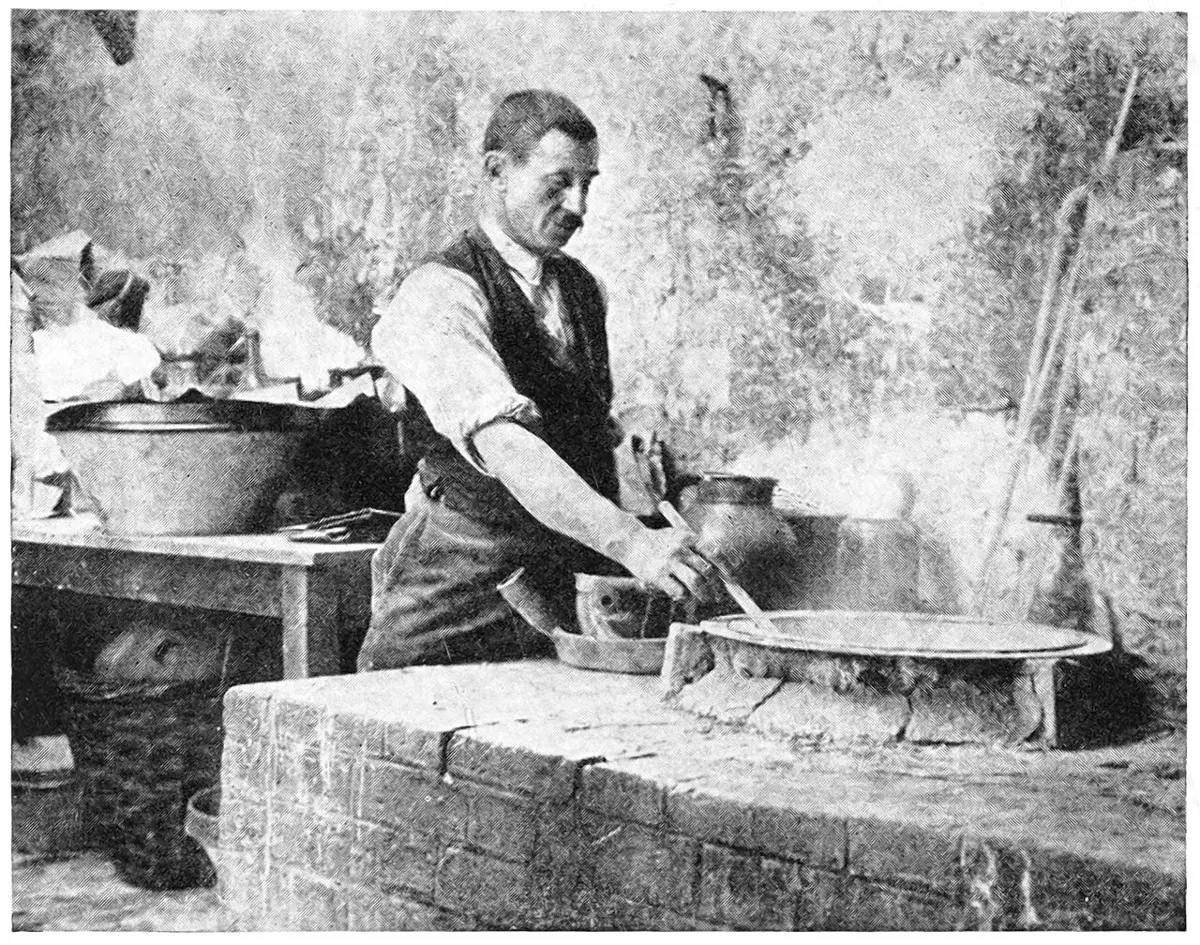
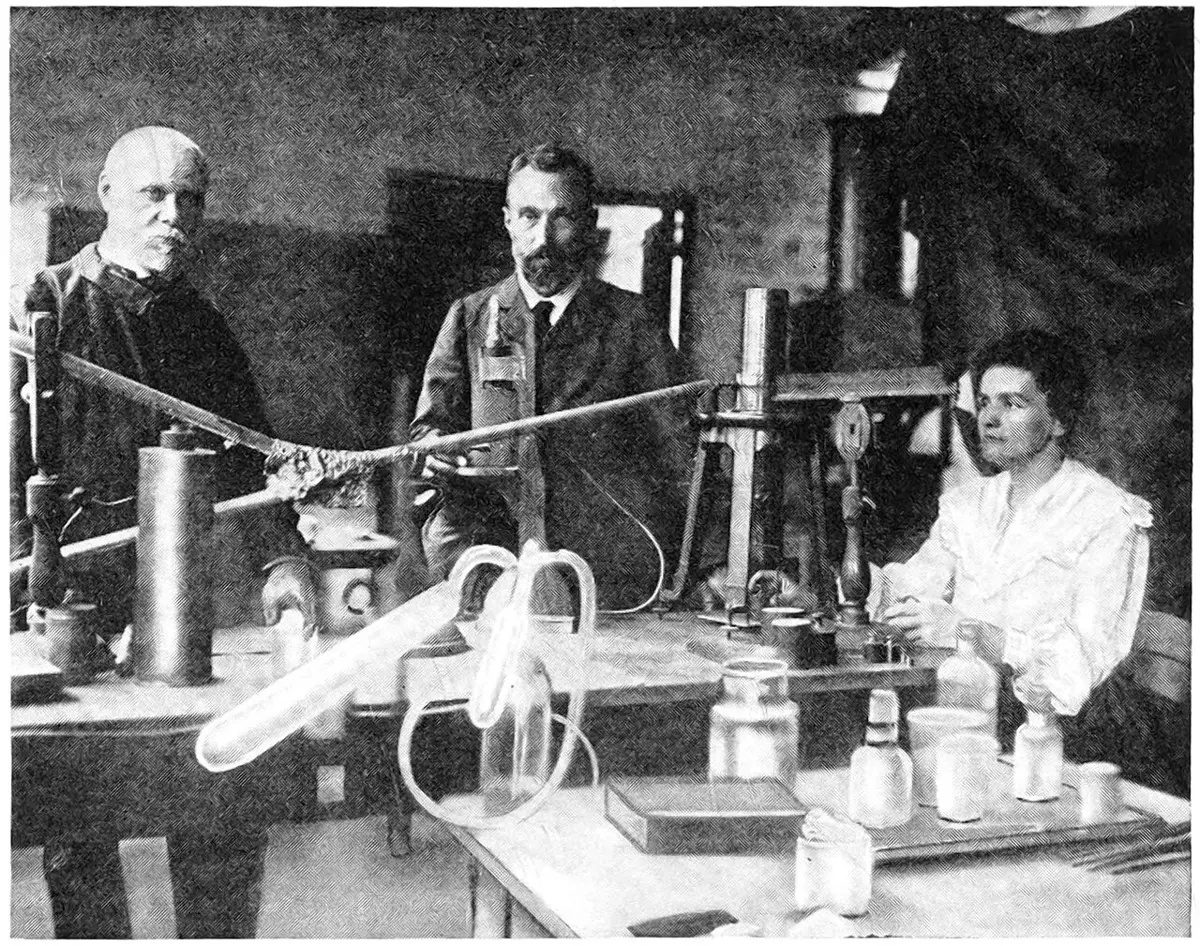
Their laboratory was an old shed with a leaking glass roof, in the courtyard of the school where Pierre taught. They worked on batches of up to 20 kilograms at a time. Marie Curie later wrote: “Sometimes I had to spend a whole day mixing a boiling mass with a heavy iron rod nearly as large as myself.” Later, the first, rough part of the work was done in a factory.
From each tonne of waste they got about 10 to 20 kg of crude barium compound with the radium mixed in. Even then, in this barium, there were only about 3 atoms of radium for every 100,000 of barium.
3. Separating radium from barium, crystal by crystal
Radium and barium are so alike that no single chemical reaction separates them. But Marie Curie found one small difference: radium chloride dissolves a little less in water than barium chloride does.
So she used fractional crystallization. She dissolved the mixture of chlorides in hot water and let it cool. As it cooled, crystals formed. Because radium chloride dissolves less, it crystallizes a little more readily, so the crystals had a little more radium in them than the liquid left behind. She dissolved the crystals again and repeated it. Each round made the crystals a little richer in radium, and each round was checked by measuring the rays. To get really pure radium chloride she had to do it several thousand times.
4. The proof: radium’s atomic weight (1902–1907)
As the radium got purer, Marie Curie measured the atomic weight of the metal in her salt. If the salt were only barium, the answer would be about 137. Her results climbed as the radium got purer:
| Stage | Atomic weight she measured |
|---|---|
| almost all barium | 138 |
| getting richer in radium | 146, then 174 |
| 1902, about a tenth of a gram of pure radium chloride | 225 |
| 1907, purer still | 226.45 |
Today the accepted value is 226. No known element had this atomic weight, and radium fitted exactly into an empty space in the periodic table, below barium. In 1903 she earned her doctorate for this work, and in the same year she shared the Nobel Prize in Physics with Pierre Curie and Henri Becquerel, for the discovery of radioactivity.
Why did the atomic weight Marie Curie measured go up as she purified her radium?
Pick an answer to see why.
5. Alone, and radium as a metal (1906–1910)
In April 1906 Pierre Curie was knocked down by a horse-drawn cart in a Paris street and killed. Marie Curie took over his post at the Sorbonne, the first woman to teach there as a professor, and carried on the work.
Some scientists still doubted that radium was an element. The final proof was to make it as a pure metal. In 1910 Marie Curie and the chemist André Debierne passed an electric current through a solution of radium chloride, using liquid mercury as the negative electrode. The radium collected in the mercury. Then they heated it in pure hydrogen gas until the mercury boiled away, leaving the metal. They had only a tenth of a gram of salt to work with.
The metal was shiny and white, melted at about 700 °C, quickly turned black in air, and reacted strongly with water, just like barium, the metal above it in the group. Its rays were exactly as strong as expected from the radium in it.
How radium works
Why does radium give off rays and heat, all by itself, year after year? The answer came from the work of Ernest Rutherford and Frederick Soddy, between 1902 and 1903, and it surprised everyone.
An atom has a tiny, heavy nucleus at its center, made of protons and neutrons Grade 9: Structure of an atom. In most atoms the nucleus never changes. In a radioactive element the nucleus is unstable: sooner or later it breaks down by itself and throws out a particle or a burst of energy. That is the radiation Grade 9: Radioactive elements and radioactive emission.
A radium nucleus throws out an alpha particle, a bundle of 2 protons and 2 neutrons. That is the nucleus of a helium atom. Having lost 2 protons, the radium atom is no longer radium: it has become a different element, the gas radon. Radon breaks down too, and so on, step by step, through a chain of elements that includes polonium, until it ends as ordinary, stable lead.
For centuries chemists had believed that one element can never turn into another. Radium does it all the time, and the 1911 presentation speech called this the start of a new age in chemistry.
Each radioactive element breaks down at its own steady rate, measured by its half-life: the time it takes for half of the atoms in a sample to break down. For radium it is about 1,600 years, so the Curies’ radium is still almost all there. For polonium it is only about 138 days. That is one reason Marie Curie could never collect pure polonium: it vanished almost as fast as she could concentrate it.
All that breaking down gives out energy. A gram of radium, with the elements it turns into, gives out about 500 joules of heat every hour: enough to melt more than its own weight of ice, hour after hour, for centuries, with no fuel. Radium salts even glow faintly in the dark. It was the first sign of the huge energy stored inside the nucleus.
In your life today
- Radiation treatment for cancer. Radiation damages cells, and fast-growing cancer cells suffer most. Radium was the first substance used to treat cancer with radiation, starting in the early 1900s. Today, cancer hospitals, including those in Nepal, use machines that make X-rays, or other radioactive sources, which are safer to handle. This treatment is called radiotherapy.
- Radon gas. The radon that radium turns into is a gas. In places with uranium in the rocks, it can seep into houses, and breathing a lot of it for many years raises the risk of lung cancer. Some countries test houses for it.
What came next
- Many more radioactive elements. Following the rays, scientists soon found dozens of radioactive substances. Many turned out to be different forms of the same element, with different masses, which Frederick Soddy called isotopes (Nobel Prize in Chemistry, 1921).
- Inside the atom. Alpha particles shot out by radioactive elements were the tool Ernest Rutherford used to discover the atom’s nucleus in 1911.
- An open question: Since Marie Curie, scientists have made elements up to number 118 by smashing atoms together. The heaviest ones break down in fractions of a second. Physicists predict an “island of stability”, heavier elements whose nuclei might last much longer. Does it exist? Nobody has reached it yet.
In your science books
- Grade 8: the atom and the modern periodic table, with its groups and periods.
- Grade 9: structure of an atom, nuclear stability, radioactive elements and radioactive emission, and gamma rays.
- Grade 10: the modern periodic table and Mendeleev’s periodic table, which had empty spaces for undiscovered elements.
- Going further: What happens inside a nucleus when it decays? and How old is the Earth?, which uses radioactive atoms as a clock.
Learn more
- The prize at nobelprize.org: The Nobel Prize in Chemistry 1911, with the presentation speech.
- Marie Curie’s own Nobel lecture, “Radium and the new concepts in chemistry”, which tells the whole story in her words.
The official reason
The prize was given “in recognition of her services to the advancement of chemistry by the discovery of the elements radium and polonium, by the isolation of radium and the study of the nature and compounds of this remarkable element.”