
- Atomic number
- 88
- Atomic mass
- 226.03
- Shells
- 2, 8, 18, 32, 18, 8, 2
- Configuration
- 1s² 2s² 2p⁶ 3s² 3p⁶ 4s² 3d¹⁰ 4p⁶ 5s² 4d¹⁰ 5p⁶ 6s² 4f¹⁴ 5d¹⁰ 6p⁶ 7s²
- In the table
- period 7, group 2 (IIA), s-block
- Kind
- Alkaline earth metal
- Valency
- 2 (Ra²⁺)
- State at 25 °C
- solid
- Melts · boils
- 700 °C · 1,737 °C
- Density
- 5.0 × as heavy as water
- Known since
- 1898
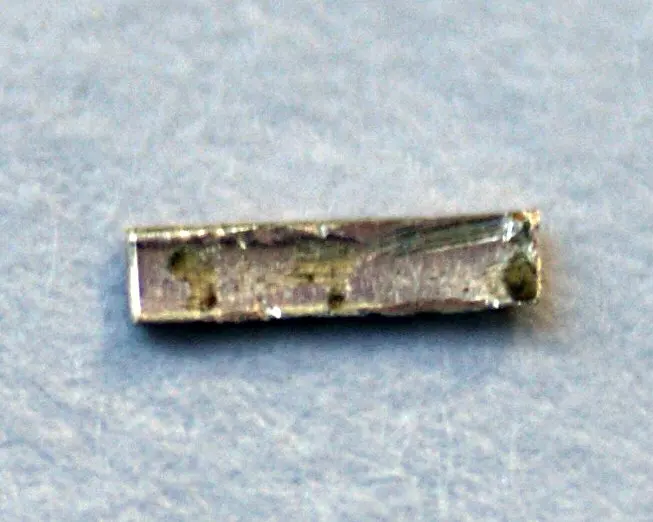
A hundred years ago, radium was the most famous element in the world. It glowed in the dark by itself, it was warm without any fire, and it cost more than any other substance on Earth. People painted it onto watch dials so they could read the time at night, and some even drank it, believing it was good for their health. It was not.
Radium was the element that taught the world that atoms can break apart and turn into other elements. It also taught, at a terrible cost, that their rays can kill. Here is its story.
The radium atom
A radium atom has 88 protons, so radium’s atomic number is 88, and 88 electrons. Its longest-lived kind, radium-226, has 138 neutrons. Every kind of radium atom is radioactive: sooner or later its nucleus breaks down.
Its 88 electrons fill seven shells: 2, 8, 18, 32, 18, 8, 2 Grade 8: Bohr and Bury’s rule. In subshells, it ends with 7s², following the filling order with no exception Grade 10: The Aufbau principle:
… 6s² 4f¹⁴ 5d¹⁰ 6p⁶ 7s²
Its place in the periodic table
- Period 7, because its electrons are in seven shells.
- Group 2, called IIA, because it has two electrons in its outermost shell. It is the last of the alkaline earth metals: beryllium, magnesium, calcium, strontium, barium and radium Grade 10: Metals.
- s-block, because its last electrons go into an s subshell.
Like every member of its group, radium gives up its two outer electrons to become Ra²⁺, with valency 2 Grade 9: Valency.
Which metal is radium most like in its chemistry?
Pick an answer to see why.
How radium was found and named
In 1896 Henri Becquerel found that uranium gives off invisible rays by itself. In Paris, Marie Curie measured these rays exactly and called the effect radioactivity. She found that pitchblende, the black ore of uranium, gave off much stronger rays than its uranium could explain. Something far more radioactive had to be hiding in it.
With her husband Pierre Curie, she broke the ore down by chemical reactions and followed the rays. In July 1898 they found polonium; in December 1898, with Gustave Bémont, radium. It stayed with barium in every reaction, because the two are in the same group. Separating them took Marie Curie four years and thousands of crystallizations, in a leaking shed, from tonnes of waste ore. In 1902 she had about a tenth of a gram of pure radium chloride, enough to weigh its atoms. In 1910, with André Debierne, she made radium as a metal. The whole story, step by step, is in Radium: hunting elements by their rays, the Nobel Prize she won for it in 1911, her second.
The name comes from the Latin radius, a ray, for the rays it sends out; the symbol is Ra. In Nepali it is रेडियम.
Where radium is found
In the universe. Radium does not last long enough to have come from the stars: even radium-226 halves every 1,600 years. All the radium on Earth is being made now, from uranium and thorium, which do come from the stars (Heavier than iron).
In the Earth. A uranium-238 nucleus breaks down in a chain of steps, each turning it into a different element, until it ends as lead. Radium-226 is one of the steps (From uranium to lead). So every uranium ore has a little radium in it, about a third of a gram for every tonne of uranium, made as fast as it breaks down. Ordinary rock and soil hold only about a millionth of a gram in each tonne. Uranium has been found in Upper Mustang Grade 8: Minerals in Nepal, so a trace of radium is there too.
Today radium is hardly made at all: less than about 100 grams a year, mostly from used nuclear fuel.
What radium is like
- Color. Fresh radium metal is shiny and white, but it soon turns black in air, as it reacts with nitrogen.
- Soft, and lighter than iron: its density is about 5 g/cm³.
- Melts at about 700 °C.
- It glows. Radium and its compounds give out a faint blue light in the dark. The energy comes from the radium’s own rays, which make the air and the compound around it light up.
- It is warm. A lump of radium is always a little warmer than its surroundings, heated by its own breaking nuclei, for centuries, with no fuel. This was the first sign of the enormous energy stored inside the nucleus.
How radium reacts
Radium reacts like the metals above it in group 2, only more strongly. Down group 2, the atoms get bigger and lose their two outer electrons more easily, so they get more reactive Grade 10: Chemical reactivity. Magnesium reacts with hot water, calcium with cold water, and radium, at the bottom, reacts strongly with cold water, giving radium hydroxide and hydrogen Grade 9: Very reactive metals and water:
Ra + 2H₂O → Ra(OH)₂ + H₂
Its compounds are like barium’s: radium chloride (RaCl₂) and radium bromide (RaBr₂) dissolve in water, while radium sulphate (RaSO₄) does not.
Which of these metals reacts most vigorously with cold water?
Pick an answer to see why.
The rays of radium
A radium-226 nucleus breaks down by throwing out an alpha particle: 2 protons and 2 neutrons, the nucleus of a helium atom (Alpha decay). With 2 protons fewer, the 86 protons left are an atom of a different element, the gas radon:
radium-226 → radon-222 + helium-4 (an alpha particle)
The mass numbers balance (226 = 222 + 4), and so do the protons (88 = 86 + 2).
The time for half of the radium-226 atoms in a sample to break down, its half-life, is about 1,600 years. Nobody can say when any one atom will break down; but out of a huge number, half go in 1,600 years, half of the rest in the next 1,600, and so on.
Natural radium has three other isotopes, all short-lived: radium-228 (half-life about 6 years), radium-223 (11 days) and radium-224 (4 days), each made in the decay chains of uranium-235 and thorium.
Radium in history: glowing paint
Mixed with zinc sulphide, which flashes when an alpha particle hits it, a trace of radium made a paint that glowed in the dark for years. From the 1910s, clocks, watches, aircraft dials and even toys were painted with it.
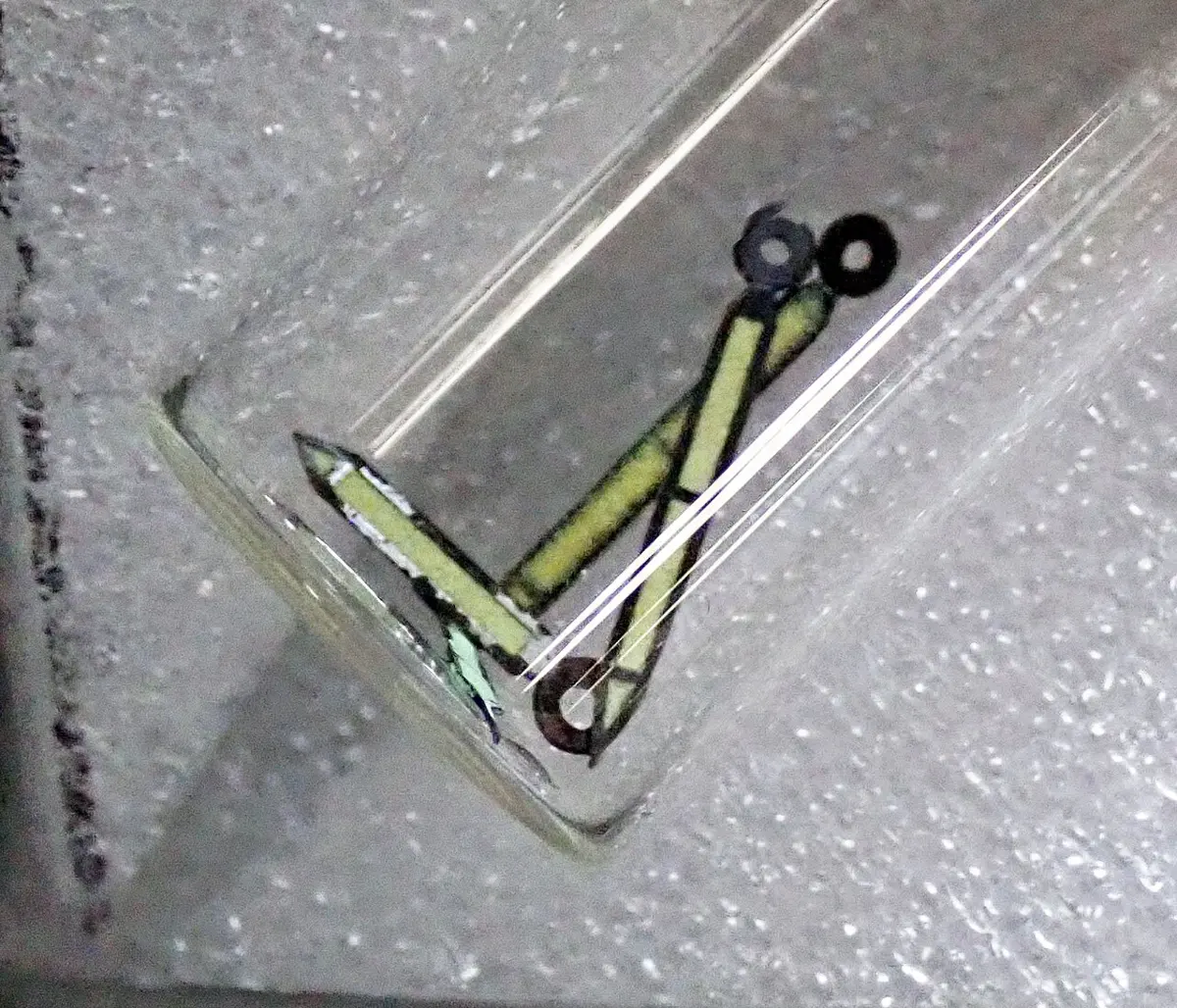
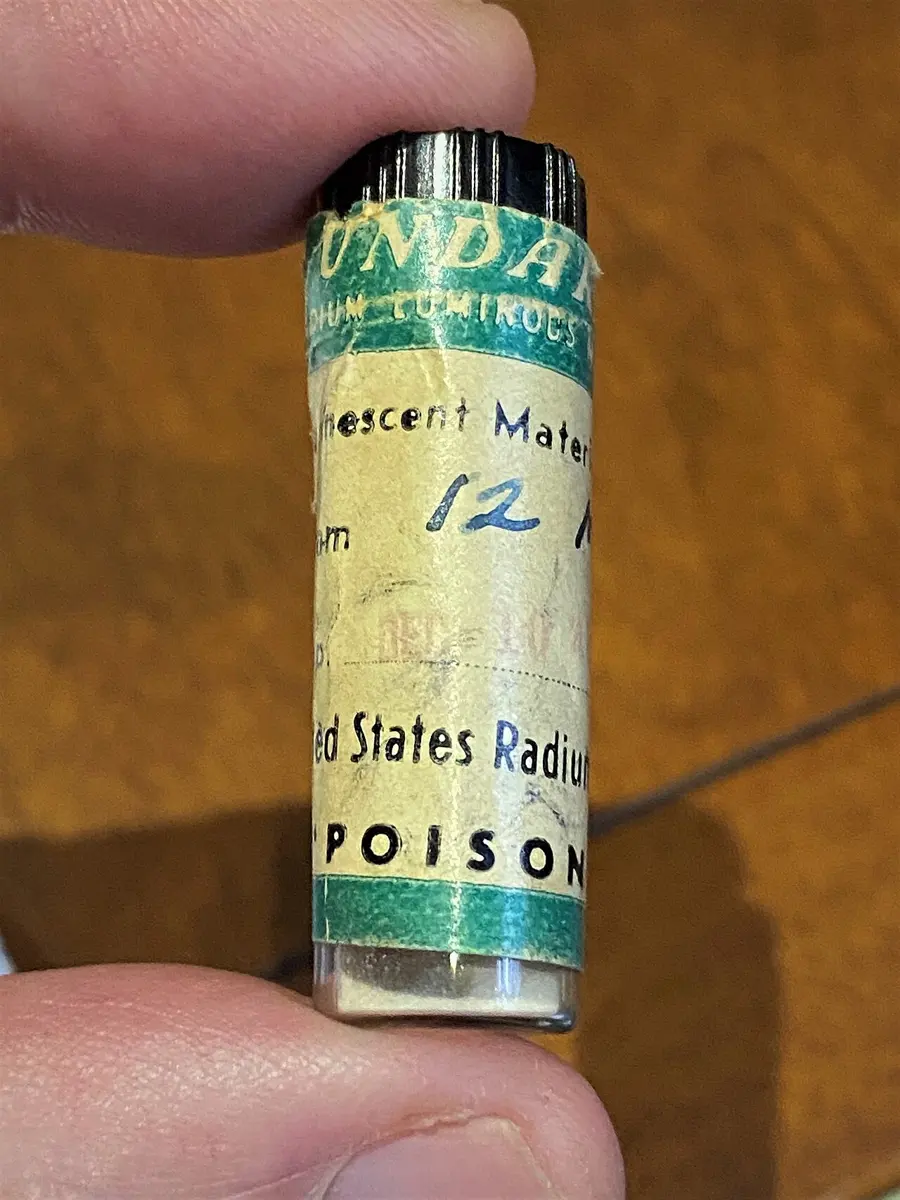
In factories in the United States, young women painted the numbers on watch faces by hand. They were told the paint was harmless, and to make a fine point they shaped their brushes between their lips. Radium behaves in the body like calcium, its neighbor in the group, so the radium they swallowed settled in their bones, where its alpha particles destroyed them from inside. Many of these “radium girls” fell ill and died.
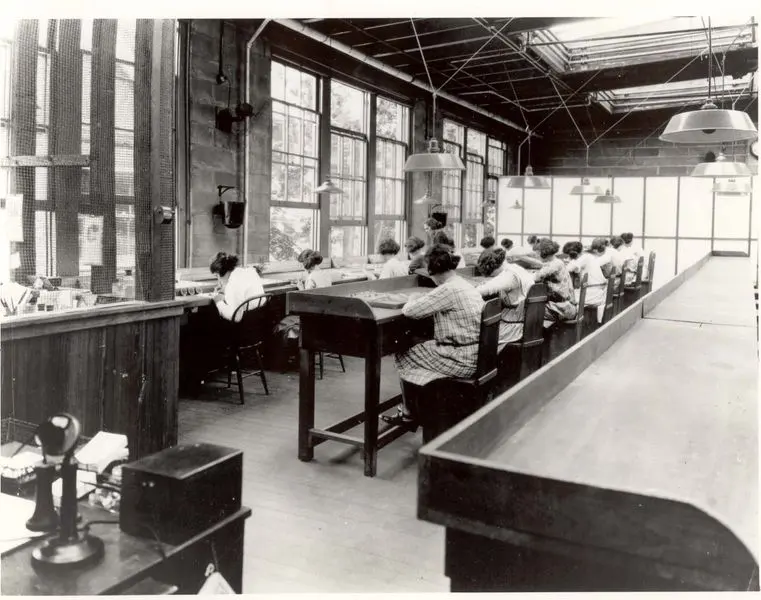
Their court cases in the 1920s helped bring in the safety rules for radiation that protect workers today. Glowing watches now use other materials, which glow after soaking up light and are not radioactive.
Radium and your health
The body has no use for radium, and it is dangerous inside it. Swallowed or breathed in, radium is taken for calcium and stored in the bones, where its alpha particles keep damaging cells for years: bone cancer, and the bone marrow that makes blood failing.
Outside the body, alpha particles are stopped by a sheet of paper or by the outer layer of the skin, but radium’s chain also gives out gamma rays, which pass through the body. Marie Curie died in 1934 of a blood disease very likely caused by her years with radium; her notebooks are still kept in lead-lined boxes.
Radon at home. The radon gas made by radium in soil and rock seeps into houses, especially into basements and closed rooms. Breathed in for many years, it raises the risk of lung cancer; the World Health Organization says that in many countries radon is the biggest cause of lung cancer after smoking. Airing rooms well keeps it low.
Medicine today. Radium’s danger became its use. In the early 1900s, tubes and needles of radium were placed in tumors to kill cancer cells, until safer sources such as cobalt-60 replaced them. Today a radium compound, radium-223 chloride, is given by injection to some men whose prostate cancer has spread to the bones. Mistaken for calcium again, the radium goes straight to where the bone is growing around the cancer, and its alpha particles, which travel less than a tenth of a millimeter, kill the cancer cells around them while sparing most of the body.
Surprising facts and records
- The heaviest alkaline earth metal, and the only radioactive one.
- More precious than anything. In the 1920s radium cost more, gram for gram, than any other substance: more than 100,000 times the price of gold.
- A dangerous fashion. In the 1920s, toothpaste, face creams and bottled “radium water” were sold as health products. A rich American who drank about 1,400 bottles of radium water died of it in 1932, and such products were soon banned.
In your science books
- Grade 8: radioactive minerals in Nepal and groups and periods.
- Grade 9: radioactive elements and radioactive emission, nuclear stability and metals and water.
- Grade 10: the alkaline earth metals, reactivity down a group and electronic configuration.
- Going further: what happens inside a nucleus when it decays and how old is the Earth.
More to explore
- Nobel Prizes with radium in them: radioactivity (1903, Becquerel and the Curies), radium: hunting elements by their rays (1911, Marie Curie), elements that transform (1908, Rutherford) and the first radioactive atoms made by people (1935, Irène Joliot-Curie and Frédéric Joliot).
- Play: find radium in Guess the Element and the Periodic Table Jigsaw.
- Read more: radium at the Royal Society of Chemistry and at PubChem.