
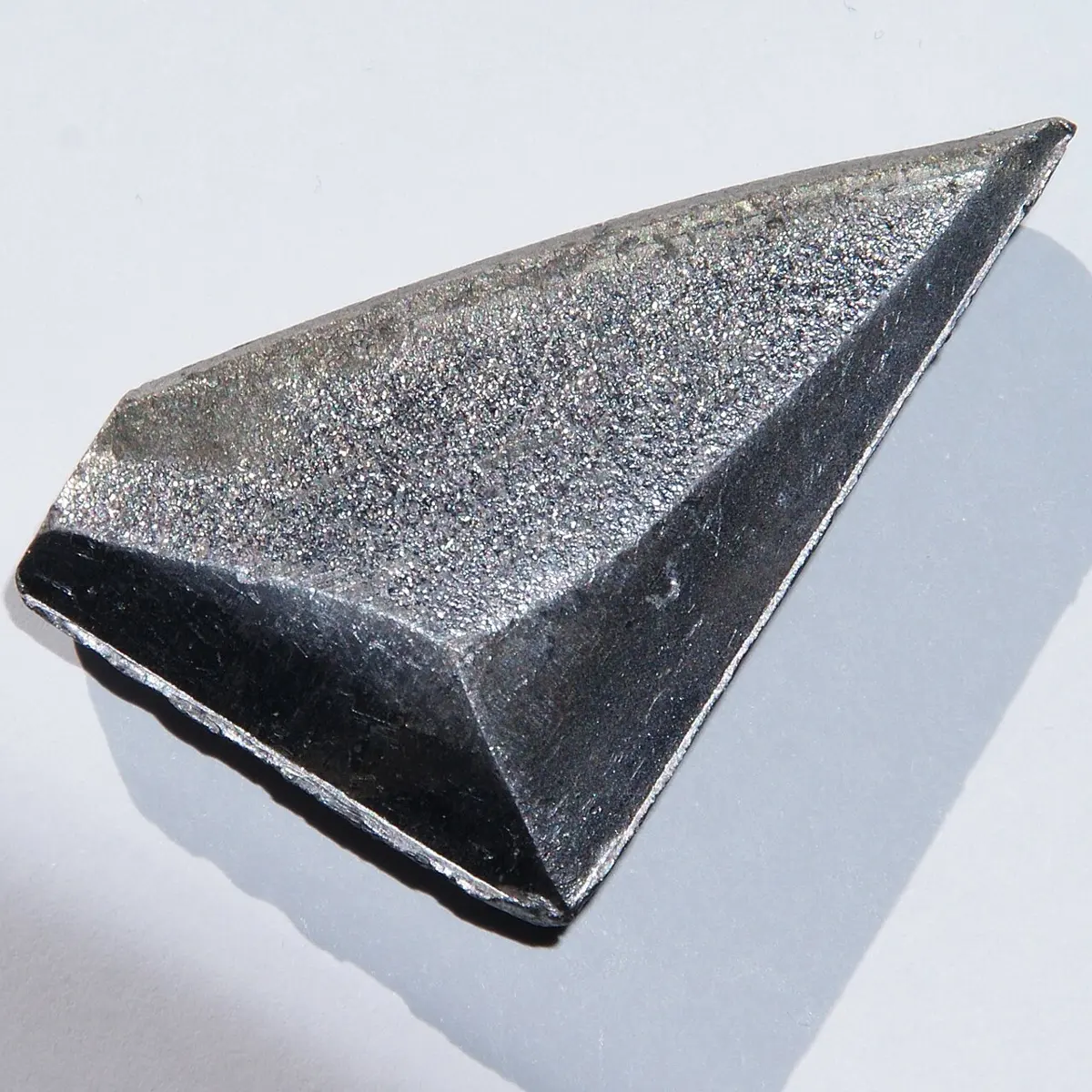
- Atomic number
- 73
- Atomic mass
- 180.95
- Shells
- 2, 8, 18, 32, 11, 2
- Configuration
- 1s² 2s² 2p⁶ 3s² 3p⁶ 4s² 3d¹⁰ 4p⁶ 5s² 4d¹⁰ 5p⁶ 6s² 4f¹⁴ 5d³
- In the table
- period 6, group 5 (VB), d-block
- Kind
- Transition metal
- Valency
- 5 (as in Ta₂O₅)
- State at 25 °C
- solid
- Melts · boils
- 3,017 °C · 5,458 °C
- Density
- 16.4 × as heavy as water
- Known since
- 1802
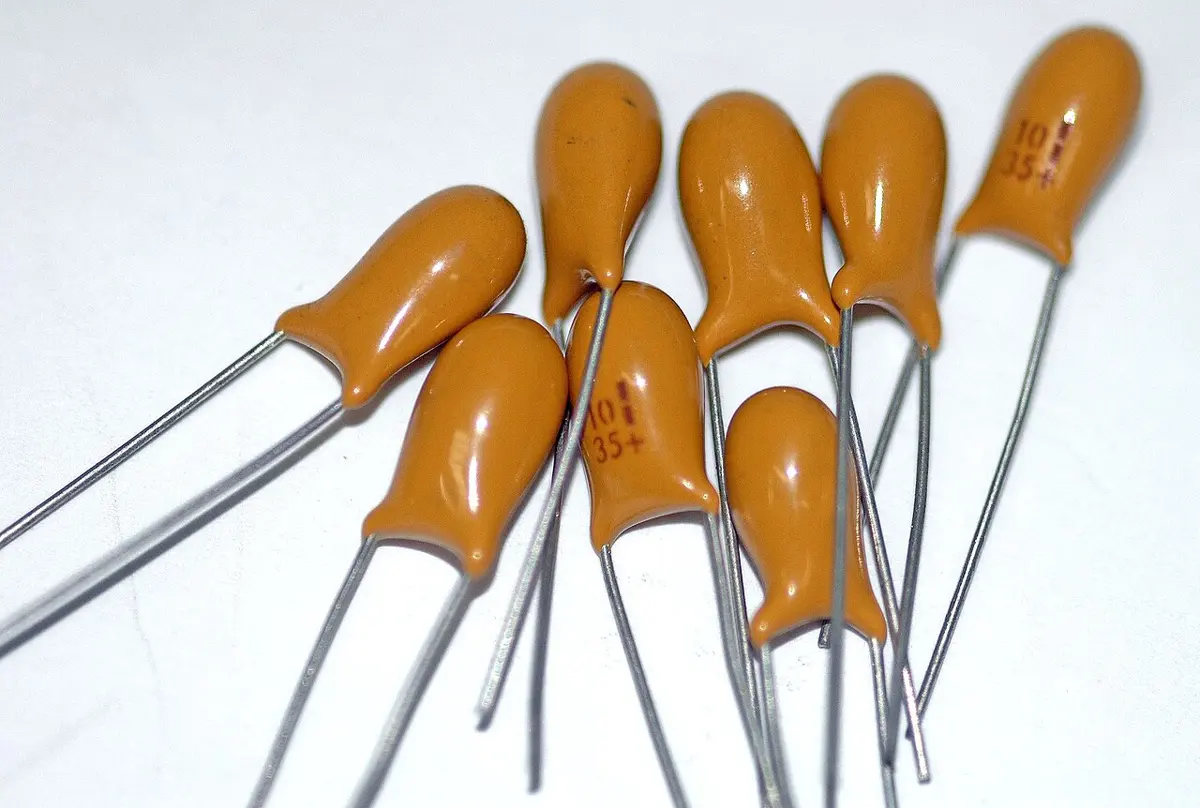
Open up an old phone or laptop and look at its circuit board. Among the hundreds of tiny parts, you may find small blocks, often yellow, orange or black, marked with a stripe at one end. Many of these are tantalum capacitors, which store electric charge and smooth the supply to the chips. A piece of tantalum smaller than a grain of rice does the job of a much bigger part.
The same metal mends broken bones, lines tanks of acids that would eat through steel, and is dug by hand from the hills of central Africa. Here is the story of tantalum, the metal named after a king who could never reach what he wanted.
The tantalum atom
A tantalum atom has 73 protons, so tantalum’s atomic number is 73, and a neutral atom has 73 electrons. Almost every tantalum atom (99.99%) is tantalum-181, with 108 neutrons: mass number 73 + 108 = 181.
The 73 electrons fill six shells: 2, 8, 18, 32, 11, 2 Grade 8: Bohr and Bury’s rule. In subshells, the inside 68 electrons fill everything up to 4f¹⁴, and the last three go into 5d Grade 10: The Aufbau principle:
… 6s² 4f¹⁴ 5d³
Its place in the periodic table
- Period 6, because its electrons are in six shells. It comes just after hafnium, two places after the fifteen lanthanides.
- Group 5, called VB in the older naming, under vanadium and niobium. All three have five outer electrons (two in s, three in d).
- d-block: a transition metal Grade 10: Metals.
Tantalum uses all five of its outer electrons, so its usual valency is 5, as in tantalum oxide, Ta₂O₅, a white powder.
Tantalum has a valency of 5 and oxygen 2. What is the formula of tantalum oxide?
Pick an answer to see why.
Niobium’s twin
Tantalum has a twin, just as hafnium has. Normally the atoms grow bigger going down a group Grade 10: Atomic size. But the fifteen lanthanides come between niobium and tantalum, and as their nuclear charge grows they pull the electrons in a little more at each step: the lanthanide contraction. So a tantalum atom is almost exactly the same size as a niobium atom, with the same five outer electrons.
That is why the two metals are always found together in the same minerals, and why chemists took more than sixty years to be sure they were two elements at all.
How tantalum was found and named
- 1802. The Swedish chemist Anders Gustaf Ekeberg, at Uppsala, found the oxide of a new metal in two heavy black minerals, one from Sweden and one from Finland.
- 1809. The English chemist William Hyde Wollaston compared Ekeberg’s oxide with the oxide of “columbium”, found a year earlier in America (see niobium), and decided they were the same element.
- 1846. The German chemist Heinrich Rose showed that the minerals hold two different metals. He named the second niobium, after Niobe, Tantalus’s daughter.
- 1864–1866. Several chemists, last of all Jean Charles de Marignac in Switzerland, proved beyond doubt that tantalum and niobium are different elements, and found a way to separate them.
- 1903. Werner von Bolton, at the Siemens & Halske company in Berlin, made the first pure tantalum that could be drawn into wire.
Ekeberg named the metal after Tantalus, a king in Greek legend who was punished by standing in water up to his chin under a tree full of fruit. Whenever he bent to drink, the water drained away; whenever he reached for the fruit, the branches lifted out of reach. Ekeberg chose the name because his new oxide, dipped in acid, would not take any up: like Tantalus, it stood in the liquid and could not drink. The English word tantalize, to tease with something just out of reach, comes from the same story. The symbol is Ta. Nepali books use the English name.
The first metal light bulb
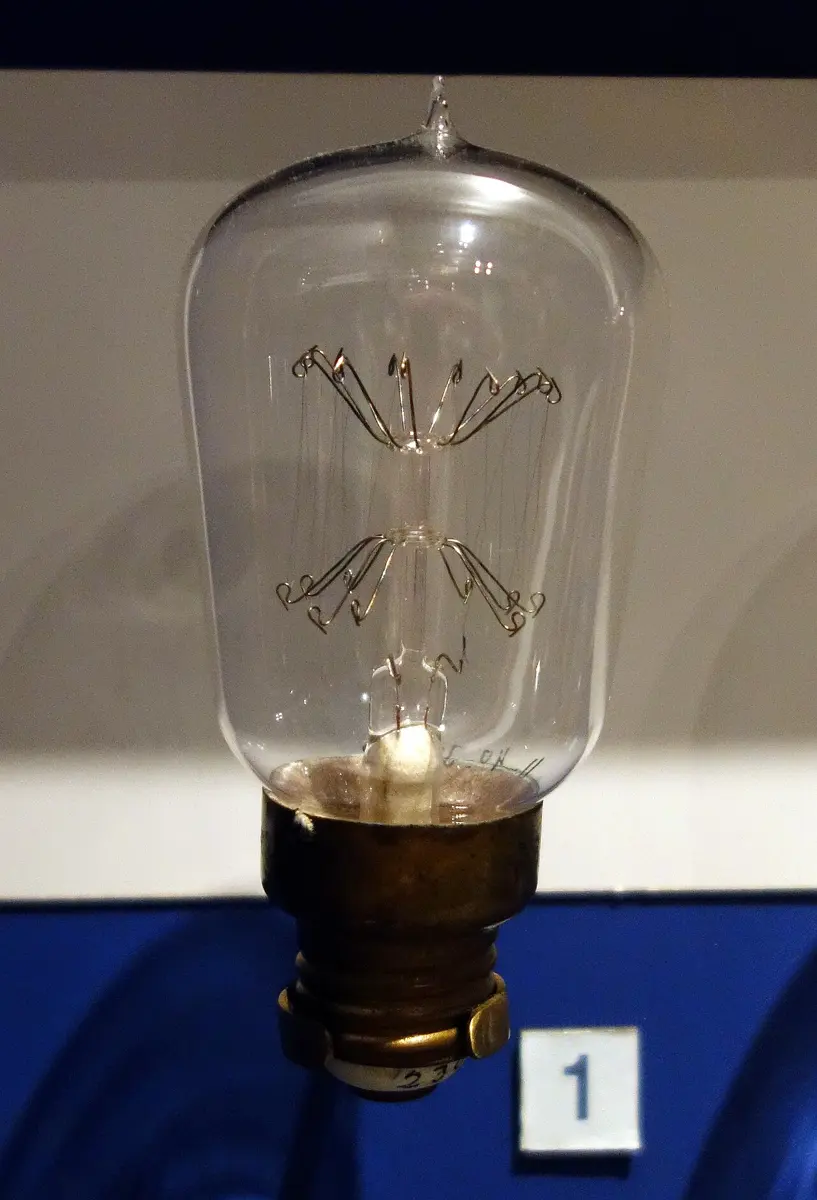
Von Bolton wanted tantalum for a reason: light bulbs. Until then, bulb filaments were made of carbon, which glowed a dim orange. A tantalum wire could be run hotter and brighter for the same electricity, and in the 1900s Siemens & Halske sold tantalum lamps all over the world. They were the first bulbs with a metal filament. Within a few years, though, filaments of tungsten, which melts at an even higher temperature, took their place.
Where tantalum is found
In the universe. Like other elements heavier than iron, tantalum was built when atomic nuclei caught neutrons, inside old giant stars and when dead stars collided (Heavier than iron).
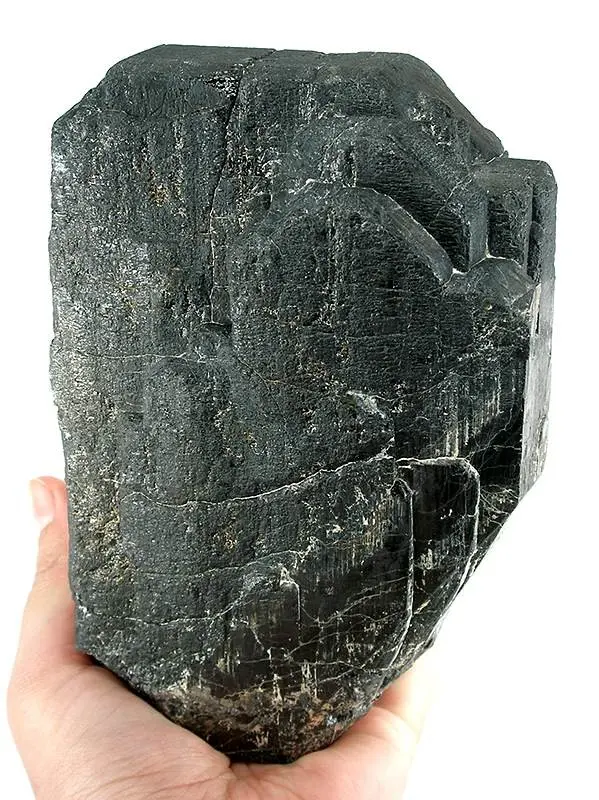
In the Earth’s crust. Tantalum is rare: only about 1 or 2 grams in every tonne of rock. Its main mineral is tantalite, a heavy black oxide of iron or manganese with tantalum and niobium. When a mineral of the same kind holds more niobium than tantalum, it is called columbite; miners call the mixture of the two coltan. Tantalum minerals are found in pegmatites, coarse-grained granite rocks that cooled slowly from the last, watery part of a magma. A little tantalum also comes from the slag left over from smelting tin ore.
In 2025 the world mined about 2,500 tonnes of tantalum. About half came from the Democratic Republic of the Congo, and much of the rest from Rwanda, Nigeria and Brazil (USGS, 2026). Twenty years ago, Australia mined the most.
In Nepal. No tantalum is mined in Nepal, and it has no part in the body or in living things.
Conflict minerals
Much of the coltan of eastern Congo is dug by hand, by miners working with spades and pans in pits and streams. During the long wars in eastern Congo, which began in the 1990s, armed groups seized many mines and sold the ore to buy weapons. Tantalum, together with tin, tungsten and gold, became known as a conflict mineral.
Since then, laws in the USA (from 2010) and the European Union (from 2021) make companies that use these metals check where their ore came from. Bags of ore from approved mines are tagged and tracked from the mine to the smelter. It is not perfect, but phone makers now publish where their tantalum comes from, and more of it is recycled from old electronics.

What tantalum is like
- A hard, heavy, blue-gray metal, which can still be bent, rolled into foil and drawn into fine wire Grade 9: Ductile.
- Very dense: 16.4 g/cm³, more than twice iron’s (7.87) and much more than lead’s (11.3).
- Melts at 3,017 °C Grade 9: High melting points. Among the metals, only tungsten, rhenium and osmium melt at a higher temperature.
- Hardly corrodes at all. A thin, tight layer of tantalum oxide forms on its surface at once and seals it. Below about 150 °C even aqua regia, the mixture of acids that dissolves gold, barely touches it. Chemical factories line tanks, pipes and heaters with tantalum where they handle hot acids.
- Kind to the body, for the same reason (below).
How tantalum reacts
Its oxide skin makes tantalum one of the least reactive metals at room temperature: it does not react with air, water or most acids. But it is not unreactive underneath.
- With oxygen, when strongly heated in air, it turns into white tantalum oxide Grade 9: Metals react with oxygen:
4Ta + 5O₂ → 2Ta₂O₅
So it is welded only under argon or helium gas, never in open air. - Hydrofluoric acid, one of the few things that dissolves its oxide, does attack it. Factories use it to dissolve tantalite ore and then separate the tantalum from the niobium.
- Making the metal. The tantalum is turned into a fluoride salt and heated with sodium, the more reactive metal, which takes the fluorine and leaves tantalum as a powder Grade 10: Reduction.
Growing the oxide on purpose
If a piece of tantalum is hung in a weak acid solution and connected to the positive side of a power supply, its oxide layer grows thicker; the higher the voltage, the thicker it grows. This is anodizing. On a polished piece, the clear layer shows bright colors, as on niobium. Its most important use is hidden inside every tantalum capacitor.
Tantalum capacitors
A capacitor stores electric charge. The simplest one is two metal plates facing each other, separated by a thin insulator. Connect it to a battery and electrons pile up on one plate and leave the other; disconnect it and the charge stays, ready to be given back in an instant (Energy between charged plates). Capacitors smooth out the supply to a phone’s chips, so that the voltage does not dip when a chip suddenly draws more current.
A capacitor holds more charge when its plates are bigger and when the insulator between them is thinner. Tantalum does both, in a tiny space:
- Tantalum powder is pressed round a tantalum wire and heated until the grains stick together. The result is a tiny sponge of metal. A pellet the size of a grain of rice has a surface, inside all its pores, as big as a page of an exercise book or more.
- The pellet is anodized: a layer of tantalum oxide grows over every grain. This is the insulator. It is extremely thin, usually less than a ten-thousandth of a millimeter, and very even.
- The pores are filled with a second conductor, manganese dioxide or a conducting plastic, which forms the second plate.
Huge plates and a very thin insulator: so a tantalum capacitor stores a lot of charge in a very small, light part. That is why they were used in so many phones, laptops, cameras, hearing aids, pacemakers and car electronics, and why capacitors are the biggest single use of tantalum.
Why is the tantalum in a capacitor made from pressed powder instead of a solid piece of metal?
Pick an answer to see why.
Tantalum in the body
Tantalum is one of the metals the body accepts best. Its oxide skin does not dissolve or react, so the body does not attack it, and bone will even grow right against it and onto it.
- Mending bones. Plates of tantalum have been used to repair the skull since the 1940s. Today a spongy kind of tantalum, full of holes like real bone, is used in hip and knee replacements: the bone grows into its pores and holds it fast.
- Fine wire and clips. Surgeons use tantalum wire, clips and mesh inside the body.
- Safe in a scanner. Tantalum is not magnetic, so people with tantalum implants can safely have an MRI scan.
Because it is so dense, tantalum also shows up clearly on an X-ray Grade 9: X-ray imaging, so doctors can see where an implant sits.
Tantalum in daily life
- Electronics: capacitors (above), and thin films of tantalum and its compounds inside chips.
- Jet engines and rockets: added to nickel superalloys for turbine blades, and to alloys for parts that must stay strong when red-hot.
- Cutting tools: tantalum carbide, very hard, is mixed into the tungsten carbide of cutting tips (see tungsten).
- Camera lenses: tantalum oxide in glass bends light more, so the lenses can be thinner.
- Chemical factories: linings, pipes and heaters for hot acids.
Tantalum and your health
Tantalum has no known job in the body, and the metal is not poisonous: that is why it can be put inside the body. Like most metal powders, fine tantalum dust should not be breathed in, and it can burn, so it is handled with care in factories. No one meets it at home except sealed inside electronics.
Isotopes: the rarest atom
Natural tantalum is a mixture of two kinds of atom. Tantalum-181 makes up 99.988%. The other 0.012% is a strange form of tantalum-180, whose nucleus holds extra energy. It should be radioactive, yet no one has ever seen one of its atoms decay: if it does, its half-life is more than ten million times the age of the universe. It is the rarest kind of atom found in nature that has lasted since the Earth formed.
Surprising facts and records
- It nearly didn’t get its own name. For decades most chemists thought tantalum and columbium (niobium) were one element.
- Among the hardest substances to melt. Tantalum carbide melts at almost 4,000 °C, and mixtures of tantalum and hafnium carbides at about the same; only a few substances are known to melt higher, and which one holds the record is still being measured (see hafnium).
In your science books
- Grade 8: the 2n² rule.
- Grade 9: the criss-cross method, properties of metals and X-ray imaging.
- Grade 10: the Aufbau principle, atomic size down a group, transition metals and reduction.
- Going further: capacitors and where the heavy elements were made.
More to explore
- Its family: vanadium and niobium above it; hafnium before it and tungsten after it.
- Play: find tantalum in Guess the Element and the Periodic Table Jigsaw.
- Read more: tantalum at the Royal Society of Chemistry and at PubChem.